tires VOLVO V90 1998 User Guide
[x] Cancel search | Manufacturer: VOLVO, Model Year: 1998, Model line: V90, Model: VOLVO V90 1998Pages: 175, PDF Size: 4.45 MB
Page 84 of 175
1998 Volvo S90
chain information.
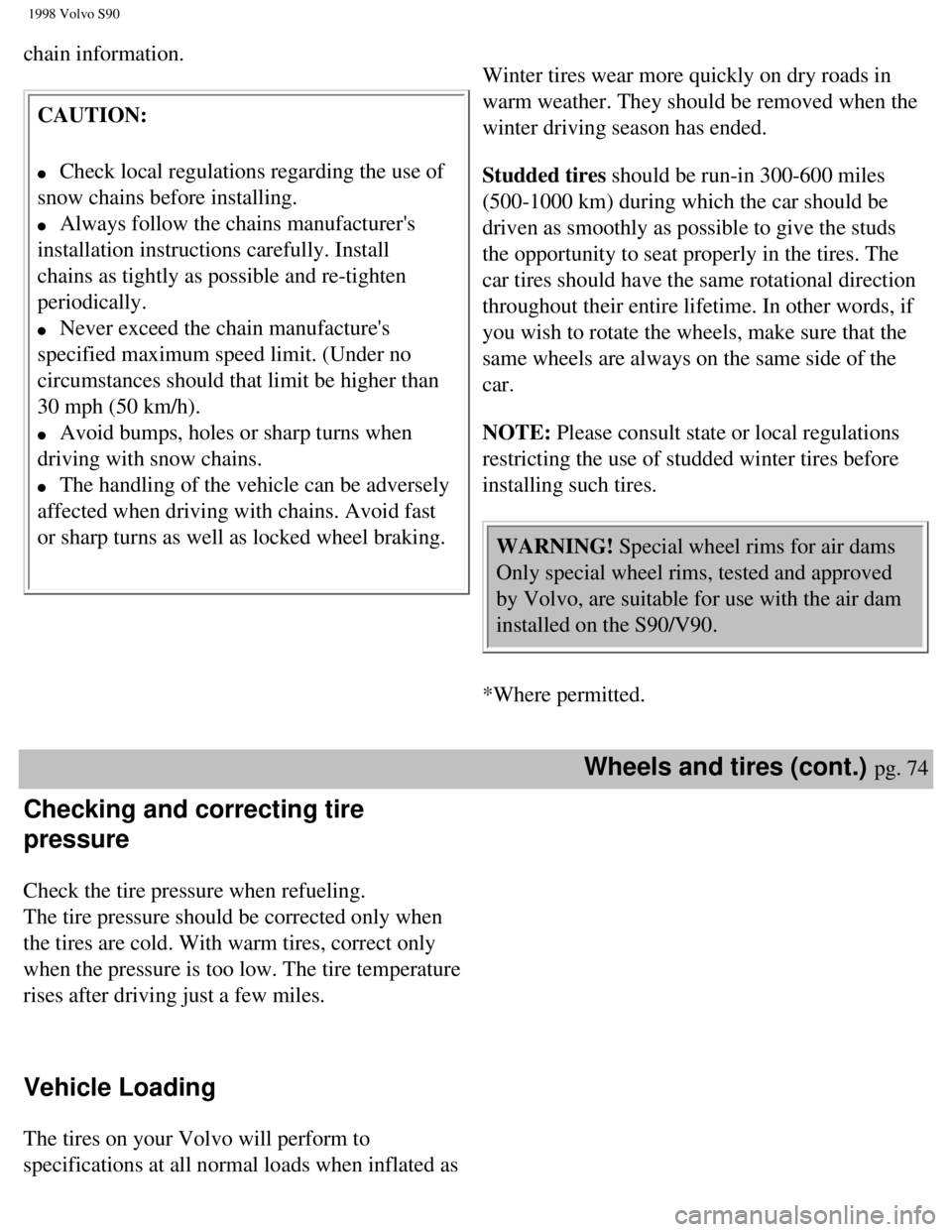
CAUTION:
l Check local regulations regarding the use of
snow chains before installing.
l Always follow the chains manufacturer's
installation instructions carefully. Install
chains as tightly as possible and re-tighten
periodically.
l Never exceed the chain manufacture's
specified maximum speed limit. (Under no
circumstances should that limit be higher than
30 mph (50 km/h).
l Avoid bumps, holes or sharp turns when
driving with snow chains.
l The handling of the vehicle can be adversely
affected when driving with chains. Avoid fast
or sharp turns as well as locked wheel braking.
Winter tires wear more quickly on dry roads in
warm weather. They should be removed when the
winter driving season has ended.
Studded tires should be run-in 300-600 miles
(500-1000 km) during which the car should be
driven as smoothly as possible to give the studs
the opportunity to seat properly in the tires. The
car tires should have the same rotational direction
throughout their entire lifetime. In other words, if
you wish to rotate the wheels, make sure that the
same wheels are always on the same side of the
car.
NOTE: Please consult state or local regulations
restricting the use of studded winter tires before
installing such tires.
WARNING! Special wheel rims for air dams
Only special wheel rims, tested and approved
by Volvo, are suitable for use with the air dam
installed on the S90/V90.
*Where permitted.
Wheels and tires (cont.) pg. 74
Checking and correcting tire
pressure
Check the tire pressure when refueling.
The tire pressure should be corrected only when
the tires are cold. With warm tires, correct only
when the pressure is too low. The tire temperature
rises after driving just a few miles.
Vehicle Loading
The tires on your Volvo will perform to
specifications at all normal loads when inflated as
file:///K|/ownersdocs/1998/1998_SV90/98S90_071.htm (3 of 5)12/30/2006 \
1:52:44 PM
Page 85 of 175
1998 Volvo S90
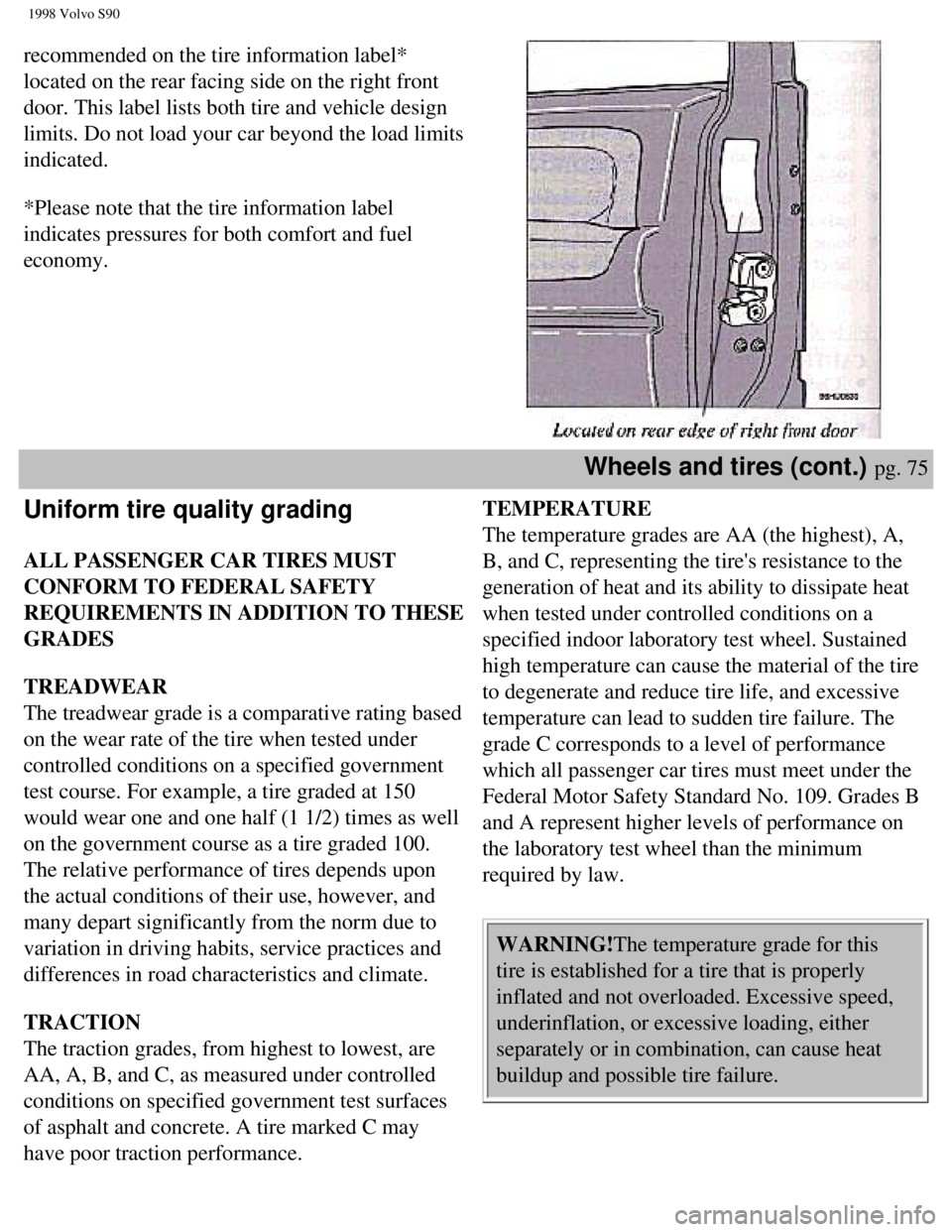
recommended on the tire information label*
located on the rear facing side on the right front
door. This label lists both tire and vehicle design
limits. Do not load your car beyond the load limits
indicated.
*Please note that the tire information label
indicates pressures for both comfort and fuel
economy.
Wheels and tires (cont.) pg. 75
Uniform tire quality grading
ALL PASSENGER CAR TIRES MUST
CONFORM TO FEDERAL SAFETY
REQUIREMENTS IN ADDITION TO THESE
GRADES
TREADWEAR
The treadwear grade is a comparative rating based
on the wear rate of the tire when tested under
controlled conditions on a specified government
test course. For example, a tire graded at 150
would wear one and one half (1 1/2) times as well
on the government course as a tire graded 100.
The relative performance of tires depends upon
the actual conditions of their use, however, and
many depart significantly from the norm due to
variation in driving habits, service practices and
differences in road characteristics and climate.
TRACTION
The traction grades, from highest to lowest, are
AA, A, B, and C, as measured under controlled
conditions on specified government test surfaces
of asphalt and concrete. A tire marked C may
have poor traction performance. TEMPERATURE
The temperature grades are AA (the highest), A,
B, and C, representing the tire's resistance to the
generation of heat and its ability to dissipate heat
when tested under controlled conditions on a
specified indoor laboratory test wheel. Sustained
high temperature can cause the material of the tire
to degenerate and reduce tire life, and excessive
temperature can lead to sudden tire failure. The
grade C corresponds to a level of performance
which all passenger car tires must meet under the
Federal Motor Safety Standard No. 109. Grades B
and A represent higher levels of performance on
the laboratory test wheel than the minimum
required by law.
WARNING!The temperature grade for this
tire is established for a tire that is properly
inflated and not overloaded. Excessive speed,
underinflation, or excessive loading, either
separately or in combination, can cause heat
buildup and possible tire failure.
file:///K|/ownersdocs/1998/1998_SV90/98S90_071.htm (4 of 5)12/30/2006 \
1:52:44 PM
Page 88 of 175

1998 Volvo S90
Changing a wheel
On sedans the spare wheel, jack and toolbag are located in the trunk, be\
neath the carpet. The jack must be completely retracted to fit into the holder.
On wagons, the spare tire and the jack are located beneath the floor mat\
in the large storage bin. Always secure the spare tire and the jack to prevent them from rattling.
l Remove the wheel cap, using the screwdriver in the tool kit.
l With the car still on the ground, use the box wrench from the tool kit t\
o loosen the wheel nuts 1/2 - 1 turn. Turn the nuts counterclockwise to loosen.
NOTE:
To avoid excessive wear and the necessity of rebalancing, mark and reins\
tall wheels in same location and position as before removal. To lessen the chance of imbalance, each
wheel hub is equipped with a guide stud to ensure that a removed wheel c\
an be reinstalled in its original position (as when changing over to winter tires/wheels).
Wheel changing (cont.) pg. 79
WARNING!
l The jack attachment must engage the bar in the jack attachment (A). Th\
e car's weight must not rest on the jack's attachment (B).
l Be sure the jack is on a firm, level, non-slippery surface.
l Never allow any part of your body to be extended under a car supported b\
y a jack.
l Use the jack intended for the car when replacing a wheel. For any other \
job, use stands to support the end of the car being worked
on.
l Apply the parking brake, select position P (automatic transmission). \
l Block the wheels standing on the ground. Use rigid wooden blocks or larg\
e stones.
l The jack should be kept well-greased.
file:///K|/ownersdocs/1998/1998_SV90/98S90_077.htm (2 of 4)12/30/2006 \
1:52:45 PM
Page 117 of 175
1998 Volvo S90
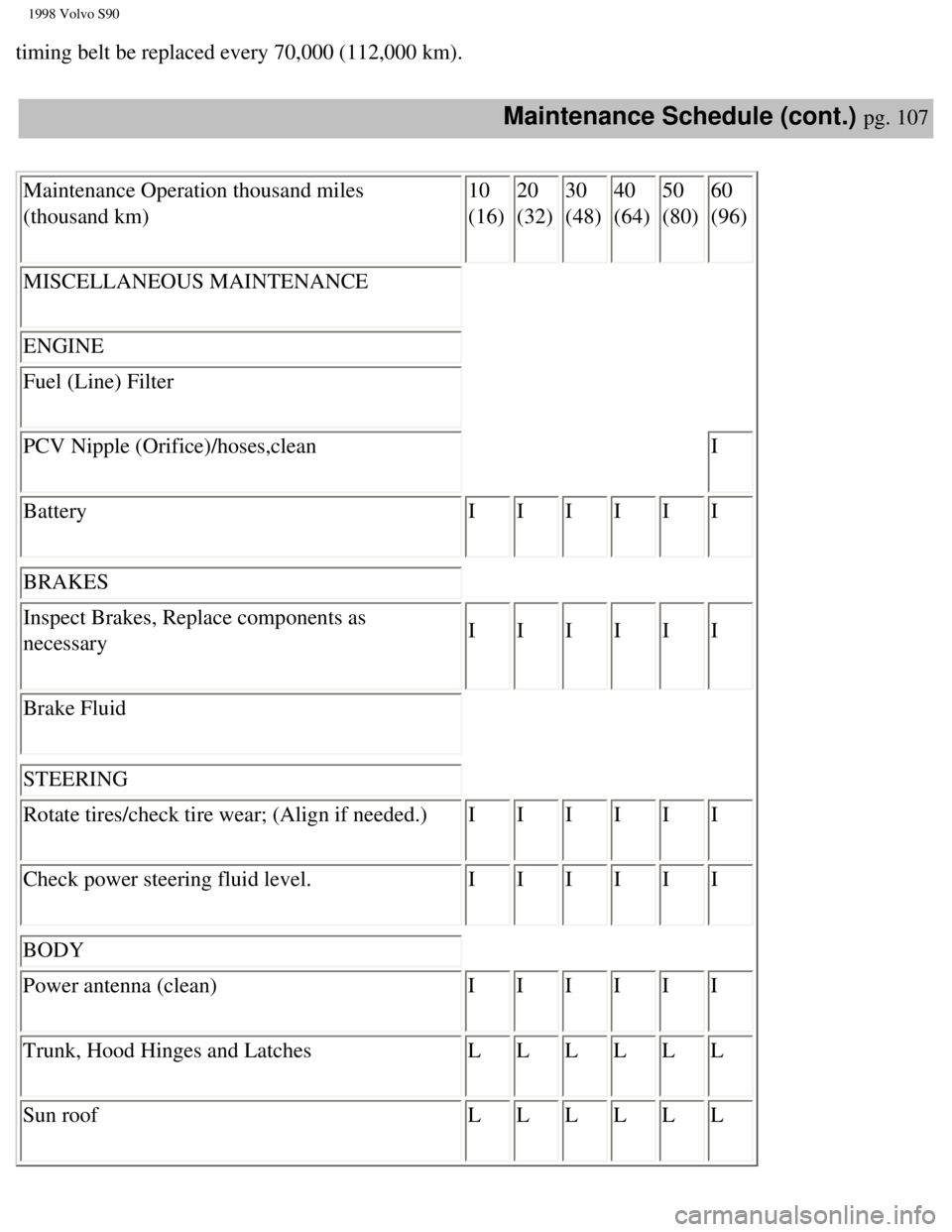
timing belt be replaced every 70,000 (112,000 km).
Maintenance Schedule (cont.) pg. 107
Maintenance Operation thousand miles
(thousand km) 10
(16) 20
(32) 30
(48) 40
(64) 50
(80) 60
(96)
MISCELLANEOUS MAINTENANCE
ENGINE
Fuel (Line) Filter
PCV Nipple (Orifice)/hoses,clean I
Battery I I I I I I
BRAKES
Inspect Brakes, Replace components as
necessary I
I I I I I
Brake Fluid
STEERING
Rotate tires/check tire wear; (Align if needed.) I I I I I I
Check power steering fluid level. I I I I I I
BODY
Power antenna (clean) I I I I I I
Trunk, Hood Hinges and Latches L L L L L L
Sun roof L L L L L L
file:///K|/ownersdocs/1998/1998_SV90/98S90_103.htm (6 of 7)12/30/2006 \
1:52:48 PM
Page 118 of 175
 Replace at 100,000 miles (160,000 km).
2) Brake fluid should be changed at owner request every second year (o\
nce a year if the car is driven in
mountainous areas or in areas wi")
1998 Volvo S90
1) Replace at 100,000 miles (160,000 km).
2) Brake fluid should be changed at owner request every second year (o\
nce a year if the car is driven in
mountainous areas or in areas with high humidity).
The following items should be checked weekly by the driver (it takes on\
ly a few minutes):
Engine oil level Windshield wipers
Brake fluid level Level of windshield washer fluid
Radiator coolant level
Tire pressure (all five tires)
Operation of all lights
Horns
The following should also be carried out at regular intervals:
Washing
Polishing
Cleaning
Contents | Top of Page
file:///K|/ownersdocs/1998/1998_SV90/98S90_103.htm (7 of 7)12/30/2006 \
1:52:48 PM
Page 137 of 175
1998 Volvo S90
Ashtray rear 1.2 W Volvo P/
N966326 1
Seat belt lock 1.2 W Volvo P/
N966326 1
Instrument
warning/
indicator lights 1.2 W Volvo P/
N966326 –
All specifications are subject to change without
notice
Specifications pg. 127
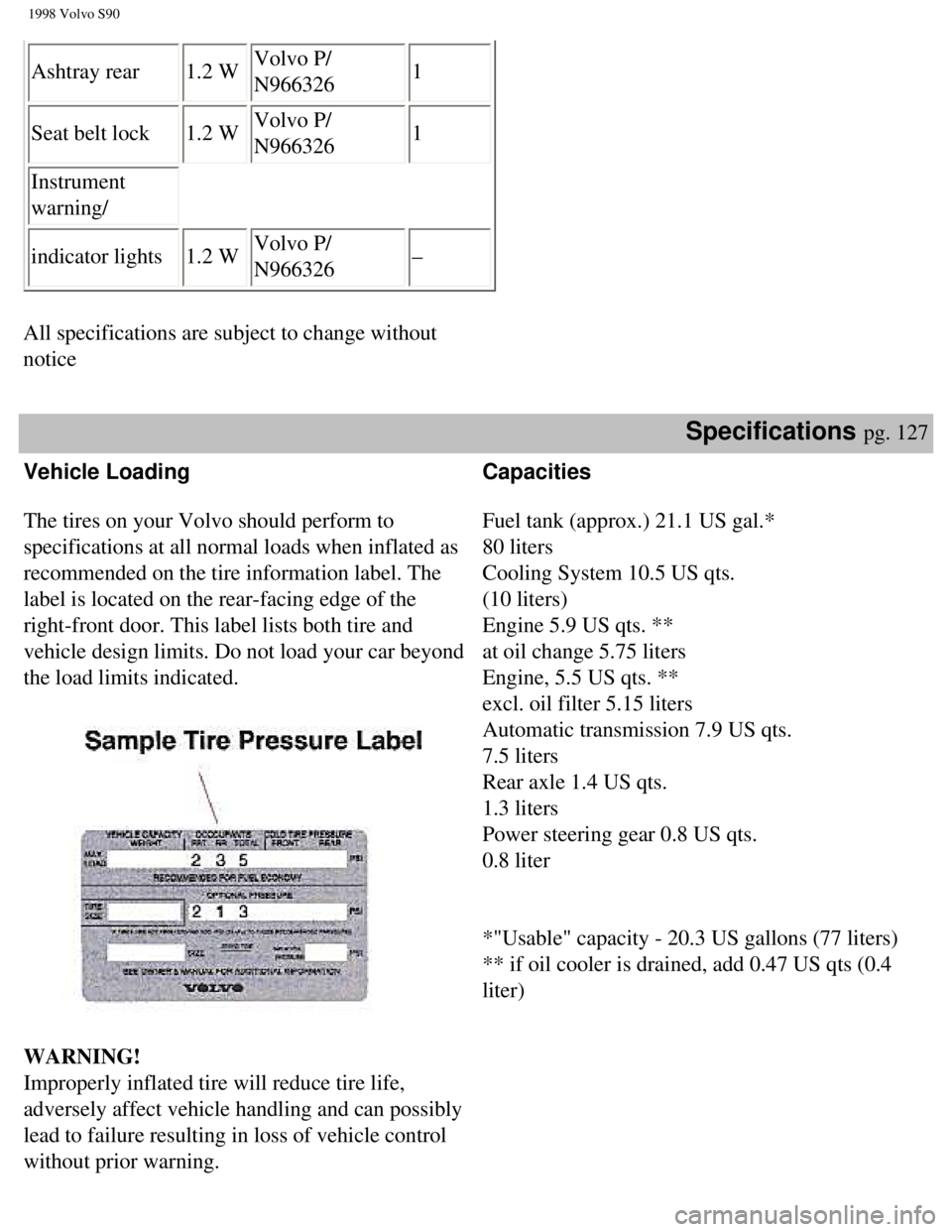
Vehicle Loading
The tires on your Volvo should perform to
specifications at all normal loads when inflated as
recommended on the tire information label. The
label is located on the rear-facing edge of the
right-front door. This label lists both tire and
vehicle design limits. Do not load your car beyond
the load limits indicated.
WARNING!
Improperly inflated tire will reduce tire life,
adversely affect vehicle handling and can possibly
lead to failure resulting in loss of vehicle control
without prior warning.
Capacities
Fuel tank (approx.) 21.1 US gal.*
80 liters
Cooling System 10.5 US qts.
(10 liters)
Engine 5.9 US qts. **
at oil change 5.75 liters
Engine, 5.5 US qts. **
excl. oil filter 5.15 liters
Automatic transmission 7.9 US qts.
7.5 liters
Rear axle 1.4 US qts.
1.3 liters
Power steering gear 0.8 US qts.
0.8 liter
*"Usable" capacity - 20.3 US gallons (77 liters)
** if oil cooler is drained, add 0.47 US qts (0.4
liter)
file:///K|/ownersdocs/1998/1998_SV90/98S90_125.htm (4 of 7)12/30/2006 \
1:52:51 PM