coolant level VOLVO V90 1998 Owners Manual
[x] Cancel search | Manufacturer: VOLVO, Model Year: 1998, Model line: V90, Model: VOLVO V90 1998Pages: 175, PDF Size: 4.45 MB
Page 24 of 175
1998 Volvo S90
NOTE: Canadian model
speedometers/odometers
indicate kilometers only.
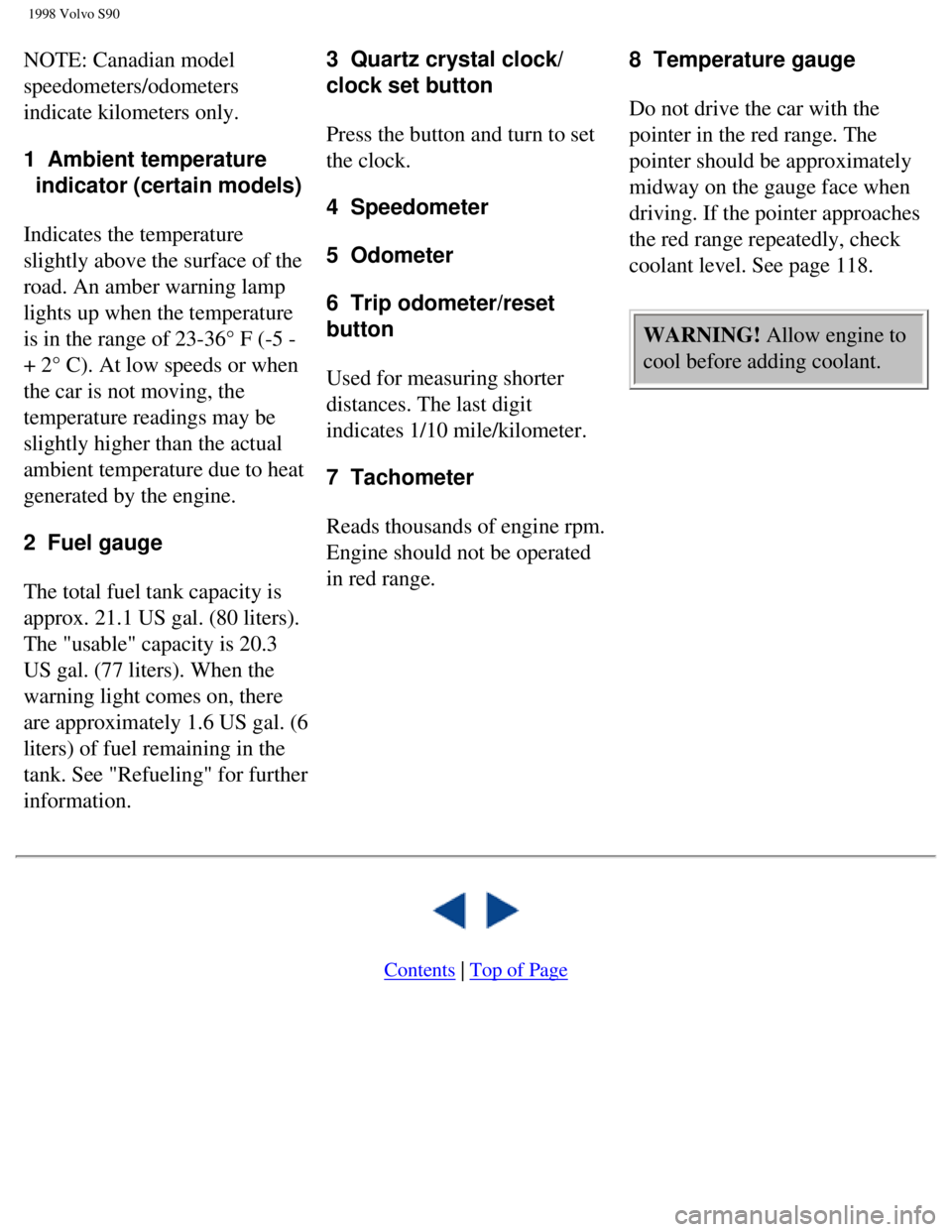
1 Ambient temperature
indicator (certain models)
Indicates the temperature
slightly above the surface of the
road. An amber warning lamp
lights up when the temperature
is in the range of 23-36° F (-5 -
+ 2° C). At low speeds or when
the car is not moving, the
temperature readings may be
slightly higher than the actual
ambient temperature due to heat
generated by the engine.
2 Fuel gauge
The total fuel tank capacity is
approx. 21.1 US gal. (80 liters).
The "usable" capacity is 20.3
US gal. (77 liters). When the
warning light comes on, there
are approximately 1.6 US gal. (6
liters) of fuel remaining in the
tank. See "Refueling" for further
information.3 Quartz crystal clock/
clock set button
Press the button and turn to set
the clock.
4 Speedometer
5 Odometer
6 Trip odometer/reset
button
Used for measuring shorter
distances. The last digit
indicates 1/10 mile/kilometer.
7 Tachometer
Reads thousands of engine rpm.
Engine should not be operated
in red range.
8 Temperature gauge
Do not drive the car with the
pointer in the red range. The
pointer should be approximately
midway on the gauge face when
driving. If the pointer approaches
the red range repeatedly, check
coolant level. See page 118.
WARNING! Allow engine to
cool before adding coolant.
Contents | Top of Page
file:///K|/ownersdocs/1998/1998_SV90/98S90_014.htm (3 of 3)12/30/2006 \
1:52:36 PM
Page 25 of 175
1998 Volvo S90
Chapter 2 - Instruments, switches and controls (cont.)Indicator and warning lights
pg. 17
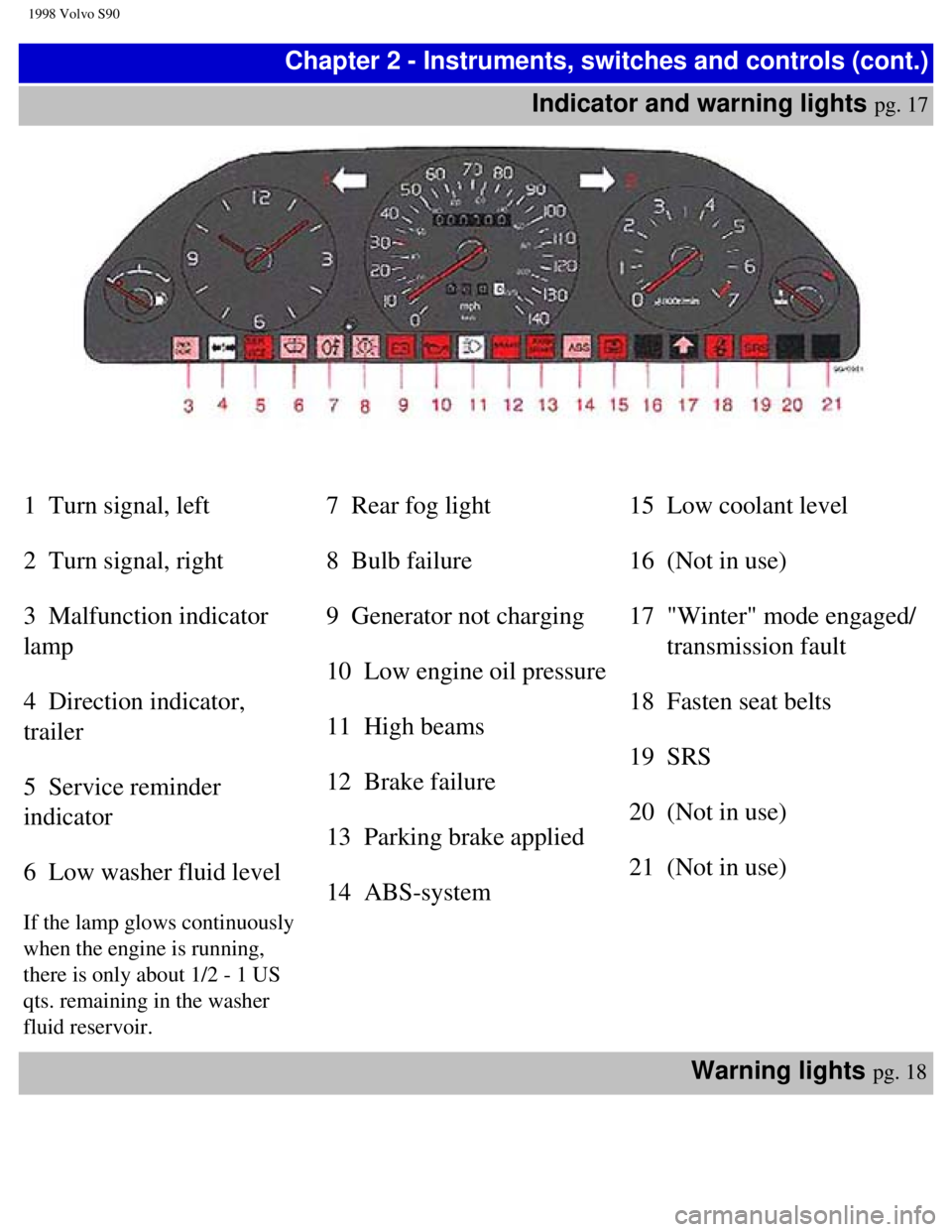
1 Turn signal, left
2 Turn signal, right
3 Malfunction indicator
lamp
4 Direction indicator,
trailer
5 Service reminder
indicator
6 Low washer fluid level
If the lamp glows continuously
when the engine is running,
there is only about 1/2 - 1 US
qts. remaining in the washer
fluid reservoir.
7 Rear fog light
8 Bulb failure
9 Generator not charging
10 Low engine oil pressure
11 High beams
12 Brake failure
13 Parking brake applied
14 ABS-system
15 Low coolant level
16 (Not in use)
17 "Winter" mode engaged/
transmission fault
18 Fasten seat belts
19 SRS
20 (Not in use)
21 (Not in use)
Warning lights
pg. 18
file:///K|/ownersdocs/1998/1998_SV90/98S90_017.htm (1 of 7)12/30/2006 \
1:52:36 PM
Page 27 of 175
1998 Volvo S90
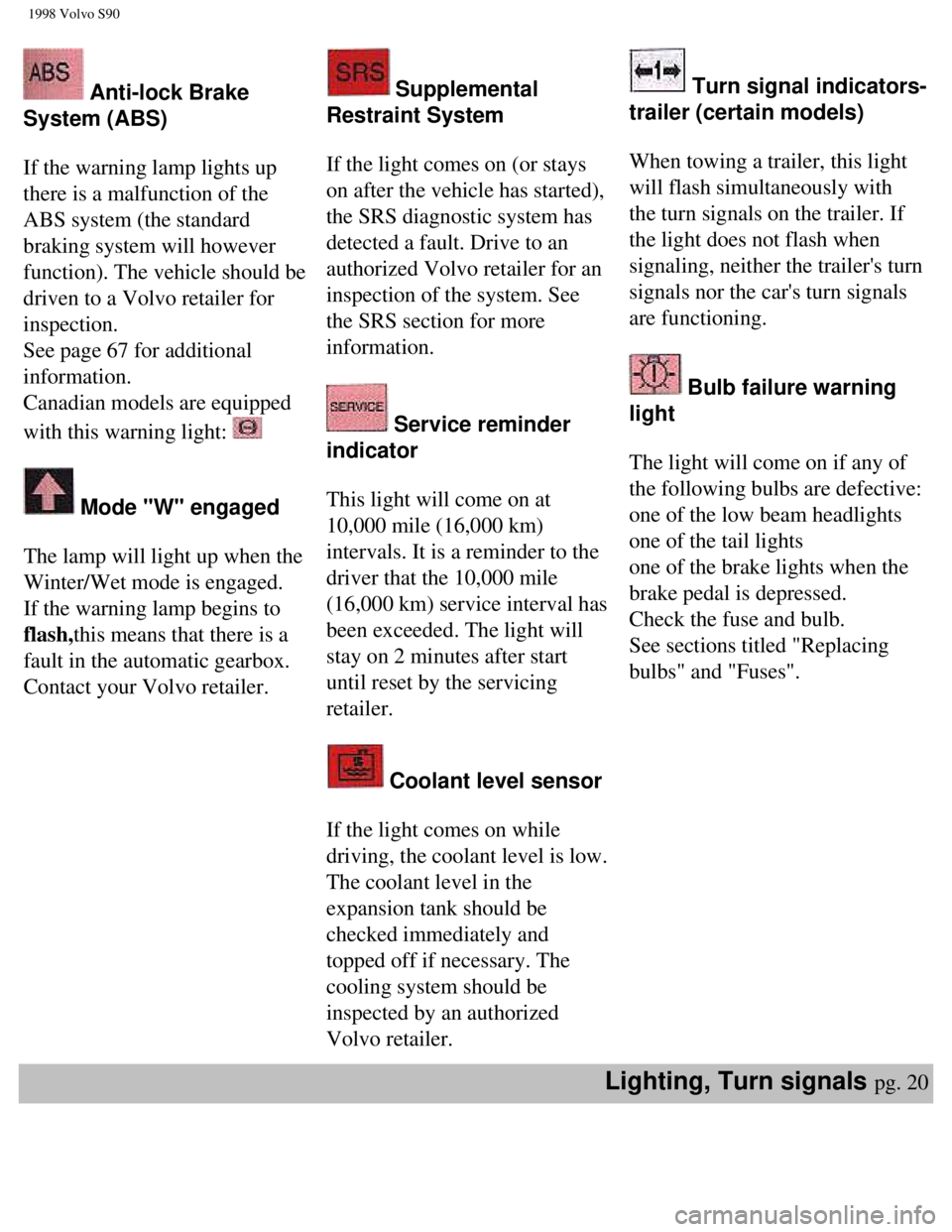
Anti-lock Brake
System (ABS)
If the warning lamp lights up
there is a malfunction of the
ABS system (the standard
braking system will however
function). The vehicle should be
driven to a Volvo retailer for
inspection.
See page 67 for additional
information.
Canadian models are equipped
with this warning light:
Mode "W" engaged
The lamp will light up when the
Winter/Wet mode is engaged.
If the warning lamp begins to
flash,this means that there is a
fault in the automatic gearbox.
Contact your Volvo retailer.
Supplemental
Restraint System
If the light comes on (or stays
on after the vehicle has started),
the SRS diagnostic system has
detected a fault. Drive to an
authorized Volvo retailer for an
inspection of the system. See
the SRS section for more
information.
Service reminder
indicator
This light will come on at
10,000 mile (16,000 km)
intervals. It is a reminder to the
driver that the 10,000 mile
(16,000 km) service interval has
been exceeded. The light will
stay on 2 minutes after start
until reset by the servicing
retailer.
Coolant level sensor
If the light comes on while
driving, the coolant level is low.
The coolant level in the
expansion tank should be
checked immediately and
topped off if necessary. The
cooling system should be
inspected by an authorized
Volvo retailer.
Turn signal indicators-
trailer (certain models)
When towing a trailer, this light
will flash simultaneously with
the turn signals on the trailer. If
the light does not flash when
signaling, neither the trailer's turn
signals nor the car's turn signals
are functioning.
Bulb failure warning
light
The light will come on if any of
the following bulbs are defective:
one of the low beam headlights
one of the tail lights
one of the brake lights when the
brake pedal is depressed.
Check the fuse and bulb.
See sections titled "Replacing
bulbs" and "Fuses".
Lighting, Turn signals pg. 20
file:///K|/ownersdocs/1998/1998_SV90/98S90_017.htm (3 of 7)12/30/2006 \
1:52:36 PM
Page 69 of 175
1998 Volvo S90
Special Tips - automatic transmission
l For driving down steep hills and when driving
for prolonged periods at low speeds, position L
should be selected. Avoid, however, repeated
changes since this can cause overheating of the
transmission oil. For driving on long continuous
uphill gradients, select position 3.
l Do not hold the car stationary on an incline by
using the accelerator pedal. Instead, apply the
hand brake (parking brake). This prevents the
transmission oil from becoming overheated.
l When towing a trailer, select shift position 3.
l The (E)conomy mode should be selected when
the cruise control is engaged.
l Never select P or R while the car is in motion.
l When initially selecting positions D, 3, L or R,
your right foot should press firmly on the brake
pedal to ensure that the car is standing still with
the engine idling.
l The gear selector should not be downshifted to
L at speeds above 75 mph (125 km/h). Always
observe posted speed limits. Cooling system
The risk for overheating is greatest, especially in
hot weather, when:
l towing a trailer up steep inclines for prolonged
periods at wide open throttle and low engine rpm.
l stopping the engine suddenly after high speed
driving (so-called "after-boiling" can occur).
To avoid overheating, the following rules should
be followed:
l Reduce speed and downshift when towing a
trailer up long, steep inclines. The risk of
overheating can be reduced by switching off the
air conditioning system for a short time.
l Do not let the engine idle unnecessarily for
prolonged periods.
l Do not mount auxiliary lamps in front of the
grill.
When the risk of overheating is imminent, or in
the event of overheating, (the temperature gauge
goes repeatedly into, or stays continually in, the
red section) the following precautions should be
taken:
l Switch off the air conditioning system.
l Pull off the road, away from traffic, stop the car
and put the gear lever into neutral. Do not stop the
engine!
l Switch the heater to full (maximum) position.
Increase the engine speed to approx. 2000 rpm
(twice idling speed) until the temperature begins
to drop.
See "Coolant" to check and top-up the coolant
level if necessary.
WARNING! Do not remove coolant expansion
tank cap. The coolant will be extremely hot.
Points to remember pg. 61
file:///K|/ownersdocs/1998/1998_SV90/98S90_058.htm (4 of 7)12/30/2006 \
1:52:42 PM
Page 80 of 175
1998 Volvo S90
cold-weather oil for hard driving or in warm
weather. See section "Engine oil" for more
information.
l The load placed on the battery is greater during
the winter since the heater, windshield wipers,
lighting etc. are used more often. Moreover, the
capacity of the battery decreases as the
temperature drops. In very cold weather, a poorly
charged battery can freeze and be damaged. It is
therefore advisable to check the state of charge
more frequently and spray an anti-rust oil on the
battery posts.
l Volvo recommends the use of snow tires on all
four wheels for winter driving - see section
"Wheels and tires".
l To prevent the washer reservoir from freezing,
add washer solvents containing antifreeze. This is
important since dirt is often splashed on the
windshield during winter driving, thus requiring
frequent use of the washers and wipers.
functions when the transmission is in reverse.
Also see "Winter/Wet" mode on page 59.
Winter/Wet mode
Enhanced Vehicle Traction
This mode may be selected for starting/moving
off on slippery roads or to lower downshift speeds
if the transmission is in "L".
Mode W
*In position D, the gearbox starts in third gear and
changes up to fourth gear.
*In position 3, second gear is locked and there is
no change up to third gear. In position L, first gear
is locked.
*These positions always offer the kick-down
feature.
Long distance trip pg. 70
Before a long distance trip
It is always worthwhile to have your car checked at a Volvo retailer
before driving long distances. Your retailer will also be able to supply\
you with bulbs, fuses, spark plugs and wiper blades for your use in the \
event that problems occur.
If you prefer to check the car yourself, please note the following:
l Check that the engine runs smoothly and that fuel consumption is
normal.
l Check engine oil, coolant levels, and for possible fuel leakage.
l Check transmission oil level and rear axle for leakage.
l Check condition of drive belts.
l Check state of charge of battery.
l Examine tires carefully (the spare tire as well), and replace those
that are worn. Check tire pressures.
l The brakes, front wheel alignment, and steering gear should be
checked by your Volvo retailer only.
l Check all lights, including high beams.
file:///K|/ownersdocs/1998/1998_SV90/98S90_067.htm (4 of 5)12/30/2006 \
1:52:43 PM
Page 118 of 175
 Replace at 100,000 miles (160,000 km).
2) Brake fluid should be changed at owner request every second year (o\
nce a year if the car is driven in
mountainous areas or in areas wi")
1998 Volvo S90
1) Replace at 100,000 miles (160,000 km).
2) Brake fluid should be changed at owner request every second year (o\
nce a year if the car is driven in
mountainous areas or in areas with high humidity).
The following items should be checked weekly by the driver (it takes on\
ly a few minutes):
Engine oil level Windshield wipers
Brake fluid level Level of windshield washer fluid
Radiator coolant level
Tire pressure (all five tires)
Operation of all lights
Horns
The following should also be carried out at regular intervals:
Washing
Polishing
Cleaning
Contents | Top of Page
file:///K|/ownersdocs/1998/1998_SV90/98S90_103.htm (7 of 7)12/30/2006 \
1:52:48 PM
Page 127 of 175
1998 Volvo S90
Check, without removing the cap, that the level is above
the "MIN" mark of the fluid reservoir.
Always entrust brake fluid changing to an authorized
Volvo retailer.
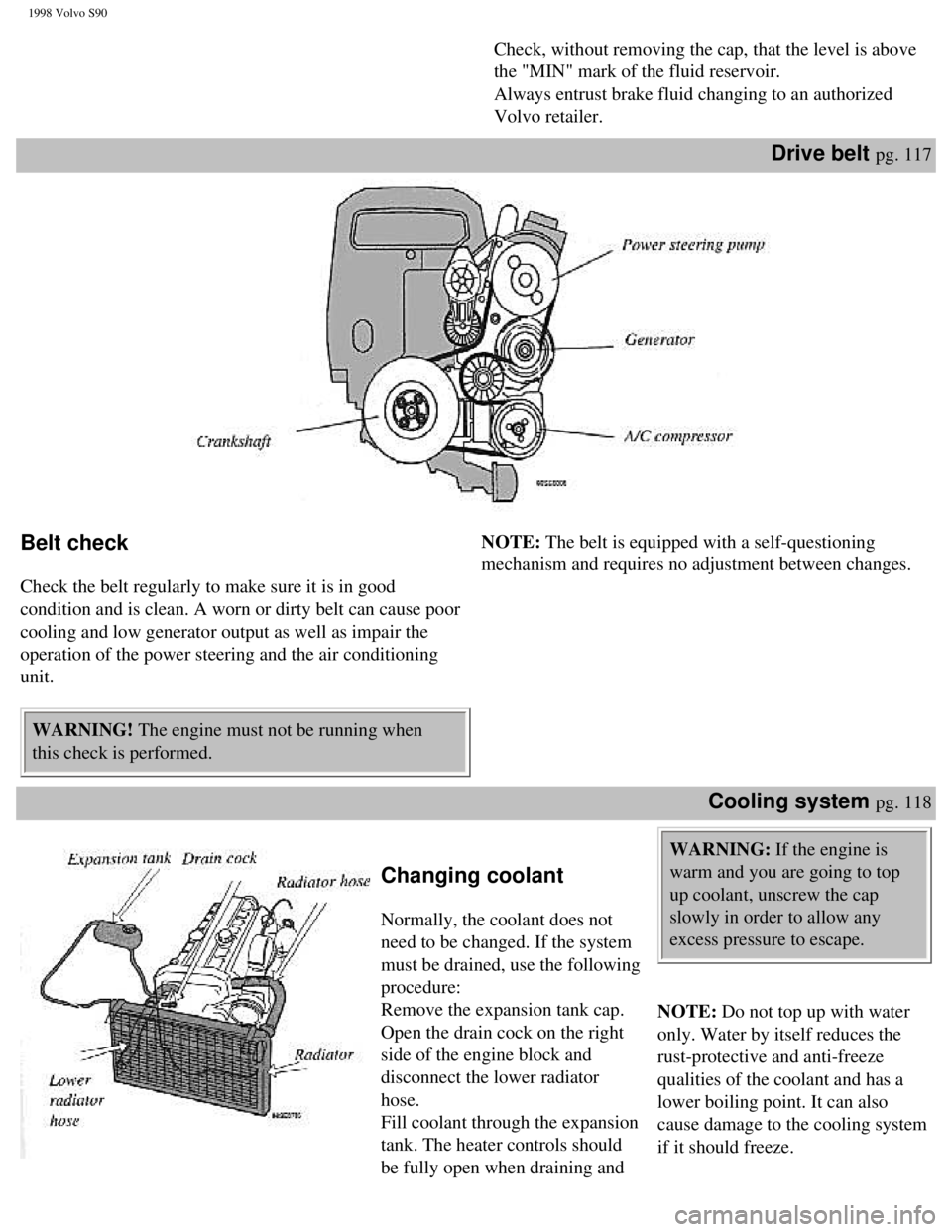
Drive belt pg. 117
Belt check
Check the belt regularly to make sure it is in good
condition and is clean. A worn or dirty belt can cause poor
cooling and low generator output as well as impair the
operation of the power steering and the air conditioning
unit.
WARNING! The engine must not be running when
this check is performed. NOTE: The belt is equipped with a self-questioning
mechanism and requires no adjustment between changes.
Cooling system pg. 118
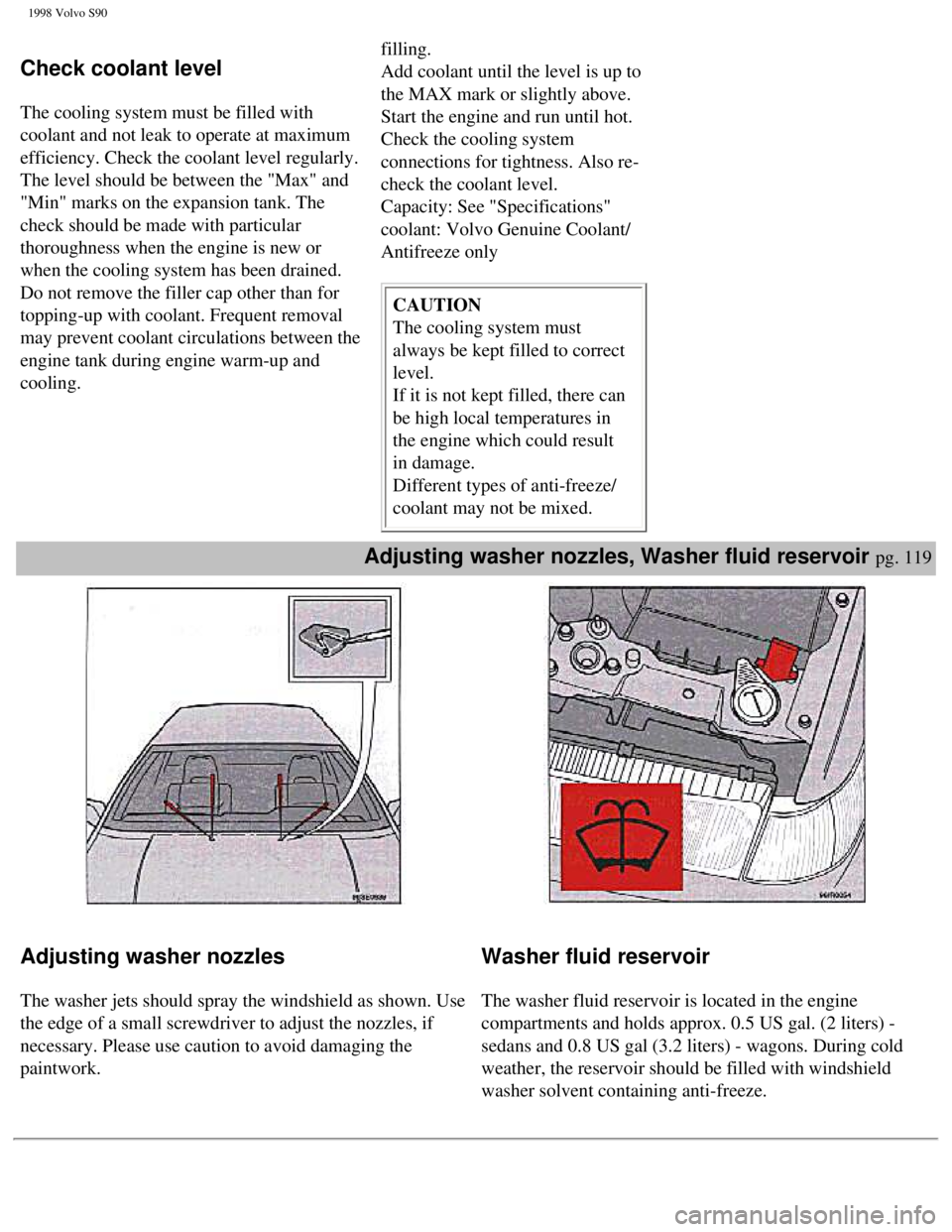
Changing coolant
Normally, the coolant does not
need to be changed. If the system
must be drained, use the following
procedure:
Remove the expansion tank cap.
Open the drain cock on the right
side of the engine block and
disconnect the lower radiator
hose.
Fill coolant through the expansion
tank. The heater controls should
be fully open when draining and
WARNING: If the engine is
warm and you are going to top
up coolant, unscrew the cap
slowly in order to allow any
excess pressure to escape.
NOTE: Do not top up with water
only. Water by itself reduces the
rust-protective and anti-freeze
qualities of the coolant and has a
lower boiling point. It can also
cause damage to the cooling system
if it should freeze.
file:///K|/ownersdocs/1998/1998_SV90/98S90_114.htm (3 of 5)12/30/2006 \
1:52:50 PM
Page 128 of 175
1998 Volvo S90
Check coolant level
The cooling system must be filled with
coolant and not leak to operate at maximum
efficiency. Check the coolant level regularly.
The level should be between the "Max" and
"Min" marks on the expansion tank. The
check should be made with particular
thoroughness when the engine is new or
when the cooling system has been drained.
Do not remove the filler cap other than for
topping-up with coolant. Frequent removal
may prevent coolant circulations between the
engine tank during engine warm-up and
cooling.
filling.
Add coolant until the level is up to
the MAX mark or slightly above.
Start the engine and run until hot.
Check the cooling system
connections for tightness. Also re-
check the coolant level.
Capacity: See "Specifications"
coolant: Volvo Genuine Coolant/
Antifreeze only
CAUTION
The cooling system must
always be kept filled to correct
level.
If it is not kept filled, there can
be high local temperatures in
the engine which could result
in damage.
Different types of anti-freeze/
coolant may not be mixed.
Adjusting washer nozzles, Washer fluid reservoir pg. 119
Adjusting washer nozzles
The washer jets should spray the windshield as shown. Use
the edge of a small screwdriver to adjust the nozzles, if
necessary. Please use caution to avoid damaging the
paintwork.
Washer fluid reservoir
The washer fluid reservoir is located in the engine
compartments and holds approx. 0.5 US gal. (2 liters) -
sedans and 0.8 US gal (3.2 liters) - wagons. During cold
weather, the reservoir should be filled with windshield
washer solvent containing anti-freeze.
file:///K|/ownersdocs/1998/1998_SV90/98S90_114.htm (4 of 5)12/30/2006 \
1:52:50 PM
Page 134 of 175
1998 Volvo S90
Chapter 9 - (cont.)
Specifications
pg. 125
Power transmission
Automatic transmission:
Reduction ratios: / AW 40
1st gear / 2.80:1
2nd gear / 1.53:1
3rd gear / 1:1
Overdrive / 0.71:1
Reverse / 2.39:1
Rear axle:
Reduction ratio / 3.73:1
All specifications are subject to change without
notice. Front suspension
McPherson-type spring and strut suspension.
Shock absorbers housed in strut casing. Rack-and-
pinion steering.
Safety-type steering column.
The alignment specifications apply to an unladen
car, but include fuel, coolant, and spare wheel.
Toe-in, measured on the wheel rim: 2.2 mm +/-
1.0 mm (15" wheels)
wheel rim: 2.3 mm +/- 1.0 mm (16" wheels)
tire sides: 2.8 +/- 1.3 mm
Rear Suspension
Multi-link rear wheel suspension consisting of
four elements per side: a trailing support arm with
load leveling shock absorber ("Nivomat" level-
regulating system on certain models), an upper L-
shaped link, a lower traverse link, and an angled
rear track rod to control wheel toe-in.
Toe-in, measured at the wheel rim: (0.4+/- 0.5
mm)
tire sides: (0.5+/- 0.8mm)
Specifications pg. 126
file:///K|/ownersdocs/1998/1998_SV90/98S90_125.htm (1 of 7)12/30/2006 \
1:52:51 PM
Page 174 of 175
1998 Volvo S90
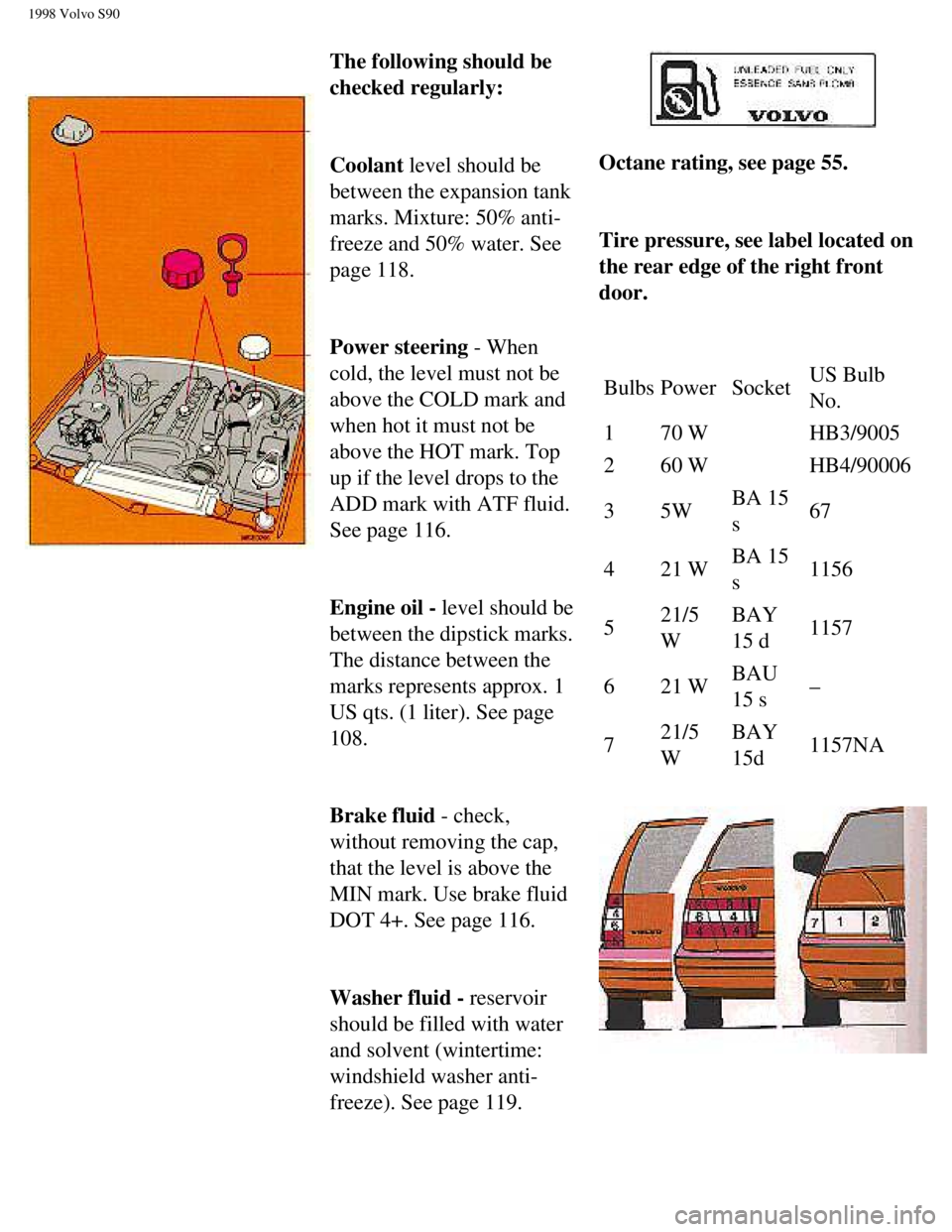
The following should be
checked regularly:
Coolant level should be
between the expansion tank
marks. Mixture: 50% anti-
freeze and 50% water. See
page 118.
Power steering - When
cold, the level must not be
above the COLD mark and
when hot it must not be
above the HOT mark. Top
up if the level drops to the
ADD mark with ATF fluid.
See page 116.
Engine oil - level should be
between the dipstick marks.
The distance between the
marks represents approx. 1
US qts. (1 liter). See page
108.
Brake fluid - check,
without removing the cap,
that the level is above the
MIN mark. Use brake fluid
DOT 4+. See page 116.
Washer fluid - reservoir
should be filled with water
and solvent (wintertime:
windshield washer anti-
freeze). See page 119.
Octane rating, see page 55.
Tire pressure, see label located on
the rear edge of the right front
door.
Bulbs Power Socket US Bulb
No.
1 70 W HB3/9005
2 60 W HB4/90006
3 5W BA 15
s 67
4 21 W BA 15
s 1156
5 21/5
W BAY
15 d
1157
6 21 W BAU
15 s –
7 21/5
W BAY
15d
1157NA
file:///K|/ownersdocs/1998/1998_SV90/98S90_161.htm (6 of 7)12/30/2006 \
1:52:56 PM