bonnet VOLVO V90 2017 User Guide
[x] Cancel search | Manufacturer: VOLVO, Model Year: 2017, Model line: V90, Model: VOLVO V90 2017Pages: 594, PDF Size: 15.07 MB
Page 401 of 594
STARTING AND DRIVING
}}
399
•
The driver makes sweeping steering wheel movements.
• The road is very steep.
• The bonnet is opened.
• When driving at high altitudes when theengine has not reached operating tempera-ture.
• The ABS system has been activated.
• In the event of heavy braking (even withoutthe ABS system having been activated).
• Many starts during a short period of timehave activated the starter motor's thermalprotection.
• The exhaust system's particulate filter is full 4
.
• A trailer is connected electrically to the car
Page 516 of 594
MAINTENANCE AND SERVICE
514
Opening and closing the bonnet
The bonnet can be opened using the handle in the passenger compartment and a handle underthe bonnet.
Open the bonnet
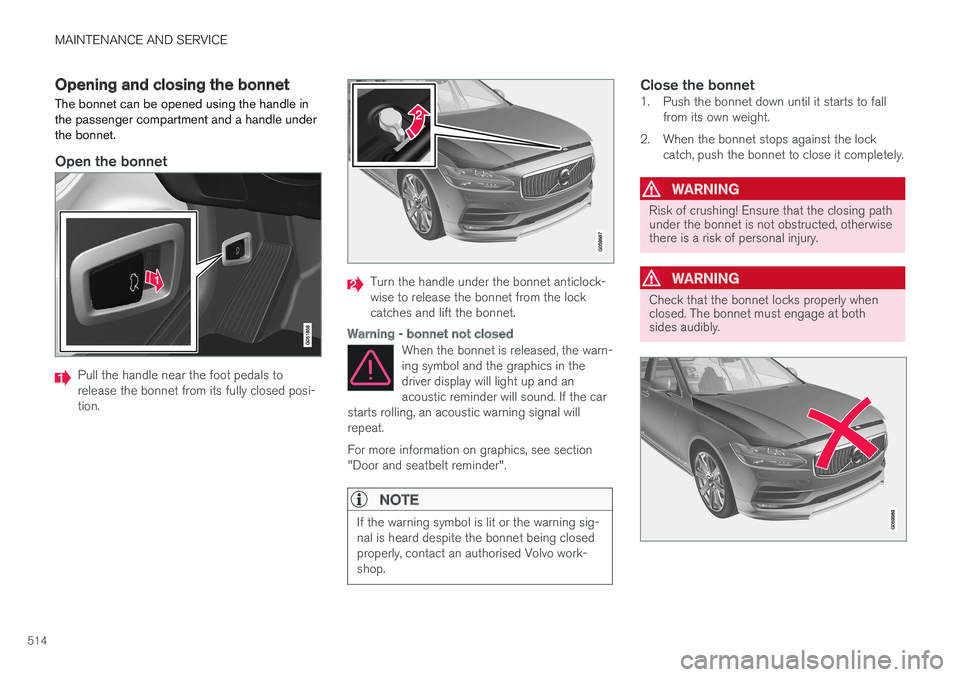
Pull the handle near the foot pedals to release the bonnet from its fully closed posi-tion.
Turn the handle under the bonnet anticlock- wise to release the bonnet from the lockcatches and lift the bonnet.
Warning - bonnet not closed
When the bonnet is released, the warn- ing symbol and the graphics in thedriver display will light up and anacoustic reminder will sound. If the car
starts rolling, an acoustic warning signal willrepeat. For more information on graphics, see section "Door and seatbelt reminder".
NOTE
If the warning symbol is lit or the warning sig- nal is heard despite the bonnet being closedproperly, contact an authorised Volvo work-shop.
Close the bonnet1. Push the bonnet down until it starts to fall from its own weight.
2. When the bonnet stops against the lock catch, push the bonnet to close it completely.
WARNING
Risk of crushing! Ensure that the closing path under the bonnet is not obstructed, otherwisethere is a risk of personal injury.
WARNING
Check that the bonnet locks properly when closed. The bonnet must engage at bothsides audibly.
Page 517 of 594
MAINTENANCE AND SERVICE
515
Bonnet completely closed.
WARNING
Never drive with an open bonnet! If there are any signs that the bonnet is not properly closed whilst driving, stop immedi-ately and close it.
Related information
•Engine compartment overview (p. 515)
• Door and seatbelt reminder (p. 62)
Engine compartment overview
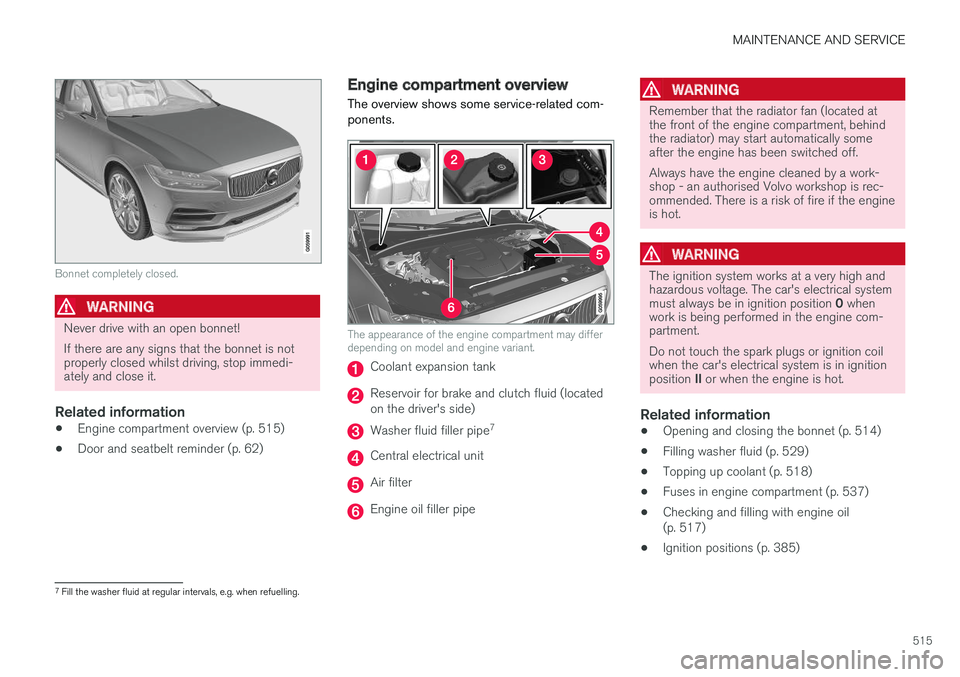
The overview shows some service-related com- ponents.
The appearance of the engine compartment may differ depending on model and engine variant.
Coolant expansion tank
Reservoir for brake and clutch fluid (located on the driver's side)
Washer fluid filler pipe 7
Central electrical unit
Air filter
Engine oil filler pipe
WARNING
Remember that the radiator fan (located at the front of the engine compartment, behindthe radiator) may start automatically someafter the engine has been switched off. Always have the engine cleaned by a work- shop - an authorised Volvo workshop is rec-ommended. There is a risk of fire if the engineis hot.
WARNING
The ignition system works at a very high and hazardous voltage. The car's electrical system must always be in ignition position
0 when
work is being performed in the engine com- partment. Do not touch the spark plugs or ignition coil when the car's electrical system is in ignition position II or when the engine is hot.
Related information
• Opening and closing the bonnet (p. 514)
• Filling washer fluid (p. 529)
• Topping up coolant (p. 518)
• Fuses in engine compartment (p. 537)
• Checking and filling with engine oil (p. 517)
• Ignition positions (p. 385)
7
Fill the washer fluid at regular intervals, e.g. when refuelling.
Page 529 of 594
MAINTENANCE AND SERVICE
527
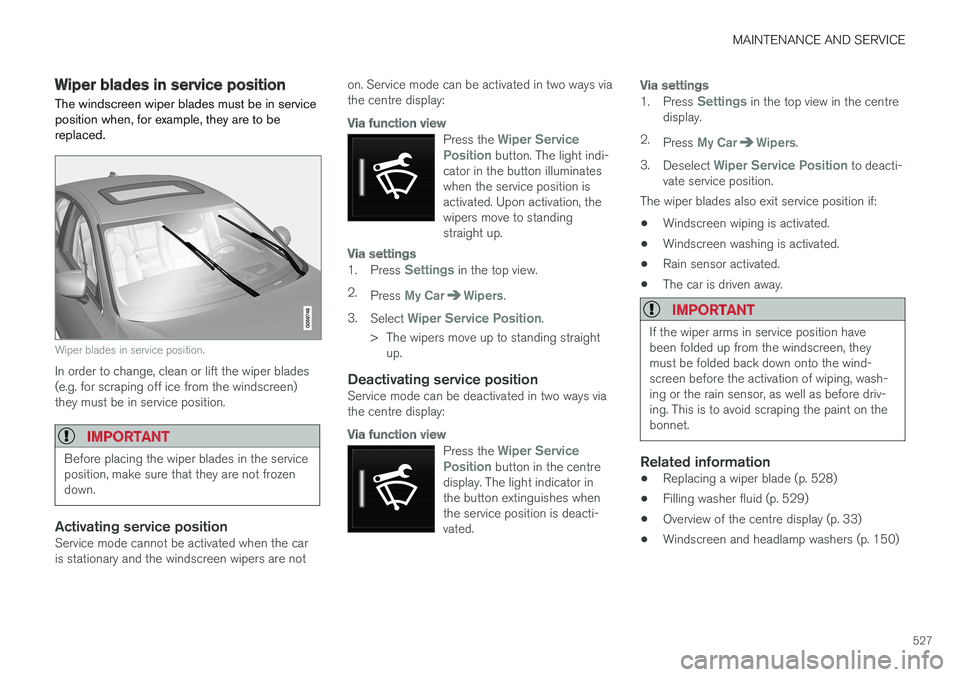
Wiper blades in service position The windscreen wiper blades must be in service position when, for example, they are to bereplaced.
Wiper blades in service position.
In order to change, clean or lift the wiper blades (e.g. for scraping off ice from the windscreen)they must be in service position.
IMPORTANT
Before placing the wiper blades in the service position, make sure that they are not frozendown.
Activating service positionService mode cannot be activated when the car is stationary and the windscreen wipers are noton. Service mode can be activated in two ways viathe centre display:
Via function view
Press the Wiper Service
Position button. The light indi-
cator in the button illuminates when the service position isactivated. Upon activation, thewipers move to standingstraight up.
Via settings
1. Press Settings in the top view.
2. Press
My CarWipers.
3. Select
Wiper Service Position.
> The wipers move up to standing straight up.
Deactivating service positionService mode can be deactivated in two ways via the centre display:
Via function view
Press the Wiper Service
Position button in the centre
display. The light indicator in the button extinguishes whenthe service position is deacti-vated.
Via settings
1. Press Settings in the top view in the centre
display.
2. Press
My CarWipers.
3. Deselect
Wiper Service Position to deacti-
vate service position.
The wiper blades also exit service position if:
• Windscreen wiping is activated.
• Windscreen washing is activated.
• Rain sensor activated.
• The car is driven away.
IMPORTANT
If the wiper arms in service position have been folded up from the windscreen, theymust be folded back down onto the wind-screen before the activation of wiping, wash-ing or the rain sensor, as well as before driv-ing. This is to avoid scraping the paint on thebonnet.
Related information
• Replacing a wiper blade (p. 528)
• Filling washer fluid (p. 529)
• Overview of the centre display (p. 33)
• Windscreen and headlamp washers (p. 150)
Page 532 of 594
||
MAINTENANCE AND SERVICE
530
IMPORTANT
Use Volvo genuine washer fluid or equivalent with a recommended pH of between 6 and 8,in working dilution (e.g. 1:1 with neutralwater).
IMPORTANT
Use washer fluid with antifreeze when the temperature is below freezing to avoid freez-ing in the pump, reservoir and hoses.
Volume:• Cars
with headlamp washing: 5.5 litres.
• Cars
without headlamp washing: 3.5 litres.
Related information
•Windscreen and headlamp washers (p. 150)
• Opening and closing the bonnet (p. 514)
Starter battery
The electrical system is single-pole and uses the chassis and engine casing as a conductor. The starter battery is used to start up the electri- cal system and drive the starter motor as well asother electrical equipment in the car. The starter battery should be replaced by a workshop 13
.
The car has a voltage-regulated AC alternator. The starter battery is a 12 V AGM battery, designed for the carbon dioxide reducing func-tions, Start/Stop and regenerative charging, andto support the functionality of the car's differentsystems. The service life and function of the starter battery is influenced by factors such as the number ofstarts, discharging, driving style, driving condi-tions, climatic conditions etc. • Never disconnect the starter battery when the engine is running.
• Check that the cables to the starter batteryare correctly connected and properly tight-ened.
WARNING
•
The battery can generate oxyhydrogen gas, which is highly explosive. A spark canbe formed if a jump lead is connectedincorrectly, and this can be enough forthe battery to explode.
• The battery contains sulphuric acid, whichcan cause serious burns.
• If sulphuric acid comes into contact witheyes, skin or clothing, flush with largequantities of water. If acid splashes intothe eyes - seek medical attention imme-diately.
When connecting an external starter battery orbattery charger, use the car's charging points inthe engine compartment. The battery terminalson the car's starter battery in the cargo area must not be used.
During charging, both the starter battery and the support battery are charged.
13 An authorised Volvo workshop is recommended.
Page 573 of 594
SPECIFICATIONS
}}
571
Fuel tank - volume
Fuel tank volume for each respective engine alternative can be read in the table.
Engine Volume (litres)
AWD approx. 60
Other engines approx. 55
Related information
• Opening/closing the fuel filler flap and refu- elling (p. 417)
Air conditioning — specifications
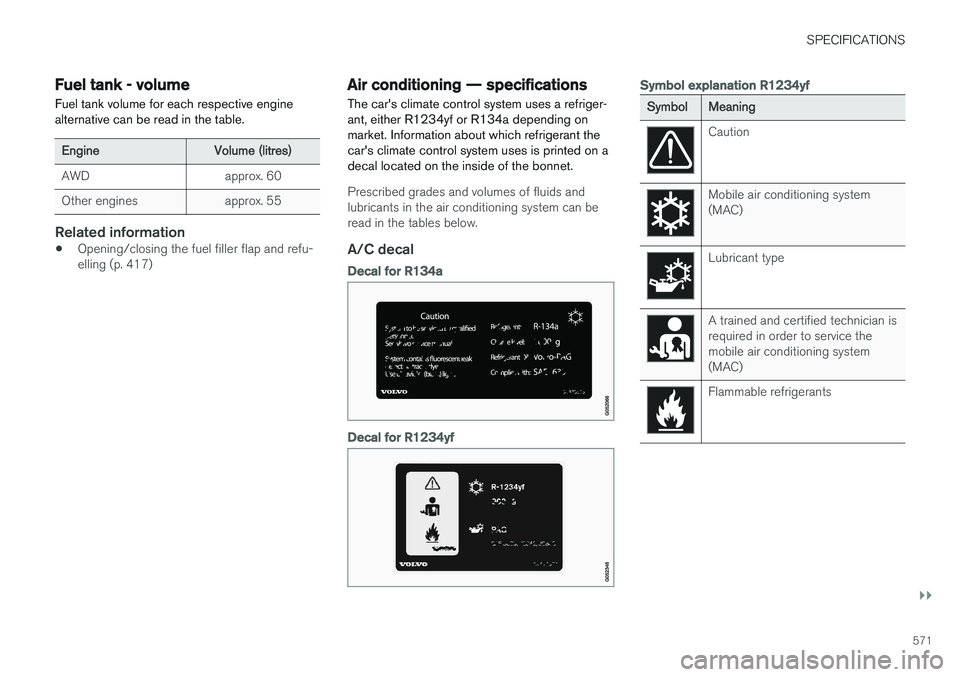
The car's climate control system uses a refriger- ant, either R1234yf or R134a depending onmarket. Information about which refrigerant thecar's climate control system uses is printed on adecal located on the inside of the bonnet.
Prescribed grades and volumes of fluids and lubricants in the air conditioning system can beread in the tables below.
A/C decal
Decal for R134a
Decal for R1234yf
Symbol explanation R1234yf
Symbol Meaning
Caution
Mobile air conditioning system (MAC)
Lubricant type
A trained and certified technician is required in order to service themobile air conditioning system(MAC)
Flammable refrigerants
Page 580 of 594
ALPHABETICAL INDEX
578Automatic car washes 549 Automatic engine stop
auto-stop 396
Automatic gearbox 390 trailer 428
Automatic relocking 242
Automatic speed limiter 281AUX jack for connecting media 448
Auxiliary heater 215
AWD, All Wheel Drive 405
B
Backrest front seat, adjusting 121, 122, 124
rear seat, lowering 130
Bag holder 228
Battery 388, 530 jump starting 388
maintenance 530
overload 415
start 530
support 533
symbols on the battery 533
warning symbols 533
Bi-Fuel introduction 54
BLIS 340, 342, 343 Bluetooth connect 447
connect car to Internet 464
phone 456
settings 463
Bonnet, opening 514
Book service and repair 506Brake assist after collision 408
Brake fluid grade 570
Brake functions 406
Brake light 143
Brakes 406 Anti-lock braking system, ABS 406
automatic when stationary 412
brake assist system, BAS 408
brake light 143
brake system 406
emergency brake lights 408
handbrake 409, 410, 411
bulbs, specifications 526C
Camera sensor 337
Car care 549 Leather upholstery 552
Car functions in centre display 47
Cargo area 226 electrical socket 220
lighting 146
mounting points 228
protective net 232
Cargo cover 230
Cargo grille 233
Car holiday 415
Car key battery low 257Car modem connect car to Internet 464
settings 468
Car status 506 Tyre pressure 487
Car upholstery 552
Car washing 549Catalytic converter Recovery 432
CD player 446
central locking 245