weight VOLVO V90 2017 User Guide
[x] Cancel search | Manufacturer: VOLVO, Model Year: 2017, Model line: V90, Model: VOLVO V90 2017Pages: 594, PDF Size: 15.07 MB
Page 429 of 594
STARTING AND DRIVING
* Option/accessory.427
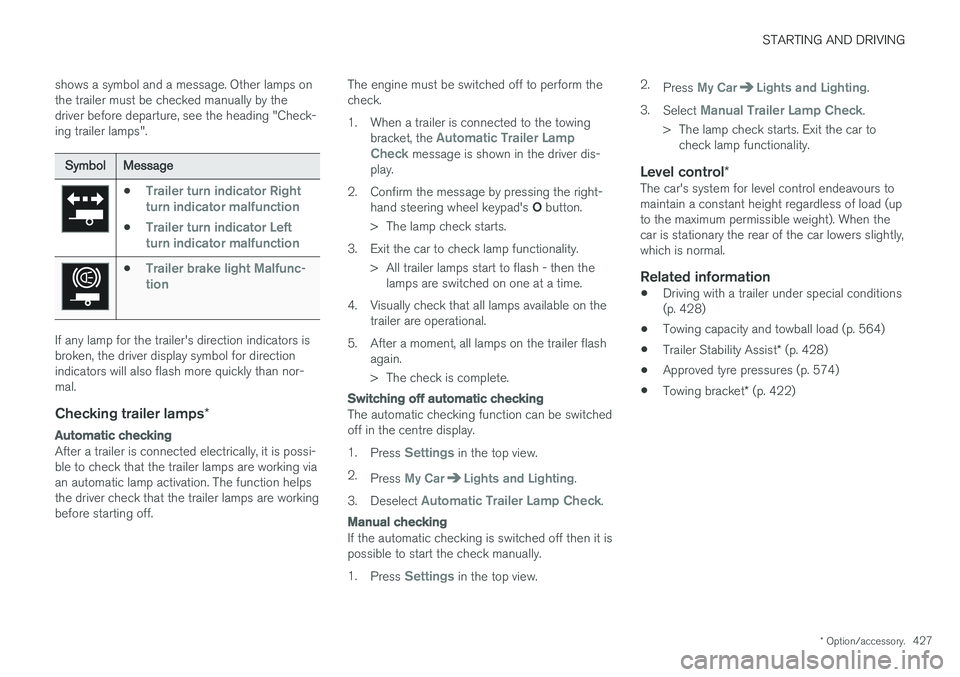
shows a symbol and a message. Other lamps on the trailer must be checked manually by thedriver before departure, see the heading "Check-ing trailer lamps".
Symbol
Message
•Trailer turn indicator Right
turn indicator malfunction
•Trailer turn indicator Left
turn indicator malfunction
•Trailer brake light Malfunc-
tion
If any lamp for the trailer's direction indicators is broken, the driver display symbol for directionindicators will also flash more quickly than nor-mal.
Checking trailer lamps *
Automatic checking
After a trailer is connected electrically, it is possi- ble to check that the trailer lamps are working viaan automatic lamp activation. The function helpsthe driver check that the trailer lamps are workingbefore starting off. The engine must be switched off to perform thecheck.
1. When a trailer is connected to the towing
bracket, the
Automatic Trailer Lamp
Check message is shown in the driver dis-
play.
2. Confirm the message by pressing the right- hand steering wheel keypad's O button.
> The lamp check starts.
3. Exit the car to check lamp functionality. > All trailer lamps start to flash - then thelamps are switched on one at a time.
4. Visually check that all lamps available on the trailer are operational.
5. After a moment, all lamps on the trailer flash again.
> The check is complete.
Switching off automatic checking
The automatic checking function can be switched off in the centre display. 1.Press
Settings in the top view.
2. Press
My CarLights and Lighting.
3. Deselect
Automatic Trailer Lamp Check.
Manual checking
If the automatic checking is switched off then it is possible to start the check manually. 1.Press
Settings in the top view. 2.
Press
My CarLights and Lighting.
3. Select
Manual Trailer Lamp Check.
> The lamp check starts. Exit the car to check lamp functionality.
Level control *The car's system for level control endeavours to maintain a constant height regardless of load (upto the maximum permissible weight). When thecar is stationary the rear of the car lowers slightly,which is normal.
Related information
•Driving with a trailer under special conditions(p. 428)
• Towing capacity and towball load (p. 564)
• Trailer Stability Assist
* (p. 428)
• Approved tyre pressures (p. 574)
• Towing bracket
* (p. 422)
Page 504 of 594
WHEELS AND TYRES
502
Dimension designation for wheel rim
Wheel and rim dimensions are designated in accordance with the examples in the tablebelow.
All wheel rims have a dimension designation, for example: 8.5Jx19x47.5.
8.5 Rim width in inches
J Rim flange profile
19 Rim diameter in inches
47,5 Off-set in mm (distance from wheel centre to wheel contact surface against the hub)
The car has an approval for the complete vehicle with certain combinations of wheel rims andtyres.
Related information
•Tyres (p. 482)
• Dimension designation for tyre (p. 502)
Dimension designation for tyre
Designations for tyre dimension, load index and speed rating.
The car has an approval for the complete vehicle with certain combinations of wheel rims andtyres.
Designation of dimensionsAll tyres have a dimension designation, such as:255/40 R19 100 W.
255 Tyre width (mm)
40 Ratio between tyre wall height and tyre width (%)
R Radial ply
19 Rim diameter in inches
100 Codes for the maximum permitted tyre load, tyre load index (LI)
W Speed rating for maximum permitted speed, speed rating (SS). (In this case 270 km/h (168 mph).)
Load indexEach tyre has a certain capacity to carry a load, a load index (LI). The car's weight determines theload capacity required of the tyres. The lowestpermitted load index is specified in a load indextable.
Speed ratingEach tyre can withstand a certain maximumspeed. Tyre speed rating, SS (Speed Symbol),must at least correspond with the car's topspeed. The table below shows the maximum per-mitted speed for each speed rating (SS). Theonly exception to these regulations is winter tyres3
, where a lower speed rating may be used.
If such a tyre is chosen, the car must not be driven faster than the speed rating of the tyre (forexample, class Q can be driven at a maximum of160 km/h (100 mph).) The top speed at whichthe car can be driven depends on road condi-tions, not the speed rating of the tyres.
NOTE
The maximum permitted speed is specified in the table.
Q 160 km/h (100 mph) (used only on win- ter tyres)
T 190 km/h (118 mph)
H 210 km/h (130 mph) V 240 km/h (149 mph)
W 270 km/h (168 mph) Y 300 km/h (186 mph)
3 Both those with metal studs and those without.
Page 516 of 594
MAINTENANCE AND SERVICE
514
Opening and closing the bonnet
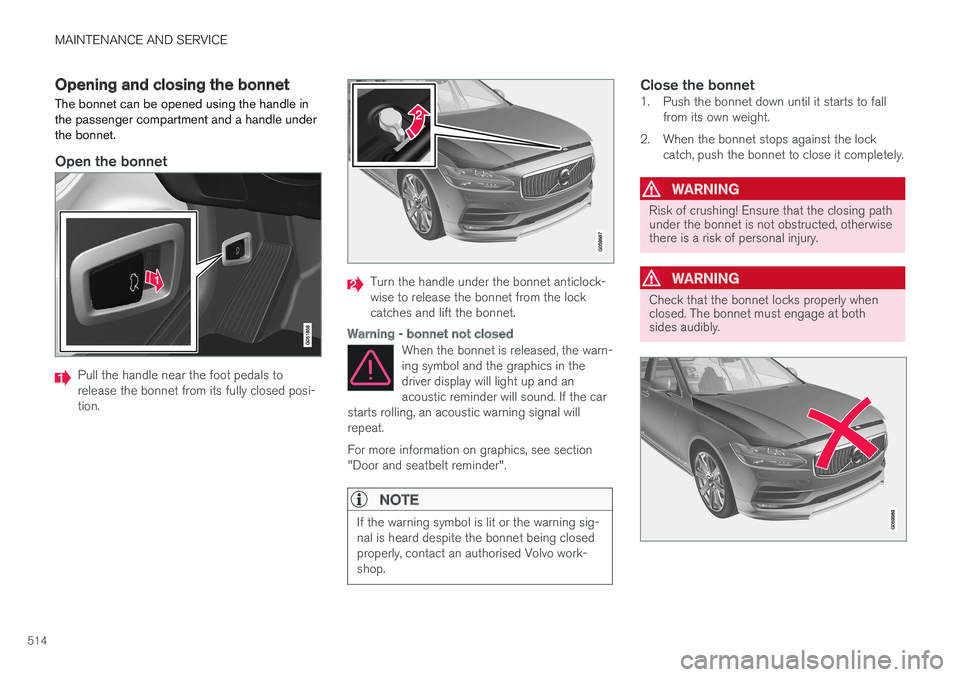
The bonnet can be opened using the handle in the passenger compartment and a handle underthe bonnet.
Open the bonnet
Pull the handle near the foot pedals to release the bonnet from its fully closed posi-tion.
Turn the handle under the bonnet anticlock- wise to release the bonnet from the lockcatches and lift the bonnet.
Warning - bonnet not closed
When the bonnet is released, the warn- ing symbol and the graphics in thedriver display will light up and anacoustic reminder will sound. If the car
starts rolling, an acoustic warning signal willrepeat. For more information on graphics, see section "Door and seatbelt reminder".
NOTE
If the warning symbol is lit or the warning sig- nal is heard despite the bonnet being closedproperly, contact an authorised Volvo work-shop.
Close the bonnet1. Push the bonnet down until it starts to fall from its own weight.
2. When the bonnet stops against the lock catch, push the bonnet to close it completely.
WARNING
Risk of crushing! Ensure that the closing path under the bonnet is not obstructed, otherwisethere is a risk of personal injury.
WARNING
Check that the bonnet locks properly when closed. The bonnet must engage at bothsides audibly.
Page 561 of 594
SPECIFICATIONS
}}
559
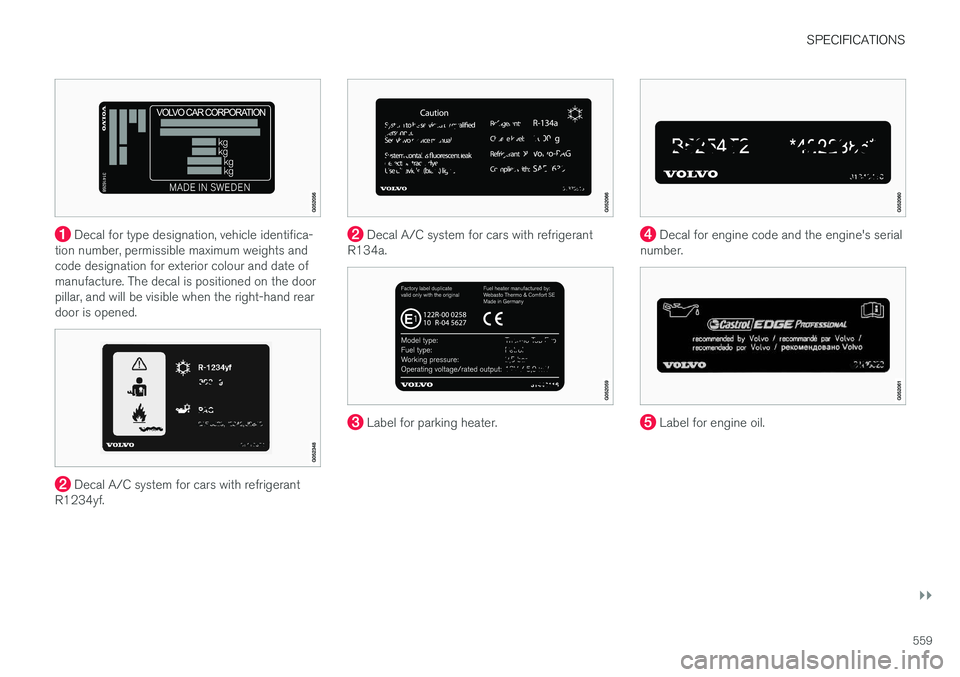
Decal for type designation, vehicle identifica-
tion number, permissible maximum weights and code designation for exterior colour and date ofmanufacture. The decal is positioned on the doorpillar, and will be visible when the right-hand reardoor is opened.
Decal A/C system for cars with refrigerant
R1234yf.
Decal A/C system for cars with refrigerant
R134a.
Label for parking heater.
Decal for engine code and the engine's serial
number.
Label for engine oil.
Page 565 of 594
SPECIFICATIONS
563
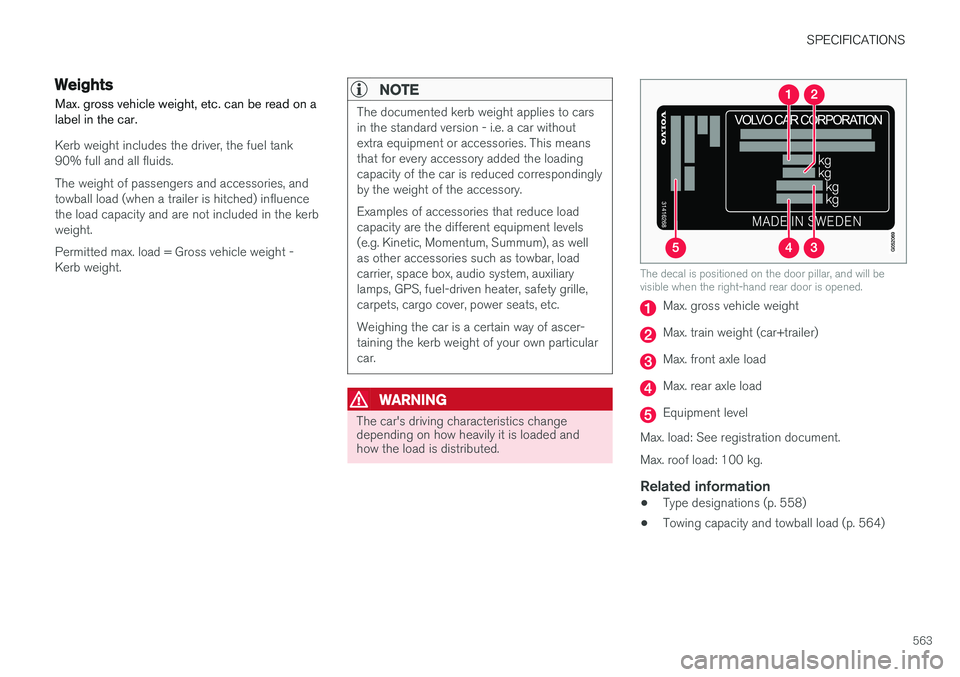
Weights Max. gross vehicle weight, etc. can be read on a label in the car.
Kerb weight includes the driver, the fuel tank 90% full and all fluids. The weight of passengers and accessories, and towball load (when a trailer is hitched) influencethe load capacity and are not included in the kerbweight. Permitted max. load = Gross vehicle weight - Kerb weight.
NOTE
The documented kerb weight applies to cars in the standard version - i.e. a car withoutextra equipment or accessories. This meansthat for every accessory added the loadingcapacity of the car is reduced correspondinglyby the weight of the accessory. Examples of accessories that reduce load capacity are the different equipment levels(e.g. Kinetic, Momentum, Summum), as wellas other accessories such as towbar, loadcarrier, space box, audio system, auxiliarylamps, GPS, fuel-driven heater, safety grille,carpets, cargo cover, power seats, etc. Weighing the car is a certain way of ascer- taining the kerb weight of your own particularcar.
WARNING
The car's driving characteristics change depending on how heavily it is loaded andhow the load is distributed.
The decal is positioned on the door pillar, and will be visible when the right-hand rear door is opened.
Max. gross vehicle weight
Max. train weight (car+trailer)
Max. front axle load
Max. rear axle load
Equipment level
Max. load: See registration document. Max. roof load: 100 kg.
Related information
• Type designations (p. 558)
• Towing capacity and towball load (p. 564)
Page 566 of 594
SPECIFICATIONS
564
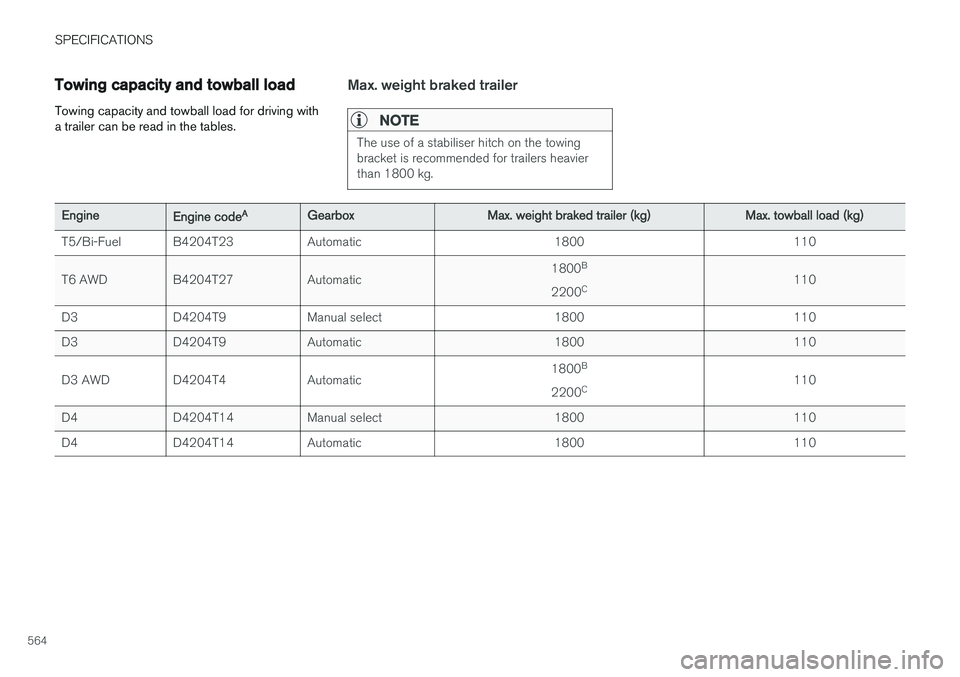
Towing capacity and towball load
Towing capacity and towball load for driving with a trailer can be read in the tables.Max. weight braked trailer
NOTE
The use of a stabiliser hitch on the towing bracket is recommended for trailers heavierthan 1800 kg.
Engine Engine codeA
Gearbox Max. weight braked trailer (kg) Max. towball load (kg)
T5/Bi-Fuel B4204T23 Automatic 1800 110
T6 AWD B4204T27 Automatic 1800
B
2200 C 110
D3 D4204T9 Manual select 1800 110
D3 D4204T9 Automatic 1800 110
D3 AWD D4204T4 Automatic 1800
B
2200 C 110
D4 D4204T14 Manual select 1800 110
D4 D4204T14 Automatic 1800 110
Page 567 of 594
SPECIFICATIONS
* Option/accessory.565
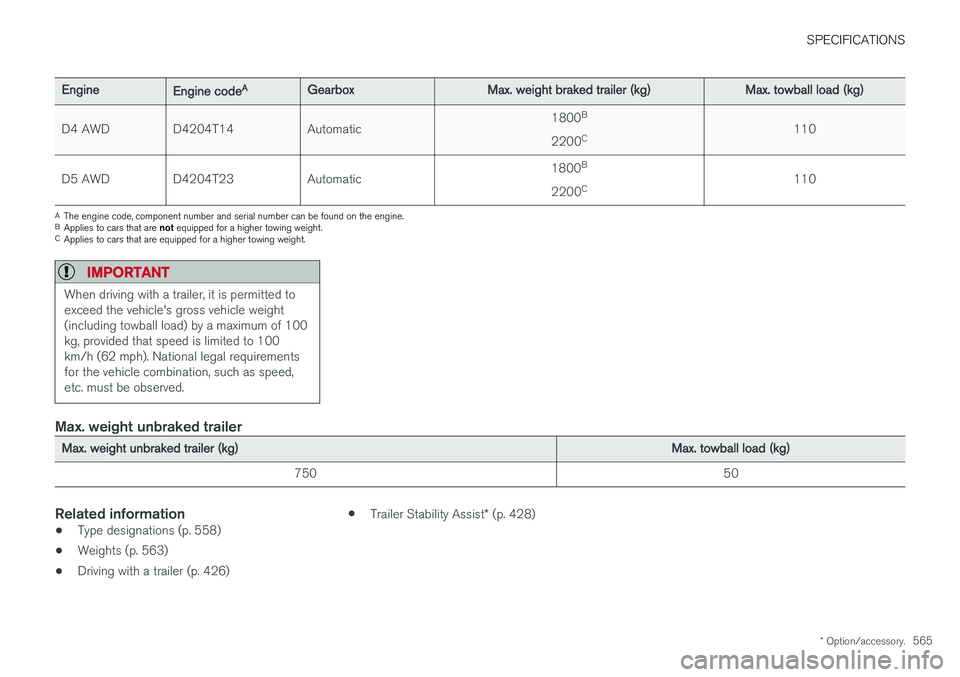
Engine
Engine codeA
Gearbox Max. weight braked trailer (kg) Max. towball load (kg)
D4 AWD D4204T14 Automatic 1800
B
2200 C 110
D5 AWD D4204T23 Automatic 1800
B
2200 C 110
A
The engine code, component number and serial number can be found on the engine.
B Applies to cars that are not equipped for a higher towing weight.
C Applies to cars that are equipped for a higher towing weight.
IMPORTANT
When driving with a trailer, it is permitted to exceed the vehicle's gross vehicle weight(including towball load) by a maximum of 100kg, provided that speed is limited to 100km/h (62 mph). National legal requirementsfor the vehicle combination, such as speed,etc. must be observed.
Max. weight unbraked trailer
Max. weight unbraked trailer (kg) Max. towball load (kg)
750 50
Related information
•Type designations (p. 558)
• Weights (p. 563)
• Driving with a trailer (p. 426) •
Trailer Stability Assist
* (p. 428)
Page 574 of 594
||
SPECIFICATIONS
572
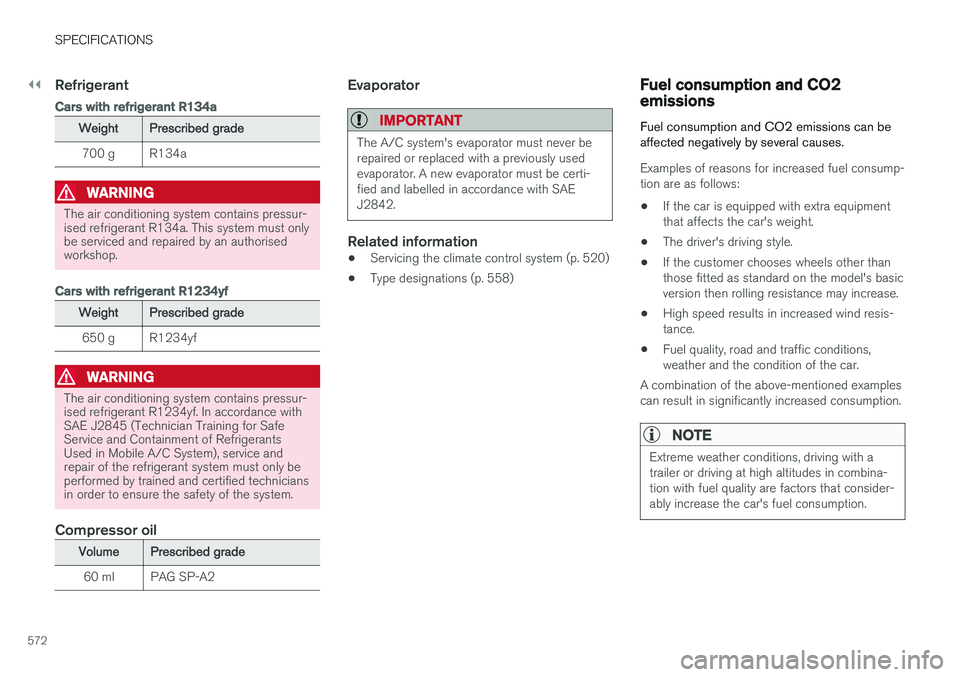
Refrigerant
Cars with refrigerant R134a
WeightPrescribed grade
700 g R134a
WARNING
The air conditioning system contains pressur- ised refrigerant R134a. This system must onlybe serviced and repaired by an authorisedworkshop.
Cars with refrigerant R1234yf
Weight Prescribed grade
650 g R1234yf
WARNING
The air conditioning system contains pressur- ised refrigerant R1234yf. In accordance withSAE J2845 (Technician Training for SafeService and Containment of RefrigerantsUsed in Mobile A/C System), service andrepair of the refrigerant system must only beperformed by trained and certified techniciansin order to ensure the safety of the system.
Compressor oil
Volume Prescribed grade
60 ml PAG SP-A2
Evaporator
IMPORTANT
The A/C system's evaporator must never be repaired or replaced with a previously usedevaporator. A new evaporator must be certi-fied and labelled in accordance with SAEJ2842.
Related information
• Servicing the climate control system (p. 520)
• Type designations (p. 558)
Fuel consumption and CO2 emissions
Fuel consumption and CO2 emissions can be affected negatively by several causes.
Examples of reasons for increased fuel consump- tion are as follows:• If the car is equipped with extra equipmentthat affects the car's weight.
• The driver's driving style.
• If the customer chooses wheels other thanthose fitted as standard on the model's basicversion then rolling resistance may increase.
• High speed results in increased wind resis-tance.
• Fuel quality, road and traffic conditions,weather and the condition of the car.
A combination of the above-mentioned examplescan result in significantly increased consumption.
NOTE
Extreme weather conditions, driving with a trailer or driving at high altitudes in combina-tion with fuel quality are factors that consider-ably increase the car's fuel consumption.
Page 575 of 594
SPECIFICATIONS
573
Related information
•Type designations (p. 558)
• Weights (p. 563)
• Economical driving (p. 422)
Page 583 of 594
ALPHABETICAL INDEX
581
filter 516
grade and volume 567
Engine oil, filling 517
Engine specifications 566Error messages Adaptive Cruise Control 302
see Messages and symbols 302, 316
Error messages in BLIS 347 Ethanol content maximum 10 percent by volume 419
External dimensions 561
F
Fan Air distribution 198
Air vents 199
Control 193
Fault tracing for the camera sensor 327
Ferry transport 405
First aid 501
First aid kit 501
Flooded road 413
Fluids, capacities 529, 570, 571
Fluids and oils 570, 571
Fog lamp front 142
rear 142
Foot brake 406, 408
Four-C 405Front seat Climate control 187
Fan 193
heating 203
Temperature 190
Ventilation 204
Front seat, manual 121
Front seat, power 121, 123 adjusting seat 122, 127
massage 124
memory function 122
multi-function control 123, 124
FSC, ecolabelling 32
Fuel 418, 419, 420 fuel consumption 572
Fuelling filling 417
Fuel tank volume 571
Fuel vapour 418
Fuse box 535Fuses changing 536
General 535
in cargo area 546
in engine compartment 537
under glovebox 542
G
Gearbox 389automatic 390
manual 392
Gear positions automatic gearbox 390
Gear selector inhibitor 394
Gear shift indicator 392Glass laminated/reinforced 32
Glovebox 225 Gracenote ®
445
Gross vehicle weight 563
GSI - Gear selector assistance 392