ECO mode VOLVO V90 2018 Owner´s Manual
[x] Cancel search | Manufacturer: VOLVO, Model Year: 2018, Model line: V90, Model: VOLVO V90 2018Pages: 656, PDF Size: 11.78 MB
Page 561 of 656
LOADING, STORAGE AND PASSENGER COMPARTMENT
}}
* Option/accessory.559
2. Carefully lift the cover up and out.
> The other end will release automaticallyand the cover can then be lifted out of the cargo compartment.
Related information
• Operating the cargo compartment cover
*
(p. 559)
• Loading recommendations (p. 555)
Operating the cargo compartment
cover
*
The cover can be used in two positions: fully open to completely cover the cargo compart-ment or partially retracted to make it easier toreach further into the cargo compartment.
Fully open
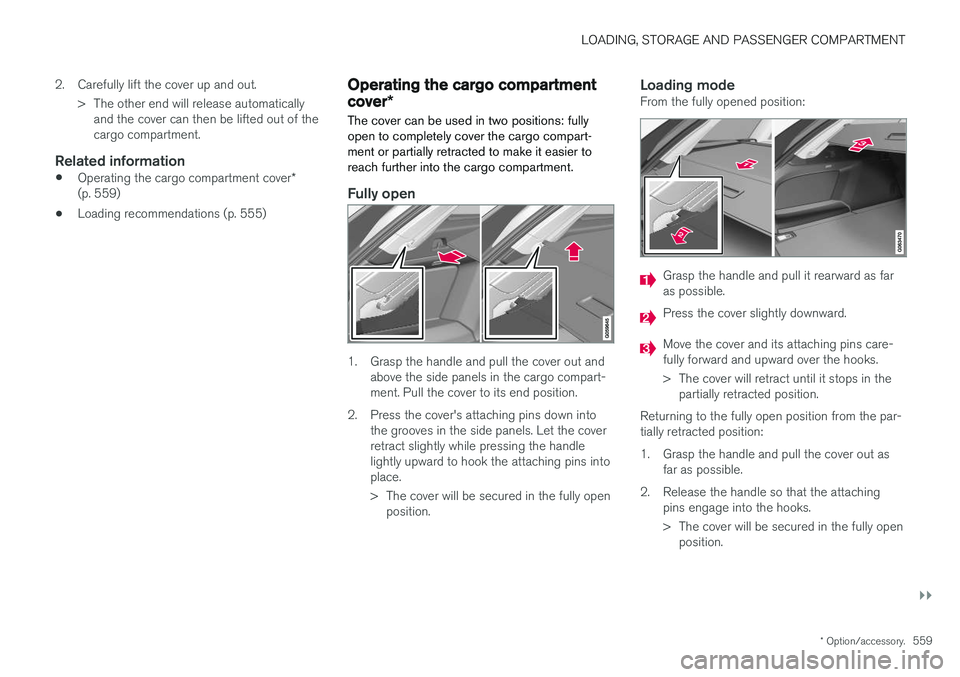
1. Grasp the handle and pull the cover out and above the side panels in the cargo compart- ment. Pull the cover to its end position.
2. Press the cover's attaching pins down into the grooves in the side panels. Let the coverretract slightly while pressing the handlelightly upward to hook the attaching pins intoplace.
> The cover will be secured in the fully openposition.
Loading modeFrom the fully opened position:
Grasp the handle and pull it rearward as far as possible.
Press the cover slightly downward.
Move the cover and its attaching pins care- fully forward and upward over the hooks.
> The cover will retract until it stops in thepartially retracted position.
Returning to the fully open position from the par- tially retracted position:
1. Grasp the handle and pull the cover out as far as possible.
2. Release the handle so that the attaching pins engage into the hooks.
> The cover will be secured in the fully openposition.
Page 575 of 656
MAINTENANCE AND SERVICE
}}
* Option/accessory.573
Hoisting the vehicle When hoisting the vehicle, it is important to ensure the jack/vehicle hoist is correctlyengaged in the designated attachment pointsunder the vehicle.
For vehicles with self-leveling *, pneumatic sus-
pension (if installed) must be turned off before the vehicle is lifted. Turning off the function in thecenter display.
WARNING
If the vehicle is lifted on a garage jack, the jack must be placed under one of the four lift-ing points. Make sure that the vehicle is cor-rectly positioned on the jack and that it can-not slide off. Make sure the jack plate has arubber pad to help keep the vehicle stableand prevent damage. Always use axle standsor similar.
NOTE
Volvo recommends only using the jack intended for your specific vehicle model. If ajack other than that recommended by Volvo isused, follow the instructions included with theequipment. The vehicle's ordinary jack is only intended to be used in temporary situations for short peri-ods of time, such as when changing wheels inthe event of a flat tire. If the vehicle needs tobe lifted more frequently, or for a longerperiod of time than for a wheel change, agarage jack or hoist is recommended. Alwaysfollow the instructions for use provided withthe equipment.
Page 578 of 656
||
MAINTENANCE AND SERVICE
* Option/accessory.
576
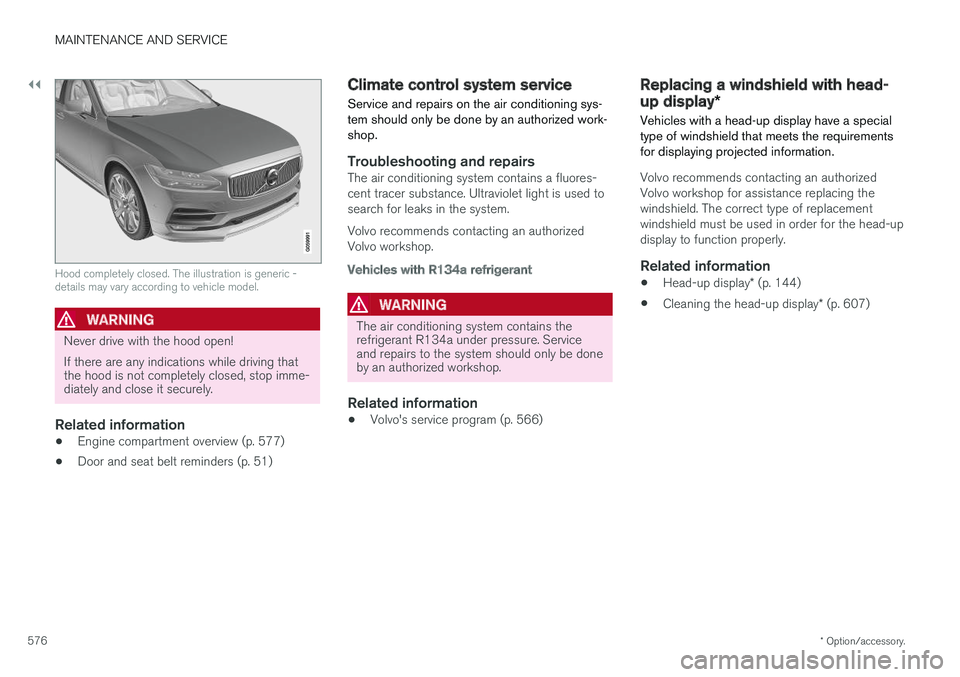
Hood completely closed. The illustration is generic - details may vary according to vehicle model.
WARNING
Never drive with the hood open! If there are any indications while driving that the hood is not completely closed, stop imme-diately and close it securely.
Related information
• Engine compartment overview (p. 577)
• Door and seat belt reminders (p. 51)
Climate control system service Service and repairs on the air conditioning sys- tem should only be done by an authorized work-shop.
Troubleshooting and repairsThe air conditioning system contains a fluores- cent tracer substance. Ultraviolet light is used tosearch for leaks in the system. Volvo recommends contacting an authorized Volvo workshop.
Vehicles with R134a refrigerant
WARNING
The air conditioning system contains the refrigerant R134a under pressure. Serviceand repairs to the system should only be doneby an authorized workshop.
Related information
•Volvo's service program (p. 566)
Replacing a windshield with head-
up display
*
Vehicles with a head-up display have a special type of windshield that meets the requirementsfor displaying projected information.
Volvo recommends contacting an authorized Volvo workshop for assistance replacing thewindshield. The correct type of replacementwindshield must be used in order for the head-updisplay to function properly.
Related information
• Head-up display
* (p. 144)
• Cleaning the head-up display
* (p. 607)
Page 579 of 656
MAINTENANCE AND SERVICE
}}
577
Engine compartment overview
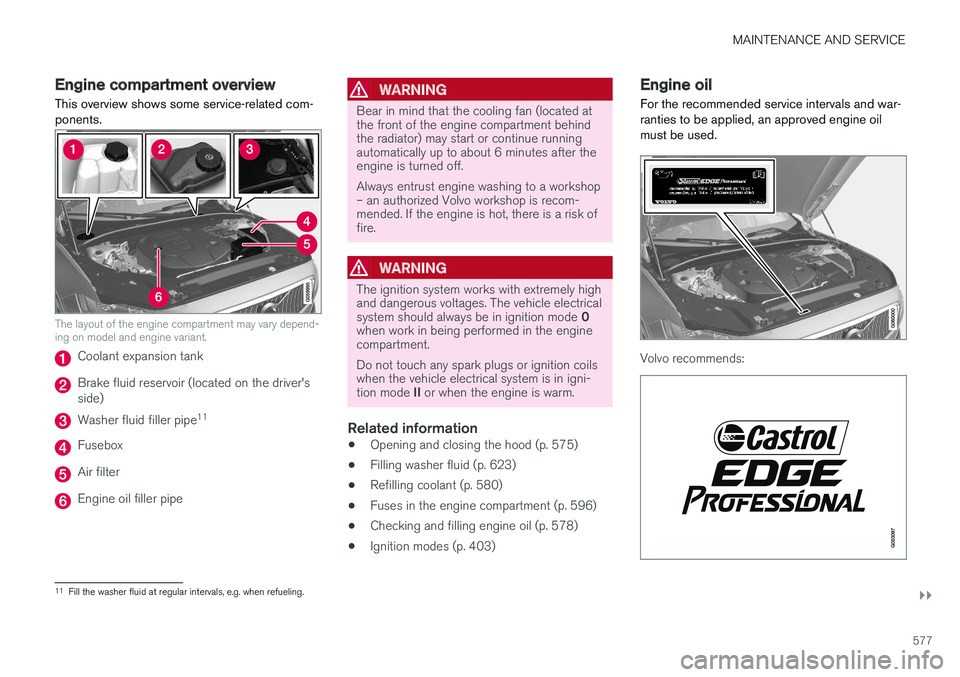
This overview shows some service-related com- ponents.
The layout of the engine compartment may vary depend- ing on model and engine variant.
Coolant expansion tank
Brake fluid reservoir (located on the driver's side)
Washer fluid filler pipe 11
Fusebox
Air filter
Engine oil filler pipe
WARNING
Bear in mind that the cooling fan (located at the front of the engine compartment behindthe radiator) may start or continue runningautomatically up to about 6 minutes after theengine is turned off. Always entrust engine washing to a workshop – an authorized Volvo workshop is recom-mended. If the engine is hot, there is a risk offire.
WARNING
The ignition system works with extremely high and dangerous voltages. The vehicle electrical system should always be in ignition mode
0
when work in being performed in the engine compartment. Do not touch any spark plugs or ignition coils when the vehicle electrical system is in igni- tion mode II or when the engine is warm.
Related information
• Opening and closing the hood (p. 575)
• Filling washer fluid (p. 623)
• Refilling coolant (p. 580)
• Fuses in the engine compartment (p. 596)
• Checking and filling engine oil (p. 578)
• Ignition modes (p. 403)
Engine oil
For the recommended service intervals and war- ranties to be applied, an approved engine oilmust be used.
Volvo recommends:
11 Fill the washer fluid at regular intervals, e.g. when refueling.
Page 582 of 656
||
MAINTENANCE AND SERVICE
580
NOTE
If the conditions for measuring oil level are not properly fulfilled (time after engine shut-down, vehicle inclination, ambient tempera- ture, etc.) the message
No value availablewill be shown in the center display. This does not mean that anything is wrong in the vehi-
cle systems.
Related information
• Engine oil (p. 577)
• Engine oil specifications (p. 634)
• Ignition modes (p. 403)
• Vehicle status (p. 570)
Refilling coolant
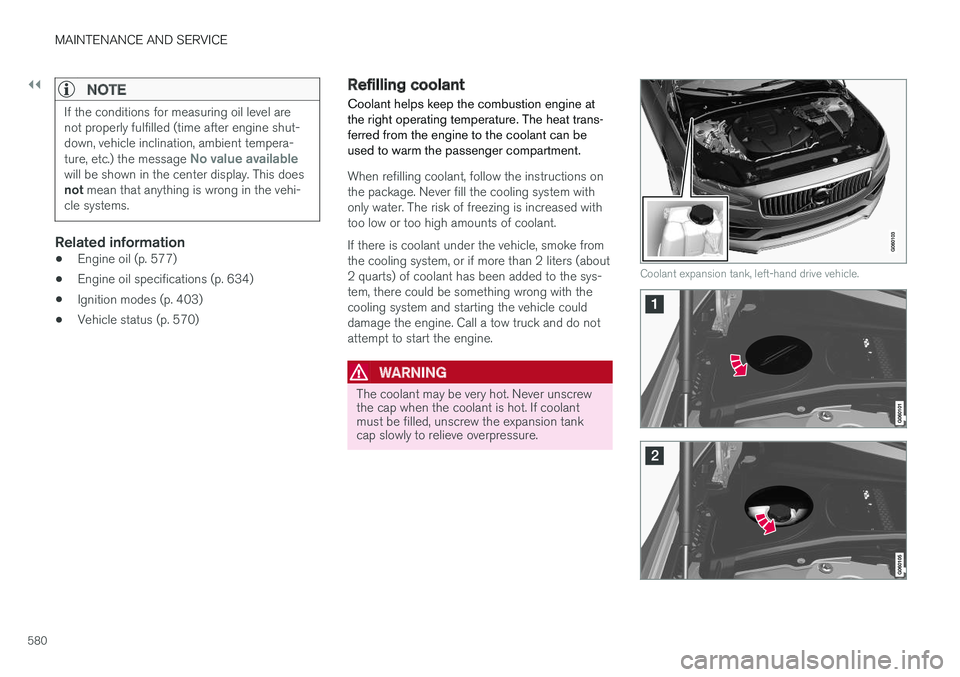
Coolant helps keep the combustion engine at the right operating temperature. The heat trans-ferred from the engine to the coolant can beused to warm the passenger compartment.
When refilling coolant, follow the instructions on the package. Never fill the cooling system withonly water. The risk of freezing is increased withtoo low or too high amounts of coolant. If there is coolant under the vehicle, smoke from the cooling system, or if more than 2 liters (about2 quarts) of coolant has been added to the sys-tem, there could be something wrong with thecooling system and starting the vehicle coulddamage the engine. Call a tow truck and do notattempt to start the engine.
WARNING
The coolant may be very hot. Never unscrew the cap when the coolant is hot. If coolantmust be filled, unscrew the expansion tankcap slowly to relieve overpressure.
Coolant expansion tank, left-hand drive vehicle.
Page 583 of 656
MAINTENANCE AND SERVICE
}}
581
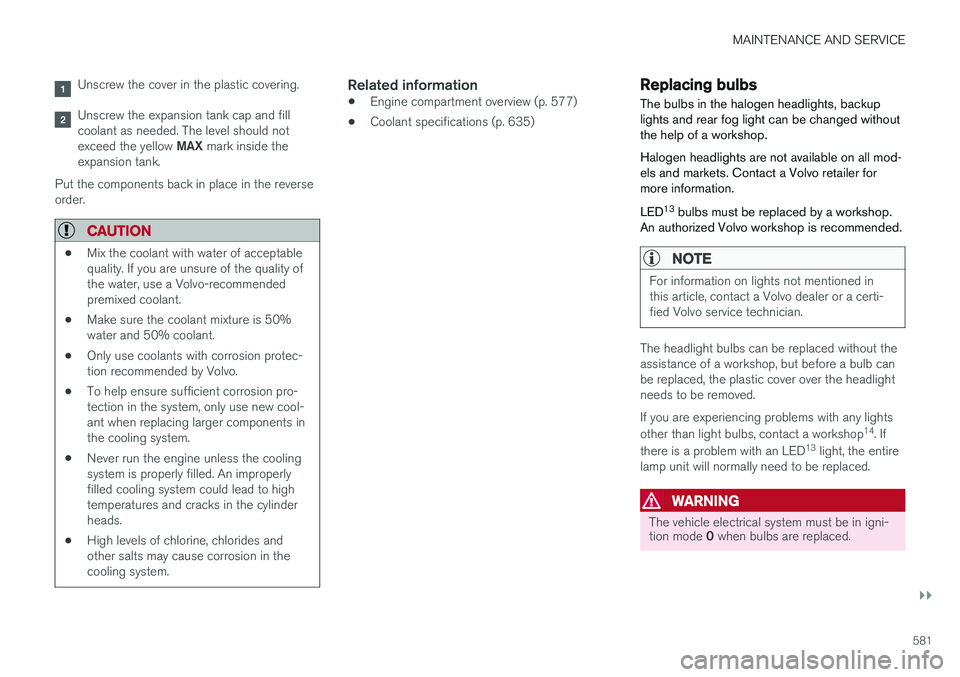
Unscrew the cover in the plastic covering.
Unscrew the expansion tank cap and fill coolant as needed. The level should not exceed the yellow MAX mark inside the
expansion tank.
Put the components back in place in the reverse order.
CAUTION
• Mix the coolant with water of acceptable quality. If you are unsure of the quality ofthe water, use a Volvo-recommendedpremixed coolant.
• Make sure the coolant mixture is 50%water and 50% coolant.
• Only use coolants with corrosion protec-tion recommended by Volvo.
• To help ensure sufficient corrosion pro-tection in the system, only use new cool-ant when replacing larger components inthe cooling system.
• Never run the engine unless the coolingsystem is properly filled. An improperlyfilled cooling system could lead to hightemperatures and cracks in the cylinderheads.
• High levels of chlorine, chlorides andother salts may cause corrosion in thecooling system.
Related information
•Engine compartment overview (p. 577)
• Coolant specifications (p. 635)
Replacing bulbs
The bulbs in the halogen headlights, backup lights and rear fog light can be changed withoutthe help of a workshop. Halogen headlights are not available on all mod- els and markets. Contact a Volvo retailer formore information. LED 13
bulbs must be replaced by a workshop.
An authorized Volvo workshop is recommended.
NOTE
For information on lights not mentioned in this article, contact a Volvo dealer or a certi-fied Volvo service technician.
The headlight bulbs can be replaced without the assistance of a workshop, but before a bulb canbe replaced, the plastic cover over the headlightneeds to be removed. If you are experiencing problems with any lights other than light bulbs, contact a workshop 14
. If
there is a problem with an LED 13
light, the entire
lamp unit will normally need to be replaced.
WARNING
The vehicle electrical system must be in igni- tion mode 0 when bulbs are replaced.
Page 592 of 656
||
MAINTENANCE AND SERVICE
590
CAUTION
Only a modern battery charger with controlled charge voltage should be used to charge thestarter battery and support battery. The rapidcharging function should not be used as thiscould damage the battery.
CAUTION
Failure to observe the following could cause the infotainment energy save mode to tempo-rarily stop working and/or a message in thedriver's display regarding the state of chargeof the starter battery may be temporarilyincorrect after an external starter battery orbattery charger has been connected:
• The negative battery terminal of the vehi- cle's starter battery must
never be used
to connect an external starter battery orbattery charger – only the vehicle's neg-
ative charging point should be used as
a grounding point.
NOTE
If the starter battery becomes discharged too many times, it will shorten its service life. The service life of the starter battery is affec- ted by several factors, such as driving condi-tions and climate. The starting capacity of thebattery reduces gradually over time. The bat-tery must therefore be recharged if the vehi-cle is not used or a long period of time or if itis only driven short distances. Severe cold fur-ther limits the starting capacity. To keep the starter battery in a good condi- tion, the vehicle should be driven at least15 minutes per week or the battery should beconnected to a battery charger with automatictrickle charging. A starter battery that is always kept fully charged has the maximum service life.
Location
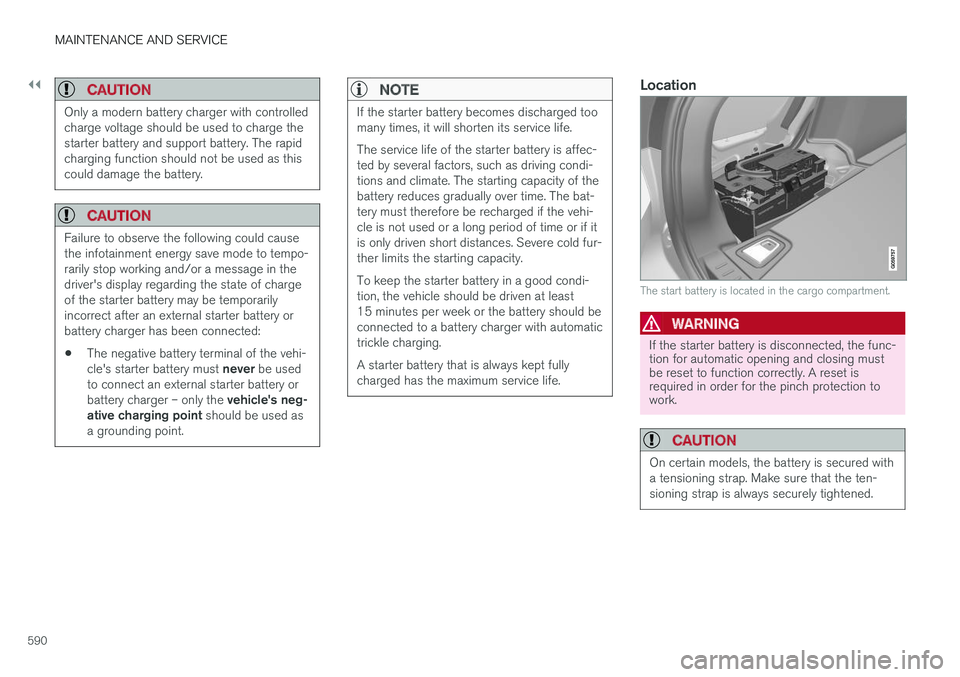
The start battery is located in the cargo compartment.
WARNING
If the starter battery is disconnected, the func- tion for automatic opening and closing mustbe reset to function correctly. A reset isrequired in order for the pinch protection towork.
CAUTION
On certain models, the battery is secured with a tensioning strap. Make sure that the ten-sioning strap is always securely tightened.
Page 596 of 656
||
MAINTENANCE AND SERVICE
594
Avoid smoking, open
flames, and/or sparks.
Risk of explosion.
Recycle properly.
NOTE
A used start battery or backup battery con- tains lead and must be recycled in an environ-mentally responsible manner.
Related information
• Start battery (p. 589)
• Support battery (p. 592)
Fuses and fuseboxes
All electrical functions and components are pro- tected by a number of fuses in order to protectthe vehicle's electrical system from damage byshort circuiting or overloading.
WARNING
Never use a foreign object or a fuse with a higher amperage than that specified toreplace a fuse. This could cause significantdamage to the electrical system and possiblylead to a fire.
If any electrical component or function is not responding, the component may have blown afuse due to temporary overload. If the same fuseblows repeatedly, there may be a problem withthe component. Volvo recommends contacting anauthorized Volvo workshop to have the compo-nent checked.
Location of fuseboxes
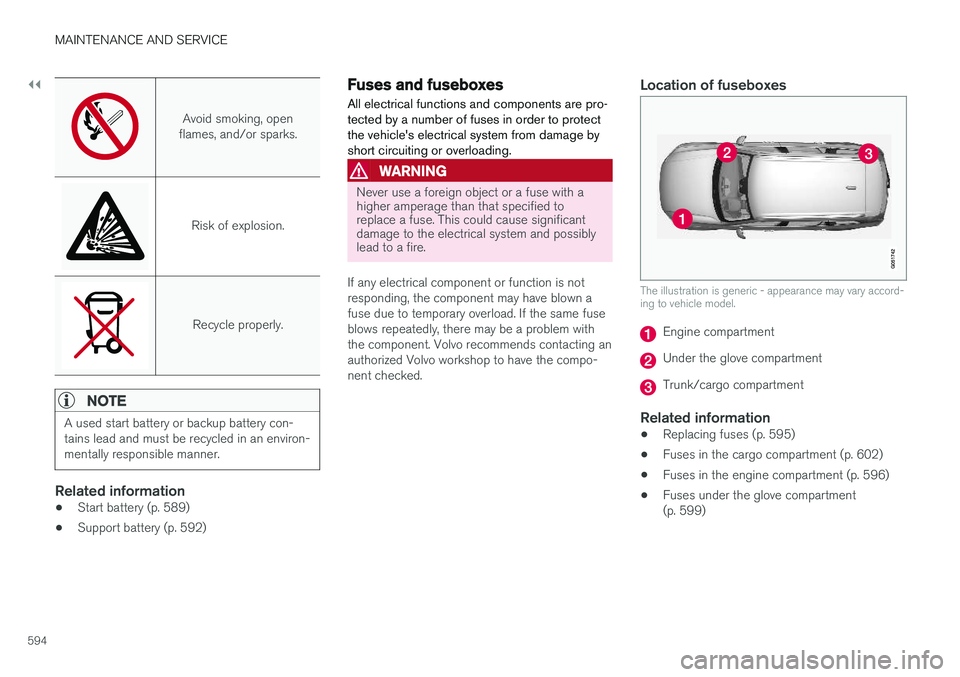
The illustration is generic - appearance may vary accord- ing to vehicle model.
Engine compartment
Under the glove compartment
Trunk/cargo compartment
Related information
• Replacing fuses (p. 595)
• Fuses in the cargo compartment (p. 602)
• Fuses in the engine compartment (p. 596)
• Fuses under the glove compartment (p. 599)
Page 619 of 656
MAINTENANCE AND SERVICE
617
Cleaning rims The vehicle should be washed as soon as it becomes dirty. This makes the vehicle easier toclean because dirt does not attach as strongly. Italso reduces the risk of scratches and keeps thevehicle looking new. Wash the vehicle in a carwash or garage with an oil separator. Use a carwashing detergent.
RimsOnly use rim cleaning products recommended by Volvo. Strong rim cleaning agents could damage the surface and stain the chromed aluminum rims.
Related information
•Cleaning the exterior (p. 611)
• Polishing and waxing (p. 612)
• Hand washing (p. 612)
• Automatic car washes (p. 614)
• High-pressure washing (p. 615)
• Cleaning exterior plastic, rubber and trimcomponents (p. 616)
• Cleaning rims (p. 617)
• Corrosion protection (p. 617)
Corrosion protection
Your vehicle is constructed with effective protec- tion against corrosion.
Corrosion protection for the body consists of modern metallic protective coatings on the sheetmetal, a high-quality painting process, corrosion-protected and minimized metal overlap, andshielding plastic components, abrasion protectionand supplemental rust inhibitor in exposed areas.In the chassis, exposed components of the wheelsuspension are made of corrosion-resistant castaluminum.
Inspection and maintenanceThe corrosion protection does not normallyrequire maintenance, but keeping the vehicleclean is always a good way to further reduce therisk of corrosion. The use of strong alkaline oracidic cleaning fluids should always be avoidedon shiny body components. Any stone chips inthe paint should be touched up as soon as theyare discovered.
Related information
• Cleaning the exterior (p. 611)
• Polishing and waxing (p. 612)
• Hand washing (p. 612)
• Automatic car washes (p. 614)
• High-pressure washing (p. 615)
• Cleaning the wiper blades (p. 615) •
Cleaning exterior plastic, rubber and trimcomponents (p. 616)
• Cleaning rims (p. 617)
Page 644 of 656
INDEX
642CZIP (Clean Zone Interior Package) 206
D
Data
recording 33 transferring between vehicle and work-
shop 568
Data sharing 504
Daytime running lights 156Decals location of 626
Defrosting 222
Detection of cyclist 333
Dimensions 629
Dipstick, electronic 578
Direction of rotation 520
Disengaging the shiftlock 417
Display lighting 166
Distance Alert 285, 286, 287 limitations 288
DivX ®
480
Door mirrors 173, 175 compass 450, 451
dimming 174
outer 173, 175
power folding 175
resetting 175
Driveline transmission 413
Drive mode 419 changing 421
Driver Alert Control 356 operation 357, 358
Driver Alert Control limitations 358
Driver performance 92, 93
Driver profile 139 edit 141
select 140
Driver support system 266 Driving cooling system 437
with a trailer 440
Driving economy 430
Driving through standing water 432 driving with a trailer towball load 632
towing capacity 632E
ECO climate 421
ECO mode 421
activate with function button 423
Economical driving 421, 430
Electrical outlet 550 use 552
Electrical system 589
Electric parking brake 407
Electronic immobilizer 246
emergency brake lights 163
Emission inspection readiness 566 Engine overheating 437
start 400
Start/Stop 424
turn off 402
Engine compartment coolant 580
engine oil 577
overview 577
Engine drag control 268
Engine oil 577 filling 578
filter 577
grade and volume 634