ESP VOLVO XC60 2009 Owner´s Manual
[x] Cancel search | Manufacturer: VOLVO, Model Year: 2009, Model line: XC60, Model: VOLVO XC60 2009Pages: 297, PDF Size: 21.16 MB
Page 213 of 297
05 During your trip
Loading05
}}
211
WARNING\b
Cover sharp edges on long loads to help
prevent injury to occupants. Secure the
load to help prevent shifting during sud-
den stops.
\b Always secure large and heavy objects
with a seat belt or cargo retaining
straps.
\b Always secure the load to help prevent
it from moving in the event of sudden
stops.
\b Switch off the engine, apply the parking
brake and put the gear selector in P
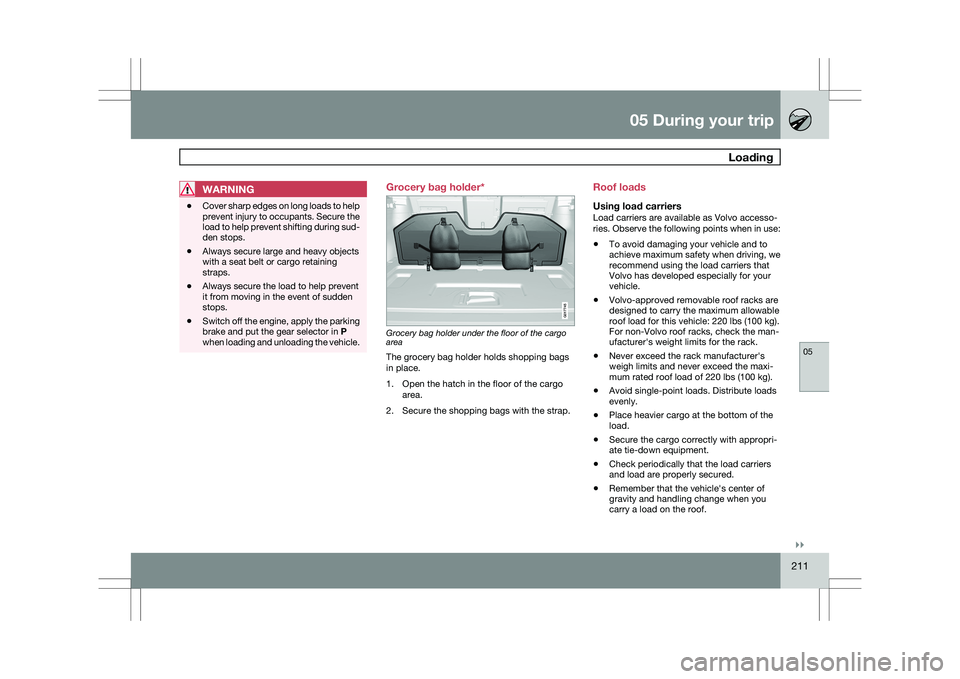
when loading and unloading the vehicle. Grocery bag holder*
Grocery bag holder under the floor of the cargo
area
The grocery bag holder holds shopping bags
in place.
1. Open the hatch in the floor of the cargo
area.
2. Secure the shopping bags with the strap. Roof loads
Using load carriersLoad carriers are available as Volvo accesso-
ries. Observe the following points when in use:
\b
To avoid damaging your vehicle and to
achieve maximum safety when driving, we
recommend using the load carriers that
Volvo has developed especially for your
vehicle.
\b Volvo-approved removable roof racks are
designed to carry the maximum allowable
roof load for this vehicle: 220 lbs (100 kg).
For non-Volvo roof racks, check the man-
ufacturer\fs weight limits for the rack.
\b Never exceed the rack manufacturer\fs
weigh limits and never exceed the maxi-
mum rated roof load of 220 lbs (100 kg).
\b Avoid single-point loads. Distribute loads
evenly.
\b Place heavier cargo at the bottom of the
load.
\b Secure the cargo correctly with appropri-
ate tie-down equipment.
\b Check periodically that the load carriers
and load are properly secured.
\b Remember that the vehicle\fs center of
gravity and handling change when you
carry a load on the roof. G017745
Page 230 of 297
06 Maintenance and specificationsEngine oil 06
228 Checking the engine oil
The oil level should be checked every time the
vehicle is refueled. This is especially important
during the period up to the first scheduled
maintenance service.
\b
See page 283 for oil specifications.
\b Refer to the Warranty and Service Records
Information booklet for information on the
oil change intervals.
Volvo recommends Castrol oil products.
CAUTION \b
Not checking the oil level regularly can
result in serious engine damage if the oil
level becomes too low.
\b Oil that is lower than the specified qual-
ity can damage the engine.
\b Volvo does not recommend the use of
oil additives.
\b Always add oil of the same type and
viscosity as already used.
\b Never fill oil above the
MAX mark. This
could cause an increase in oil consump-
tion.
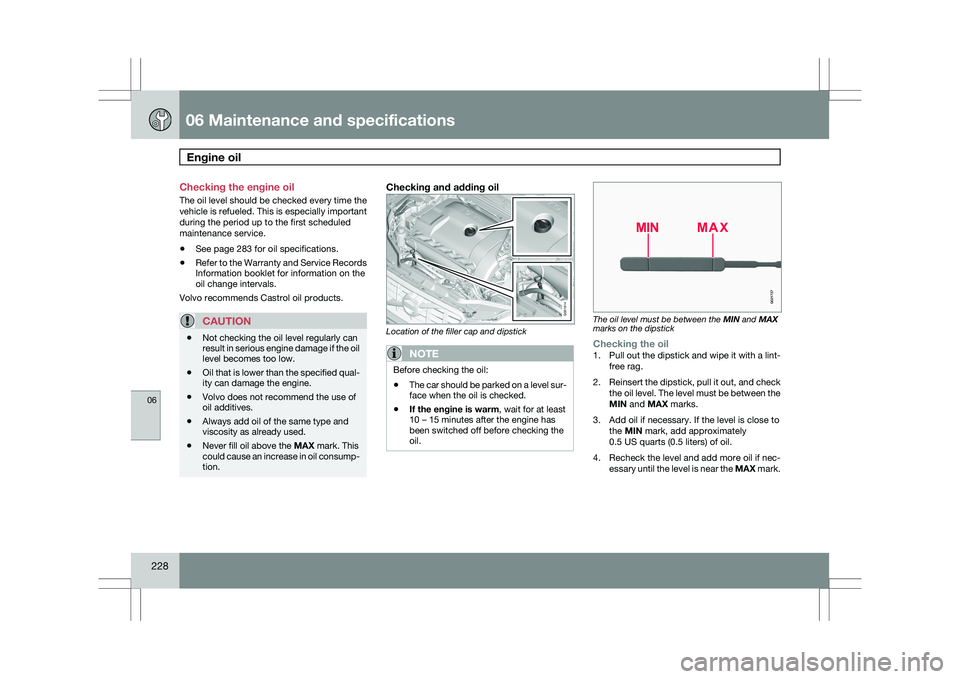
Checking and adding oil Location of the filler cap and dipstick
NOTE
Before checking the oil:
\b
The car should be parked on a level sur-
face when the oil is checked.
\b If the engine is warm, wait for at least
10 – 15 minutes after the engine has
been switched off before checking the
oil. The oil level must be between the MIN and MAX
marks on the dipstickChecking the oil1.
Pull out the dipstick and wipe it with a lint-
free rag.
2. Reinsert the dipstick, pull it out, and check
the oil level. The level must be between the
MIN and MAX marks.
3. Add oil if necessary. If the level is close to the MIN mark, add approximately
0.5 US quarts (0.5 liters) of oil.
4. Recheck the level and add more oil if nec-
essary until the level is near the MAX mark. G031914 G02173
7
Page 244 of 297
06 Maintenance and specificationsBattery 06
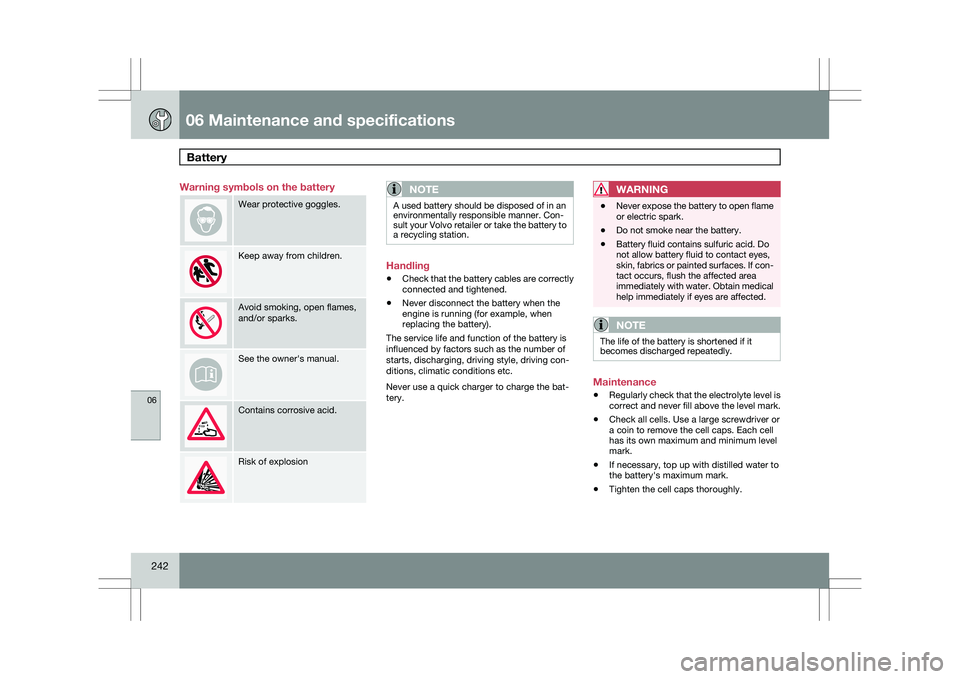
242 Warning symbols on the battery
Wear protective goggles.
Keep away from children.
Avoid smoking, open flames,
and/or sparks.
See the owner\fs manual.
Contains corrosive acid.
Risk of explosion
NOTE A used battery should be disposed of in an
environmentally responsible manner. Con-
sult your Volvo retailer or take the battery to
a recycling station.
Handling
\b
Check that the battery cables are correctly
connected and tightened.
\b Never disconnect the battery when the
engine is running (for example, when
replacing the battery).
The service life and function of the battery is
influenced by factors such as the number of
starts, discharging, driving style, driving con-
ditions, climatic conditions etc.
Never use a quick charger to charge the bat-
tery.WARNING \b
Never expose the battery to open flame
or electric spark.
\b Do not smoke near the battery.
\b Battery fluid contains sulfuric acid. Do
not allow battery fluid to contact eyes,
skin, fabrics or painted surfaces. If con-
tact occurs, flush the affected area
immediately with water. Obtain medical
help immediately if eyes are affected.
NOTE The life of the battery is shortened if it
becomes discharged repeatedly.
Maintenance
\b
Regularly check that the electrolyte level is
correct and never fill above the level mark.
\b Check all cells. Use a large screwdriver or
a coin to remove the cell caps. Each cell
has its own maximum and minimum level
mark.
\b If necessary, top up with distilled water to
the battery\fs maximum mark.
\b Tighten the cell caps thoroughly.
Page 256 of 297
06 Maintenance and specificationsWheels and tires 06
254 wheels to reduce the chance of oversteer
during hard braking.
\b Hitting curbs or potholes can damage the
tires and/or wheels permanently.
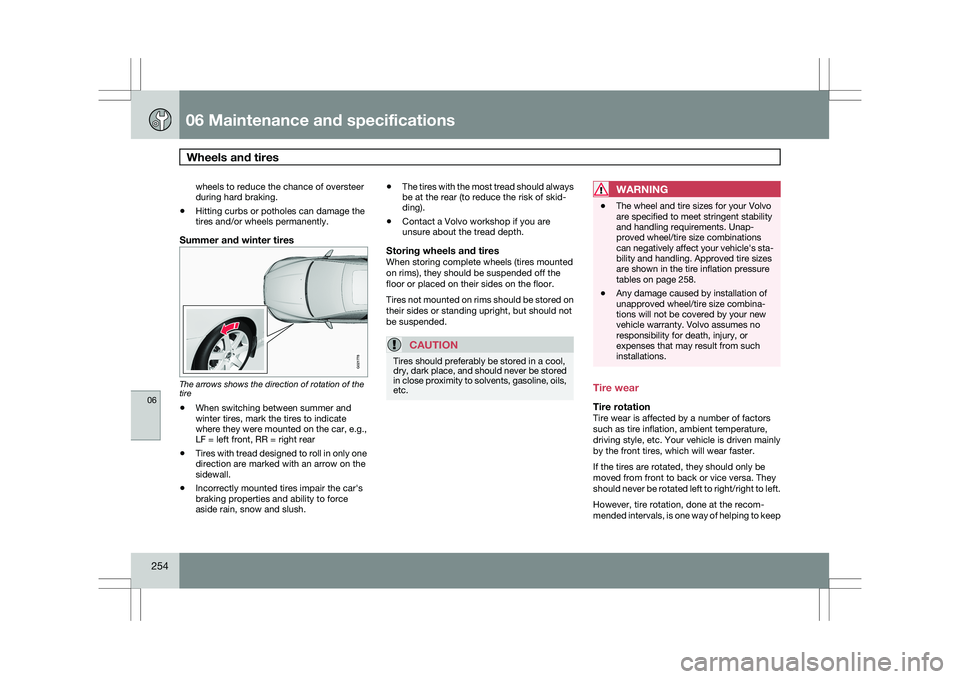
Summer and winter tires The arrows shows the direction of rotation of the
tire
\b
When switching between summer and
winter tires, mark the tires to indicate
where they were mounted on the car, e.g.,
LF = left front, RR = right rear
\b Tires with tread designed to roll in only one
direction are marked with an arrow on the
sidewall.
\b Incorrectly mounted tires impair the car\fs
braking properties and ability to force
aside rain, snow and slush. \b
The tires with the most tread should always
be at the rear (to reduce the risk of skid-
ding).
\b Contact a Volvo workshop if you are
unsure about the tread depth.Storing wheels and tiresWhen storing complete wheels (tires mounted
on rims), they should be suspended off the
floor or placed on their sides on the floor.
Tires not mounted on rims should be stored on
their sides or standing upright, but should not
be suspended.
CAUTION Tires should preferably be stored in a cool,
dry, dark place, and should never be stored
in close proximity to solvents, gasoline, oils,
etc.
WARNING \b
The wheel and tire sizes for your Volvo
are specified to meet stringent stability
and handling requirements. Unap-
proved wheel/tire size combinations
can negatively affect your vehicle\fs sta-
bility and handling. Approved tire sizes
are shown in the tire inflation pressure
tables on page 258.
\b Any damage caused by installation of
unapproved wheel/tire size combina-
tions will not be covered by your new
vehicle warranty. Volvo assumes no
responsibility for death, injury, or
expenses that may result from such
installations. Tire wear
Tire rotationTire wear is affected by a number of factors
such as tire inflation, ambient temperature,
driving style, etc. Your vehicle is driven mainly
by the front tires, which will wear faster.
If the tires are rotated, they should only be
moved from front to back or vice versa. They
should never be rotated left to right/right to left.
However, tire rotation, done at the recom-
mended intervals, is one way of helping to keep G021778
Page 258 of 297
06 Maintenance and specificationsWheels and tires 06
256
NOTE \b
The placards shown indicate inflation
pressure for the tires installed on the
vehicle at the factory only.
\b A certain amount of air seepage from
the tires occurs naturally and tire pres-
sure fluctuates with seasonal changes
in temperature. Always check tire pres-
sure regularly. \b
Use a tire gauge to check the tire inflation
pressure, including the spare, at least once
a month and before long trips. You are
strongly urged to buy a reliable tire pres-
sure gauge, as automatic service station
gauges may be inaccurate.
\b Use the recommended cold inflation pres-
sure for optimum tire performance and
wear.
\b Under-inflation or over-inflation may cause
uneven treadwear patterns.
NOTE A certain amount of air seepage from the
tires occurs naturally and tire pressure fluc-
tuates with seasonal changes in tempera-
ture. Always check tire pressure regularly.
WARNING \b
Under-inflation is the most common
cause of tire failure and may result in
severe tire cracking, tread separation,
or "blow-out," with unexpected loss of
vehicle control and increased risk of
injury.
\b Under-inflated tires reduce the load car-
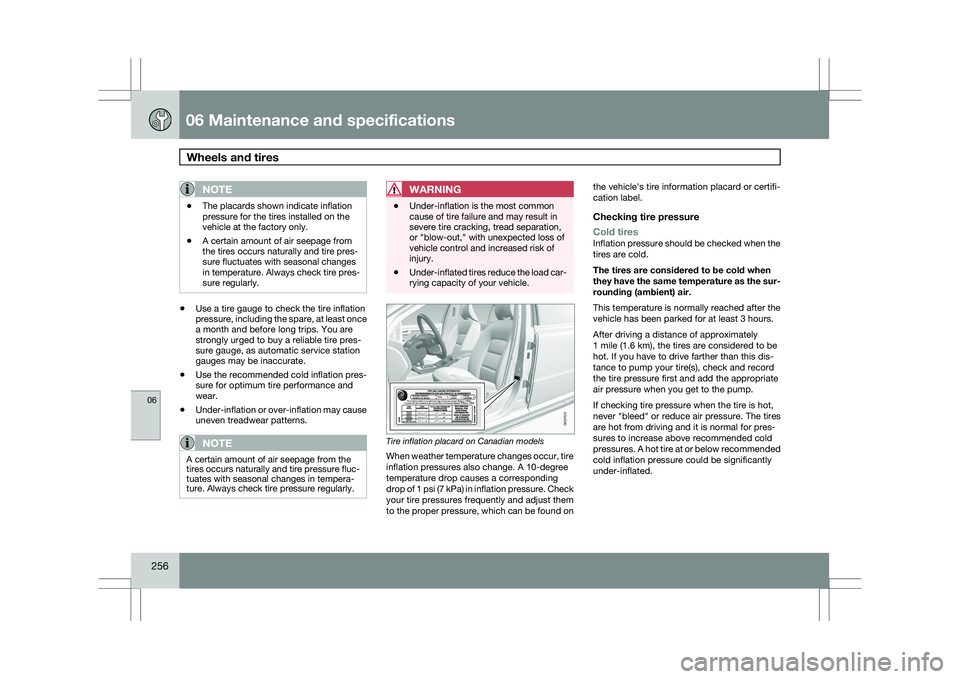
rying capacity of your vehicle. Tire inflation placard on Canadian models
When weather temperature changes occur, tire
inflation pressures also change. A 10-degree
temperature drop causes a corresponding
drop of 1 psi (7 kPa) in inflation pressure. Check
your tire pressures frequently and adjust them
to the proper pressure, which can be found onthe vehicle\fs tire information placard or certifi-
cation label.
Checking tire pressure
Cold tires
Inflation pressure should be checked when the
tires are cold.
The tires are considered to be cold when
they have the same temperature as the sur-
rounding (ambient) air.
This temperature is normally reached after the
vehicle has been parked for at least 3 hours.
After driving a distance of approximately
1 mile (1.6 km), the tires are considered to be
hot. If you have to drive farther than this dis-
tance to pump your tire(s), check and record
the tire pressure first and add the appropriate
air pressure when you get to the pump.
If checking tire pressure when the tire is hot,
never "bleed" or reduce air pressure. The tires
are hot from driving and it is normal for pres-
sures to increase above recommended cold
pressures. A hot tire at or below recommended
cold inflation pressure could be significantly
under-inflated. G032522
Page 266 of 297
06 Maintenance and specificationsWheels and tires 06
264 Temporary Spare
The spare tire in your vehicle is called a "Tem-
porary Spare".
Recommended tire pressure (see the placard
on the B-pillar or on the fuel filler door) should
be maintained irrespective of which position on
the vehicle the temporary spare tire is used on.
In the event of damage to this tire, a new one
can be purchased from your Volvo retailer.
WARNING
Current legislation prohibits the use of the
"Temporary Spare" tire other than as a tem-
porary replacement for a punctured tire. It
must be replaced as soon as possible by a
standard tire. Road holding and handling
may be affected with the "Temporary
Spare" in use. Do not exceed 50 mph
(80 km/h).
CAUTION
The vehicle must not be driven with wheels
of different dimensions or with a spare tire
other than the one that came with the vehi-
cle. The use of different size wheels can
seriously damage your car\fs transmission. Changing a wheel
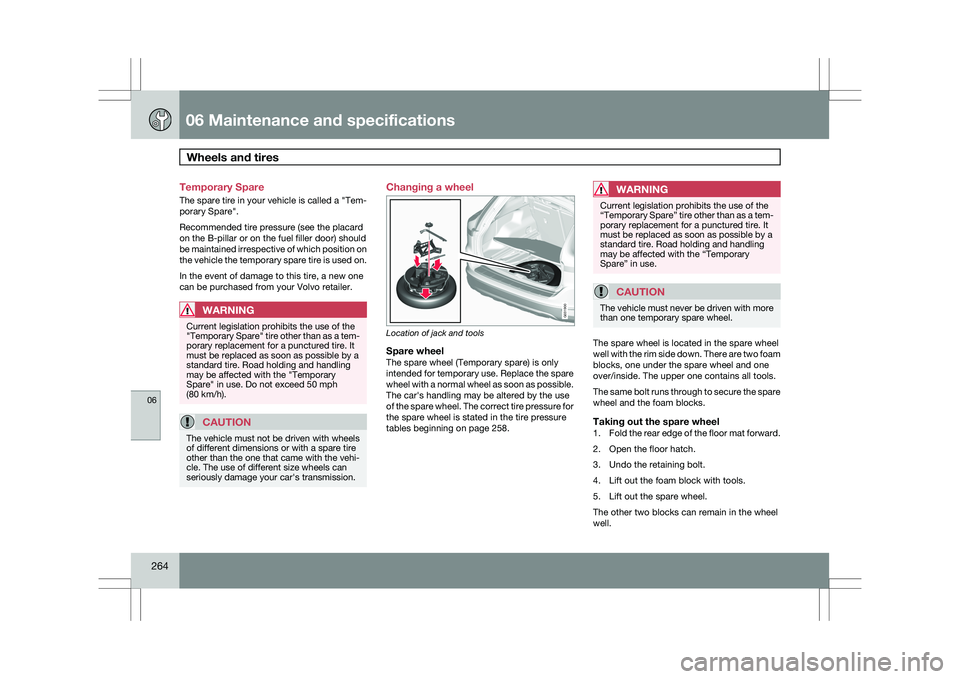
Location of jack and tools
Spare wheelThe spare wheel (Temporary spare) is only
intended for temporary use. Replace the spare
wheel with a normal wheel as soon as possible.
The car\fs handling may be altered by the use
of the spare wheel. The correct tire pressure for
the spare wheel is stated in the tire pressure
tables beginning on page 258.
WARNING Current legislation prohibits the use of the
“Temporary Spare” tire other than as a tem-
porary replacement for a punctured tire. It
must be replaced as soon as possible by a
standard tire. Road holding and handling
may be affected with the “Temporary
Spare” in use.
CAUTION
The vehicle must never be driven with more
than one temporary spare wheel.
The spare wheel is located in the spare wheel
well with the rim side down. There are two foam
blocks, one under the spare wheel and one
over/inside. The upper one contains all tools.
The same bolt runs through to secure the spare
wheel and the foam blocks.
Taking out the spare wheel1.
Fold the rear edge of the floor mat forward.
2. Open the floor hatch.
3. Undo the retaining bolt.
4. Lift out the foam block with tools.
5. Lift out the spare wheel.
The other two blocks can remain in the wheel
well. G031900
Page 274 of 297
06 Maintenance and specificationsWheels and tires 06
272 When low inflation pressure is detected, TPMS
will light up the tire pressure warning light
(
) (also referred to as a telltale) in the
instrument panel and will display one of the
following messages in the text window: LOW
TIRE PRESS. CHECK TIRES or VERY LOW
TIRE PRESSURE.
NOTE If a fault occurs in TPMS, the tire pressure
warning light will flash for approximately
1 minute and TIRE PRESS SYST
SERVICE REQUIRED will be displayed.
Each tire, including the spare (if provided),
should be checked monthly when cold and
inflated to the inflation pressure recommended
by the vehicle manufacturer on the vehicle
placard or tire inflation pressure label. (If your
vehicle has tires of a different size than the size
indicated on the vehicle placard or tire inflation
pressure label, you should determine the
proper tire inflation pressure for those tires.)
As an added safety feature, your vehicle has
been equipped with a tire pressure monitoring
system (TPMS) that illuminates a low tire pres-
sure telltale when one or more of your tires is
significantly under-inflated. Accordingly, when
the low tire pressure telltale illuminates, you
should stop and check your tires as soon as possible, and inflate them to the proper pres-
sure. Driving on a significantly under-inflated
tire causes the tire to overheat and can lead to
tire failure. Under-inflation also reduces fuel
efficiency and tire tread life, and may affect the
vehicle\fs handling and stopping ability.
Please note that the TPMS is not a substitute
for proper tire maintenance, and it is the driv-
er\fs responsibility to maintain correct tire pres-
sure, even if under-inflation has not reached
the level to trigger illumination of the TPMS low
tire pressure telltale.
Your vehicle has also been equipped with a
TPMS malfunction indicator to indicate when
the system is not operating properly. The
TPMS malfunction indicator is combined with
the low tire pressure telltale. When the system
detects a malfunction, the telltale will flash for
approximately one minute and then remain
continuously illuminated. This sequence will
continue upon subsequent vehicle start-ups as
long as the malfunction exists. When the mal-
function indicator is illuminated, the system
may not be able to detect or signal low tire
pressure as intended. TPMS malfunctions may
occur for a variety of reasons, including the
installation of replacement or alternate tires or
wheels on the vehicle that prevent the TPMS
from functioning properly. Always check the
TPMS malfunction telltale after replacing one
or more tires or wheels on your vehicle to
ensure that the replacement or alternate tires
and wheels allow the TPMS to continue to
function properly.
NOTE
TPMS indicates low tire pressure but does
not replace normal tire maintenance. For
information on correct tire pressure, please
refer to the Tire inflation pressure tables or
consult your Volvo retailer.
Erasing warning messagesWhen a low tire pressure warning message has
been displayed, and the tire pressure warning
light has come on:
1. Use a tire pressure gauge to check the
inflation pressure of all four tires.
2. Re-inflate the tire(s) to the correct pressure
(consult the tire pressure placard or the
tables beginning on page
258.
3. In certain cases, it may be necessary to drive the vehicle for several minutes at a
speed of 20 mph (30 km/h) or faster. This
will erase the warning text and the warning
light will go out.
Page 277 of 297
06 Maintenance and specifications
Vehicle care06
}}
275
fully. Solvents or stain removers should not be
used.
CAUTION
\b
Avoid waxing or polishing plastic or rub-
ber components
\b Polishing chromed strips can wear
away or damage the surface
\b Polishes containing abrasive sub-
stances should not be used
Automatic car wash
\b
We do NOT recommend washing your car
in an automatic wash during the first six
months (because the paint will not have
hardened sufficiently).
\b An automatic wash is a simple and quick
way to clean your car, but it is worth
remembering that it may not be as thor-
ough as when you yourself go over the car
with sponge and water. Keeping the under-
body clean is most important, especially in
the winter. Some automatic washers do
not have facilities for washing the under-
body.
CAUTION \b
Before driving into an automatic car
wash, turn off the optional rain sensor
to avoid damaging the windshield wip-
ers.
\b Make sure that side view mirrors, auxil-
iary lamps, etc, are secure, and that any
antenna(s) are retracted or removed.
Otherwise there is risk of the machine
dislodging them.
\b Chromed wheels: Clean chrome-
plated wheels using the same deter-
gents used for the body of the vehicle.
Aggressive wheel-cleaning agents can
permanently stain chrome-plated
wheels.
WARNING \b
When the vehicle is driven immediately
after being washed, apply the brakes,
including the parking brake, several
times in order to remove any moisture
from the brake linings.
\b Engine cleaning agents should not be
used when the engine is warm. This
constitutes a fire risk.
Exterior lightingCondensation may form temporarily on the
inside of the lenses of exterior lights such as headlights, fog lights, or taillights. This is nor-
mal and the lights are designed to withstand
moisture. Normally, condensation will dissi-
pate after the lights have been on for a short
time.
Polishing and waxing
\b
Normally, polishing is not required during
the first year after delivery, however, wax-
ing may be beneficial.
\b Before applying polish or wax the vehicle
must be washed and dried. Tar spots can
be removed with kerosene or tar remover.
Difficult spots may require a fine rubbing
compound.
\b After polishing use liquid or paste wax.
\b Several commercially available products
contain both polish and wax.
\b Waxing alone does not substitute for pol-
ishing a dull surface.
\b A wide range of polymer-based waxes can
be purchased today. These waxes are easy
to use and produce a long-lasting, high-
gloss finish that protects the bodywork
against oxidation, road dirt and fading.
\b Do not polish or wax your vehicle in direct
sunlight (the surface of the vehicle should
not be warmer than 113 °F (45 °C).
Page 279 of 297
06 Maintenance and specifications
Vehicle care06
}}
277
CAUTION\b
Under no circumstances should gaso-
line, naphtha or similar cleaning agents
be used on the plastic or the leather
since these can cause damage.
\b Take extra care when removing stains
such as ink or lipstick since the coloring
can spread.
\b Use solvents sparingly. Too much sol-
vent can damage the seat padding.
\b Start from the outside of the stain and
work toward the center.
\b Sharp objects (e.g. pencils or pens in a
pocket) or Velcro fasteners on clothing
may damage the textile upholstery.
\b Clothing that is not colorfast, such as
new jeans or suede garments, may stain
the upholstery.
Cleaning the seat beltsClean only with lukewarm water and a mild
soap solution.
Cleaning floor matsThe floor mats should be vacuumed or brushed
clean regularly, especially during winter when
they should be taken out for drying. Spots on
textile mats can be removed with a mild deter- gent. For best protection in winter, Volvo rec-
ommends the use of Volvo rubber floor mats.
Consult your Volvo retailer.
Spots on interior plastic, metal, or wood
surfaces
Cleaning interior plastic components should
be done with a cleaning agent specially
designed for this purpose. Consult your Volvo
retailer.
Touching up paintwork
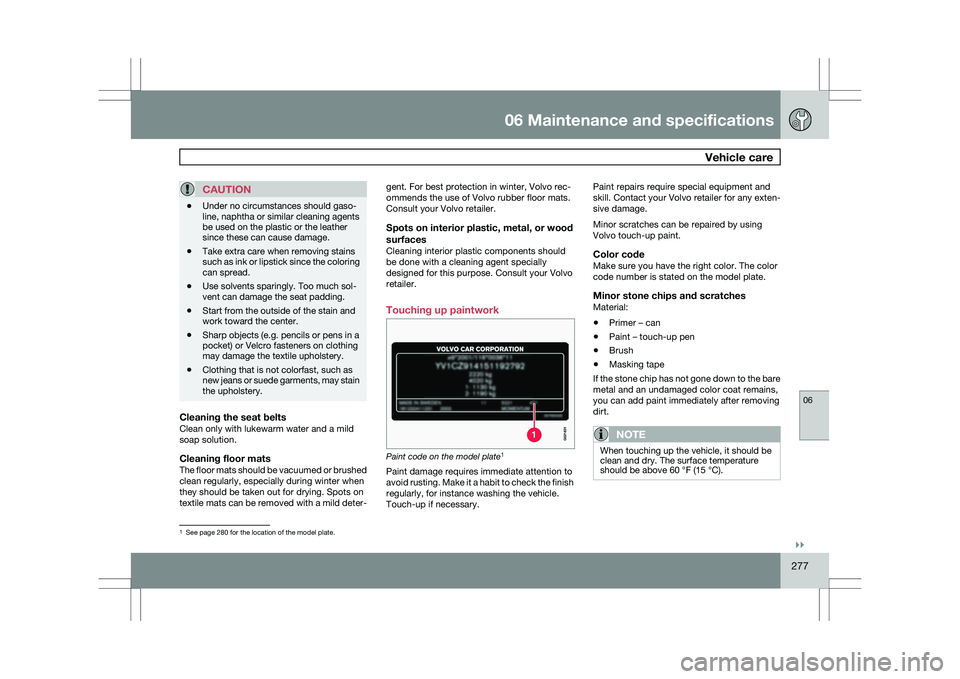
Paint code on the model plate
1
Paint damage requires immediate attention to
avoid rusting. Make it a habit to check the finish
regularly, for instance washing the vehicle.
Touch-up if necessary. Paint repairs require special equipment and
skill. Contact your Volvo retailer for any exten-
sive damage.
Minor scratches can be repaired by using
Volvo touch-up paint.Color codeMake sure you have the right color. The color
code number is stated on the model plate.
Minor stone chips and scratchesMaterial:
\b
Primer – can
\b Paint – touch-up pen
\b Brush
\b Masking tape
If the stone chip has not gone down to the bare
metal and an undamaged color coat remains,
you can add paint immediately after removing
dirt.
NOTE When touching up the vehicle, it should be
clean and dry. The surface temperature
should be above 60 °F (15 °C).
1
See page 280 for the location of the model plate.
Page 282 of 297
06 Maintenance and specificationsLabel information 06
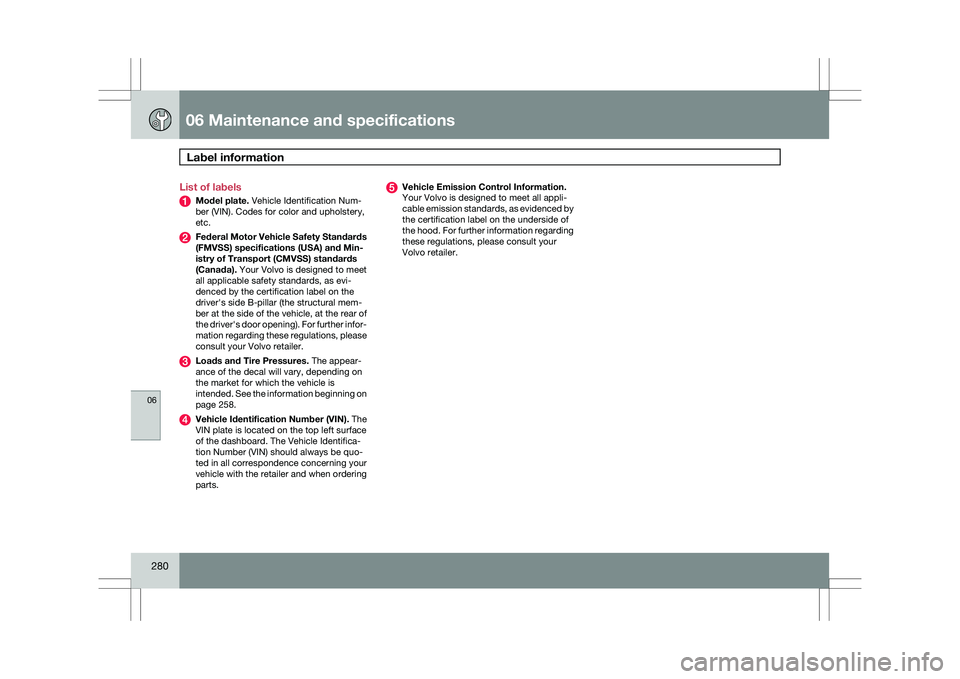
280 List of labels
Model plate. Vehicle Identification Num-
ber (VIN). Codes for color and upholstery,
etc.
Federal Motor Vehicle Safety Standards
(FMVSS) specifications (USA) and Min-
istry of Transport (CMVSS) standards
(Canada). Your Volvo is designed to meet
all applicable safety standards, as evi-
denced by the certification label on the
driver\fs side B-pillar (the structural mem-
ber at the side of the vehicle, at the rear of
the driver\fs door opening). For further infor-
mation regarding these regulations, please
consult your Volvo retailer.
Loads and Tire Pressures. The appear-
ance of the decal will vary, depending on
the market for which the vehicle is
intended. See the information beginning
on
page 258. Vehicle Identification Number (VIN). The
VIN plate is located on the top left surface
of the dashboard. The Vehicle Identifica-
tion Number (VIN) should always be quo-
ted in all correspondence concerning your
vehicle with the retailer and when ordering
parts. Vehicle Emission Control Information.
Your Volvo is designed to meet all appli-
cable emission standards, as evidenced by
the certification label on the underside of
the hood. For further information regarding
these regulations, please consult your
Volvo retailer.