cooling VOLVO XC60 2009 Owner´s Manual
[x] Cancel search | Manufacturer: VOLVO, Model Year: 2009, Model line: XC60, Model: VOLVO XC60 2009Pages: 297, PDF Size: 21.16 MB
Page 114 of 297
03 Your driving environmentBrakes 03
112 Brake system
The brake system is a hydraulic system con-
sisting of two separate brake circuits. If a prob-
lem should occur in one of these circuits, it is
still possible to stop the vehicle with the other
brake circuit.
If the brake pedal must be depressed farther
than normal and requires greater foot pressure,
the stopping distance will be longer.
A warning light in the instrument panel will light
up to warn the driver that a fault has occurred.
If this light comes on while driving or braking,
stop immediately and check the brake fluid
level in the reservoir.
NOTE
Press the brake pedal hard and maintain
pressure on the pedal – do not pump the
brakes.
WARNING
If the fluid level is below the MIN mark in the
reservoir or if a brake system message is
shown in the information display:
DO NOT
DRIVE. Have the vehicle towed to a trained
and qualified Volvo service technician and
have the brake system inspected.
Power brakes function only when the
engine is running
The power brakes utilize vacuum pressure
which is only created when the engine is run-
ning. Never let the vehicle roll to a stop with the
engine switched off.
If the power brakes are not working, the brake
pedal must be pressed approximately five
times harder than usual to make up for the lack
of power assistance. This can happen for
example when towing your vehicle or if the
engine is switched off when the vehicle is roll-
ing. The brake pedal feels harder than usual.
Water on brake discs and brake pads
affects braking
Driving in rain and slush or passing through an
automatic car wash can cause water to collect
on the brake discs and pads. This will cause a
delay in braking effect when the pedal is
depressed. To avoid such a delay when the
brakes are needed, depress the pedal occa-
sionally when driving through rain, slush, etc.
This will remove the water from the brakes.
Check that brake application feels normal. This
should also be done after washing or starting
in very damp or cold weather.
Severe strain on the brake systemThe brakes will be subject to severe strain
when driving in mountains or hilly areas, or
when towing a trailer. Vehicle speed is usually slower, which means that the cooling of the
brakes is less efficient than when driving on
level roads. To reduce the strain on the brakes,
shift into a lower gear and let the engine help
with the braking. Do not forget that if you are
towing a trailer, the brakes will be subjected to
a greater than normal load.
Anti-lock braking systemThe Anti-lock Braking System (ABS) helps to
improve vehicle control (stopping and steering)
during severe braking conditions by limiting
brake lockup. When the system "senses"
impending lockup, braking pressure is auto-
matically modulated in order to help prevent
lockup that could lead to a skid.
The system performs a brief self-diagnostic
test when the engine has been started and
driver releases the brake pedal. Another auto-
matic test may be performed when the vehicle
first reaches a speed of approximately 25 mph
(40 km/h
). The brake pedal will pulsate several
times and a sound may be audible from the
ABS control module. This is normal.
Cleaning the brake discsCoatings of dirt and water on the brake discs
may result in delayed brake function. This delay
is minimized by cleaning the brake linings.
Cleaning the brake pads is advisable in wet
weather, prior to long-term parking, and after
the vehicle has been washed. Do this by brak-
Page 131 of 297
04 Comfort and driving pleasure
Climate system04
}}
* Option/accessory, for more information, see Introduction. 129
Heated rear seats*Heat control for the outboard seating positions
takes place in the same way as for the front
seat.
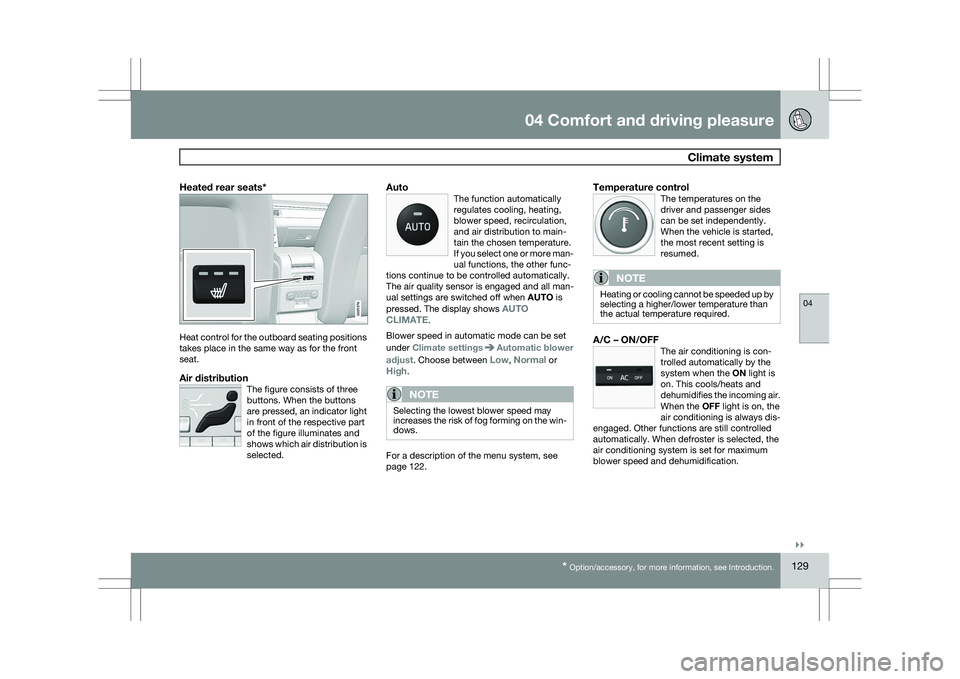
Air distributionThe figure consists of three
buttons. When the buttons
are pressed, an indicator light
in front of the respective part
of the figure illuminates and
shows which air distribution is
selected.
AutoThe function automatically
regulates cooling, heating,
blower speed, recirculation,
and air distribution to main-
tain the chosen temperature.
If you select one or more man-
ual functions, the other func-
tions continue to be controlled automatically.
The air quality sensor is engaged and all man-
ual settings are switched off when AUTO is
pressed. The display shows AUTO
CLIMATE.
Blower speed in automatic mode can be set
under Climate settings Automatic blower
adjust. Choose between Low, Normal or
High.
NOTE Selecting the lowest blower speed may
increases the risk of fog forming on the win-
dows.
For a description of the menu system, see
page 122.
Temperature controlThe temperatures on the
driver and passenger sides
can be set independently.
When the vehicle is started,
the most recent setting is
resumed.
NOTE Heating or cooling cannot be speeded up by
selecting a higher/lower temperature than
the actual temperature required.
A/C – ON/OFFThe air conditioning is con-
trolled automatically by the
system when the ON light is
on. This cools/heats and
dehumidifies the incoming air.
When the OFF light is on, the
air conditioning is always dis-
engaged. Other functions are still controlled
automatically. When defroster is selected, the
air conditioning system is set for maximum
blower speed and dehumidification. G021376
Page 133 of 297
04 Comfort and driving pleasure
Climate system04
}}
131
\b
The left orange light comes on – the air
quality sensor is disengaged.
\b The center green light comes on – recircu-
lation not engaged, providing it is not
required for cooling in hot weather.
\b The right orange light comes on – recircu-
lation is engaged.
NOTE \b
The air quality sensor should always be
engaged in order to obtain the best air
in the passenger compartment.
\b Recirculation is limited in cold weather
to avoid fogging. \b
If the insides of the windows start fog-
ging, disengage the air quality sensor.
Use the defroster function to increase
airflow to the front, side, and rear win-
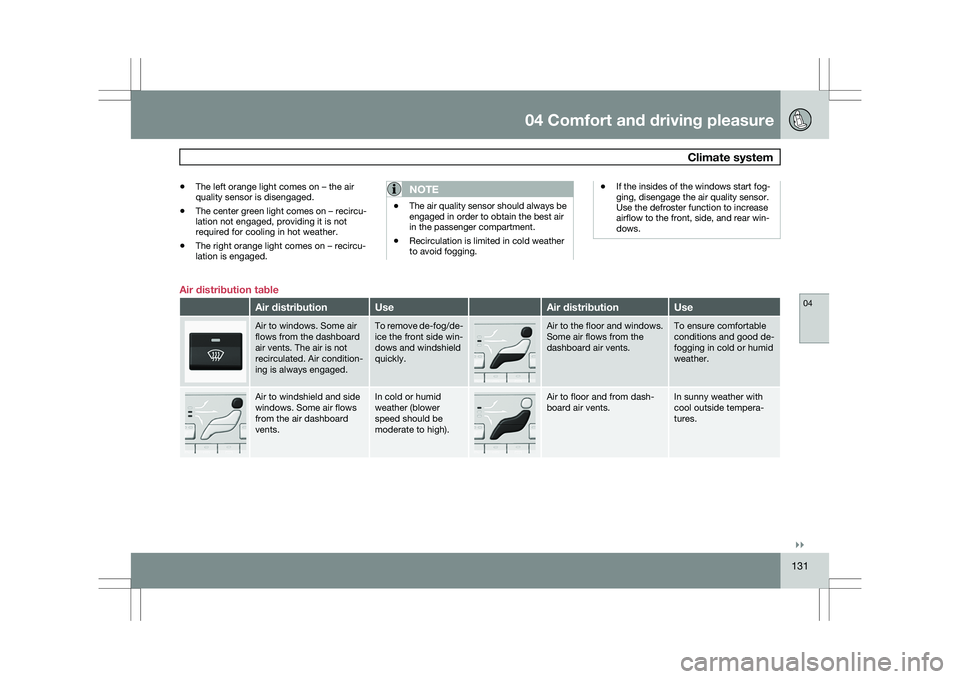
dows. Air distribution table
Air distribution Use Air distribution Use
Air to windows. Some air
flows from the dashboard
air vents. The air is not
recirculated. Air condition-
ing is always engaged. To remove de-fog/de-
ice the front side win-
dows and windshield
quickly. Air to the floor and windows.
Some air flows from the
dashboard air vents. To ensure comfortable
conditions and good de-
fogging in cold or humid
weather.
Air to windshield and side
windows. Some air flows
from the air dashboard
vents. In cold or humid
weather (blower
speed should be
moderate to high). Air to floor and from dash-
board air vents. In sunny weather with
cool outside tempera-
tures.
Page 134 of 297
04 Comfort and driving pleasureClimate system 04
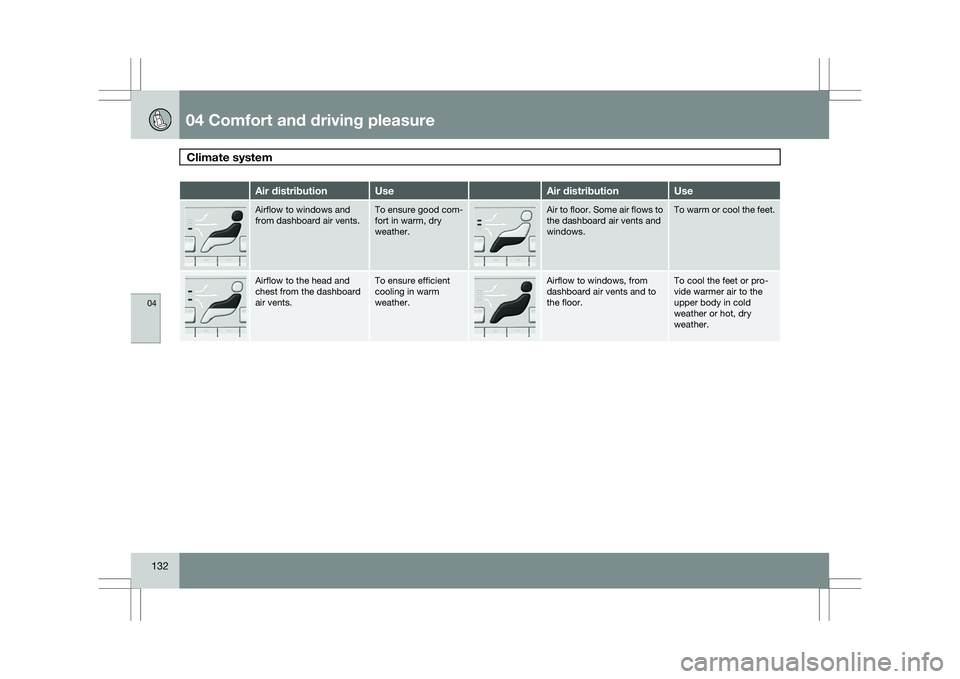
132 Air distribution Use Air distribution Use
Airflow to windows and
from dashboard air vents. To ensure good com-
fort in warm, dry
weather. Air to floor. Some air flows to
the dashboard air vents and
windows. To warm or cool the feet.
Airflow to the head and
chest from the dashboard
air vents. To ensure efficient
cooling in warm
weather. Airflow to windows, from
dashboard air vents and to
the floor. To cool the feet or pro-
vide warmer air to the
upper body in cold
weather or hot, dry
weather.
Page 205 of 297
05 During your trip
Driving recommendations05
}}
203
Driving through water
\b
The vehicle can be driven through water up
to a depth of approximately 10 in. (25 cm),
at a maximum speed of 6 mph (10 km/h).
\b Take particular care when driving through
flowing water.
\b Clean the electrical connections for trailer
wiring after driving in mud or water.
\b When driving through water, maintain low
speed and do not stop in the water.
WARNING After driving through water, press lightly on
the brake pedal to ensure that the brakes
are functioning normally. Water or mud can
make the brake linings slippery, resulting in
delayed braking effect.
CAUTION \b
Engine damage will occur if water is
drawn into the air cleaner.
\b If the vehicle is driven through water
deeper than 10 in (25 cm), water may
enter the differential and the transmis-
sion. This reduces the oil\fs lubricating
capacity and may shorten the service
life of these components.
\b Do not allow the vehicle to stand in
water up to the door sills longer than
absolutely necessary. This could result
in electrical malfunctions.
\b If the engine has been stopped while the
vehicle is in water, do not attempt to
restart it. Have the vehicle towed out of
the water.
Engine and cooling systemUnder special conditions, for example when
driving in hilly terrain, extreme heat or with
heavy loads, there is a risk that the engine and
cooling system will overheat. Proceed as fol-
lows to avoid overheating the engine.
\b
Maintain a low speed when driving with a
trailer up long, steep hills.
\b Do not turn the engine off immediately
when stopping after a hard drive.
WARNING The cooling fan may start or continue to
operate (for up to 6 minutes) after the engine
has been switched off.
\b
Remove any auxiliary lights from in front of
the grille when driving in hot weather con-
ditions.
\b Do not exceed engine speeds of 4500 rpm
if driving with a trailer in hilly terrain. The oil
temperature could become too high.
Conserving electrical currentKeep the following in mind to help minimize
battery drain:
\bWhen the engine is not running, avoid
using ignition mode
II. Many electrical sys-
tems (the audio system, the optional navi-
gation system, power windows, etc) will
function in ignition modes 0 and I. These
modes reduce drain on the battery.
\b Please keep in mind that using systems,
accessories, etc., that consume a great
deal of current when the engine is not run-
ning could result in the battery being com-
pletely drained.
\b The optional 12 volt socket in the cargo
area provides electrical current even with
the ignition switched off, which drains the
battery.
Page 209 of 297
05 During your trip
Refueling05
}}
207
Octane rating
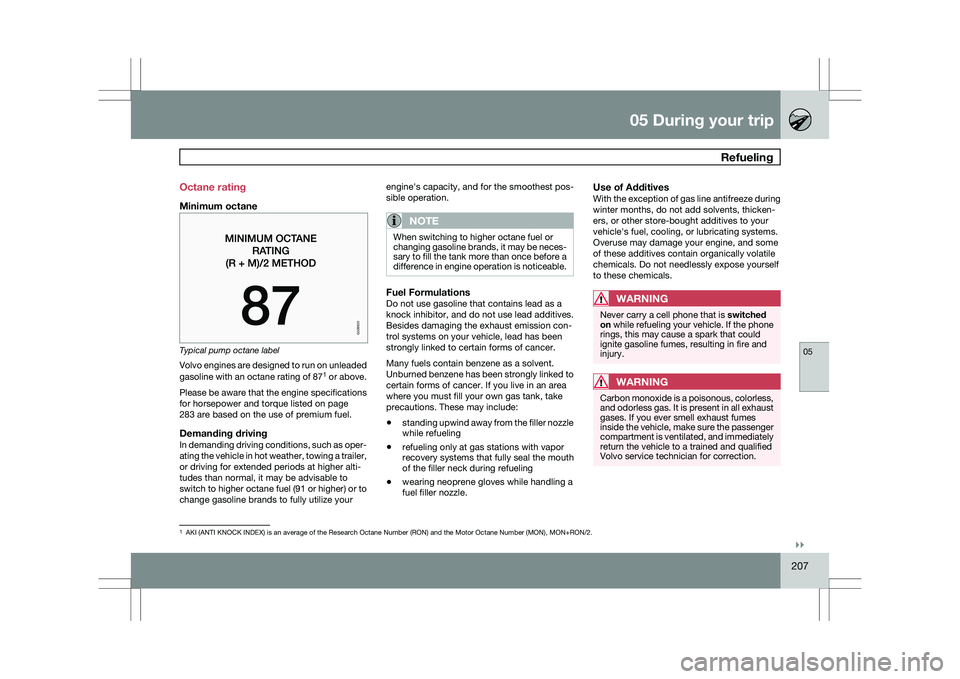
Minimum octane
Typical pump octane label
Volvo engines are designed to run on unleaded
gasoline with an octane rating of 87
1
or above.
Please be aware that the engine specifications
for horsepower and torque listed on page
283 are based on the use of premium fuel.
Demanding drivingIn demanding driving conditions, such as oper-
ating the vehicle in hot weather, towing a trailer,
or driving for extended periods at higher alti-
tudes than normal, it may be advisable to
switch to higher octane fuel (91 or higher) or to
change gasoline brands to fully utilize your engine\fs capacity, and for the smoothest pos-
sible operation.
NOTE When switching to higher octane fuel or
changing gasoline brands, it may be neces-
sary to fill the tank more than once before a
difference in engine operation is noticeable.
Fuel FormulationsDo not use gasoline that contains lead as a
knock inhibitor, and do not use lead additives.
Besides damaging the exhaust emission con-
trol systems on your vehicle, lead has been
strongly linked to certain forms of cancer.
Many fuels contain benzene as a solvent.
Unburned benzene has been strongly linked to
certain forms of cancer. If you live in an area
where you must fill your own gas tank, take
precautions. These may include:
\b
standing upwind away from the filler nozzle
while refueling
\b refueling only at gas stations with vapor
recovery systems that fully seal the mouth
of the filler neck during refueling
\b wearing neoprene gloves while handling a
fuel filler nozzle.
Use of AdditivesWith the exception of gas line antifreeze during
winter months, do not add solvents, thicken-
ers, or other store-bought additives to your
vehicle\fs fuel, cooling, or lubricating systems.
Overuse may damage your engine, and some
of these additives contain organically volatile
chemicals. Do not needlessly expose yourself
to these chemicals.
WARNING Never carry a cell phone that is
switched
on while refueling your vehicle. If the phone
rings, this may cause a spark that could
ignite gasoline fumes, resulting in fire and
injury.
WARNING Carbon monoxide is a poisonous, colorless,
and odorless gas. It is present in all exhaust
gases. If you ever smell exhaust fumes
inside the vehicle, make sure the passenger
compartment is ventilated, and immediately
return the vehicle to a trained and qualified
Volvo service technician for correction.
1
AKI (ANTI KNOCK INDEX) is an average of the Research Octane Number (R\
ON) and the Motor Octane Number (MON), MON+RON/2.
G028920
Page 229 of 297
06 Maintenance and specifications
Hood and engine compartment06
227
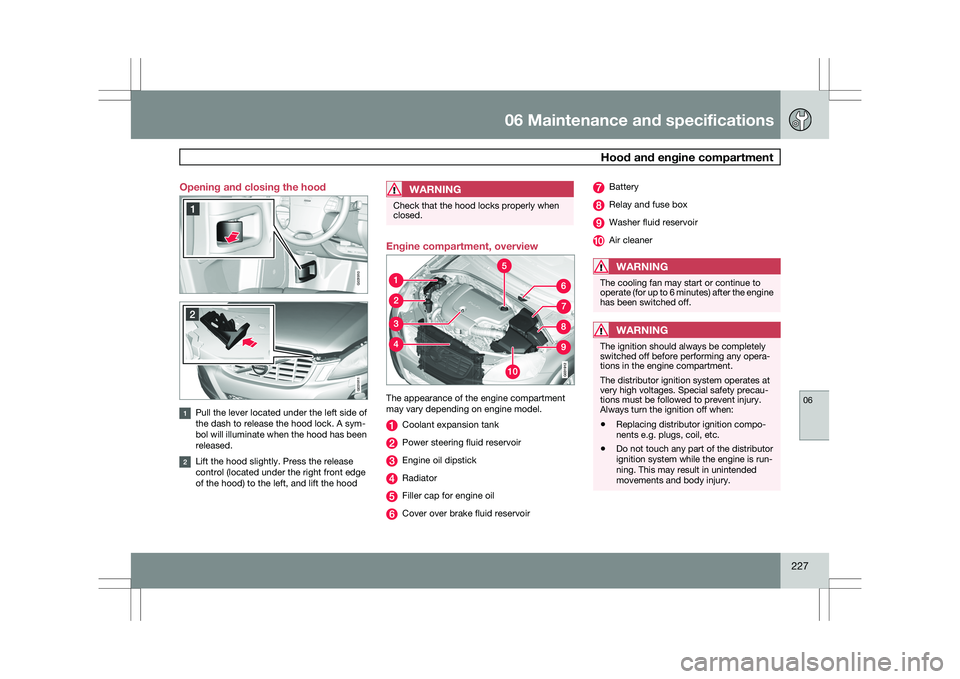
Opening and closing the hood
Pull the lever located under the left side of
the dash to release the hood lock. A sym-
bol will illuminate when the hood has been
released.
Lift the hood slightly. Press the release
control (located under the right front edge
of the hood) to the left, and lift the hood
WARNING Check that the hood locks properly when
closed.
Engine compartment, overview
The appearance of the engine compartment
may vary depending on engine model.
Coolant expansion tank
Power steering fluid reservoir
Engine oil dipstick
Radiator
Filler cap for engine oil
Cover over brake fluid reservoir Battery
Relay and fuse box
Washer fluid reservoir
Air cleaner
WARNING
The cooling fan may start or continue to
operate (for up to 6 minutes) after the engine
has been switched off.
WARNING
The ignition should always be completely
switched off before performing any opera-
tions in the engine compartment.
The distributor ignition system operates at
very high voltages. Special safety precau-
tions must be followed to prevent injury.
Always turn the ignition off when:
\b
Replacing distributor ignition compo-
nents e.g. plugs, coil, etc.
\b Do not touch any part of the distributor
ignition system while the engine is run-
ning. This may result in unintended
movements and body injury. G031910 G031911
Page 232 of 297
06 Maintenance and specificationsFluids 06
230 Coolant
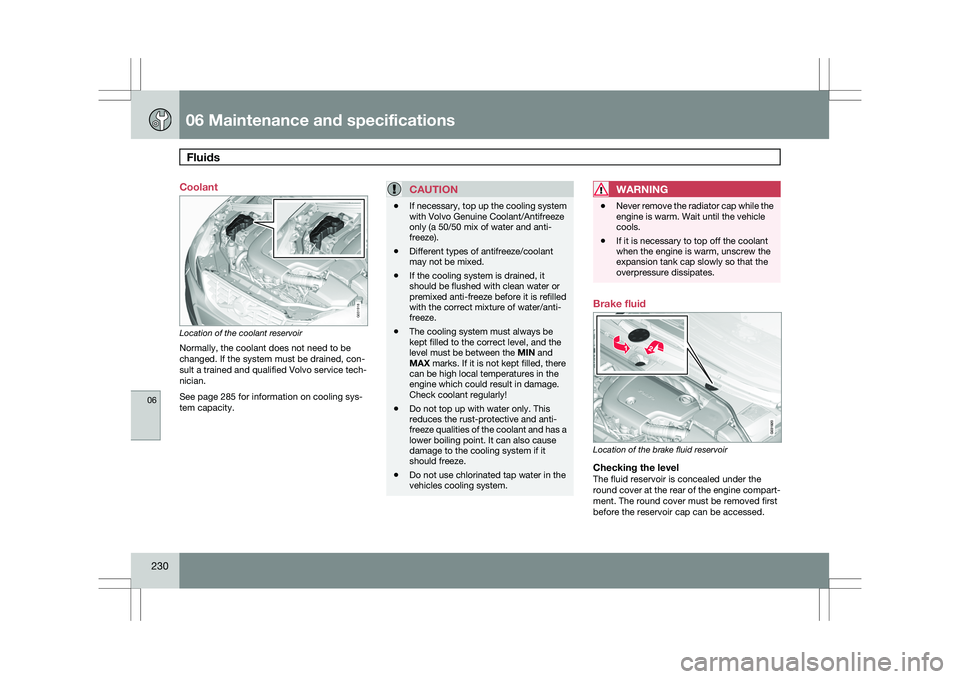
Location of the coolant reservoir
Normally, the coolant does not need to be
changed. If the system must be drained, con-
sult a trained and qualified Volvo service tech-
nician.
See page 285 for information on cooling sys-
tem capacity.
CAUTION \b
If necessary, top up the cooling system
with Volvo Genuine Coolant/Antifreeze
only (a 50/50 mix of water and anti-
freeze).
\b Different types of antifreeze/coolant
may not be mixed.
\b If the cooling system is drained, it
should be flushed with clean water or
premixed anti-freeze before it is refilled
with the correct mixture of water/anti-
freeze.
\b The cooling system must always be
kept filled to the correct level, and the
level must be between the MIN and
MAX marks. If it is not kept filled, there
can be high local temperatures in the
engine which could result in damage.
Check coolant regularly!
\b Do not top up with water only. This
reduces the rust-protective and anti-
freeze qualities of the coolant and has a
lower boiling point. It can also cause
damage to the cooling system if it
should freeze.
\b Do not use chlorinated tap water in the
vehicles cooling system.WARNING \b
Never remove the radiator cap while the
engine is warm. Wait until the vehicle
cools.
\b If it is necessary to top off the coolant
when the engine is warm, unscrew the
expansion tank cap slowly so that the
overpressure dissipates. Brake fluid
Location of the brake fluid reservoir
Checking the levelThe fluid reservoir is concealed under the
round cover at the rear of the engine compart-
ment. The round cover must be removed first
before the reservoir cap can be accessed. G031918
Page 250 of 297
06 Maintenance and specificationsFuses 06
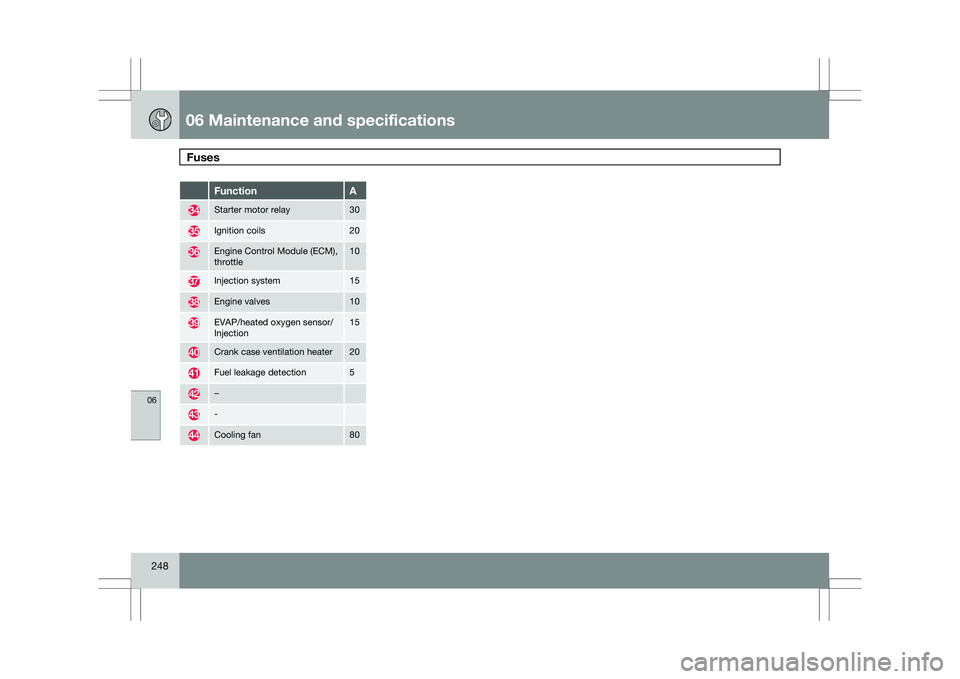
248 Function A
Starter motor relay 30
Ignition coils 20
Engine Control Module (ECM),
throttle 10
Injection system 15
Engine valves 10
EVAP/heated oxygen sensor/
Injection 15
Crank case ventilation heater 20
Fuel leakage detection 5
–
-
Cooling fan 80
Page 291 of 297
07 Index07
289
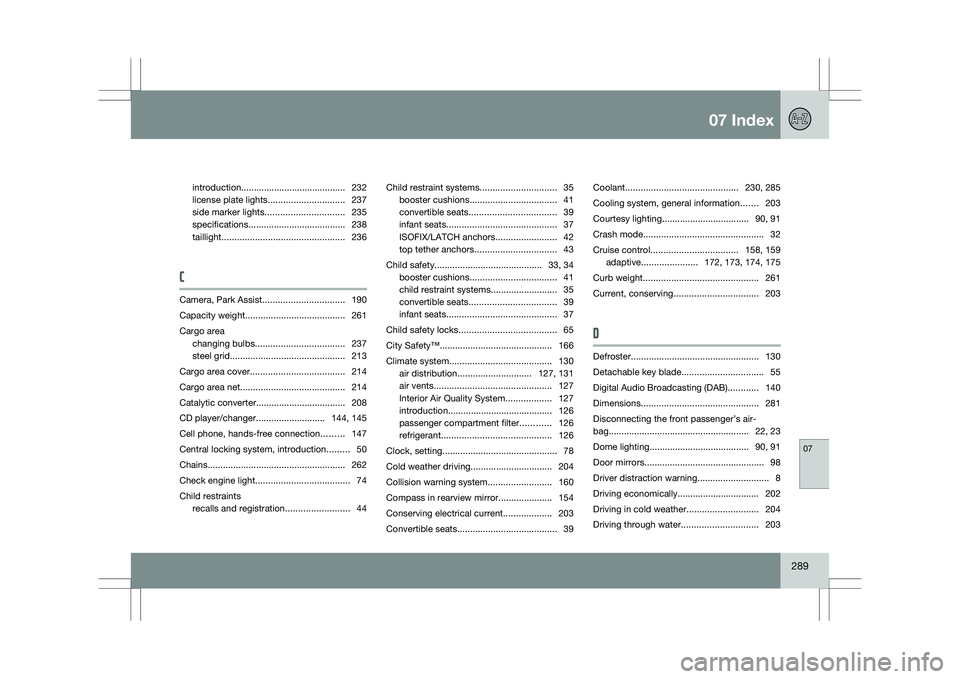
introduction......................................... 232
license plate lights
.............................. 237
side marker lights ............................... 235
specifications ...................................... 238
taillight ................................................ 236
C Camera, Park Assist................................
190
Capacity weight ....................................... 261
Cargo area changing bulbs ................................... 237
steel grid............................................. 213
Cargo area cover ..................................... 214
Cargo area net ......................................... 214
Catalytic converter ................................... 208
CD player/changer ...........................144, 145
Cell phone, hands-free connection .........147
Central locking system, introduction .........50
Chains ...................................................... 262
Check engine light ..................................... 74
Child restraints recalls and registration .........................44Child restraint systems
..............................35
booster cushions .................................. 41
convertible seats .................................. 39
infant seats........................................... 37
ISOFIX/LATCH anchors ........................42
top tether anchors ................................ 43
Child safety.......................................... 33, 34
booster cushions .................................. 41
child restraint systems ..........................35
convertible seats .................................. 39
infant seats........................................... 37
Child safety locks ...................................... 65
City Safety™............................................ 166
Climate system ........................................ 130
air distribution ............................. 127, 131
air vents.............................................. 127
Interior Air Quality System.................. 127
introduction
......................................... 126
passenger compartment filter ............126
refrigerant ........................................... 126
Clock, setting ............................................. 78
Cold weather driving ................................ 204
Collision warning system .........................160
Compass in rearview mirror .....................154
Conserving electrical current ...................203
Convertible seats ....................................... 39Coolant
............................................ 230, 285
Cooling system, general information .......203
Courtesy lighting .................................. 90, 91
Crash mode............................................... 32
Cruise control .................................. 158, 159
adaptive...................... 172, 173, 174, 175
Curb weight............................................. 261
Current, conserving ................................. 203
D Defroster..................................................
130
Detachable key blade................................ 55
Digital Audio Broadcasting (DAB) ............140
Dimensions .............................................. 281
Disconnecting the front passenger’s air-
bag....................................................... 22, 23
Dome lighting ....................................... 90, 91
Door mirrors ............................................... 98
Driver distraction warning ............................ 8
Driving economically
................................ 202
Driving in cold weather ............................204
Driving through water ..............................203