rear seats VOLVO XC60 2009 Owner´s Manual
[x] Cancel search | Manufacturer: VOLVO, Model Year: 2009, Model line: XC60, Model: VOLVO XC60 2009Pages: 297, PDF Size: 21.16 MB
Page 17 of 297
01 Safety
Seat belts01
}}
15
WARNING\b
Never repair the belt yourself; have this
work done by a trained and qualified
Volvo service technician only.
\b Any device used to induce slack into the
shoulder belt portion of the three-point
belt system will have a detrimental
effect on the amount of protection avail-
able to you in the event of a collision.
\b The seat back should not be tilted too
far back. The shoulder belt must be taut
in order to function properly.
\b Do not use child safety seats or child
booster cushions/backrests in the front
passenger\fs seat. We also recommend
that children who have outgrown these
devices sit in the rear seat with the seat
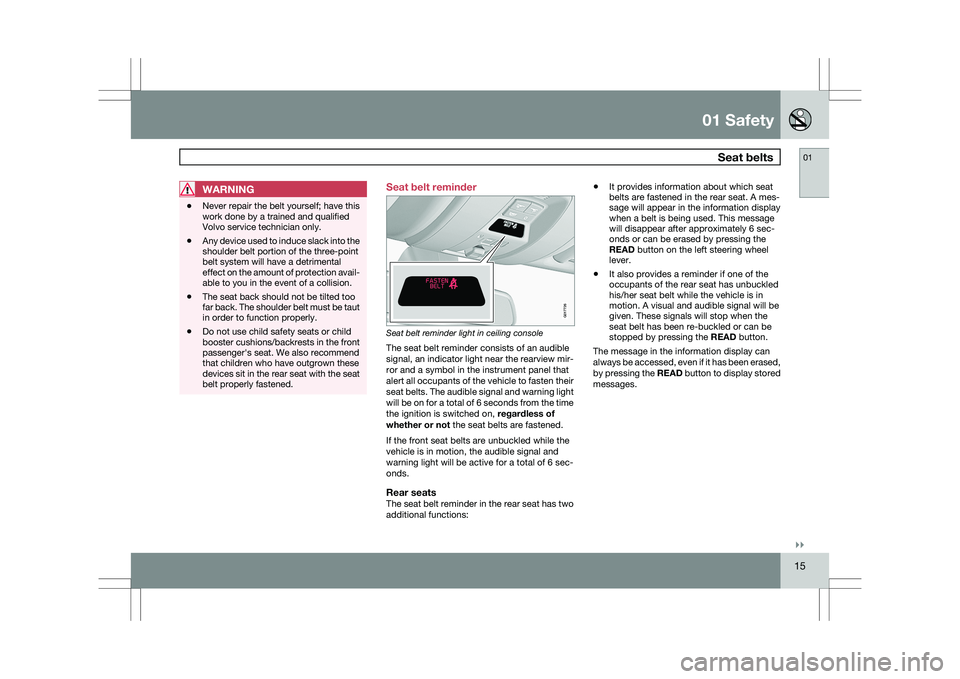
belt properly fastened. Seat belt reminder
Seat belt reminder light in ceiling console
The seat belt reminder consists of an audible
signal, an indicator light near the rearview mir-
ror and a symbol in the instrument panel that
alert all occupants of the vehicle to fasten their
seat belts. The audible signal and warning light
will be on for a total of 6 seconds from the time
the ignition is switched on,
regardless of
whether or not the seat belts are fastened.
If the front seat belts are unbuckled while the
vehicle is in motion, the audible signal and
warning light will be active for a total of 6 sec-
onds.
Rear seatsThe seat belt reminder in the rear seat has two
additional functions: \b
It provides information about which seat
belts are fastened in the rear seat. A mes-
sage will appear in the information display
when a belt is being used. This message
will disappear after approximately 6 sec-
onds or can be erased by pressing the
READ button on the left steering wheel
lever.
\b It also provides a reminder if one of the
occupants of the rear seat has unbuckled
his/her seat belt while the vehicle is in
motion. A visual and audible signal will be
given. These signals will stop when the
seat belt has been re-buckled or can be
stopped by pressing the
READ button.
The message in the information display can
always be accessed, even if it has been erased,
by pressing the READ button to display stored
messages. G017726
Page 21 of 297
01 Safety
Supplemental Restraint System (SRS)01
}}
19
Front airbag deployment
\b
The front airbags are designed to deploy
during certain frontal or front-angular col-
lisions, impacts, or decelerations, depend-
ing on the crash severity, angle, speed and
object impacted. The airbags may also
deploy in certain non-frontal collisions
where rapid deceleration occurs.
\b The SRS sensors, which trigger the front
airbags, are designed to react to both the
impact of the collision and the inertial
forces generated by it, and to determine if
the intensity of the collision is sufficient for
the seat belt pretensioners and/or airbags
to be deployed.
However, not all frontal collisions activate the
front airbags.
\b If the collision involves a nonrigid object
(e.g., a snow drift or bush), or a rigid, fixed
object at a low speed, the front airbags will
not necessarily deploy.
\b Front airbags do not normally deploy in a
side impact collision, in a collision from the
rear or in a rollover situation.
\b The amount of damage to the bodywork
does not reliably indicate if the airbags
should have deployed or not.WARNING \b
Do not use child safety seats or child
booster cushions/backrests in the front
passenger\fs seat. We also recommend
that occupants under 4 feet 7 inches
(140 cm) in height who have outgrown
these devices sit in the rear seat with the
seat belt fastened 1
.
\b Never drive with the airbags deployed.
The fact that they hang out can impair
the steering of your vehicle. Other
safety systems can also be damaged.
\b The smoke and dust formed when the
airbags are deployed can cause skin
and eye irritation in the event of pro-
longed exposure. Should you have questions about any compo-
nent in the SRS system, please contact a
trained and qualified Volvo service technician
or Volvo Customer Support:
In the USA
Volvo Cars of North America, LLC
Customer Care Center
P.O. Box 914 Rockleigh, New Jersey
07647-09141-800-458-1552
www.volvocars.us
In Canada
Volvo Cars of Canada Corp.
National Customer Service
175 Gordon Baker Road
North York, Ontario M2H 2N7
1-800-663-8255
www.volvocanada.com
1
See also the Occupant Weight Sensor information
on page 22.
Page 25 of 297
01 Safety
Occupant Weight Sensor01
}}
23
WARNING\b
Never try to open, remove, or repair any
components in the OWS system. This
could result in system malfunction.
Maintenance or repairs should only be
carried out by an a trained and qualified
Volvo service technician.
\b The front passenger\fs seat should not
be modified in any way. This could
reduce pressure on the seat cushion,
which might interfere with the OWS sys-
tem\fs function. Passeng-
er\fs seat
occu-
pancy sta-
tus OWS indi-
cator light
status Passeng-
er\fs side
front air-
bag status
Seat unoc-
cupied OWS indica-
tor light
lights up. Passenger\fs
side front
airbag disa-
bled
Seat occu-
pied by low
weight
occupant/
object
A OWS indica-
tor light
lights up Passenger\fs
side front
airbag disa-
bled
Seat occu-
pied by
heavy occu-
pant/object OWS indica-
tor light is
not lit Passenger\fs
side front
airbag ena-
bled
A
Volvo recommends that children always be properly
restrained in appropriate child restraints in the rear seats. Do
not assume that the passenger\fs side front airbag is disabled
unless the PASSENGER AIRBAG OFF indicator lamp is lit.
Make sure the child restraint is properly installed. If there is
any doubt as to the status of the passenger\fs side front air-
bag, move the child restraint to the rear seat.
The OWS is designed to enable (may inflate)
the passenger\fs side front airbag anytime the
system senses that a person of adult size is
sitting properly in the front passenger\fs seat. The PASSENGER AIRBAG OFF indicator lamp
will be off and remain off.
If a person of adult size is sitting in the front
passenger\fs seat, but the PASSENGER AIR-
BAG OFF indicator lamp is on, it is possible that
the person isn\ft sitting properly in the seat. If
this happens:
\b
Turn the vehicle off and ask the person to
place the seatback in an upright position.
\b Have the person sit upright in the seat,
centered on the seat cushion, with the per-
son\fs legs comfortably extended.
\b Restart the vehicle and have the person
remain in this position for about two
minutes. This will allow the system to
detect that person and enable the pas-
senger\fs frontal airbag.
\b If the PASSENGER AIRBAG OFF indicator
lamp remains on even after this, the person
should be advised to ride in the rear seat.
This condition reflects limitations of the OWS
classification capability. It does not indicate
OWS malfunction.
ModificationsIf you are considering modifying your vehicle in
any way to accommodate a disability, for
example by altering or adapting the driver\fs or
front passenger\fs seat(s) and/or airbag sys-
tems, please contact Volvo at:
Page 29 of 297
01 Safety
Side impact protection (SIPS) airbags01
27
WARNING\b
The SIPS airbag system is a supple-
ment to the structural Side Impact Pro-
tection System and the three-point seat
belt system. It is not designed to deploy
during collisions from the front or rear of
the vehicle or in rollover situations.
\b The use of seat covers on the front seats
may impede SIPS airbag deployment.
\b No objects, accessory equipment or
stickers may be placed on, attached to
or installed near the SIPS airbag system
or in the area affected by SIPS airbag
deployment.
\b Never try to open or repair any compo-
nents of the SIPS airbag system. This
should be done only by a trained and
qualified Volvo service technician.
\b In order for the SIPS airbag to provide
its best protection, both front seat
occupants should sit in an upright posi-
tion with the seat belt properly fastened.
\b Failure to follow these instructions can
result in injury to the occupants of the
vehicle in the event of an accident.
Page 30 of 297
01 SafetyVolvo Inflatable Curtain (VIC) 01
28 General information
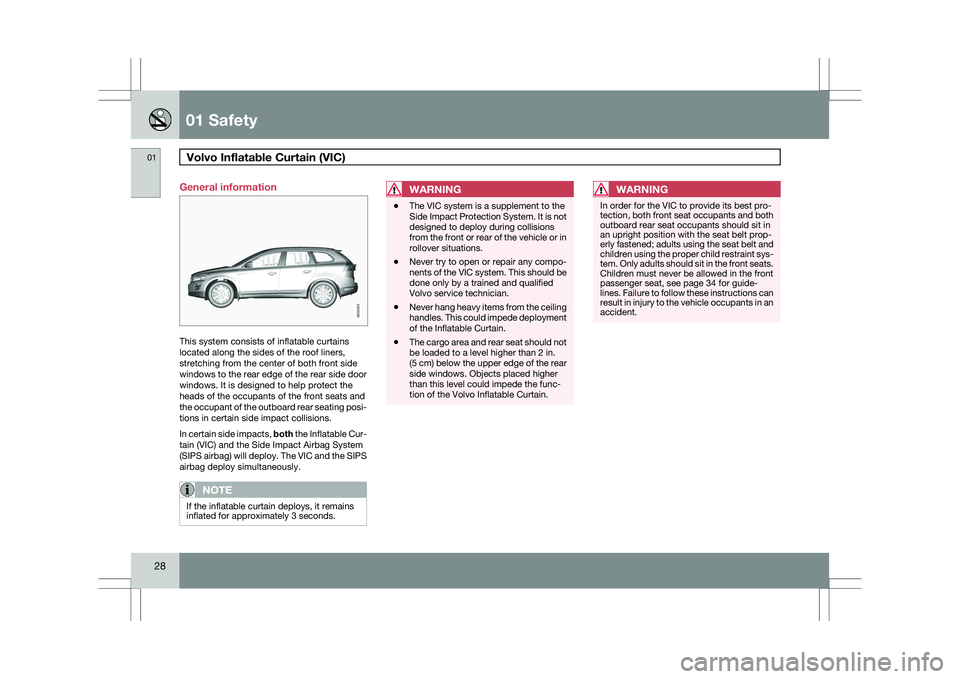
This system consists of inflatable curtains
located along the sides of the roof liners,
stretching from the center of both front side
windows to the rear edge of the rear side door
windows. It is designed to help protect the
heads of the occupants of the front seats and
the occupant of the outboard rear seating posi-
tions in certain side impact collisions.
In certain side impacts, both the Inflatable Cur-
tain (VIC) and the Side Impact Airbag System
(SIPS airbag) will deploy. The VIC and the SIPS
airbag deploy simultaneously.
NOTE
If the inflatable curtain deploys, it remains
inflated for approximately 3 seconds.
WARNING \b
The VIC system is a supplement to the
Side Impact Protection System. It is not
designed to deploy during collisions
from the front or rear of the vehicle or in
rollover situations.
\b Never try to open or repair any compo-
nents of the VIC system. This should be
done only by a trained and qualified
Volvo service technician.
\b Never hang heavy items from the ceiling
handles. This could impede deployment
of the Inflatable Curtain.
\b The cargo area and rear seat should not
be loaded to a level higher than 2 in.
(5 cm) below the upper edge of the rear
side windows. Objects placed higher
than this level could impede the func-
tion of the Volvo Inflatable Curtain.WARNING In order for the VIC to provide its best pro-
tection, both front seat occupants and both
outboard rear seat occupants should sit in
an upright position with the seat belt prop-
erly fastened; adults using the seat belt and
children using the proper child restraint sys-
tem. Only adults should sit in the front seats.
Children must never be allowed in the front
passenger seat, see page 34 for guide-
lines. Failure to follow these instructions can
result in injury to the vehicle occupants in an
accident. G032025
Page 31 of 297
01 Safety
Whiplash Protection System – WHIPS01
}}
29
General information
Whiplash Protection System (WHIPS) –
front seats only
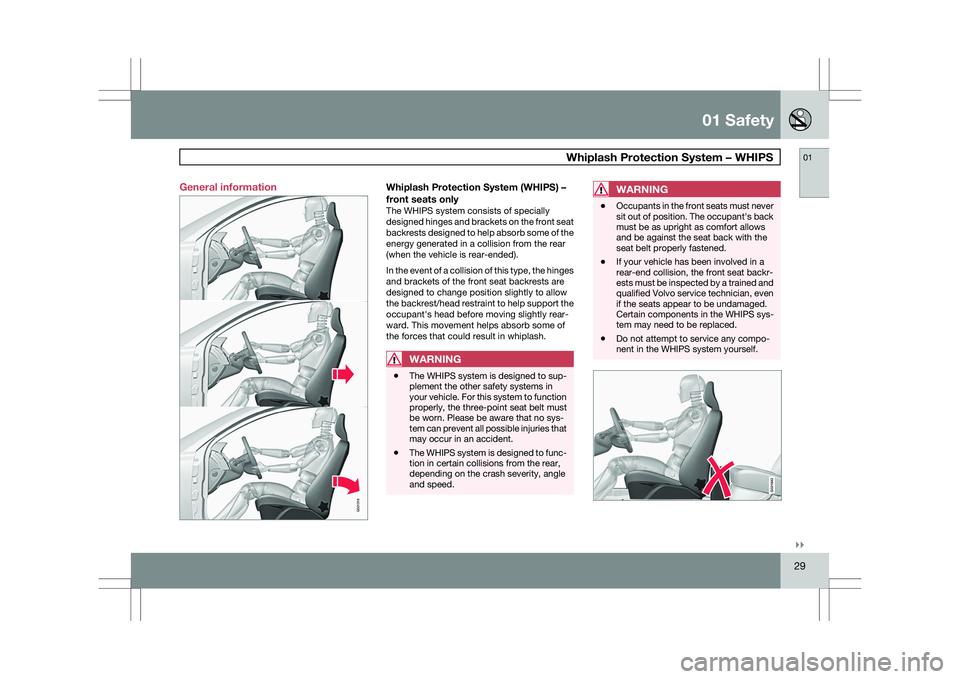
The WHIPS system consists of specially
designed hinges and brackets on the front seat
backrests designed to help absorb some of the
energy generated in a collision from the rear
(when the vehicle is rear-ended).
In the event of a collision of this type, the hinges
and brackets of the front seat backrests are
designed to change position slightly to allow
the backrest/head restraint to help support the
occupant\fs head before moving slightly rear-
ward. This movement helps absorb some of
the forces that could result in whiplash.
WARNING
\b
The WHIPS system is designed to sup-
plement the other safety systems in
your vehicle. For this system to function
properly, the three-point seat belt must
be worn. Please be aware that no sys-
tem can prevent all possible injuries that
may occur in an accident.
\b The WHIPS system is designed to func-
tion in certain collisions from the rear,
depending on the crash severity, angle
and speed.
WARNING \b
Occupants in the front seats must never
sit out of position. The occupant\fs back
must be as upright as comfort allows
and be against the seat back with the
seat belt properly fastened.
\b If your vehicle has been involved in a
rear-end collision, the front seat backr-
ests must be inspected by a trained and
qualified Volvo service technician, even
if the seats appear to be undamaged.
Certain components in the WHIPS sys-
tem may need to be replaced.
\b Do not attempt to service any compo-
nent in the WHIPS system yourself. G02101
8 G021842
Page 32 of 297
01 SafetyWhiplash Protection System – WHIPS 01
30
WARNING \b
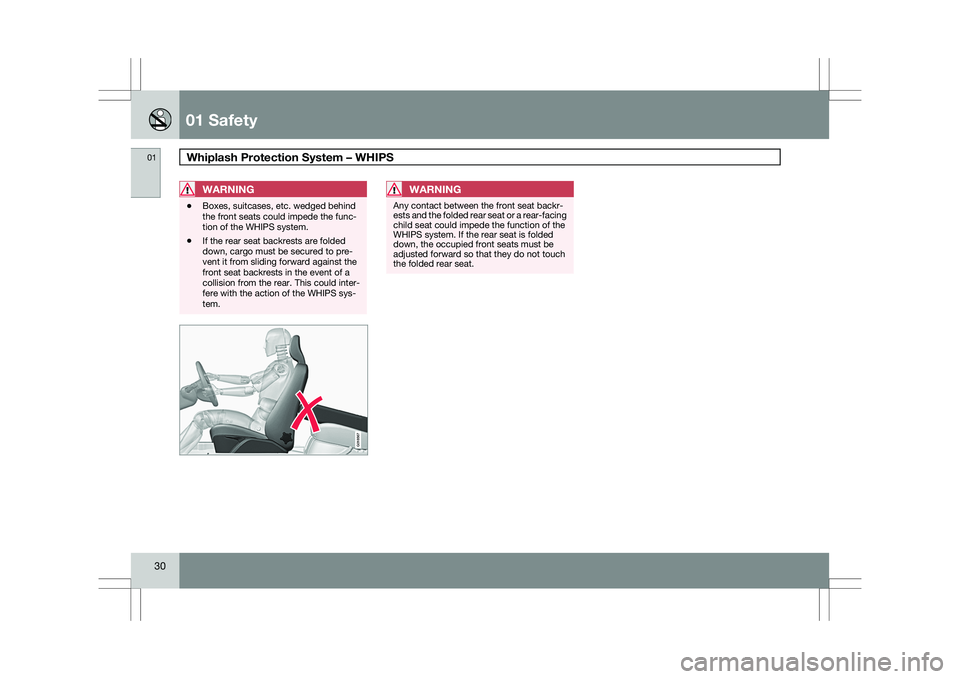
Boxes, suitcases, etc. wedged behind
the front seats could impede the func-
tion of the WHIPS system.
\b If the rear seat backrests are folded
down, cargo must be secured to pre-
vent it from sliding forward against the
front seat backrests in the event of a
collision from the rear. This could inter-
fere with the action of the WHIPS sys-
tem.WARNING Any contact between the front seat backr-
ests and the folded rear seat or a rear-facing
child seat could impede the function of the
WHIPS system. If the rear seat is folded
down, the occupied front seats must be
adjusted forward so that they do not touch
the folded rear seat. G018567
Page 35 of 297
01 Safety
Child safety01
}}
33
Children should be seated safely
Volvo recommends the proper use of restraint
systems for all occupants including children.
Remember that, regardless of age and size, a
child should always be properly restrained in a
vehicle.
Your vehicle is also equipped with ISOFIX/
LATCH attachments, which make it more con-
venient to install child seats.
Some restraint systems for children are
designed to be secured in the vehicle by lap
belts or the lap portion of a lap-shoulder belt.
Such child restraint systems can help protect
children in vehicles in the event of an accident
only if they are used properly. However, chil-
dren could be endangered in a crash if the child
restraints are not properly secured in the vehi-
cle. Failure to follow the installation instructions
for your child restraint can result in your child
striking the vehicle\fs interior in a sudden stop.
Holding a child in your arms is NOT a suitable
substitute for a child restraint system. In an
accident, a child held in a person\fs arms can
be crushed between the vehicle\fs interior and
an unrestrained person. The child could also be
injured by striking the interior, or by being ejec-
ted from the vehicle during a sudden maneuver
or impact. The same can also happen if the
infant or child rides unrestrained on the seat.
Other occupants should also be properly
restrained to help reduce the chance of injuring
or increasing the injury of a child.
All states and provinces have legislation gov-
erning how and where children should be car-
ried in a vehicle. Find out the regulations exist-
ing in your state or province. Recent accident
statistics have shown that children are safer in
rear seating positions than front seating posi-
tions when properly restrained. A child restraint
system can help protect a child in a vehicle.
Here\fs what to look for when selecting a child
restraint system:
It should have a label certifying that it meets
applicable Federal Motor Vehicle Safety
Standards (FMVSS 213) – or in Canada,
CMVSS 213.
Make sure the child restraint system is
approved for the child\fs height, weight and
development – the label required by the stand-
ard or regulation, or instructions for infant
restraints, typically provide this information.
In using any child restraint system, we urge you
to carefully look over the instructions that are
provided with the restraint. Be sure you under-
stand them and can use the device properly
and safely in this vehicle. A misused child
restraint system can result in increased injuries
for both the infant or child and other occupants
in the vehicle.
When a child has outgrown the child safety
seat, you should use the rear seat with the
standard seat belt fastened. The best way to
help protect the child here is to place the child
on a cushion so that the seat belt is properly
located on the hips (see the illustration
on page
35). Legislation in your state or province may
mandate the use of a child seat or cushion in
combination with the seat belt, depending on
the child\fs age and/or size. Please check local
regulations.
A specially designed and tested booster cush-
ion can be obtained from your Volvo retailer.
USA: for children weighing 33 – 80 lbs.
(15 – 36 kg) and 38 – 54 inches (97 – 137 cm)
in height
Canada: for children weighing 40 – 80 lbs.
(18 – 36 kg) and 40 – 54 inches (102 – 137 cm)
in height
Page 36 of 297
01 SafetyChild safety 01
34
WARNING \b
Do not use child safety seats or child
booster cushions/backrests in the front
passenger\fs seat. We also recommend
that children under 4 feet 7 inches
(140 cm) in height who have outgrown
these devices sit in the rear seat with the
seat belt fastened.
\b On hot days, the temperature in the
vehicle interior can rise very quickly.
Exposure to these high temperatures
for even a short period of time can
cause heat-related injury or death.
Small children are particularly at risk. Automatic Locking Retractor/
Emergency Locking Retractor (ALR/
ELR)
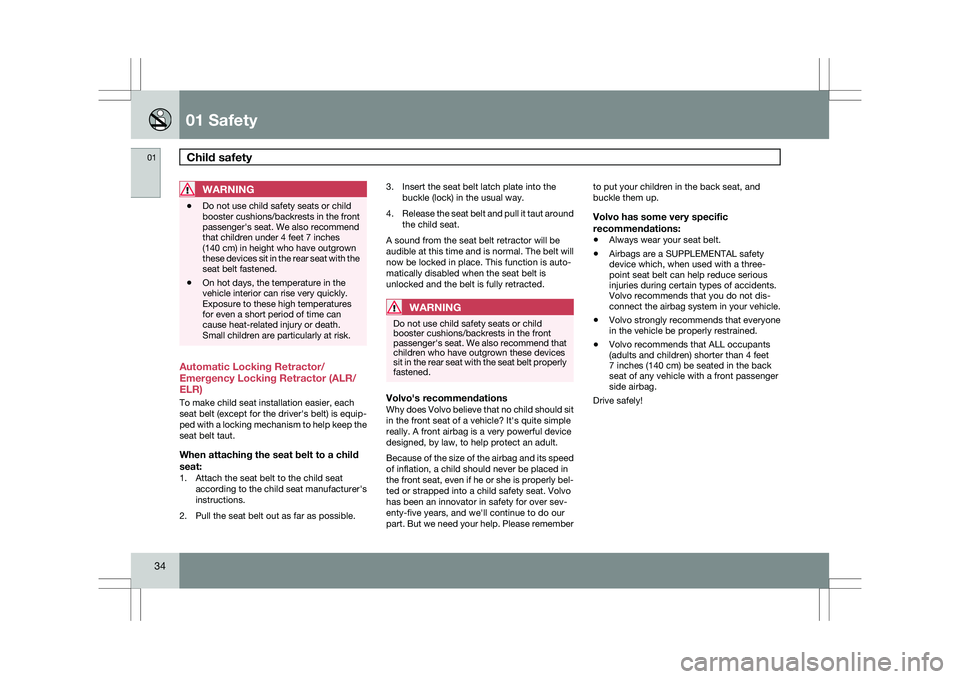
To make child seat installation easier, each
seat belt (except for the driver\fs belt) is equip-
ped with a locking mechanism to help keep the
seat belt taut.
When attaching the seat belt to a child
seat:
1. Attach the seat belt to the child seat
according to the child seat manufacturer\fs
instructions.
2. Pull the seat belt out as far as possible. 3. Insert the seat belt latch plate into the
buckle (lock) in the usual way.
4. Release the seat belt and pull it taut around
the child seat.
A sound from the seat belt retractor will be
audible at this time and is normal. The belt will
now be locked in place. This function is auto-
matically disabled when the seat belt is
unlocked and the belt is fully retracted.
WARNING Do not use child safety seats or child
booster cushions/backrests in the front
passenger\fs seat. We also recommend that
children who have outgrown these devices
sit in the rear seat with the seat belt properly
fastened.
Volvo\fs recommendationsWhy does Volvo believe that no child should sit
in the front seat of a vehicle? It\fs quite simple
really. A front airbag is a very powerful device
designed, by law, to help protect an adult.
Because of the size of the airbag and its speed
of inflation, a child should never be placed in
the front seat, even if he or she is properly bel-
ted or strapped into a child safety seat. Volvo
has been an innovator in safety for over sev-
enty-five years, and we\fll continue to do our
part. But we need your help. Please rememberto put your children in the back seat, and
buckle them up.
Volvo has some very specific
recommendations:
\b
Always wear your seat belt.
\b Airbags are a SUPPLEMENTAL safety
device which, when used with a three-
point seat belt can help reduce serious
injuries during certain types of accidents.
Volvo recommends that you do not dis-
connect the airbag system in your vehicle.
\b Volvo strongly recommends that everyone
in the vehicle be properly restrained.
\b Volvo recommends that ALL occupants
(adults and children) shorter than 4 feet
7 inches (140 cm) be seated in the back
seat of any vehicle with a front passenger
side airbag.
Drive safely!
Page 37 of 297
01 Safety
Child restraint systems01
}}
35
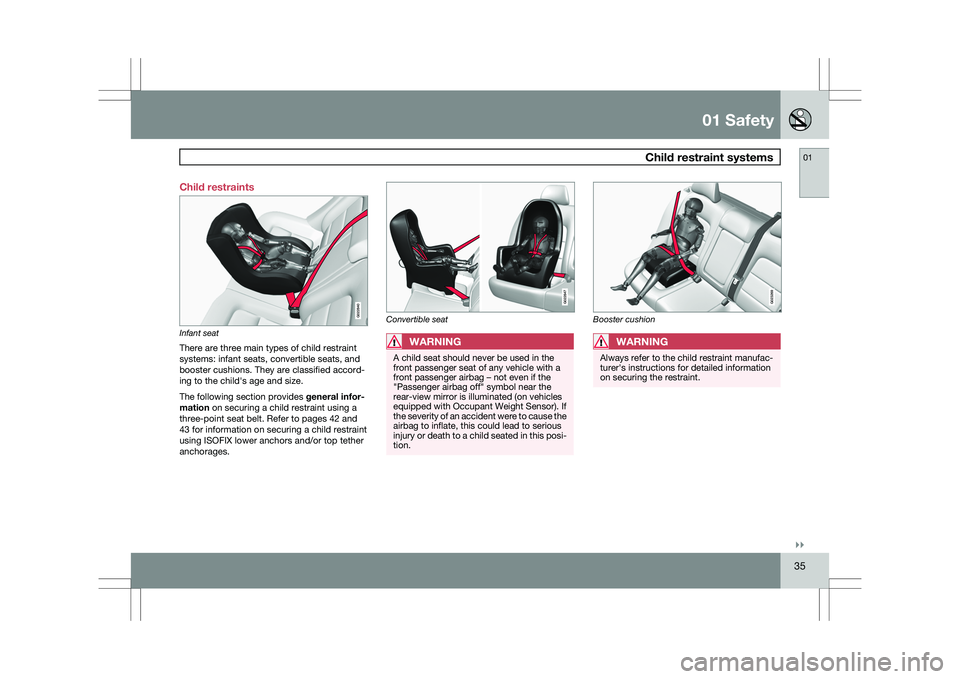
Child restraints
Infant seat
There are three main types of child restraint
systems: infant seats, convertible seats, and
booster cushions. They are classified accord-
ing to the child\fs age and size.
The following section provides
general infor-
mation on securing a child restraint using a
three-point seat belt. Refer to pages 42 and
43 for information on securing a child restraint
using ISOFIX lower anchors and/or top tether
anchorages. Convertible seat
WARNING
A child seat should never be used in the
front passenger seat of any vehicle with a
front passenger airbag – not even if the
"Passenger airbag off" symbol near the
rear-view mirror is illuminated (on vehicles
equipped with Occupant Weight Sensor). If
the severity of an accident were to cause the
airbag to inflate, this could lead to serious
injury or death to a child seated in this posi-
tion. Booster cushionWARNING
Always refer to the child restraint manufac-
turer\fs instructions for detailed information
on securing the restraint. G022840 G022847 G023269