clock VOLVO XC60 2013 Owner´s Manual
[x] Cancel search | Manufacturer: VOLVO, Model Year: 2013, Model line: XC60, Model: VOLVO XC60 2013Pages: 382, PDF Size: 7.08 MB
Page 250 of 382
06 Infotainment
Bluetooth® hands-free connection
06
248
NOTE
Changes made from the infotainment sys-
tem to a contact in the cell phone's phone
book will result in a new contact being
added to the infotainment system's phone
book. However, this contact will not be
saved in the cell phone's phone book. The
infotainment system's display will show
duplicate contacts with different icons.
Please also note that if a speed dial number
is saved or if a contact's information is edi-
ted, this will result in a new contact in the
infotainment system's phone book.
The symbol must be displayed before
the phone book can be used and the hands-
free function must be in phone mode.
The infotainment system saves a copy of each
paired cell phone's phone book. This phone
book can be copied each time the phone is
connected.
–Activate/deactivate this function in phone
mode in Phone menu
Phone settings
Download phone book.
If the phone book contains information about
someone who is trying to call you, this infor-
mation will be shown in the display.
Contact shortcutsA quick way of searching the phone book for
contacts in normal view is to turn TUNE clock-
wise to access the phone book and then coun-
ter-clockwise to select a contact from the list.
Press OK/MENU to call.
Each name in the phone book has a default
phone number. If the
symbol is displayed to
the right of it, this indicates that there are addi-
tional phone numbers for this contact. To use
a phone number other than the default one,
press the
button on the center console
control panel. Turn TUNE to select a different
phone number and press OK/MENU to call.
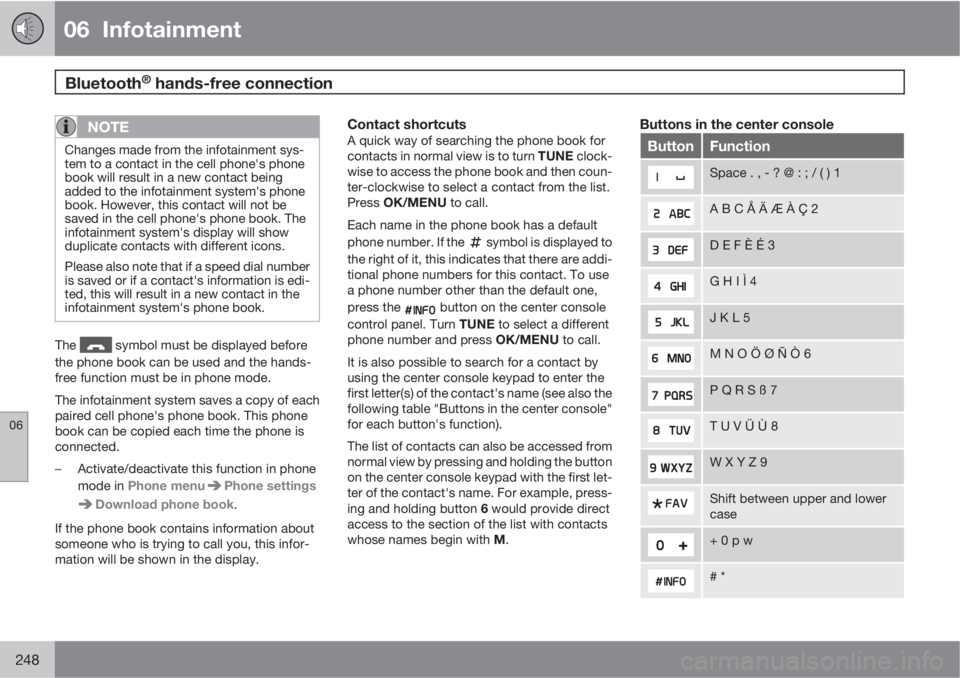
It is also possible to search for a contact by
using the center console keypad to enter the
first letter(s) of the contact's name (see also the
following table "Buttons in the center console"
for each button's function).
The list of contacts can also be accessed from
normal view by pressing and holding the button
on the center console keypad with the first let-
ter of the contact's name. For example, press-
ing and holding button 6 would provide direct
access to the section of the list with contacts
whose names begin with M.
Buttons in the center console
ButtonFunction
Space . , - ? @ : ; / ( ) 1
A B C Å Ä Æ À Ç 2
D E F È É 3
G H I Ì 4
J K L 5
M N O Ö Ø Ñ Ò 6
P Q R S ß 7
T U V Ü Ù 8
W X Y Z 9
Shift between upper and lower
case
+ 0 p w
# *
Page 276 of 382
07 During your trip
Refueling
07
274
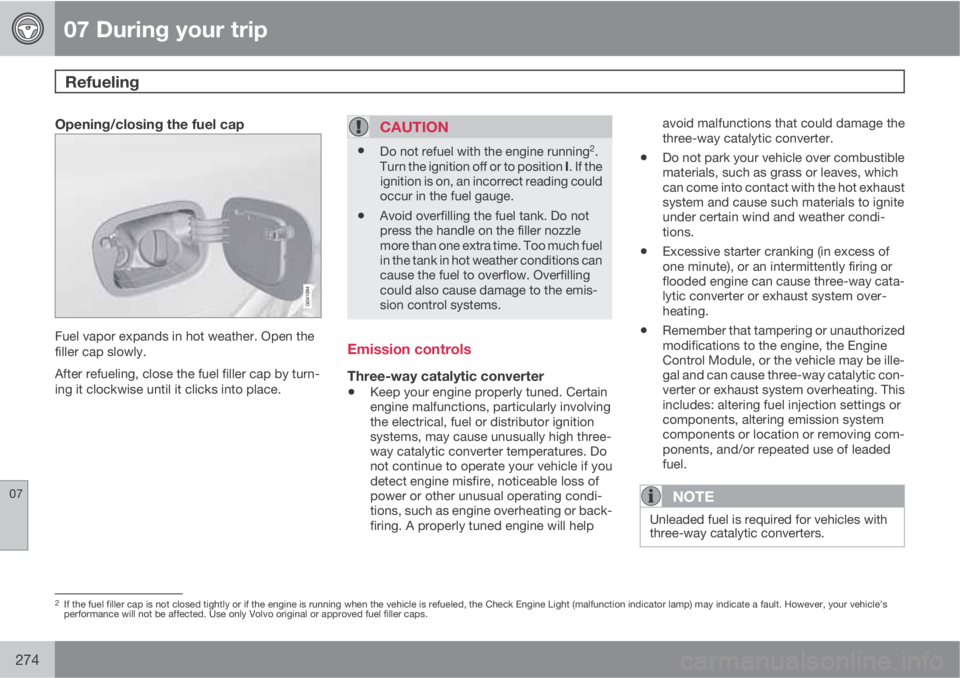
Opening/closing the fuel cap
Fuel vapor expands in hot weather. Open the
filler cap slowly.
After refueling, close the fuel filler cap by turn-
ing it clockwise until it clicks into place.
CAUTION
•Do not refuel with the engine running2.
Turn the ignition off or to position I. If the
ignition is on, an incorrect reading could
occur in the fuel gauge.
•Avoid overfilling the fuel tank. Do not
press the handle on the filler nozzle
more than one extra time. Too much fuel
in the tank in hot weather conditions can
cause the fuel to overflow. Overfilling
could also cause damage to the emis-
sion control systems.
Emission controls
Three-way catalytic converter
•Keep your engine properly tuned. Certain
engine malfunctions, particularly involving
the electrical, fuel or distributor ignition
systems, may cause unusually high three-
way catalytic converter temperatures. Do
not continue to operate your vehicle if you
detect engine misfire, noticeable loss of
power or other unusual operating condi-
tions, such as engine overheating or back-
firing. A properly tuned engine will helpavoid malfunctions that could damage the
three-way catalytic converter.
•Do not park your vehicle over combustible
materials, such as grass or leaves, which
can come into contact with the hot exhaust
system and cause such materials to ignite
under certain wind and weather condi-
tions.
•Excessive starter cranking (in excess of
one minute), or an intermittently firing or
flooded engine can cause three-way cata-
lytic converter or exhaust system over-
heating.
•Remember that tampering or unauthorized
modifications to the engine, the Engine
Control Module, or the vehicle may be ille-
gal and can cause three-way catalytic con-
verter or exhaust system overheating. This
includes: altering fuel injection settings or
components, altering emission system
components or location or removing com-
ponents, and/or repeated use of leaded
fuel.
NOTE
Unleaded fuel is required for vehicles with
three-way catalytic converters.
2If the fuel filler cap is not closed tightly or if the engine is running when the vehicle is refueled, the Check Engine Light (malfunction indicator lamp) may indicate a fault. However, your vehicle's
performance will not be affected. Use only Volvo original or approved fuel filler caps.
Page 312 of 382
08 Wheels and tires
Tire Sealing System
08
310
CAUTION
If your vehicle is equipped with the Tire
Pressure Monitoring System (TPMS), the
use of the sealing compound may lead to
incorrect tire pressure readings or in rare
cases, damage to the tire pressure sensor.
Use the tire sealing system to check and
adjust the damaged tire's inflation pressure.
NOTE
•Safely stow the tire sealing system in a
convenient place as it will soon be used
again to check the tire’s inflation pres-
sure.
•The empty bottle of sealing compound
cannot be removed from the bottle
holder. Consult a trained and qualified
Volvo service technician to have the
bottle removed and properly disposed
of.
WARNING
If heavy vibrations, unsteady steering
behavior, or noises should occur while driv-
ing, reduce speed and park the vehicle in a
safe place. Recheck the tire for bumps,
cracks, or other visible damage, and
recheck its inflation pressure. If the pressure
is below 19 psi (1.3 bar), do not continue
driving. Have the vehicle towed to a trained
and qualified Volvo service technician.
Stage 2: Checking inflation pressure1. Connect the tire sealing system as descri-
bed in stage 1.
2. Refer to the inflation pressure table in this
chapter for the correct inflation pressure. If
the tire needs to be inflated, start the tire
sealing system’s compressor. If neces-
sary, release air from the tire by turning the
air release knob counterclockwise.
CAUTION
The compressor should not be used for
more than 10 minutes at a time to avoid
overheating.
WARNING
If you interrupt your trip for more than 1
hour, check the inflation pressure in the
damaged tire again before continuing.
Replacing the sealing compound
container
The sealing compound container must be
replaced if:
•the tire sealing system has been used to
repair a tire
•the container’s expiration date has passed
(see the date on decal).
NOTE
•After use, the sealing compound bottle,
the hose, and certain other system
components must be replaced. Please
consult your Volvo retailer for replace-
ment parts.
•If the sealing compound bottle’s expi-
ration date has passed, please take it to
a Volvo retailer or a recycling station
that can properly dispose of harmful
substances.
Page 313 of 382
08 Wheels and tires
Tire Sealing System
08
311 Inflating tires
The tire sealing system can be used to inflate
the tires. To do so:
1. Park the car in a safe place.
2. The compressor should be switched off.
Ensure that the on/off switch is in position
0 (the 0 side of the switch should be
pressed down).
3. Take out the electrical wire and hose.
4. Remove the valve cap from the tire’s infla-
tion valve and screw the hose connector
onto the valve as tightly as possible by
hand.
5. Connect the electrical wire to the nearest
12-volt socket in the vehicle.
6. Start the vehicle’s engine.WARNING
•The vehicle’s engine should be running
when the tire sealing system is used to
avoid battery drain. Therefore, be sure
the vehicle is parked in a well ventilated
place, or outdoors, before using the sys-
tem. The parking brake should be
securely applied and the gear selector
should be in the P (park) position.
•Children should never be left unattended
in the vehicle when the engine is running.
7. Check the tire’s inflation pressure on the
gauge. Switch off the compressor briefly to
get a clear reading from the pressure
gauge.
8. Refer to the tire inflation table in this chap-
ter for the correct inflation pressure. If the
tire needs to be inflated, start the tire seal-
ing system’s compressor (press the on/off
switch to position I). If necessary, release
air from the tire by turning the air release
knob counterclockwise.
CAUTION
The compressor should not be used for
more than 10 minutes at a time to avoid
overheating.
9. Turn off the compressor (press the on/off
switch to position 0) when the correct infla-
tion pressure has been reached.
10. Unscrew the hose from the tire’s inflation
valve and reinstall the valve cap.
11. Disconnect the electrical wire from the
12-volt socket.
Page 315 of 382
08 Wheels and tires
Changing a wheel
08
313
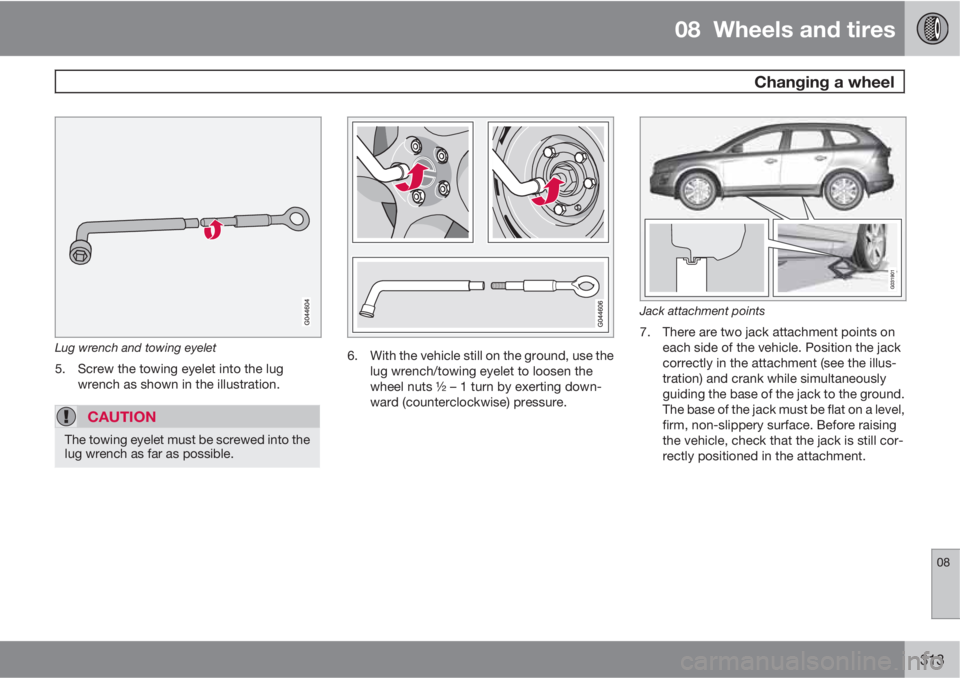
Lug wrench and towing eyelet
5. Screw the towing eyelet into the lug
wrench as shown in the illustration.
CAUTION
The towing eyelet must be screwed into the
lug wrench as far as possible.
6. With the vehicle still on the ground, use the
lug wrench/towing eyelet to loosen the
wheel nuts ½ – 1 turn by exerting down-
ward (counterclockwise) pressure.
Jack attachment points
7. There are two jack attachment points on
each side of the vehicle. Position the jack
correctly in the attachment (see the illus-
tration) and crank while simultaneously
guiding the base of the jack to the ground.
The base of the jack must be flat on a level,
firm, non-slippery surface. Before raising
the vehicle, check that the jack is still cor-
rectly positioned in the attachment.
Page 334 of 382
09 Maintenance and specifications
Replacing bulbs 09
332
NOTE
Before starting to replace a bulb, see
page 330.
1. Open the retaining clamps by pressing
them to the sides.
2. Pull the cover straight out.
Reinstall the cover in the reverse order.
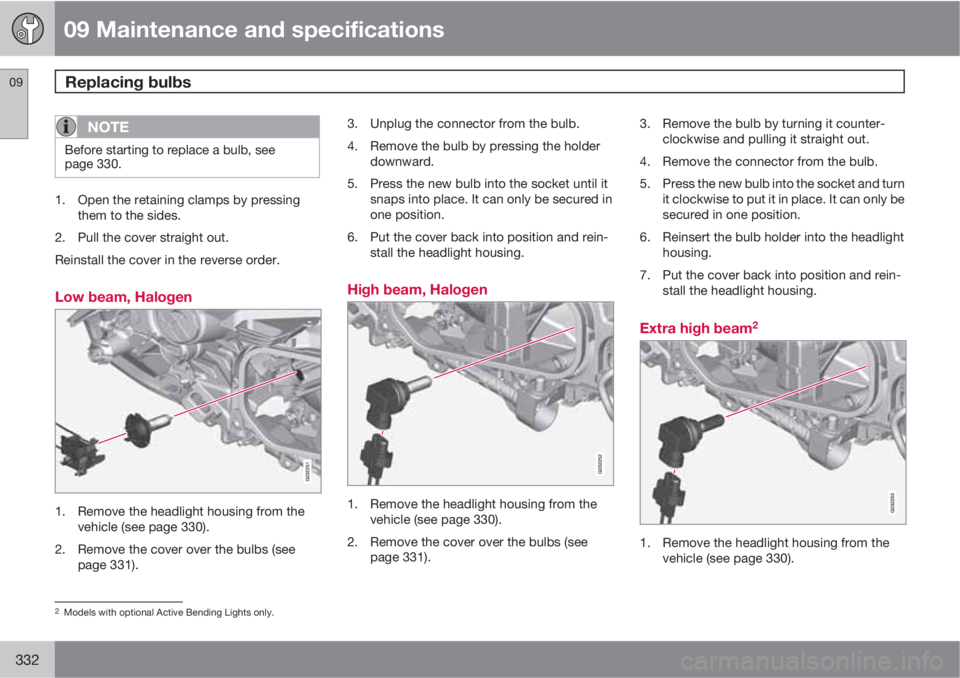
Low beam, Halogen
1. Remove the headlight housing from the
vehicle (see page 330).
2. Remove the cover over the bulbs (see
page 331).3. Unplug the connector from the bulb.
4. Remove the bulb by pressing the holder
downward.
5. Press the new bulb into the socket until it
snaps into place. It can only be secured in
one position.
6. Put the cover back into position and rein-
stall the headlight housing.
High beam, Halogen
1. Remove the headlight housing from the
vehicle (see page 330).
2. Remove the cover over the bulbs (see
page 331).3. Remove the bulb by turning it counter-
clockwise and pulling it straight out.
4. Remove the connector from the bulb.
5. Press the new bulb into the socket and turn
it clockwise to put it in place. It can only be
secured in one position.
6. Reinsert the bulb holder into the headlight
housing.
7. Put the cover back into position and rein-
stall the headlight housing.
Extra high beam2
1. Remove the headlight housing from the
vehicle (see page 330).
2Models with optional Active Bending Lights only.
Page 335 of 382
09 Maintenance and specifications
Replacing bulbs09
333
2. Remove the cover over the bulbs (see
page 331).
3. Disconnect the wiring connector from the
bulb holder.
4. Remove the bulb holder from the headlight
housing by pulling it straight out.
5. Insert a new bulb in the holder until it snaps
in place. It can only be inserted in one way.
6. Press the bulb holder into position in the
headlight housing.
7. Reconnect the wiring connector to the bulb
holder.
8. Put the cover back into position and rein-
stall the headlight housing.
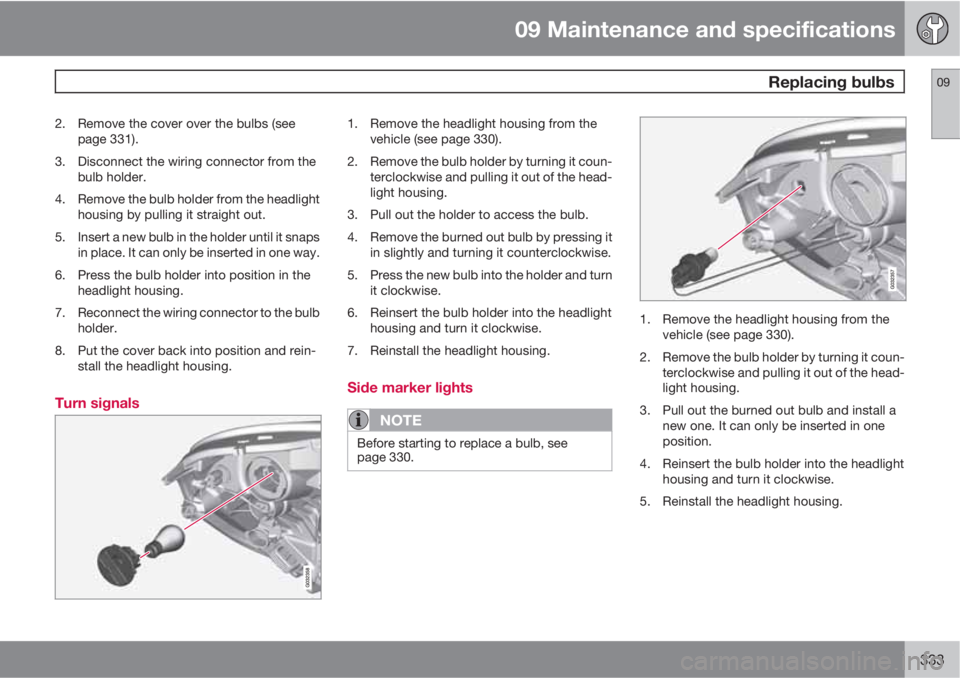
Turn signals
1. Remove the headlight housing from the
vehicle (see page 330).
2. Remove the bulb holder by turning it coun-
terclockwise and pulling it out of the head-
light housing.
3. Pull out the holder to access the bulb.
4. Remove the burned out bulb by pressing it
in slightly and turning it counterclockwise.
5. Press the new bulb into the holder and turn
it clockwise.
6. Reinsert the bulb holder into the headlight
housing and turn it clockwise.
7. Reinstall the headlight housing.
Side marker lights
NOTE
Before starting to replace a bulb, see
page 330.
1. Remove the headlight housing from the
vehicle (see page 330).
2. Remove the bulb holder by turning it coun-
terclockwise and pulling it out of the head-
light housing.
3. Pull out the burned out bulb and install a
new one. It can only be inserted in one
position.
4. Reinsert the bulb holder into the headlight
housing and turn it clockwise.
5. Reinstall the headlight housing.
Page 336 of 382
09 Maintenance and specifications
Replacing bulbs 09
334
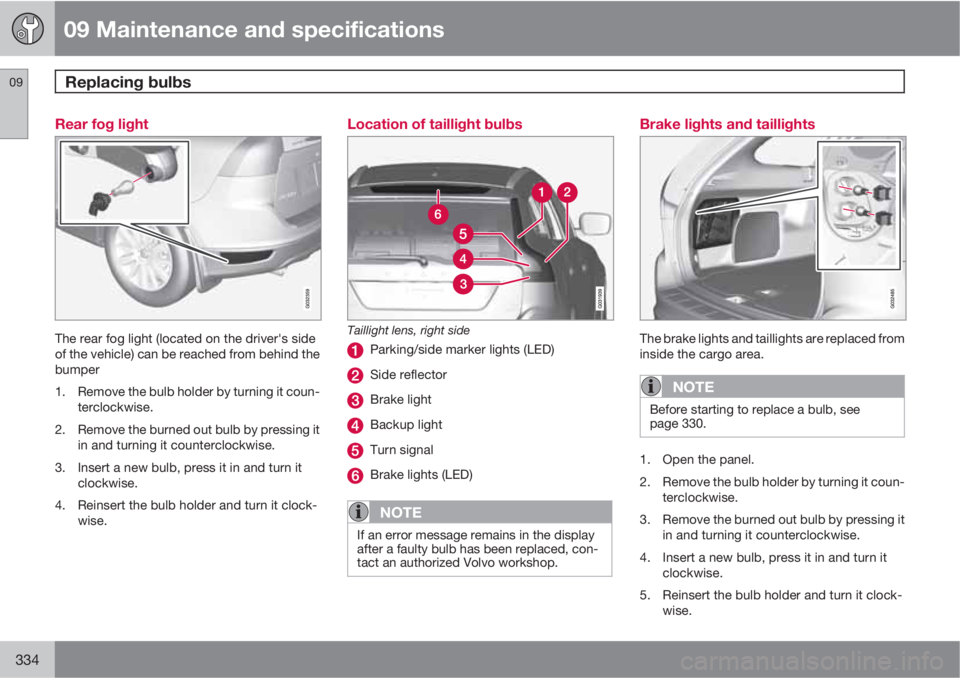
Rear fog light
The rear fog light (located on the driver's side
of the vehicle) can be reached from behind the
bumper
1. Remove the bulb holder by turning it coun-
terclockwise.
2. Remove the burned out bulb by pressing it
in and turning it counterclockwise.
3. Insert a new bulb, press it in and turn it
clockwise.
4. Reinsert the bulb holder and turn it clock-
wise.
Location of taillight bulbs
Taillight lens, right side
Parking/side marker lights (LED)
Side reflector
Brake light
Backup light
Turn signal
Brake lights (LED)
NOTE
If an error message remains in the display
after a faulty bulb has been replaced, con-
tact an authorized Volvo workshop.
Brake lights and taillights
The brake lights and taillights are replaced from
inside the cargo area.
NOTE
Before starting to replace a bulb, see
page 330.
1. Open the panel.
2. Remove the bulb holder by turning it coun-
terclockwise.
3. Remove the burned out bulb by pressing it
in and turning it counterclockwise.
4. Insert a new bulb, press it in and turn it
clockwise.
5. Reinsert the bulb holder and turn it clock-
wise.
Page 373 of 382
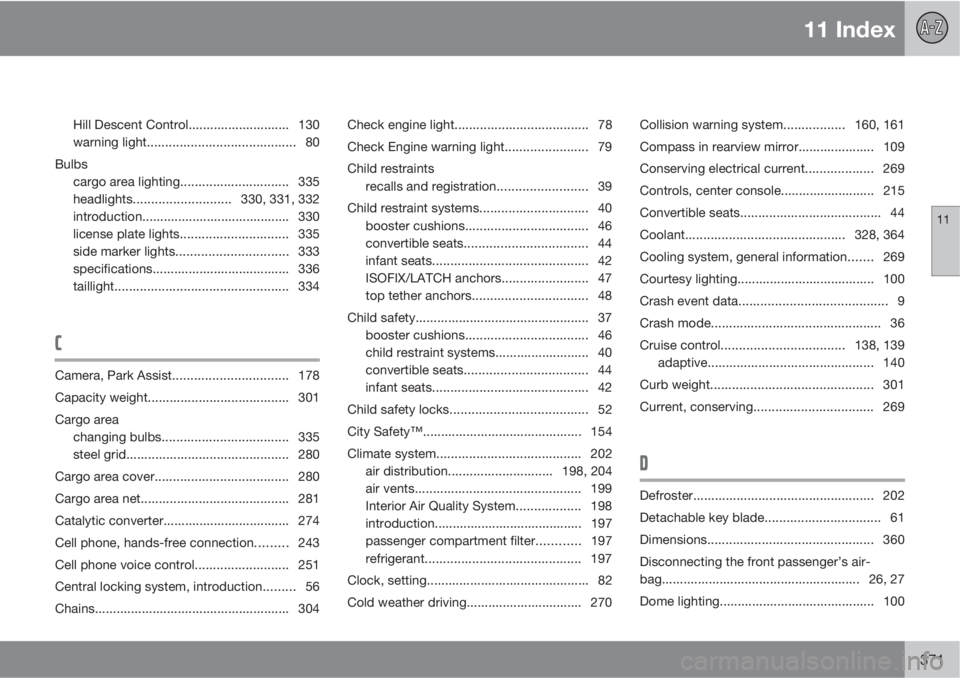
11 Index
11
371
Hill Descent Control............................ 130
warning light......................................... 80
Bulbs
cargo area lighting.............................. 335
headlights...........................330, 331, 332
introduction......................................... 330
license plate lights.............................. 335
side marker lights...............................333
specifications...................................... 336
taillight................................................ 334
C
Camera, Park Assist................................ 178
Capacity weight....................................... 301
Cargo area
changing bulbs................................... 335
steel grid............................................. 280
Cargo area cover..................................... 280
Cargo area net......................................... 281
Catalytic converter................................... 274
Cell phone, hands-free connection......... 243
Cell phone voice control.......................... 251
Central locking system, introduction......... 56
Chains...................................................... 304Check engine light..................................... 78
Check Engine warning light....................... 79
Child restraints
recalls and registration......................... 39
Child restraint systems.............................. 40
booster cushions.................................. 46
convertible seats.................................. 44
infant seats........................................... 42
ISOFIX/LATCH anchors........................ 47
top tether anchors................................ 48
Child safety................................................ 37
booster cushions.................................. 46
child restraint systems.......................... 40
convertible seats.................................. 44
infant seats........................................... 42
Child safety locks...................................... 52
City Safety™............................................ 154
Climate system........................................ 202
air distribution............................. 198, 204
air vents.............................................. 199
Interior Air Quality System.................. 198
introduction......................................... 197
passenger compartment filter............ 197
refrigerant........................................... 197
Clock, setting............................................. 82
Cold weather driving................................ 270Collision warning system.................160, 161
Compass in rearview mirror..................... 109
Conserving electrical current................... 269
Controls, center console.......................... 215
Convertible seats....................................... 44
Coolant............................................328, 364
Cooling system, general information....... 269
Courtesy lighting...................................... 100
Crash event data......................................... 9
Crash mode............................................... 36
Cruise control..................................138, 139
adaptive.............................................. 140
Curb weight............................................. 301
Current, conserving................................. 269
D
Defroster.................................................. 202
Detachable key blade................................ 61
Dimensions.............................................. 360
Disconnecting the front passenger’s air-
bag....................................................... 26, 27
Dome lighting........................................... 100