sport mode VOLVO XC60 2013 Owner´s Manual
[x] Cancel search | Manufacturer: VOLVO, Model Year: 2013, Model line: XC60, Model: VOLVO XC60 2013Pages: 382, PDF Size: 7.08 MB
Page 231 of 382
06 Infotainment
Radio
06
* Option/accessory, for more information, see Introduction.229
In many cases, a main HD Radio station (FM
wavebands only) will also have sub-channels
offering additional types of programming or
music.
In such cases, the “-” symbol will be displayed
to the left of the frequency number and a num-
ber will be displayed to the right of the fre-
quency number indicating that the currently
tuned frequency has at least one sub-channel.
Selecting sub-channelsTo listen to a station's sub-channel(s), press
and hold the right arrow key on the center con-
sole or on the steering wheel keypad for
approximately 1 second. To go back to the
main channel, press and hold the left arrow key
on the center console or on the steering wheel
keypad for approximately 1 second. To go to
subchannel 2 (if available), press and hold the
right arrow key on the center console or on the
steering wheel keypad for approximately
1 second.
If you are currently tuned to a frequency's main
channel, pressing and holding the left arrow
key for approximately 1 second will tune to the
next lower radio frequency.
NOTE
•When the radio has gone into HD mode,
it may take several seconds before the
">" symbol (if the current frequency has
any sub-channels) is displayed to the
left of the frequency. Pressing and hold-
ing the arrow keys for approximately
1 second before the main-/sub-channel
icon is displayed will cause the radio to
tune to the next available radio station,
not to the current station's sub-chan-
nels.
•When you are no longer in broadcasting
range of the currently tuned sub-chan-
nel,
No reception will be displayed.
The radio will then be muted and it will
be necessary to tune to or search for a
new radio station.
Sub-channels can also be stored as presets,
see page 226 for information on storing sta-
tions.
If you press a sub-channel's preset button, it
may take up to 6 seconds before the channel
becomes audible. If you press this button while
you are out of digital range of the transmitter,
No reception will be displayed.
SiriusXM
E satellite radio*
Listening to satellite radio
The SiriusXM
E satellite system consists of a
number of high elevation satellites in geosyn-
chronous orbit.
NOTE
•The digital signals from the satellites are
line-of-sight, which means that physical
obstructions such as bridges, tunnels,
etc, may temporarily interfere with sig-
nal reception.
•Avoid any obstructions, such as metal-
lic objects transported on roof racks or
in a ski box, or other antennas that may
impede signals from the SiriusXM
E
satellites.
Selecting SiriusXM
E radio mode1. With the infotainment system switched on,
press RADIO.
2.
Turn TUNE or the thumb wheel on the
steering wheel keypad to scroll to the
desired waveband (
SAT1 or SAT2) and
press OK/MENU or the thumb wheel on
the steering wheel keypad.
Activating SiriusXM
E radio1. Tune to a satellite channel that has no
audio, which means that the channel is
Page 258 of 382
06 Infotainment
Rear Seat Entertainment (RSE)*
06
256* Option/accessory, for more information, see Introduction.
more of the screens. However, it is not possible
to play a film from USB while a CD or DVD is
being played.
CAUTION
When transporting large objects in the rear
seat, be sure that there is adequate space
between the object(s) and the RSE screens
to help avoid scratching or damaging these
screens.
If necessary, cover the screens with a suit-
able material.
NOTE
•The RSE screens and remote control
may not function in very low or very high
cabin temperatures. They will become
operable again after the climate control
system has created a comfortable tem-
perature in the cabin.
•Keep the IR transceivers' lenses clean
by wiping them regularly with a damp
cloth. A dirty lens could affect the func-
tion of the remote control.
Ignition modes and electrical current to
RSE
RSE can be activated with the ignition in
modes I or II (and when the engine is running).See page 84 for detailed information about the
various ignition modes. If a film is being played,
it will stop momentarily while the engine is
being started and will resume when the engine
is running.
NOTE
Using RSE for more than approx.
10 minutes when the engine is not running
will drain the vehicle's battery and may
make the engine difficult or impossible to
start.
A message will be displayed on the screen
if the battery's charge level becomes too
low.
Using the system's menusSelections in the RSE menus are made using
the remote control. See page 261 for more
information about the RSE menus.
Remote control
A remote control is included with the RSE sys-
tem, which can be used to control both screens
in the rear seat as well as other infotainment
system functions.
See page 264 for more detailed information
about the remote control.
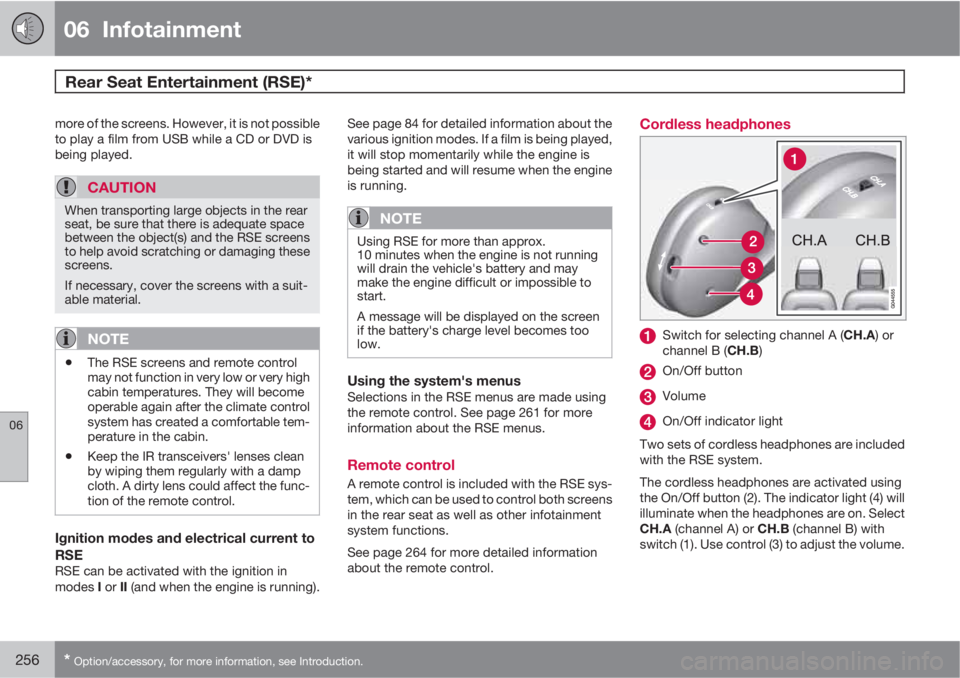
Cordless headphones
Switch for selecting channel A (CH.A) or
channel B (CH.B)
On/Off button
Volume
On/Off indicator light
Two sets of cordless headphones are included
with the RSE system.
The cordless headphones are activated using
the On/Off button (2). The indicator light (4) will
illuminate when the headphones are on. Select
CH.A (channel A) or CH.B (channel B) with
switch (1). Use control (3) to adjust the volume.
Page 270 of 382
07 During your trip
Driving recommendations
07
268
General information
Economical driving conserves natural
resources
Better driving economy may be obtained by
thinking ahead, avoiding rapid starts and stops
and adjusting the speed of your vehicle to
immediate traffic conditions.
Observe the following rules:
•Bring the engine to normal operating tem-
perature as soon as possible by driving
with a light foot on the accelerator pedal for
the first few minutes of operation. A cold
engine uses more fuel and is subject to
increased wear.
•Whenever possible, avoid using the vehicle
for driving short distances. This does not
allow the engine to reach normal operating
temperature.
•Drive carefully and avoid rapid acceleration
and hard braking.
•Use the transmission's Drive (D) position
as often as possible and avoid using kick-
down.
•Using the transmission's Sport mode1 may
increase fuel consumption somewhat. Use
the transmission's Drive (D) position as
often as possible. See page 122 for addi-
tional information about Sport mode.
•Do not exceed posted speed limits.
•Avoid carrying unnecessary items (extra
load) in the vehicle.
•Maintain correct tire pressure. Check tire
pressure regularly (when tires are cold).
•Remove snow tires when threat of snow or
ice has ended.
•Note that roof racks, ski racks, etc,
increase air resistance and also fuel con-
sumption.
•At highway driving speeds, fuel consump-
tion will be lower with the air conditioning
on and the windows closed than with the
air conditioning off and the windows open.
•Using the onboard trip computer's fuel
consumption modes can help you learn
how to drive more economically.
Other factors that decrease gas mileage
are:
•Dirty air cleaner
•Dirty engine oil and clogged oil filter
•Dragging brakes
•Incorrect front end alignment
Some of the above mentioned items and others
are checked at the standard maintenance
intervals.
WARNING
Driving with the tailgate open: Driving with
the tailgate open could lead to poisonous
exhaust gases entering the passenger com-
partment. If the tailgate must be kept open
for any reason, proceed as follows:
•Close the windows
•Set the ventilation system control to air
flow to floor, windshield and side win-
dows and the blower control to its high-
est setting.
Weight distribution affects handlingAt the specified curb weight your vehicle has a
tendency to understeer, which means that the
steering wheel has to be turned more than
might seem appropriate for the curvature of a
bend. This ensures good stability and reduces
the risk of rear wheel skid. Remember that
these properties can alter with the vehicle load.
The heavier the load in the cargo area, the less
the tendency to understeer.
Handling, roadholdingVehicle load, tire design and inflation pressure
all affect vehicle handling. Therefore, check
that the tires are inflated to the recommended
pressure according to the vehicle load. See the
"Tire pressure" section. Loads should be dis-
1Models with the T6 turbo engine only.
Page 294 of 382
08 Wheels and tires
General information
08
292
Introduction
Your vehicle is equipped with tires according
to the vehicle's tire information placard on the
B-pillar (the structural member at the side of
the vehicle, at the rear of the driver's door
opening).
CAUTION
Some Volvo models are equipped with an
Ultra High Performance tire and wheel com-
bination designed to provide maximum dry
pavement performance with consideration
for hydroplaning resistance. They may be
more susceptible to road hazard damage
and, depending on driving conditions, may
achieve a tread life of less than 20,000 miles
(30,000 km). Even if this vehicle is equipped
with Volvo’s advanced AWD or DSTC sys-
tem, these tires are not designed for winter
driving, and should be replaced with winter
tires when weather conditions dictate.
The tires have good road holding characteris-
tics and offer good handling on dry and wet
surfaces. It should be noted however that the
tires have been developed to give these fea-
tures on snow/ice-free surfaces.
Most models are equipped with "all-season"
tires, which provide a somewhat higher degree
of road holding on slippery surfaces than tireswithout the "all-season" rating. However, for
optimum road holding on icy or snow-covered
roads, we recommend suitable winter tires on
all four wheels.
When replacing tires, be sure that the new tires
are the same size designation, type (radial) and
preferably from the same manufacturer, on all
four wheels. Otherwise there is a risk of altering
the car's roadholding and handling characte-
ristics.
New Tires
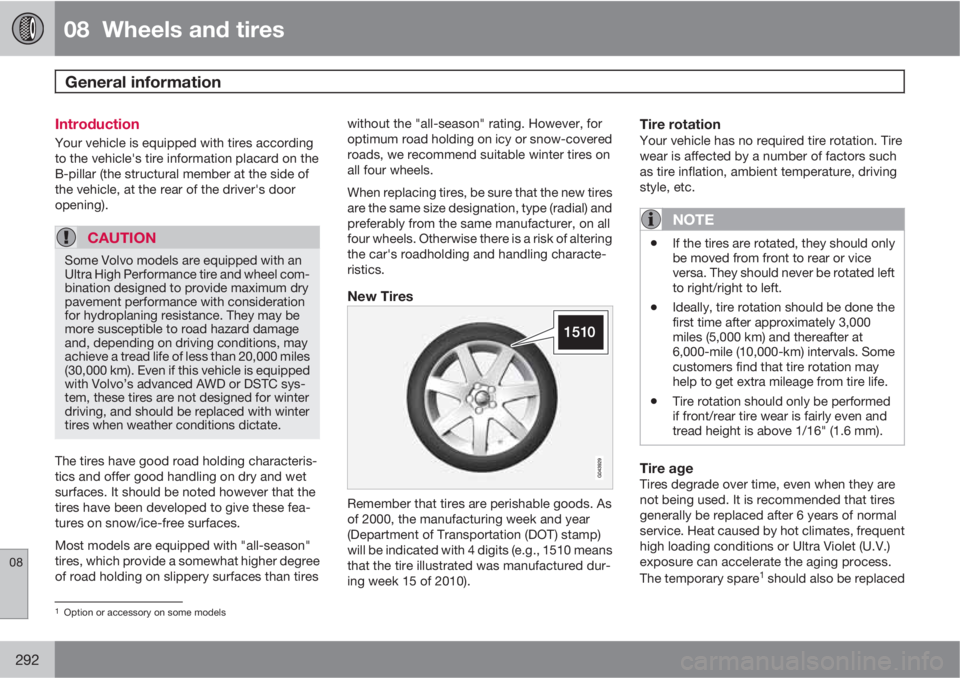
Remember that tires are perishable goods. As
of 2000, the manufacturing week and year
(Department of Transportation (DOT) stamp)
will be indicated with 4 digits (e.g., 1510 means
that the tire illustrated was manufactured dur-
ing week 15 of 2010).
Tire rotationYour vehicle has no required tire rotation. Tire
wear is affected by a number of factors such
as tire inflation, ambient temperature, driving
style, etc.
NOTE
•If the tires are rotated, they should only
be moved from front to rear or vice
versa. They should never be rotated left
to right/right to left.
•Ideally, tire rotation should be done the
first time after approximately 3,000
miles (5,000 km) and thereafter at
6,000-mile (10,000-km) intervals. Some
customers find that tire rotation may
help to get extra mileage from tire life.
•Tire rotation should only be performed
if front/rear tire wear is fairly even and
tread height is above 1/16" (1.6 mm).
Tire ageTires degrade over time, even when they are
not being used. It is recommended that tires
generally be replaced after 6 years of normal
service. Heat caused by hot climates, frequent
high loading conditions or Ultra Violet (U.V.)
exposure can accelerate the aging process.
The temporary spare
1 should also be replaced
1Option or accessory on some models
Page 320 of 382
08 Wheels and tires
Tire Pressure Monitoring System (TPMS)
08
318* Option/accessory, for more information, see Introduction.
tion pressure table on page 297), for example,
if higher inflation pressure is necessary when
transporting heavy loads, etc.
This is done in the vehicle's menu system. See
page 191 for a description of the menu system.
To recalibrate:
1. Switch off the engine.
2. Inflate the tires to the desired pressure and
put the ignition in mode I or II (see page
85 for additional information).
3.
Press the MY CAR key in the center con-
sole control panel and select Settings
Car settingsTyre pressure
4.
Press OK/MENU, select
Calibrate tyre
pressure and press OK/MENU again.
5. Drive the vehicle at a speed above 25 mph
(40 km/h) continuously for at least
10 minutes.
> When the calibration message is no
longer displayed, TPMS has been reca-
librated to the new inflation pressure.
Activating/deactivating TPMS (Canadian
models only)*
1. Switch off the engine.
2.
Put the ignition in mode I or II (see page
85 for additional information).3.
Press the MY CAR key in the center con-
sole control panel and select Settings
Car settingsTyre pressure
4.
Select
Tyre pressure system and press
OK/MENU to turn the system on or off.
Self-supporting run flat tires (SST)*
Self-supporting run flat tires are available as
optional equipment. The vehicle must be
equipped with the Tire Pressure Monitoring
System (TPMS) if tires of this type are installed.
Tires of this type have specially reinforced
sidewalls that make it possible to continue
driving to a limited extent even though the tire
has lost some or all of its inflation pressure.
These tires are mounted on special rims (nor-
mal tires can also be mounted on these rims).
If an SST tire loses inflation pressure, the yel-
low TPMS symbol illuminates in the instrument
panel and a text message is also displayed. If
this happens, reduce speed to not more than
50 mph (80 km/h). The tire should be replaced
as soon as possible.
Drive carefully; it may be difficult to determine
which tire is damaged. To find the damaged
tire, check the inflation pressure in all four tires.
WARNING
•SST tires should only be mounted by
service technicians who are familiar
with tires of this type.
•SST tires may only be mounted on vehi-
cles equipped with TPMS.
•Do not drive faster than 50 mph
(80 km/h) if TPMS indicates that a tire
has lost inflation pressure.
•Do not drive farther than 50 miles
(80 km) before replacing a damaged
SST tire.
•Drive carefully and avoid e.g., hard
braking or fast turns.
•SST tires must be replaced if they are
damaged. A tire of this type cannot be
repaired.
Page 361 of 382
10 Specifications
Label information
10
359 List of labels
Model
plate. Vehicle Identification Number (VIN).
Codes for color and upholstery, etc. The
model plate is located on the rear side of
the B-pillar (the pillar between the front and
rear passenger doors) and the rear pas-
senger's door must be open in order to see
it.
Federal Motor Vehicle Safety Standards
(FMVSS) specifications (USA) and Min-
istry of Transport (CMVSS) standards
(Canada). Your Volvo is designed to meet
all applicable safety standards, as evi-
denced by the certification label on the
driver's side B-pillar (the structural mem-
ber at the side of the vehicle, at the rear of
the driver's door opening). For further infor-
mation regarding these regulations, please
consult your Volvo retailer.
Tire inflation
pressures. This label indicates the correct
inflation pressures for the tires that were on
the vehicle when it left the factory. Cana-
dian models have the upper decal; U.S.
models have the lower one.
Vehicle Identification Number
(VIN). The VIN plate is located on the top
left surface of the dashboard. The Vehicle
Identification Number (VIN) should always
be quoted in all correspondence concern-
ing your vehicle with the retailer and when
ordering parts.
Vehicle Emission Control Information.
Your Volvo is designed to meet all appli-
cable emission standards, as evidenced by
the certification label on the underside of
the hood. For further information regarding
these regulations, please consult your
Volvo retailer.