ECU VOLVO XC60 2013 Owner´s Manual
[x] Cancel search | Manufacturer: VOLVO, Model Year: 2013, Model line: XC60, Model: VOLVO XC60 2013Pages: 382, PDF Size: 7.08 MB
Page 314 of 382
08 Wheels and tires
Changing a wheel
08
312* Option/accessory, for more information, see Introduction.
Removing a wheel
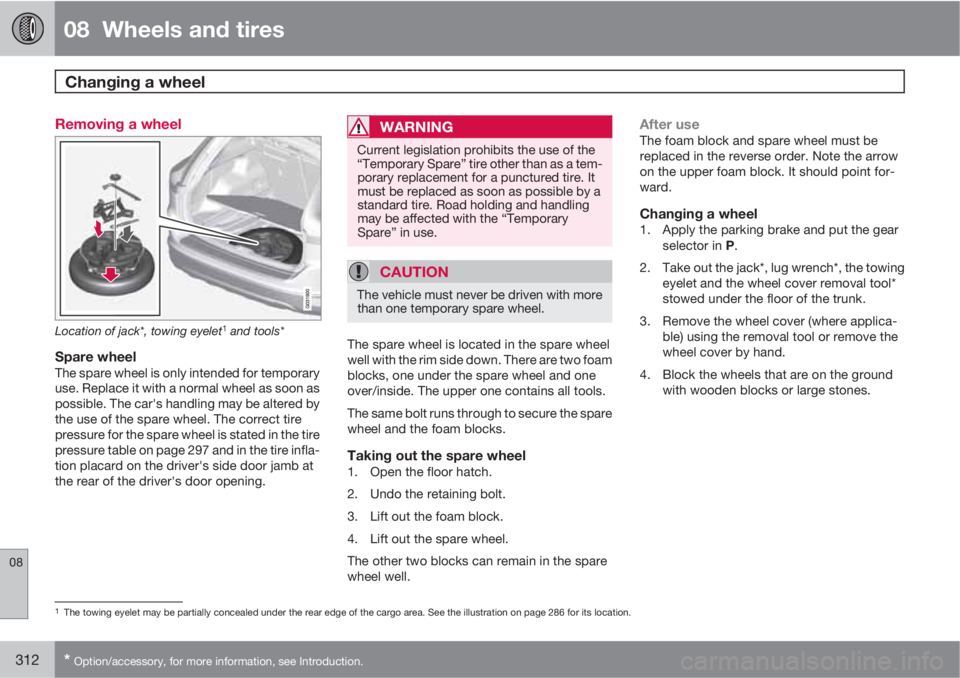
Location of jack*, towing eyelet1 and tools*
Spare wheelThe spare wheel is only intended for temporary
use. Replace it with a normal wheel as soon as
possible. The car's handling may be altered by
the use of the spare wheel. The correct tire
pressure for the spare wheel is stated in the tire
pressure table on page 297 and in the tire infla-
tion placard on the driver's side door jamb at
the rear of the driver's door opening.
WARNING
Current legislation prohibits the use of the
“Temporary Spare” tire other than as a tem-
porary replacement for a punctured tire. It
must be replaced as soon as possible by a
standard tire. Road holding and handling
may be affected with the “Temporary
Spare” in use.
CAUTION
The vehicle must never be driven with more
than one temporary spare wheel.
The spare wheel is located in the spare wheel
well with the rim side down. There are two foam
blocks, one under the spare wheel and one
over/inside. The upper one contains all tools.
The same bolt runs through to secure the spare
wheel and the foam blocks.
Taking out the spare wheel1. Open the floor hatch.
2. Undo the retaining bolt.
3. Lift out the foam block.
4. Lift out the spare wheel.
The other two blocks can remain in the spare
wheel well.
After useThe foam block and spare wheel must be
replaced in the reverse order. Note the arrow
on the upper foam block. It should point for-
ward.
Changing a wheel1. Apply the parking brake and put the gear
selector in P.
2. Take out the jack*, lug wrench*, the towing
eyelet and the wheel cover removal tool*
stowed under the floor of the trunk.
3. Remove the wheel cover (where applica-
ble) using the removal tool or remove the
wheel cover by hand.
4. Block the wheels that are on the ground
with wooden blocks or large stones.
1The towing eyelet may be partially concealed under the rear edge of the cargo area. See the illustration on page 286 for its location.
Page 333 of 382
09 Maintenance and specifications
Replacing bulbs09
331
NOTE
•Always switch off the ignition before
starting to replace a bulb.
•The optional Active Bending Light bulbs
contain trace amounts of mercury.
These bulbs should always be disposed
of by a trained and qualified Volvo serv-
ice technician.
Removing the headlight housing1. Switch off the ignition by briefly pressing
the START/STOP ENGINE button.
2. Remove the remote key from the ignition
slot
1.
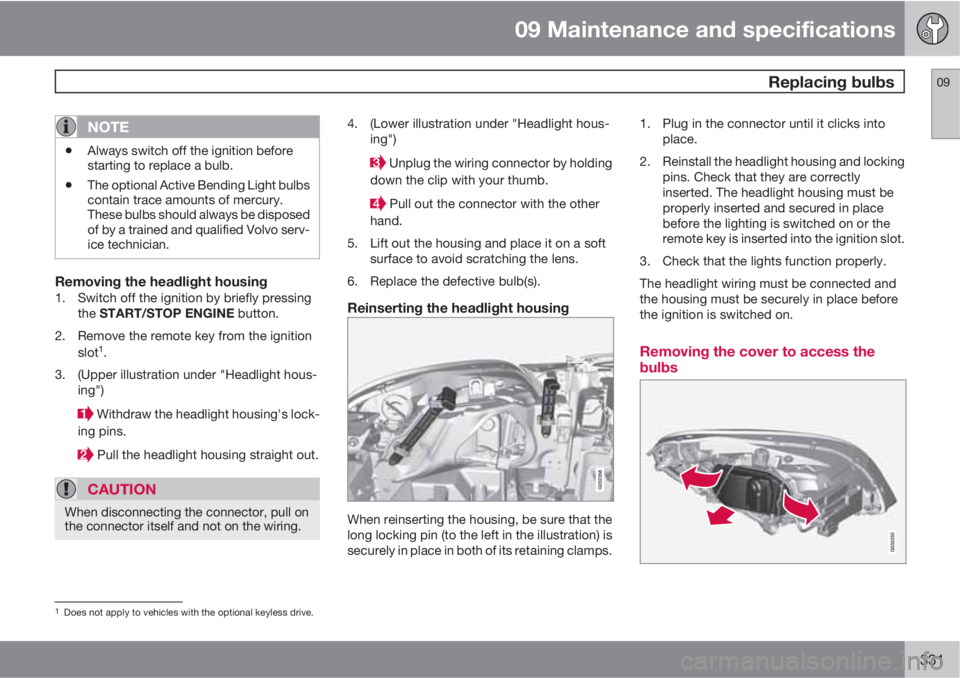
3. (Upper illustration under "Headlight hous-
ing")
Withdraw the headlight housing's lock-
ing pins.
Pull the headlight housing straight out.
CAUTION
When disconnecting the connector, pull on
the connector itself and not on the wiring.
4. (Lower illustration under "Headlight hous-
ing")
Unplug the wiring connector by holding
down the clip with your thumb.
Pull out the connector with the other
hand.
5. Lift out the housing and place it on a soft
surface to avoid scratching the lens.
6. Replace the defective bulb(s).
Reinserting the headlight housing
When reinserting the housing, be sure that the
long locking pin (to the left in the illustration) is
securely in place in both of its retaining clamps.1. Plug in the connector until it clicks into
place.
2. Reinstall the headlight housing and locking
pins. Check that they are correctly
inserted. The headlight housing must be
properly inserted and secured in place
before the lighting is switched on or the
remote key is inserted into the ignition slot.
3. Check that the lights function properly.
The headlight wiring must be connected and
the housing must be securely in place before
the ignition is switched on.
Removing the cover to access the
bulbs
1Does not apply to vehicles with the optional keyless drive.
Page 334 of 382
09 Maintenance and specifications
Replacing bulbs 09
332
NOTE
Before starting to replace a bulb, see
page 330.
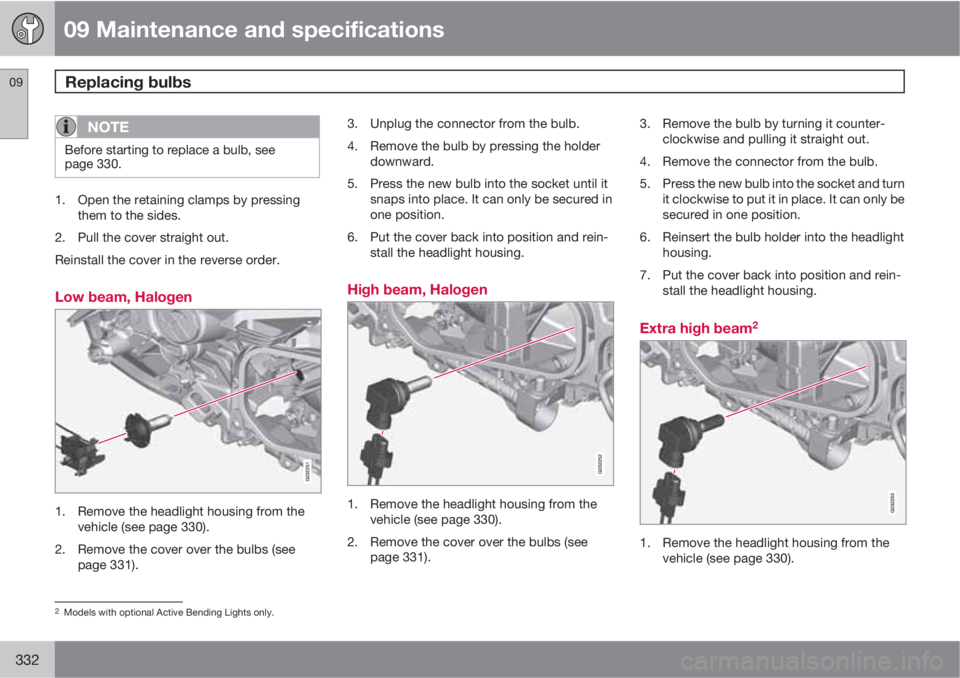
1. Open the retaining clamps by pressing
them to the sides.
2. Pull the cover straight out.
Reinstall the cover in the reverse order.
Low beam, Halogen
1. Remove the headlight housing from the
vehicle (see page 330).
2. Remove the cover over the bulbs (see
page 331).3. Unplug the connector from the bulb.
4. Remove the bulb by pressing the holder
downward.
5. Press the new bulb into the socket until it
snaps into place. It can only be secured in
one position.
6. Put the cover back into position and rein-
stall the headlight housing.
High beam, Halogen
1. Remove the headlight housing from the
vehicle (see page 330).
2. Remove the cover over the bulbs (see
page 331).3. Remove the bulb by turning it counter-
clockwise and pulling it straight out.
4. Remove the connector from the bulb.
5. Press the new bulb into the socket and turn
it clockwise to put it in place. It can only be
secured in one position.
6. Reinsert the bulb holder into the headlight
housing.
7. Put the cover back into position and rein-
stall the headlight housing.
Extra high beam2
1. Remove the headlight housing from the
vehicle (see page 330).
2Models with optional Active Bending Lights only.
Page 340 of 382
09 Maintenance and specifications
Wiper blades and washer fluid 09
338
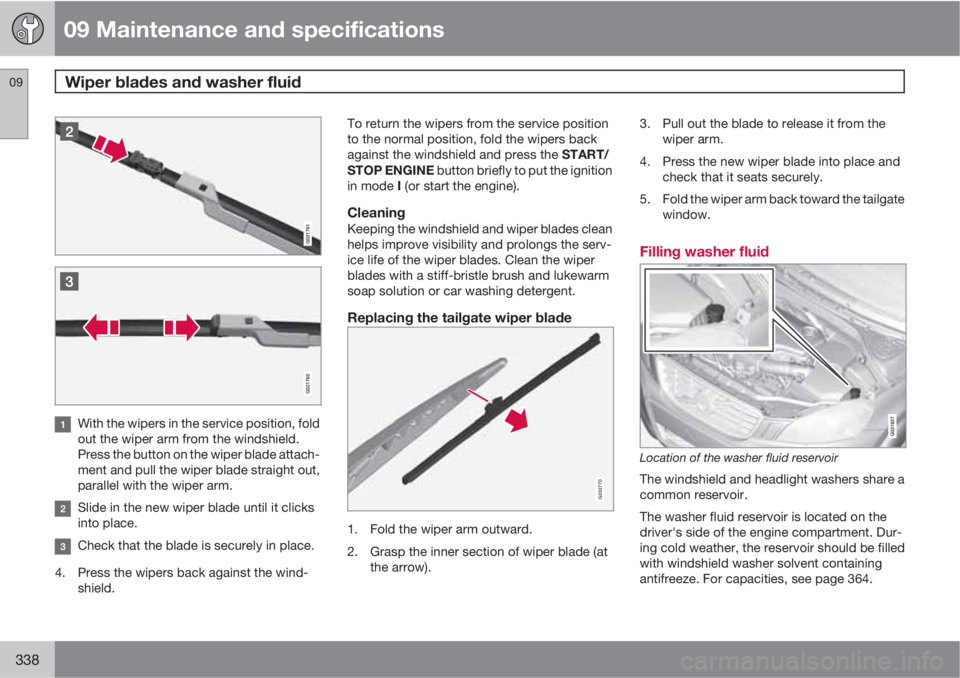
With the wipers in the service position, fold
out the wiper arm from the windshield.
Press the button on the wiper blade attach-
ment and pull the wiper blade straight out,
parallel with the wiper arm.
Slide in the new wiper blade until it clicks
into place.
Check that the blade is securely in place.
4. Press the wipers back against the wind-
shield.To return the wipers from the service position
to the normal position, fold the wipers back
against the windshield and press the START/
STOP ENGINE button briefly to put the ignition
in mode I (or start the engine).
CleaningKeeping the windshield and wiper blades clean
helps improve visibility and prolongs the serv-
ice life of the wiper blades. Clean the wiper
blades with a stiff-bristle brush and lukewarm
soap solution or car washing detergent.
Replacing the tailgate wiper blade
G032770
1. Fold the wiper arm outward.
2. Grasp the inner section of wiper blade (at
the arrow).3. Pull out the blade to release it from the
wiper arm.
4. Press the new wiper blade into place and
check that it seats securely.
5. Fold the wiper arm back toward the tailgate
window.
Filling washer fluid
Location of the washer fluid reservoir
The windshield and headlight washers share a
common reservoir.
The washer fluid reservoir is located on the
driver's side of the engine compartment. Dur-
ing cold weather, the reservoir should be filled
with windshield washer solvent containing
antifreeze. For capacities, see page 364.
Page 342 of 382
09 Maintenance and specifications
Battery 09
340
WARNING
•Never expose the battery to open flame
or electric spark.
•Do not smoke near the battery.
•Battery fluid contains sulfuric acid. Do
not allow battery fluid to contact eyes,
skin, fabrics or painted surfaces. If con-
tact occurs, flush the affected area
immediately with water. Obtain medical
help immediately if eyes are affected.
NOTE
The life of the battery is shortened if it
becomes discharged repeatedly.
Maintenance
•Use a screw driver to open the caps or
cover and a flashlight to inspect the level.
•If necessary, add distilled water. The level
should never be above the indicator.
•The fluid level should be checked if the
battery has been recharged.
•After inspection, be sure the cap over each
battery cell or the cover is securely in
place.
•Check that the battery cables are correctly
connected and properly tightened.
•Never disconnect the battery when the
engine is running, or when the key is in the
ignition. This could damage the vehicle's
electrical system.
•The battery should be disconnected from
the vehicle when a battery charger is used
directly on the battery.
•To help keep the battery in good condition,
the vehicle should be driven for at least 15
minutes a week or connected to a charger
with an automatic charging function.
•If the battery is fully discharged a number
of times, this may shorten its service life.
Keeping the battery fully charged helps
prolong its service life.
•The service life of a battery is affected by
factors such as driving conditions and cli-
mate. Extreme cold may also further
decrease the battery’s starting capacity.
•Because the battery’s starting capacity
decreases with time, it may be necessary
to recharge it if the vehicle is not driven for
an extended period of time or if the vehicle
is usually only driven short distances.
CAUTION
•Always use distilled or deionized water
(battery water).
•Never fill above the level mark in the cell.
Changing
Page 343 of 382
09 Maintenance and specifications
Battery09
341
WARNING
Connect and disconnect the positive and
negative cables in the correct sequence.
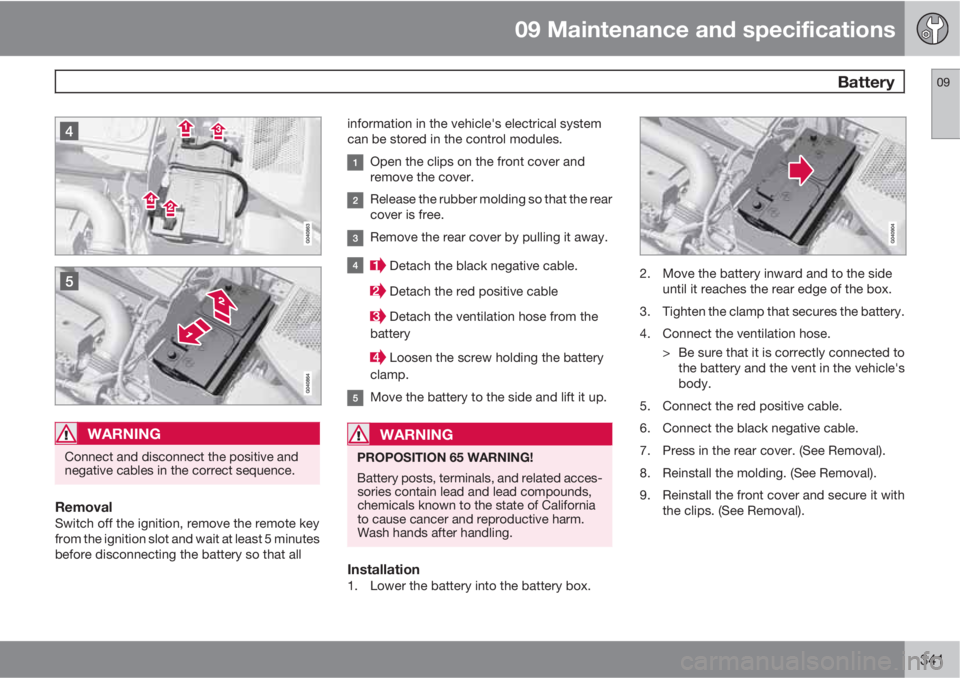
RemovalSwitch off the ignition, remove the remote key
from the ignition slot and wait at least 5 minutes
before disconnecting the battery so that allinformation in the vehicle's electrical system
can be stored in the control modules.
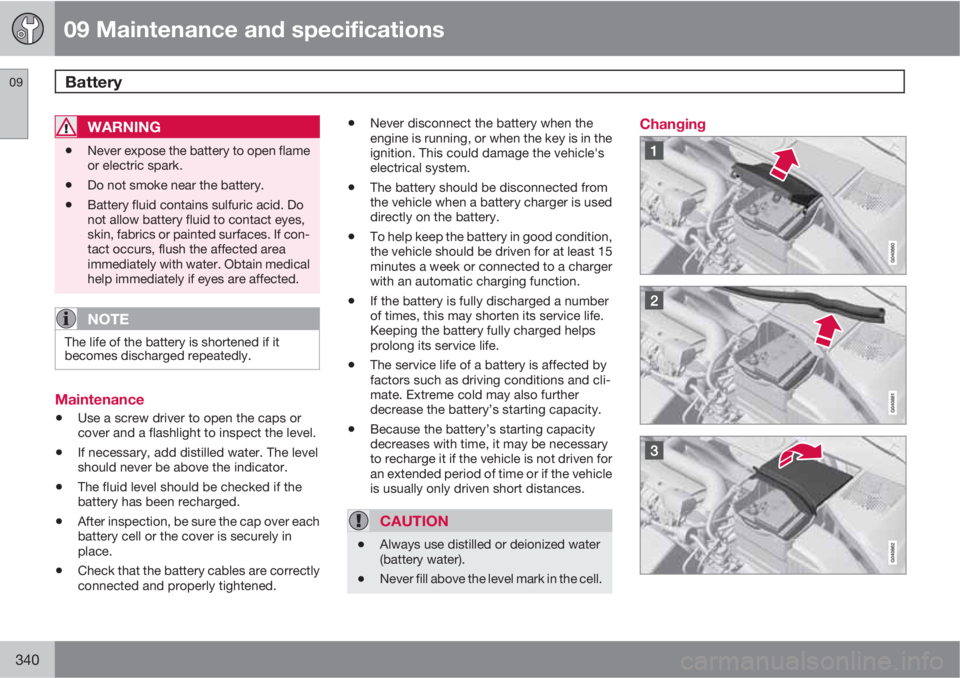
Open the clips on the front cover and
remove the cover.
Release the rubber molding so that the rear
cover is free.
Remove the rear cover by pulling it away.
Detach the black negative cable.
Detach the red positive cable
Detach the ventilation hose from the
battery
Loosen the screw holding the battery
clamp.
Move the battery to the side and lift it up.
WARNING
PROPOSITION 65 WARNING!
Battery posts, terminals, and related acces-
sories contain lead and lead compounds,
chemicals known to the state of California
to cause cancer and reproductive harm.
Wash hands after handling.
Installation1. Lower the battery into the battery box.
2. Move the battery inward and to the side
until it reaches the rear edge of the box.
3. Tighten the clamp that secures the battery.
4. Connect the ventilation hose.
> Be sure that it is correctly connected to
the battery and the vent in the vehicle's
body.
5. Connect the red positive cable.
6. Connect the black negative cable.
7. Press in the rear cover. (See Removal).
8. Reinstall the molding. (See Removal).
9. Reinstall the front cover and secure it with
the clips. (See Removal).
Page 353 of 382
09 Maintenance and specifications
Vehicle care09
351
CAUTION
•Avoid waxing or polishing plastic or rub-
ber components
•Polishing chromed strips can wear
away or damage the surface
•Polishes containing abrasive sub-
stances should not be used
Automatic car wash
•We do NOT recommend washing your car
in an automatic wash during the first few
months (because the paint will not have
hardened sufficiently).
•An automatic wash is a simple and quick
way to clean your car, but it is worth
remembering that it may not be as thor-
ough as when you yourself go over the car
with sponge and water. Keeping the under-
body clean is most important, especially in
the winter. Some automatic washers do
not have facilities for washing the under-
body.
CAUTION
•Before driving into an automatic car
wash, turn off the optional rain sensor to
avoid damaging the windshield wipers.
•Make sure that side view mirrors, auxil-
iary lamps, etc, are secure, and that any
antenna(s) are retracted or removed.
Otherwise there is risk of the machine
dislodging them.
•Chromed wheels: Clean chrome-
plated wheels using the same deter-
gents used for the body of the vehicle.
Aggressive wheel-cleaning agents can
permanently stain chrome-plated
wheels.
WARNING
•When the vehicle is driven immediately
after being washed, apply the brakes,
including the parking brake, several
times in order to remove any moisture
from the brake linings.
•Engine cleaning agents should not be
used when the engine is warm. This
constitutes a fire risk.
Exterior lightingCondensation may form temporarily on the
inside of the lenses of exterior lights such as
headlights, fog lights, or taillights. This is nor-mal and the lights are designed to withstand
moisture. Normally, condensation will dissi-
pate after the lights have been on for a short
time.
Polishing and waxing
•Normally, polishing is not required during
the first year after delivery, however, wax-
ing may be beneficial.
•Before applying polish or wax the vehicle
must be washed and dried. Tar spots can
be removed with kerosene or tar remover.
Difficult spots may require a fine rubbing
compound.
•After polishing use liquid or paste wax.
•Several commercially available products
contain both polish and wax.
•Waxing alone does not substitute for pol-
ishing a dull surface.
•A wide range of polymer-based waxes can
be purchased today. These waxes are easy
to use and produce a long-lasting, high-
gloss finish that protects the bodywork
against oxidation, road dirt and fading.
•Do not polish or wax your vehicle in direct
sunlight (the surface of the vehicle should
not be warmer than 113 °F (45 °C).
Page 378 of 382
11 Index
11
376
Remote key/PCC
common functions................................ 59
Reporting safety defects............................ 17
Roadside Assistance............................... 369
Road sign information (RSI)..................... 136
Rollover Protection System (ROPS).......... 35
Roll Stability Control (RSC)........................ 35
Roof loads............................................... 279
S
Safety, occupant........................................ 16
Safety defects, reporting........................... 17
Seat belt
reminder................................................ 19
Seat belts
Automatic locking retractor/Emergency
locking retractor.................................... 38
buckling................................................ 18
maintenance......................................... 18
pretensioners........................................ 18
reminder................................................ 18
reminder warning light.......................... 80
securing child restraint systems 42, 44, 46
unbuckling............................................ 18use during pregnancy........................... 20
using.....................................................18
Seats, front.......................................... 86, 87
Sensus.....................................................188
Shiftlock....................................................... 9
override............................................... 123
Side door mirrors..................................... 107
Side impact airbags................................... 30
Side marker lights, changing bulbs......... 333
Sign information (RSI).............................. 136
SiriusXM
E satellite radio......................... 229
Snow chains............................................ 304
Snow tires................................................ 304
Spare tire................................................. 305
Speed-dependent steering...................... 207
Spin control............................................. 134
SRS............................................................ 21
Stability system...............................134, 135
Engine Drag Control (EDC).................134
indicator light........................................ 79
Starting the engine..................................116
remote start........................................ 118
with keyless drive...............................116Starting the vehicle
after a crash (crash mode)....................36
Start inhibitor (immobilizer)........................ 58
Steel grid in cargo area............................ 280
Steering wheel
adjusting............................................... 93
horn....................................................... 93
keypad.................................. 93, 191, 216
Stone chips, touching up......................... 354
Storage spaces........................................ 208
Studded tires........................................... 304
Sunroof
laminated panoramic roof................... 110
Supplemental restraint system.................. 21
warning light......................................... 80
Symbols, overview................................... 366
T
Tailgate
driving with it open.............................268
locking/unlocking.................................. 68
opening manually................................. 69