belt VOLVO XC60 2013 Owner´s Manual
[x] Cancel search | Manufacturer: VOLVO, Model Year: 2013, Model line: XC60, Model: VOLVO XC60 2013Pages: 382, PDF Size: 7.08 MB
Page 147 of 382
04 Driver support
Adaptive Cruise Control (ACC)*
04
* Option/accessory, for more information, see Introduction.145
Please note that the lowest speed that can be
set is 18 mph (30 km/h), although ACC can
maintain a set speed/distance to a vehicle
ahead down to a standstill. Queue Assist con-
sists of the following features:
Enhanced speed interval
NOTE
The driver's door must be closed and the
driver's seat belt must be fastened before
ACC can be put in active mode. If the driv-
er's seat belt is taken off or if the driver's
door is opened, ACC will return to standby
mode.
Your vehicle can maintain the set time interval
to the vehicle ahead at any permissible speed,
including a complete stop.
In order to activate ACC at speeds below
18 mph (30 km/h):
•The vehicle ahead must be within a rea-
sonable distance (not farther away than
approx. 100 ft/30 meters)
•The lowest speed that can be selected is
18 mph (30 km/h), although ACC will also
help maintain the set time interval to the
vehicle ahead at lower speeds, including a
complete stop.During short stops (less than approximately
3 seconds) in slow-moving traffic, your vehicle
will begin moving again automatically as soon
as the vehicle ahead begins to move.
If it takes more than 3 seconds for the vehicle
ahead to begin moving, ACC will be automati-
cally go into standby mode.
The driver will then have to reactivate ACC in
one of the following ways:
•By pressing
•By accelerating up to at least 3 mph
(4 km/h). ACC will then resume following
the vehicle ahead.
Your vehicle will then resume following the
vehicle ahead at the set time interval.
NOTE
ACC can remain active and keep your vehi-
cle at a standstill for up to 4 minutes. After
4 minutes have elapsed, the parking brake
will be engaged and ACC will go into
standby mode.
To reactivate ACC, the driver must release
the parking brake (see page 128).
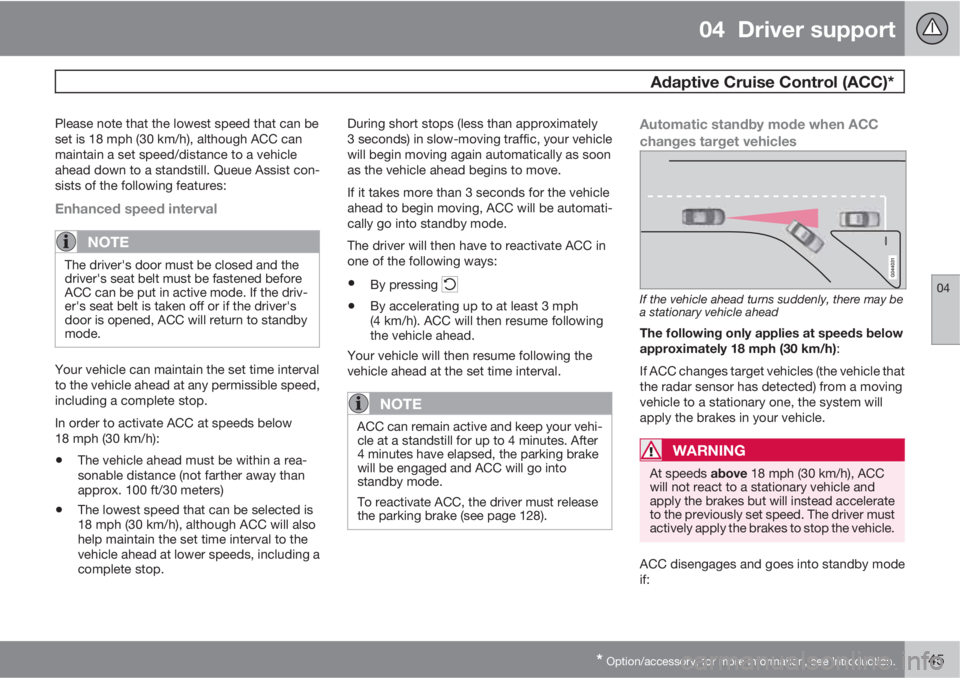
Automatic standby mode when ACC
changes target vehicles
If the vehicle ahead turns suddenly, there may be
a stationary vehicle ahead
The following only applies at speeds below
approximately 18 mph (30 km/h):
If ACC changes target vehicles (the vehicle that
the radar sensor has detected) from a moving
vehicle to a stationary one, the system will
apply the brakes in your vehicle.
WARNING
At speeds above 18 mph (30 km/h), ACC
will not react to a stationary vehicle and
apply the brakes but will instead accelerate
to the previously set speed. The driver must
actively apply the brakes to stop the vehicle.
ACC disengages and goes into standby mode
if:
Page 148 of 382
04 Driver support
Adaptive Cruise Control (ACC)*
04
146* Option/accessory, for more information, see Introduction.
•Your vehicle's speed goes below 10 mph
(15 km/h) and ACC cannot determine if the
target object is a stationary vehicle or some
other type of object such as e.g., a speed
bump.
•Your vehicle's speed goes below 10 mph
(15 km/h) and the vehicle ahead turns so
that ACC no longer has a target vehicle to
follow.
No automatic braking when at a
standstill
In certain situations, ACC will no longer apply
the brakes and go into standby mode while the
vehicle is not moving. This means that the
driver will have to apply the brakes.
This happens if:
•The driver presses the brake pedal
•The parking brake is activated
•The gear selected is moved to P,N or R
•The driver presses the button to put
ACC in standby mode
The parking brake is applied
automatically
In certain situations, ACC will apply the parking
brake in order to continue keeping the vehicle
at a standstill.
This happens if:
•The driver opens the door or takes off
his/her seat belt
•DSTC is put in Sport mode (see page 134)
•ACC has kept the vehicle at a standstill for
more than 2 minutes
•The engine has been switched off
•The brakes have overheated
Turning ACC off completely
•From standby mode, press once.
•From active mode, press twice.
The set speed and time interval are then
cleared from the system's memory and cannot
be resumed by pressing
.
The radar sensor and its limitations
In addition to being used by ACC, the radar
sensor is also used by Distance Alert (see
page 151) and Collision Warning with Full
Auto-brake and Pedestrian Detection (see
page 160). This sensor is designed to detect
cars or larger vehicles driving in the same
direction as your vehicle, in the same lane.
WARNING
Accessories or other objects, such as extra
headlights, must not be installed in front of
the grille.
Modification of the radar sensor could make
its use illegal.
The radar sensor's capacity to detect vehicles
ahead is impeded:
•if the radar sensor is obstructed and can-
not detect other vehicles, for example in
heavy rain, or if snow or other objects are
obscuring the radar sensor.
NOTE
Keep the area in front of the radar sensor
clean.
•if the speed of vehicles ahead is signifi-
cantly different from your own speed.
Page 272 of 382
07 During your trip
Driving recommendations
07
270
the ignition switched off, which drains the
battery.
Before a long distance tripIt is always worthwhile to have your vehicle
checked by a trained and qualified Volvo serv-
ice technician before driving long distances.
Your retailer will also be able to supply you with
bulbs, fuses, spark plugs and wiper blades for
your use in the event that problems occur.
As a minimum, the following items should be
checked before any long trip:
•Check that engine runs smoothly and that
fuel consumption is normal.
•Check for fuel, oil, and fluid leakage.
•Have the transmission oil level checked.
•Check condition of drive belts.
•Check state of the battery's charge.
•Examine tires carefully (the spare tire as
well), and replace those that are worn.
Check tire pressures.
•The brakes, front wheel alignment, and
steering gear should be checked by a
trained and qualified Volvo service techni-
cian only.
•Check all lights, including high beams.
•Reflective warning triangles are legally
required in some states/provinces.
•Have a word with a trained and qualified
Volvo service technician if you intend to
drive in countries where it may be difficult
to obtain the correct fuel.
•Consider your destination. If you will be
driving through an area where snow or ice
are likely to occur, consider snow tires.
Cold weather precautionsIf you wish to check your vehicle before the
approach of cold weather, the following advice
is worth noting:
•Make sure that the engine coolant contains
50 percent antifreeze. Any other mixture
will reduce freeze protection. This gives
protection against freezing down to
–31 °F (–35 °C). The use of "recycled" anti-
freeze is not approved by Volvo. Different
types of antifreeze must not be mixed.
•Volvo recommends using only genuine
Volvo antifreeze in your vehicle's radiator.
•Try to keep the fuel tank well filled – this
helps prevent the formation of condensa-
tion in the tank. In addition, in extremely
cold weather conditions it is worthwhile to
add fuel line de-icer before refueling.
•The viscosity of the engine oil is important.
Oil with low viscosity (thinner oil) improves
cold-weather starting as well as decreas-
ing fuel consumption while the engine is
warming up. 0W-30 oil is recommended fordriving in areas with sustained low temper-
atures.
•The load placed on the battery is greater
during the winter since the windshield wip-
ers, lighting, etc., are used more often.
Moreover, the capacity of the battery
decreases as the temperature drops. In
very cold weather, a poorly charged bat-
tery can freeze and be damaged. It is there-
fore advisable to check the state of charge
more frequently and spray an anti-rust oil
on the battery posts.
•Volvo recommends the use of snow tires
on all four wheels for winter driving, see
page 304.
•To prevent the washer fluid reservoir from
freezing, add washer solvents containing
antifreeze. This is important since dirt is
often splashed on the windshield during
winter driving, requiring the frequent use of
the washers and wipers. Volvo Washer
Solvent should be diluted as follows: Down
to 14 °F (–10 °C): 1 part washer solvent and
4 parts water Down to 5 °F (–15 °C): 1 part
washer solvent and 3 parts water Down to
0 °F (–18 °C): 1 part washer solvent and
2 parts water Down to –18 °F (–28 °C):
1 part washer solvent and 1 part water.
•Use Volvo Teflon Lock Spray in the locks.
•Avoid using de-icing sprays as they can
cause damage to the locks.
Page 280 of 382
07 During your trip
Loading
07
278* Option/accessory, for more information, see Introduction.
ing the outer handle twice. The tailgate can
then be opened/closed manually.
Folding down the rear seat backrests
The rear seat backrests can be folded down for
additional loading space, see page 91.
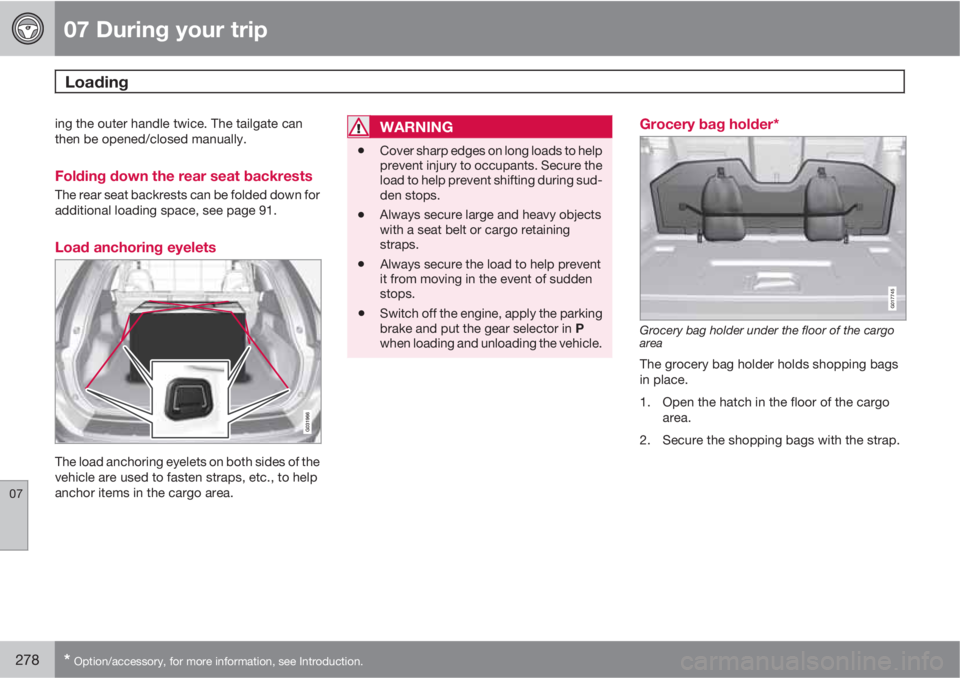
Load anchoring eyelets
The load anchoring eyelets on both sides of the
vehicle are used to fasten straps, etc., to help
anchor items in the cargo area.
WARNING
•Cover sharp edges on long loads to help
prevent injury to occupants. Secure the
load to help prevent shifting during sud-
den stops.
•Always secure large and heavy objects
with a seat belt or cargo retaining
straps.
•Always secure the load to help prevent
it from moving in the event of sudden
stops.
•Switch off the engine, apply the parking
brake and put the gear selector in P
when loading and unloading the vehicle.
Grocery bag holder*
G017745
Grocery bag holder under the floor of the cargo
area
The grocery bag holder holds shopping bags
in place.
1. Open the hatch in the floor of the cargo
area.
2. Secure the shopping bags with the strap.
Page 324 of 382
09 Maintenance and specifications
Volvo maintenance 09
322
Introduction
Volvo advises you to follow the maintenance
program outlined in the Warranty and Service
Records Information booklet. This mainte-
nance program contains inspections and serv-
ices necessary for the proper function of your
vehicle. The maintenance services contain
several checks that require special tools and
training, and therefore must be performed by a
qualified technician. To keep your Volvo in top
condition, specify time-tested and proven
Genuine Volvo Parts and Accessories.
The Federal Clean Air Act – U.S.The Federal Clean Air Act requires vehicle
manufacturers to furnish written instructions to
the ultimate purchaser to assure the proper
servicing and function of the components that
control emissions. These services, which are
listed in the "Warranty and Service Records
Information" booklet, are not covered by the
warranty. You will be required to pay for labor
and material used.
MaintenanceYour Volvo passed several major inspections
before it was delivered to you, in accordance
with Volvo specifications. The maintenance
procedures outlined in the Warranty and Serv-
ice Records Information booklet, many of
which will positively affect your vehicle's emis-
sions, should be performed as indicated. It isrecommended that receipts for vehicle emis-
sion maintenance be retained in case ques-
tions arise concerning maintenance. Inspec-
tion and maintenance should also be per-
formed anytime a malfunction is observed or
suspected.
Applicable warranties – U.S./CanadaIn accordance with applicable U.S. and Cana-
dian regulations, the following list of warranties
is provided.
•New Vehicle Limited Warranty
•Parts and Accessories Limited Warranty
•Corrosion Protection Limited Warranty
•Seat Belt and Supplemental Restraint Sys-
tems Limited Warranty
•Emission Design and Defect Warranty
•Emission Performance Warranty
These are the federal warranties; other warran-
ties are provided as required by state/provin-
cial law. Refer to your separate Warranty and
Service Records Information booklet for
detailed information concerning each of the
warranties.
Periodic maintenance helps minimize
emissions
Periodic maintenance will help keep your vehi-
cle running well. Your Warranty and Service
Records Information booklet provides a com-prehensive periodic maintenance schedule up
to 150,000 miles (240,000 km) of vehicle main-
tenance. The schedule includes components
that affect vehicle emissions. This page
describes some of the emission-related com-
ponents.
Page 355 of 382
09 Maintenance and specifications
Vehicle care09
353
CAUTION
•Under no circumstances should gaso-
line, naphtha or similar cleaning agents
be used on the plastic or the leather
since these can cause damage.
•Take extra care when removing stains
such as ink or lipstick since the coloring
can spread.
•Use solvents sparingly. Too much sol-
vent can damage the seat padding.
•Start from the outside of the stain and
work toward the center.
•Sharp objects (e.g. pencils or pens in a
pocket) or Velcro fasteners on clothing
may damage the textile upholstery.
•Clothing that is not colorfast, such as
new jeans or suede garments, may stain
the upholstery.
Cleaning a leather-covered steering
wheel
•Remove soil, dust, etc., with a damp
sponge and a neutral soap solution.
•Leather should be allowed to breath. Never
cover the steering wheel with a plastic pro-
tector.
•Volvo recommends cleaning, protecting
and conditioning the steering wheel withVolvo's Leather Care Kit 951 0251 and
Leather Softener 943 7429.
If there are stains on the steering wheel:
Type 1 (ink, wine, coffee, milk, sweat or blood)
–Use a soft cloth or sponge. Wipe the wheel
with a solution with 5% ammonia. For
blood stains, mix approx. 1 cup (2 dl) of
water and one ounce (25g) of salt and wipe
the stain.
Type 2 (fat, oil, sauces, or chocolate)
1. Same procedure as for type I stains.
2. Finish by rubbing the wheel with absorbent
paper or a towel.
Type 3 (dry soil or dust)
1. Remove the soil/dust with a soft brush.
2. Same procedure as for type I stains.
CAUTION
Sharp objects, such as rings, could damage
the leather on the steering wheel.
Cleaning the seat beltsClean only with lukewarm water and a mild
soap solution.
Cleaning floor matsThe floor mats should be vacuumed or brushed
clean regularly, especially during winter when
they should be taken out for drying. Spots on
textile mats can be removed with a mild deter-
gent. For best protection in winter, Volvo rec-
ommends the use of Volvo rubber floor mats.
Consult your Volvo retailer.
Spots on interior plastic, metal, or wood
surfaces
Cleaning interior plastic components should
be done with a cleaning agent specially
designed for this purpose. Consult your Volvo
retailer.
Page 368 of 382
10 Specifications
Overview of information and warning symbols
10
366* Option/accessory, for more information, see Introduction.
Introduction
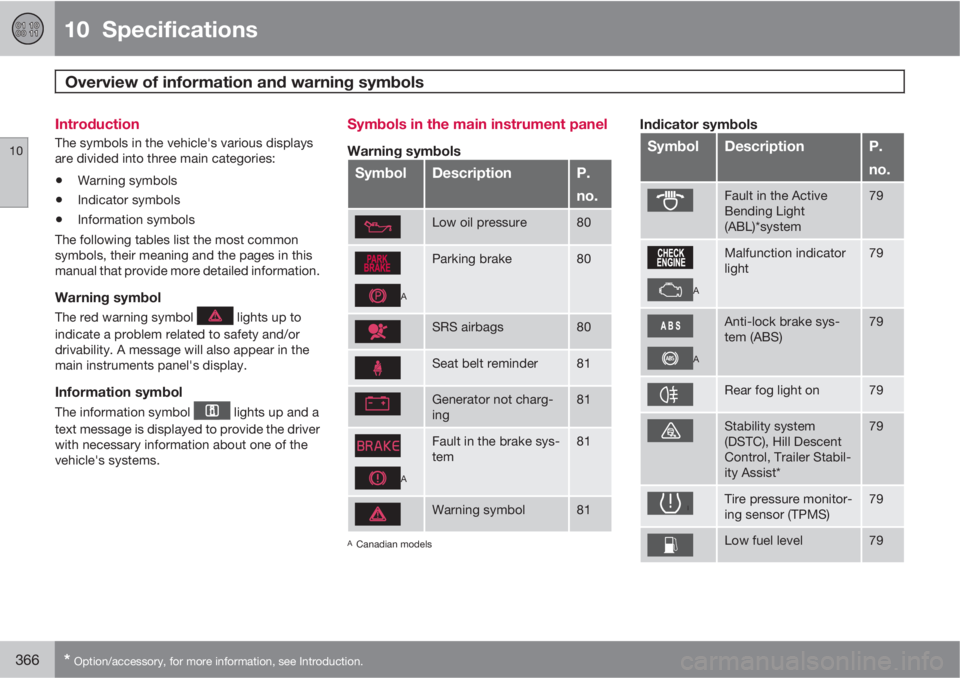
The symbols in the vehicle's various displays
are divided into three main categories:
•Warning symbols
•Indicator symbols
•Information symbols
The following tables list the most common
symbols, their meaning and the pages in this
manual that provide more detailed information.
Warning symbol
The red warning symbol lights up to
indicate a problem related to safety and/or
drivability. A message will also appear in the
main instruments panel's display.
Information symbol
The information symbol lights up and a
text message is displayed to provide the driver
with necessary information about one of the
vehicle's systems.
Symbols in the main instrument panel
Warning symbols
SymbolDescriptionP.
no.
Low oil pressure80
A
Parking brake80
SRS airbags80
Seat belt reminder81
Generator not charg-
ing81
A
Fault in the brake sys-
tem81
Warning symbol81
ACanadian models
Indicator symbols
SymbolDescriptionP.
no.
Fault in the Active
Bending Light
(ABL)*system79
A
Malfunction indicator
light79
A
Anti-lock brake sys-
tem (ABS)79
Rear fog light on79
Stability system
(DSTC), Hill Descent
Control, Trailer Stabil-
ity Assist*79
Tire pressure monitor-
ing sensor (TPMS)79
Low fuel level79
Page 370 of 382
10 Specifications
Overview of information and warning symbols
10
368* Option/accessory, for more information, see Introduction.
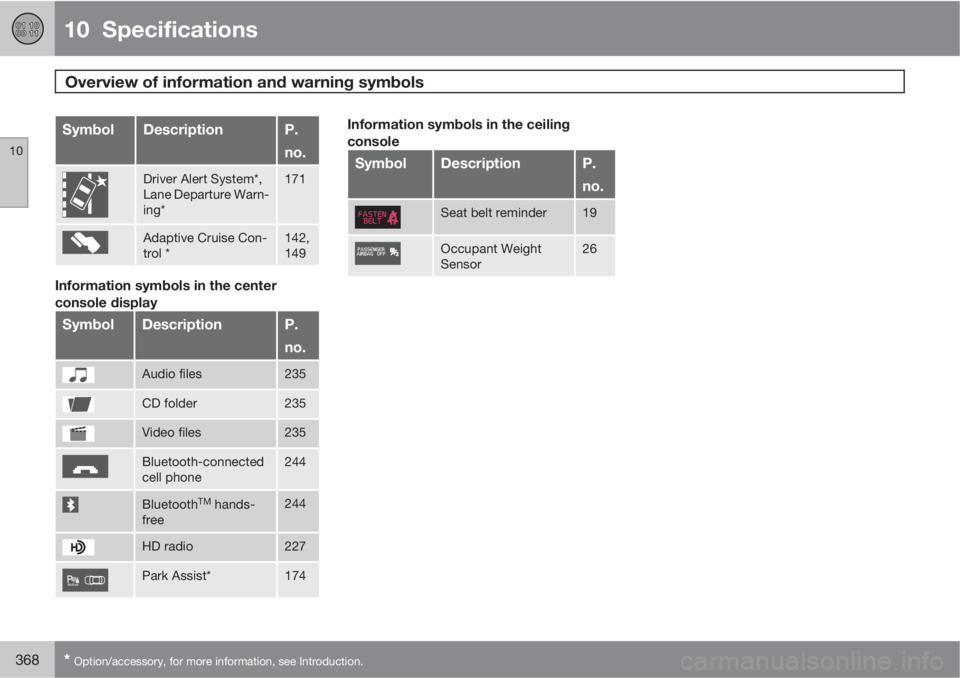
SymbolDescriptionP.
no.
Driver Alert System*,
Lane Departure Warn-
ing*171
Adaptive Cruise Con-
trol *142,
149
Information symbols in the center
console display
SymbolDescriptionP.
no.
Audio files235
CD folder235
Video files235
Bluetooth-connected
cell phone244
BluetoothTM hands-
free244
HD radio227
Park Assist*174
Information symbols in the ceiling
console
SymbolDescriptionP.
no.
Seat belt reminder19
Occupant Weight
Sensor26
Page 377 of 382
11 Index
11
375
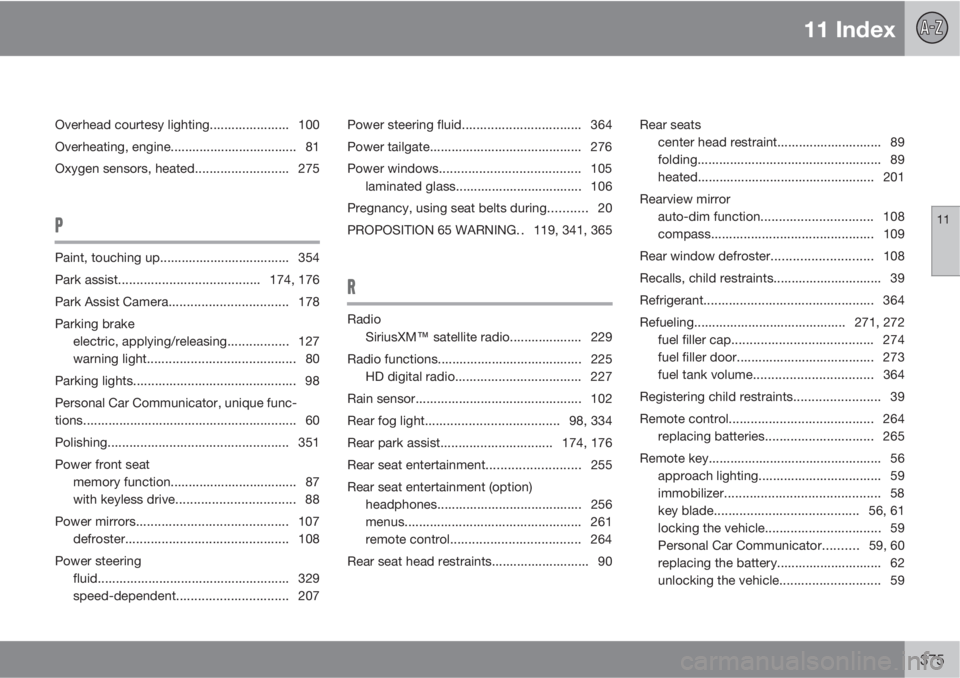
Overhead courtesy lighting...................... 100
Overheating, engine................................... 81
Oxygen sensors, heated.......................... 275
P
Paint, touching up.................................... 354
Park assist.......................................174, 176
Park Assist Camera................................. 178
Parking brake
electric, applying/releasing................. 127
warning light......................................... 80
Parking lights............................................. 98
Personal Car Communicator, unique func-
tions........................................................... 60
Polishing.................................................. 351
Power front seat
memory function................................... 87
with keyless drive................................. 88
Power mirrors.......................................... 107
defroster............................................. 108
Power steering
fluid..................................................... 329
speed-dependent............................... 207Power steering fluid................................. 364
Power tailgate.......................................... 276
Power windows....................................... 105
laminated glass................................... 106
Pregnancy, using seat belts during........... 20
PROPOSITION 65 WARNING. . 119, 341, 365
R
Radio
SiriusXM
E satellite radio.................... 229
Radio functions........................................ 225
HD digital radio................................... 227
Rain sensor.............................................. 102
Rear fog light..................................... 98, 334
Rear park assist............................... 174, 176
Rear seat entertainment..........................255
Rear seat entertainment (option)
headphones........................................256
menus................................................. 261
remote control.................................... 264
Rear seat head restraints........................... 90Rear seats
center head restraint............................. 89
folding................................................... 89
heated................................................. 201
Rearview mirror
auto-dim function............................... 108
compass............................................. 109
Rear window defroster............................108
Recalls, child restraints.............................. 39
Refrigerant............................................... 364
Refueling..........................................271, 272
fuel filler cap....................................... 274
fuel filler door...................................... 273
fuel tank volume.................................364
Registering child restraints........................ 39
Remote control........................................ 264
replacing batteries.............................. 265
Remote key................................................ 56
approach lighting.................................. 59
immobilizer........................................... 58
key blade........................................ 56, 61
locking the vehicle................................ 59
Personal Car Communicator..........59, 60
replacing the battery............................. 62
unlocking the vehicle............................ 59
Page 378 of 382
11 Index
11
376
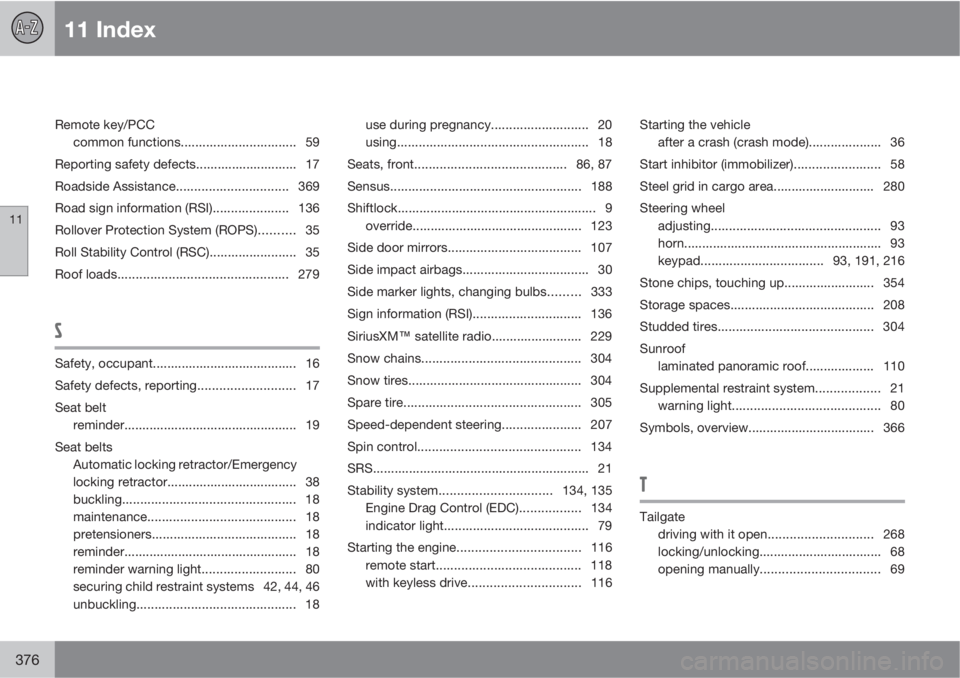
Remote key/PCC
common functions................................ 59
Reporting safety defects............................ 17
Roadside Assistance............................... 369
Road sign information (RSI)..................... 136
Rollover Protection System (ROPS).......... 35
Roll Stability Control (RSC)........................ 35
Roof loads............................................... 279
S
Safety, occupant........................................ 16
Safety defects, reporting........................... 17
Seat belt
reminder................................................ 19
Seat belts
Automatic locking retractor/Emergency
locking retractor.................................... 38
buckling................................................ 18
maintenance......................................... 18
pretensioners........................................ 18
reminder................................................ 18
reminder warning light.......................... 80
securing child restraint systems 42, 44, 46
unbuckling............................................ 18use during pregnancy........................... 20
using.....................................................18
Seats, front.......................................... 86, 87
Sensus.....................................................188
Shiftlock....................................................... 9
override............................................... 123
Side door mirrors..................................... 107
Side impact airbags................................... 30
Side marker lights, changing bulbs......... 333
Sign information (RSI).............................. 136
SiriusXM
E satellite radio......................... 229
Snow chains............................................ 304
Snow tires................................................ 304
Spare tire................................................. 305
Speed-dependent steering...................... 207
Spin control............................................. 134
SRS............................................................ 21
Stability system...............................134, 135
Engine Drag Control (EDC).................134
indicator light........................................ 79
Starting the engine..................................116
remote start........................................ 118
with keyless drive...............................116Starting the vehicle
after a crash (crash mode)....................36
Start inhibitor (immobilizer)........................ 58
Steel grid in cargo area............................ 280
Steering wheel
adjusting............................................... 93
horn....................................................... 93
keypad.................................. 93, 191, 216
Stone chips, touching up......................... 354
Storage spaces........................................ 208
Studded tires........................................... 304
Sunroof
laminated panoramic roof................... 110
Supplemental restraint system.................. 21
warning light......................................... 80
Symbols, overview................................... 366
T
Tailgate
driving with it open.............................268
locking/unlocking.................................. 68
opening manually................................. 69