remote VOLVO XC60 2013 Owner´s Manual
[x] Cancel search | Manufacturer: VOLVO, Model Year: 2013, Model line: XC60, Model: VOLVO XC60 2013Pages: 382, PDF Size: 7.08 MB
Page 267 of 382
06 Infotainment
Remote control*
06
* Option/accessory, for more information, see Introduction.265
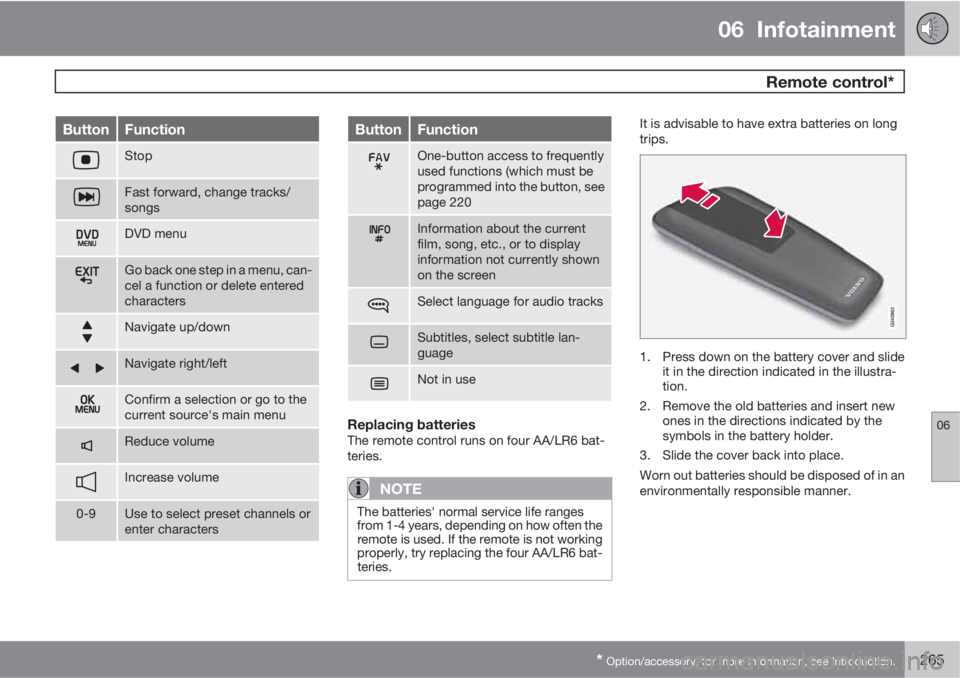
ButtonFunction
Stop
Fast forward, change tracks/
songs
DVD menu
Go back one step in a menu, can-
cel a function or delete entered
characters
Navigate up/down
Navigate right/left
Confirm a selection or go to the
current source's main menu
Reduce volume
Increase volume
0-9Use to select preset channels or
enter characters
ButtonFunction
One-button access to frequently
used functions (which must be
programmed into the button, see
page 220
Information about the current
film, song, etc., or to display
information not currently shown
on the screen
Select language for audio tracks
Subtitles, select subtitle lan-
guage
Not in use
Replacing batteriesThe remote control runs on four AA/LR6 bat-
teries.
NOTE
The batteries' normal service life ranges
from 1-4 years, depending on how often the
remote is used. If the remote is not working
properly, try replacing the four AA/LR6 bat-
teries.
It is advisable to have extra batteries on long
trips.
1. Press down on the battery cover and slide
it in the direction indicated in the illustra-
tion.
2. Remove the old batteries and insert new
ones in the directions indicated by the
symbols in the battery holder.
3. Slide the cover back into place.
Worn out batteries should be disposed of in an
environmentally responsible manner.
Page 278 of 382
07 During your trip
Loading
07
276* Option/accessory, for more information, see Introduction.
Introduction
The load carrying capacity of your vehicle is
determined by factors such as the number of
passengers, the amount of cargo, the weight
of any accessories that may be installed, etc.
To increase loading space, the rear seat back-
rests can be folded down, see page 89.
When loading the cargo area, keep the follow-
ing in mind:
•Load objects in the cargo area against the
backrest whenever possible.
•Unstable loads can be secured to the load
anchoring eyelets with straps or web lash-
ings to help keep them from shifting.
•Stop the engine and apply the parking
brake when loading or unloading long
objects. The gear selector can be knocked
out of position by long loads, which could
set the vehicle in motion.
WARNING
•Stop the engine, put the gear selector in
P, and apply the parking brake when
loading or unloading long objects.
•The vehicle's driving characteristics
may change depending on the weight
and distribution of the load.
•A 44-pound (20 kg) object produces a
force of 2,200 pounds (1,000 kg) in a
head-on collision at 30 mph (50 km/h).
•The cargo area and rear seat should not
be loaded to a level higher than 2 in.
(5 cm) below the upper edge of the rear
side windows. Objects placed higher
than this level could impede the func-
tion of the Inflatable Curtain.
Power tailgate*
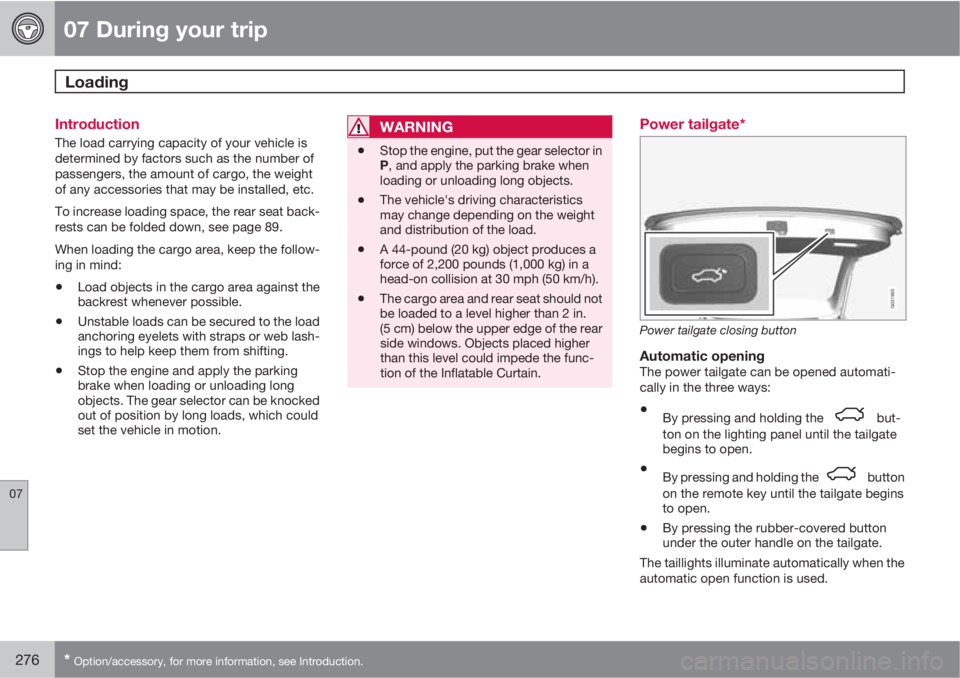
G031965
Power tailgate closing button
Automatic openingThe power tailgate can be opened automati-
cally in the three ways:
•By pressing and holding the but-
ton on the lighting panel until the tailgate
begins to open.
•By pressing and holding the button
on the remote key until the tailgate begins
to open.
•By pressing the rubber-covered button
under the outer handle on the tailgate.
The taillights illuminate automatically when the
automatic open function is used.
Page 279 of 382
07 During your trip
Loading
07
277
CAUTION
Be sure that there is adequate space above
and behind the vehicle before opening the
tailgate automatically.
The vehicle should not be driven or moved
with the tailgate in the open position. How-
ever, if the vehicle is moved with the tailgate
in the open position, the automatic closing
function will be inoperative until one of the
following occurs:
•The tailgate is closed manually
•The ignition is switched off and the key
is removed for approximately 10
minutes (the tailgate will function again
after restart).
NOTE
If the tailgate has been opened and closed
continuously for more than 60 seconds, the
automatic function will be deactivated to
avoid overloading the electrical system. The
automatic function can be used again after
approximately 10 minutes.
If the vehicle's battery has been discharged
or disconnected, the tailgate must be
opened and closed once manually to reset
the system.
Programming the tailgate opening angleThe tailgate's maximum opening angle can be
programmed, which can be useful, for exam-
ple, if the tailgate has to be opened in a garage
with a low ceiling.
To do so:
•Open the tailgate manually, hold it at the
desired maximum opening angle and
press the tailgate's closing button for at
least 3 seconds. When the tailgate is
released, programming is complete.
•To remove this programming, open the tail-
gate manually to a higher opening angle.
Automatic closingThe power tailgate can be closed by pressing
the
button on the tailgate (see the illus-
tration) or by pressing it down.
NOTE
If the tailgate is pressed down e.g., by the
weight of snow or strong wind, it will close
automatically.
WARNING
Be sure that no one is near the tailgate when
it is opened or closed automatically. The
tailgate should never be obstructed in any
way when it is operated.
Interrupting automatic opening/closingAutomatic opening or closing the tailgate can
be interrupted in four ways:
•By pressing the button on the
lighting panel.
•By pressing the button on the
remote key.
•By pressing the button on the lower edge
of the tailgate.
•By pressing the rubber-covered button
under the outer handle on the tailgate.
If one of these actions is taken, the tailgate will
stop and reopen.
Pinch protectionIf the tailgate is obstructed while it is being
operated, the pinch protection function is acti-
vated.
•If the tailgate is being opened, the electri-
cal function will be switched off and the
tailgate will be released from the electrical
system.
•If the tailgate is being closed, it will stop
and reopen.
Operating the tailgate manuallyThe power tailgate can be disconnected from
the vehicle’s electrical system by quickly pull-
Page 289 of 382
07 During your trip
Emergency towing
07
287
WARNING
•When the vehicle is being towed, the
ignition should be in mode II (in mode I,
all of the vehicle's airbags are deacti-
vated). See page 85 for more informa-
tion about ignition modes.
•Never remove the remote key from the
ignition slot when the vehicle is being
towed. For vehicles with keyless drive,
the remote key must remain inside the
vehicle.
•The power brakes and power steering
will not function when the engine is not
running. Approximately 5 times more
pressure will be required on the brake
pedal and the steering wheel will be
considerably harder to turn.
•The towing eyelets must not be used for
pulling the vehicle out of a ditch or for
any similar purpose involving severe
strain. Do not use the towing eyelets to
pull the vehicle up onto a flat bed tow
truck.
Towing the vehicle
1. With the remote key fully pressed into the
ignition slot1, press START/STOP
ENGINE for approximately 2 seconds to
activate ignition mode II.
2. The remote key must remain in the ignition
slot
2 for the entire time that the vehicle is
being towed.
3. Keep the tow rope taut when the towing
vehicle slows down by applying light pres-
sure on the brake pedal. This will help pre-
vent jarring movements of the vehicle
being towed.
4. Be prepared to apply the brakes to stop the
vehicle being towed.
CAUTION
General towing precautions:
•Please check with state and local
authorities before attempting this type
of towing, as vehicles being towed are
subject to regulations regarding maxi-
mum towing speed, length and type of
towing device, lighting, etc.
•If the vehicle's battery is dead, attach
jumper cables (see page 119) to provide
current for releasing the electric parking
brake and to move the gear selector
from the P position to N. If this is not
possible, see page 123 for information
about manually overriding the shiftlock
system to move the gear selector from
P to N.
•Maximum speed: 50 mph (80 km/h). Do
not exceed the maximum allowable
towing speed.
•Maximum distance with front wheels on
ground: 50 miles (80 km).
•The vehicle should only be towed in the
forward direction.
1Not necessary in vehicles with the optional keyless drive.2For vehicles with the the optional keyless dirive, the remote key must be in the vehicle.
Page 327 of 382
09 Maintenance and specifications
Hood and engine compartment09
325 Opening and closing the hood
G031911
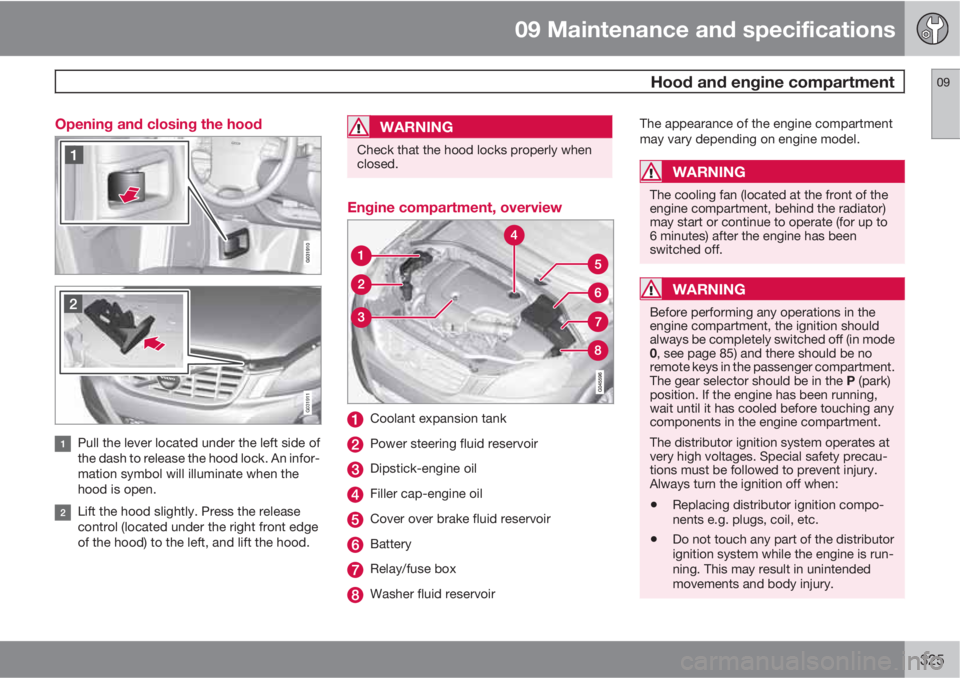
Pull the lever located under the left side of
the dash to release the hood lock. An infor-
mation symbol will illuminate when the
hood is open.
Lift the hood slightly. Press the release
control (located under the right front edge
of the hood) to the left, and lift the hood.
WARNING
Check that the hood locks properly when
closed.
Engine compartment, overview
Coolant expansion tank
Power steering fluid reservoir
Dipstick-engine oil
Filler cap-engine oil
Cover over brake fluid reservoir
Battery
Relay/fuse box
Washer fluid reservoirThe appearance of the engine compartment
may vary depending on engine model.
WARNING
The cooling fan (located at the front of the
engine compartment, behind the radiator)
may start or continue to operate (for up to
6 minutes) after the engine has been
switched off.
WARNING
Before performing any operations in the
engine compartment, the ignition should
always be completely switched off (in mode
0, see page 85) and there should be no
remote keys in the passenger compartment.
The gear selector should be in the P (park)
position. If the engine has been running,
wait until it has cooled before touching any
components in the engine compartment.
The distributor ignition system operates at
very high voltages. Special safety precau-
tions must be followed to prevent injury.
Always turn the ignition off when:
•Replacing distributor ignition compo-
nents e.g. plugs, coil, etc.
•Do not touch any part of the distributor
ignition system while the engine is run-
ning. This may result in unintended
movements and body injury.
Page 332 of 382
09 Maintenance and specifications
Replacing bulbs 09
330* Option/accessory, for more information, see Introduction.
Introduction
All bulb specifications are listed on page 336.
The following bulbs should only be replaced by
a trained and qualified Volvo service techni-
cian:
•Dome lighting, reading lights
•Glove compartment lighting
•Footwell lighting
•Turn signals in the door mirrors
•Approach lighting in the door mirrors
•Brake lights/rear fog light/taillights
•Rear parking lights
•Active Bending Lights
•LED bulbs
NOTE
For information regarding any other bulbs
not mentioned in this section, please con-
tact your Volvo retailer or a trained and
authorized Volvo service technician.
WARNING
•The engine should not be running when
changing bulbs.
•If the engine has been running just prior
to replacing bulbs in the headlight hous-
ing, please keep in mind that compo-
nents in the engine compartment will be
hot.
WARNING
•Active Bending Lights* – due to the high
voltage used by these headlights, these
bulbs should only be replaced by a
trained and qualified Volvo service tech-
nician.
•Turn off the lights and remove the
remote key from the ignition before
changing any bulbs.
Headlight housing
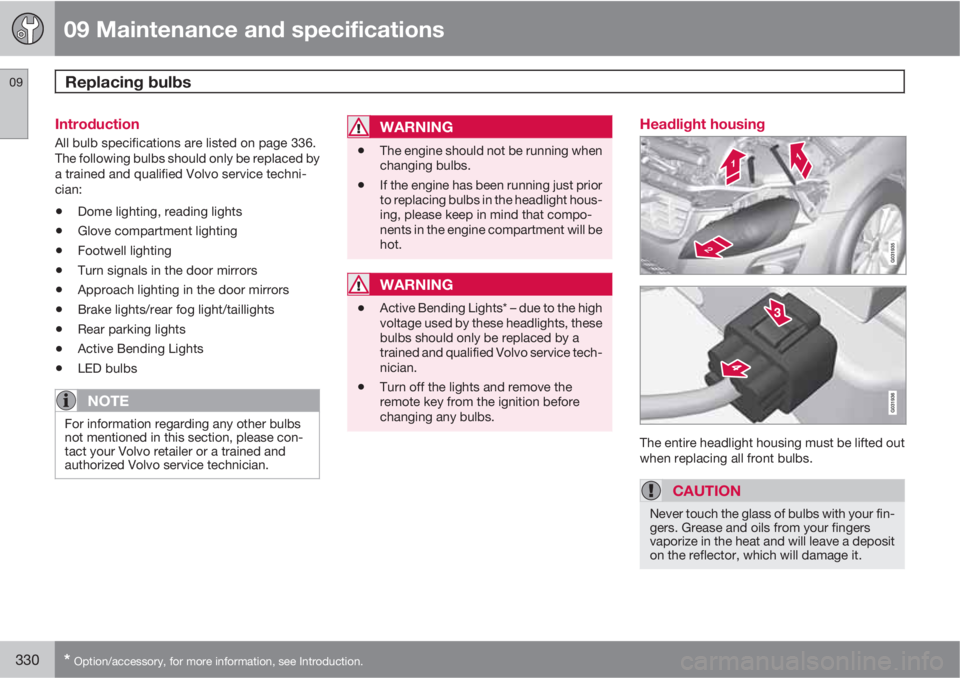
The entire headlight housing must be lifted out
when replacing all front bulbs.
CAUTION
Never touch the glass of bulbs with your fin-
gers. Grease and oils from your fingers
vaporize in the heat and will leave a deposit
on the reflector, which will damage it.
Page 333 of 382
09 Maintenance and specifications
Replacing bulbs09
331
NOTE
•Always switch off the ignition before
starting to replace a bulb.
•The optional Active Bending Light bulbs
contain trace amounts of mercury.
These bulbs should always be disposed
of by a trained and qualified Volvo serv-
ice technician.
Removing the headlight housing1. Switch off the ignition by briefly pressing
the START/STOP ENGINE button.
2. Remove the remote key from the ignition
slot
1.
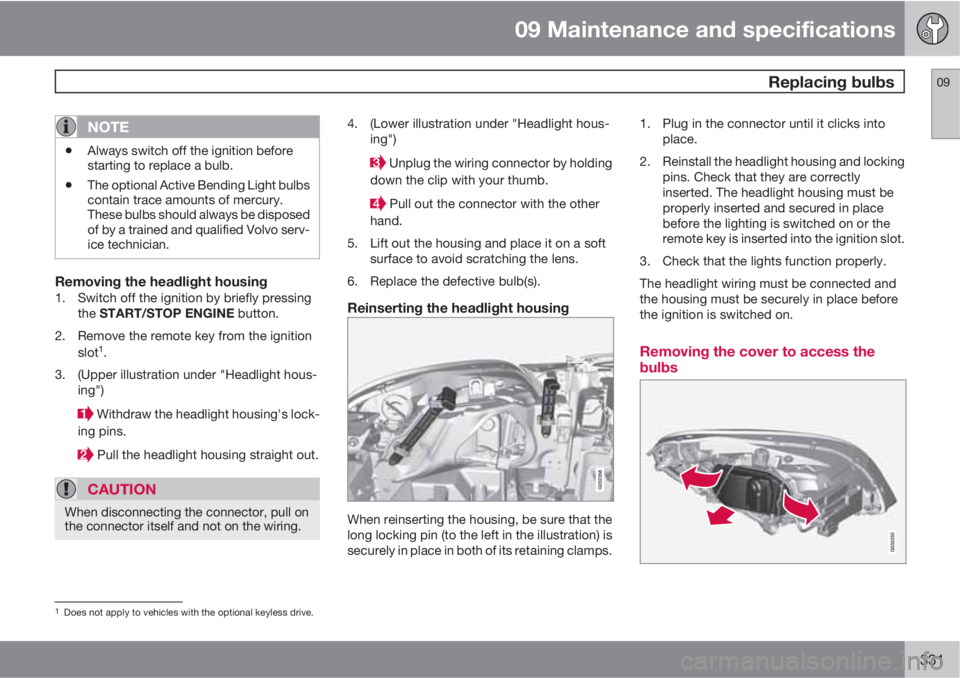
3. (Upper illustration under "Headlight hous-
ing")
Withdraw the headlight housing's lock-
ing pins.
Pull the headlight housing straight out.
CAUTION
When disconnecting the connector, pull on
the connector itself and not on the wiring.
4. (Lower illustration under "Headlight hous-
ing")
Unplug the wiring connector by holding
down the clip with your thumb.
Pull out the connector with the other
hand.
5. Lift out the housing and place it on a soft
surface to avoid scratching the lens.
6. Replace the defective bulb(s).
Reinserting the headlight housing
When reinserting the housing, be sure that the
long locking pin (to the left in the illustration) is
securely in place in both of its retaining clamps.1. Plug in the connector until it clicks into
place.
2. Reinstall the headlight housing and locking
pins. Check that they are correctly
inserted. The headlight housing must be
properly inserted and secured in place
before the lighting is switched on or the
remote key is inserted into the ignition slot.
3. Check that the lights function properly.
The headlight wiring must be connected and
the housing must be securely in place before
the ignition is switched on.
Removing the cover to access the
bulbs
1Does not apply to vehicles with the optional keyless drive.
Page 339 of 382
09 Maintenance and specifications
Wiper blades and washer fluid09
337 Wiper blades
The windshield wiper blades are different
lengths. The blade on the driver’s side is longer
than the one on the passenger side.
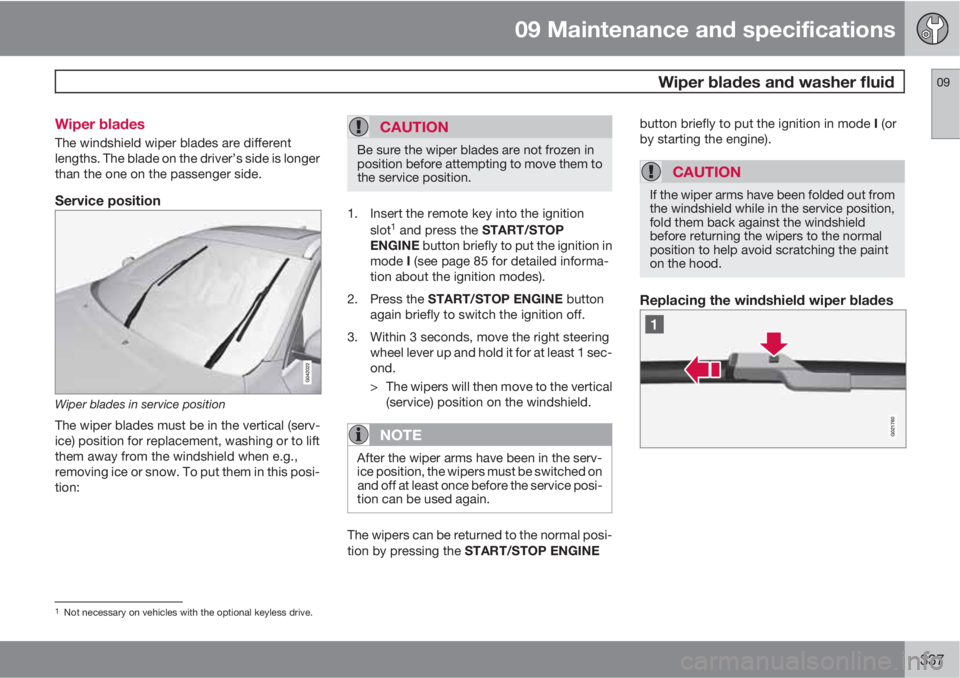
Service position
Wiper blades in service position
The wiper blades must be in the vertical (serv-
ice) position for replacement, washing or to lift
them away from the windshield when e.g.,
removing ice or snow. To put them in this posi-
tion:
CAUTION
Be sure the wiper blades are not frozen in
position before attempting to move them to
the service position.
1. Insert the remote key into the ignition
slot1 and press the START/STOP
ENGINE button briefly to put the ignition in
mode I (see page 85 for detailed informa-
tion about the ignition modes).
2.
Press the START/STOP ENGINE button
again briefly to switch the ignition off.
3. Within 3 seconds, move the right steering
wheel lever up and hold it for at least 1 sec-
ond.
> The wipers will then move to the vertical
(service) position on the windshield.
NOTE
After the wiper arms have been in the serv-
ice position, the wipers must be switched on
and off at least once before the service posi-
tion can be used again.
The wipers can be returned to the normal posi-
tion by pressing the START/STOP ENGINEbutton briefly to put the ignition in mode I (or
by starting the engine).
CAUTION
If the wiper arms have been folded out from
the windshield while in the service position,
fold them back against the windshield
before returning the wipers to the normal
position to help avoid scratching the paint
on the hood.
Replacing the windshield wiper blades
1Not necessary on vehicles with the optional keyless drive.
Page 343 of 382
09 Maintenance and specifications
Battery09
341
WARNING
Connect and disconnect the positive and
negative cables in the correct sequence.
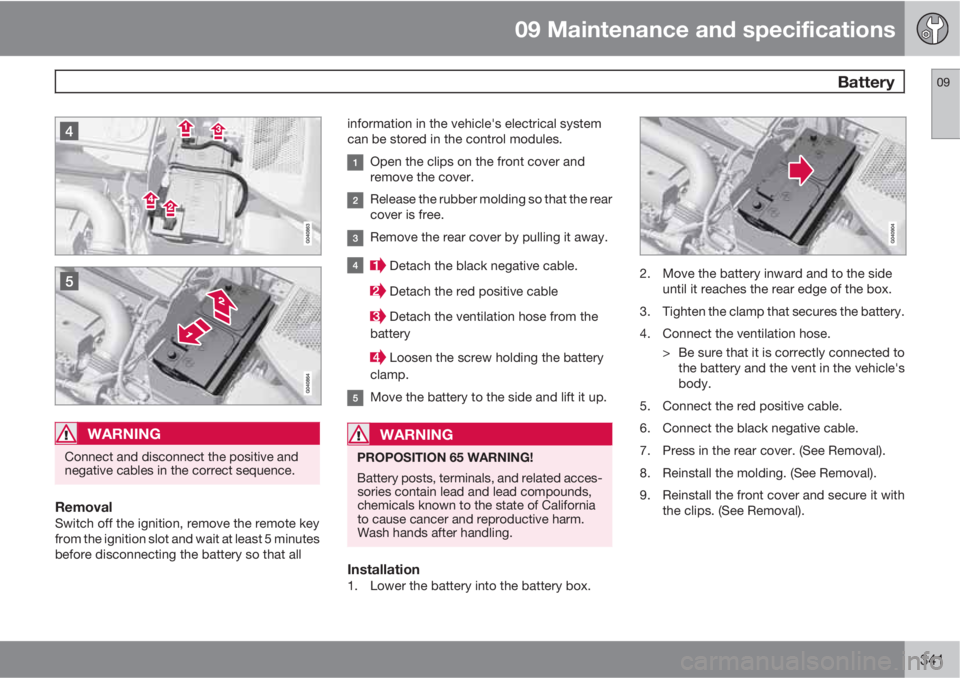
RemovalSwitch off the ignition, remove the remote key
from the ignition slot and wait at least 5 minutes
before disconnecting the battery so that allinformation in the vehicle's electrical system
can be stored in the control modules.
Open the clips on the front cover and
remove the cover.
Release the rubber molding so that the rear
cover is free.
Remove the rear cover by pulling it away.
Detach the black negative cable.
Detach the red positive cable
Detach the ventilation hose from the
battery
Loosen the screw holding the battery
clamp.
Move the battery to the side and lift it up.
WARNING
PROPOSITION 65 WARNING!
Battery posts, terminals, and related acces-
sories contain lead and lead compounds,
chemicals known to the state of California
to cause cancer and reproductive harm.
Wash hands after handling.
Installation1. Lower the battery into the battery box.
2. Move the battery inward and to the side
until it reaches the rear edge of the box.
3. Tighten the clamp that secures the battery.
4. Connect the ventilation hose.
> Be sure that it is correctly connected to
the battery and the vent in the vehicle's
body.
5. Connect the red positive cable.
6. Connect the black negative cable.
7. Press in the rear cover. (See Removal).
8. Reinstall the molding. (See Removal).
9. Reinstall the front cover and secure it with
the clips. (See Removal).
Page 372 of 382
11 Index
11
370
1, 2, 3 ...
12-volt sockets........................................ 210
A
ABS (anti-lock brake system).................. 125
Accessory installation warning.................. 13
Active chassis system.............................207
Active high beams..................................... 96
Active yaw control................................... 134
Adaptive brake lights............................... 124
Adaptive cruise control.................... 140, 142
Airbags
disconnecting the front passenger’s
side.................................................26, 27
front...................................................... 22
inflatable curtain................................... 32
side impact........................................... 30
Air conditioning........................................ 202
Air distribution.......................................... 198
Air distribution table................................. 204
Air vents................................................... 199
All Wheel Drive......................................... 123Anti-freeze.......................................270, 328
Anti-lock brake system
warning light......................................... 78
Anti-lock Brake System (ABS)................. 125
Approach lighting..............................59, 101
Audio system
AUX/USB sockets............................... 238
BluetoothŸ devices............................. 241
BluetoothŸ hands-free system........... 243
Bluetooth streaming audio................. 241
getting started.................................... 215
HD digital radio................................... 227
introduction......................................... 214
media player....................................... 234
overview.............................................. 214
radio functions.................................... 225
Rear seat entertainment..................... 255
SiriusXM
E satellite radio.................... 229
sound settings.................................... 220
steering wheel keypad........................ 216
voice control....................................... 251
Auto-dim rearview mirror......................... 108
Automatic locking retractor....................... 38
Automatic transmission
Geartronic........................................... 122
general description.....................121, 122oil........................................................ 364
shiftlock override................................ 123
Axle weight.............................................. 301
B
Battery
changing..................................... 340, 341
maintenance....................................... 340
remote key, replacing........................... 62
specifications...................................... 365
warning symbols................................. 339
Blind Spot Information System
(BLIS)....................................... 182, 183, 184
Bluetooth cell phone connection............. 243
Booster cushion, integrated...................... 49
Booster cushions....................................... 46
Brake lights.............................................. 124
Brake system
ABS..................................................... 125
Brake pad inspection.......................... 124
checking fluid level............................. 328
emergency brake assistance.............. 125
fluid..................................................... 364
general information............................. 124