brake VOLVO XC60 2013 Owner´s Manual
[x] Cancel search | Manufacturer: VOLVO, Model Year: 2013, Model line: XC60, Model: VOLVO XC60 2013Pages: 382, PDF Size: 7.08 MB
Page 330 of 382
09 Maintenance and specifications
Fluids 09
328
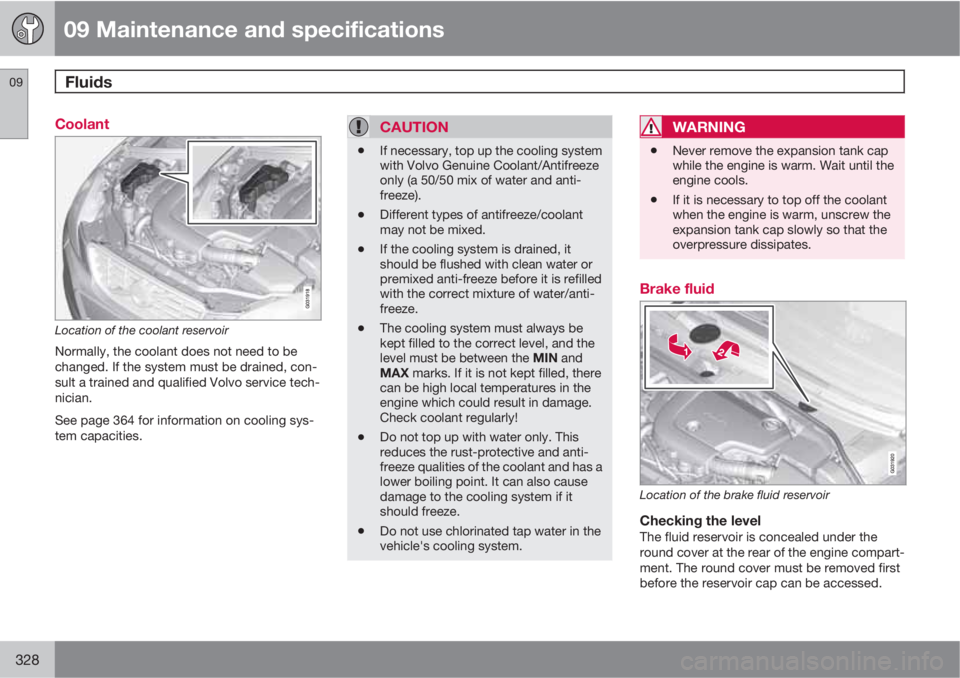
Coolant
Location of the coolant reservoir
Normally, the coolant does not need to be
changed. If the system must be drained, con-
sult a trained and qualified Volvo service tech-
nician.
See page 364 for information on cooling sys-
tem capacities.
CAUTION
•If necessary, top up the cooling system
with Volvo Genuine Coolant/Antifreeze
only (a 50/50 mix of water and anti-
freeze).
•Different types of antifreeze/coolant
may not be mixed.
•If the cooling system is drained, it
should be flushed with clean water or
premixed anti-freeze before it is refilled
with the correct mixture of water/anti-
freeze.
•The cooling system must always be
kept filled to the correct level, and the
level must be between the MIN and
MAX marks. If it is not kept filled, there
can be high local temperatures in the
engine which could result in damage.
Check coolant regularly!
•Do not top up with water only. This
reduces the rust-protective and anti-
freeze qualities of the coolant and has a
lower boiling point. It can also cause
damage to the cooling system if it
should freeze.
•Do not use chlorinated tap water in the
vehicle's cooling system.
WARNING
•Never remove the expansion tank cap
while the engine is warm. Wait until the
engine cools.
•If it is necessary to top off the coolant
when the engine is warm, unscrew the
expansion tank cap slowly so that the
overpressure dissipates.
Brake fluid
Location of the brake fluid reservoir
Checking the levelThe fluid reservoir is concealed under the
round cover at the rear of the engine compart-
ment. The round cover must be removed first
before the reservoir cap can be accessed.
Page 331 of 382
09 Maintenance and specifications
Fluids09
329
The brake fluid should always be between the
MIN and MAX marks on the inside of the res-
ervoir. Check, without removing the cap, that
there is sufficient fluid in the reservoir.
Fluid type: DOT 4+ boiling point >536 °F
(280 °C), P/N 9437433
Replace: The fluid should be replaced accord-
ing to the intervals specified in the Warranty
and Service Records Information booklet.
When driving under extremely hard conditions
(mountain driving, etc), it may be necessary to
replace the fluid more often. Consult a trained
and qualified Volvo service technician.
Always entrust brake fluid changing to a
trained and qualified Volvo service technician.
WARNING
•If the fluid level is below the MIN mark
in the reservoir or if a brake-related
message is shown in the information
display: DO NOT DRIVE. Have the car
towed to a trained and qualified Volvo
service technician and have the brake
system inspected.
•Dot 4+ should never be mixed with any
other type of brake fluid.
Filling1. Turn and open the cover.
2. Unscrew the reservoir cap and fill the fluid.
The level must be between the MIN and
MAX marks.
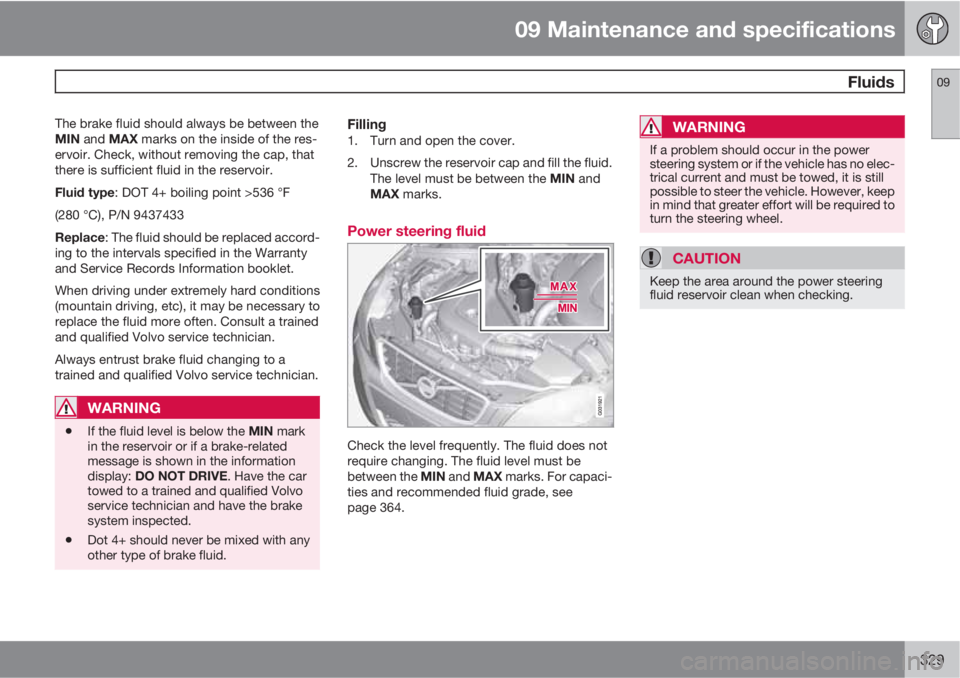
Power steering fluid
Check the level frequently. The fluid does not
require changing. The fluid level must be
between the MIN and MAX marks. For capaci-
ties and recommended fluid grade, see
page 364.
WARNING
If a problem should occur in the power
steering system or if the vehicle has no elec-
trical current and must be towed, it is still
possible to steer the vehicle. However, keep
in mind that greater effort will be required to
turn the steering wheel.
CAUTION
Keep the area around the power steering
fluid reservoir clean when checking.
Page 332 of 382
09 Maintenance and specifications
Replacing bulbs 09
330* Option/accessory, for more information, see Introduction.
Introduction
All bulb specifications are listed on page 336.
The following bulbs should only be replaced by
a trained and qualified Volvo service techni-
cian:
•Dome lighting, reading lights
•Glove compartment lighting
•Footwell lighting
•Turn signals in the door mirrors
•Approach lighting in the door mirrors
•Brake lights/rear fog light/taillights
•Rear parking lights
•Active Bending Lights
•LED bulbs
NOTE
For information regarding any other bulbs
not mentioned in this section, please con-
tact your Volvo retailer or a trained and
authorized Volvo service technician.
WARNING
•The engine should not be running when
changing bulbs.
•If the engine has been running just prior
to replacing bulbs in the headlight hous-
ing, please keep in mind that compo-
nents in the engine compartment will be
hot.
WARNING
•Active Bending Lights* – due to the high
voltage used by these headlights, these
bulbs should only be replaced by a
trained and qualified Volvo service tech-
nician.
•Turn off the lights and remove the
remote key from the ignition before
changing any bulbs.
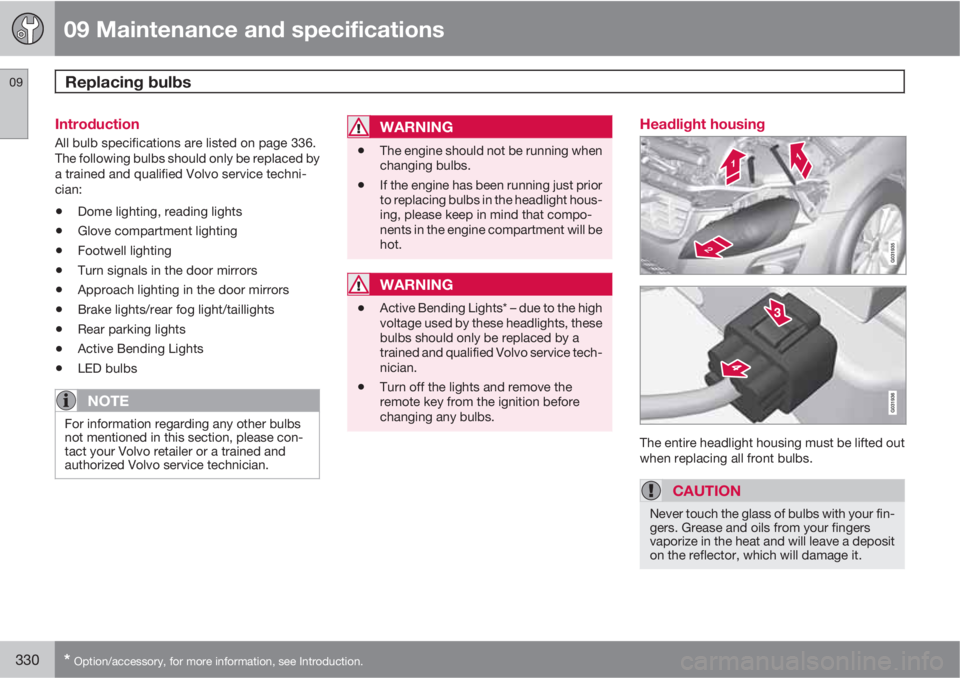
Headlight housing
The entire headlight housing must be lifted out
when replacing all front bulbs.
CAUTION
Never touch the glass of bulbs with your fin-
gers. Grease and oils from your fingers
vaporize in the heat and will leave a deposit
on the reflector, which will damage it.
Page 336 of 382
09 Maintenance and specifications
Replacing bulbs 09
334
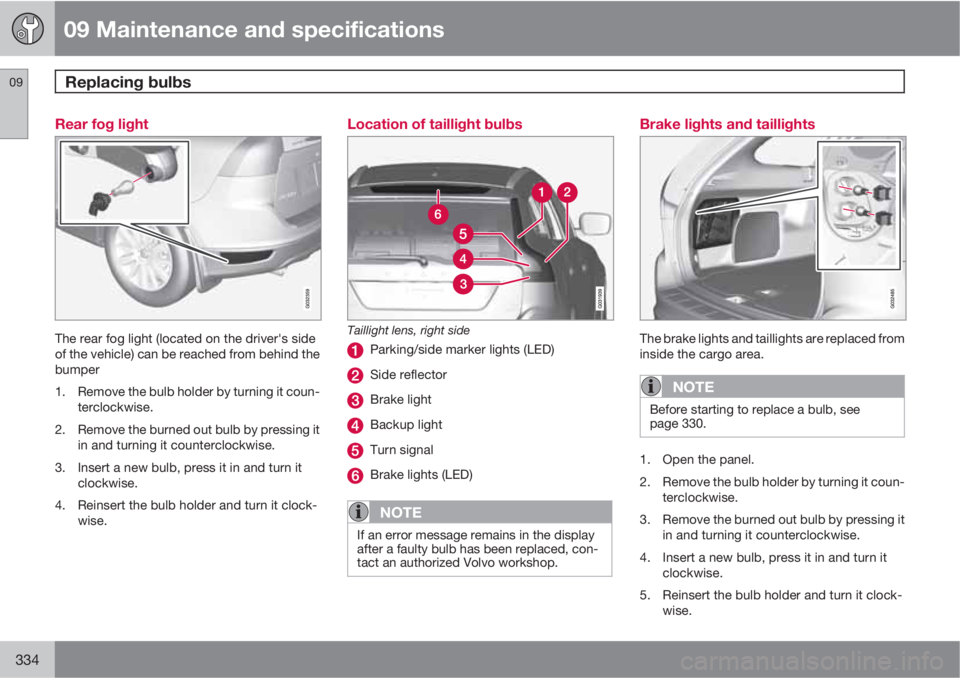
Rear fog light
The rear fog light (located on the driver's side
of the vehicle) can be reached from behind the
bumper
1. Remove the bulb holder by turning it coun-
terclockwise.
2. Remove the burned out bulb by pressing it
in and turning it counterclockwise.
3. Insert a new bulb, press it in and turn it
clockwise.
4. Reinsert the bulb holder and turn it clock-
wise.
Location of taillight bulbs
Taillight lens, right side
Parking/side marker lights (LED)
Side reflector
Brake light
Backup light
Turn signal
Brake lights (LED)
NOTE
If an error message remains in the display
after a faulty bulb has been replaced, con-
tact an authorized Volvo workshop.
Brake lights and taillights
The brake lights and taillights are replaced from
inside the cargo area.
NOTE
Before starting to replace a bulb, see
page 330.
1. Open the panel.
2. Remove the bulb holder by turning it coun-
terclockwise.
3. Remove the burned out bulb by pressing it
in and turning it counterclockwise.
4. Insert a new bulb, press it in and turn it
clockwise.
5. Reinsert the bulb holder and turn it clock-
wise.
Page 338 of 382
09 Maintenance and specifications
Replacing bulbs 09
336* Option/accessory, for more information, see Introduction.
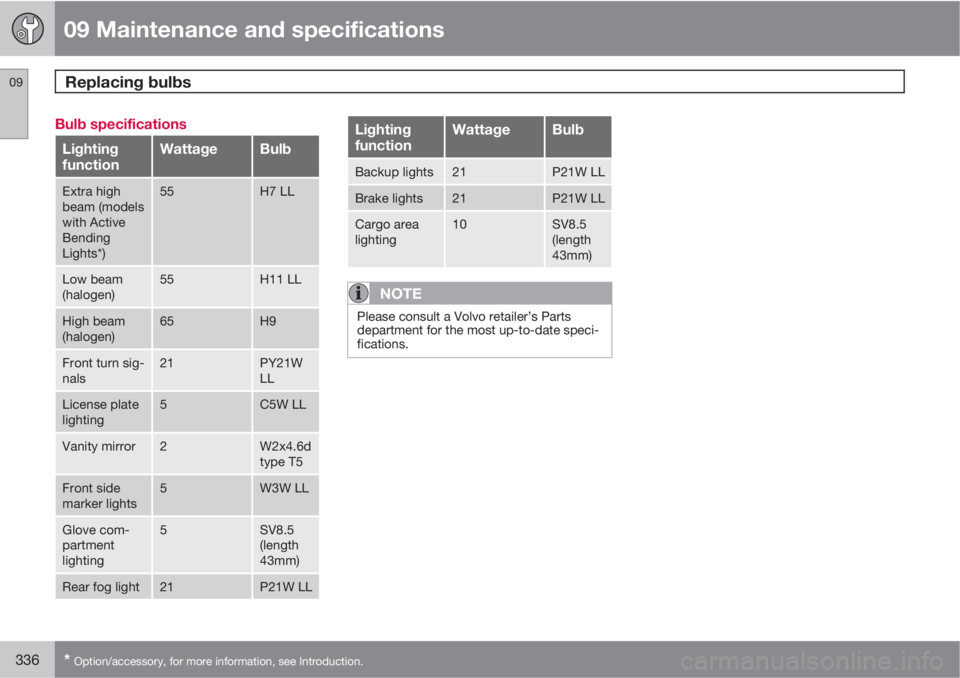
Bulb specifications
Lighting
functionWattageBulb
Extra high
beam (models
with Active
Bending
Lights*)55H7 LL
Low beam
(halogen)55H11 LL
High beam
(halogen)65H9
Front turn sig-
nals21PY21W
LL
License plate
lighting5C5W LL
Vanity mirror2W2x4.6d
type T5
Front side
marker lights5W3W LL
Glove com-
partment
lighting5SV8.5
(length
43mm)
Rear fog light21P21W LL
Lighting
functionWattageBulb
Backup lights21P21W LL
Brake lights21P21W LL
Cargo area
lighting10SV8.5
(length
43mm)
NOTE
Please consult a Volvo retailer’s Parts
department for the most up-to-date speci-
fications.
Page 350 of 382
09 Maintenance and specifications
Fuses 09
348* Option/accessory, for more information, see Introduction.
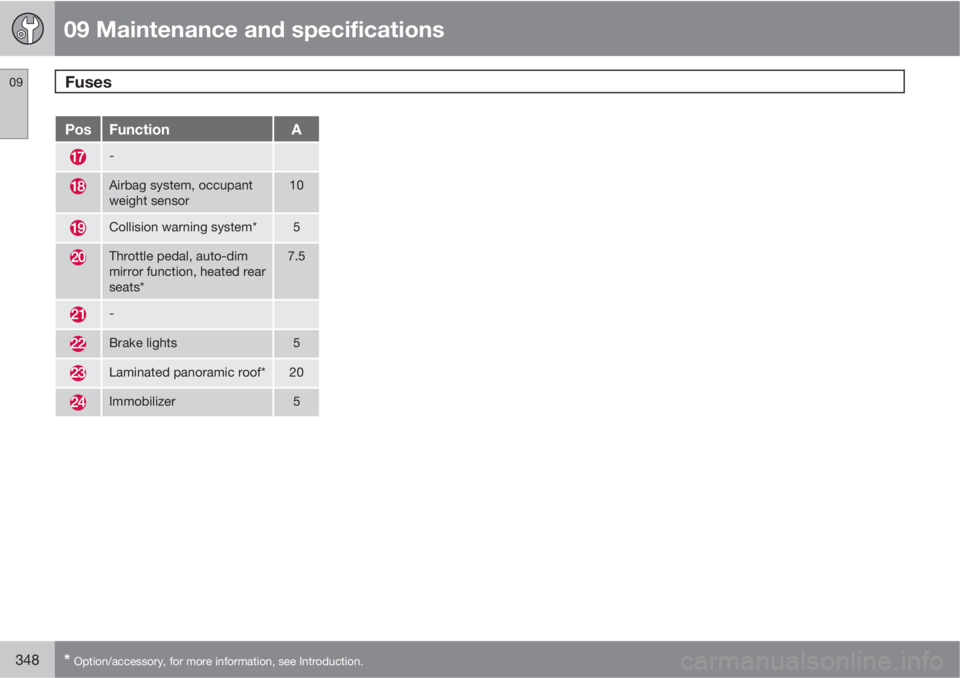
PosFunctionA
-
Airbag system, occupant
weight sensor10
Collision warning system*5
Throttle pedal, auto-dim
mirror function, heated rear
seats*7.5
-
Brake lights5
Laminated panoramic roof*20
Immobilizer5
Page 351 of 382
09 Maintenance and specifications
Fuses09
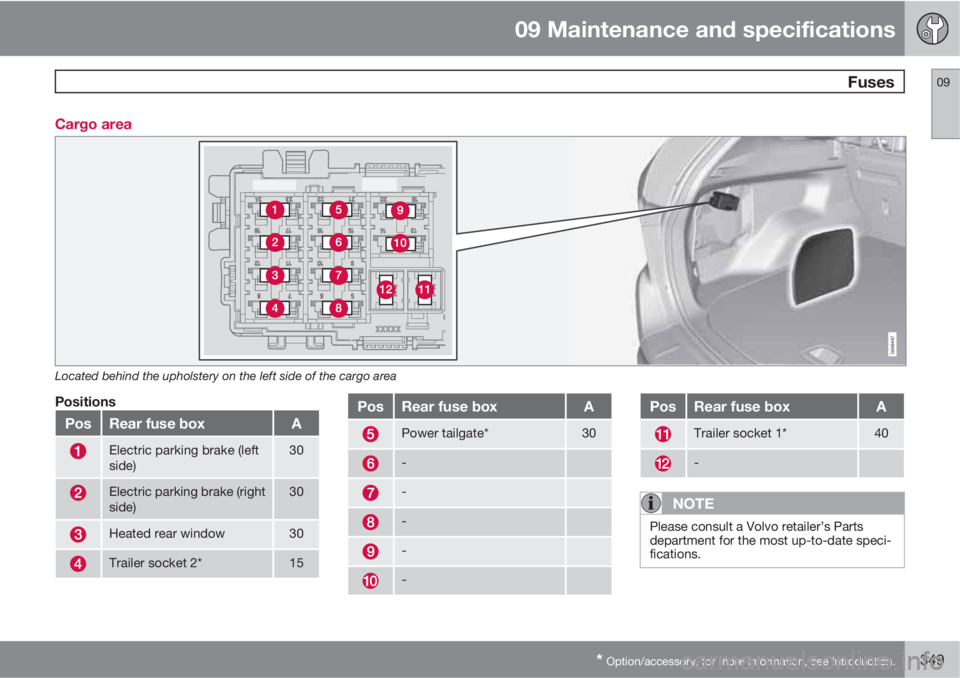
* Option/accessory, for more information, see Introduction.349 Cargo area
Located behind the upholstery on the left side of the cargo area
Positions
PosRear fuse boxA
Electric parking brake (left
side)30
Electric parking brake (right
side)30
Heated rear window30
Trailer socket 2*15
PosRear fuse boxA
Power tailgate*30
-
-
-
-
-
PosRear fuse boxA
Trailer socket 1*40
-
NOTE
Please consult a Volvo retailer’s Parts
department for the most up-to-date speci-
fications.
Page 353 of 382
09 Maintenance and specifications
Vehicle care09
351
CAUTION
•Avoid waxing or polishing plastic or rub-
ber components
•Polishing chromed strips can wear
away or damage the surface
•Polishes containing abrasive sub-
stances should not be used
Automatic car wash
•We do NOT recommend washing your car
in an automatic wash during the first few
months (because the paint will not have
hardened sufficiently).
•An automatic wash is a simple and quick
way to clean your car, but it is worth
remembering that it may not be as thor-
ough as when you yourself go over the car
with sponge and water. Keeping the under-
body clean is most important, especially in
the winter. Some automatic washers do
not have facilities for washing the under-
body.
CAUTION
•Before driving into an automatic car
wash, turn off the optional rain sensor to
avoid damaging the windshield wipers.
•Make sure that side view mirrors, auxil-
iary lamps, etc, are secure, and that any
antenna(s) are retracted or removed.
Otherwise there is risk of the machine
dislodging them.
•Chromed wheels: Clean chrome-
plated wheels using the same deter-
gents used for the body of the vehicle.
Aggressive wheel-cleaning agents can
permanently stain chrome-plated
wheels.
WARNING
•When the vehicle is driven immediately
after being washed, apply the brakes,
including the parking brake, several
times in order to remove any moisture
from the brake linings.
•Engine cleaning agents should not be
used when the engine is warm. This
constitutes a fire risk.
Exterior lightingCondensation may form temporarily on the
inside of the lenses of exterior lights such as
headlights, fog lights, or taillights. This is nor-mal and the lights are designed to withstand
moisture. Normally, condensation will dissi-
pate after the lights have been on for a short
time.
Polishing and waxing
•Normally, polishing is not required during
the first year after delivery, however, wax-
ing may be beneficial.
•Before applying polish or wax the vehicle
must be washed and dried. Tar spots can
be removed with kerosene or tar remover.
Difficult spots may require a fine rubbing
compound.
•After polishing use liquid or paste wax.
•Several commercially available products
contain both polish and wax.
•Waxing alone does not substitute for pol-
ishing a dull surface.
•A wide range of polymer-based waxes can
be purchased today. These waxes are easy
to use and produce a long-lasting, high-
gloss finish that protects the bodywork
against oxidation, road dirt and fading.
•Do not polish or wax your vehicle in direct
sunlight (the surface of the vehicle should
not be warmer than 113 °F (45 °C).
Page 364 of 382
10 Specifications
Specifications
10
362
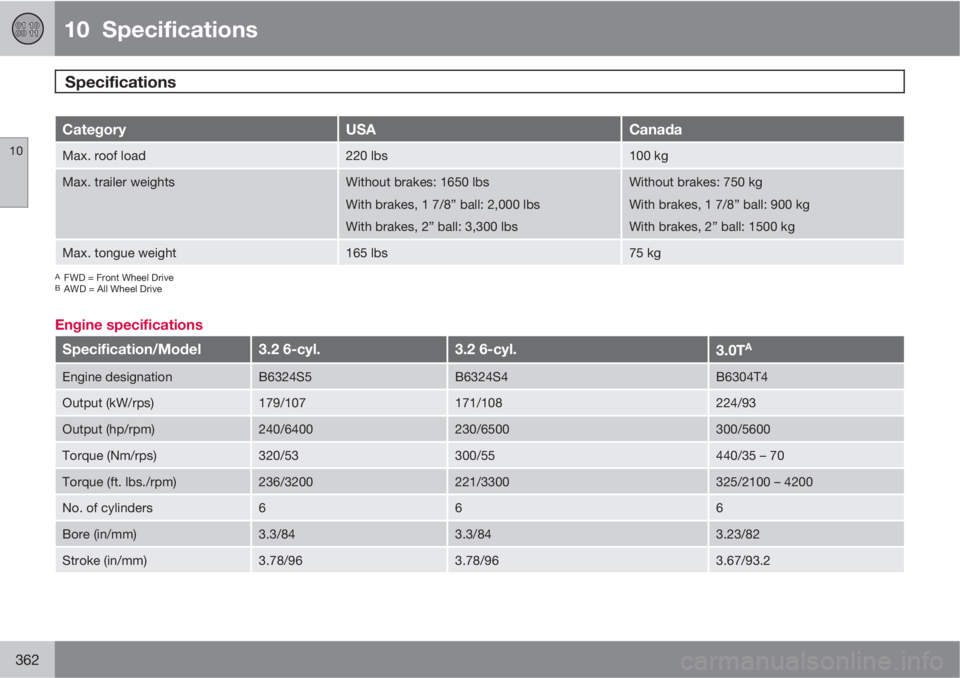
CategoryUSACanada
Max. roof load220 lbs100 kg
Max. trailer weightsWithout brakes: 1650 lbs
With brakes, 1 7/8” ball: 2,000 lbs
With brakes, 2” ball: 3,300 lbsWithout brakes: 750 kg
With brakes, 1 7/8” ball: 900 kg
With brakes, 2” ball: 1500 kg
Max. tongue weight165 lbs75 kg
AFWD = Front Wheel DriveBAWD = All Wheel Drive
Engine specifications
Specification/Model3.2 6-cyl.3.2 6-cyl.3.0TA
Engine designationB6324S5B6324S4B6304T4
Output (kW/rps)179/107171/108224/93
Output (hp/rpm)240/6400230/6500300/5600
Torque (Nm/rps)320/53300/55440/35 – 70
Torque (ft. lbs./rpm)236/3200221/3300325/2100 – 4200
No. of cylinders666
Bore (in/mm)3.3/843.3/843.23/82
Stroke (in/mm)3.78/963.78/963.67/93.2
Page 366 of 382
10 Specifications
Specifications
10
364
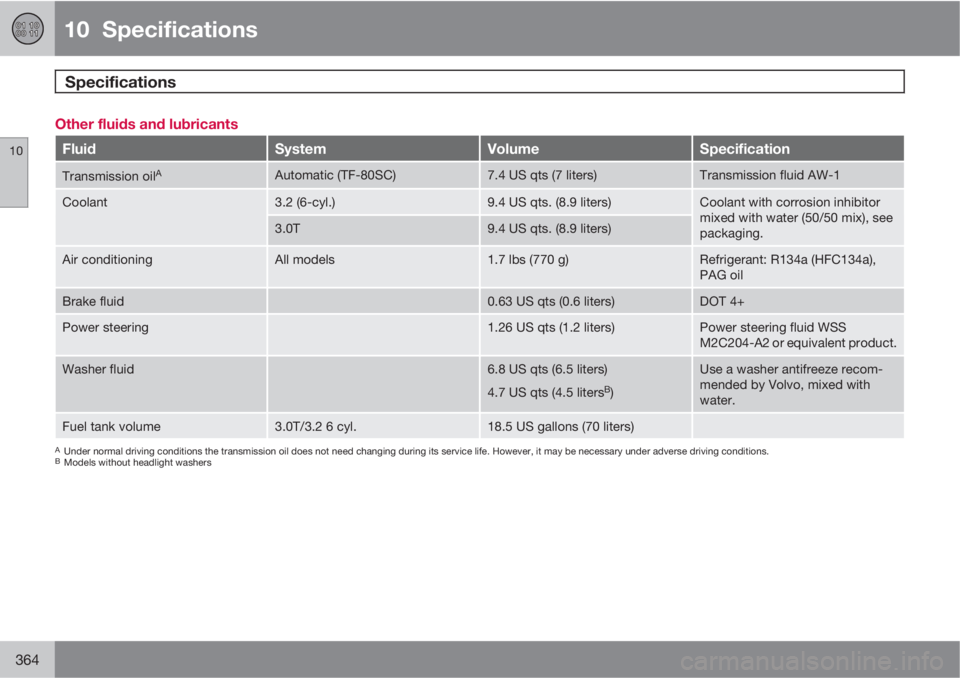
Other fluids and lubricants
FluidSystemVolumeSpecification
Transmission oilAAutomatic (TF-80SC)7.4 US qts (7 liters)Transmission fluid AW-1
Coolant3.2 (6-cyl.)9.4 US qts. (8.9 liters)Coolant with corrosion inhibitor
mixed with water (50/50 mix), see
packaging.
3.0T9.4 US qts. (8.9 liters)
Air conditioningAll models1.7 lbs (770 g)Refrigerant: R134a (HFC134a),
PAG oil
Brake fluid0.63 US qts (0.6 liters)DOT 4+
Power steering1.26 US qts (1.2 liters)Power steering fluid WSS
M2C204-A2 or equivalent product.
Washer fluid6.8 US qts (6.5 liters)
4.7 US qts (4.5 liters
B)
Use a washer antifreeze recom-
mended by Volvo, mixed with
water.
Fuel tank volume3.0T/3.2 6 cyl.18.5 US gallons (70 liters)
AUnder normal driving conditions the transmission oil does not need changing during its service life. However, it may be necessary under adverse driving conditions.BModels without headlight washers