transmission oil VOLVO XC60 2016 Owner´s Manual
[x] Cancel search | Manufacturer: VOLVO, Model Year: 2016, Model line: XC60, Model: VOLVO XC60 2016Pages: 398, PDF Size: 9.98 MB
Page 11 of 398
Contents
9
11
11 Specifications
Label information.................................... 368
Dimensions............................................. 371
Weights................................................... 374
Engine specifications.............................. 376
Oil specifications..................................... 377
Oil volume............................................... 378
Coolant – specification and volume........ 379Transmission oil – specification and vol-
umes....................................................... 379
Brake fluid – specification and volume... 379
Power steering – specification................ 380Fuel tank volume – specification and vol-
ume......................................................... 380 Air conditioning – specification and vol-
ume......................................................... 380
Battery specifications............................. 381
Symbols – general information............... 382
Warning symbols.................................... 382
Indicator symbols.................................... 383
Information symbols............................... 384
Information symbols – ceiling console.... 385
Information symbols – center console.... 385
12
12 Index
Index....................................................... 386
Page 250 of 398
||
08 Starting and driving
08
248
WARNING
•Always remove the remote key from the ignition slot when leaving the vehi-cle and ensure that the ignition inmode
0 (see Ignition modes (p. 79) for
information about the ignition modes).
• On vehicles with the optional keylessdrive, never remove the remote keyfrom the vehicle while it is being drivenor towed.
• Always place the gear selector in Parkand apply the parking brake beforeleaving the vehicle. Never leave thevehicle unattended with the enginerunning.
• Always open garage doors fully beforestarting the engine inside a garage toensure adequate ventilation. Theexhaust gases contain carbon monox-ide, which is invisible and odorless butvery poisonous.
NOTE
•
After a cold start, idle speed may be noticeably higher than normal for ashort period. This is done to help bringcomponents in the emission controlsystem to their normal operating tem-perature as quickly as possible, whichenables them to control emissions andhelp reduce the vehicle's impact on the environment 3
.
CAUTION
• When starting in cold weather, the automatic transmission may shift up atslightly higher engine speeds than nor-mal until the automatic transmissionfluid reaches normal operating tem-perature.
• Do not race a cold engine immediatelyafter starting. Oil flow may not reachsome lubrication points fast enough toprevent engine damage.
• The engine should be idling when youmove the gear selector. Never acceler-ate until after you feel the transmissionengage. Accelerating immediately afterselecting a gear will cause harshengagement and premature transmis-sion wear.
• Selecting
P or N when idling at a
standstill for prolonged periods of timewill help prevent overheating of theautomatic transmission fluid.
Related information
• Switching off the engine (p. 249)
3
If the gear selector is in the D or R positions and the car is not moving, engine speed (rpm) will be lower and it will take longer for the engine to reach normal operating temperature.
Page 266 of 398
08 Starting and driving
08
264
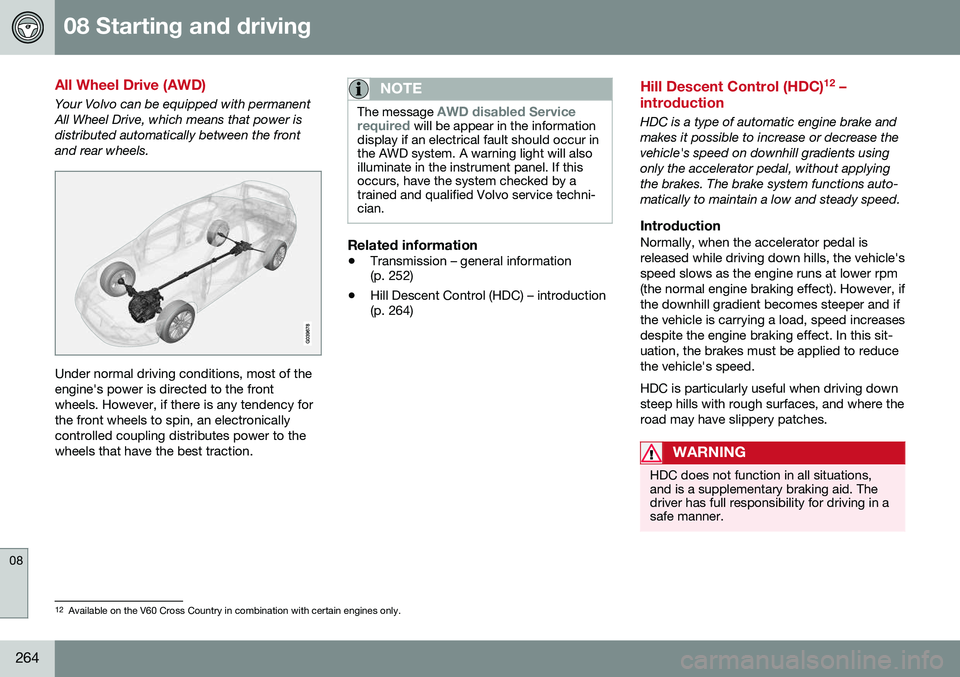
All Wheel Drive (AWD)
Your Volvo can be equipped with permanent All Wheel Drive, which means that power isdistributed automatically between the frontand rear wheels.
Under normal driving conditions, most of the engine's power is directed to the frontwheels. However, if there is any tendency forthe front wheels to spin, an electronicallycontrolled coupling distributes power to thewheels that have the best traction.
NOTE
The message AWD disabled Service
required will be appear in the information
display if an electrical fault should occur in the AWD system. A warning light will alsoilluminate in the instrument panel. If thisoccurs, have the system checked by atrained and qualified Volvo service techni-cian.
Related information
• Transmission – general information (p. 252)
• Hill Descent Control (HDC) – introduction(p. 264)
Hill Descent Control (HDC) 12
–
introduction
HDC is a type of automatic engine brake and makes it possible to increase or decrease thevehicle's speed on downhill gradients usingonly the accelerator pedal, without applyingthe brakes. The brake system functions auto-matically to maintain a low and steady speed.
IntroductionNormally, when the accelerator pedal isreleased while driving down hills, the vehicle'sspeed slows as the engine runs at lower rpm(the normal engine braking effect). However, ifthe downhill gradient becomes steeper and ifthe vehicle is carrying a load, speed increasesdespite the engine braking effect. In this sit-uation, the brakes must be applied to reducethe vehicle's speed. HDC is particularly useful when driving down steep hills with rough surfaces, and where theroad may have slippery patches.
WARNING
HDC does not function in all situations, and is a supplementary braking aid. Thedriver has full responsibility for driving in asafe manner.
12 Available on the V60 Cross Country in combination with certain engines only.
Page 275 of 398
08 Starting and driving
08
273
Driving through water
The vehicle should be driven with extreme caution if it is necessary to drive throughstanding water. The vehicle can be driven through water up to a depth of approximately 13 in. (35 cm) atwalking speed to help prevent water fromentering the differential and the transmission.Water reduces the oil's lubricating capacityand may shorten the service life of thesecomponents.
• Take particular care when driving through flowing water.
• Clean the electrical connections for trailerwiring after driving in mud or water.
• When driving through water, maintain lowspeed and do not stop in the water.WARNING
•Avoid driving through standing or rushing water. Doing so can be dan-gerous and it may also be difficult todetermine the actual depth of thewater.
• If water cannot be avoided, after driv-ing through the water, press lightly onthe brake pedal to ensure that thebrakes are functioning normally. Wateror mud can make the brake liningsslippery, resulting in delayed brakingeffect.
CAUTION
•
Engine damage will occur if water is drawn into the air cleaner.
• If the vehicle is driven through waterdeeper than approximately 13 in.(35 cm), water may enter the differen-tial and the transmission. This reducesthe oil's lubricating capacity and mayshorten the service life of these com-ponents.
• Damage to any components, theengine, transmission, turbo-charger,differential or its internal componentscaused by flooding, vapor lock orinsufficient oil is not covered underwarranty.
• Do not allow the vehicle to stand inwater up to the door sills longer thanabsolutely necessary. This could resultin electrical malfunctions.
• If the engine has been stopped whilethe vehicle is in water, do not attemptto restart it. Have the vehicle towedout of the water.
Related information
•
Towing the vehicle (p. 285)
• Towing by tow truck (p. 286)
Page 276 of 398
08 Starting and driving
08
274
Engine and cooling system
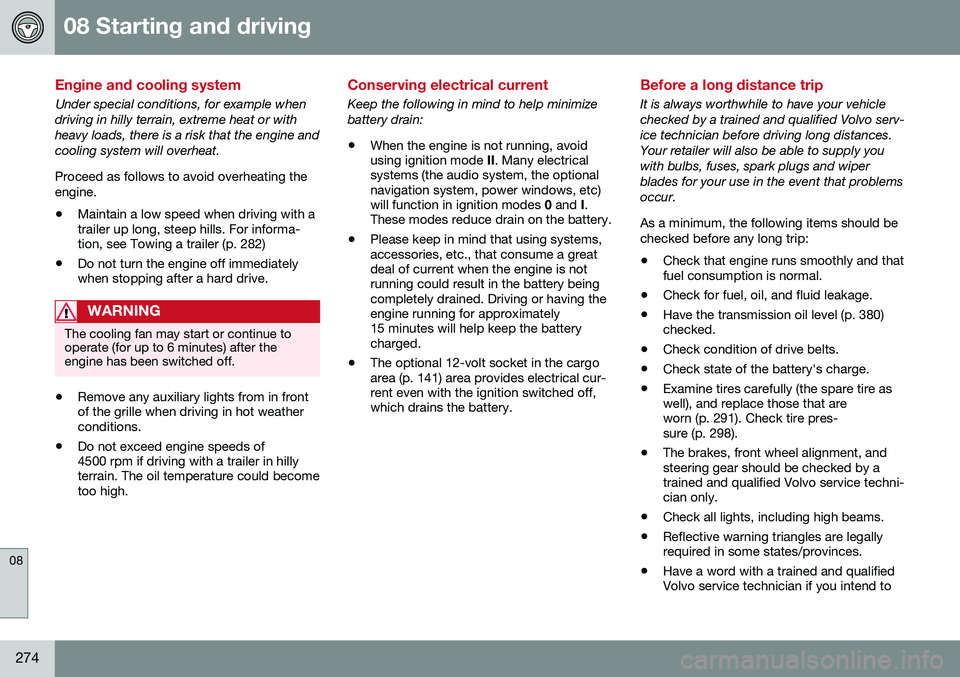
Under special conditions, for example when driving in hilly terrain, extreme heat or withheavy loads, there is a risk that the engine andcooling system will overheat. Proceed as follows to avoid overheating the engine. •Maintain a low speed when driving with a trailer up long, steep hills. For informa-tion, see Towing a trailer (p. 282)
• Do not turn the engine off immediatelywhen stopping after a hard drive.
WARNING
The cooling fan may start or continue to operate (for up to 6 minutes) after theengine has been switched off.
•
Remove any auxiliary lights from in front of the grille when driving in hot weatherconditions.
• Do not exceed engine speeds of4500 rpm if driving with a trailer in hillyterrain. The oil temperature could becometoo high.
Conserving electrical current
Keep the following in mind to help minimize battery drain:
• When the engine is not running, avoid using ignition mode
II. Many electrical
systems (the audio system, the optionalnavigation system, power windows, etc)will function in ignition modes 0 and I.
These modes reduce drain on the battery.
• Please keep in mind that using systems,accessories, etc., that consume a greatdeal of current when the engine is notrunning could result in the battery beingcompletely drained. Driving or having theengine running for approximately15 minutes will help keep the batterycharged.
• The optional 12-volt socket in the cargoarea (p. 141) area provides electrical cur-rent even with the ignition switched off,which drains the battery.
Before a long distance trip
It is always worthwhile to have your vehicle checked by a trained and qualified Volvo serv-ice technician before driving long distances.Your retailer will also be able to supply youwith bulbs, fuses, spark plugs and wiperblades for your use in the event that problemsoccur. As a minimum, the following items should be checked before any long trip:
• Check that engine runs smoothly and that fuel consumption is normal.
• Check for fuel, oil, and fluid leakage.
• Have the transmission oil level (p. 380)checked.
• Check condition of drive belts.
• Check state of the battery's charge.
• Examine tires carefully (the spare tire aswell), and replace those that areworn (p. 291). Check tire pres-sure (p. 298).
• The brakes, front wheel alignment, andsteering gear should be checked by atrained and qualified Volvo service techni-cian only.
• Check all lights, including high beams.
• Reflective warning triangles are legallyrequired in some states/provinces.
• Have a word with a trained and qualifiedVolvo service technician if you intend to
Page 283 of 398
08 Starting and driving
08
* Option/accessory, for more information, see Introduction.281
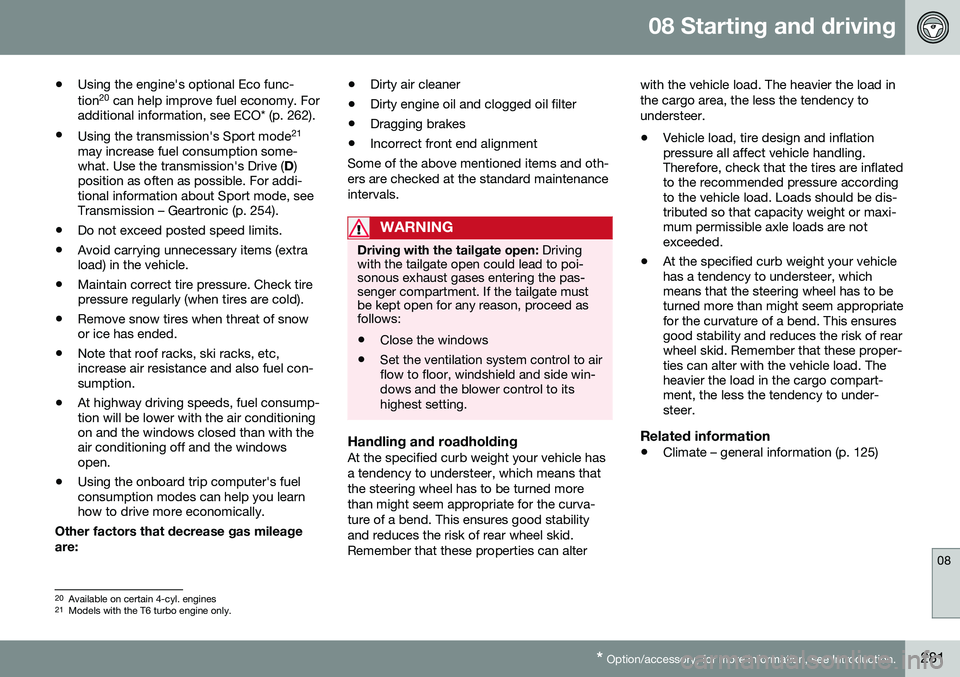
•
Using the engine's optional Eco func- tion20
can help improve fuel economy. For
additional information, see ECO* (p. 262).
• Using the transmission's Sport mode 21
may increase fuel consumption some- what. Use the transmission's Drive ( D)
position as often as possible. For addi-tional information about Sport mode, seeTransmission – Geartronic (p. 254).
• Do not exceed posted speed limits.
• Avoid carrying unnecessary items (extraload) in the vehicle.
• Maintain correct tire pressure. Check tirepressure regularly (when tires are cold).
• Remove snow tires when threat of snowor ice has ended.
• Note that roof racks, ski racks, etc,increase air resistance and also fuel con-sumption.
• At highway driving speeds, fuel consump-tion will be lower with the air conditioningon and the windows closed than with theair conditioning off and the windowsopen.
• Using the onboard trip computer's fuelconsumption modes can help you learnhow to drive more economically.
Other factors that decrease gas mileage are: •
Dirty air cleaner
• Dirty engine oil and clogged oil filter
• Dragging brakes
• Incorrect front end alignment
Some of the above mentioned items and oth-ers are checked at the standard maintenanceintervals.
WARNING
Driving with the tailgate open: Driving
with the tailgate open could lead to poi- sonous exhaust gases entering the pas-senger compartment. If the tailgate mustbe kept open for any reason, proceed asfollows: • Close the windows
• Set the ventilation system control to air flow to floor, windshield and side win-dows and the blower control to itshighest setting.
Handling and roadholdingAt the specified curb weight your vehicle has a tendency to understeer, which means thatthe steering wheel has to be turned morethan might seem appropriate for the curva-ture of a bend. This ensures good stabilityand reduces the risk of rear wheel skid.Remember that these properties can alter with the vehicle load. The heavier the load inthe cargo area, the less the tendency toundersteer. •
Vehicle load, tire design and inflation pressure all affect vehicle handling.Therefore, check that the tires are inflatedto the recommended pressure accordingto the vehicle load. Loads should be dis-tributed so that capacity weight or maxi-mum permissible axle loads are notexceeded.
• At the specified curb weight your vehiclehas a tendency to understeer, whichmeans that the steering wheel has to beturned more than might seem appropriatefor the curvature of a bend. This ensuresgood stability and reduces the risk of rearwheel skid. Remember that these proper-ties can alter with the vehicle load. Theheavier the load in the cargo compart-ment, the less the tendency to under-steer.
Related information
• Climate – general information (p. 125)
20
Available on certain 4-cyl. engines
21 Models with the T6 turbo engine only.
Page 354 of 398
||
10 Maintenance and servicing
10
352* Option/accessory, for more information, see Introduction.
Engine compartment, upper
Engine compartment, front
Engine compartment, lower
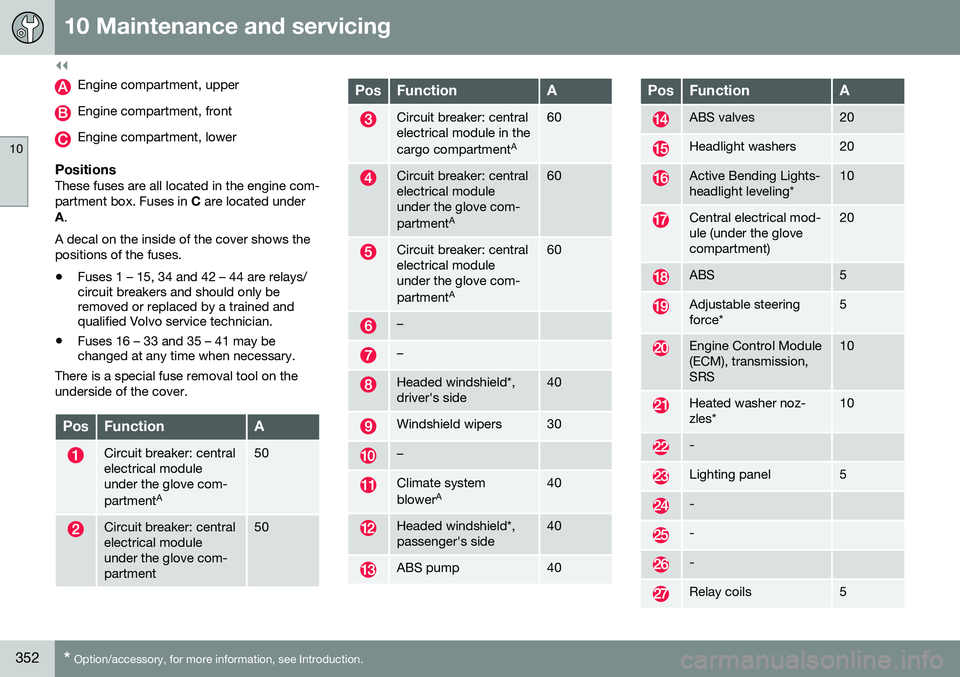
PositionsThese fuses are all located in the engine com- partment box. Fuses in C are located under
A .
A decal on the inside of the cover shows thepositions of the fuses. • Fuses 1 – 15, 34 and 42 – 44 are relays/ circuit breakers and should only beremoved or replaced by a trained andqualified Volvo service technician.
• Fuses 16 – 33 and 35 – 41 may bechanged at any time when necessary.
There is a special fuse removal tool on the underside of the cover.
PosFunctionA
Circuit breaker: central electrical moduleunder the glove com- partment A50
Circuit breaker: central electrical moduleunder the glove com-partment50
PosFunctionA
Circuit breaker: central electrical module in the cargo compartment A60
Circuit breaker: central electrical moduleunder the glove com- partmentA60
Circuit breaker: central electrical moduleunder the glove com- partmentA60
–
–
Headed windshield*, driver's side40
Windshield wipers30
–
Climate system blowerA40
Headed windshield*, passenger's side40
ABS pump40
PosFunctionA
ABS valves20
Headlight washers20
Active Bending Lights- headlight leveling*10
Central electrical mod- ule (under the glovecompartment)20
ABS5
Adjustable steering force*5
Engine Control Module (ECM), transmission,SRS10
Heated washer noz- zles*10
-
Lighting panel5
-
-
-
Relay coils5
Page 355 of 398
10 Maintenance and servicing
10
}}
* Option/accessory, for more information, see Introduction.353
PosFunctionA
Auxiliary lights*20
Horn15
Relay coils, Engine Control Module (ECM)10
Control module - auto- matic transmission15
A/C compressor (not 4-cyl. engines)15
Relay-coils A/C, relay coils in engine com-partment cold zone forStart/Stop5
Starter motor relay A30
Engine control module (4-cyl. engines) Ignition coils (5-/6-cyl. engines), condenser(6-cyl. engines)20
Engine Control Module (4-cyl. engines)20
Engine Control Module (5-cyl. & 6-cyl. engines)10
PosFunctionA
4-cyl. engines: mass air meter, thermostat,EVAP valve10
5-/6-cyl. engines: Injection system, massair meter (6-cyl.engines only), enginecontrol module15
A/C compressor (5-/6- cyl. engines), enginevalves, engine controlmodule (6-cyl.engines), solenoids (6-cyl. non-turbo only),mass air meter (6-cyl.only), oil level sensor(5-cyl. only)10
Engine valves/oil pump/center heatedoxygen sensor (4-cyl.engines)15
Front/rear heated oxy- gen sensors (4-cyl.engines), EVAP valve(5-/6-cyl. engines),heated oxygen sensors(5-/6-cyl. engines)15
PosFunctionA
Oil pump/crankcase ventilation heater/cool-ant pump (5-cyl.engines)10
Ignition coils (4-cyl. engines)15
Fuel leakage detection (5-/6-cyl. engines),control module forradiator shutter (5-cyl.engines)5
Fuel leakage detection, A/C solenoid (4-cyl.engines)7.5
Coolant pump (4-cyl. engines)50
Cooling fan60 (4/5- cyl.engines)
80 (6-cyl. engines)
Power steering100
A
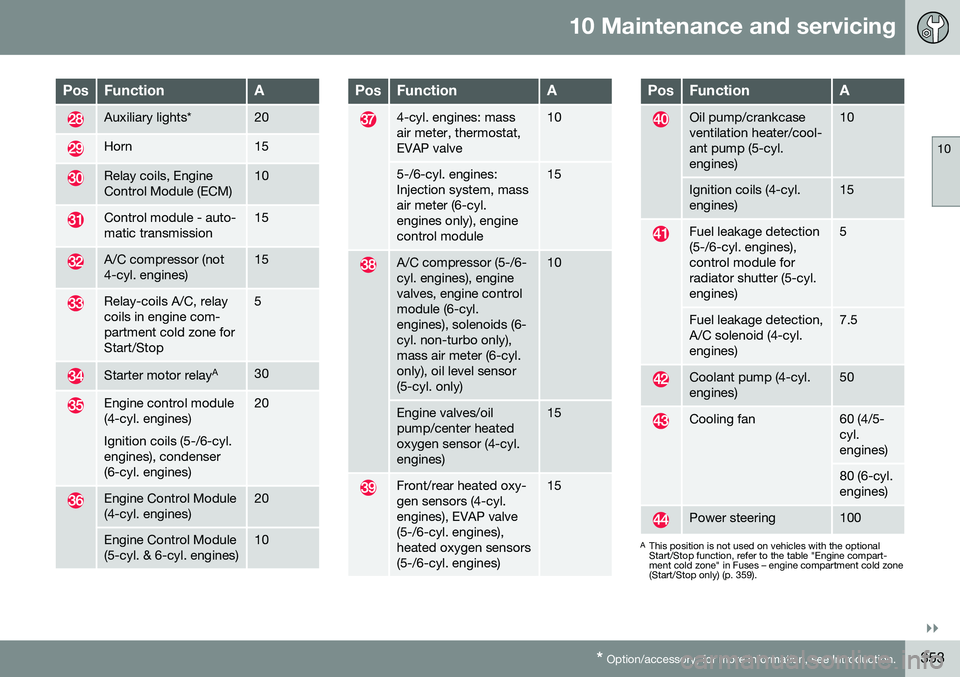
This position is not used on vehicles with the optional Start/Stop function, refer to the table "Engine compart-ment cold zone" in Fuses – engine compartment cold zone(Start/Stop only) (p. 359).
Page 381 of 398
11 Specifications
11
379
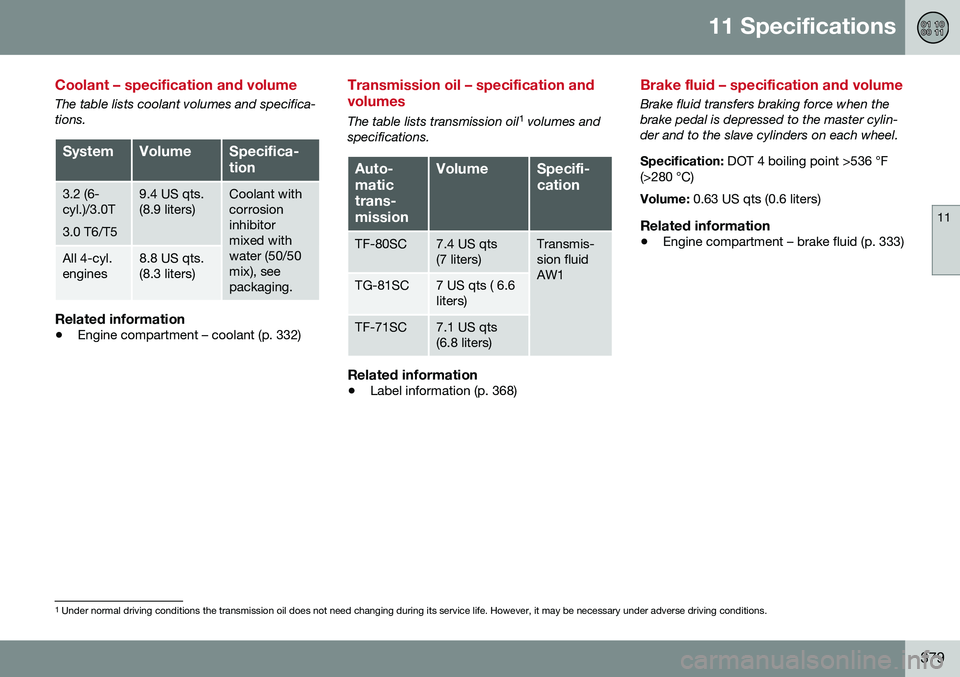
Coolant – specification and volume
The table lists coolant volumes and specifica- tions.
SystemVolumeSpecifica- tion
3.2 (6- cyl.)/3.0T 3.0 T6/T59.4 US qts. (8.9 liters)Coolant with corrosioninhibitormixed withwater (50/50mix), seepackaging.
All 4-cyl. engines8.8 US qts. (8.3 liters)
Related information
•Engine compartment – coolant (p. 332)
Transmission oil – specification and volumes
The table lists transmission oil 1
volumes and
specifications.
Auto- matictrans-missionVolumeSpecifi- cation
TF-80SC7.4 US qts (7 liters)Transmis- sion fluidAW1
TG-81SC7 US qts ( 6.6 liters)
TF-71SC7.1 US qts (6.8 liters)
Related information
• Label information (p. 368)
Brake fluid – specification and volume
Brake fluid transfers braking force when the brake pedal is depressed to the master cylin-der and to the slave cylinders on each wheel. Specification:
DOT 4 boiling point >536 °F
(>280 °C) Volume: 0.63 US qts (0.6 liters)
Related information
•Engine compartment – brake fluid (p. 333)
1
Under normal driving conditions the transmission oil does not need changing during its service life. However, it may be necessary under adverse driving conditions.
Page 388 of 398
12 Index
12
386
A
ABS (anti-lock brake system).................. 268
Accessory installation warning.................. 23
Active chassis system............................. 174
Active high beams..................................... 90Active yaw control........................... 174, 175
Adaptive brake lights............................... 268
Adaptive cruise control.................... 184, 185Airbags disconnecting the front passenger’s
side....................................................... 36
front...................................................... 32
inflatable curtain................................... 41
side impact........................................... 39
Air conditioning................................ 131, 132
Air distribution.................................. 127, 133
Air distribution table................................. 135
Air vents................................................... 127
Alarm........................................ 169, 170, 171
All Wheel Drive......................................... 264
Ambient temperature sensor..................... 77
Anti-freeze....................................... 275, 332Anti-lock brake system warning light......................................... 73
Anti-lock Brake System (ABS)................. 268 Approach lighting.............................. 97, 153
Auto-dim rearview mirror......................... 104
Automatic locking retractor....................... 47Automatic transmission
Eco (driving function).......................... 262
Geartronic........................................... 254
general description..................... 252, 254
oil........................................................ 379
shiftlock override................................ 256
Axle weight.............................................. 302
B
Battery maintenance............................... 347, 348
remote key, replacing......................... 158
replacing............................................. 348
specifications...................................... 381
start/stop............................................ 381
warning symbols................................. 346
Blind Spot Information System (BLIS)..... 240 Cross Traffic Alert (CTA)..................... 243
Booster cushion, integrated.......... 57, 59, 60
Booster cushions....................................... 54
Brake lights.............................................. 268 Brake system
ABS..................................................... 268
Brake pad inspection.......................... 266
checking fluid level............................. 333
emergency brake assistance.............. 269
fluid..................................................... 379
general information............................. 266
Hill Descent Control.................... 264, 265
Bulbs cargo area lighting.............................. 341
headlights........... 335, 336, 337, 338, 339
introduction......................................... 335
license plate lights.............................. 341
specifications...................................... 342
taillight................................................ 340
C
Camera, Park Assist................................ 236
Capacity weight....................................... 302Cargo area changing bulbs................................... 341
steel grid............................................. 147
Cargo area cover..................................... 147
Cargo area net......................................... 144
Cargo net................................................. 144
Catalytic converter................................... 280