warning VOLVO XC60 2018 Owner´s Manual
[x] Cancel search | Manufacturer: VOLVO, Model Year: 2018, Model line: XC60, Model: VOLVO XC60 2018Pages: 660, PDF Size: 11.77 MB
Page 157 of 660
LIGHTING
}}
* Option/accessory.155
Active high beam
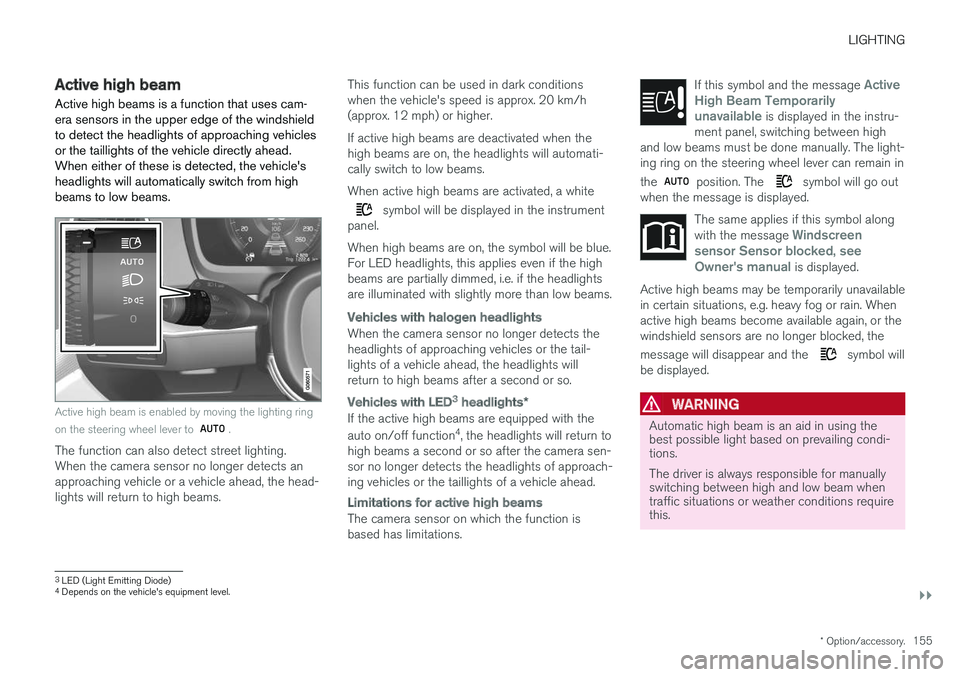
Active high beams is a function that uses cam- era sensors in the upper edge of the windshieldto detect the headlights of approaching vehiclesor the taillights of the vehicle directly ahead.When either of these is detected, the vehicle'sheadlights will automatically switch from highbeams to low beams.
Active high beam is enabled by moving the lighting ring on the steering wheel lever to
.
The function can also detect street lighting. When the camera sensor no longer detects anapproaching vehicle or a vehicle ahead, the head-lights will return to high beams. This function can be used in dark conditionswhen the vehicle's speed is approx. 20 km/h(approx. 12 mph) or higher. If active high beams are deactivated when the high beams are on, the headlights will automati-cally switch to low beams. When active high beams are activated, a white
symbol will be displayed in the instrument
panel. When high beams are on, the symbol will be blue. For LED headlights, this applies even if the highbeams are partially dimmed, i.e. if the headlightsare illuminated with slightly more than low beams.
Vehicles with halogen headlights
When the camera sensor no longer detects the headlights of approaching vehicles or the tail-lights of a vehicle ahead, the headlights willreturn to high beams after a second or so.
Vehicles with LED3 headlights *
If the active high beams are equipped with the auto on/off function 4
, the headlights will return to
high beams a second or so after the camera sen- sor no longer detects the headlights of approach-ing vehicles or the taillights of a vehicle ahead.
Limitations for active high beams
The camera sensor on which the function is based has limitations. If this symbol and the message
Active
High Beam Temporarily
unavailable is displayed in the instru-
ment panel, switching between high
and low beams must be done manually. The light- ing ring on the steering wheel lever can remain in the
position. The symbol will go out
when the message is displayed.
The same applies if this symbol along with the message Windscreen
sensor Sensor blocked, see
Owner's manual is displayed.
Active high beams may be temporarily unavailable in certain situations, e.g. heavy fog or rain. Whenactive high beams become available again, or thewindshield sensors are no longer blocked, the message will disappear and the
symbol will
be displayed.
WARNING
Automatic high beam is an aid in using the best possible light based on prevailing condi-tions. The driver is always responsible for manually switching between high and low beam whentraffic situations or weather conditions requirethis.
3 LED (Light Emitting Diode)4
Depends on the vehicle's equipment level.
Page 158 of 660
||
LIGHTING
156
Related information
•Lighting panel and controls (p. 150)
• Using high beam (p. 154)
• Camera limitations (p. 324)
Using turn signals
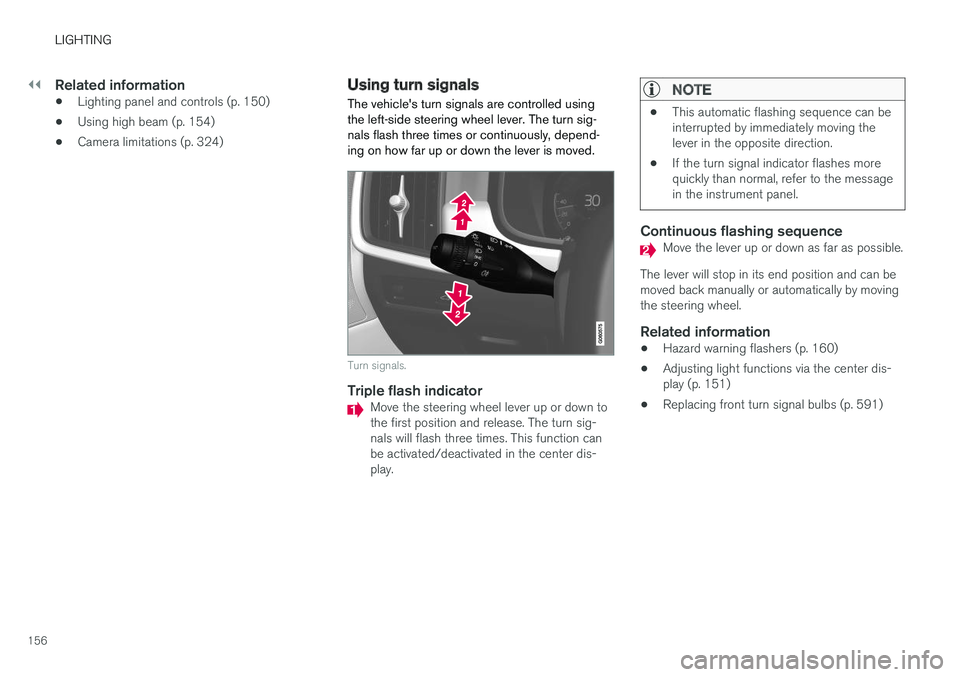
The vehicle's turn signals are controlled using the left-side steering wheel lever. The turn sig-nals flash three times or continuously, depend-ing on how far up or down the lever is moved.
Turn signals.
Triple flash indicatorMove the steering wheel lever up or down to the first position and release. The turn sig-nals will flash three times. This function canbe activated/deactivated in the center dis-play.
NOTE
• This automatic flashing sequence can be interrupted by immediately moving thelever in the opposite direction.
• If the turn signal indicator flashes morequickly than normal, refer to the messagein the instrument panel.
Continuous flashing sequenceMove the lever up or down as far as possible.
The lever will stop in its end position and can be moved back manually or automatically by movingthe steering wheel.
Related information
• Hazard warning flashers (p. 160)
• Adjusting light functions via the center dis-play (p. 151)
• Replacing front turn signal bulbs (p. 591)
Page 161 of 660
LIGHTING
* Option/accessory.159
Press the button for On/Off. The
symbol in
the instrument panel illuminates when the rear fog light is on. The rear fog light turns off automatically when:
• the start knob is turned clockwise to turn off the ignition or when the lighting ring is turned to the
position.
• the lighting ring is in the
position and
the front fog lights are turned off.
NOTE
Regulations concerning rear fog light use vary from country to country.
Related information
• Lighting panel and controls (p. 150)
• Front fog lights/cornering illumination
*
(p. 157)
• Ignition modes (p. 401)
Brake lights The brake lights are automatically illuminated when braking.
The brake lights illuminate when the brake pedal is depressed. They also illuminate when thebrakes are automatically applied by one of thedriver support systems.
Related information
• Emergency brake lights (p. 159)
• Brake functions (p. 402)
Emergency brake lights
The emergency brake lights are activated to warn following vehicles of hard braking. This function causes an additional taillight on each side of the vehicle to illuminate.
The emergency brake lights are activated in the event of hard braking or if the ABS system isactivated and the vehicle is traveling at a highspeed. After the driver decelerates to a low speed and then releases the brake, the brake lights resumetheir normal brightness.
Related information
• Brake lights (p. 159)
• Brakes (p. 403)
• Hazard warning flashers (p. 160)
Page 162 of 660
LIGHTING
* Option/accessory.
160
Hazard warning flashers
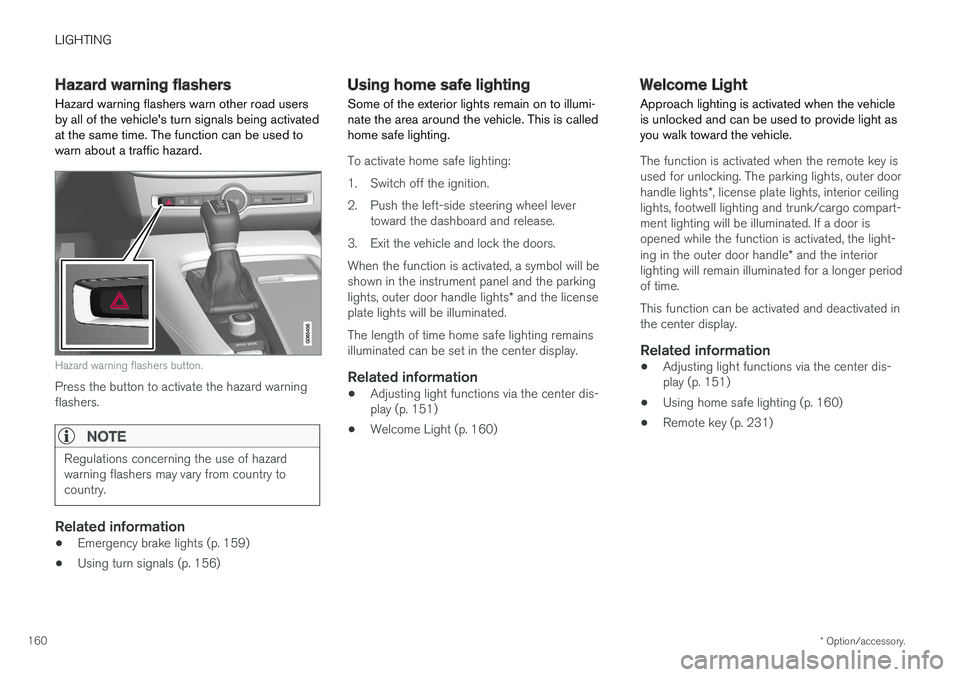
Hazard warning flashers warn other road users by all of the vehicle's turn signals being activatedat the same time. The function can be used towarn about a traffic hazard.
Hazard warning flashers button.
Press the button to activate the hazard warning flashers.
NOTE
Regulations concerning the use of hazard warning flashers may vary from country tocountry.
Related information
• Emergency brake lights (p. 159)
• Using turn signals (p. 156)
Using home safe lighting
Some of the exterior lights remain on to illumi- nate the area around the vehicle. This is calledhome safe lighting.
To activate home safe lighting:
1. Switch off the ignition.
2. Push the left-side steering wheel lever toward the dashboard and release.
3. Exit the vehicle and lock the doors.When the function is activated, a symbol will be shown in the instrument panel and the parking lights, outer door handle lights * and the license
plate lights will be illuminated. The length of time home safe lighting remains illuminated can be set in the center display.
Related information
• Adjusting light functions via the center dis-play (p. 151)
• Welcome Light (p. 160)
Welcome Light Approach lighting is activated when the vehicle is unlocked and can be used to provide light asyou walk toward the vehicle.
The function is activated when the remote key is used for unlocking. The parking lights, outer door handle lights
*, license plate lights, interior ceiling
lights, footwell lighting and trunk/cargo compart- ment lighting will be illuminated. If a door isopened while the function is activated, the light- ing in the outer door handle * and the interior
lighting will remain illuminated for a longer period of time. This function can be activated and deactivated in the center display.
Related information
• Adjusting light functions via the center dis-play (p. 151)
• Using home safe lighting (p. 160)
• Remote key (p. 231)
Page 168 of 660
WINDOWS, GLASS AND MIRRORS
* Option/accessory.
166
Windows, glass and mirrors
The vehicle is equipped with controls for win- dows, glass and mirrors. Some of the windowsin the car are laminated.
Laminated glass
The windshield and panoramic roof * have lamina-
ted glass. The glass is reinforced, which provides better protection against break-ins and improvedsoundproofing in the passenger compartment.Laminated glass is available as an option forsome other glass surfaces.
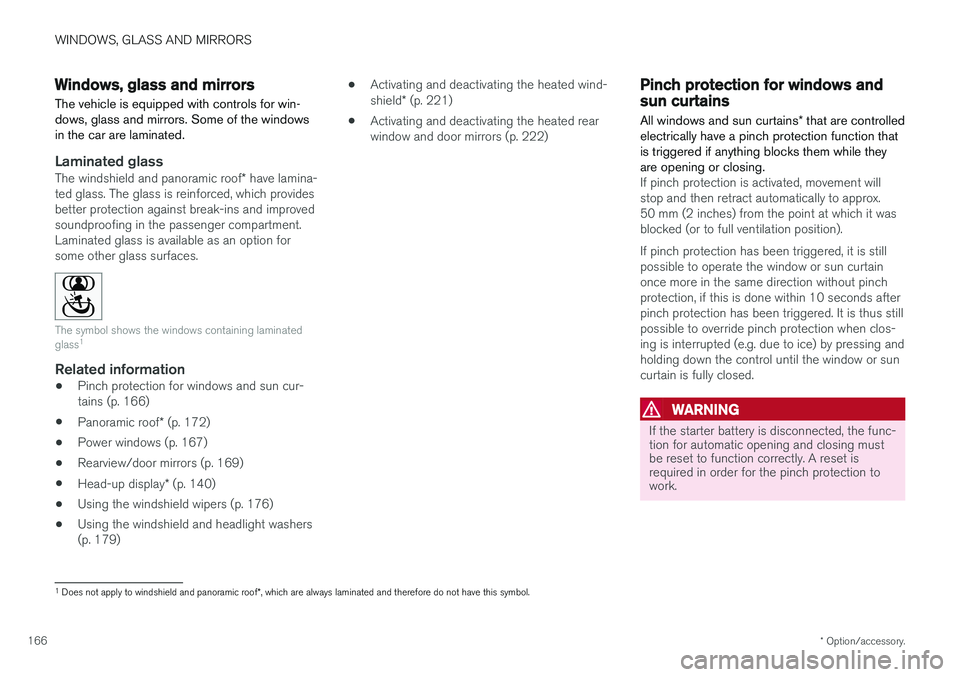
The symbol shows the windows containing laminated glass 1
Related information
•
Pinch protection for windows and sun cur- tains (p. 166)
• Panoramic roof
* (p. 172)
• Power windows (p. 167)
• Rearview/door mirrors (p. 169)
• Head-up display
* (p. 140)
• Using the windshield wipers (p. 176)
• Using the windshield and headlight washers(p. 179) •
Activating and deactivating the heated wind- shield
* (p. 221)
• Activating and deactivating the heated rear window and door mirrors (p. 222)
Pinch protection for windows andsun curtains
All windows and sun curtains * that are controlled
electrically have a pinch protection function that is triggered if anything blocks them while theyare opening or closing.
If pinch protection is activated, movement will stop and then retract automatically to approx.50 mm (2 inches) from the point at which it wasblocked (or to full ventilation position). If pinch protection has been triggered, it is still possible to operate the window or sun curtainonce more in the same direction without pinchprotection, if this is done within 10 seconds afterpinch protection has been triggered. It is thus stillpossible to override pinch protection when clos-ing is interrupted (e.g. due to ice) by pressing andholding down the control until the window or suncurtain is fully closed.
WARNING
If the starter battery is disconnected, the func- tion for automatic opening and closing mustbe reset to function correctly. A reset isrequired in order for the pinch protection towork.
1 Does not apply to windshield and panoramic roof *, which are always laminated and therefore do not have this symbol.
Page 169 of 660
WINDOWS, GLASS AND MIRRORS
}}
* Option/accessory.167
Related information
•Reset procedure for pinch protection (p. 167)
• Operating the power windows (p. 168)
• Panoramic roof
* (p. 172)
Reset procedure for pinchprotection
If the power windows are not operating properly, you can try a reset procedure.
WARNING
If the starter battery is disconnected, the func- tion for automatic opening and closing mustbe reset to function correctly. A reset isrequired in order for the pinch protection towork.
If the problem persists or if it affects the panor- amic roof or sunroof, contact a workshop. 2
Resetting a power window
1. Start with the window in the closed position.
2. Then operate the window in manual mode
three times upward toward the closed posi- tion.
> The system will be automatically initiated.
Related information
• Pinch protection for windows and sun cur- tains (p. 166)
• Operating the power windows (p. 168)
Power windows
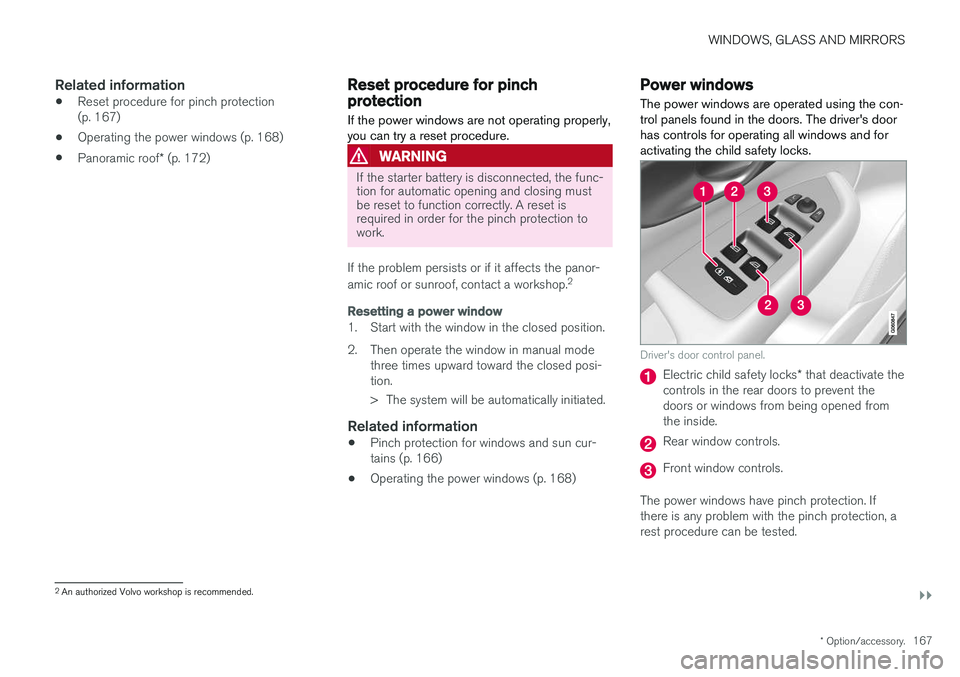
The power windows are operated using the con- trol panels found in the doors. The driver's doorhas controls for operating all windows and foractivating the child safety locks.
Driver's door control panel.
Electric child safety locks * that deactivate the
controls in the rear doors to prevent the doors or windows from being opened fromthe inside.
Rear window controls.
Front window controls.
The power windows have pinch protection. If there is any problem with the pinch protection, arest procedure can be tested.
2 An authorized Volvo workshop is recommended.
Page 170 of 660
||
WINDOWS, GLASS AND MIRRORS
* Option/accessory.
168
WARNING
Children, other passengers or objects can be trapped by the moving parts.
• Always operate the windows with caution.
• Do not allow children to play with the operating controls.
• Never leave a child alone in the vehicle.
• Remember to always cut the current tothe power windows by setting the vehi- cle's electrical system to ignition mode
0
and then taking the remote key with you when leaving the vehicle.
• Never stick objects or body parts outthrough the windows, even if the vehicleelectrical system is completely turned off.
Related information
•Operating the power windows (p. 168)
• Pinch protection for windows and sun cur-tains (p. 166)
• Reset procedure for pinch protection(p. 167)
Operating the power windows
All power windows can be operated using the control panel in the driver's door. The controlpanels in the other doors can be used to oper-ate that particular door.
The power windows have pinch protection. If there is any problem with the pinch protection, arest procedure can be tested.
WARNING
Children, other passengers or objects can be trapped by the moving parts.
• Always operate the windows with caution.
• Do not allow children to play with the operating controls.
• Never leave a child alone in the vehicle.
• Remember to always cut the current tothe power windows by setting the vehi- cle's electrical system to ignition mode
0
and then taking the remote key with you when leaving the vehicle.
• Never stick objects or body parts outthrough the windows, even if the vehicleelectrical system is completely turned off.
Operating the power windows.
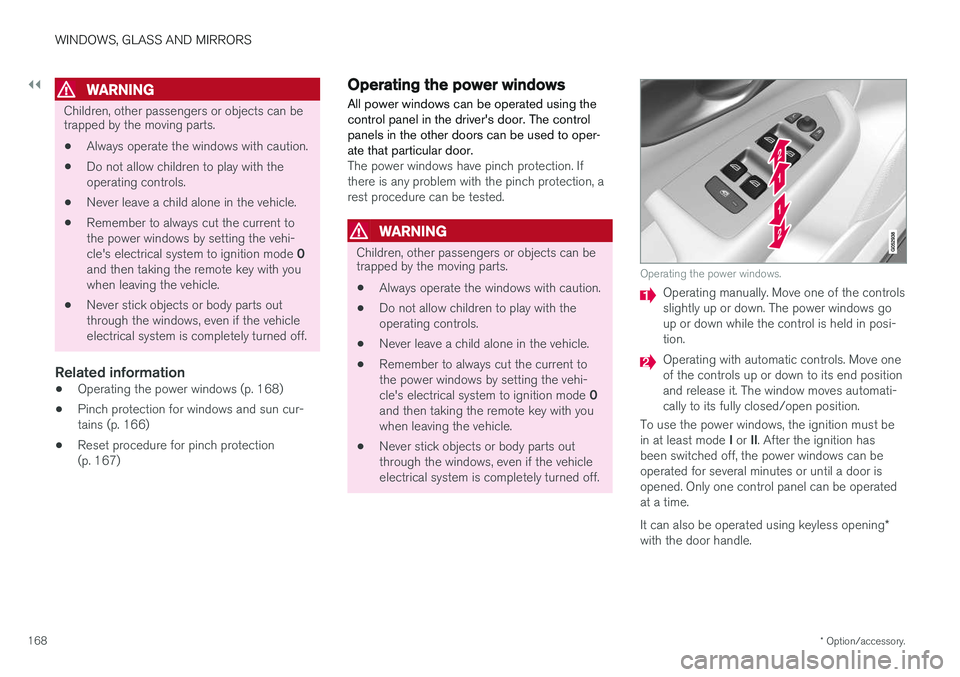
Operating manually. Move one of the controls slightly up or down. The power windows goup or down while the control is held in posi-tion.
Operating with automatic controls. Move one of the controls up or down to its end positionand release it. The window moves automati-cally to its fully closed/open position.
To use the power windows, the ignition must be in at least mode I or II. After the ignition has
been switched off, the power windows can be operated for several minutes or until a door isopened. Only one control panel can be operatedat a time. It can also be operated using keyless opening *
with the door handle.
Page 171 of 660
WINDOWS, GLASS AND MIRRORS
* Option/accessory.169
WARNING
Make sure that no child or other passenger comes into contact with the windows as they are closing with keyless closing *.
NOTE
One way to reduce the pulsating wind noise heard when the rear windows are open is toalso open the front windows slightly.
NOTE
The windows cannot be opened at speeds over approx. 180 km/h (ca112 mph), but theycan be closed. The driver is always responsible for following applicable traffic regulations.
Related information
• Power windows (p. 167)
• Pinch protection for windows and sun cur- tains (p. 166)
• Reset procedure for pinch protection(p. 167)
• Keyless locking and unlocking
* (p. 246)
• Locking and unlocking using the remote key(p. 233)
• Locking and unlocking from inside the vehi-cle (p. 249)
Rearview/door mirrors
The rearview mirror and door mirrors can be used to improve the driver's visibility behind thevehicle.
Rearview mirrorThe rearview mirror can be easily adjusted man- ually. The rearview mirror can be equipped with HomeLink *, auto-dim * and compass *.
Door mirrors
WARNING
The door mirror on the passenger side is curved to improve visibility. Objects in the mir-ror may appear farther away than they actuallyare.
The joystick in the drivers' door control panel is used to adjust the position of the door mirrors.There are also several automatic settings thatcan also be connected to the memory function buttons for the power seat *.
Related information
•
HomeLink ®
* (p. 450)
• Compass (p. 454)
• Adjusting the rearview mirror dimming func- tion (p. 170)
• Adjusting the door mirrors (p. 170) •
Storing memory settings in power front seats
* (p. 186)
• Activating and deactivating the heated rear window and door mirrors (p. 222)
Page 174 of 660
WINDOWS, GLASS AND MIRRORS
* Option/accessory.
172
Panoramic roof *
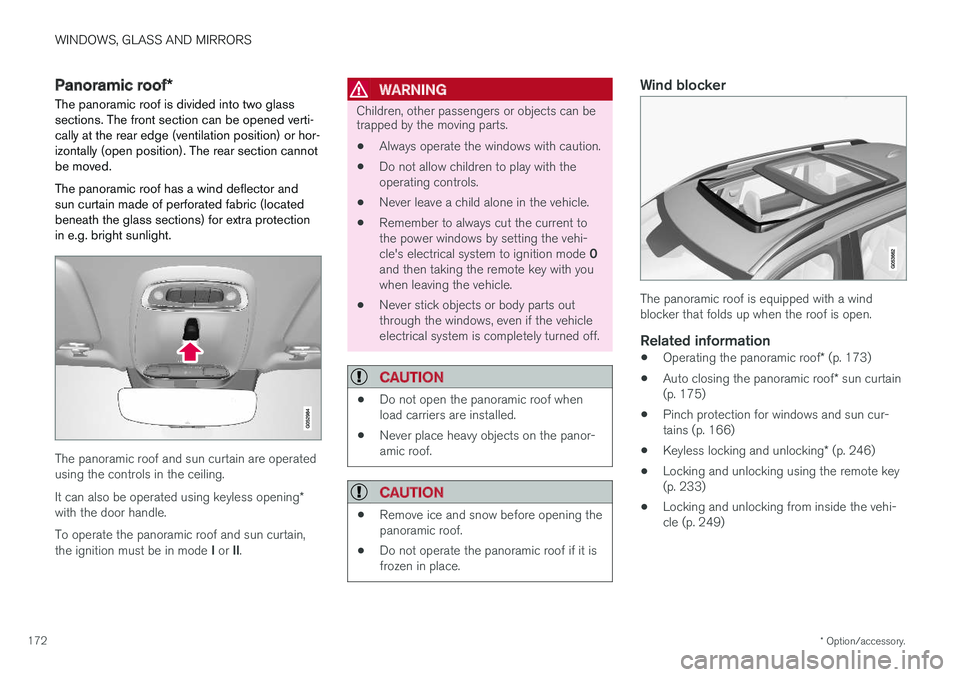
The panoramic roof is divided into two glass sections. The front section can be opened verti-cally at the rear edge (ventilation position) or hor-izontally (open position). The rear section cannotbe moved. The panoramic roof has a wind deflector and sun curtain made of perforated fabric (locatedbeneath the glass sections) for extra protectionin e.g. bright sunlight.
The panoramic roof and sun curtain are operated using the controls in the ceiling. It can also be operated using keyless opening *
with the door handle. To operate the panoramic roof and sun curtain, the ignition must be in mode I or II.
WARNING
Children, other passengers or objects can be trapped by the moving parts.
• Always operate the windows with caution.
• Do not allow children to play with the operating controls.
• Never leave a child alone in the vehicle.
• Remember to always cut the current tothe power windows by setting the vehi- cle's electrical system to ignition mode
0
and then taking the remote key with you when leaving the vehicle.
• Never stick objects or body parts outthrough the windows, even if the vehicleelectrical system is completely turned off.
CAUTION
• Do not open the panoramic roof when load carriers are installed.
• Never place heavy objects on the panor-amic roof.
CAUTION
• Remove ice and snow before opening the panoramic roof.
• Do not operate the panoramic roof if it isfrozen in place.
Wind blocker
The panoramic roof is equipped with a wind blocker that folds up when the roof is open.
Related information
•
Operating the panoramic roof
* (p. 173)
• Auto closing the panoramic roof
* sun curtain
(p. 175)
• Pinch protection for windows and sun cur-tains (p. 166)
• Keyless locking and unlocking
* (p. 246)
• Locking and unlocking using the remote key(p. 233)
• Locking and unlocking from inside the vehi-cle (p. 249)
Page 175 of 660
WINDOWS, GLASS AND MIRRORS
}}
* Option/accessory.173
Operating the panoramic roof *
The panoramic roof and sun curtain are oper- ated using a control in the ceiling panel, andboth are equipped with pinch protection.
WARNING
Children, other passengers or objects can be trapped by the moving parts.
• Always operate the windows with caution.
• Do not allow children to play with the operating controls.
• Never leave a child alone in the vehicle.
• Remember to always cut the current tothe power windows by setting the vehi- cle's electrical system to ignition mode
0
and then taking the remote key with you when leaving the vehicle.
• Never stick objects or body parts outthrough the windows, even if the vehicleelectrical system is completely turned off.
CAUTION
•Do not open the panoramic roof when load carriers are installed.
• Never place heavy objects on the panor-amic roof.
CAUTION
• Remove ice and snow before opening the panoramic roof.
• Do not operate the panoramic roof if it isfrozen in place.
To operate the panoramic roof and sun curtain, the ignition must be in mode
I or II.
It can also be operated using keyless opening *
with the door handle.
WARNING
Make sure that no child or other passenger comes into contact with the windows as they are closing with keyless closing *.
CAUTION
Check that the panoramic roof is properly closed when closing.
The movement of the roof will stop if the control is released during manual operation or when the glass has reached the comfort 4
or fully open/
closed position. The movement of both the pan- oramic roof and the sun curtain is also stopped ifthe control in the ceiling is operated again in the direction opposite that of the current direction ofmovement. The panoramic roof and sun curtain are also equipped with pinch protection.
NOTE
For manual opening, the sun curtain must be completely open before the panoramic roofcan be opened. For the reverse procedure,the panoramic roof must be completelyclosed before the sun curtain can be com-pletely closed.
4
The comfort position is a position which helps keep wind and resonance sounds to a comfortably low level.