towing VOLVO XC60 TWIN ENGINE 2019 Owner's Manual
[x] Cancel search | Manufacturer: VOLVO, Model Year: 2019, Model line: XC60 TWIN ENGINE, Model: VOLVO XC60 TWIN ENGINE 2019Pages: 695, PDF Size: 14.96 MB
Page 572 of 695
||
WHEELS AND TIRES
* Option/accessory.570
Related information
Recommended tire pressure (p. 565)
Adjusting tire pressure (p. 564)
Calibrating the tire pressure monitoring sys-tem* (p. 567)
Viewing tire pressure status in the centerdisplay* (p. 568)
Tire pressure monitoring system* (p. 565)
Inflate tires with the compressor included inthe tire sealing system (p. 583)
When changing wheels
The wheels can be changed, e.g. to switch tosnow tires or spare tires. Follow the applicableinstructions for removing and installing thewheel.
Changing to tires of another dimension
Make sure that the tire dimension is approved foruse on the vehicle.
If you change to tires of another dimension, con-tact an authorized Volvo workshop to update thevehicle's software. A software update may benecessary when changing to tires of larger/smaller dimensions or when changing to or fromsnow tires.
Related information
Removing a wheel (p. 572)
Installing a wheel (p. 574)
Tool kit (p. 570)
Snow tires (p. 577)
Spare wheel (p. 575)
Wheel bolts (p. 571)
Tool kit
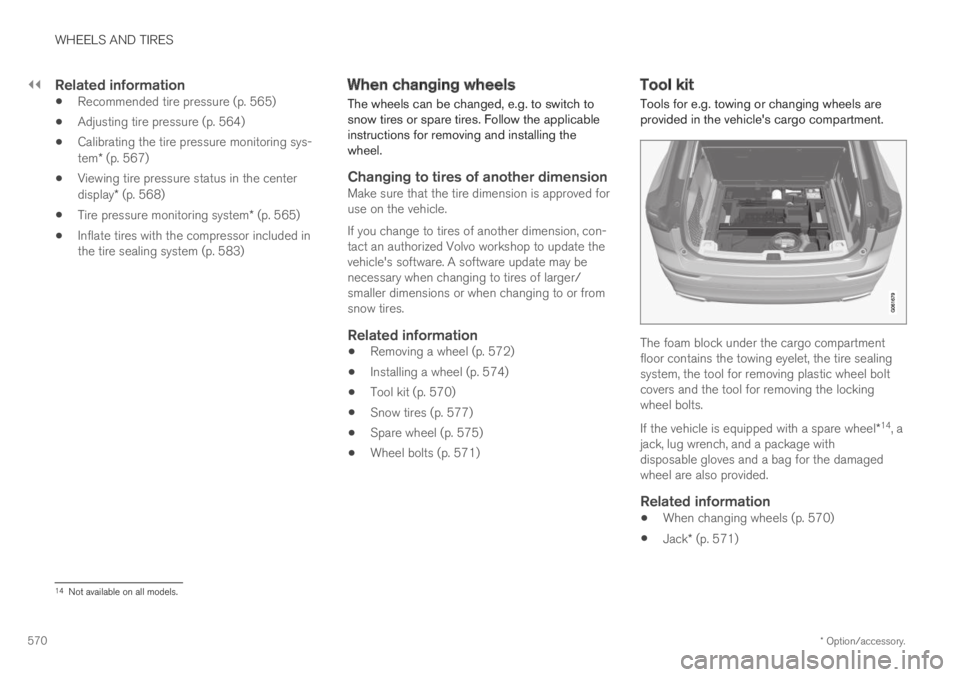
Tools for e.g. towing or changing wheels areprovided in the vehicle's cargo compartment.
The foam block under the cargo compartmentfloor contains the towing eyelet, the tire sealingsystem, the tool for removing plastic wheel boltcovers and the tool for removing the lockingwheel bolts.
If the vehicle is equipped with a spare wheel*14, ajack, lug wrench, and a package withdisposable gloves and a bag for the damagedwheel are also provided.
Related information
When changing wheels (p. 570)
Jack* (p. 571)
14Not available on all models.
Page 575 of 695
WHEELS AND TIRES
}}
* Option/accessory.573
1.Turn on the vehicle's hazard warning flashersif a wheel change must be performed in anarea with traffic.
2. Apply the parking brake and put the gearselector in P.
For vehicles with Leveling Control*: If thevehicle is equipped with pneumatic suspen-sion, this must be switched off before thevehicle is lifted with the jack*.
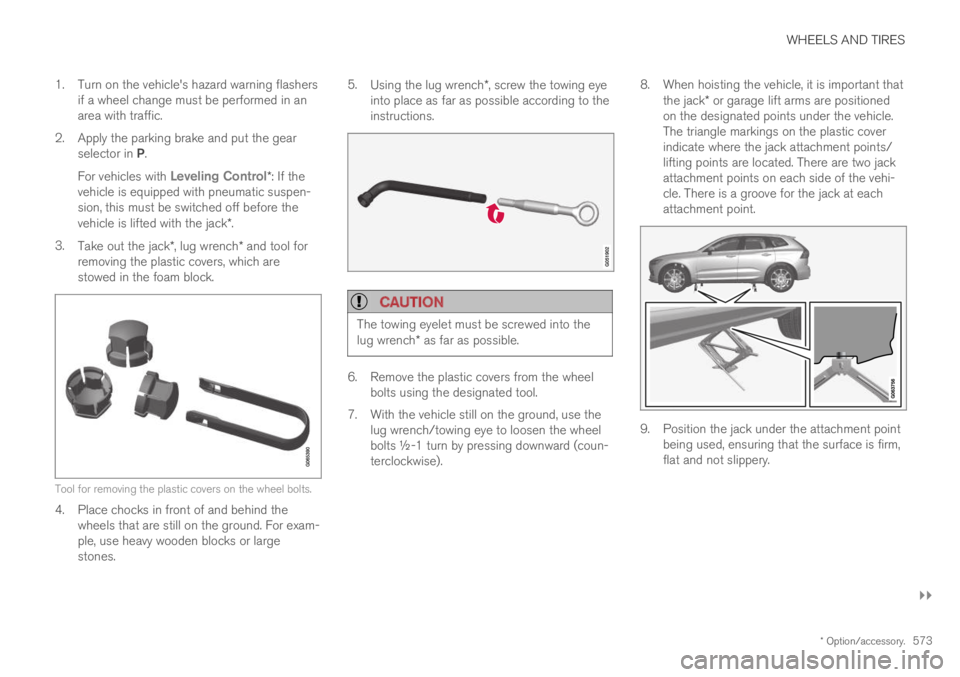
3.Take out the jack*, lug wrench* and tool forremoving the plastic covers, which arestowed in the foam block.
Tool for removing the plastic covers on the wheel bolts.
4. Place chocks in front of and behind thewheels that are still on the ground. For exam-ple, use heavy wooden blocks or largestones.
5.Using the lug wrench*, screw the towing eyeinto place as far as possible according to theinstructions.
CAUTION
The towing eyelet must be screwed into thelug wrench* as far as possible.
6. Remove the plastic covers from the wheelbolts using the designated tool.
7.With the vehicle still on the ground, use thelug wrench/towing eye to loosen the wheelbolts ½-1 turn by pressing downward (coun-terclockwise).
8. When hoisting the vehicle, it is important thatthe jack* or garage lift arms are positionedon the designated points under the vehicle.The triangle markings on the plastic coverindicate where the jack attachment points/lifting points are located. There are two jackattachment points on each side of the vehi-cle. There is a groove for the jack at eachattachment point.
9. Position the jack under the attachment pointbeing used, ensuring that the surface is firm,flat and not slippery.
Page 586 of 695
||
WHEELS AND TIRES
584
Related information
Recommended tire pressure (p. 565)
Using the tire sealing system (p. 579)
Tire sealing system (p. 578)
Determining the vehicle's permittedweight
Properly loading your vehicle will provide maxi-mum return of vehicle design performance.
Weight designations
Before loading your vehicle, familiarize yourselfwith the following terms for determining yourvehicle's weight ratings, with or without a trailer,from the vehicle's Federal/Canadian Motor Vehi-cle Safety Standards (FMVSS/CMVSS) label, andthe vehicle's tire information placard:
Curb weight
The weight of the vehicle including a full tank offuel and all standard equipment. It does notinclude passengers, cargo, or optional equipment.
Capacity weight
All weight added to the curb weight, includingcargo and optional equipment. When towing, tow-bar weight is also part of cargo weight.
Permissible axle weight
The maximum allowable weight that can be car-ried by a single axle (front or rear). These num-bers are shown on the Federal/Canadian MotorVehicle Safety Standards (FMVSS/CMVSS) label.The total load on each axle must never exceed itsmaximum permissible weight.
Gross vehicle weight (GVW)
The vehicle's curb weight + cargo + passengers.
Steps for Determining Correct Load
Limit
1. Locate the statement "the combined weightof occupants and cargo should never exceedXXX kg or XXX lbs." on your vehicle's plac-ard.
2. Determine the combined weight of the driverand passengers that will be riding in yourvehicle.
3. Subtract the combined weight of the driverand passengers from XXX kg or XXX lbs.
4. The resulting figure equals the availableamount of cargo and luggage load capacity.For example, if the "XXX" amount equals1400 lbs. and there will be five 150 lb. pas-sengers in your vehicle, the amount of availa-ble cargo and luggage load capacity is 650lbs. (1400 - 750 (5 × 150) = 650 lbs.)
5. Determine the combined weight of luggageand cargo being loaded on the vehicle. Thatweight may not safely exceed the availablecargo and luggage load capacity calculatedin Step 4.
6. If your vehicle will be towing a trailer, loadfrom your trailer will be transferred to yourvehicle. Consult this manual to determinehow this reduces the available cargo and lug-gage load capacity of your vehicle.
Page 597 of 695
LOADING, STORAGE AND PASSENGER COMPARTMENT
}}
* Option/accessory.595
Cargo compartment
The vehicle has a flexible cargo compartmentthat makes it possible to carry and secure largeobjects.
The cargo capacity of the vehicle can be consid-erably increased by folding down the rear seatbackrests. To make loading and unloading easier,the rear section of the vehicle can be raised andlowered using the level control function*. Use theload anchoring eyelets or grocery bag holders tohelp secure objects in place, and the retractablecargo compartment cover* to help concealobjects in the cargo compartment.
If the vehicle is equipped with a temporary sparetire, this is secured to the cargo compartmentfloor under the cover. The towing eyelet and tiresealing system are located under the cargo com-partment floor.
Related information
Loading recommendations (p. 595)
Grocery bag holders (p. 597)
Load anchoring eyelets (p. 598)
Installing and removing the cargo compart-ment cover* (p. 598)
Loading recommendations
There are a number of things to consider whencarrying loads in or on the vehicle.
Load-carrying capacity is determined by the vehi-cle's curb weight. The total weight of all passen-gers and any installed accessories reduces thevehicle's load-carrying capacity by the corres-ponding amount.
WARNING
The vehicle's driving characteristics changedepending on the weight and position of theload.
Loading the cargo compartment/trunk
Position objects so they are pressing againstthe rear seat backrests.
Distribute the load evenly.
Heavy objects should be positioned as lowas possible. Avoid placing heavy objects onfolded-down seat backrests.
Cover sharp corners with a soft cloth or simi-lar to help prevent damage to the upholstery.
Use the load anchoring eyelets and tension-ing straps or similar to secure all objects.
WARNING
In a head-on collision at a speed of 50 km/h(30 mph), an unsecured object weighing 20kg (44 pounds) can reach a projectile weightequivalent to 1000 kg (2200 pounds).
WARNING
If objects are loaded higher than the upperedge of the side windows, leave a 10 cm (4in.) space between the objects and the win-dow. Objects placed closer to this couldimpede the function of the inflatable curtainconcealed inside the headlining.
WARNING
Always secure the load. Otherwise, it may shiftduring heavy braking and injure people in thevehicle.
Cover sharp edges and sharp corners withsomething soft.
Turn off the engine and apply the parkingbrake when loading/unloading long objects.Otherwise, it is possible for the load to reachthe gear lever or gear selector and move it toa drive position – which could cause the vehi-cle to begin rolling.
Page 598 of 695
||
LOADING, STORAGE AND PASSENGER COMPARTMENT
* Option/accessory.596
Extra cargo space
The rear seat backrests can be folded down toincrease cargo compartment space and simplifyloading. If the rear seat backrests are foldeddown, make sure that no objects loaded into thevehicle prevent the WHIPS system for the frontseats from functioning correctly.
The ski hatch in the rear seat can be folded downto carry skis or other long, thin objects.
Raising/lowering the rear end of the
vehicle *
The rear end of the vehicle can be lowered orraised for easier loading or to facilitate attachinga trailer*.
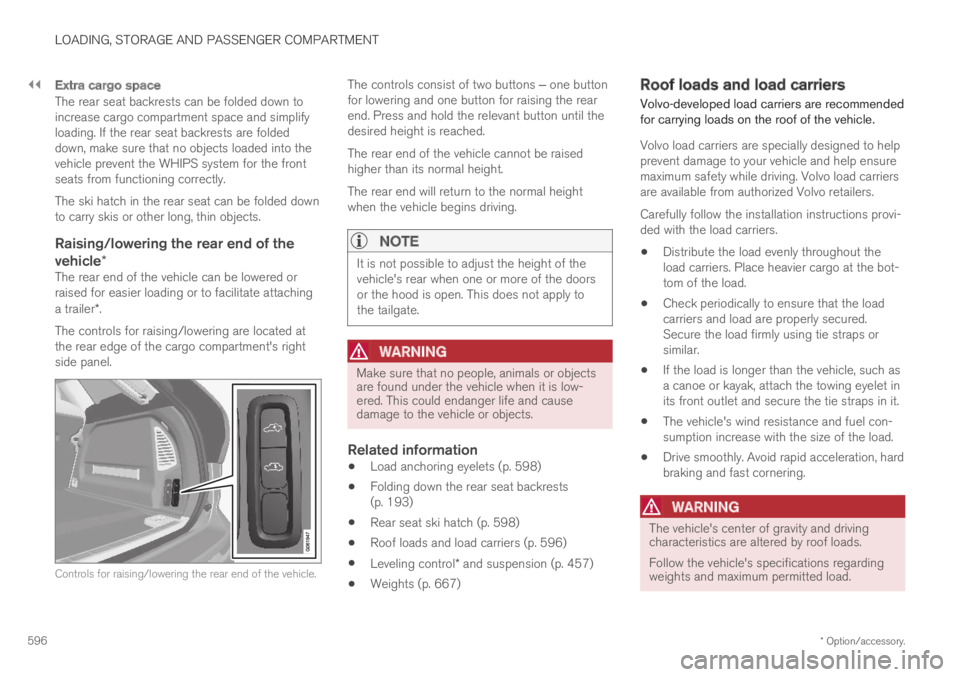
The controls for raising/lowering are located atthe rear edge of the cargo compartment's rightside panel.
Controls for raising/lowering the rear end of the vehicle.
The controls consist of two buttons ‒ one buttonfor lowering and one button for raising the rearend. Press and hold the relevant button until thedesired height is reached.
The rear end of the vehicle cannot be raisedhigher than its normal height.
The rear end will return to the normal heightwhen the vehicle begins driving.
NOTE
It is not possible to adjust the height of thevehicle's rear when one or more of the doorsor the hood is open. This does not apply tothe tailgate.
WARNING
Make sure that no people, animals or objectsare found under the vehicle when it is low-ered. This could endanger life and causedamage to the vehicle or objects.
Related information
Load anchoring eyelets (p. 598)
Folding down the rear seat backrests(p. 193)
Rear seat ski hatch (p. 598)
Roof loads and load carriers (p. 596)
Leveling control* and suspension (p. 457)
Weights (p. 667)
Roof loads and load carriers
Volvo-developed load carriers are recommendedfor carrying loads on the roof of the vehicle.
Volvo load carriers are specially designed to helpprevent damage to your vehicle and help ensuremaximum safety while driving. Volvo load carriersare available from authorized Volvo retailers.
Carefully follow the installation instructions provi-ded with the load carriers.
Distribute the load evenly throughout theload carriers. Place heavier cargo at the bot-tom of the load.
Check periodically to ensure that the loadcarriers and load are properly secured.Secure the load firmly using tie straps orsimilar.
If the load is longer than the vehicle, such asa canoe or kayak, attach the towing eyelet inits front outlet and secure the tie straps in it.
The vehicle's wind resistance and fuel con-sumption increase with the size of the load.
Drive smoothly. Avoid rapid acceleration, hardbraking and fast cornering.
WARNING
The vehicle's center of gravity and drivingcharacteristics are altered by roof loads.
Follow the vehicle's specifications regardingweights and maximum permitted load.
Page 669 of 695
SPECIFICATIONS
667
Weights
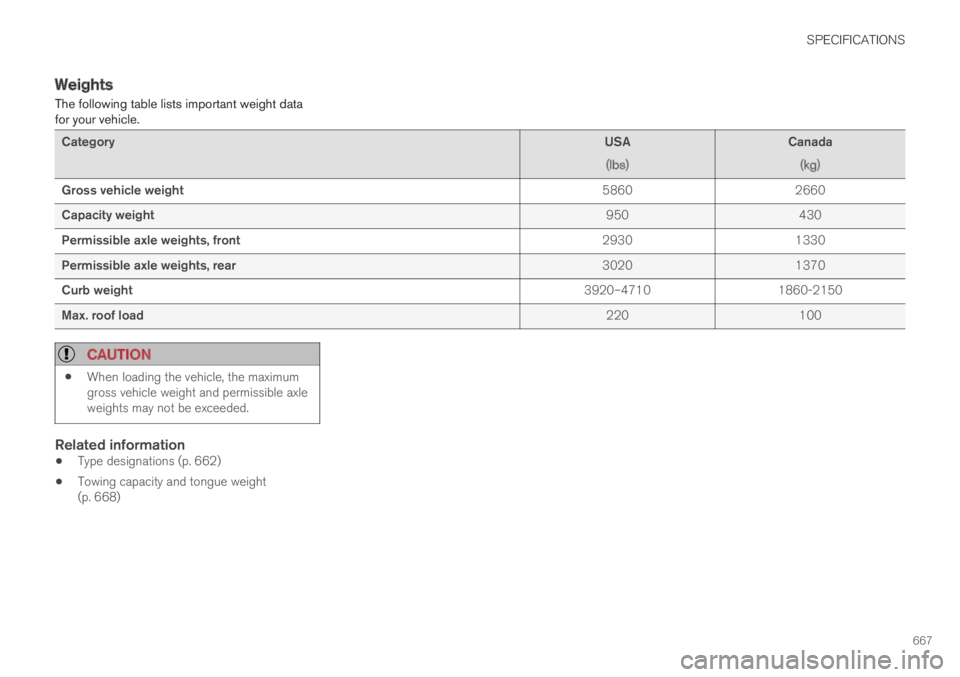
The following table lists important weight datafor your vehicle.
CategoryUSA
(lbs)
Canada
(kg)
Gross vehicle weight58602660
Capacity weight950430
Permissible axle weights, front29301330
Permissible axle weights, rear30201370
Curb weight3920–47101860-2150
Max. roof load220100
CAUTION
When loading the vehicle, the maximumgross vehicle weight and permissible axleweights may not be exceeded.
Related information
Type designations (p. 662)
Towing capacity and tongue weight(p. 668)
Page 670 of 695
SPECIFICATIONS
* Option/accessory.668
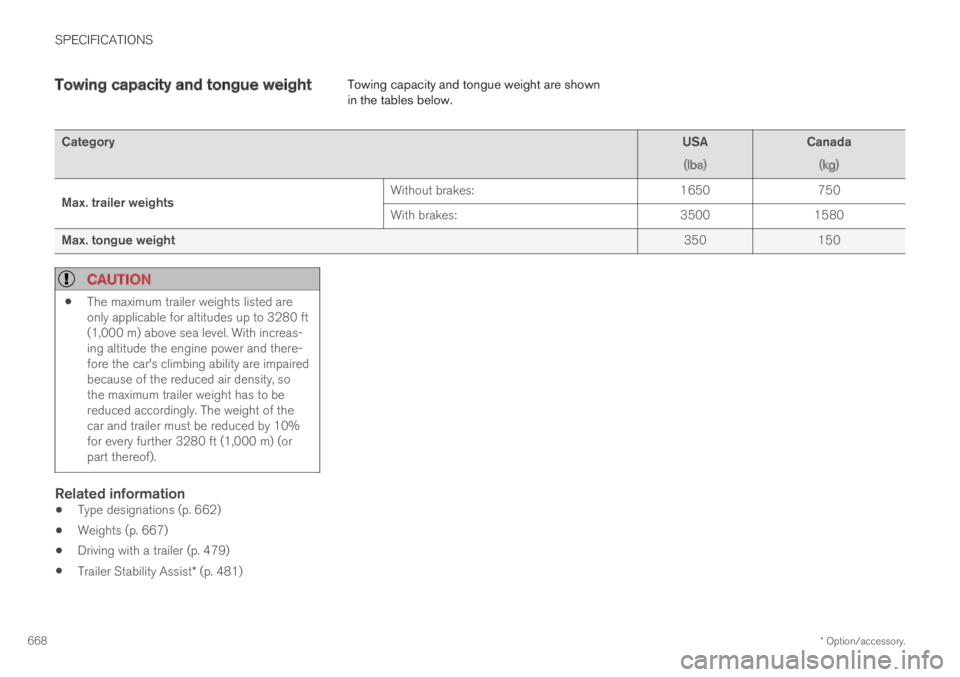
Towing capacity and tongue weightTowing capacity and tongue weight are shownin the tables below.
CategoryUSA
(lbs)
Canada
(kg)
Max. trailer weightsWithout brakes:1650750
With brakes:35001580
Max. tongue weight350150
CAUTION
The maximum trailer weights listed areonly applicable for altitudes up to 3280 ft(1,000 m) above sea level. With increas-ing altitude the engine power and there-fore the car's climbing ability are impairedbecause of the reduced air density, sothe maximum trailer weight has to bereduced accordingly. The weight of thecar and trailer must be reduced by 10%for every further 3280 ft (1,000 m) (orpart thereof).
Related information
Type designations (p. 662)
Weights (p. 667)
Driving with a trailer (p. 479)
Trailer Stability Assist* (p. 481)
Page 680 of 695
INDEX
678
Coolant, filling 623
Cooling system
overheating 475
Corner Traction Control 273
Corrosion protection 654
Covering
cargo compartment 600
Crash, see Collision 42
Crash event data 33
Cross Traffic Alert – CTA 355, 356, 357, 358
Cruise control 285, 286
manage speed 286, 287
temporary deactivation 288, 289
turn off 290
CTA – Cross Traffic Alert 355, 356, 357, 358
Curb weight 667
Customer Privacy Policy 35
CZIP (Clean Zone Interior Package) 204
D
Data
recording33
transferring between vehicle and work-
shop610
Data sharing544
Daytime running lights154
Decals
location662
Defrosting218
Detection of cyclist339
Dimensions665
Dipstick, electronic622
Direction of rotation558
Display
driver information84
Display lighting163
Distance Alert290, 291, 292
limitations293
DivX®519
Door mirrors169, 170
compass489
dimming170
outer169, 170
power folding170
resetting170
store position186, 187
Driveline
transmission444
Drive mode450
changing455
Driver Alert Control365
operation366, 367
Driver Alert Control limitations367
Driver performance92, 93
Driver profile136
edit137, 138, 139
select137
Driver support system272
Drive systems449
Driving
cooling system475
with a trailer479
Driving economy463
Driving through standing water469
driving with a trailer
towball load668
towing capacity668
E
Economical driving463
Electrical outlet590
use592
Electrical system 625
Electric drive motor
specifications 669
Page 689 of 695
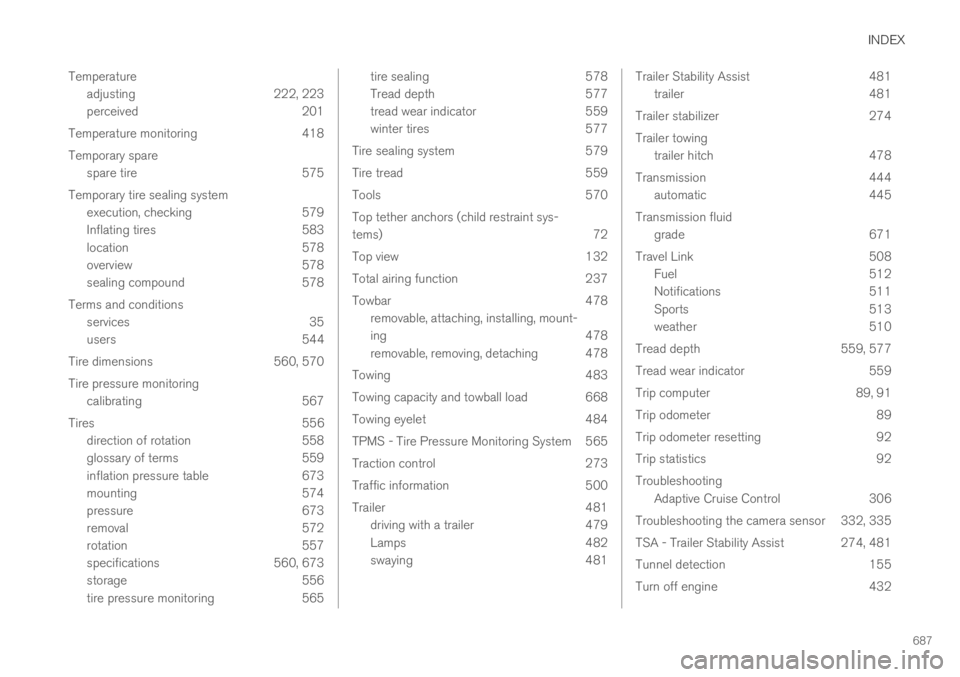
INDEX
687
Temperature
adjusting 222, 223
perceived 201
Temperature monitoring 418
Temporary spare
spare tire 575
Temporary tire sealing system
execution, checking 579
Inflating tires 583
location 578
overview 578
sealing compound 578
Terms and conditions
services 35
users 544
Tire dimensions 560, 570
Tire pressure monitoring
calibrating 567
Tires 556
direction of rotation 558
glossary of terms 559
inflation pressure table 673
mounting 574
pressure 673
removal 572
rotation 557
specifications 560, 673
storage 556
tire pressure monitoring 565
tire sealing578
Tread depth577
tread wear indicator 559
winter tires 577
Tire sealing system 579
Tire tread 559
Tools 570
Top tether anchors (child restraint sys-
tems)72
Top view 132
Total airing function 237
Towbar 478
removable, attaching, installing, mount-
ing 478
removable, removing, detaching 478
Towing 483
Towing capacity and towball load 668
Towing eyelet 484
TPMS - Tire Pressure Monitoring System 565
Traction control 273
Traffic information 500
Trailer 481
driving with a trailer 479
Lamps 482
swaying 481
Trailer Stability Assist481
trailer481
Trailer stabilizer 274
Trailer towing
trailer hitch 478
Transmission 444
automatic 445
Transmission fluid
grade 671
Travel Link 508
Fuel 512
Notifications 511
Sports 513
weather 510
Tread depth 559, 577
Tread wear indicator 559
Trip computer 89, 91
Trip odometer 89
Trip odometer resetting 92
Trip statistics 92
Troubleshooting
Adaptive Cruise Control 306
Troubleshooting the camera sensor 332, 335
TSA - Trailer Stability Assist 274, 481
Tunnel detection 155
Turn off engine 432