brake fluid VOLVO XC60 TWIN ENGINE 2020 Owners Manual
[x] Cancel search | Manufacturer: VOLVO, Model Year: 2020, Model line: XC60 TWIN ENGINE, Model: VOLVO XC60 TWIN ENGINE 2020Pages: 687, PDF Size: 14.65 MB
Page 16 of 687
14
Fuses in the engine compartment615
Fuses under the glove compartment 622
Fuses in the cargo compartment 628
Cleaning the interior 633
Cleaning the center display 633
Cleaning the head-up display *
634
Cleaning fabric upholstery and ceiling liner 635
Cleaning the seat belt 635
Cleaning floor mats and inlay mats 635
Cleaning leather upholstery *
636
Cleaning the leather steering wheel 637
Cleaning interior plastic, metal andwood surfaces 637
Cleaning the exterior 638
Polishing and waxing 638
Hand washing 639
Automatic car washes 641
High-pressure washing 642
Cleaning the wiper blades 642
Cleaning exterior plastic, rubberand trim components 643
Cleaning rims 644
Corrosion protection 644
Paintwork 645
Touching up minor paint damage645
Color codes 646
Changing rear window wipers 647
Replacing windshield wiper blades 648
Putting the wiper blades in service position 649
Filling washer fluid 650
SPECIFICATIONS
Type designations 654
Dimensions 657
Weights 659
Towing capacity and tongue weight 660
Engine specifications 661
Engine oil specifications 662
Coolant specifications 663
Transmission fluid specifications 663
Brake fluid specifications 663
Fuel tank volume 664
Air conditioning specifications 664
Approved tire pressure 665
Page 102 of 687
DISPLAYS AND VOICE CONTROL
100
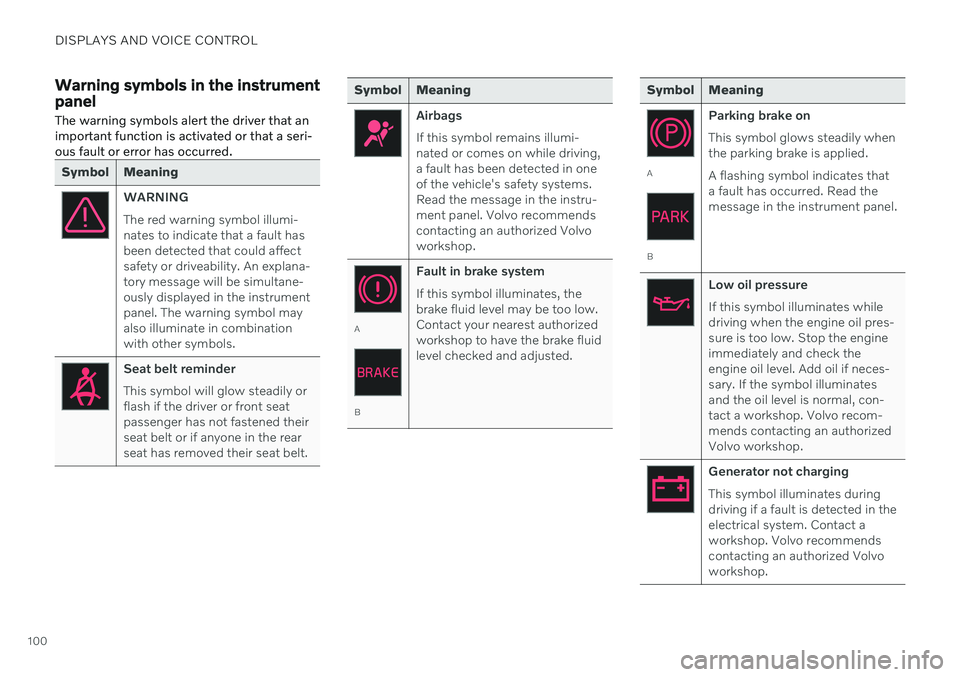
Warning symbols in the instrument panelThe warning symbols alert the driver that an important function is activated or that a seri-ous fault or error has occurred.
Symbol Meaning
WARNING The red warning symbol illumi- nates to indicate that a fault hasbeen detected that could affectsafety or driveability. An explana-tory message will be simultane-ously displayed in the instrumentpanel. The warning symbol mayalso illuminate in combinationwith other symbols.
Seat belt reminder This symbol will glow steadily or flash if the driver or front seatpassenger has not fastened theirseat belt or if anyone in the rearseat has removed their seat belt.
Symbol Meaning
Airbags If this symbol remains illumi- nated or comes on while driving,a fault has been detected in oneof the vehicle's safety systems.Read the message in the instru-ment panel. Volvo recommendscontacting an authorized Volvoworkshop.
A
B Fault in brake system If this symbol illuminates, the brake fluid level may be too low.Contact your nearest authorizedworkshop to have the brake fluidlevel checked and adjusted.
Symbol Meaning
A
B
Parking brake on This symbol glows steadily when the parking brake is applied. A flashing symbol indicates that a fault has occurred. Read themessage in the instrument panel.
Low oil pressure If this symbol illuminates while driving when the engine oil pres-sure is too low. Stop the engineimmediately and check theengine oil level. Add oil if neces-sary. If the symbol illuminatesand the oil level is normal, con-tact a workshop. Volvo recom-mends contacting an authorizedVolvo workshop.
Generator not charging This symbol illuminates during driving if a fault is detected in theelectrical system. Contact aworkshop. Volvo recommendscontacting an authorized Volvoworkshop.
Page 410 of 687

||
STARTING AND DRIVING
408be felt from the brake pedal when ABS is operating, which is normal. After the vehicle is started, a brief test of the ABS system is automatically performed whenthe driver releases the brake pedal. An addi-tional automatic test of the system may beperformed when the vehicle is traveling at alow speed. During the test, the brake pedalmay feel as though it is pulsating.
Light braking charges the hybrid
battery
When the brakes are applied lightly, the elec-tric motor braking function is used. This con-verts the vehicle's kinetic energy into electricalenergy, which is used to charge the hybridbattery. When the battery is being chargedwith the electric motor braking function, thiswill be indicated in the instrument panel.When the battery is being charged with the electric motor braking function, this will be indicated in theinstrument panel.
This function is active at speeds in the range of 150-5 km/h (93-3 mph). When braking atspeeds outside of this range, or during harderbraking, the hydraulic braking system is usedto augment braking. This is indicated in theinstrument panel with the pointer down in thered area.
Symbols in the instrument panel
Symbol Meaning
A
B Check the brake fluid level. If the level is low, fill brake fluid andcheck to determine the reasonfor the loss of brake fluid.
A
BFault in pedal sensor.
2
Anti-lock Braking System
Page 411 of 687

STARTING AND DRIVING
409
Symbol Meaning
A
BSteady glow for 2 seconds after the engine is started: Automaticfunction check. Steady glow for more than 2 seconds: Fault in the ABS sys-tem. The vehicle's regular brakesystem is still working, but with-out the ABS function.
If the message Brake pedal
Characteristics changed Serv- ice required
is displayed, the
"Brake-by-wire" system is not functioning properly. Greaterpressure will be required to brakethe vehicle.
A In Canada.
B In the US.
WARNING
If the warning symbols for both brake fault and ABS fault are lit simultaneously, theremay be a fault in the brake system.
If the brake fluid reservoir level is nor- mal when this occurs, drive carefully tothe nearest workshop to have thebrake system checked - an authorizedVolvo workshop is recommended.
If the brake fluid has fallen below theMIN
level in the brake fluid reservoir,
the vehicle should not be driven untilthe brake fluid has been filled. The rea-son for the brake fluid loss must bechecked.
Related information
Brake Assist System (p. 409)
Auto-hold brakes (p. 414)
Hill Start Assist (p. 416)
Braking on wet roads (p. 410)
Braking on salted roads (p. 410)
Maintenance of the brake system(p. 410)
Brake lights (p. 164)
Brake Assist System The brake enhancing system, (BAS 3
), helps
increase braking force and can thereby reduce braking distance.
The system monitors the driver's braking hab- its and increases braking force when neces-sary. Braking force can be increased up to thepoint at which the ABS intervenes. The func-tion is deactivated when pressure on the brakepedal is decreased.
Related information
Brakes (p. 407)
3
Brake Assist System
Page 444 of 687

STARTING AND DRIVING
* Option/accessory.
442
Preparing for a long trip
It is important to have the vehicle's systems and equipment checked carefully before driv-ing long distances.
Check that
the engine is running properly and that fuel consumption is normal
there are no leaks (fuel, oil or other fluid)
the brake pedal is functioning properly
all lights are working
‒ adjust the head-
light height if the vehicle is carrying aheavy load
tire tread depth and air pressure are atcorrect levels. Change to snow tires whendriving in areas where there is a risk ofsnowy or icy roads
the start battery is sufficiently charged
the wiper blades are in good condition
Related information
Checking tire pressure (p. 545)
Filling washer fluid (p. 650)
Winter driving (p. 442)
Economical driving (p. 438)
Vehicle modem settings (p. 519)
Loading recommendations (p. 577)
Driving with a trailer (p. 457)
Pilot Assist
* (p. 291)
Tire sealing system (p. 561)
Winter driving
It is important to check the vehicle before driving in cold/snowy conditions to makesure it can be driven safely.
Before the cold season arrives: Make sure the engine coolant contains 50% antifreeze. This mixture helps pro-tect the engine from frost erosion down toapprox. –35 °C (–31 °F). Do not mix dif-ferent types of antifreeze as this couldpose a health risk.
Keep the fuel tank well filled to preventcondensation from forming.
Check the viscosity of the engine oil. Oilwith low viscosity (thinner oil) improvescold-weather starting and reduces fuelconsumption when driving with a coldengine.
CAUTION
Low-viscosity oil should not be used with hard driving or in hot weather.
Check the condition and charge level of the start battery. Cold weather placesgreater demands on the start battery andreduces its capacity.
Use washer fluid containing antifreeze tohelp prevent ice from forming in thewasher fluid reservoir.
Page 445 of 687

STARTING AND DRIVING
}}
443
Slippery driving conditionsTo help optimize traction and roadholding, Volvo recommends using snow tires on allwheels whenever there is a risk of snow or iceon the road.
NOTE
Certain countries require use of winter tires by law. Not all countries permit the use ofstudded tires.
Practice driving on slippery surfaces under controlled conditions to learn how the vehiclereacts.
Related information
Snow tires (p. 559)
Snow chains (p. 560)
Braking on salted roads (p. 410)
Braking on wet roads (p. 410)
Filling washer fluid (p. 650)
Start battery (p. 607)
Replacing windshield wiper blades(p. 648)
Changing rear window wipers (p. 647)
Refilling coolant (p. 604)
Driving through standing water
It may be necessary to drive the vehicle through standing water, e.g. deep puddles orflooding on the road. This must be done withgreat caution.
To help prevent damage to the vehicle when driving through water:
Do not drive in water higher than the floorof the vehicle. If possible, check the depthof the water at its deepest point beforedriving through it. Be particularly carefulwhen driving through flowing water.
Always select the
Off Road drive mode
before driving in water to ensure the gaso- line engine is running.
Do not drive faster than walking speed.
Do not stop the vehicle in the water. Drivecarefully forward or back the vehicle out ofthe water.
Remember that waves created by passingvehicles could cause the water level to riseabove the vehicle's floor level.
Avoid driving through salt water to helpavoid the risk of corrosion.
CAUTION
Parts of the vehicle (e.g. engine, transmis- sion, driveline, electrical components, etc.)can be damaged if the vehicle is driventhrough water higher than its floor level.Damage to any components caused byflooding, vapor lock or insufficient oil is notcovered under warranty. If the engine stalls while the vehicle is in water, do not attempt to restart it. Havethe vehicle towed on the bed of a towtruck to a workshop - an authorized Volvoworkshop is recommended.
CAUTION
Because it can be difficult to determine the water depth, Volvo recommends not driv-ing through standing or running water. Thedriver is always responsible for operatingthe vehicle in a safe manner and adheringto all applicable laws and regulations.
When you have passed the water, press lightly on the brake pedal and check that the brakesare functioning properly. Water, mud, slush,etc. can make the brake linings slippery,resulting in delayed braking effect. If the vehicle is equipped with a trailer cou- pling contact, clean the contact after driving inwater or mud.
Page 594 of 687
||
MAINTENANCE AND SERVICE
592
How can I prepare for my next OBD II
emission inspection?
If your Check Engine (MIL) light is lit or was lit but went out without service, haveyour vehicle diagnosed and, if necessary,serviced by a qualified Volvo technician.
If you recently had service for a lit CheckEngine light, or if you had service thatrequired disconnecting the battery, aperiod of driving is necessary to bring theOBD II system to "ready" for inspection.Two half-hour trips of mixed stop-and-go/highway driving are typically needed toallow OBD II to reach readiness. YourVolvo retailer can provide you with moreinformation on planning a trip.
Maintain your vehicle in accordance withyour vehicle's maintenance schedule.
Owner maintenancePeriodic maintenance requirements and inter-vals are described in your vehicle's Warrantyand Service Records Information booklet. The following points can be carried out between the normally scheduled maintenance services.
Each time the vehicle is refueled:
Check the engine oil level.
Clean the windshield, windshield wipers, headlights, and taillights.
Monthly:
Check cold tire pressure in all tires. Inspect the tires for wear.
Check that engine coolant and other fluidlevels are between the indicated "min"and "max" markings.
Clean interior glass surfaces with a glasscleaner and soft paper towels.
Wipe driver information displays with asoft cloth.
Visually inspect battery terminals for cor-rosion. Corrosion may indicate a loose ter-minal connector, or a battery near the endof its useful service life. Consult your Volvoretailer for additional information.
As needed:
Wash the vehicle, including the undercarriage, to reduce wear that can be caused by abuildup of dirt, and corrosion that can becaused by salt residues. Clean leaves and twigs from air intake vents at the base of the windshield, and from other pla-ces where they may collect.
NOTE
Complete service information for qualified technicians is available online for purchaseor subscription at www.volvotechinfo.com.
Related information
Vehicle status (p. 595)
Scheduling service and repairs (p. 595)
Connecting equipment to the vehicle's data link connector (p. 39)
Technician certification (p. 40)
Climate control system service (p. 599)
Maintenance of the brake system (p. 410)
Engine compartment overview (p. 601)
Page 603 of 687

MAINTENANCE AND SERVICE
}}
601
Engine compartment overview
This overview shows some service-related components.
Some of the components included in the vehi- cle's electric drive system are located in theengine compartment. Exercise caution whenaccessing the engine compartment and onlytouch what is required for normal mainte-nance.
WARNING
Orange wiring may only be handled by qualified personnel.
WARNING
A number of electrical components in Twin Engine Plug-in Hybrid vehicles use high-voltage current and can be extremely dan-gerous if handled incorrectly.
Do not touch anything that is not clearly described in this Owner's Man-ual.
Be careful when checking/filling fluidsin the engine compartment.
The layout of the engine compartment may vary depending on model and engine variant.
Coolant expansion tank
Brake fluid reservoir (located on the driv- er's side)
Washer fluid filler pipe 12
Fusebox
Air filter
Engine oil filler pipe
WARNING
Bear in mind that the cooling fan (located at the front of the engine compartmentbehind the radiator) may start or continuerunning automatically up to about6 minutes after the engine is turned off. Always entrust engine washing to a work- shop – an authorized Volvo workshop isrecommended. If the engine is hot, there isa risk of fire.
WARNING
The ignition system works with extremely high and dangerous voltages. The vehicleelectrical system should always be in igni-tion mode
0 when work in being per-
formed in the engine compartment. Do not touch any spark plugs or ignition coils when the vehicle electrical system isin ignition mode II or when the engine is
warm.
Related information
Opening and closing the hood (p. 599)
Filling washer fluid (p. 650)
Refilling coolant (p. 604)
Fuses in the engine compartment (p. 615)
12
Fill the washer fluid at regular intervals, e.g. when refueling.
Page 665 of 687

SPECIFICATIONS
663
Coolant specifications
Recommended grade: Volvo-approved pre-
mixed coolant. If concentrated coolant is used, mix with 50% water of acceptablequality (i.e. not salt water, etc.). Consult aVolvo retailer if you have any questions.
To avoid deterioration of the cooling system, engine trouble, etc., only approved Volvo cool-ant should be used.
WARNING
Coolant is hazardous if ingested and could cause damage to organs (kidneys). Theproduct contains ethylene glycol, inhibitor,water, etc.
Related information
Refilling coolant (p. 604)
Transmission fluid specifications
Under normal driving conditions, the trans- mission fluid will not need to be changed dur-ing the transmission's service life. However,it may need to be changed if the vehicle isdriven frequently in adverse driving condi-tions.
Automatic transmission
Prescribed transmission fluid: AW-1
Related information
Type designations (p. 654)
Brake fluid specifications
The medium in the hydraulic brake system is called brake fluid and is used to transfer brak-ing force from e.g. pressure on the brakepedal via a master brake cylinder to one ormore slave cylinders, which in turn act on amechanical brake.
Recommended grade: Volvo Original or simi-
lar fluid that meets a combination of Dot 4, 5.1 and ISO 4925 class 6.
NOTE
Changing or filling brake fluid should be entrusted to an authorized Volvo work-shop.
Related information
Engine compartment overview (p. 601)
Page 669 of 687

INDEX
667
1, 2, 3 ...
4WD 421
A
ABSanti-lock brakes 407
AC (Air conditioning) 225
Accessories and extra equipment 37 installation 38
Accessory installation warning 38, 39
Active Bending Lights 162
Adapting driving characteristics 423
Adaptive Cruise Control 282 activating 284
auto-brake 304
change cruise control functionality 288
limitations 287
manage speed 302
passing 308
set time interval 303
standby mode 286
switching target vehicles 301
Symbols and messages 289
troubleshooting 287
turn off 285
WARNING 300
Adjusting the steering wheel 202
Airbag 54
activation/deactivation 58
driver's side 55
passenger side 55, 58
Air bag, see Airbag 54
Air conditioning 225Air conditioning, fluid volume and grade 664
Air distribution 209 air vents 209, 211
changing 210
defrosting 220
recirculation 219
table showing options 212
Air quality 206, 208 allergy and asthma 208
passenger compartment filter 209
Air recirculation 219
Alarm 268 deactivating 269
Allergy and asthma-inducing sub-
stances 208
All Wheel Drive, AWD 421
All Wheel Drive (AWD) 421
All Wheel Drive (four-wheel drive) 421
Android Auto 504, 505, 506Antenna location 256
Apple CarPlay 500, 501, 503
Approach lighting 165
Apps 472
Assistance at risk of collision 355 activating/deactivating 356
at risk of run-off 356
during collision risks from behind 358during collision risks from oncoming
traffic 357
limitations 359
Symbols and messages 360
Audio and media 470 Audio system HD digital radio 481 SiriusXM ®
Satellite radio 482, 483,
484
Auto-climate 219
Auto hold 414
Auto-hold brakes 414 activating/deactivating 415
after collision 416
driver support 272
Automatic car wash 641
Automatic high beam 161
Automatic locking 260
INDEX