AUX VOLVO XC70 2003 User Guide
[x] Cancel search | Manufacturer: VOLVO, Model Year: 2003, Model line: XC70, Model: VOLVO XC70 2003Pages: 257, PDF Size: 5.33 MB
Page 102 of 257

2003 VOLVO XC70
If an auxiliary seat is installed in the vehicle, store the seat before \
loading cargo. The auxiliary seat is not
designed to carry or restrain cargo.
Remember the following when loading the car:
l Load the cargo against the backrest.
l Load heavy cargo as low as possible.
l Load wide cargo on either side of the rear seat split.
l If no one is sitting in the rear seat, reinforce the backrest by fasteni\
ng the rear seat belts.
l Never load cargo above the backrest without a cargo net.
WARNING!
When the rear seat backrest(s) are folded down, the car should not be \
loaded to a level higher than 2
in. (5 cm) below the upper edge of the rear passenger door windows. Ob\
jects placed higher than this
level could impede the function of the inflatable curtain.
pg. 69 Steel grid/Cargo net
file:///K|/ownersdocs/2003/2003_XC70/03xc70_04b.htm (11 of 21)12/30/20\
06 4:17:57 PM
Page 106 of 257

2003 VOLVO XC70
WARNING!
The nylon cargo net must not be used when the optional rear-facing auxil\
iary child seat in the cargo
area is in use.
When not in use, the cargo net should not be stored unattached in the ca\
r to prevent it from being
thrown forward in the event of a sudden stop, etc.
CAUTION:
l If the net is installed in the forward position and the rear seat cushio\
ns are folded forward, the net
should be positioned so that it is in front of the rear seat cushions bu\
t behind the front seat backrests (C).
l The eyelets on the floor of the car under the front seats must not be us\
ed to secure the lower straps of
the cargo net. If these eyelets are used and the front seats are moved b\
ack, the cargo net or upper
brackets may be damaged.
Folding and storing the cargo net
The cargo net can be folded and stored under the floor of the cargo area\
on cars not equipped with the
optional auxiliary rear-facing child seat or the optional bass speaker.
Press the buttons on the hinges at the center of the upper and lower rod\
s. This releases the hinges so that
the net can be folded.
pg. 71 Cargo area cover, Vanity mirrors
Cargo area cover
file:///K|/ownersdocs/2003/2003_XC70/03xc70_04b.htm (15 of 21)12/30/20\
06 4:17:57 PM
Page 108 of 257
2003 VOLVO XC70
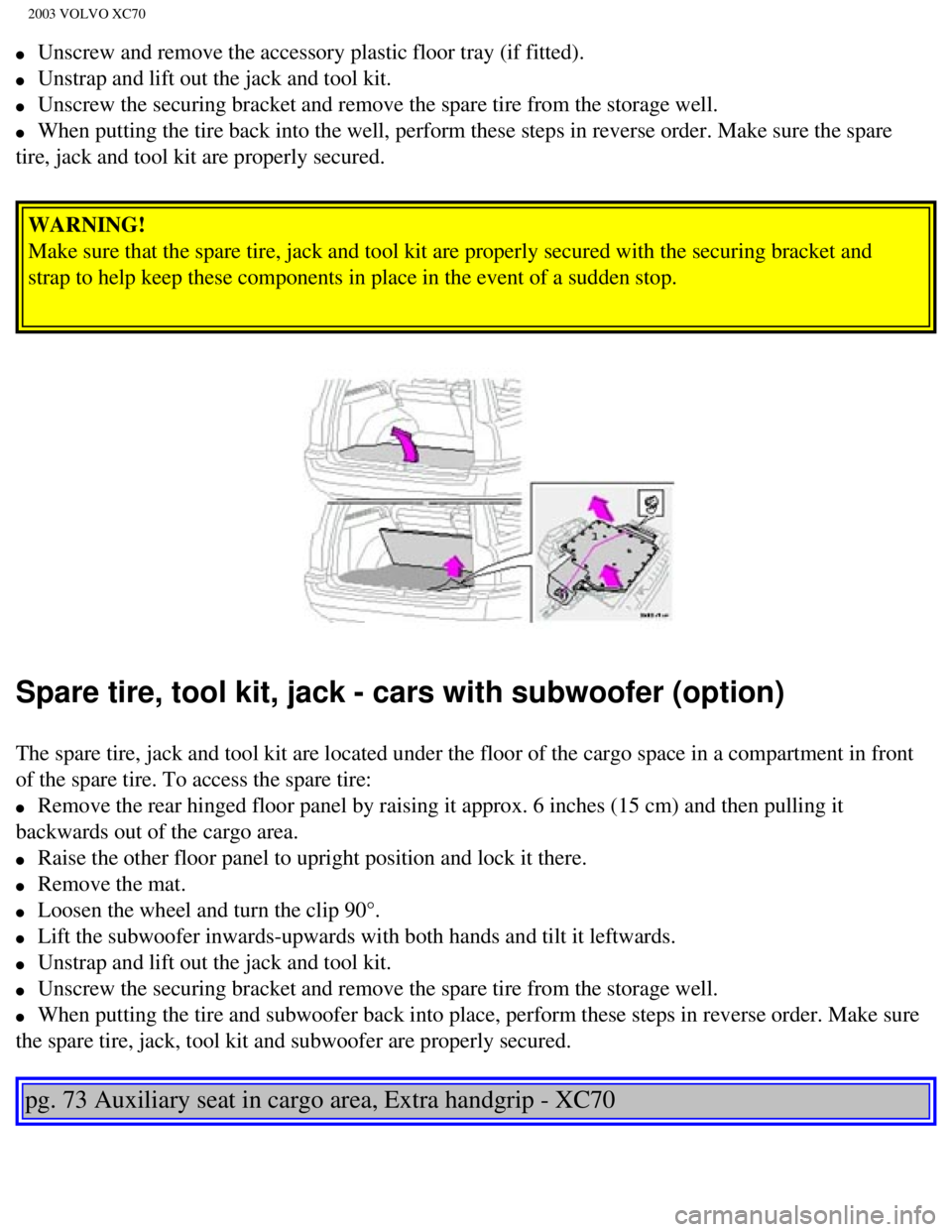
l Unscrew and remove the accessory plastic floor tray (if fitted).
l Unstrap and lift out the jack and tool kit.
l Unscrew the securing bracket and remove the spare tire from the storage \
well.
l When putting the tire back into the well, perform these steps in reverse\
order. Make sure the spare
tire, jack and tool kit are properly secured.
WARNING!
Make sure that the spare tire, jack and tool kit are properly secured wi\
th the securing bracket and
strap to help keep these components in place in the event of a sudden st\
op.
Spare tire, tool kit, jack - cars with subwoofer (option)
The spare tire, jack and tool kit are located under the floor of the car\
go space in a compartment in front
of the spare tire. To access the spare tire:
l Remove the rear hinged floor panel by raising it approx. 6 inches (15 c\
m) and then pulling it
backwards out of the cargo area.
l Raise the other floor panel to upright position and lock it there.
l Remove the mat.
l Loosen the wheel and turn the clip 90°.
l Lift the subwoofer inwards-upwards with both hands and tilt it leftwards\
.
l Unstrap and lift out the jack and tool kit.
l Unscrew the securing bracket and remove the spare tire from the storage \
well.
l When putting the tire and subwoofer back into place, perform these steps\
in reverse order. Make sure
the spare tire, jack, tool kit and subwoofer are properly secured.
pg. 73 Auxiliary seat in cargo area, Extra handgrip - XC70
file:///K|/ownersdocs/2003/2003_XC70/03xc70_04b.htm (17 of 21)12/30/20\
06 4:17:57 PM
Page 109 of 257

If all the seats are occupied, a rear-facing auxiliary seat in the cargo\
area can be used. This seat is
designed for two children, each weighing between 50")
2003 VOLVO XC70
Auxiliary seat (option)
If all the seats are occupied, a rear-facing auxiliary seat in the cargo\
area can be used. This seat is
designed for two children, each weighing between 50 - 88 lbs. (23 - 40 \
kg) with a total seat capacity of
176 lbs. (80 kg) and up to 55 inches (140 cm) in height.
Raising
Remove the cargo area cover, if installed, from the car. Raise the backr\
est section forward until it locks
in place.
Flip the seat cushion over.
Lowering
Flip the seat cushion back into storage position.
Pull the release handle and lower the backrest to storage position. WARNING!
l If your car is equipped with an auxiliary seat (option or accessory), \
the tailgate must be fitted with
a lock cylinder. Unlocking from the outside can then be carried out in t\
he usual way (key in driver's
door and/or remote control) and also by using the key in the tailgate. \
l Both rear seat backrests must be up when the auxiliary seat is being use\
d. Do not use a booster
cushion or child seat in conjunction with the auxiliary seat.
l The luggage net should be retracted and the child safety lock in the tai\
lgate should be open to allow
access to the cargo area.
NOTE: If you have locked the car with the remote control and if you then after\
wards use a key in the
tailgate's lock cylinder (certain models) to unlock the tailgate only,\
the alarm will sound. See
page 80 for
information on turning off a sounding alarm.
file:///K|/ownersdocs/2003/2003_XC70/03xc70_04b.htm (18 of 21)12/30/20\
06 4:17:57 PM
Page 141 of 257

2003 VOLVO XC70
engine speeds above 4500 rpm if you are towing a trailer in hilly terrai\
n.
Reduce speed when towing a trailer up long, steep inclines. The risk of \
overheating can be reduced by
switching off the air conditioning system for a short time.
Do not let the engine idle unnecessarily for prolonged periods.
Do not mount auxiliary lamps in front of the grill.
When the risk of overheating is imminent, or in the event of overheating\
(the temperature gauge goes
repeatedly into, or stays continually in, the red section), the followi\
ng precautions should be taken:
l Switch off the air conditioning system.
l Pull off the road, away from traffic, stop the car and put the gear sele\
ctor into neutral.
l Switch the heater to full (maximum) position. Increase the engine spee\
d to approx. 2000 rpm (twice
idling speed) until the temperature begins to drop.
WARNING!
Do not remove coolant expansion tank cap. The coolant will be extremely \
hot.
If necessary, see
page 129 and 132 for information on checking and topping-up the coolant
level.
CAUTION: Drive slowly and carefully if going through standing water (i.e. flood\
ed roadways, etc.).
Damage to the engine could result if excess water is drawn in through th\
e air intake system. Never drive
the vehicle in water deeper than 1 foot (300 mm). See the flood warnin\
g on
page 7.
WARNING!
l Driving with the tailgate open: Driving with the tailgate open could mean that poisonous exhaust
gases enter the passenger compartment.
If the tailgate must be kept open for any reason, proceed as follows:
- Close the windows.
- Set the ventilation system control to air flow to floor, windshield an\
d side windows and blower
control to its highest setting.
l Floor mats: An extra mat on the driver's floor can cause the accelerator pedal to \
catch. Check that
the movement of the accelerator pedal is not impeded. Not more than one \
protective floor covering
may be used at one time.
file:///K|/ownersdocs/2003/2003_XC70/03xc70_06a.htm (18 of 22)12/30/20\
06 4:18:00 PM
Page 147 of 257

2003 VOLVO XC70
Rear towing eyelet
Precautions when the car is in tow
l The steering wheel must be unlocked. Turn the ignition key to position I\
or II.
l The gear selector must be in position N.
l Maximum speed: 50 mph (80 km/h)
l Maximum distance with front wheels on ground: 50 miles (80 km).
l While the car is being towed, try to keep the tow rope taut at all times\
.
l Cars with an automatic transmission should only be towed in forward dire\
ction.
CAUTION:
l Please check with state and local authorities before attempting this typ\
e of towing, as vehicles being
towed are subject to regulations regarding maximum towing speed, length \
and type of towing device,
lighting, etc.
l If the car's battery is dead, do not attempt to start the vehicle by pus\
hing or pulling it as this will
damage the three-way catalytic converter(s). The engine must be jump s\
tarted using an auxiliary battery
(see
page 103).
l If the car is being towed on a flat bed truck, the towing eyelets must n\
ot be used to secure the car on
the flat bed. Consult the tow truck operator.
WARNING!
l Remember that the power brakes and power steering will not function when\
engine is not running.
The braking and steering systems will function but the brake pedal press\
ure required is 3 - 4 times
above normal and greater steering effort must be exerted.
l The towing eyelets must not be used for pulling another vehicle out of a\
ditch or for any similar
purpose involving severe strain.
l Do not use the towing eyelets to pull the car up onto a flat bed tow tru\
ck.
pg. 100 Vehicle towing information
file:///K|/ownersdocs/2003/2003_XC70/03xc70_06b.htm (2 of 10)12/30/200\
6 4:18:00 PM
Page 151 of 257

2003 VOLVO XC70
1. If necessary, remove the cotter pin from the locking bolt and slide t\
he locking bolt out of the hitch
assembly.
2. Slide the ball holder into the hitch assembly.
3. Align the hole in the ball holder with the one in the hitch assembly.\
4. Slide the locking bolt through the hitch assembly/ball holder.
5. Insert the cotter pin in the hole at the end of the locking bolt.
Removing the ball holder
1. Remove the cotter pin from the locking bolt and slide the locking bol\
t out of the ball holder/hitch
assembly.
2. Pull the ball holder out of the hitch assembly.
NOTE: A cover for the hitch assembly can be purchased from your Volvo retaile\
r.
pg. 103 Jump starting
Jump starting
Follow these instructions to jump start your car's dead battery or to ju\
mp start another car's dead battery
using your car. Although your car's battery is located under the floor o\
f the cargo area, jumper cables
should be connected in the engine compartment, to the points shown in the illustrations.
If the 12-volt auxiliary battery to be used is in another car, check tha\
t the cars are not touching to prevent
premature completion of a negative circuit. Be sure to follow jump start\
ing instructions provided for the
other vehicle.
To jump start your car:
l Switch off the ignition.
file:///K|/ownersdocs/2003/2003_XC70/03xc70_06b.htm (6 of 10)12/30/200\
6 4:18:00 PM
Page 152 of 257
 terminal (1) to the\
positive (+) terminal in your cars
engine compartment (2), located under a small black plastic cover att")
2003 VOLVO XC70
l First connect the auxiliary battery positive (+) terminal (1) to the\
positive (+) terminal in your car's
engine compartment (2), located under a small black plastic cover atta\
ched to the fuse box cover,
marked with a "+" sign. Remove the cover on the main fuse box if necessa\
ry to access this terminal. See
page 113.
l Then connect the auxiliary battery negative (-) terminal (3) to the \
ground point in your car's engine
compartment (4).
Start the engine in the assisting car, then start the engine in the car \
with the dead battery.
l After the engine has started, first remove the negative (-) terminal j\
umper cable. Then remove the
positive (+) terminal jumper cable.
CAUTION:
Improper hookup of jumper cables or use of other than 12-volt batteries \
could result in damage to
equipment and/or the battery.
WARNING!
l Do not connect the jumper cable to any part of the fuel system or to any\
moving parts. Avoid
touching hot manifolds.
l Never expose the battery to open flame or electric spark.
l Do not smoke near the battery.
l Batteries generate hydrogen gas which is flammable and explosive.
l Battery fluid contains sulfuric acid. Do not allow battery fluid to cont\
act eyes, skin, fabrics or
painted surfaces. If contact occurs, flush the affected area immediately\
with water. Obtain medical
help immediately if eyes are affected.
Failure to follow the instructions for jump starting can lead to persona\
l injury.
NOTE: Refer to
pages 138-139 for information on properly maintaining the battery.
PROPOSITION 65 WARNING!
Battery posts, terminals, and related accessories contain lead and lead \
compounds, chemicals known
to the state of California to cause cancer and reproductive harm. Wash h\
ands after handling.
pg. 104 Winter driving
file:///K|/ownersdocs/2003/2003_XC70/03xc70_06b.htm (7 of 10)12/30/200\
6 4:18:00 PM
Page 168 of 257

2003 VOLVO XC70
pg. 117 Fuses in the engine compartment
Relays/fuses in the engine compartment
When replacing fuses, be sure to replace a blown fuse with a new one of \
the same color and amperage
(written on the fuse). Fuse amperage is also indicated on the inside o\
f the fuse box cover.
A - To open, press the plastic catches on the rear side of the fuse box \
cover and lift
Ordinary fuses
Location Amperage
1 Accessories 25A
2 Auxiliary lamps (option) 20A
3 Vacuum pump 15A
4 Oxygen sensors 20A
5 Crankcase ventilation heater, solenoid valves 10A
6 Mass airflow sensor, engine control module, injectors 15A
7 Throttle module 10A
file:///K|/ownersdocs/2003/2003_XC70/03xc70_08a.htm (3 of 21)12/30/200\
6 4:18:03 PM
Page 172 of 257

2003 VOLVO XC70
Ordinary fuses
Location Amperage
1 Rear electrical module, cargo area lighting 10A
2 Rear fog light 10A
3 Brake lights 15A
4 Backup lights 10A
5 Rear window defroster, relay 15I -
accessories 5A
6 Unlocking tailgate 10A
7 Auxiliary 12 volt socket in cargo area
(option) 15A
8 Central locking rear doors/fuel filler door 20A
9 Trailer (30 feed) 15A
10 CD changer, VNS 10A
11 Accessory control module (AEM) 15A
12 Tailgate wiper 15A
13 Loudspeaker (subwoofer) cargo area -
option 15A
14 Brake lights 7.5A
15 Trailer (15I feed) 20A
16 -
17 All Wheel Drive control module 7.5A
18 -
pg. 120 Replacing bulbs
file:///K|/ownersdocs/2003/2003_XC70/03xc70_08a.htm (7 of 21)12/30/200\
6 4:18:03 PM