battery VOLVO XC70 2003 User Guide
[x] Cancel search | Manufacturer: VOLVO, Model Year: 2003, Model line: XC70, Model: VOLVO XC70 2003Pages: 257, PDF Size: 5.33 MB
Page 153 of 257

2003 VOLVO XC70
Cold weather precautions
If you wish to check your car before the approach of cold weather, the f\
ollowing advice is worth noting:
l Make sure that the engine coolant contains 50 percent antifreeze. Any ot\
her mixture will reduce
freeze protection. This gives protection against freezing down to -31°\
F (-35°C). See section "Coolant".
The use of "recycled" antifreeze is not approved by Volvo. Different typ\
es of antifreeze must not
be mixed.
l Volvo recommends using only genuine Volvo antifreeze in your car's radia\
tor. Your local Volvo
retailer stocks plenty of Volvo engine coolant to protect your car durin\
g cold weather.
l Try to keep the fuel tank well filled - this prevents the formation of condensation in the tank. \
In
addition, in extremely cold weather conditions it is worthwhile to add f\
uel line de-icer before refueling.
l The viscosity of the engine oil is important. Oil with low viscosity (thinner oil) improves cold-
weather starting as well as decreasing fuel consumption while the engine\
is warming up. For winter use,
5W-30 oil, particularly the synthetic type *, is recommended. Be sure to\
use good quality oil but do not
use this cold-weather oil for hard driving or in warm weather. See section "Engine oil" for more
information.
l The load placed on the battery is greater during the winter since the windshield wipers, lighting, etc\
.
are used more often. Moreover, the capacity of the battery decreases as \
the temperature drops. In very
cold weather, a poorly charged battery can freeze and be damaged. It is \
therefore advisable to check the
state of charge more frequently and spray an anti-rust oil on the batter\
y posts.
l Volvo recommends the use of snow tires on all four wheels for winter dri\
ving - see section "Wheels
and tires".
l To prevent the washer fluid reservoir from freezing, add washer solvents\
containing antifreeze (see
page 130 for the location of the washer fluid reservoir). This is important sin\
ce dirt is often splashed on
the windshield during winter driving, requiring the frequent use of the \
washers and wipers. The Volvo
Washer Solvent should be diluted as follows:
Down to 14° F (-10° C): 1 part washer solvent and 4 parts water \
Down to 5° F (-15° C): 1 part washer solvent and 3 parts water
Down to 0° F (-18° C): 1 part washer solvent and 2 parts water
Down to -18° F (-28° C): 1 part washer solvent and 1 part water \
l Use Volvo Teflon Lock Spray in the locks.
NOTE: Avoid the use of de-icing sprays as they can cause damage to the locks.
W Winter/Wet driving mode - enhanced vehicle traction
l Mode W will only function if the gear selector is in the (D)rive posit\
ion.
l Press the button at the base of the gear selector to engage/disengage th\
is driving mode (see
illustration).
l An LED in the button will light up to indicate that W is engaged and this will also be displayed in the
instrument panel (see
page 27).
l This mode may be selected for starting/moving off on slippery roads.
file:///K|/ownersdocs/2003/2003_XC70/03xc70_06b.htm (8 of 10)12/30/200\
6 4:18:00 PM
Page 154 of 257

2003 VOLVO XC70
pg. 105 Long distance trips
Before a long distance trip
It is always worthwhile to have your car checked at a Volvo retailer bef\
ore driving long distances. Your
retailer will also be able to supply you with bulbs, fuses, spark plugs \
and wiper blades for your use in the
event that problems occur.
As a minimum, the following items should be checked before any long trip\
:
l Check that engine runs smoothly and that fuel consumption is normal.
l Check for fuel, oil, and fluid leakage.
l Check condition of accessory drive belts.
l Check transmission oil level*.
l Check state of the battery's charge.
l Examine tires carefully (the spare tire as well), and replace those th\
at are worn. Check tire pressures.
l The brakes, front wheel alignment, and steering gear should be checked b\
y your Volvo retailer only.
l Check all lights, including high beams.
l Reflective warning triangles are legal requirement in some countries.
l Have a word with your Volvo retailer if you intend to drive in countries\
where it may be difficult to
obtain the correct fuel.
l Consider your destination. If you will be driving through an area where \
snow or ice are likely to
occur, consider snow tires.
* To prevent injury from contact with hot surfaces, do not inspect your \
car's transmission fluid yourself.
Have your car's transmission fluid level inspected by a qualified Volvo \
service technician.
pg. 106 Three-way catalytic converters
file:///K|/ownersdocs/2003/2003_XC70/03xc70_06b.htm (9 of 10)12/30/200\
6 4:18:00 PM
Page 166 of 257
2003 VOLVO XC70
2 0 0 3
VOLVO XC70
Chapter 8 - Maintenance/Servicing
pg. 115 Maintenance/Servicing
Fuses 116
Replacing bulbs 120
Paint touch up 126
Washing the car 127
Cleaning the upholstery 128
Maintenance service, Warranty 129
Fuel/emissions systems 130
Drive belt, Air pump system, Coolant 131
Emissions maintenance 132
Washer fluid reservoir, Hoisting the
car 133
Opening the hood, Engine
compartment 134
Engine oil 135
Power steering/Brake fluid reservoirs 137
Battery maintenance 138
Replacing wiper blades 140
file:///K|/ownersdocs/2003/2003_XC70/03xc70_08a.htm (1 of 21)12/30/200\
6 4:18:03 PM
Page 193 of 257
2003 VOLVO XC70
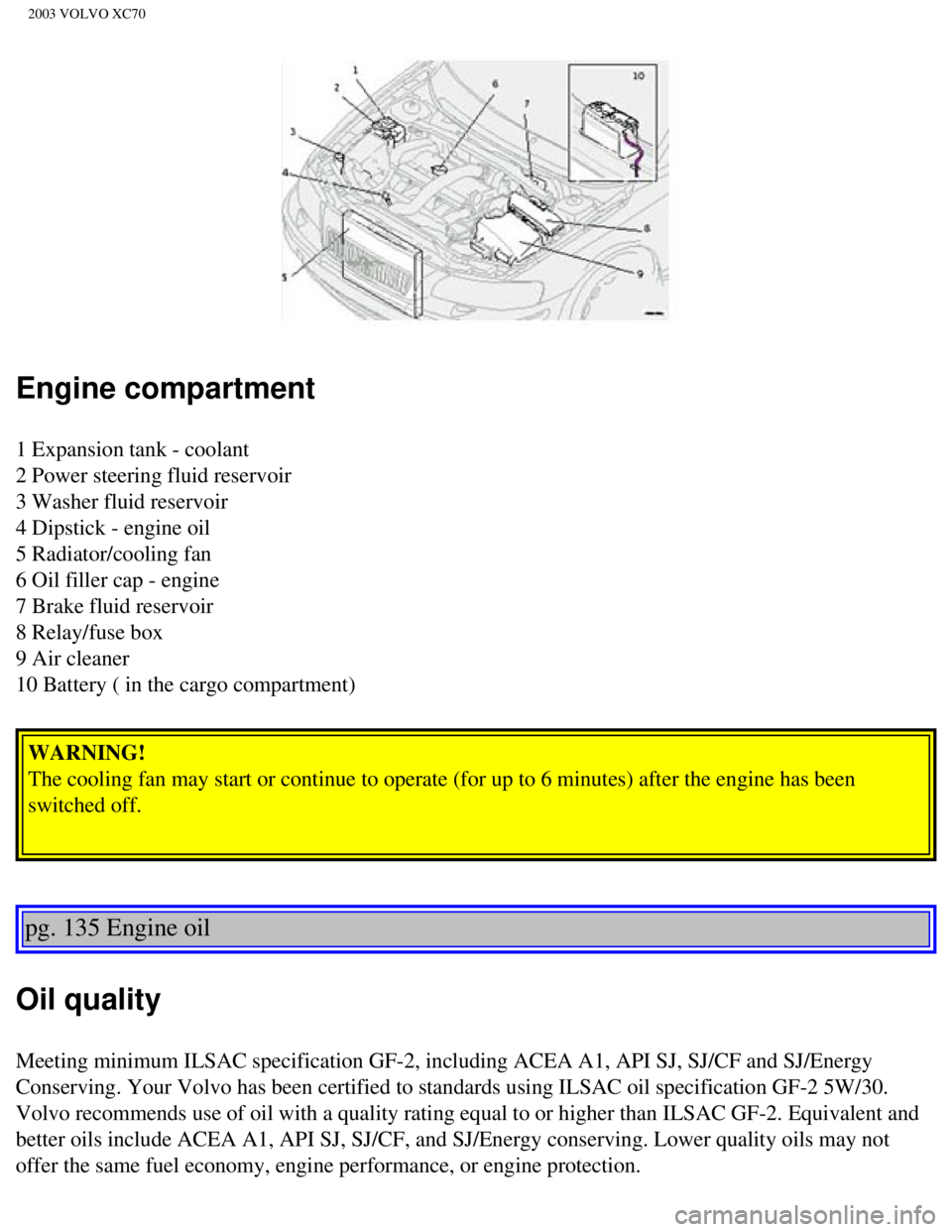
Engine compartment
1 Expansion tank - coolant
2 Power steering fluid reservoir
3 Washer fluid reservoir
4 Dipstick - engine oil
5 Radiator/cooling fan
6 Oil filler cap - engine
7 Brake fluid reservoir
8 Relay/fuse box
9 Air cleaner
10 Battery ( in the cargo compartment) WARNING!
The cooling fan may start or continue to operate (for up to 6 minutes)\
after the engine has been
switched off.
pg. 135 Engine oil
Oil quality
Meeting minimum ILSAC specification GF-2, including ACEA A1, API SJ, SJ/\
CF and SJ/Energy
Conserving. Your Volvo has been certified to standards using ILSAC oil s\
pecification GF-2 5W/30.
Volvo recommends use of oil with a quality rating equal to or higher tha\
n ILSAC GF-2. Equivalent and
better oils include ACEA A1, API SJ, SJ/CF, and SJ/Energy conserving. Lo\
wer quality oils may not
offer the same fuel economy, engine performance, or engine protection. \
file:///K|/ownersdocs/2003/2003_XC70/03xc70_08b.htm (7 of 16)12/30/200\
6 4:18:04 PM
Page 197 of 257

2003 VOLVO XC70
Fluid type: ATF
Replace: No fluid change required
NOTE: If a problem should occur in the power steering system or if the car ha\
s no electrical current and
must be towed, it is still possible to steer the car. However, keep in m\
ind that greater effort will be
required to turn the steering wheel.
Brake fluid
The brake fluid should always be above the MIN mark on the side of the r\
eservoir. Check, without
removing the cap, that there is sufficient fluid in the reservoir.
Fluid type: DOT 4+ boiling point >536°F(280°C), P/N 9437433
Replace: Every second year or 30,000 miles (48,000 km). The fluid shou\
ld be replaced once a year or
every 15,000 miles (24,000 km) when driving under extremely hard condi\
tions (mountain driving, etc.)
Always entrust brake fluid changing to an authorized Volvo retailer.
pg. 138 Battery maintenance
Battery maintenance
The battery in your car is located under the floor of the cargo area.
Driving habits and conditions, climate, the number of starts, etc. all a\
ffect the service life and function of
the battery. In order for your battery to perform satisfactorily, keep t\
he following in mind:
file:///K|/ownersdocs/2003/2003_XC70/03xc70_08b.htm (11 of 16)12/30/20\
06 4:18:04 PM
Page 198 of 257
,
whichever is sooner. The fluid should be at the level shown in the illus")
2003 VOLVO XC70
l Check the fluid level in each cell in the battery every 24 months or eve\
ry 15,000* miles (24,000 km),
whichever is sooner. The fluid should be at the level shown in the illus\
tration above (A**).
Use a screwdriver to open the caps and a flashlight to inspect the level\
.
l If necessary, add distilled water. The level should never be above the indicator (A).
l The fluid level should be checked if the battery has been recharged.
l After inspection, be sure the cap over each battery cell is securely in \
place.
l Check that the battery cables are correctly connected and properly tight\
ened.
l Never disconnect the battery when the engine is running, for example whe\
n changing the battery.
l The battery should be disconnected from the vehicle when a battery charg\
er is used directly on the
battery. However, if the battery is being charged via the connecting poi\
nts in the engine compartment
(see
page 101), the battery must be connected.
PROPOSITION 65 WARNING!
Battery posts, terminals, and related accessories contain lead and lead \
compounds, chemicals known
to the state of California to cause cancer and reproductive harm. Wash h\
ands after handling.
* More frequently in warm climates.
** The level indicator inside the battery could be designed in various w\
ays. See illustration above!
Battery warning symbols Battery warning symbols
file:///K|/ownersdocs/2003/2003_XC70/03xc70_08b.htm (12 of 16)12/30/20\
06 4:18:04 PM
Page 199 of 257
12/30/20\
06 4:18:04 PM")
2003 VOLVO XC70
pg. 139 Battery maintenance
Replacing the battery
file:///K|/ownersdocs/2003/2003_XC70/03xc70_08b.htm (13 of 16)12/30/20\
06 4:18:04 PM
Page 200 of 257
2003 VOLVO XC70
l Switch off the ignition.
l Unscrew the cover over the battery. Wait at least 10 minutes after switching off the ignition before
disconnecting the battery so that all information in the car's electrica\
l system can be stored in the control
modules.
l Disconnect the negative (ground) cable first.
l Disconnect the positive cable and pull the ventilation hose* from the ba\
ttery.
l Lift out the old battery and put a new battery into place.
l Connect the positive cable first.
l Connect the negative (ground) cable.
l Be sure that the ventilation hose* is securely connected to the battery \
and that the other end of the
hose is properly routed through the ventilation opening in the floor of \
the battery compartment.
l Reinstall the cover and screw it securely in place.
WARNING!
l Never expose the battery to open flame or electric spark.
l Do not smoke near the battery.
l Battery fluid contains sulfuric acid. Do not allow battery fluid to cont\
act eyes, skin, fabrics or
painted surfaces. If contact occurs, flush the affected area immediately\
with water. Obtain medical
help immediately if eyes are affected.
NOTE: After the battery has been disconnected or replaced, lock and unlock th\
e car with the central
locking system's remote control to reactivate such features as the power\
windows, sunroof, courtesy
lighting, etc. WARNING!
* Ventilation hose: The battery generates hydrogen gas, which is flammab\
le and explosive. The
battery is fitted with a ventilation hose which vents hydrogen gas out o\
f the battery
compartment through a ventilation opening in the bottom of this compartm\
ent. If the battery
must be replaced, it is essential that the ventilation hose is properly \
connected to the battery
and that it is routed through the ventilation opening provided (see ill\
ustration).
Be sure the ventilation hose is free of debris.
Only use replacement batteries equipped with a ventilation hose. Consult\
your Volvo retailer.
pg. 140 Replacing wiper blades
file:///K|/ownersdocs/2003/2003_XC70/03xc70_08b.htm (14 of 16)12/30/20\
06 4:18:04 PM
Page 211 of 257

2003 VOLVO XC70
Distributor ignition system
Firing order: 1-2-4-5-3
Electronic ignition setting: Not adjustable
Spark plugs: Champion RC8PYP 8 (or equivalent)
Spark plug gap: 0.028-0.032" (0.7-0.8 mm)
Tightening torque: 18.4 ft. lbs. (25 Nm) WARNING!
The ignition system operates at very high voltages. Special safety preca\
utions must be followed to
prevent injury. Always turn the ignition off when:
l Replacing ignition components e.g. plugs, coil, etc.
l Do not touch any part of the ignition system while the engine is running\
. This may result in a shock
and bodily injury.
Front suspension
Spring strut suspension with integrated shock absorbers and control arms\
linked to the support frame.
Power-assisted rack and pinion steering. Safety type steering column. Th\
e alignment specifications
apply to an unladen car but include fuel, coolant and spare wheel.
Rear suspension
Individual rear wheel suspension with longitudinal support arms, double \
link arms and track rods.
All specifications are subject to change without prior notice.
pg. 148 Electrical system
Electrical system
12 Volt, negative ground.
Voltage-controlled generator. Single-wire system with chassis and engine\
used as conductors. Grounded
on chassis.
Battery
file:///K|/ownersdocs/2003/2003_XC70/03xc70_09.htm (9 of 11)12/30/2006\
4:18:05 PM
Page 212 of 257

2003 VOLVO XC70
Voltage: 12 Volt, capacity: 600 A/115 min reserve capacity.
The battery contains corrosive and poisonous acids. It is of the utmost \
importance that old batteries are
disposed of correctly. Your Volvo retailer can assist you in this matter\
.
Generator
Rated output: max. current: 140 A
Starter motor:
Output: 1.7 kW
Bulbs
Bulb US no. Power Socket
Headlights
- High beam HB360W -
- Low beam H7 55W -
Front parking lights 5W W2.1x9.5d
Front direction indicators (yellow) 21 W BAU 15d
Front fog lights H1 55 W -
Rear direction indicators (yellow) 21W BAU 15 s
Tail lights 67 5W BA 15 s
Brake lights 115621W BA 15 s
Backup lights 115621W BA 15 s
Rear fog light/rear parking lights 21/4W BA 15 s
License plate light - 5 W W 2.1x9.5d
Door step courtesy lights
Front -5W SV 8.5
Cargo area lights - 5 W SV 8.5
Glove compartment light -2 W BA 9s
Vanity mirror light(s) - 12V
1.2W -
Instrument lighting - 3 W W
2.1x9.5d
All specifications are subject to change without prior notice.
pg. 149 Volvo On Call
file:///K|/ownersdocs/2003/2003_XC70/03xc70_09.htm (10 of 11)12/30/200\
6 4:18:05 PM