belt VOLVO XC70 2003 Owner's Manual
[x] Cancel search | Manufacturer: VOLVO, Model Year: 2003, Model line: XC70, Model: VOLVO XC70 2003Pages: 257, PDF Size: 5.33 MB
Page 31 of 257

2003 VOLVO XC70
provided with the restraint. Be sure you understand them and can use the\
device properly and
safely in this vehicle. A misused child restraint system can result in i\
ncreased injuries for both the
infant or child and other occupants in the vehicle.
A child who has outgrown the child safety seat should use the rear seat \
with the standard seat belt
fastened. Place the child on an approved cushion so that the seat belt i\
s properly located on the child's
hips (see
page 13).Legislation in your state or province may mandate the use of a child \
seat or cushion in
combination with the seat belt, depending on the child's age and/or size\
. Please check local regulations.
A specially designed and tested booster cushion (not available in Canad\
a ) for children between 50 - 80
lbs (22.7 - 36 kg) and 38 -54 inches (97 - 137 cm) in height can be \
obtained from your Volvo retailer.
If necessary, an auxiliary seat for children is available for use in the\
luggage compartment of station
wagon models. This seat is designed for two children, each weighing betw\
een 50 - 88 lbs. (23 - 40 kg)
and up to 59 inches (150 cm) in height.
WARNING!
l When using the auxiliary seat for children, both sections of the rear se\
at backrest must be secured
in the upright position.
l Do not use a booster cushion or child seat in conjunction with the auxil\
iary seat.
pg. 17 Occupant safety
Seat belt maintenance
Check periodically that the seat belts are in good condition. Use water \
and a mild detergent for cleaning.
Check seat belt mechanism function as follows: Attach the seat belt and \
pull rapidly on the strap.
Volvo Concern for Safety
Safety is the cornerstone of Volvo. Our concern dates back to 1927 when \
the first Volvo rolled off the
production line. Three-point seat belts (a Volvo invention), safety ca\
ges, and energy-absorbing impact
zones were designed into Volvo cars long before it was fashionable or re\
quired by government
regulation. We will not compromise our commitment to safety. We continue\
to seek out new safety
features and to refine those already in our cars. You can help. We would\
appreciate hearing your
suggestions about improving automobile safety. We also want to know if y\
ou ever have a safety concern
with your car. Call us in the U.S. at: 800-458-1552 or in Canada at: 800\
-663-8255.
file:///K|/ownersdocs/2003/2003_XC70/03xc70_01b.htm (8 of 14)12/30/200\
6 4:17:52 PM
Page 46 of 257

2003 VOLVO XC70
An indicator light will flash when STC or DSTC is actively working to st\
abilize the car. See pages 20-21 for
more detailed information.
Turn signal indicator - trailer (certain models)
If you are towing a trailer, this light will flash simultaneously with t\
he turn signals on the trailer. If the light
does not flash when signaling, neither the trailer's turn signals nor th\
e car's turn signals are functioning.
Seat belt reminder
This symbol lights up to indicate that the driver has not fastened his/h\
er seat belt.
pg. 30 Text information window
Messages in the text window
When a warning light in the instrument panel comes on, a message is also\
displayed in the text window. After
you have read the message, you can erase it by pressing button A (see i\
llustration above).
NOTE: Certain messages cannot be erased until the condition has been corrected\
.
file:///K|/ownersdocs/2003/2003_XC70/03xc70_02a.htm (9 of 13)12/30/200\
6 4:17:53 PM
Page 96 of 257

2003 VOLVO XC70
Removing the center backrest
XC70 with 3-section rear seat
l Press the button at the top of the center section to the rear to release\
the locking mechanism.
l Fold the backrest section slightly forward.
l Pull up on the handle at the upper rear side of the backrest (see illus\
tration above) to release this
section of the backrest from the retaining bar at the base of the backre\
st. Lift out the backrest.
Replacing the center backrest
l Before the center section is put back in place, the right section of the\
backrest must be locked in the
upright position.
l Replace the backrest by pressing the bottom section onto the retaining b\
ar until the backrest clicks
into place.
Please consult your Volvo retailer for information about accessory equip\
ment that can be placed in the
center section of the backrest.
WARNING!
l For safety reasons, the center section of the backrest or seat cushion s\
hould not be left in the car
after they have been removed.
l Please be aware that with the center section of the backrest removed, un\
anchored objects in the rear
cargo area could be thrown forward between the outboard sections of the \
backrest in the event of a
sudden stop.
l When the center section of the backrest is put back in place, the right-\
hand section of the backrest
must be in the upright position in order to lock the center section secu\
rely in place and to be able to
use the center seat belt.
file:///K|/ownersdocs/2003/2003_XC70/03xc70_04b.htm (5 of 21)12/30/200\
6 4:17:57 PM
Page 102 of 257

2003 VOLVO XC70
If an auxiliary seat is installed in the vehicle, store the seat before \
loading cargo. The auxiliary seat is not
designed to carry or restrain cargo.
Remember the following when loading the car:
l Load the cargo against the backrest.
l Load heavy cargo as low as possible.
l Load wide cargo on either side of the rear seat split.
l If no one is sitting in the rear seat, reinforce the backrest by fasteni\
ng the rear seat belts.
l Never load cargo above the backrest without a cargo net.
WARNING!
When the rear seat backrest(s) are folded down, the car should not be \
loaded to a level higher than 2
in. (5 cm) below the upper edge of the rear passenger door windows. Ob\
jects placed higher than this
level could impede the function of the inflatable curtain.
pg. 69 Steel grid/Cargo net
file:///K|/ownersdocs/2003/2003_XC70/03xc70_04b.htm (11 of 21)12/30/20\
06 4:17:57 PM
Page 128 of 257

2003 VOLVO XC70
NOTE: During a transitional period, a small number of service stations may sti\
ll have fuel nozzles that
are not compatible with the fuel filler neck on cars equipped with the e\
vaporative control system. Please
refer to
page 130 for additional information.
CAUTION:
l Do not refuel with the engine running *. Turn the ignition off or to pos\
ition I. If the ignition is on, an
incorrect reading could occur in the fuel gauge.
l After refueling, close the fuel filler cap by turning it clockwise until\
it clicks into place *.
l Allow for fuel expansion by not overfilling the tank. Overfilling could \
also cause damage to the
emission control systems.
l Avoid spilling gasoline when refueling. In addition to causing damage to\
the environment, gasolines
containing alcohol can cause damage to painted surfaces, which may not b\
e covered under the New
Vehicle Limited Warranty.
l Do not use gasolines containing methanol (methyl alcohol, wood alcohol)\
. This practice can result in
vehicle performance deterioration and can damage critical parts in the f\
uel system. Such damage may
not be covered under the New Vehicle Limited Warranty.
* If the fuel filler cap is not closed tightly or if the engine is runni\
ng when the car is refueled, the Check
Engine light (malfunction indicator lamp) may indicate a fault. Howeve\
r, your vehicle's performance
will not be affected. Use only Volvo original or approved fuel filler ca\
ps.
pg. 87 Starting the engine
Starting the engine
1. Fasten the seat belt.
WARNING!
Before starting, check that the seat, steering wheel and mirrors adjuste\
d properly. Make sure the brake
pedal can be depressed completely. Adjust the seat if necessary. See
page 56.
2. Apply the parking brake, if not already set. The gear selector (automatic transmission) is locked in
the (P)ark position (SHIFT-LOCK). Manual transmission: the clutch must be fully depressed.
3. Without touching the accelerator pedal, turn the ignition key* to the starting position. Allow the
starter to operate for up to 10 seconds. Release the key as soon as the \
engine starts. If the engine fails to
start, repeat this step.
file:///K|/ownersdocs/2003/2003_XC70/03xc70_06a.htm (5 of 22)12/30/200\
6 4:17:59 PM
Page 154 of 257

2003 VOLVO XC70
pg. 105 Long distance trips
Before a long distance trip
It is always worthwhile to have your car checked at a Volvo retailer bef\
ore driving long distances. Your
retailer will also be able to supply you with bulbs, fuses, spark plugs \
and wiper blades for your use in the
event that problems occur.
As a minimum, the following items should be checked before any long trip\
:
l Check that engine runs smoothly and that fuel consumption is normal.
l Check for fuel, oil, and fluid leakage.
l Check condition of accessory drive belts.
l Check transmission oil level*.
l Check state of the battery's charge.
l Examine tires carefully (the spare tire as well), and replace those th\
at are worn. Check tire pressures.
l The brakes, front wheel alignment, and steering gear should be checked b\
y your Volvo retailer only.
l Check all lights, including high beams.
l Reflective warning triangles are legal requirement in some countries.
l Have a word with your Volvo retailer if you intend to drive in countries\
where it may be difficult to
obtain the correct fuel.
l Consider your destination. If you will be driving through an area where \
snow or ice are likely to
occur, consider snow tires.
* To prevent injury from contact with hot surfaces, do not inspect your \
car's transmission fluid yourself.
Have your car's transmission fluid level inspected by a qualified Volvo \
service technician.
pg. 106 Three-way catalytic converters
file:///K|/ownersdocs/2003/2003_XC70/03xc70_06b.htm (9 of 10)12/30/200\
6 4:18:00 PM
Page 166 of 257
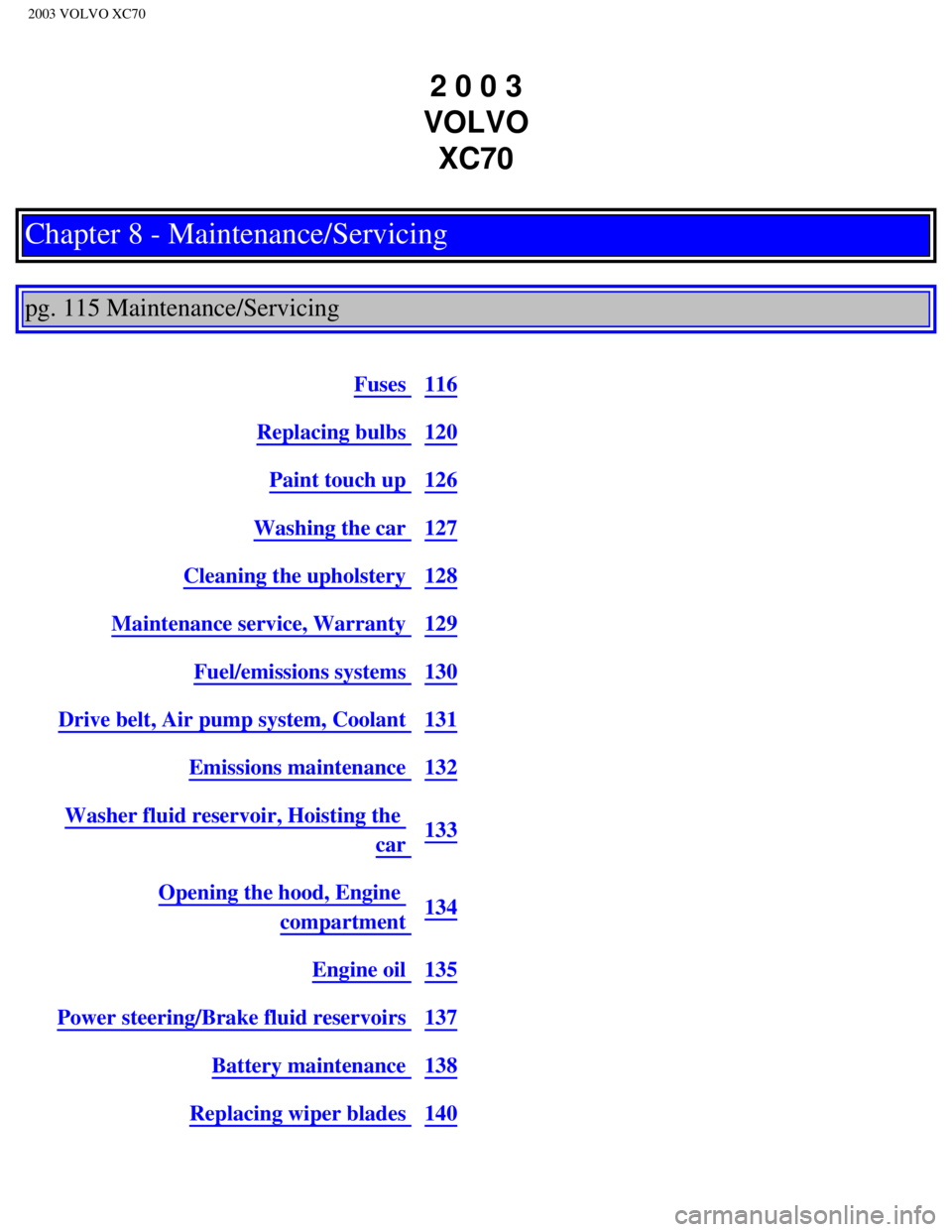
2003 VOLVO XC70
2 0 0 3
VOLVO XC70
Chapter 8 - Maintenance/Servicing
pg. 115 Maintenance/Servicing
Fuses 116
Replacing bulbs 120
Paint touch up 126
Washing the car 127
Cleaning the upholstery 128
Maintenance service, Warranty 129
Fuel/emissions systems 130
Drive belt, Air pump system, Coolant 131
Emissions maintenance 132
Washer fluid reservoir, Hoisting the
car 133
Opening the hood, Engine
compartment 134
Engine oil 135
Power steering/Brake fluid reservoirs 137
Battery maintenance 138
Replacing wiper blades 140
file:///K|/ownersdocs/2003/2003_XC70/03xc70_08a.htm (1 of 21)12/30/200\
6 4:18:03 PM
Page 185 of 257
.
Cleaning the upholstery
l The fabric can be cleaned")
2003 VOLVO XC70
l Do not polish or wax your car in direct sunlight (the surface of the ca\
r should not be warmer than
113° F (45° C).
Cleaning the upholstery
l The fabric can be cleaned with soapy water or a detergent. For more difficult spot\
s caused by oil, ice
cream, shoe polish, grease, etc., use a clothing/fabric stain remover.
l The plastic in the upholstery can be cleaned with a soft cloth and mild soap soluti\
on.
l Leather upholstery/suede-like upholstery (alcanteraTM) can be cleaned with a soft cloth and mild
soap solution. For more difficult spots, Volvo offers a leather care kit\
.
l Under no circumstances should gasoline, naphtha or similar cleaning agen\
ts be used on the
plastic or the leather since these can cause damage.
Cleaning the seat belts
Clean only with lukewarm water and mild soap solution.
Cleaning floor mats
The floor mats should be vacuumed or brushed clean regularly, especially\
during winter, when they
should be taken out for drying. Spots on textile mats can be removed wit\
h a mild detergent.
Stain removal
l Take extra care when removing stains such as ink or lipstick since the c\
oloring can spread.
l Use solvents sparingly. Too much solvent can damage the seat padding.
l Start from the outside of the stain and work toward the center.
pg. 129 Maintenance service, Warranty
Maintenance service
Volvo advises you to follow the service program outlined in the Warranty\
and Service Records
Information booklet. This maintenance program contains inspections and s\
ervices necessary for the
proper function of your car. The maintenance services contain several ch\
ecks which require special
instruments and tools and therefore must be performed by a qualified tec\
hnician. To keep your Volvo in
top condition, specify time-tested and proven Genuine Volvo Parts and Ac\
cessories.
The Federal Clean Air Act - U.S.
file:///K|/ownersdocs/2003/2003_XC70/03xc70_08a.htm (20 of 21)12/30/20\
06 4:18:03 PM
Page 186 of 257

2003 VOLVO XC70
The Federal Clean Air Act requires vehicle manufacturers to furnish writ\
ten instructions to the ultimate
purchaser to assure the proper servicing and function of the components \
that control emissions. These
services, which are listed in the "Warranty and Service Records Informat\
ion booklet," are not covered
by the warranty. You will be required to pay for labor and material used\
.
Maintenance services
Your Volvo passed several major inspections before it was delivered to y\
ou, in accordance with Volvo
specifications. The maintenance services outlined in the Warranty and Se\
rvice Records Information
booklet, many of which will positively affect your vehicle's emissions, \
should be performed as
indicated. It is recommended that receipts for vehicle emission services\
be retained in case questions
arise concerning maintenance.
Inspection and service should also be performed anytime a malfunction is\
observed or suspected.
Page 128 provides information about maintenance of emission-related components.
Applicable warranties - U.S.
In accordance with applicable U.S. and Canadian regulations, the followi\
ng list of warranties is
provided.
l New Car Limited Warranty
l Parts and Accessories Limited Warranty
l Corrosion Protection Limited Warranty
l Seat Belt and Supplemental Restraint Systems Limited Warranty
l Emission Design and Defect Warranty
l Emission Performance Warranty
These are the Federal warranties; other warranties are provided as requi\
red by state/provincial law. Refer
to your separate Warranty and Service Records Information booklet for de\
tailed information concerning
each of the warranties.
Contents | Top of Page
file:///K|/ownersdocs/2003/2003_XC70/03xc70_08a.htm (21 of 21)12/30/20\
06 4:18:03 PM
Page 188 of 257

2003 VOLVO XC70
charcoal canister to the engine's air intake system and into the combust\
ion process.
NOTE:
l Overfilling the fuel tank can cause damage to the evaporative control sy\
stem.
l If the fuel filler cap is not closed tightly or if the engine is running\
when the car is refueled, the
Malfunction Indicator Lamp may indicate a fault.
l During a transitional period, a small number of service stations may sti\
ll have fuel nozzles that are not
compatible with the fuel filler neck on cars equipped with the evaporati\
ve emission control system
mandated by the U.S. Environmental Protection Agency and the California \
Air Resources Board. If you
experience difficulties in refueling your vehicle, please ask the gas st\
ation attendant for assistance.
CAUTION:
Fuel must not be siphoned from the fuel tank. This will damage the evapo\
rative control system.
pg. 131 Drive belt, Coolant
Belt check
Check the belt regularly to make sure it is in good condition and is cle\
an. A worn or dirty belt can cause
poor cooling and low alternator output as well as impair the operation o\
f the power steering and the air
conditioning unit.
NOTE: The drive belt is equipped with a self-tensioning mechanism and requires\
no adjustment
between changes.
WARNING!
The engine must not be running when this check is
performed.
Check coolant level
The cooling system must be filled with coolant and not leak to operate a\
t maximum efficiency. Check
the coolant level regularly. The level should be between the "MAX" and "\
MIN" marks on the expansion
tank. The check should be made with particular thoroughness when the eng\
ine is new or when the
cooling system has been drained. Do not remove the filler cap other than\
for topping up with coolant.
Frequent removal may prevent coolant circulation between the engine and \
the expansion tank during
file:///K|/ownersdocs/2003/2003_XC70/03xc70_08b.htm (2 of 16)12/30/200\
6 4:18:04 PM