tire VOLVO XC70 2009 Owner´s Manual
[x] Cancel search | Manufacturer: VOLVO, Model Year: 2009, Model line: XC70, Model: VOLVO XC70 2009Pages: 286, PDF Size: 9.21 MB
Page 194 of 286

05 During your tripDriving recommendations
05194
General informationEconomical driving conserves natural
resourcesBetter driving economy may be obtained by
thinking ahead, avoiding rapid starts and stops
and adjusting the speed of your vehicle to
immediate traffic conditions.
Observe the following rules:•
Bring the engine to normal operating tem-
perature as soon as possible by driving
with a light foot on the accelerator pedal for
the first few minutes of operation. A cold
engine uses more fuel and is subject to
increased wear.
•
Whenever possible, avoid using the vehicle
for driving short distances. This does not
allow the engine to reach normal operating
temperature.
•
Drive carefully and avoid rapid acceleration
and hard braking.
•
Use the transmission's Drive (D) position
as often as possible and avoid using kick-
down.
•
Do not exceed posted speed limits.
•
Avoid carrying unnecessary items (extra
load) in the vehicle.
•
Maintain correct tire pressure. Check tire
pressure regularly (when tires are cold).
•
Remove snow tires when threat of snow or
ice has ended.
•
Note that roof racks, ski racks, etc,
increase air resistance and also fuel con-
sumption.
•
At highway driving speeds, fuel consump-
tion will be lower with the air conditioning
on and the windows closed than with the
air conditioning off and the windows open.
•
Using the onboard trip computer's fuel
consumption modes can help you learn
how to drive more economically.
Other factors that decrease gas mileage
are:
•
Dirty air cleaner
•
Dirty engine oil and clogged oil filter
•
Dragging brakes
•
Incorrect front end alignment
Some of the above mentioned items and others
are checked at the standard maintenance
intervals.
WARNING
Driving with the tailgate open: Driving with
the tailgate open could lead to poisonous
exhaust gases entering the passenger com-
partment. If the tailgate must be kept open
for any reason, proceed as follows:•
Close the windows
•
Set the ventilation system control to air
flow to floor, windshield and side win-
dows and the blower control to its high-
est setting.
Weight distribution affects handlingAt the specified curb weight your vehicle has a
tendency to understeer, which means that the
steering wheel has to be turned more than
might seem appropriate for the curvature of a
bend. This ensures good stability and reduces
the risk of rear wheel skid. Remember that
these properties can alter with the vehicle load.
The heavier the load in the cargo area, the less
the tendency to understeer.Handling, roadholdingVehicle load, tire design and inflation pressure
all affect vehicle handling. Therefore, check
that the tires are inflated to the recommended
pressure according to the vehicle load. See the
"Tire pressure" section. Loads should be dis-
tributed so that capacity weight or maximum
permissible axle loads are not exceeded.
Page 196 of 286
05 During your tripDriving recommendations
05196
Before a long distance tripIt is always worthwhile to have your vehicle
checked by a trained and qualified Volvo serv-
ice technician before driving long distances.
Your retailer will also be able to supply you with
bulbs, fuses, spark plugs and wiper blades for
your use in the event that problems occur.
As a minimum, the following items should be
checked before any long trip:•
Check that engine runs smoothly and that
fuel consumption is normal.
•
Check for fuel, oil, and fluid leakage
•
Have the transmission oil level checked.
•
Check condition of drive belts.
•
Check state of the battery's charge.
•
Examine tires carefully (the spare tire as
well), and replace those that are worn.
Check tire pressures.
•
The brakes, front wheel alignment, and
steering gear should be checked by a
trained and qualified Volvo service techni-
cian only.
•
Check all lights, including high beams.
•
Reflective warning triangles are legally
required in some states/provinces.
•
Have a word with a trained and qualified
Volvo service technician if you intend to
drive in countries where it may be difficult
to obtain the correct fuel.
•
Consider your destination. If you will be
driving through an area where snow or ice
are likely to occur, consider snow tires.
Cold weather precautionsIf you wish to check your vehicle before the
approach of cold weather, the following advice
is worth noting:•
Make sure that the engine coolant contains
50 percent antifreeze. Any other mixture
will reduce freeze protection. This gives
protection against freezing down to
–31 °F (–35 °C). The use of "recycled" anti-
freeze is not approved by Volvo. Different
types of antifreeze must not be mixed.
•
Volvo recommends using only genuine
Volvo antifreeze in your vehicle's radiator.
•
Try to keep the fuel tank well filled – this
helps prevent the formation of condensa-
tion in the tank. In addition, in extremely
cold weather conditions it is worthwhile to
add fuel line de-icer before refueling.
•
The viscosity of the engine oil is important.
Oil with low viscosity (thinner oil) improves
cold-weather starting as well as decreas-
ing fuel consumption while the engine is
warming up. For winter use, 5W-30 oil, par-
ticularly the synthetic type, is recom-
mended. Be sure to use good quality oil but
do not use cold-weather oil for hard driving
or in warm weather, see page 272 for more
information on engine oil.
NOTE
Synthetic oil is not used when the oil is
changed at the normal maintenance inter-
vals except at owner request and at addi-
tional charge.•
The load placed on the battery is greater
during the winter since the windshield wip-
ers, lighting, etc. are used more often.
Moreover, the capacity of the battery
decreases as the temperature drops. In
very cold weather, a poorly charged bat-
tery can freeze and be damaged. It is there-
fore advisable to check the state of charge
more frequently and spray an anti-rust oil
on the battery posts.
•
Volvo recommends the use of snow tires
on all four wheels for winter driving, see
page 253.
•
To prevent the washer fluid reservoir from
freezing, add washer solvents containing
antifreeze. This is important since dirt is
often splashed on the windshield during
winter driving, requiring the frequent use of
the washers and wipers. Volvo Washer
Solvent should be diluted as follows: Down
to 14 °F (–10 °C): 1 part washer solvent and
4 parts water Down to 5 °F (–15 °C): 1 part
washer solvent and 3 parts water Down to
0 °F (–18 °C): 1 part washer solvent and
Page 209 of 286

05 During your trip
Cargo area
05
209
The two-sections of the net are attached to the
rear side of the rear seat backrest. The cas-
settes have different widths, and the widest
section should be mounted on the right side
(seen from the rear of the vehicle).
1. Fold down the rear seat backrests.
2. Align the cassette’s mounting rail above
the mounting brackets on the backrest
.
3. Slide the cassette onto the mounting
brackets
.
4. Return the backrest to the upright position.
Using the net(s)
G018246
With the backrests uprightThe net is pulled up from the cassette and
locks in position after approximately 1 minute.
Pull up the right side of the net by grasping
its strap.Insert the net’s rod in the retaining bracket
on the right side near the ceiling and press
it forward. It will click into place.Extend the left section of the rod and insert
it in the bracket on the left side of the cargo
compartment. Press it forward until it clicks
into place.Pull up the left side of the cargo net and
secure it on the rod.NOTE
•
The net can be fastened in the same
way if the rear seat backrests are folded
down. In this case, use the retaining
brackets near the ceiling, above the
front seats.
•
The front passenger's seat backrest
can also be folded down for carrying
long objects, see page 79.
Removing the cargo net cassettes1. Retract the net(s) in the reverse order ( See
page 209, "With the backrests upright")
2. Fold the entire rear seat backrest down.
3. Slide the cassettes outward until they
release from the mounting brackets.
WARNING
•
When not in use, return the cassettes to
their storage compartment under the
cargo area floor.
•
Objects in the cargo area should be
securely anchored, even if the cargo net
is correctly installed and in use.
Using the cargo net with the cargo area
cover
G018247
Straps for pulling up the netThe cargo net(s) can also be pulled up from the
backrest when the cargo area cover is pulled
out.
The straps for pulling up the cargo net are
located at the arrows in the illustration. Follow
the same procedure as for using the nets with
the backrests upright.
Page 210 of 286

05 During your tripTowing a trailer
05210
IntroductionVolvo recommends the use of Volvo trailer
hitches that are specially designed for the vehi-
cle.
NOTE
See page 271 for the maximum trailer and
tongue weights recommended by Volvo.•
Observe the legal requirements of the
state/province in which the vehicles are
•
All Volvo models are equipped with
energy-absorbing shock-mounted bump-
ers. Trailer hitch installation should not
interfere with the proper operation of this
bumper system.
Trailer towing does not normally present any
particular problems, but take into considera-
tion:
•
Increase tire pressure to recommended
full. See the tire inflation tables on pages
248 and 249.
•
When your vehicle is new, avoid towing
heavy trailers during the first 620 miles
(1,000 km).
•
Maximum speed when towing a trailer:
50 mph (80 km/h).
•
Engine and transmission are subject to
increased loads. Therefore, engine coolant
temperature should be closely watchedwhen driving in hot climates or hilly terrain.
Use a lower gear and turn off the air con-
ditioner if the temperature gauge needle
enters the red range.
•
If the automatic transmission begins to
overheat, a message will be displayed in
the text window.
•
Avoid overload and other abusive opera-
tion.
•
Hauling a trailer affects handling, durabil-
ity, and economy.
•
It is necessary to balance trailer brakes
with the towing vehicle brakes to provide a
safe stop (check and observe state/local
regulations).
•
Do not connect the trailer's brake system
directly to the vehicle's brake system.
•
More frequent vehicle maintenance is
required.
•
Remove the ball and drawbar assembly
when the hitch is not being used.
•
Volvo recommends the use of synthetic
engine oil when towing a trailer over long
distances or in mountainous areas.
WARNING
•
Bumper-attached trailer hitches must
not be used on Volvos, nor should
safety chains be attached to the
bumper.
•
Trailer hitches attaching to the vehicle
rear axle must not be used.
•
Never connect a trailer's hydraulic
brake system directly to the vehicle
brake system, nor a trailer's lighting
system directly to the vehicle lighting
system. Consult your nearest author-
ized Volvo retailer for correct installa-
tion.
•
When towing a trailer, the trailer's safety
wire must be correctly fastened to the
hole or hook provided in the trailer hitch
on the vehicle. The safety wire should
never be fastened to or wound around
the drawbar ball.
Page 212 of 286
05 During your tripEmergency towing
05212
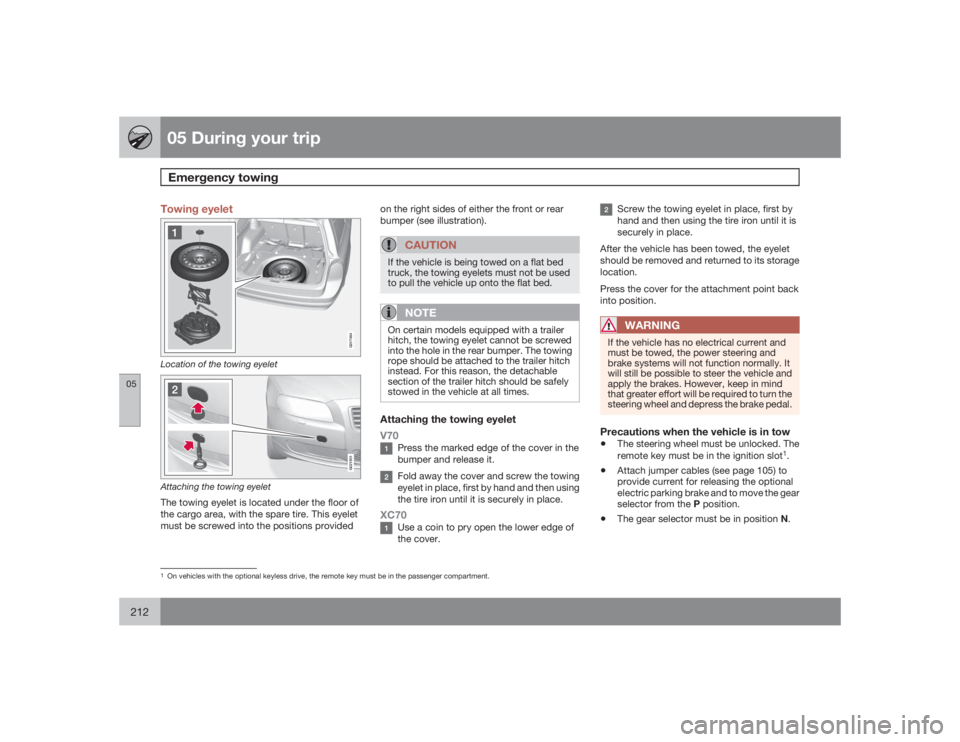
Towing eyelet
G017464
Location of the towing eyelet
G021501
Attaching the towing eyeletThe towing eyelet is located under the floor of
the cargo area, with the spare tire. This eyelet
must be screwed into the positions providedon the right sides of either the front or rear
bumper (see illustration).
CAUTION
If the vehicle is being towed on a flat bed
truck, the towing eyelets must not be used
to pull the vehicle up onto the flat bed.
NOTE
On certain models equipped with a trailer
hitch, the towing eyelet cannot be screwed
into the hole in the rear bumper. The towing
rope should be attached to the trailer hitch
instead. For this reason, the detachable
section of the trailer hitch should be safely
stowed in the vehicle at all times.Attaching the towing eyelet
V70
Press the marked edge of the cover in the
bumper and release it.Fold away the cover and screw the towing
eyelet in place, first by hand and then using
the tire iron until it is securely in place.
XC70
Use a coin to pry open the lower edge of
the cover.
Screw the towing eyelet in place, first by
hand and then using the tire iron until it is
securely in place.
After the vehicle has been towed, the eyelet
should be removed and returned to its storage
location.
Press the cover for the attachment point back
into position.WARNING
If the vehicle has no electrical current and
must be towed, the power steering and
brake systems will not function normally. It
will still be possible to steer the vehicle and
apply the brakes. However, keep in mind
that greater effort will be required to turn the
steering wheel and depress the brake pedal.Precautions when the vehicle is in tow•
The steering wheel must be unlocked. The
remote key must be in the ignition slot
1.
•
Attach jumper cables (see page 105) to
provide current for releasing the optional
electric parking brake and to move the gear
selector from the P position.
•
The gear selector must be in position N.
1On vehicles with the optional keyless drive, the remote key must be in the passenger compartment.
Page 214 of 286
G020922
214
Volvo maintenance................................................................................ 216
Maintaining your car.............................................................................. 217
Hood and engine compartment............................................................ 219
Engine oil............................................................................................... 220
Fluids..................................................................................................... 222
Replacing bulbs.................................................................................... 224
Wiper blades and washer fluid.............................................................. 231
Battery................................................................................................... 233
Fuses..................................................................................................... 236
Wheels and tires.................................................................................... 244
Vehicle care........................................................................................... 261
Label information.................................................................................. 266
Specifications........................................................................................ 268
Volvo programs..................................................................................... 276
Page 217 of 286
06 Maintenance and specifications
Maintaining your car
06``217 Owner maintenance
Periodic maintenance requirements and inter-
vals are described in your vehicle's Warranty
and Service Records Information booklet.
The following points can be carried out
between the normally scheduled maintenance
services.Each time the car is refueled:•
Check the engine oil level.
•
Clean the windshield, windshield wipers,
headlights, and tail lights.
Monthly:•
Check cold tire pressure in all tires. Inspect
the tires for wear.
•
Check that engine coolant and other fluid
levels are between the indicated "min" and
"max" markings.
•
Clean interior glass surfaces with a glass
cleaner and soft paper towels.
•
Wipe driver information displays with a soft
cloth.
•
Visually inspect battery terminals for cor-
rosion. Corrosion may indicate a loose ter-
minal connector, or a battery near the end
of its useful service life. Consult your Volvo
retailer for additional information.
As needed:Wash the car, including the undercarriage, to
reduce wear that can be caused by a buildup
of dirt, and corrosion that can be caused by salt
residues.
Clean leaves and twigs from air intake vents at
the base of the windshield, and from other pla-
ces where they may collect.
NOTE
Complete service information for qualified
technicians is available online for purchase
or subscription at www.volvotechinfo.com.Emission inspection readinessWhat is an Onboard Diagnostic System
(OBD II)?OBD II is part of your vehicle's computerized
engine management system. It stores diagnos-
tic information about your vehicle's emission
controls. It can light the Check Engine light
(MIL) if it detects an emission control "fault." A
"fault" is a component or system that is not
performing within an expected range. A fault
may be permanent or temporary. OBD II will
store a message about any fault.
How do states use OBD II for emission
inspections?Many states connect a computer directly to a
vehicle's OBD II system. The inspector can
then read "faults." In some states, this type of
inspection has replaced the tailpipe emission
test.How can my vehicle fail OBD II emission
inspection?Your vehicle can fail OBD II emission inspec-
tion for any of the following reasons.•
If your Check Engine (MIL) light is lit, your
vehicle may fail inspection.
•
If your vehicle's Check Engine light was lit,
but went out without any action on your
part, OBD II will still have a recorded fault.
Your vehicle may pass or fail, depending
on the inspection practices in your area.
•
If you had recent service that required dis-
connecting the battery, OBD II diagnostic
information may be incomplete and "not
ready" for inspection. A vehicle that is not
ready may fail inspection.
How can I prepare for my next OBD II
emission inspection?•
If your Check Engine (MIL) light is lit – or
was lit but went out without service, have
Page 224 of 286
06 Maintenance and specificationsReplacing bulbs
06224
IntroductionAll bulb specifications are listed on page 230.
The following bulbs should only be replaced by
a trained and qualified Volvo service techni-
cian:•
Dome lighting
•
Reading lights
•
Glove compartment lighting
•
Turn signals in the door mirror
•
Approach lighting in the door mirror
•
Brake/fog/taillights
•
Rear side parking lights
•
Active Bi-XenonŸ and LED bulbsNOTE
For information regarding any other bulbs
not mentioned in this section, please con-
tact your Volvo retailer or a trained and
authorized Volvo service technician.
WARNING
•
Active Bi-XenonŸ headlights (option) –
due to the high voltage used by these
headlights, these bulbs should only be
replaced by a trained and qualified
Volvo service technician.
•
Turn off the lights and remove the
remote key from the ignition before
changing any bulbs.
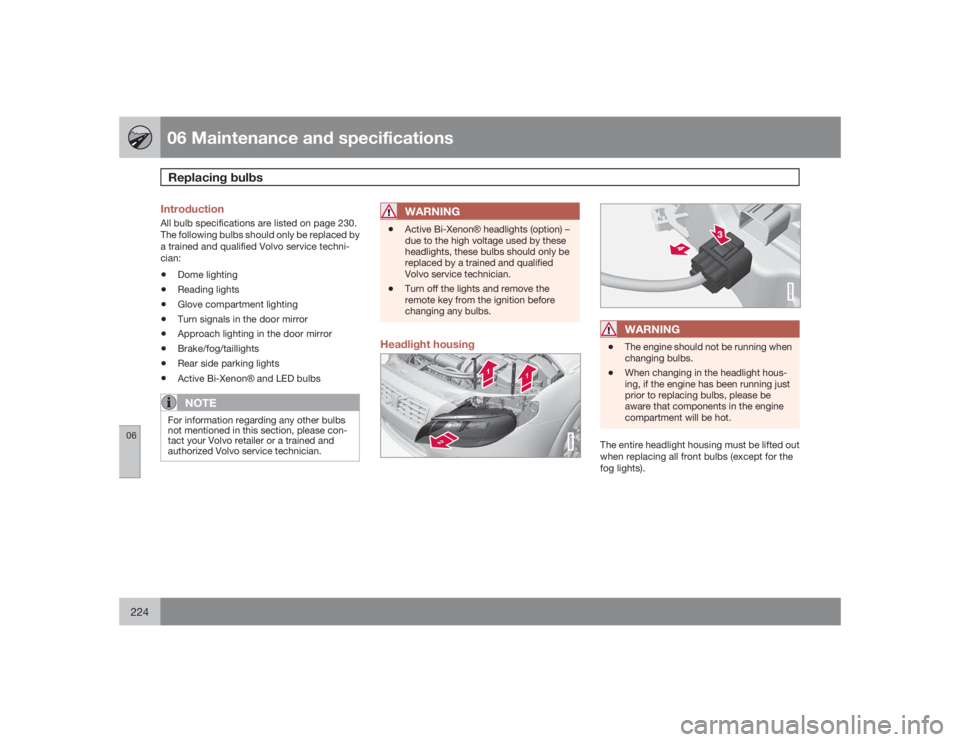
Headlight housing
G010479
G010325
WARNING
•
The engine should not be running when
changing bulbs.
•
When changing in the headlight hous-
ing, if the engine has been running just
prior to replacing bulbs, please be
aware that components in the engine
compartment will be hot.
The entire headlight housing must be lifted out
when replacing all front bulbs (except for the
fog lights).
Page 228 of 286
06 Maintenance and specificationsReplacing bulbs
06228
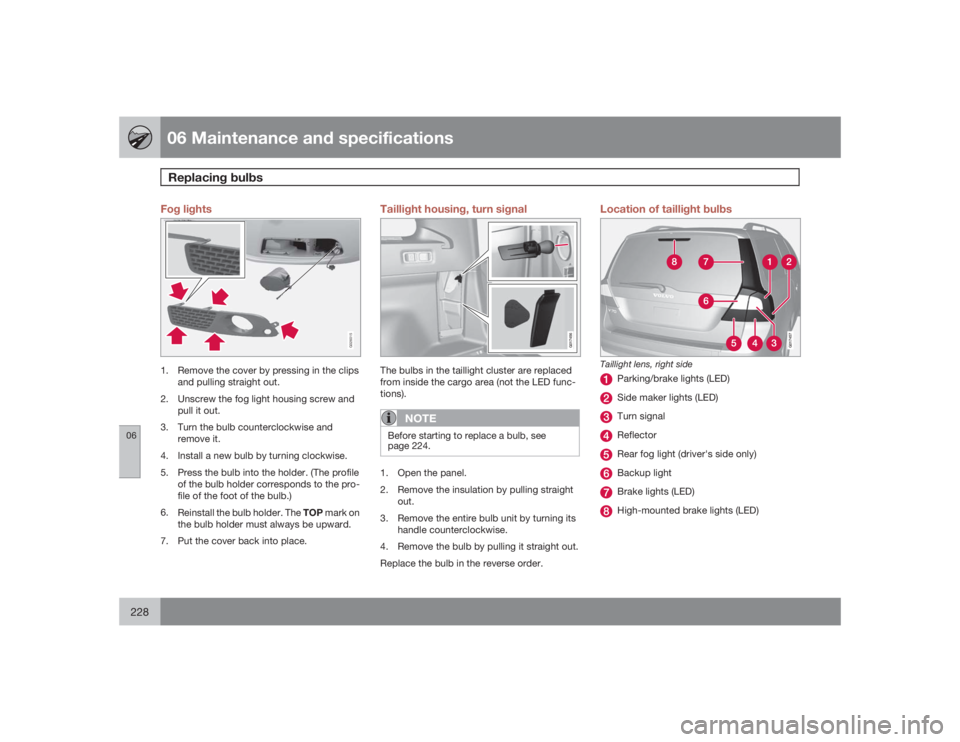
Fog lights
G026015
1. Remove the cover by pressing in the clips
and pulling straight out.
2. Unscrew the fog light housing screw and
pull it out.
3. Turn the bulb counterclockwise and
remove it.
4. Install a new bulb by turning clockwise.
5. Press the bulb into the holder. (The profile
of the bulb holder corresponds to the pro-
file of the foot of the bulb.)
6.
Reinstall the bulb holder. The TOP mark on
the bulb holder must always be upward.
7. Put the cover back into place.
Taillight housing, turn signal
G017456
The bulbs in the taillight cluster are replaced
from inside the cargo area (not the LED func-
tions).
NOTE
Before starting to replace a bulb, see
page 224.1. Open the panel.
2. Remove the insulation by pulling straight
out.
3. Remove the entire bulb unit by turning its
handle counterclockwise.
4. Remove the bulb by pulling it straight out.
Replace the bulb in the reverse order.
Location of taillight bulbs
G017457
Taillight lens, right side
Parking/brake lights (LED)Side maker lights (LED)Turn signalReflectorRear fog light (driver's side only)Backup lightBrake lights (LED)High-mounted brake lights (LED)
Page 229 of 286
06 Maintenance and specifications
Replacing bulbs
06``229
NOTE
If an error message remains in the display
after a faulty bulb has been replaced, con-
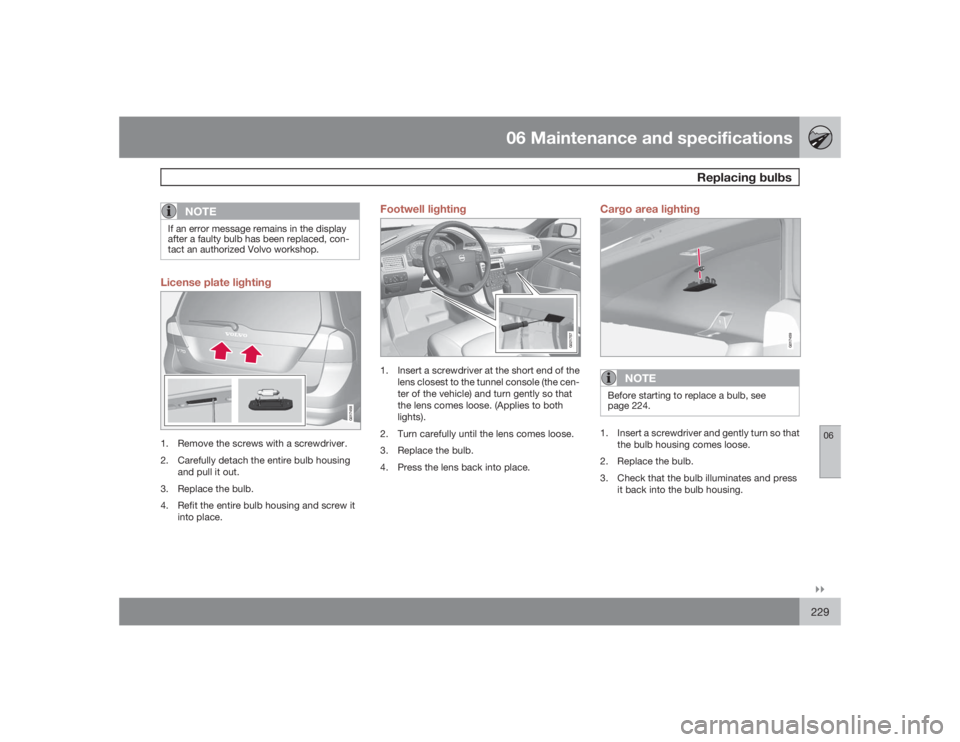
tact an authorized Volvo workshop.License plate lighting
G017458
1. Remove the screws with a screwdriver.
2. Carefully detach the entire bulb housing
and pull it out.
3. Replace the bulb.
4. Refit the entire bulb housing and screw it
into place.
Footwell lighting
G021757
1. Insert a screwdriver at the short end of the
lens closest to the tunnel console (the cen-
ter of the vehicle) and turn gently so that
the lens comes loose. (Applies to both
lights).
2. Turn carefully until the lens comes loose.
3. Replace the bulb.
4. Press the lens back into place.
Cargo area lighting
G017459
NOTE
Before starting to replace a bulb, see
page 224.1. Insert a screwdriver and gently turn so that
the bulb housing comes loose.
2. Replace the bulb.
3. Check that the bulb illuminates and press
it back into the bulb housing.