light VOLVO XC70 2013 Owner´s Manual
[x] Cancel search | Manufacturer: VOLVO, Model Year: 2013, Model line: XC70, Model: VOLVO XC70 2013Pages: 382, PDF Size: 6.78 MB
Page 272 of 382

07 During your trip
Driving recommendations
07
270
the ignition switched off, which drains the
battery.
Before a long distance tripIt is always worthwhile to have your vehicle
checked by a trained and qualified Volvo serv-
ice technician before driving long distances.
Your retailer will also be able to supply you with
bulbs, fuses, spark plugs and wiper blades for
your use in the event that problems occur.
As a minimum, the following items should be
checked before any long trip:
•Check that engine runs smoothly and that
fuel consumption is normal.
•Check for fuel, oil, and fluid leakage.
•Have the transmission oil level checked.
•Check condition of drive belts.
•Check state of the battery's charge.
•Examine tires carefully (the spare tire as
well), and replace those that are worn.
Check tire pressures.
•The brakes, front wheel alignment, and
steering gear should be checked by a
trained and qualified Volvo service techni-
cian only.
•Check all lights, including high beams.
•Reflective warning triangles are legally
required in some states/provinces.
•Have a word with a trained and qualified
Volvo service technician if you intend to
drive in countries where it may be difficult
to obtain the correct fuel.
•Consider your destination. If you will be
driving through an area where snow or ice
are likely to occur, consider snow tires.
Cold weather precautionsIf you wish to check your vehicle before the
approach of cold weather, the following advice
is worth noting:
•Make sure that the engine coolant contains
50 percent antifreeze. Any other mixture
will reduce freeze protection. This gives
protection against freezing down to
–31 °F (–35 °C). The use of "recycled" anti-
freeze is not approved by Volvo. Different
types of antifreeze must not be mixed.
•Volvo recommends using only genuine
Volvo antifreeze in your vehicle's radiator.
•Try to keep the fuel tank well filled – this
helps prevent the formation of condensa-
tion in the tank. In addition, in extremely
cold weather conditions it is worthwhile to
add fuel line de-icer before refueling.
•The viscosity of the engine oil is important.
Oil with low viscosity (thinner oil) improves
cold-weather starting as well as decreas-
ing fuel consumption while the engine is
warming up. 0W-30 oil is recommended fordriving in areas with sustained low temper-
atures.
•The load placed on the battery is greater
during the winter since the windshield wip-
ers, lighting, etc., are used more often.
Moreover, the capacity of the battery
decreases as the temperature drops. In
very cold weather, a poorly charged bat-
tery can freeze and be damaged. It is there-
fore advisable to check the state of charge
more frequently and spray an anti-rust oil
on the battery posts.
•Volvo recommends the use of snow tires
on all four wheels for winter driving, see
page 306.
•To prevent the washer fluid reservoir from
freezing, add washer solvents containing
antifreeze. This is important since dirt is
often splashed on the windshield during
winter driving, requiring the frequent use of
the washers and wipers. Volvo Washer
Solvent should be diluted as follows: Down
to 14 °F (–10 °C): 1 part washer solvent and
4 parts water Down to 5 °F (–15 °C): 1 part
washer solvent and 3 parts water Down to
0 °F (–18 °C): 1 part washer solvent and
2 parts water Down to –18 °F (–28 °C):
1 part washer solvent and 1 part water.
•Use Volvo Teflon Lock Spray in the locks.
•Avoid using de-icing sprays as they can
cause damage to the locks.
Page 273 of 382
07 During your trip
Refueling
07
271 Fuel requirements
Deposit control gasoline (detergent
additives)
Volvo recommends the use of detergent gas-
oline to control engine deposits. Detergent
gasoline is effective in keeping injectors and
intake valves clean. Consistent use of deposit
control gasolines will help ensure good driva-
bility and fuel economy. If you are not sure
whether the gasoline contains deposit control
additives, check with the service station oper-
ator.
NOTE
Volvo does not recommend the use of exter-
nal fuel injector cleaning systems.
Unleaded fuelEach Volvo has a three-way catalytic converter
and must use only unleaded gasoline. U.S. and
Canadian regulations require that pumps deliv-
ering unleaded gasoline be labeled "UNLEA-
DED". Only these pumps have nozzles which
fit your vehicle's filler inlet. It is unlawful to dis-
pense leaded fuel into a vehicle labelled
"unleaded gasoline only". Leaded gasoline
damages the three-way catalytic converter and
the heated oxygen sensor system. Repeated
use of leaded gasoline will lessen the effective-ness of the emission control system and could
result in loss of emission warranty coverage.
State and local vehicle inspection programs
will make detection of misfueling easier, pos-
sibly resulting in emission test failure for mis-
fueled vehicles.
NOTE
Some U.S. and Canadian gasolines contain
an octane enhancing additive called methyl-
cyclopentadienyl manganese tricarbonyl
(MMT). If such fuels are used, your Emission
Control System performance may be affec-
ted, and the Check Engine Light (malfunc-
tion indicator light) located on your instru-
ment panel may light. If this occurs, please
return your vehicle to a trained and qualified
Volvo service technician for service.
Gasoline containing alcohol and ethers,
"Oxygenated fuels"
Some fuel suppliers sell gasoline containing
"oxygenates" which are usually alcohols or
ethers. In some areas, state or local laws
require that the service pump be marked indi-
cating use of alcohols or ethers. However,
there are areas in which the pumps are
unmarked. If you are not sure whether there is
alcohol or ethers in the gasoline you buy, check
with the service station operator. To meet sea-sonal air quality standards, some areas require
the use of "oxygenated" fuel.
Volvo allows the use of the following "oxygen-
ated" fuels; however, the octane ratings listed
on page 272 must still be met.
Alcohol – EthanolFuels containing up to 10% ethanol by volume
may be used. Ethanol may also be referred to
as Ethyl alcohol, or "Gasohol".
Ethers – MTBE: Fuels containing up to
15% MTBE may be used.
MethanolDo not use gasolines containing methanol
(methyl alcohol, wood alcohol). This practice
can result in vehicle performance deterioration
and can damage critical parts in the fuel sys-
tem. Such damage may not be covered under
the New Vehicle Limited Warranty.
Page 275 of 382
07 During your trip
Refueling
07
273
Opening/closing the fuel filler door
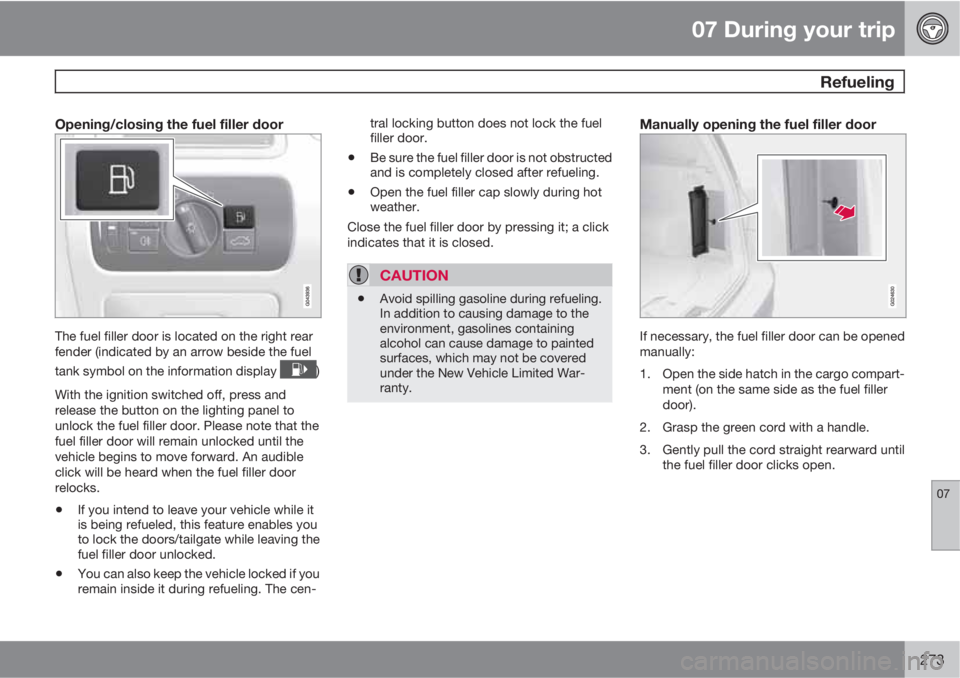
The fuel filler door is located on the right rear
fender (indicated by an arrow beside the fuel
tank symbol on the information display
)
With the ignition switched off, press and
release the button on the lighting panel to
unlock the fuel filler door. Please note that the
fuel filler door will remain unlocked until the
vehicle begins to move forward. An audible
click will be heard when the fuel filler door
relocks.
•If you intend to leave your vehicle while it
is being refueled, this feature enables you
to lock the doors/tailgate while leaving the
fuel filler door unlocked.
•You can also keep the vehicle locked if you
remain inside it during refueling. The cen-tral locking button does not lock the fuel
filler door.
•Be sure the fuel filler door is not obstructed
and is completely closed after refueling.
•Open the fuel filler cap slowly during hot
weather.
Close the fuel filler door by pressing it; a click
indicates that it is closed.
CAUTION
•Avoid spilling gasoline during refueling.
In addition to causing damage to the
environment, gasolines containing
alcohol can cause damage to painted
surfaces, which may not be covered
under the New Vehicle Limited War-
ranty.
Manually opening the fuel filler door
If necessary, the fuel filler door can be opened
manually:
1. Open the side hatch in the cargo compart-
ment (on the same side as the fuel filler
door).
2. Grasp the green cord with a handle.
3. Gently pull the cord straight rearward until
the fuel filler door clicks open.
Page 276 of 382
07 During your trip
Refueling
07
274
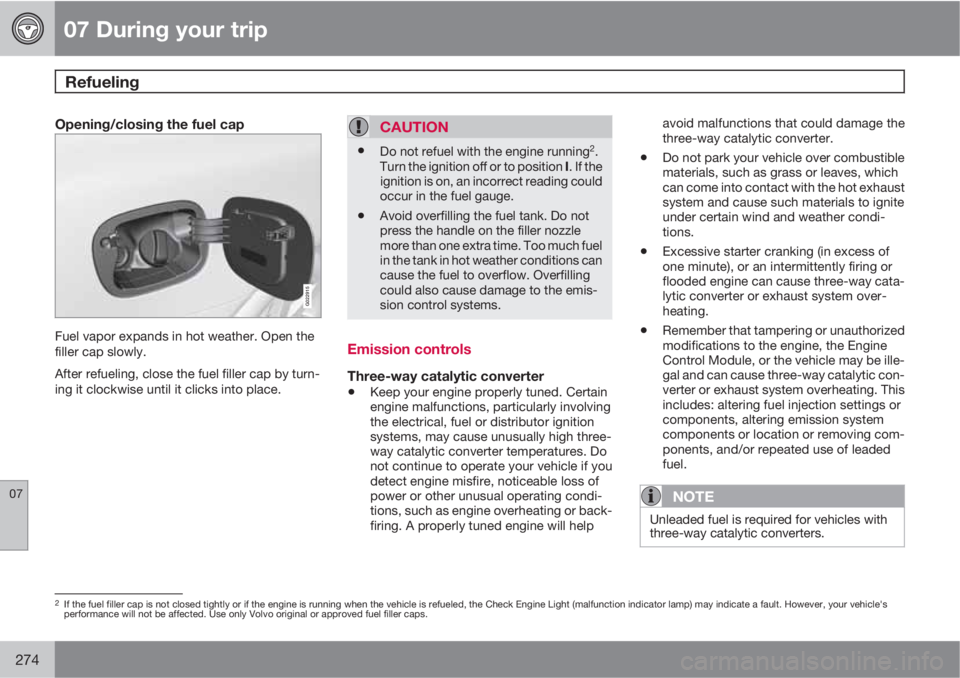
Opening/closing the fuel cap
G022915
Fuel vapor expands in hot weather. Open the
filler cap slowly.
After refueling, close the fuel filler cap by turn-
ing it clockwise until it clicks into place.
CAUTION
•Do not refuel with the engine running2.
Turn the ignition off or to position I. If the
ignition is on, an incorrect reading could
occur in the fuel gauge.
•Avoid overfilling the fuel tank. Do not
press the handle on the filler nozzle
more than one extra time. Too much fuel
in the tank in hot weather conditions can
cause the fuel to overflow. Overfilling
could also cause damage to the emis-
sion control systems.
Emission controls
Three-way catalytic converter
•Keep your engine properly tuned. Certain
engine malfunctions, particularly involving
the electrical, fuel or distributor ignition
systems, may cause unusually high three-
way catalytic converter temperatures. Do
not continue to operate your vehicle if you
detect engine misfire, noticeable loss of
power or other unusual operating condi-
tions, such as engine overheating or back-
firing. A properly tuned engine will helpavoid malfunctions that could damage the
three-way catalytic converter.
•Do not park your vehicle over combustible
materials, such as grass or leaves, which
can come into contact with the hot exhaust
system and cause such materials to ignite
under certain wind and weather condi-
tions.
•Excessive starter cranking (in excess of
one minute), or an intermittently firing or
flooded engine can cause three-way cata-
lytic converter or exhaust system over-
heating.
•Remember that tampering or unauthorized
modifications to the engine, the Engine
Control Module, or the vehicle may be ille-
gal and can cause three-way catalytic con-
verter or exhaust system overheating. This
includes: altering fuel injection settings or
components, altering emission system
components or location or removing com-
ponents, and/or repeated use of leaded
fuel.
NOTE
Unleaded fuel is required for vehicles with
three-way catalytic converters.
2If the fuel filler cap is not closed tightly or if the engine is running when the vehicle is refueled, the Check Engine Light (malfunction indicator lamp) may indicate a fault. However, your vehicle's
performance will not be affected. Use only Volvo original or approved fuel filler caps.
Page 278 of 382
07 During your trip
Loading
07
276* Option/accessory, for more information, see Introduction.
Introduction
The load carrying capacity of your vehicle is
determined by factors such as the number of
passengers, the amount of cargo, the weight
of any accessories that may be installed, etc.
To increase loading space, the rear seat back-
rests can be folded down, see page 87.
When loading the cargo area, keep the follow-
ing in mind:
•Load objects in the cargo area against the
backrest whenever possible.
•Unstable loads can be secured to the load
anchoring eyelets with straps or web lash-
ings to help keep them from shifting.
•Stop the engine and apply the parking
brake when loading or unloading long
objects. The gear selector can be knocked
out of position by long loads, which could
set the vehicle in motion.
WARNING
•Stop the engine, put the gear selector in
P, and apply the parking brake when
loading or unloading long objects.
•The vehicle's driving characteristics
may change depending on the weight
and distribution of the load.
•A 44-pound (20 kg) object produces a
force of 2,200 pounds (1,000 kg) in a
head-on collision at 30 mph (50 km/h).
•The cargo area and rear seat should not
be loaded to a level higher than 2 in.
(5 cm) below the upper edge of the rear
side windows. Objects placed higher
than this level could impede the func-
tion of the Inflatable Curtain.
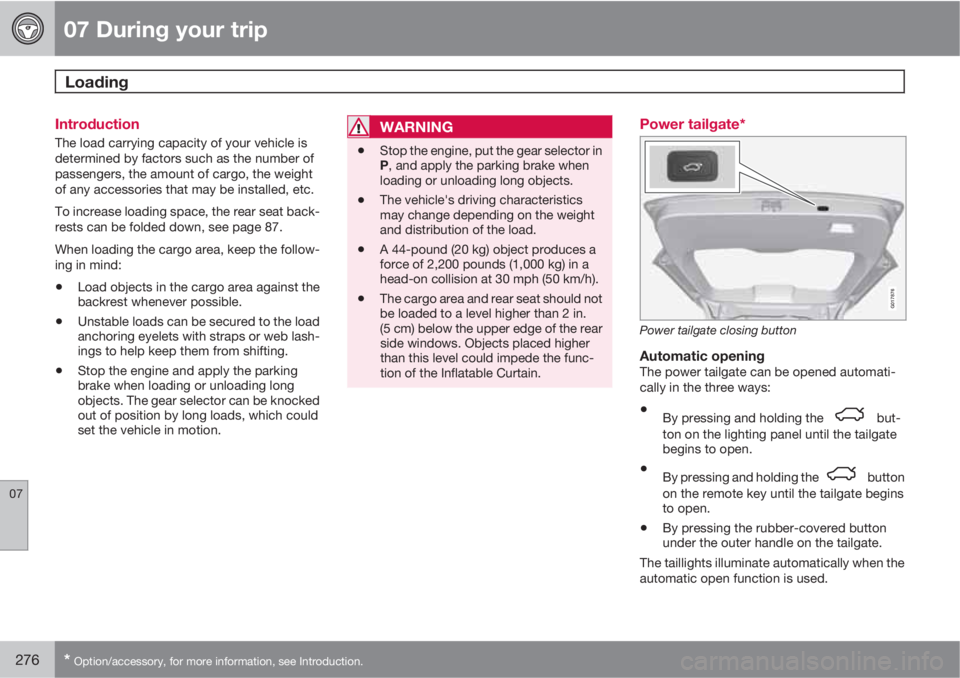
Power tailgate*
G017876
Power tailgate closing button
Automatic openingThe power tailgate can be opened automati-
cally in the three ways:
•By pressing and holding the but-
ton on the lighting panel until the tailgate
begins to open.
•By pressing and holding the button
on the remote key until the tailgate begins
to open.
•By pressing the rubber-covered button
under the outer handle on the tailgate.
The taillights illuminate automatically when the
automatic open function is used.
Page 279 of 382
07 During your trip
Loading
07
277
CAUTION
Be sure that there is adequate space above
and behind the vehicle before opening the
tailgate automatically.
The vehicle should not be driven or moved
with the tailgate in the open position. How-
ever, if the vehicle is moved with the tailgate
in the open position, the automatic closing
function will be inoperative until one of the
following occurs:
•The tailgate is closed manually
•The ignition is switched off and the key
is removed for approximately 10
minutes (the tailgate will function again
after restart).
NOTE
If the tailgate has been opened and closed
continuously too long, the automatic func-
tion will be deactivated to avoid overloading
the electrical system. The automatic func-
tion can be used again after approximately
2 minutes.
If the vehicle's battery has been discharged
or disconnected, the tailgate must be
opened and closed once manually to reset
the system.
Programming the tailgate opening angleThe tailgate's maximum opening angle can be
programmed, which can be useful, for exam-
ple, if the tailgate has to be opened in a garage
with a low ceiling.
To do so:
•Open the tailgate manually, hold it at the
desired maximum opening angle and
press the tailgate's closing button for at
least 3 seconds. When the tailgate is
released, programming is complete.
•To remove this programming, open the tail-
gate manually to a higher opening angle.
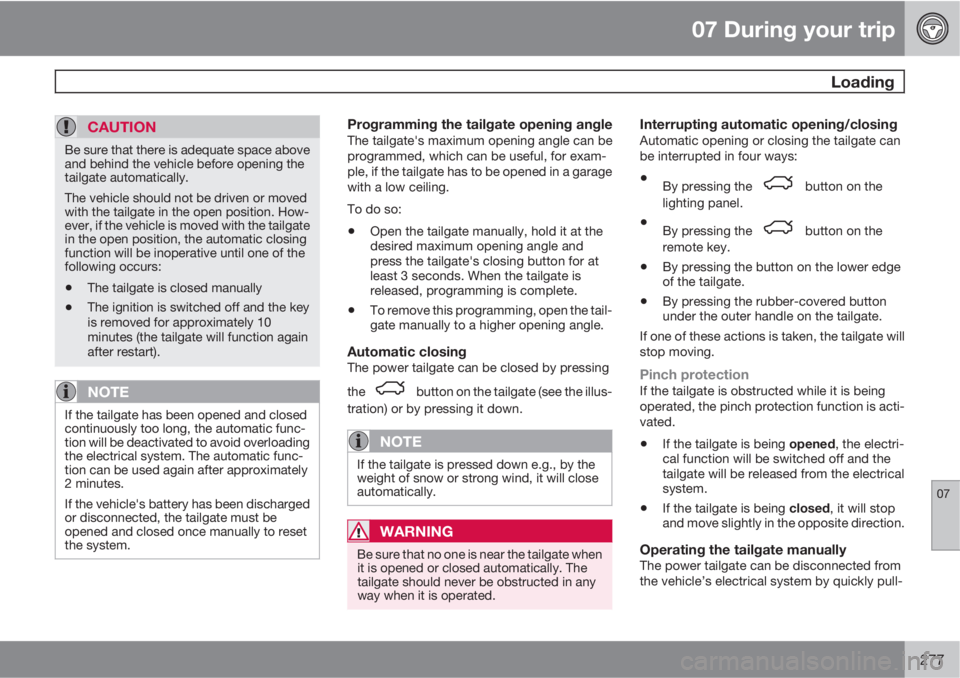
Automatic closingThe power tailgate can be closed by pressing
the
button on the tailgate (see the illus-
tration) or by pressing it down.
NOTE
If the tailgate is pressed down e.g., by the
weight of snow or strong wind, it will close
automatically.
WARNING
Be sure that no one is near the tailgate when
it is opened or closed automatically. The
tailgate should never be obstructed in any
way when it is operated.
Interrupting automatic opening/closingAutomatic opening or closing the tailgate can
be interrupted in four ways:
•By pressing the button on the
lighting panel.
•By pressing the button on the
remote key.
•By pressing the button on the lower edge
of the tailgate.
•By pressing the rubber-covered button
under the outer handle on the tailgate.
If one of these actions is taken, the tailgate will
stop moving.
Pinch protectionIf the tailgate is obstructed while it is being
operated, the pinch protection function is acti-
vated.
•If the tailgate is being opened, the electri-
cal function will be switched off and the
tailgate will be released from the electrical
system.
•If the tailgate is being closed, it will stop
and move slightly in the opposite direction.
Operating the tailgate manuallyThe power tailgate can be disconnected from
the vehicle’s electrical system by quickly pull-
Page 280 of 382
07 During your trip
Loading
07
278
ing the outer handle twice. The tailgate can
then be opened/closed manually.
Folding down the rear seat backrests
The rear seat backrests can be folded down for
additional loading space, see page 89.
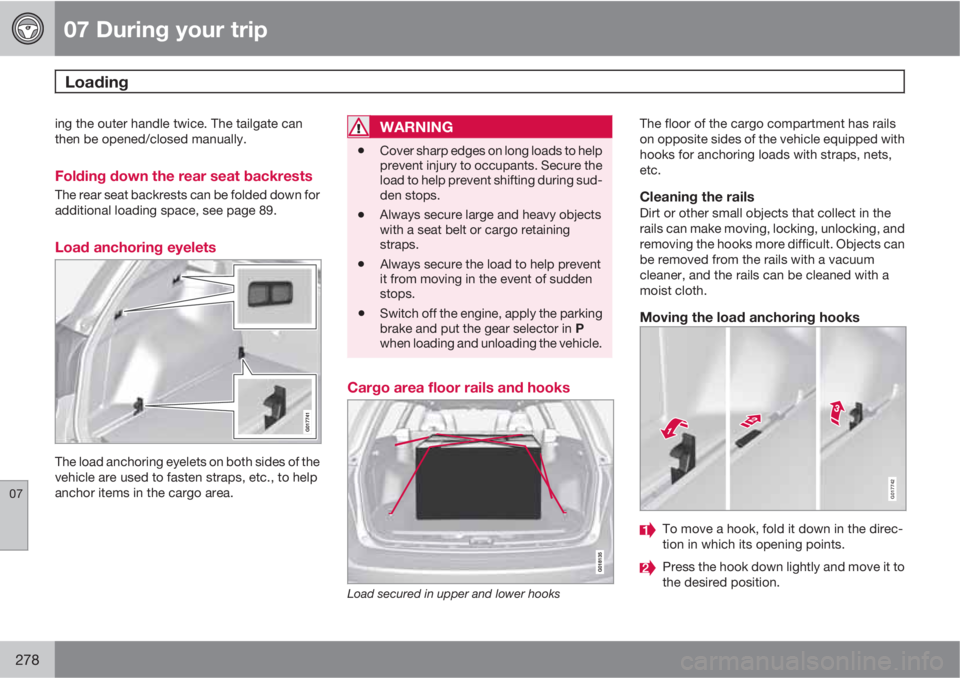
Load anchoring eyelets
The load anchoring eyelets on both sides of the
vehicle are used to fasten straps, etc., to help
anchor items in the cargo area.
WARNING
•Cover sharp edges on long loads to help
prevent injury to occupants. Secure the
load to help prevent shifting during sud-
den stops.
•Always secure large and heavy objects
with a seat belt or cargo retaining
straps.
•Always secure the load to help prevent
it from moving in the event of sudden
stops.
•Switch off the engine, apply the parking
brake and put the gear selector in P
when loading and unloading the vehicle.
Cargo area floor rails and hooks
Load secured in upper and lower hooks
The floor of the cargo compartment has rails
on opposite sides of the vehicle equipped with
hooks for anchoring loads with straps, nets,
etc.
Cleaning the railsDirt or other small objects that collect in the
rails can make moving, locking, unlocking, and
removing the hooks more difficult. Objects can
be removed from the rails with a vacuum
cleaner, and the rails can be cleaned with a
moist cloth.
Moving the load anchoring hooks
G017742
To move a hook, fold it down in the direc-
tion in which its opening points.
Press the hook down lightly and move it to
the desired position.
Page 281 of 382
07 During your trip
Loading
07
279
Fold up the hook. It will lock in place.
NOTE
There should be at least 2 in. (50 cm)
between the hooks in the rail.
WARNING
Switch off the engine, apply the parking
brake and put the gear selector in P when
loading and unloading the vehicle.
Removing a hook
G018134
The load-securing hooks can easily be
removed, for example, to clean the rail.
To remove a hook, fold it down in the direc-
tion in which its opening points.
Press the hook down lightly and move the
it to an opening in the rail.
Pull the hook straight up.
Replace a hook in the rail in the reverse order.
NOTE
In order to return a removed hook into a rail,
it must be pressed down lightly.
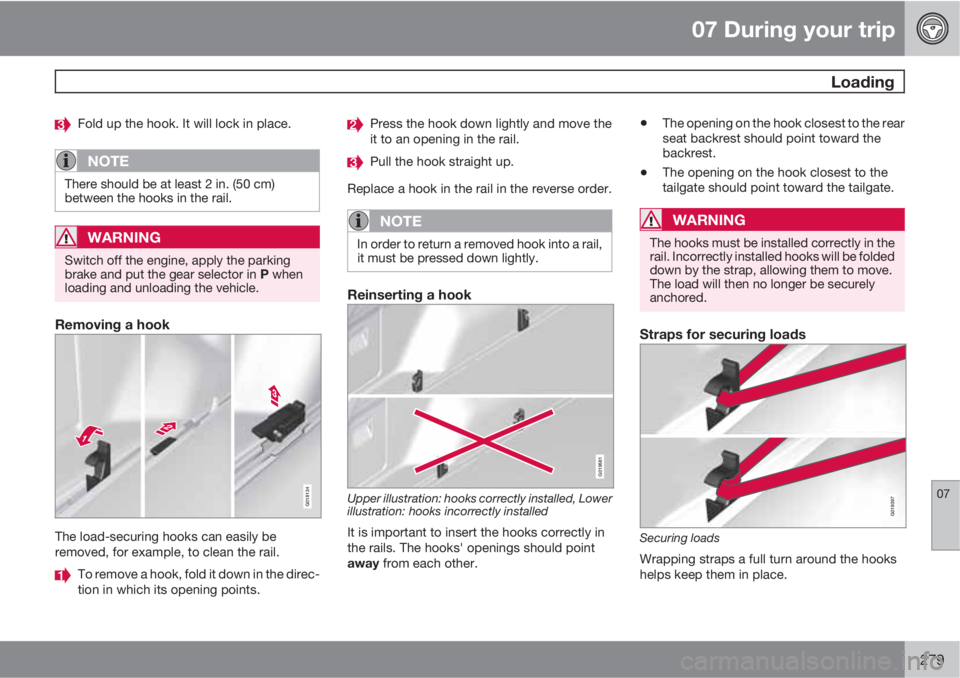
Reinserting a hook
G019581
Upper illustration: hooks correctly installed, Lower
illustration: hooks incorrectly installed
It is important to insert the hooks correctly in
the rails. The hooks' openings should point
away from each other.
•The opening on the hook closest to the rear
seat backrest should point toward the
backrest.
•The opening on the hook closest to the
tailgate should point toward the tailgate.
WARNING
The hooks must be installed correctly in the
rail. Incorrectly installed hooks will be folded
down by the strap, allowing them to move.
The load will then no longer be securely
anchored.
Straps for securing loads
G019397
Securing loads
Wrapping straps a full turn around the hooks
helps keep them in place.
Page 283 of 382
07 During your trip
Cargo area
07
* Option/accessory, for more information, see Introduction.281 Steel cargo grid*
G017748
Your vehicle can be equipped with a steel grid
that helps prevent objects in the cargo area
from moving forward into the passenger com-
partment.
Folding the grid up/downGrasp the lowering edge of the grid and pull it
rearward/upward, or push it downward/for-
ward.
NOTE
If the steel grid is to be used with the
optional cargo area cover, the grid must be
folded down before the cargo area cover is
put in place.
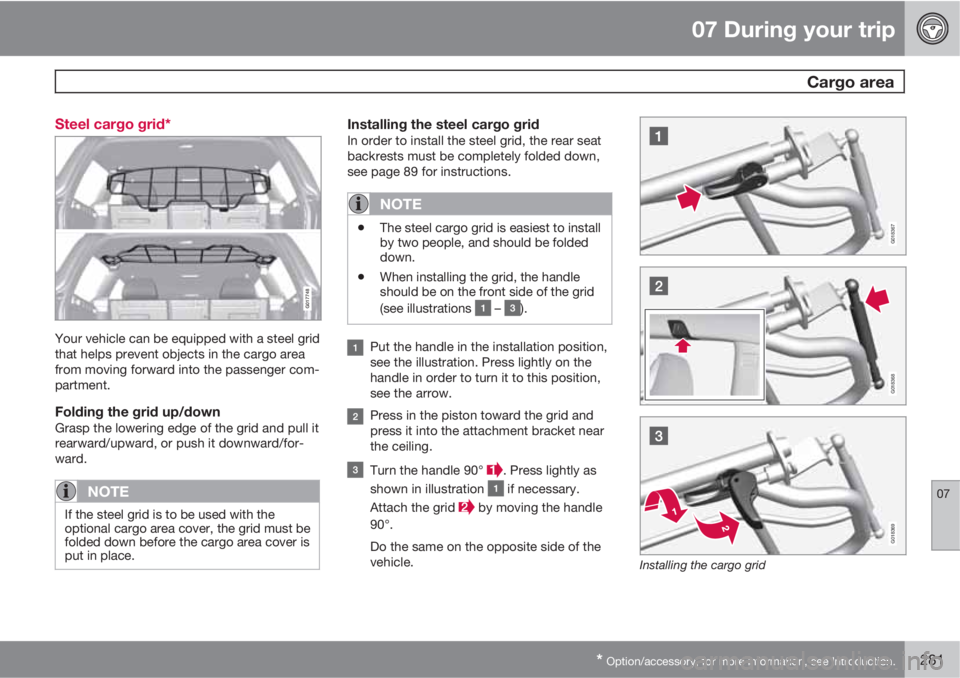
Installing the steel cargo gridIn order to install the steel grid, the rear seat
backrests must be completely folded down,
see page 89 for instructions.
NOTE
•The steel cargo grid is easiest to install
by two people, and should be folded
down.
•When installing the grid, the handle
should be on the front side of the grid
(see illustrations
– ).
Put the handle in the installation position,
see the illustration. Press lightly on the
handle in order to turn it to this position,
see the arrow.
Press in the piston toward the grid and
press it into the attachment bracket near
the ceiling.
Turn the handle 90° . Press lightly as
shown in illustration
if necessary.
Attach the grid
by moving the handle
90°.
Do the same on the opposite side of the
vehicle.
G018367
G018368
G018369
Installing the cargo grid
Page 284 of 382
07 During your trip
Cargo area
07
282* Option/accessory, for more information, see Introduction.
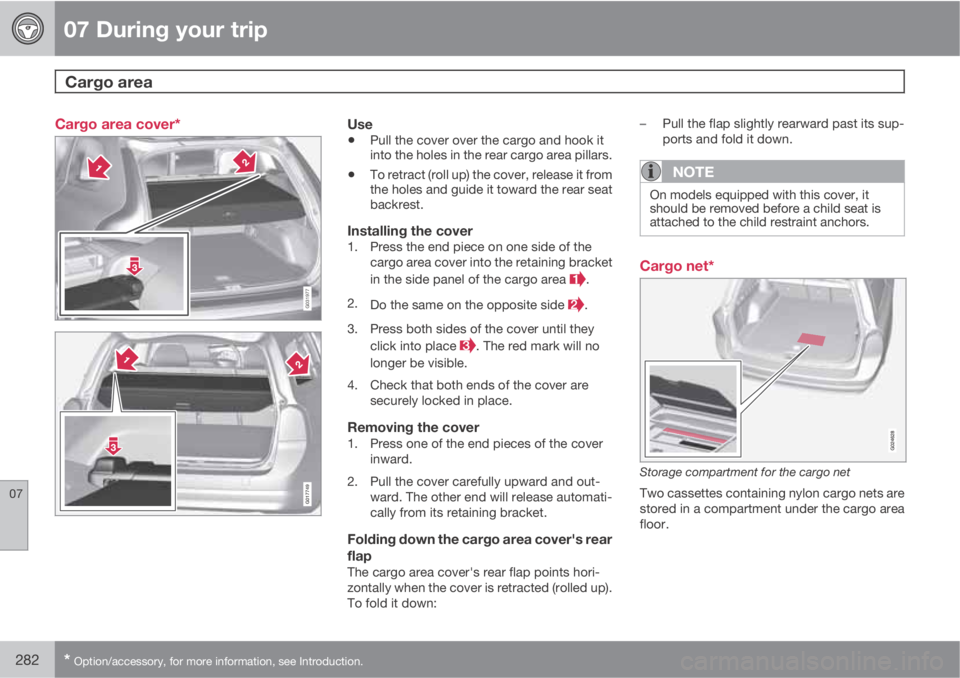
Cargo area cover*
G031977
G017749
Use
•Pull the cover over the cargo and hook it
into the holes in the rear cargo area pillars.
•To retract (roll up) the cover, release it from
the holes and guide it toward the rear seat
backrest.
Installing the cover1. Press the end piece on one side of the
cargo area cover into the retaining bracket
in the side panel of the cargo area
.
2.
Do the same on the opposite side
.
3. Press both sides of the cover until they
click into place
. The red mark will no
longer be visible.
4. Check that both ends of the cover are
securely locked in place.
Removing the cover1. Press one of the end pieces of the cover
inward.
2. Pull the cover carefully upward and out-
ward. The other end will release automati-
cally from its retaining bracket.
Folding down the cargo area cover's rear
flap
The cargo area cover's rear flap points hori-
zontally when the cover is retracted (rolled up).
To fold it down:–Pull the flap slightly rearward past its sup-
ports and fold it down.
NOTE
On models equipped with this cover, it
should be removed before a child seat is
attached to the child restraint anchors.
Cargo net*
Storage compartment for the cargo net
Two cassettes containing nylon cargo nets are
stored in a compartment under the cargo area
floor.