fluid VOLVO XC70 2013 Owner´s Manual
[x] Cancel search | Manufacturer: VOLVO, Model Year: 2013, Model line: XC70, Model: VOLVO XC70 2013Pages: 382, PDF Size: 6.78 MB
Page 322 of 382
320
Volvo maintenance................................................................................ 322
Maintaining your car............................................................................. 323
Hood and engine compartment............................................................325
Engine oil............................................................................................... 326
Fluids..................................................................................................... 328
Replacing bulbs.................................................................................... 330
Wiper blades and washer fluid.............................................................. 337
Battery................................................................................................... 339
Fuses..................................................................................................... 342
Vehicle care........................................................................................... 350
Page 325 of 382

09 Maintenance and specifications
Maintaining your car09
323 Owner maintenance
Periodic maintenance requirements and inter-
vals are described in your vehicle's Warranty
and Service Records Information booklet.
The following points can be carried out
between the normally scheduled maintenance
services.
Each time the car is refueled:
•Check the engine oil level.
•Clean the windshield, windshield wipers,
headlights, and taillights.
Monthly:
•Check cold tire pressure in all tires. Inspect
the tires for wear.
•Check that engine coolant and other fluid
levels are between the indicated "min" and
"max" markings.
•Clean interior glass surfaces with a glass
cleaner and soft paper towels.
•Wipe driver information displays with a soft
cloth.
•Visually inspect battery terminals for cor-
rosion. Corrosion may indicate a loose ter-
minal connector, or a battery near the end
of its useful service life. Consult your Volvo
retailer for additional information.
As needed:Wash the car, including the undercarriage, to
reduce wear that can be caused by a buildup
of dirt, and corrosion that can be caused by salt
residues.
Clean leaves and twigs from air intake vents at
the base of the windshield, and from other pla-
ces where they may collect.
NOTE
Complete service information for qualified
technicians is available online for purchase
or subscription at www.volvotechinfo.com.
Hoisting the vehicle
If a garage jack is used to lift the vehicle, the
two jack attachments points should be used.They are specially reinforced to bear the weight
of the vehicle. A garage jack can also be placed
under the front of the engine support frame.
Take care not to damage the splash guard
under the engine. Ensure that the jack is posi-
tioned so that the vehicle cannot slide off it.
Always use axle stands or similar structures.
If a two-post hoist is used to lift the vehicle, the
front and rear lift arm pads should be centered
under the reinforced lift plates on the inboard
edge of the sill rail (see illustration).
Emission inspection readiness
What is an Onboard Diagnostic System
(OBD II)?
OBD II is part of your vehicle's computerized
engine management system. It stores diagnos-
tic information about your vehicle's emission
controls. It can light the Check Engine light
(MIL) if it detects an emission control "fault." A
"fault" is a component or system that is not
performing within an expected range. A fault
may be permanent or temporary. OBD II will
store a message about any fault.
How do states use OBD II for emission
inspections?
Many states connect a computer directly to a
vehicle's OBD II system. The inspector can
then read "faults." In some states, this type of
Page 327 of 382
09 Maintenance and specifications
Hood and engine compartment09
325 Opening and closing the hood
G010951
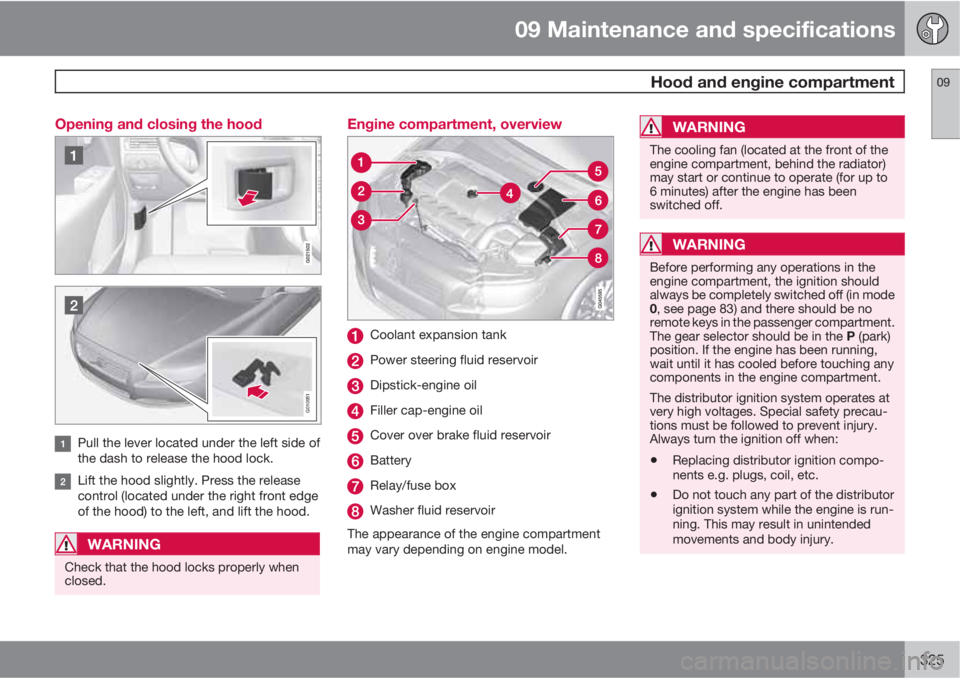
Pull the lever located under the left side of
the dash to release the hood lock.
Lift the hood slightly. Press the release
control (located under the right front edge
of the hood) to the left, and lift the hood.
WARNING
Check that the hood locks properly when
closed.
Engine compartment, overview
Coolant expansion tank
Power steering fluid reservoir
Dipstick-engine oil
Filler cap-engine oil
Cover over brake fluid reservoir
Battery
Relay/fuse box
Washer fluid reservoir
The appearance of the engine compartment
may vary depending on engine model.
WARNING
The cooling fan (located at the front of the
engine compartment, behind the radiator)
may start or continue to operate (for up to
6 minutes) after the engine has been
switched off.
WARNING
Before performing any operations in the
engine compartment, the ignition should
always be completely switched off (in mode
0, see page 83) and there should be no
remote keys in the passenger compartment.
The gear selector should be in the P (park)
position. If the engine has been running,
wait until it has cooled before touching any
components in the engine compartment.
The distributor ignition system operates at
very high voltages. Special safety precau-
tions must be followed to prevent injury.
Always turn the ignition off when:
•Replacing distributor ignition compo-
nents e.g. plugs, coil, etc.
•Do not touch any part of the distributor
ignition system while the engine is run-
ning. This may result in unintended
movements and body injury.
Page 330 of 382
09 Maintenance and specifications
Fluids 09
328
Coolant
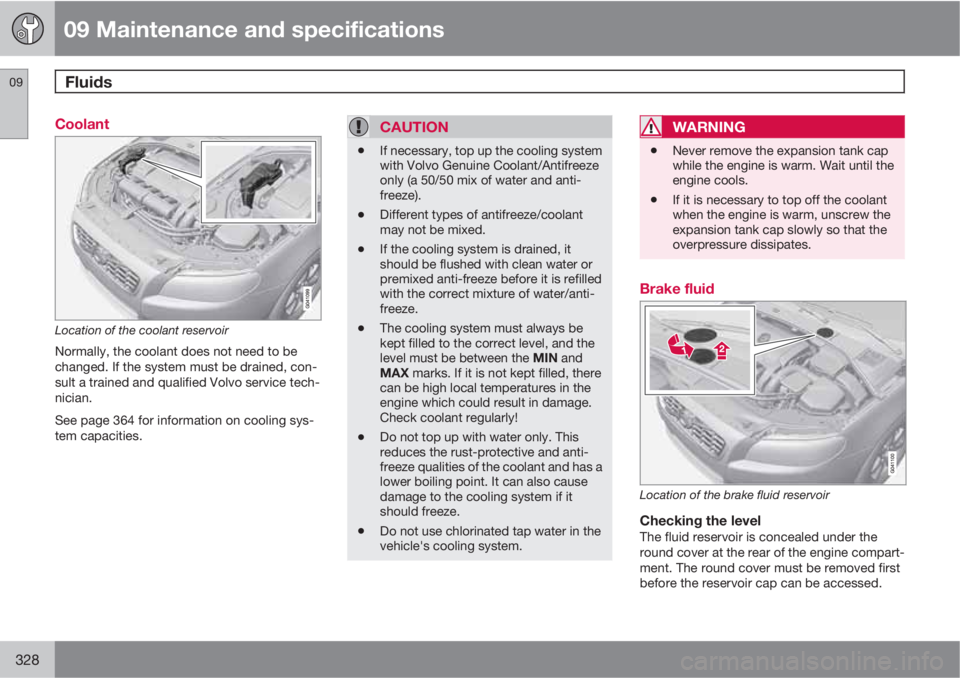
Location of the coolant reservoir
Normally, the coolant does not need to be
changed. If the system must be drained, con-
sult a trained and qualified Volvo service tech-
nician.
See page 364 for information on cooling sys-
tem capacities.
CAUTION
•If necessary, top up the cooling system
with Volvo Genuine Coolant/Antifreeze
only (a 50/50 mix of water and anti-
freeze).
•Different types of antifreeze/coolant
may not be mixed.
•If the cooling system is drained, it
should be flushed with clean water or
premixed anti-freeze before it is refilled
with the correct mixture of water/anti-
freeze.
•The cooling system must always be
kept filled to the correct level, and the
level must be between the MIN and
MAX marks. If it is not kept filled, there
can be high local temperatures in the
engine which could result in damage.
Check coolant regularly!
•Do not top up with water only. This
reduces the rust-protective and anti-
freeze qualities of the coolant and has a
lower boiling point. It can also cause
damage to the cooling system if it
should freeze.
•Do not use chlorinated tap water in the
vehicle's cooling system.
WARNING
•Never remove the expansion tank cap
while the engine is warm. Wait until the
engine cools.
•If it is necessary to top off the coolant
when the engine is warm, unscrew the
expansion tank cap slowly so that the
overpressure dissipates.
Brake fluid
Location of the brake fluid reservoir
Checking the levelThe fluid reservoir is concealed under the
round cover at the rear of the engine compart-
ment. The round cover must be removed first
before the reservoir cap can be accessed.
Page 331 of 382
09 Maintenance and specifications
Fluids09
329
The brake fluid should always be between the
MIN and MAX marks on the inside of the res-
ervoir. Check, without removing the cap, that
there is sufficient fluid in the reservoir.
Fluid type: DOT 4+ boiling point >536 °F
(>280 °C), P/N 9437433
Replace: The fluid should be replaced accord-
ing to the intervals specified in the Warranty
and Service Records Information booklet.
When driving under extremely hard conditions
(mountain driving, etc), it may be necessary to
replace the fluid more often. Consult a trained
and qualified Volvo service technician.
Always entrust brake fluid changing to a
trained and qualified Volvo service technician.
WARNING
•If the fluid level is below the MIN mark
in the reservoir or if a brake-related
message is shown in the information
display: DO NOT DRIVE. Have the car
towed to a trained and qualified Volvo
service technician and have the brake
system inspected.
•Dot 4+ should never be mixed with any
other type of brake fluid.
Filling1. Turn and open the cover.2. Unscrew the reservoir cap and fill the fluid.
The level must be between the MIN and
MAX marks.
Power steering fluid
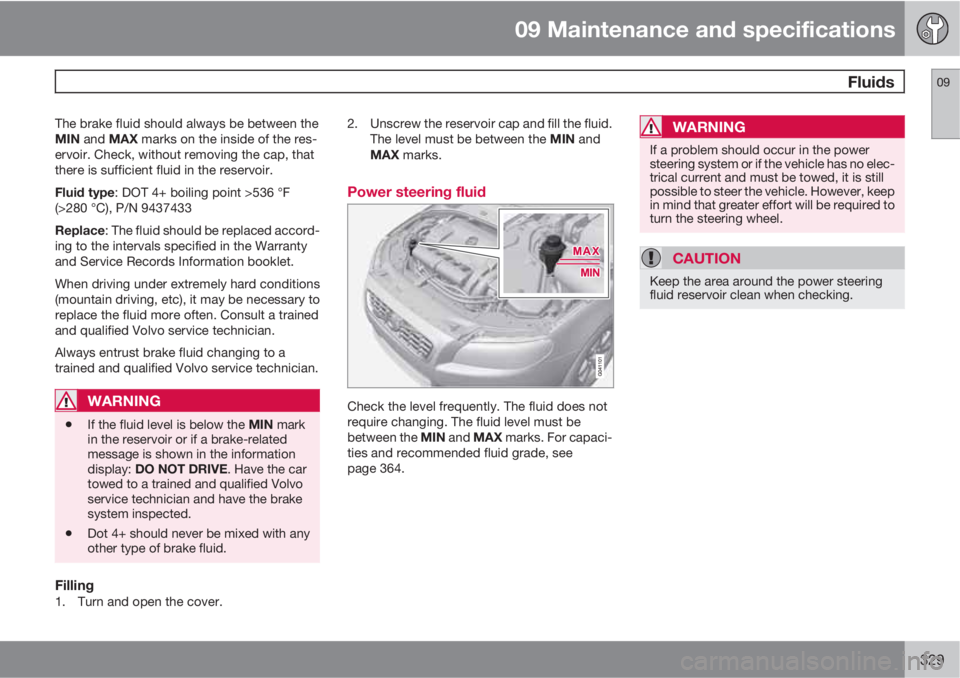
Check the level frequently. The fluid does not
require changing. The fluid level must be
between the MIN and MAX marks. For capaci-
ties and recommended fluid grade, see
page 364.
WARNING
If a problem should occur in the power
steering system or if the vehicle has no elec-
trical current and must be towed, it is still
possible to steer the vehicle. However, keep
in mind that greater effort will be required to
turn the steering wheel.
CAUTION
Keep the area around the power steering
fluid reservoir clean when checking.
Page 339 of 382
09 Maintenance and specifications
Wiper blades and washer fluid09
337 Wiper blades
The windshield wiper blades are different
lengths. The blade on the driver’s side is longer
than the one on the passenger side.
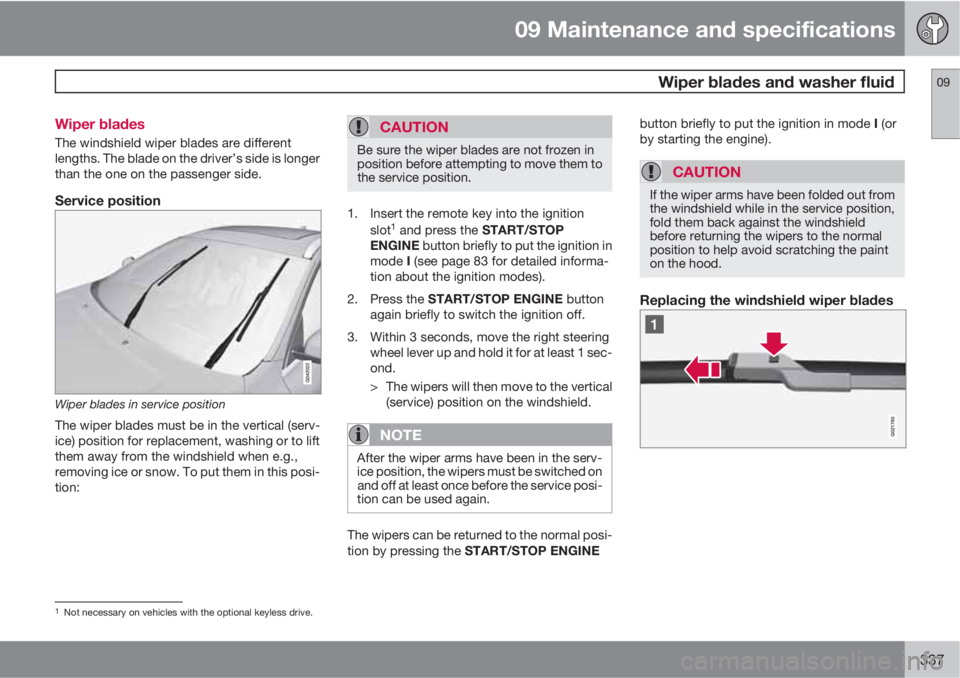
Service position
Wiper blades in service position
The wiper blades must be in the vertical (serv-
ice) position for replacement, washing or to lift
them away from the windshield when e.g.,
removing ice or snow. To put them in this posi-
tion:
CAUTION
Be sure the wiper blades are not frozen in
position before attempting to move them to
the service position.
1. Insert the remote key into the ignition
slot1 and press the START/STOP
ENGINE button briefly to put the ignition in
mode I (see page 83 for detailed informa-
tion about the ignition modes).
2.
Press the START/STOP ENGINE button
again briefly to switch the ignition off.
3. Within 3 seconds, move the right steering
wheel lever up and hold it for at least 1 sec-
ond.
> The wipers will then move to the vertical
(service) position on the windshield.
NOTE
After the wiper arms have been in the serv-
ice position, the wipers must be switched on
and off at least once before the service posi-
tion can be used again.
The wipers can be returned to the normal posi-
tion by pressing the START/STOP ENGINEbutton briefly to put the ignition in mode I (or
by starting the engine).
CAUTION
If the wiper arms have been folded out from
the windshield while in the service position,
fold them back against the windshield
before returning the wipers to the normal
position to help avoid scratching the paint
on the hood.
Replacing the windshield wiper blades
1Not necessary on vehicles with the optional keyless drive.
Page 340 of 382
09 Maintenance and specifications
Wiper blades and washer fluid 09
338
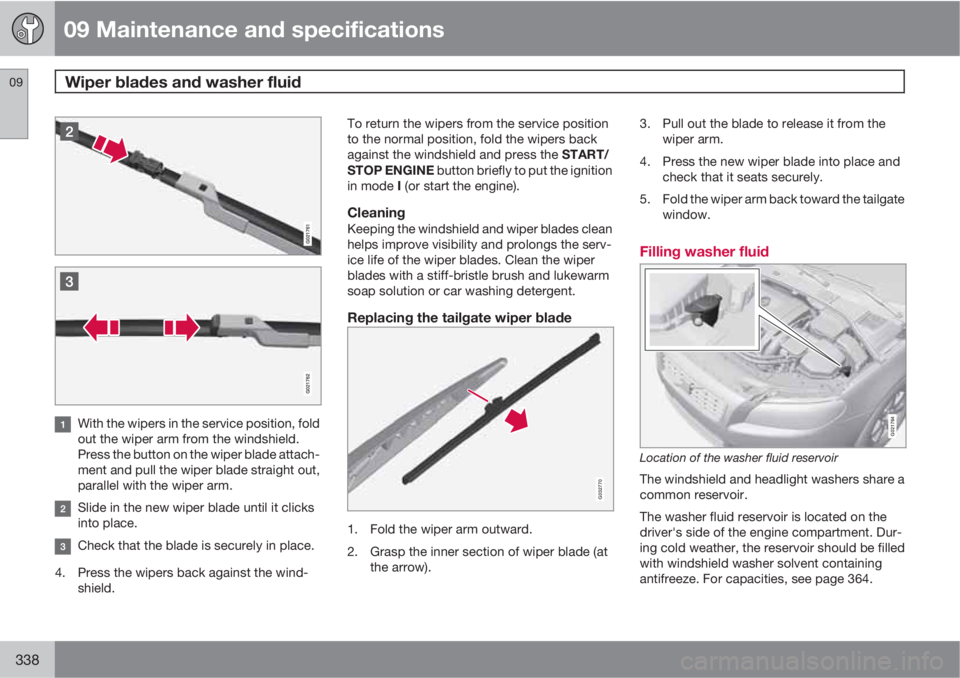
With the wipers in the service position, fold
out the wiper arm from the windshield.
Press the button on the wiper blade attach-
ment and pull the wiper blade straight out,
parallel with the wiper arm.
Slide in the new wiper blade until it clicks
into place.
Check that the blade is securely in place.
4. Press the wipers back against the wind-
shield.To return the wipers from the service position
to the normal position, fold the wipers back
against the windshield and press the START/
STOP ENGINE button briefly to put the ignition
in mode I (or start the engine).
CleaningKeeping the windshield and wiper blades clean
helps improve visibility and prolongs the serv-
ice life of the wiper blades. Clean the wiper
blades with a stiff-bristle brush and lukewarm
soap solution or car washing detergent.
Replacing the tailgate wiper blade
G032770
1. Fold the wiper arm outward.
2. Grasp the inner section of wiper blade (at
the arrow).3. Pull out the blade to release it from the
wiper arm.
4. Press the new wiper blade into place and
check that it seats securely.
5. Fold the wiper arm back toward the tailgate
window.
Filling washer fluid
G021764
Location of the washer fluid reservoir
The windshield and headlight washers share a
common reservoir.
The washer fluid reservoir is located on the
driver's side of the engine compartment. Dur-
ing cold weather, the reservoir should be filled
with windshield washer solvent containing
antifreeze. For capacities, see page 364.
Page 342 of 382
09 Maintenance and specifications
Battery 09
340
WARNING
•Never expose the battery to open flame
or electric spark.
•Do not smoke near the battery.
•Battery fluid contains sulfuric acid. Do
not allow battery fluid to contact eyes,
skin, fabrics or painted surfaces. If con-
tact occurs, flush the affected area
immediately with water. Obtain medical
help immediately if eyes are affected.
NOTE
The life of the battery is shortened if it
becomes discharged repeatedly.
Maintenance
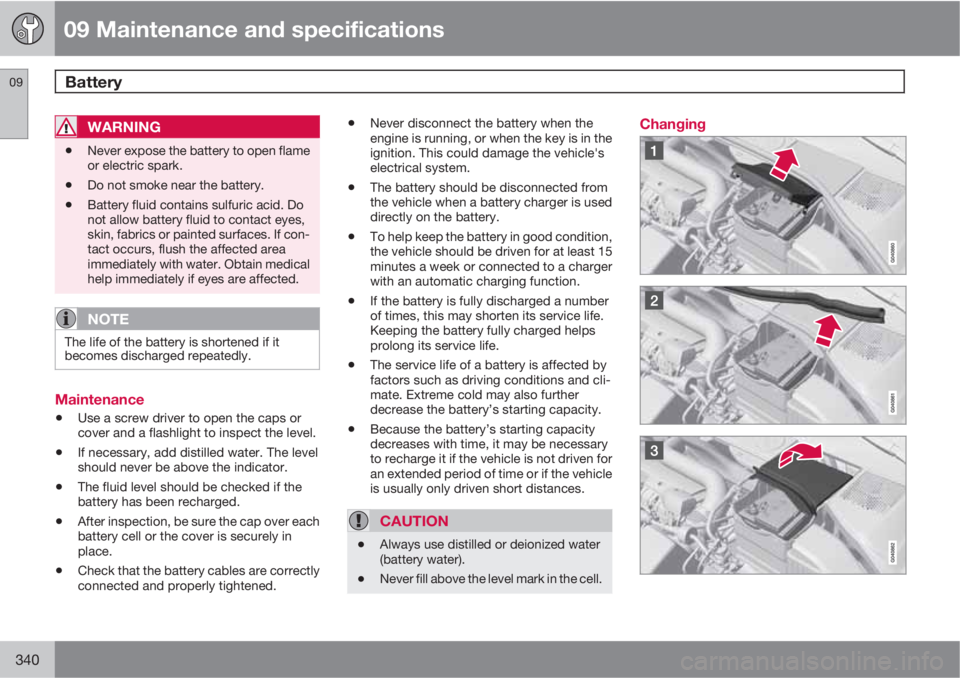
•Use a screw driver to open the caps or
cover and a flashlight to inspect the level.
•If necessary, add distilled water. The level
should never be above the indicator.
•The fluid level should be checked if the
battery has been recharged.
•After inspection, be sure the cap over each
battery cell or the cover is securely in
place.
•Check that the battery cables are correctly
connected and properly tightened.
•Never disconnect the battery when the
engine is running, or when the key is in the
ignition. This could damage the vehicle's
electrical system.
•The battery should be disconnected from
the vehicle when a battery charger is used
directly on the battery.
•To help keep the battery in good condition,
the vehicle should be driven for at least 15
minutes a week or connected to a charger
with an automatic charging function.
•If the battery is fully discharged a number
of times, this may shorten its service life.
Keeping the battery fully charged helps
prolong its service life.
•The service life of a battery is affected by
factors such as driving conditions and cli-
mate. Extreme cold may also further
decrease the battery’s starting capacity.
•Because the battery’s starting capacity
decreases with time, it may be necessary
to recharge it if the vehicle is not driven for
an extended period of time or if the vehicle
is usually only driven short distances.
CAUTION
•Always use distilled or deionized water
(battery water).
•Never fill above the level mark in the cell.
Changing
Page 366 of 382
10 Specifications
Specifications
10
364
Extreme engine operationSAE 0W-30 oil meeting ACEA A5/B5 require-
ments is recommended for driving in areas with
sustained low temperatures.
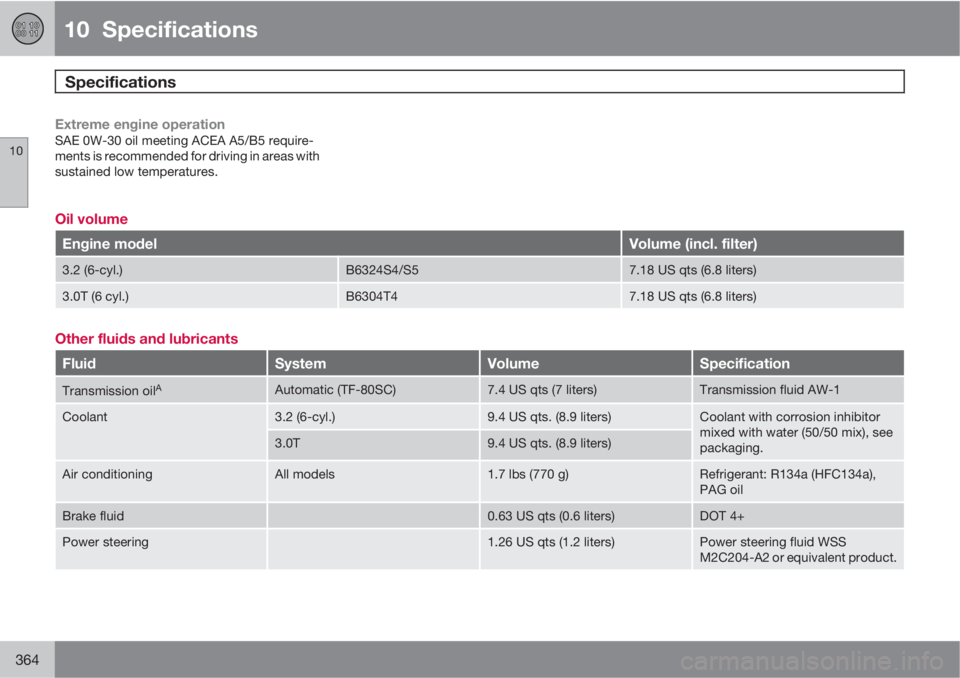
Oil volume
Engine modelVolume (incl. filter)
3.2 (6-cyl.)B6324S4/S57.18 US qts (6.8 liters)
3.0T (6 cyl.)B6304T47.18 US qts (6.8 liters)
Other fluids and lubricants
FluidSystemVolumeSpecification
Transmission oilAAutomatic (TF-80SC)7.4 US qts (7 liters)Transmission fluid AW-1
Coolant3.2 (6-cyl.)9.4 US qts. (8.9 liters)Coolant with corrosion inhibitor
mixed with water (50/50 mix), see
packaging.
3.0T9.4 US qts. (8.9 liters)
Air conditioningAll models1.7 lbs (770 g)Refrigerant: R134a (HFC134a),
PAG oil
Brake fluid0.63 US qts (0.6 liters)DOT 4+
Power steering1.26 US qts (1.2 liters)Power steering fluid WSS
M2C204-A2 or equivalent product.
Page 367 of 382
10 Specifications
Specifications
10
365
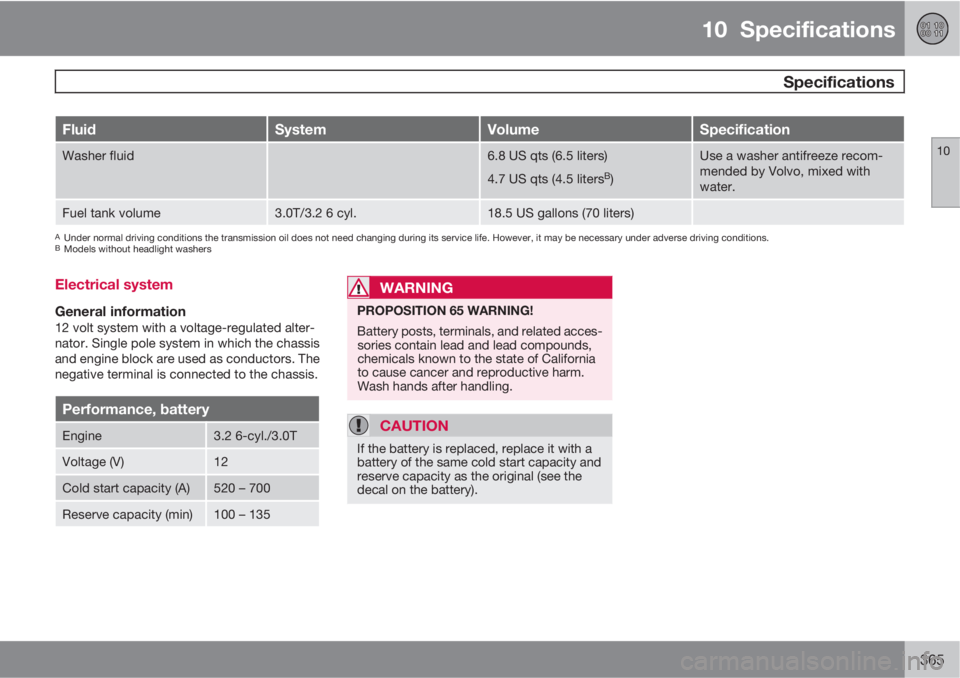
FluidSystemVolumeSpecification
Washer fluid6.8 US qts (6.5 liters)
4.7 US qts (4.5 liters
B)
Use a washer antifreeze recom-
mended by Volvo, mixed with
water.
Fuel tank volume3.0T/3.2 6 cyl.18.5 US gallons (70 liters)
AUnder normal driving conditions the transmission oil does not need changing during its service life. However, it may be necessary under adverse driving conditions.BModels without headlight washers
Electrical system
General information12 volt system with a voltage-regulated alter-
nator. Single pole system in which the chassis
and engine block are used as conductors. The
negative terminal is connected to the chassis.
Performance, battery
Engine3.2 6-cyl./3.0T
Voltage (V)12
Cold start capacity (A)520 – 700
Reserve capacity (min)100 – 135
WARNING
PROPOSITION 65 WARNING!
Battery posts, terminals, and related acces-
sories contain lead and lead compounds,
chemicals known to the state of California
to cause cancer and reproductive harm.
Wash hands after handling.
CAUTION
If the battery is replaced, replace it with a
battery of the same cold start capacity and
reserve capacity as the original (see the
decal on the battery).