fuel pressure VOLVO XC70 2013 Owner´s Manual
[x] Cancel search | Manufacturer: VOLVO, Model Year: 2013, Model line: XC70, Model: VOLVO XC70 2013Pages: 382, PDF Size: 6.78 MB
Page 325 of 382

09 Maintenance and specifications
Maintaining your car09
323 Owner maintenance
Periodic maintenance requirements and inter-
vals are described in your vehicle's Warranty
and Service Records Information booklet.
The following points can be carried out
between the normally scheduled maintenance
services.
Each time the car is refueled:
•Check the engine oil level.
•Clean the windshield, windshield wipers,
headlights, and taillights.
Monthly:
•Check cold tire pressure in all tires. Inspect
the tires for wear.
•Check that engine coolant and other fluid
levels are between the indicated "min" and
"max" markings.
•Clean interior glass surfaces with a glass
cleaner and soft paper towels.
•Wipe driver information displays with a soft
cloth.
•Visually inspect battery terminals for cor-
rosion. Corrosion may indicate a loose ter-
minal connector, or a battery near the end
of its useful service life. Consult your Volvo
retailer for additional information.
As needed:Wash the car, including the undercarriage, to
reduce wear that can be caused by a buildup
of dirt, and corrosion that can be caused by salt
residues.
Clean leaves and twigs from air intake vents at
the base of the windshield, and from other pla-
ces where they may collect.
NOTE
Complete service information for qualified
technicians is available online for purchase
or subscription at www.volvotechinfo.com.
Hoisting the vehicle
If a garage jack is used to lift the vehicle, the
two jack attachments points should be used.They are specially reinforced to bear the weight
of the vehicle. A garage jack can also be placed
under the front of the engine support frame.
Take care not to damage the splash guard
under the engine. Ensure that the jack is posi-
tioned so that the vehicle cannot slide off it.
Always use axle stands or similar structures.
If a two-post hoist is used to lift the vehicle, the
front and rear lift arm pads should be centered
under the reinforced lift plates on the inboard
edge of the sill rail (see illustration).
Emission inspection readiness
What is an Onboard Diagnostic System
(OBD II)?
OBD II is part of your vehicle's computerized
engine management system. It stores diagnos-
tic information about your vehicle's emission
controls. It can light the Check Engine light
(MIL) if it detects an emission control "fault." A
"fault" is a component or system that is not
performing within an expected range. A fault
may be permanent or temporary. OBD II will
store a message about any fault.
How do states use OBD II for emission
inspections?
Many states connect a computer directly to a
vehicle's OBD II system. The inspector can
then read "faults." In some states, this type of
Page 352 of 382
09 Maintenance and specifications
Vehicle care 09
350
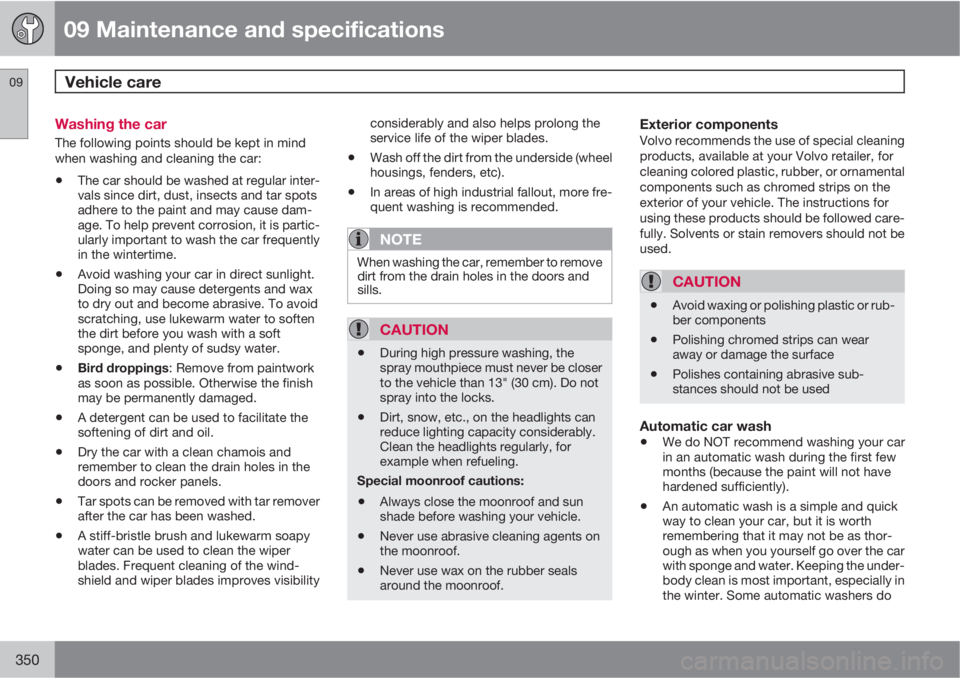
Washing the car
The following points should be kept in mind
when washing and cleaning the car:
•The car should be washed at regular inter-
vals since dirt, dust, insects and tar spots
adhere to the paint and may cause dam-
age. To help prevent corrosion, it is partic-
ularly important to wash the car frequently
in the wintertime.
•Avoid washing your car in direct sunlight.
Doing so may cause detergents and wax
to dry out and become abrasive. To avoid
scratching, use lukewarm water to soften
the dirt before you wash with a soft
sponge, and plenty of sudsy water.
•Bird droppings: Remove from paintwork
as soon as possible. Otherwise the finish
may be permanently damaged.
•A detergent can be used to facilitate the
softening of dirt and oil.
•Dry the car with a clean chamois and
remember to clean the drain holes in the
doors and rocker panels.
•Tar spots can be removed with tar remover
after the car has been washed.
•A stiff-bristle brush and lukewarm soapy
water can be used to clean the wiper
blades. Frequent cleaning of the wind-
shield and wiper blades improves visibilityconsiderably and also helps prolong the
service life of the wiper blades.
•Wash off the dirt from the underside (wheel
housings, fenders, etc).
•In areas of high industrial fallout, more fre-
quent washing is recommended.
NOTE
When washing the car, remember to remove
dirt from the drain holes in the doors and
sills.
CAUTION
•During high pressure washing, the
spray mouthpiece must never be closer
to the vehicle than 13" (30 cm). Do not
spray into the locks.
•Dirt, snow, etc., on the headlights can
reduce lighting capacity considerably.
Clean the headlights regularly, for
example when refueling.
Special moonroof cautions:
•Always close the moonroof and sun
shade before washing your vehicle.
•Never use abrasive cleaning agents on
the moonroof.
•Never use wax on the rubber seals
around the moonroof.
Exterior componentsVolvo recommends the use of special cleaning
products, available at your Volvo retailer, for
cleaning colored plastic, rubber, or ornamental
components such as chromed strips on the
exterior of your vehicle. The instructions for
using these products should be followed care-
fully. Solvents or stain removers should not be
used.
CAUTION
•Avoid waxing or polishing plastic or rub-
ber components
•Polishing chromed strips can wear
away or damage the surface
•Polishes containing abrasive sub-
stances should not be used
Automatic car wash
•We do NOT recommend washing your car
in an automatic wash during the first few
months (because the paint will not have
hardened sufficiently).
•An automatic wash is a simple and quick
way to clean your car, but it is worth
remembering that it may not be as thor-
ough as when you yourself go over the car
with sponge and water. Keeping the under-
body clean is most important, especially in
the winter. Some automatic washers do
Page 368 of 382
10 Specifications
Overview of information and warning symbols
10
366* Option/accessory, for more information, see Introduction.
Introduction
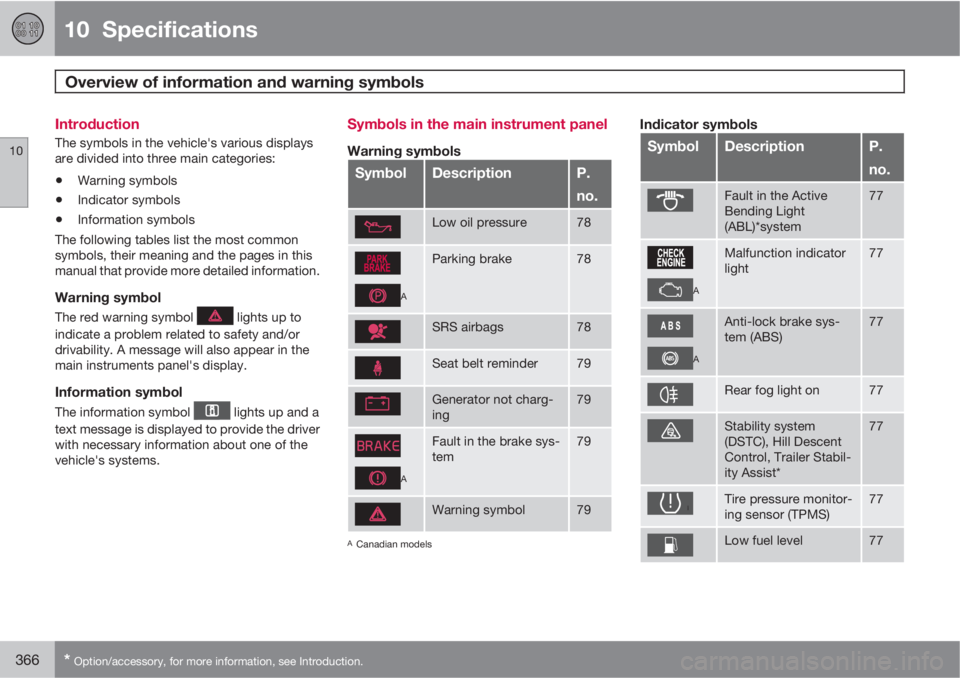
The symbols in the vehicle's various displays
are divided into three main categories:
•Warning symbols
•Indicator symbols
•Information symbols
The following tables list the most common
symbols, their meaning and the pages in this
manual that provide more detailed information.
Warning symbol
The red warning symbol lights up to
indicate a problem related to safety and/or
drivability. A message will also appear in the
main instruments panel's display.
Information symbol
The information symbol lights up and a
text message is displayed to provide the driver
with necessary information about one of the
vehicle's systems.
Symbols in the main instrument panel
Warning symbols
SymbolDescriptionP.
no.
Low oil pressure78
A
Parking brake78
SRS airbags78
Seat belt reminder79
Generator not charg-
ing79
A
Fault in the brake sys-
tem79
Warning symbol79
ACanadian models
Indicator symbols
SymbolDescriptionP.
no.
Fault in the Active
Bending Light
(ABL)*system77
A
Malfunction indicator
light77
A
Anti-lock brake sys-
tem (ABS)77
Rear fog light on77
Stability system
(DSTC), Hill Descent
Control, Trailer Stabil-
ity Assist*77
Tire pressure monitor-
ing sensor (TPMS)77
Low fuel level77
Page 374 of 382
11 Index
11
372
Disconnecting the front passenger’s air-
bag....................................................... 26, 27
Dome lighting....................................... 98, 99
Door mirrors............................................. 105
Driver alert............................................... 166
Driver distraction warning.......................... 13
Driving economically................................ 268
Driving in cold weather............................ 270
Driving through water..............................269
E
ECC.........................................198, 200, 201
Economical driving.................................. 268
Electric parking brake.............................. 124
Electronic Climate Control.......198, 200, 201
air distribution table............................ 202
Interior Air Quality System.................. 201
ventilated seats................................... 198
Emergency locking retractor...................... 37
Emergency starting.................................. 116
Emergency towing................................... 288
Emission inspection readiness................ 323Engine
overheating........................................... 79
specifications...................................... 362
starting................................................ 113
switching off....................................... 116
Engine compartment overview................325
Engine oil................................................. 363
checking............................................. 326
low pressure warning light.............. 77, 78
volumes.............................................. 364
Engine remote start (ERS)........................ 115
Environment............................................... 12
Eyelets for anchoring loads..................... 278
F
Federal Clean Air Act............................... 322
Flat tires
repairing with tire sealing system....... 308
Floor mats
cleaning.............................................. 353
placing correctly................................. 113
Floor rails................................................. 278
Fluid specifications.................................. 364Fog lights
front, changing bulbs.......................... 334
front/rear......................................... 96, 97
Four C (active chassis system)................206
Front airbags.............................................. 22
disconnecting passenger’s side air-
bag.................................................. 26, 27
Front fog lights........................................... 96
changing bulbs................................... 334
Front park assist.............................. 172, 174
Front seats...........................................84, 86
heated................................................. 198
Fuel filler cap........................................... 274
Fuel filler door, opening........................... 273
Fuel level warning light.............................. 77
Fuel requirements............................ 271, 272
Fuel tank volume.....................................364
Fuses............................... 342, 343, 346, 349
G
Garage door opener
HomeLink® Wireless Control System. 110
Gasoline requirements............................. 272
Page 376 of 382
11 Index
11
374
Interior lighting..................................... 98, 99
iPodŸ connector (audio system)............. 238
ISOFIX/LATCH anchors............................. 46
J
Jack
attaching.............................................314
location of........................................... 314
Jump starting........................................... 116
K
Key blade.................................54, 59, 62, 63
private locking...................................... 62
Keyless drive
general description............................... 63
starting the vehicle.............................113
L
Labels
list of................................................... 359
location of........................................... 358
LATCH anchors......................................... 46
Leather care............................................. 352
Lighting panel............................................ 92
Load anchoring eyelets...........................278
Loading
floor rails............................................. 278
hooks for securing loads............278, 279
Loading the vehicle.......................... 276, 303
roof loads............................................ 280
Locking...................................................... 66
tailgate.................................................. 67
Locking the vehicle.................................... 57
Locks, child safety..................................... 51
Low beams................................................ 92
Low fuel level warning light........................ 77
Low oil pressure warning light................... 78
M
Main instrument panel............................. 187
Maintenance............................................ 322
hoisting the vehicle............................. 323
performed by the owner.....................323
Malfunction indicator light......................... 77
Media player (infotainment system)......... 234
Menu........................................................ 189
Messages in the instrument panel........... 187
Mirrors
defroster............................................. 106
power door......................................... 105
rearview, auto-dim function................ 106
retractable........................................... 105
vanity.................................................. 209
Moonroof................................................. 108
Motor oil
checking............................................. 326
volumes.............................................. 364
MY CAR................................................... 189
N
Net in cargo area..................................... 282