fog light VOLVO XC70 2016 Owner´s Manual
[x] Cancel search | Manufacturer: VOLVO, Model Year: 2016, Model line: XC70, Model: VOLVO XC70 2016Pages: 396, PDF Size: 10.01 MB
Page 206 of 396
07 Driver support
07
204
City Safety – operation
Using City Safety™
NOTE
The City Safety™ function is activated automatically each time the engine hasbeen switched off and restarted.
On and OffIn certain situations, it may be desirable to switch City Safety™ off, such as when drivingin close quarters where leaves, branches, etc.may obscure the hood and windshield. When the engine is running, City Safety™ can be switched off as follows: Press My Car in the center console control
panel and go to
SettingsCar settings
Driver support systemsCity Safety.
Select
Off.
If the engine is switched off, City Safety™ will reactivate when the engine is restarted.
WARNING
The laser sensor emits light when the igni- tion is in mode II or higher, even if City
Safety™ has been switched off.
To switch City Safety™ on again:
• Follow the same procedure as for switch- ing City Safety™ off but select
On.
Related information
•City Safety – introduction (p. 202)
• City Safety – function (p. 203)
• City Safety – limitations (p. 204)
• City Safety – troubleshooting (p. 205)
• City Safety – symbols and messages (p. 207)
• City Safety – Laser sensor (p. 208)
• My Car – introduction (p. 76)
City Safety – limitations
Limitations
WARNING
The laser sensor has certain limitations and its function may be reduced (or it maynot function at all) in conditions such asheavy rain or snowfall, or by dense fog orthick, blowing dust or snow. Condensa-tion, dirt, ice or snow on the windshieldmay also interfere with the sensor’s func-tion.
The sensor used by City Safety™ is designed to detect cars and other larger motor vehiclesahead of your vehicle in both daylight anddarkness. Objects such as warning flags hanging from long objects on the roof or accessories suchas auxiliary lights or protective arches on thefront of the vehicle that are higher than thehood may also impede the sensor’s function. Braking distance to the vehicle ahead increa- ses on slippery road surfaces, which mayreduce City Safety’s capacity to avoid a colli-sion. In situations like this, the stability sys-tem (see Stability system – introduction(p. 175)) will help provide the best possiblebraking capacity and stability. City Safety™ emits a laser beam and meas- ures the way in which the light is reflected.
Page 219 of 396
07 Driver support
07
* Option/accessory, for more information, see Introduction.217
The camera’s limitations
The camera has the same limitations as the human eye. The camera is used by Pedestrian and Cyclist Detection with Full Auto Brake Collision warn-ing – introduction (p. 209), Active High Beams(Active high beams (AHB)* (p. 90)), Road SignInformation (Road Sign Information (RSI)* –introduction (p. 179)) and Driver Alert System(Driver Alert System (p. 222)) with LaneDeparture Warning.
NOTE
• To help protect the camera in very hot conditions, it may be temporarilyswitched off for approximately 15minutes after the engine has beenstarted.
• Keep the section of the windshield infront of the camera clean and free ofice, snow, or condensation.
WARNING
•
The camera has the same type of limi- tations as the human eye, i.e., it can-not see as well in heavy snowfall orrain, thick fog or in heavy blowing dustor snow. In such conditions, systemsdepending on the camera may experi-ence greatly reduced functionality ormay be temporarily deactivated.
• Never place any objects, decals, etc.,on the windshield in front of the cam-era. This could reduce or block thecamera’s function, and could causeone or more of the systems that utilizethe camera to stop functioning.
• Strong sunlight, reflections from theroad surface, ice or snow covering theroad, a dirty road surface, or unclearlane marker lines may drasticallyreduce the camera’s capacity todetect the side of a lane, a pedestrian,a cyclist or another vehicle.
Related information
•
Collision warning – introduction (p. 209)
• Collision warning* – function (p. 211)
• Collision warning* – operation (p. 212)
• Collision warning* – Pedestrian detection (p. 214)
• Collision warning* – Cyclist detection(p. 213)
• Collision warning* – limitations (p. 215) •
Collision warning – troubleshooting(p. 218)
• Collision warning – symbols and mes-sages (p. 220)
• Road Sign Information (RSI)* – introduc-tion (p. 179)
• Driver Alert System (p. 222)
• Active high beams (AHB)* (p. 90)
Page 243 of 396
07 Driver support
07
* Option/accessory, for more information, see Introduction.241
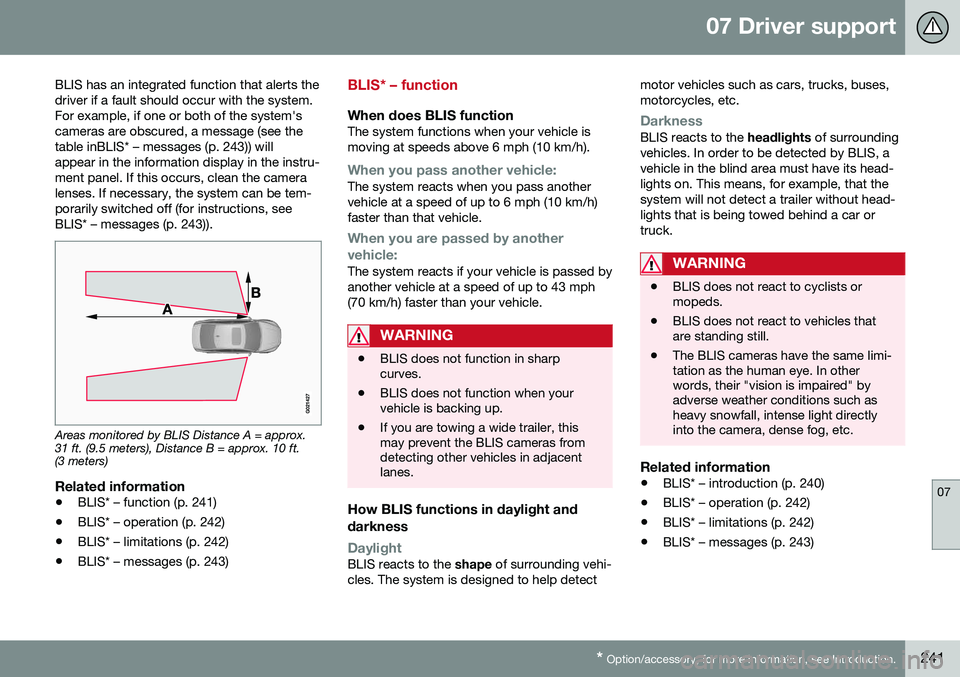
BLIS has an integrated function that alerts the driver if a fault should occur with the system.For example, if one or both of the system'scameras are obscured, a message (see thetable inBLIS* – messages (p. 243)) willappear in the information display in the instru-ment panel. If this occurs, clean the cameralenses. If necessary, the system can be tem-porarily switched off (for instructions, seeBLIS* – messages (p. 243)).
Areas monitored by BLIS Distance A = approx. 31 ft. (9.5 meters), Distance B = approx. 10 ft.(3 meters)
Related information
•
BLIS* – function (p. 241)
• BLIS* – operation (p. 242)
• BLIS* – limitations (p. 242)
• BLIS* – messages (p. 243)
BLIS* – function
When does BLIS functionThe system functions when your vehicle is moving at speeds above 6 mph (10 km/h).
When you pass another vehicle:The system reacts when you pass another vehicle at a speed of up to 6 mph (10 km/h)faster than that vehicle.
When you are passed by another
vehicle:
The system reacts if your vehicle is passed by another vehicle at a speed of up to 43 mph(70 km/h) faster than your vehicle.
WARNING
• BLIS does not function in sharp curves.
• BLIS does not function when yourvehicle is backing up.
• If you are towing a wide trailer, thismay prevent the BLIS cameras fromdetecting other vehicles in adjacentlanes.
How BLIS functions in daylight and darkness
DaylightBLIS reacts to the
shape of surrounding vehi-
cles. The system is designed to help detect motor vehicles such as cars, trucks, buses, motorcycles, etc.
DarknessBLIS reacts to the
headlights of surrounding
vehicles. In order to be detected by BLIS, a vehicle in the blind area must have its head-lights on. This means, for example, that thesystem will not detect a trailer without head-lights that is being towed behind a car ortruck.
WARNING
• BLIS does not react to cyclists or mopeds.
• BLIS does not react to vehicles thatare standing still.
• The BLIS cameras have the same limi-tation as the human eye. In otherwords, their "vision is impaired" byadverse weather conditions such asheavy snowfall, intense light directlyinto the camera, dense fog, etc.
Related information
•
BLIS* – introduction (p. 240)
• BLIS* – operation (p. 242)
• BLIS* – limitations (p. 242)
• BLIS* – messages (p. 243)
Page 336 of 396
10 Maintenance and servicing
10
334
CAUTION
Keep the area around the power steering fluid reservoir clean when checking.
Bulbs – introduction
Certain bulbs can be replaced by the vehicle's owner. However, the bulbs on the followinglist should only be replaced by a trained andqualified Volvo service technician. All bulb specifications are listed in Bulbs – specifications (p. 341).• Active Bending Lights
• Front parking lights
• Daytime running lights
• Turn signals in the door mirrors
• Approach lighting in the door mirrors
• Interior lighting
• Brake lights
• Rear parking lights
• Rear side marker lights
• Back-up lights
• Rear fog light
• LED bulbsNOTE
• For information regarding any bulbs not mentioned in this section, pleasecontact your Volvo retailer or a trainedand authorized Volvo service techni-cian.
• Always switch off the ignition beforestarting to replace a bulb.
• If an error message remains in the dis-play after a faulty bulb has beenreplaced, contact an authorized Volvoworkshop.
• Condensation may form temporarily onthe inside of the lenses of exteriorlights such as headlights, fog lights, ortaillights. This is normal and the lightsare designed to withstand moisture.Normally, condensation will dissipateafter the lights have been on for ashort time.
• The optional Active Bending Lightbulbs contain trace amounts of mer-cury. These bulbs should always bedisposed of by a trained and qualifiedVolvo service technician.
Page 341 of 396
10 Maintenance and servicing
10
339
7. Reinstall the headlight housing.
Related information
•
Bulbs – specifications (p. 341)
Bulbs – front side marker lights
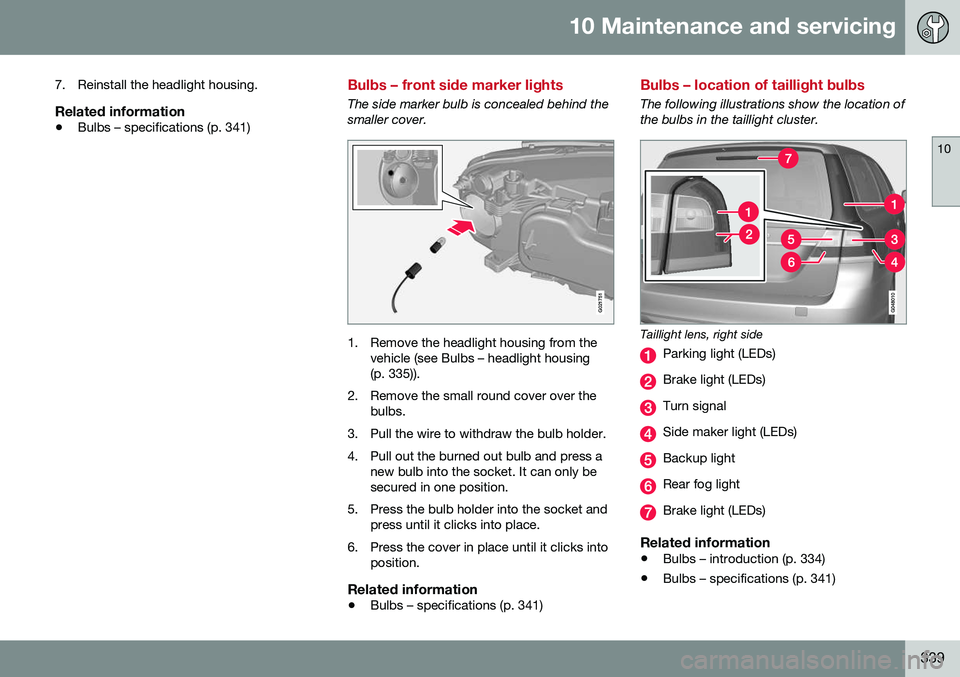
The side marker bulb is concealed behind the smaller cover.
G021751
1. Remove the headlight housing from the
vehicle (see Bulbs – headlight housing (p. 335)).
2. Remove the small round cover over the bulbs.
3. Pull the wire to withdraw the bulb holder.
4. Pull out the burned out bulb and press a new bulb into the socket. It can only be secured in one position.
5. Press the bulb holder into the socket and press until it clicks into place.
6. Press the cover in place until it clicks into position.
Related information
• Bulbs – specifications (p. 341)
Bulbs – location of taillight bulbs
The following illustrations show the location of the bulbs in the taillight cluster.
Taillight lens, right side
Parking light (LEDs)
Brake light (LEDs)
Turn signal
Side maker light (LEDs)
Backup light
Rear fog light
Brake light (LEDs)
Related information
• Bulbs – introduction (p. 334)
• Bulbs – specifications (p. 341)
Page 363 of 396
10 Maintenance and servicing
10
}}
361
Automatic car wash
The vehicle should be washed at regular inter- vals since dirt, dust, insects and tar spotsadhere to the paint and may cause damage.To help prevent corrosion, it is particularlyimportant to wash the car frequently in thewintertime.• We do NOT recommend washing your car in an automatic wash during the firstfew months (because the paint will nothave hardened sufficiently).
• An automatic wash is a simple and quickway to clean your car, but it is worthremembering that it may not be as thor-ough as when you yourself go over thecar with sponge and water. Keeping theunderbody clean is most important, espe-cially in the winter. Some automaticwashers do not have facilities for washingthe underbody.
NOTE
Condensation may form temporarily on the inside of the lenses of exterior lights suchas headlights, fog lights, or taillights. Thisis normal and the lights are designed towithstand moisture. Normally, condensa-tion will dissipate after the lights have beenon for a short time.
CAUTION
• Before driving into an automatic car wash, turn off the optional rain sensorto avoid damaging the windshield wip-ers.
• Make sure that side view mirrors, aux-iliary lamps, etc, are secure, and thatany antenna(s) are retracted orremoved. Otherwise there is risk of themachine dislodging them.
• Chromed wheels:
Clean chrome-
plated wheels using the same deter-gents used for the body of the vehicle.Aggressive wheel-cleaning agents canpermanently stain chrome-platedwheels.
WARNING
• When the vehicle is driven immediately after being washed, apply the brakes,including the parking brake, severaltimes in order to remove any moisturefrom the brake linings.
• Engine cleaning agents should not beused when the engine is warm. Thisconstitutes a fire risk.
Related information
•
Polishing and waxing (p. 361)
• Cleaning the interior (p. 362)
• Washing the car (p. 360)
Polishing and waxing
Normally, polishing is not required during the first year after delivery, however, waxing maybe beneficial.
• Before applying polish or wax the vehicle must be washed and dried. Tar spots canbe removed with kerosene or tar remover.Difficult spots may require a fine rubbingcompound.
• After polishing use liquid or paste wax.
• Several commercially available productscontain both polish and wax.
• Waxing alone does not substitute for pol-ishing a dull surface.
• A wide range of polymer-based waxescan be purchased today. These waxesare easy to use and produce a long-last-ing, high-gloss finish that protects thebodywork against oxidation, road dirt andfading.
• Do not polish or wax your vehicle in directsunlight (the surface of the vehicle shouldnot be warmer than 113 °F (45 °C).
Page 382 of 396
||
11 Specifications
11
380* Option/accessory, for more information, see Introduction.
Symbols in the main instrument panel
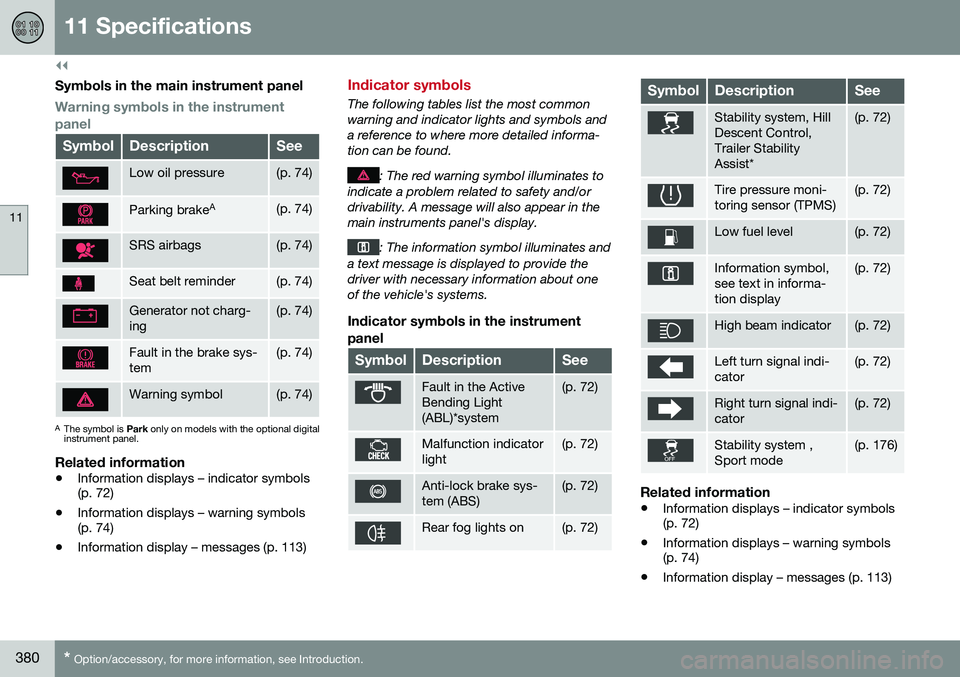
Warning symbols in the instrument panel
SymbolDescriptionSee
Low oil pressure(p. 74)
Parking brake A(p. 74)
SRS airbags(p. 74)
Seat belt reminder(p. 74)
Generator not charg- ing(p. 74)
Fault in the brake sys- tem(p. 74)
Warning symbol(p. 74)
A
The symbol is Park only on models with the optional digital
instrument panel.
Related information
• Information displays – indicator symbols (p. 72)
• Information displays – warning symbols(p. 74)
• Information display – messages (p. 113)
Indicator symbols
The following tables list the most common warning and indicator lights and symbols anda reference to where more detailed informa-tion can be found.
: The red warning symbol illuminates to
indicate a problem related to safety and/or drivability. A message will also appear in themain instruments panel's display.
: The information symbol illuminates and
a text message is displayed to provide the driver with necessary information about oneof the vehicle's systems.
Indicator symbols in the instrument
panel
SymbolDescriptionSee
Fault in the Active Bending Light(ABL)*system(p. 72)
Malfunction indicator light(p. 72)
Anti-lock brake sys- tem (ABS)(p. 72)
Rear fog lights on(p. 72)
SymbolDescriptionSee
Stability system, Hill Descent Control,Trailer StabilityAssist*(p. 72)
Tire pressure moni- toring sensor (TPMS)(p. 72)
Low fuel level(p. 72)
Information symbol, see text in informa-tion display(p. 72)
High beam indicator(p. 72)
Left turn signal indi- cator(p. 72)
Right turn signal indi- cator(p. 72)
Stability system , Sport mode(p. 176)
Related information
• Information displays – indicator symbols (p. 72)
• Information displays – warning symbols(p. 74)
• Information display – messages (p. 113)
Page 388 of 396
12 Index
12
386
Interior Air Quality System.................. 125
ventilated seats................................... 130
Electronic oil level sensor........................ 330
Electronic stability control....................... 175
Emergency locking retractor...................... 47
Emergency starting.................................. 250
Emergency towing........................... 284, 285
Emission inspection readiness................ 325Engine overheating........................................... 75
specifications...................................... 373
Start/Stop........... 256, 257, 258, 259, 260
starting................................................ 246
switching off............................... 248, 249
Engine compartment overview................ 328
Engine oil................................................. 374 checking............................................. 329
low pressure warning light.................... 74
volumes.............................................. 375
Engine remote start (ERS)........................ 248
Environment............................................... 22F
Federal Clean Air Act............................... 322 Flat tires repairing with tire sealing system....... 313
Floor mats cleaning.............................................. 363
placing correctly................................. 246
Floor rails................................................. 144
Fluid specifications.......................... 376, 377
Fog lights................................................... 73 rear........................................................ 94
Four C (active chassis system)................ 175
Front airbags.............................................. 32 disconnecting passenger’s side airbag 36
Front park assist.............................. 232, 236
Front seats................................................. 80 heated................................................. 129
Fuel filler cap........................................... 278
Fuel filler door, opening................... 277, 278
Fuel level warning light.............................. 73
Fuel requirements............................ 275, 276
Fuel tank volume..................................... 377
Fuses....................................... 348, 350, 357
G
Garage door opener HomeLink ®
Wireless Control
System........................................ 108, 109
Gasoline requirements............................. 276
Gas tank volume...................................... 377
Gauges...................................................... 68
Geartronic................................................ 253
Geartronic automatic transmission.......... 253
Generator warning light............................. 75
Glossary of tire terminology..................... 302
Grocery bag holder.................................. 146
Gross vehicle weight............................... 301
H
Hazard warning flashers............................ 94 Headlights Active Bending Lights........................... 92
active high beams................................. 90
changing bulbs... 335, 336, 337, 338, 339
daytime running lights.......................... 89
high/low beams.................................... 90
high beam flash.................................... 90
tunnel detection.................................... 92
Page 391 of 396
12 Index
12
389
Power windows....................................... 100
laminated glass................................... 101
Pregnancy, using seat belts during........... 30
Private locking......................................... 158
PROPOSITION 65 WARNING.. 250, 348, 378
R
Rails, floor................................................ 144
Rain sensor................................................ 98
Rear fog lights............................................ 94
Rear park assist............................... 232, 236
Rear seat head restraints........................... 85Rear seats center head restraint............................. 84
folding............................................. 84, 86
heated................................................. 129
Rearview mirror auto-dim function............................... 104
compass............................................. 105
Rear window defroster............................ 104
Recalls....................................................... 26
Recalls, child restraints.............................. 47
Refrigerant............................................... 377
Refueling.......................................... 275, 276 fuel filler cap....................................... 278 fuel filler door.............................. 277, 278
fuel tank volume................................. 377
Registering child restraints........................ 47 Remote control private locking.................................... 158
Remote key...................... 152, 153, 156, 159 approach lighting................................ 155
immobilizer......................................... 154
key blade.... 152, 153, 156, 157, 158, 159
locking the vehicle.............................. 155
replacing the battery........................... 160
unlocking the vehicle.......................... 155
Reporting safety defects............................ 27
Roadside Assistance................................. 24
Road sign information (RSI)..................... 179
Roof loads............................................... 142
S
Safety, occupant........................................ 26
Safety defects, reporting........................... 27
Safety mode.............................................. 44Seat belt reminder................................................ 30 Seat belts
Automatic locking retractor/Emer-
gency locking retractor......................... 47
buckling................................................ 29
maintenance......................................... 29
pretensioners........................................ 28
reminder................................................ 30
reminder warning light.......................... 74
securing child restraint systems.... 49,51, 53
unbuckling............................................ 29
use during pregnancy........................... 30
using..................................................... 28
Seats, front.......................................... 80, 81
Sensus..................................................... 111Service connected service booking................ 325
Shiftlock..................................................... 14 override............................................... 255
Side door mirrors............................. 102, 103
Side impact airbags................................... 39
Side marker lights, changing bulbs......... 339
Sign information (RSI).............................. 179
Snow chains............................................ 304
Snow tires........................................ 304, 305
Spare tire................................................. 294
Spin control..................................... 175, 176