isofix VOLVO XC70 2016 Owner´s Manual
[x] Cancel search | Manufacturer: VOLVO, Model Year: 2016, Model line: XC70, Model: VOLVO XC70 2016Pages: 396, PDF Size: 10.01 MB
Page 4 of 396
Contents
2
01
01 Introduction
On-board owner's manual........................ 11
Owner's information.................................. 13
Contacting Volvo....................................... 13
About this manual..................................... 14
Change of ownership................................ 18
Crash event data....................................... 18
Volvo Structural Parts Statement.............. 19
Information on the Internet....................... 20
Volvo ID..................................................... 21
Open Source Software Notice.................. 21
Volvo and the environment....................... 22
Important warnings................................... 23
Volvo On Call Roadside Assistance.......... 24
Technician certification............................. 24
02
02 Safety
Occupant safety........................................ 26
Recall information..................................... 26
Reporting safety defects........................... 27
Seat belts – general.................................. 28
Seat belts – buckling/unbuckling.............. 29
Seat belt reminder..................................... 30
Seat belts – pregnancy............................. 30
Supplemental Restraint System (SRS)..... 31
Front airbags............................................. 32
Occupant Weight Sensor.......................... 36
Side impact protection (SIPS) airbags...... 39
Inflatable Curtain (IC)................................ 41
Whiplash Protection System (WHIPS)...... 42
Crash mode – general information............ 44
Crash mode – starting the vehicle............ 45
Crash mode – moving the vehicle............. 45
Child safety............................................... 45
Child restraints.......................................... 47
Infant seats............................................... 49
Convertible seats...................................... 51
Booster cushions...................................... 53
ISOFIX/LATCH lower anchors.................. 54
Top tether anchors.................................... 56
02
Integrated booster cushion – general
information................................................ 57
Integrated booster cushion – using.......... 59
Integrated booster cushion – stowing...... 60
Child safety locks...................................... 61
Page 47 of 396
02 Safety
02
}}
45
Crash mode – starting the vehicle
If Crash mode has been set Crash mode (p. 44)) and damage to the vehicle isminor and there is no fuel leakage, you mayattempt to start the engine. To do so:
1. Remove the remote key from the ignitionslot and open the driver's door. If a mes- sage is displayed that the ignition is on,press the start button.
2. Close the driver's door and reinsert the remote key in the ignition slot.
3. Try to start the vehicle.
WARNING
If the message Safety mode See manualis still displayed, the vehicle should not be driven and must be towed. Concealedfaults may make the vehicle difficult tocontrol.
Related information
• Crash mode – general information (p. 44)
• Crash mode – moving the vehicle (p. 45)
Crash mode – moving the vehicle
If the message Normal mode appears after
an attempt has been made to start the engine, Starting the vehicle after a crash (p. 45), thevehicle may be moved carefully from its pres-ent position, if for example, it is blocking traf-fic. It should, however, not be moved fartherthan is absolutely necessary.
WARNING
Even if the vehicle appears to be drivable after Crash mode has been set, it shouldnot be driven or towed (pulled by anothervehicle). There may be concealed damagethat could make it difficult or impossible tocontrol. The vehicle should be transportedon a flatbed tow truck to a trained andqualified Volvo service technician forinspection/repairs.
Related information
• Crash mode – general information (p. 44)
Child safety
Children should always be seated safely when traveling in the vehicle.
General informationVolvo recommends the proper use of restraintsystems (p. 47) for all occupants includingchildren. Remember that, regardless of ageand size, a child should always be properlyrestrained in a vehicle. Your vehicle is also equipped with ISOFIX/ LATCH attachments (p. 54), which make itmore convenient to install child seats. Some restraint systems for children are designed to be secured in the vehicle by lapbelts or the lap portion of a lap-shoulder belt.Such child restraint systems can help protectchildren in vehicles in the event of an acci-dent only if they are used properly. However,children could be endangered in a crash if thechild restraints are not properly secured in thevehicle. Failure to follow the installationinstructions for your child restraint can resultin your child striking the vehicle's interior in asudden stop. Holding a child in your arms is NOT a suitable substitute for a child restraint system. In anaccident, a child held in a person's arms canbe crushed between the vehicle's interior andan unrestrained person. The child could alsobe injured by striking the interior, or by beingejected from the vehicle during a suddenmaneuver or impact. The same can also hap-
Page 49 of 396
02 Safety
02
}}
47
Volvo has some very specific recommendations:
•Always wear your seat belt (p. 28).
• Airbags are a SUPPLEMENTAL safety device which, when used with a three-point seat belt can help reduce seriousinjuries during certain types of accidents.Volvo recommends that you do not dis-connect the airbag system in your vehi-cle.
• Volvo strongly recommends that every-one in the vehicle be properly restrained.
• Volvo recommends that ALL occupants(adults and children) shorter than 4 feet7 inches (140 cm) be seated in the backseat of any vehicle with a front passengerside airbag.
• Drive safely!
Related information
• Infant seats (p. 49)
• Convertible seats (p. 51)
• Booster cushions (p. 53)
• Integrated booster cushion – generalinformation (p. 57)
• Child safety locks (p. 61)
• Top tether anchors (p. 56)
Child restraints
Suitable child restraints should always be used when children travel in the vehicle.
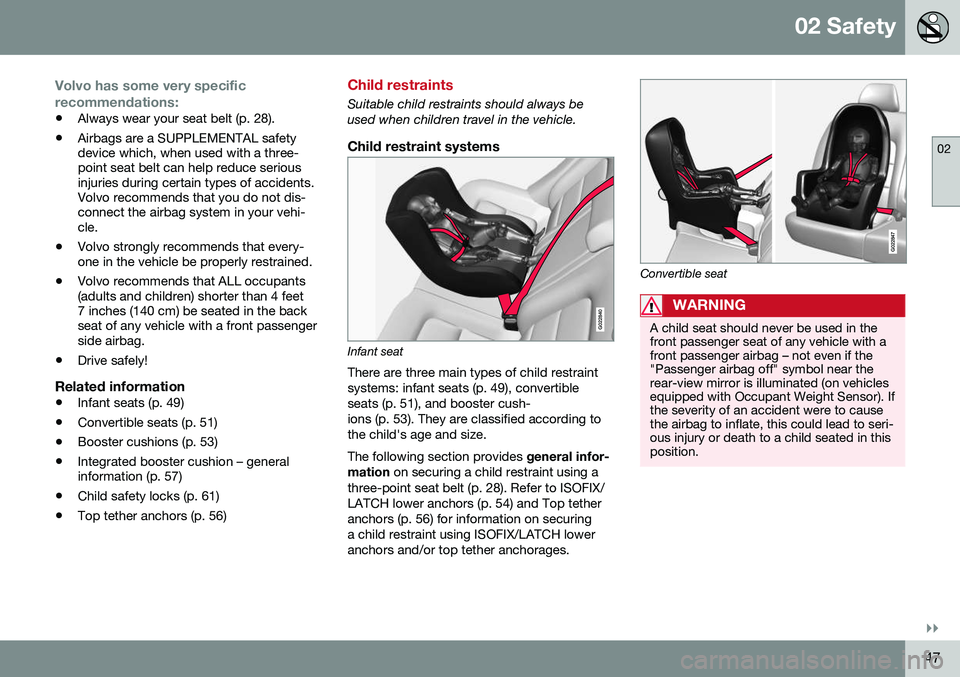
Child restraint systems
G022840
Infant seat
There are three main types of child restraint systems: infant seats (p. 49), convertibleseats (p. 51), and booster cush-ions (p. 53). They are classified according tothe child's age and size. The following section provides general infor-
mation on securing a child restraint using a
three-point seat belt (p. 28). Refer to ISOFIX/ LATCH lower anchors (p. 54) and Top tetheranchors (p. 56) for information on securinga child restraint using ISOFIX/LATCH loweranchors and/or top tether anchorages.
G022847
Convertible seat
WARNING
A child seat should never be used in the front passenger seat of any vehicle with afront passenger airbag – not even if the"Passenger airbag off" symbol near therear-view mirror is illuminated (on vehiclesequipped with Occupant Weight Sensor). Ifthe severity of an accident were to causethe airbag to inflate, this could lead to seri-ous injury or death to a child seated in thisposition.
Page 51 of 396
02 Safety
02
}}
49
http://www.tc.gc.ca/roadsafety/childsafety/ menu.htm.
Related information
•
Child safety locks (p. 61)
• Integrated booster cushion – general information (p. 57)
Infant seats
Suitable child restraints should always be used when children (depending on their age/size) are seated in the vehicle.
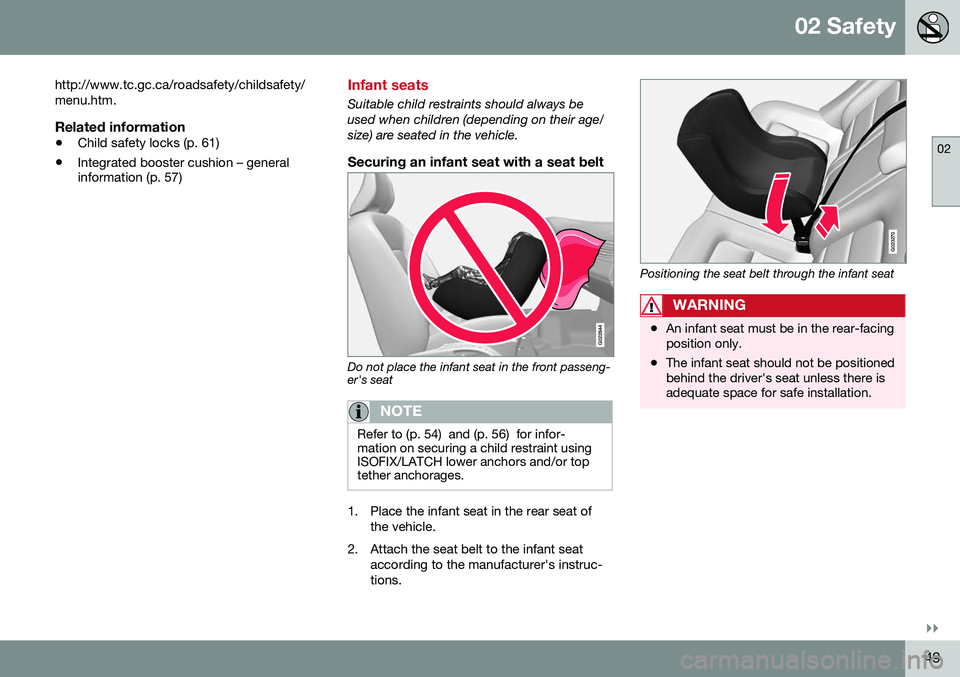
Securing an infant seat with a seat belt
G022844
Do not place the infant seat in the front passeng- er's seat
NOTE
Refer to (p. 54) and (p. 56) for infor- mation on securing a child restraint usingISOFIX/LATCH lower anchors and/or toptether anchorages.
1. Place the infant seat in the rear seat of
the vehicle.
2. Attach the seat belt to the infant seat according to the manufacturer's instruc- tions.
G023270
Positioning the seat belt through the infant seat
WARNING
•An infant seat must be in the rear-facing position only.
• The infant seat should not be positionedbehind the driver's seat unless there isadequate space for safe installation.
Page 53 of 396
02 Safety
02
}}
51
WARNING
It should not be possible to move the child restraint (child seat) more than 1 in.(2.5 cm) in any direction along the seat beltpath.
The infant seat can be removed by unbuck- ling the seat belt and letting it retract com-pletely.
Related information
•Child safety (p. 45)
• Child restraints (p. 47)
• Convertible seats (p. 51)
• Integrated booster cushion – general information (p. 57)
• ISOFIX/LATCH lower anchors (p. 54)
• Top tether anchors (p. 56)
Convertible seats
Suitable child restraints should always be used when children (depending on their age/size) are seated in the vehicle.
Securing a convertible seat with a seat
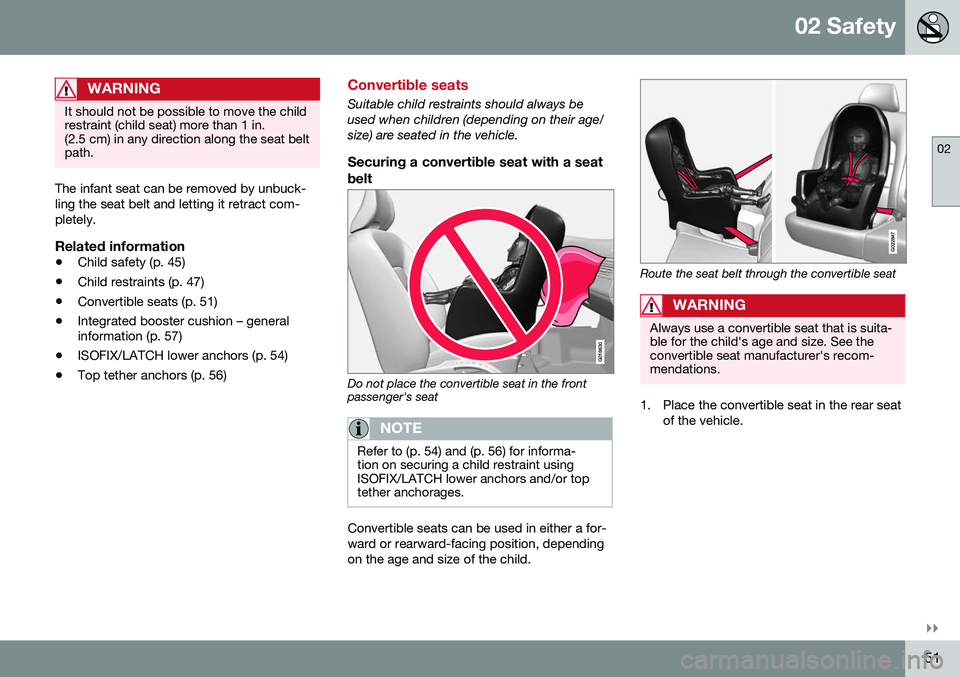
belt
G018630
Do not place the convertible seat in the front passenger's seat
NOTE
Refer to (p. 54) and (p. 56) for informa- tion on securing a child restraint usingISOFIX/LATCH lower anchors and/or toptether anchorages.
Convertible seats can be used in either a for- ward or rearward-facing position, dependingon the age and size of the child.
G022847
Route the seat belt through the convertible seat
WARNING
Always use a convertible seat that is suita- ble for the child's age and size. See theconvertible seat manufacturer's recom-mendations.
1. Place the convertible seat in the rear seat of the vehicle.
Page 55 of 396
02 Safety
02
}}
53
WARNING
It should not be possible to move the child restraint (child seat) more than 1 in.(2.5 cm) in any direction along the seat beltpath.
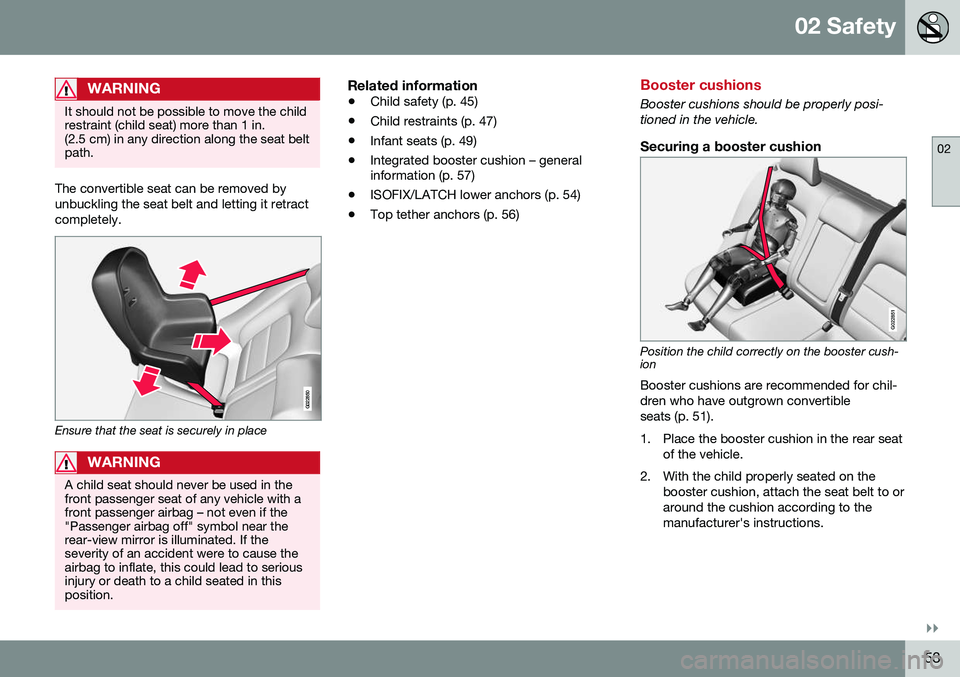
The convertible seat can be removed by unbuckling the seat belt and letting it retractcompletely.
G022850
Ensure that the seat is securely in place
WARNING
A child seat should never be used in the front passenger seat of any vehicle with afront passenger airbag – not even if the"Passenger airbag off" symbol near therear-view mirror is illuminated. If theseverity of an accident were to cause theairbag to inflate, this could lead to seriousinjury or death to a child seated in thisposition.
Related information
•Child safety (p. 45)
• Child restraints (p. 47)
• Infant seats (p. 49)
• Integrated booster cushion – general information (p. 57)
• ISOFIX/LATCH lower anchors (p. 54)
• Top tether anchors (p. 56)
Booster cushions
Booster cushions should be properly posi- tioned in the vehicle.
Securing a booster cushion
G022851
Position the child correctly on the booster cush- ion
Booster cushions are recommended for chil- dren who have outgrown convertibleseats (p. 51).
1. Place the booster cushion in the rear seat of the vehicle.
2. With the child properly seated on the booster cushion, attach the seat belt to or around the cushion according to themanufacturer's instructions.
Page 56 of 396
||
02 Safety
02
54
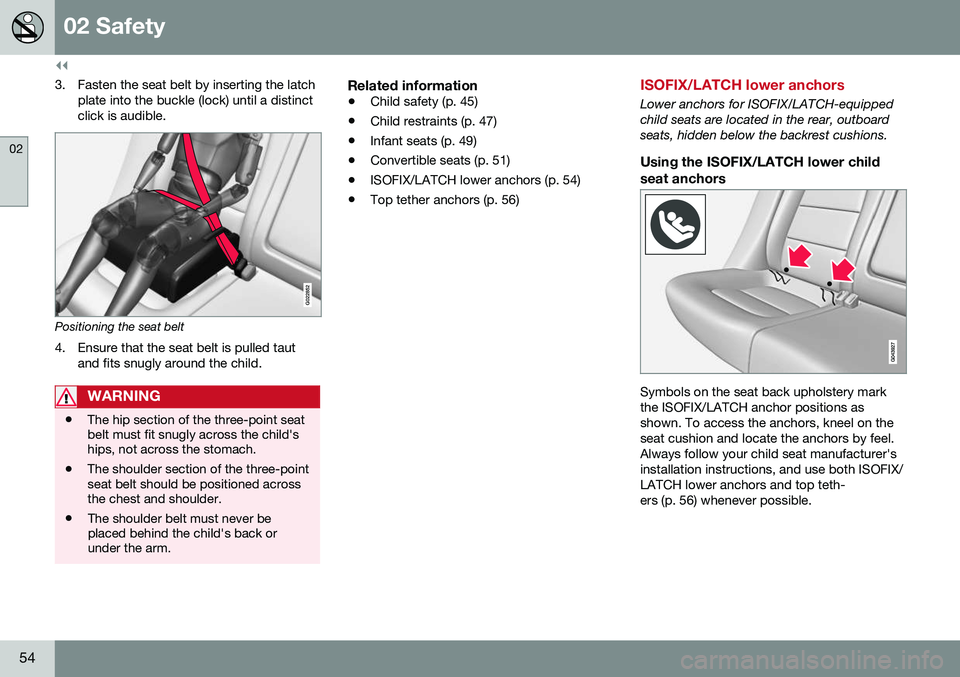
3. Fasten the seat belt by inserting the latchplate into the buckle (lock) until a distinct click is audible.
G022852
Positioning the seat belt
4. Ensure that the seat belt is pulled tautand fits snugly around the child.
WARNING
•The hip section of the three-point seat belt must fit snugly across the child'ships, not across the stomach.
• The shoulder section of the three-pointseat belt should be positioned acrossthe chest and shoulder.
• The shoulder belt must never beplaced behind the child's back orunder the arm.
Related information
•
Child safety (p. 45)
• Child restraints (p. 47)
• Infant seats (p. 49)
• Convertible seats (p. 51)
• ISOFIX/LATCH lower anchors (p. 54)
• Top tether anchors (p. 56)
ISOFIX/LATCH lower anchors
Lower anchors for ISOFIX/LATCH-equipped child seats are located in the rear, outboardseats, hidden below the backrest cushions.
Using the ISOFIX/LATCH lower child
seat anchors
Symbols on the seat back upholstery mark the ISOFIX/LATCH anchor positions asshown. To access the anchors, kneel on theseat cushion and locate the anchors by feel.Always follow your child seat manufacturer'sinstallation instructions, and use both ISOFIX/LATCH lower anchors and top teth-ers (p. 56) whenever possible.
Page 57 of 396
02 Safety
02
55
To access the anchors1. Put the child restraint in position.
2. Kneel on the child restraint to press downthe seat cushion and locate the anchors by feel.
3. Fasten the attachment on the child restraint's lower straps to the ISOFIX/LATCH/LATCH lower anchors.
4. Firmly tension the lower child seat straps according to the manufacturer's instruc-tions.
WARNING
Volvo's ISOFIX/LATCH anchors conform to FMVSS/CMVSS standards. Always refer tothe child restraint system's manual forweight and size ratings.
NOTE
•The rear seat's center position is not equipped with ISOFIX/LATCH loweranchors. When installing a childrestraint in this position, attach therestraint's top tether strap (if it is soequipped) to the top tether anchoragepoint and secure the restraint with thevehicle's center seat belt.
• Always follow your child seat manufac-turer's installation instructions, anduse both ISOFIX/LATCH lower anchorsand top tethers whenever possible.
G018631
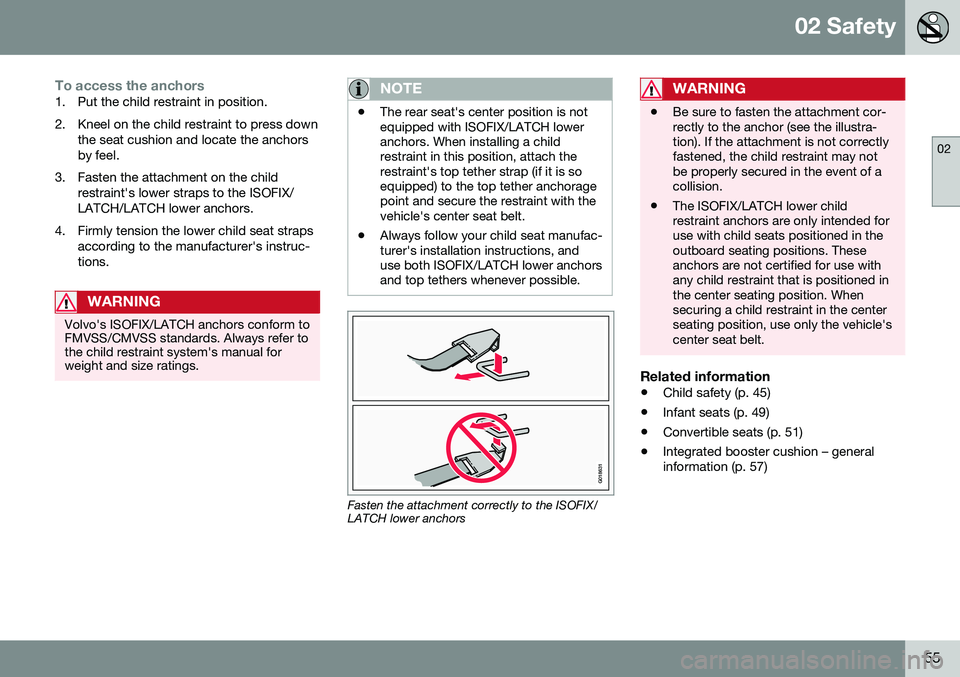
Fasten the attachment correctly to the ISOFIX/ LATCH lower anchors
WARNING
•
Be sure to fasten the attachment cor- rectly to the anchor (see the illustra-tion). If the attachment is not correctlyfastened, the child restraint may notbe properly secured in the event of acollision.
• The ISOFIX/LATCH lower childrestraint anchors are only intended foruse with child seats positioned in theoutboard seating positions. Theseanchors are not certified for use withany child restraint that is positioned inthe center seating position. Whensecuring a child restraint in the centerseating position, use only the vehicle'scenter seat belt.
Related information
•
Child safety (p. 45)
• Infant seats (p. 49)
• Convertible seats (p. 51)
• Integrated booster cushion – general information (p. 57)
Page 58 of 396
02 Safety
02
56
Top tether anchors
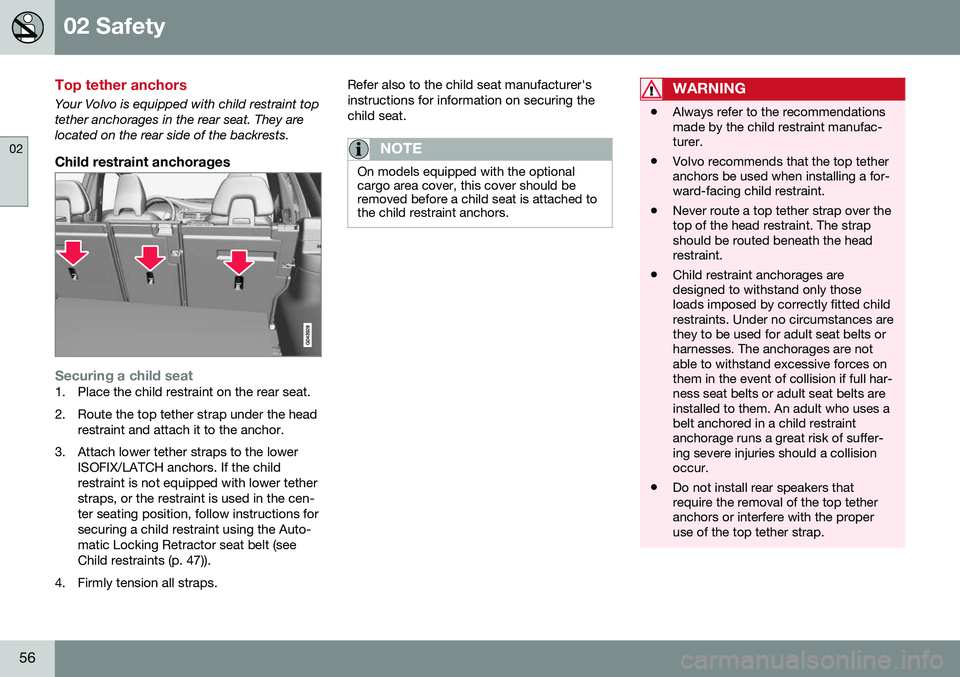
Your Volvo is equipped with child restraint top tether anchorages in the rear seat. They arelocated on the rear side of the backrests.
Child restraint anchorages
Securing a child seat1. Place the child restraint on the rear seat.
2. Route the top tether strap under the headrestraint and attach it to the anchor.
3. Attach lower tether straps to the lower ISOFIX/LATCH anchors. If the child restraint is not equipped with lower tetherstraps, or the restraint is used in the cen-ter seating position, follow instructions forsecuring a child restraint using the Auto-matic Locking Retractor seat belt (seeChild restraints (p. 47)).
4. Firmly tension all straps. Refer also to the child seat manufacturer'sinstructions for information on securing thechild seat.
NOTE
On models equipped with the optional cargo area cover, this cover should beremoved before a child seat is attached tothe child restraint anchors.
WARNING
•
Always refer to the recommendations made by the child restraint manufac-turer.
• Volvo recommends that the top tetheranchors be used when installing a for-ward-facing child restraint.
• Never route a top tether strap over thetop of the head restraint. The strapshould be routed beneath the headrestraint.
• Child restraint anchorages aredesigned to withstand only thoseloads imposed by correctly fitted childrestraints. Under no circumstances arethey to be used for adult seat belts orharnesses. The anchorages are notable to withstand excessive forces onthem in the event of collision if full har-ness seat belts or adult seat belts areinstalled to them. An adult who uses abelt anchored in a child restraintanchorage runs a great risk of suffer-ing severe injuries should a collisionoccur.
• Do not install rear speakers thatrequire the removal of the top tetheranchors or interfere with the properuse of the top tether strap.
Page 59 of 396
02 Safety
02
}}
57
Related information
•Child safety (p. 45)
• Infant seats (p. 49)
• Convertible seats (p. 51)
• Integrated booster cushion – general information (p. 57)
• ISOFIX/LATCH lower anchors (p. 54)
Integrated booster cushion – general information
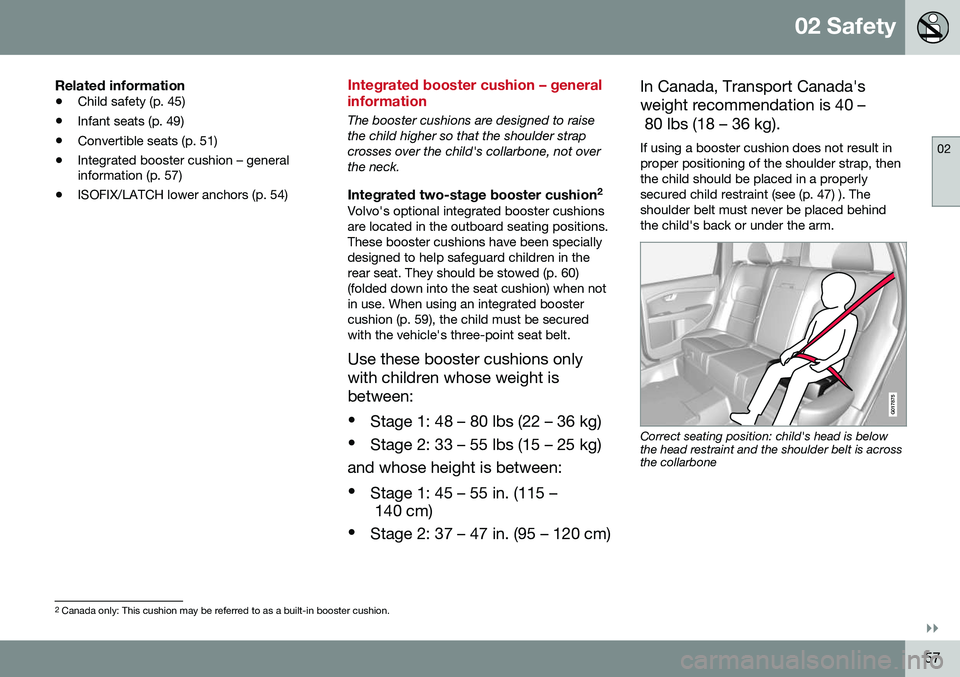
The booster cushions are designed to raise the child higher so that the shoulder strapcrosses over the child's collarbone, not overthe neck.
Integrated two-stage booster cushion 2Volvo's optional integrated booster cushionsare located in the outboard seating positions.These booster cushions have been speciallydesigned to help safeguard children in therear seat. They should be stowed (p. 60)(folded down into the seat cushion) when notin use. When using an integrated boostercushion (p. 59), the child must be securedwith the vehicle's three-point seat belt.
Use these booster cushions only with children whose weight isbetween: • Stage 1: 48 – 80 lbs (22 – 36 kg)
• Stage 2: 33 – 55 lbs (15 – 25 kg)
and whose height is between:• Stage 1: 45 – 55 in. (115 – 140 cm)
• Stage 2: 37 – 47 in. (95 – 120 cm) In Canada, Transport Canada's weight recommendation is 40 – 80 lbs (18 – 36 kg). If using a booster cushion does not result in proper positioning of the shoulder strap, thenthe child should be placed in a properlysecured child restraint (see (p. 47) ). Theshoulder belt must never be placed behindthe child's back or under the arm.
G017875
Correct seating position: child's head is below the head restraint and the shoulder belt is acrossthe collarbone
2
Canada only: This cushion may be referred to as a built-in booster cushion.