ECU VOLVO XC90 2003 User Guide
[x] Cancel search | Manufacturer: VOLVO, Model Year: 2003, Model line: XC90, Model: VOLVO XC90 2003Pages: 242, PDF Size: 6.5 MB
Page 90 of 242

2003 VOLVO XC90
Lower attachments
1. Insert the lower attachment bracket through the steel grid's lower mo\
unt from underneath.
2. Install the spring on the attachment bracket and tighten the knob.
3. Secure the attachment bracket hook in the lower cargo eyelet. Turn th\
e knob to tension the attachment bracket in the
cargo eyelet.
4. Repeat the operation on the opposite side.
5. Tighten both attachment brackets alternatively.
6. Place the protective caps on the threads above the knobs.
WARNING!
Seven-seat models:
- The backrests of the optional third row seats must be folded down when\
installing the steel grid.
- The steel grid is installed behind the second row of seats in seven-se\
at models. To avoid the risk of injury, no one
should be allowed to sit in the third row of seats when the steel grid i\
s in place in the vehicle.
pg. 70 Interior
Securing cargo (contd)
Cargo area cover
Installing the cargo area cover:
Press the end pieces of the cargo area cover down in the holders.
file:///K|/ownersdocs/2003/2003_XC90/03xc90_04b.htm (8 of 10)12/30/200\
6 4:18:55 PM
Page 91 of 242
.
Removing the cargo area cover:
Press the end pieces of the cover inw")
2003 VOLVO XC90
Pull out the cargo area cover and hook it in the holes in the rear cargo\
area pillars (see illustration above).
Removing the cargo area cover:
Press the end pieces of the cover inward. Pull up and lift out.
Grocery bag holder (five-seat models only)
1. Fold down the lower section of the tailgate.
2. Fold up the rear section of the cargo compartment floor.
3. Hang or secure your grocery bags by means of the straps or holders.
pg. 71 Interior
Compartments under the cargo area floor - five-seat models
Fold up the rear section of the cargo area floor and lift out the recess\
ed cover to access these compartments.
If the vehicle is equipped with the optional grocery bag holder:
Fold up the rear section of the cargo area floor, disconnect the grocery\
bag holder's retaining cords and lift out the grocery
bag holder.
The following items are stored under the cargo area floor:
1. Tool bag (including the crank for the jack)
2. Jack
file:///K|/ownersdocs/2003/2003_XC90/03xc90_04b.htm (9 of 10)12/30/200\
6 4:18:55 PM
Page 96 of 242

2003 VOLVO XC90
Remote controls
Your vehicle is equipped with a remote control transmitter. This transmi\
tter uses a radio signal to allow
"keyless" entry into the passenger compartment or the tailgate. You will\
be supplied with two coded key
ring transmitters, which will enable you to lock/unlock all doors and th\
e tailgate from a distance of 10-
15 feet (3- 5 meters).
On vehicles equipped with an alarm, the alarm will also be activated/dea\
ctivated by this system.
The vehicle can also be locked/unlocked with the key.
Buttons in remote control:
1-Lock, 2-Unlock, 3-Unlock tailgate,
4-"Panic" function,*, 5-Approach lighting
As an extra security precaution in certain situations (valet parking, e\
tc.), Volvo recommends that the
transmitter not be included when the keys are given to anyone. The servi\
ce key can be used instead. If
one of the transmitters is misplaced, contact the nearest authorized Vol\
vo retailer for assistance.
Using the remote control
l Press the LOCK button once to lock all doors and tailgate.
l Press the UNLOCK button once to unlock the driver's door and fuel filler\
door. Wait for at least 1
second and press this button again (within 10 seconds) to unlock all d\
oors and the tailgate.
l To unlock the tailgate (without unlocking the doors), press the Unlock\
tailgate button twice within 3
seconds.
NOTE:
l Airbag deployment will automatically unlock the doors.
l The keys may also be used to lock and unlock the doors, and to activate \
and deactivate the alarm
system.
l To avoid leaving your keys in the vehicle, make a habit of always lockin\
g the vehicle with the remote
control.
file:///K|/ownersdocs/2003/2003_XC90/03xc90_05.htm (4 of 11)12/30/2006\
4:18:56 PM
Page 125 of 242
.\
The LED in the button will go out
to indicate that the system is not in")
2003 VOLVO XC90
To temporarily off the system
l Press the button in the center control panel (see illustration above).\
The LED in the button will go out
to indicate that the system is not in active mode.
l Press the button again to reactivate the system.
Faults in the system
If a fault should occur in the system, the LED in the button will be swi\
tched off and a message will be
displayed in the text window.
Cleaning the sensors
For the system to function properly, the sensors should be kept clean. T\
hey can be cleaned with car
washing detergent and a sponge.
WARNING!
This system is designed to be a supplementary aid when the vehicle is ba\
cking up. It is not, however,
intended to replace the driver's attention and judgement.
pg. 100 Starting and driving
Towing
Positions for attaching towing eyelets
Emergency towing
The towing eyelet is located in the tool bag, under the floor of the car\
go area. This eyelet must be
screwed into the positions provided on the right sides of either the fro\
nt or rear bumper (see illustrations).
To attach the towing eyelet:
A Use a coin to pry open the lower edge of the cover (A).
B Screw the towing eyelet (C) in place (B), first by hand and then us\
ing the tire iron until it is securely
file:///K|/ownersdocs/2003/2003_XC90/03xc90_06b.htm (7 of 17)12/30/200\
6 4:18:59 PM
Page 126 of 242

2003 VOLVO XC90
in place.
After the vehicle has been towed, the eyelet should be removed and retur\
ned to the tool bag. Press the
cover back into position.
Precautions when the vehicle is in tow
l The steering wheel must be unlocked. Turn the ignition key to position I\
or II.
l The gear selector must be in position N.
l Maximum speed: 50 mph (80 km/h). Do not exceed the maximum allowable t\
owing speed.
l Maximum distance with front wheels on ground: 50 miles (80 km).
l While the vehicle is being towed, try to keep the tow rope taut at all t\
imes.
l The vehicle should only be towed in forward direction.
CAUTION
- Please check with state and local authorities before attempting this t\
ype of towing, as vehicles being
towed are subject to regulations regarding maximum towing speed, length \
and type of towing device,
lighting, etc.
- If the vehicle's battery is dead, do not attempt to start the vehicle \
by pushing or pulling it as this will
damage the three-way catalytic converter(s). The engine must be jump s\
tarted using an auxiliary
battery (see
page 102).
- If the vehicle is being towed on a flat bed truck, the towing eyelets \
must not be used to secure the
vehicle on the flat bed. Consult the tow truck operator.
WARNING!
- Remember that the power brakes and power steering will not function wh\
en engine is not running.
The braking and steering systems will function but the brake pedal press\
ure required is 3 - 4 times
above normal and greater steering effort must be exerted.
- The towing eyelets must not be used for pulling the vehicle out of a d\
itch or for any similar purpose
involving severe strain. Do not use the towing eyelets to pull the vehic\
le up onto a flat bed tow truck.
pg. 101 Starting and driving
file:///K|/ownersdocs/2003/2003_XC90/03xc90_06b.htm (8 of 17)12/30/200\
6 4:18:59 PM
Page 127 of 242

2003 VOLVO XC90
Towing vehicles with front wheel drive/All Wheel Drive
Volvo recommends the use of flat bed equipment.
If wheel lift equipment must be used, please use extreme caution to help\
avoid damage to the vehicle. In
this case, the vehicle should be towed with the rear wheels on the groun\
d if at all possible.
If it is absolutely necessary to tow the vehicle with the front wheels o\
n the ground, please refer to the
towing information on the previous page. CAUTION
Sling-type equipment applied at the front will damage radiator and air c\
onditioning lines.
It is equally important not to use sling-type equipment at the rear or a\
pply lifting equipment inside the
rear wheels; serious damage to the rear axle may result.
If the vehicle is being towed on a flat bed truck, the towing eyelets mu\
st not be used to secure the
vehicle on the flat bed. Consult the tow truck operator.
WARNING!
Do not use the towing eyelets to pull the vehicle up onto a flat bed tow\
truck.
pg. 102 Starting and driving
Jump starting
Jump starting
file:///K|/ownersdocs/2003/2003_XC90/03xc90_06b.htm (9 of 17)12/30/200\
6 4:18:59 PM
Page 137 of 242
 of detergent to 2.6 US gal. (10 liters) of warm wat\
er. After washing with a detergent the
vehicle should be well rinsed with clean water.
Bumpers: Wash the bumper")
2003 VOLVO XC90
fl. oz. (8.5 cl) of detergent to 2.6 US gal. (10 liters) of warm wat\
er. After washing with a detergent the
vehicle should be well rinsed with clean water.
Bumpers: Wash the bumpers with the same cleaning agent used on the rest of the v\
ehicle. Never clean
the bumpers with gasoline or paint thinner. Difficult spots can be remov\
ed with denatured alcohol. To
avoid scratches, do not dry the bumpers with paper.
NOTE: When washing the vehicle, remember to remove dirt from the drain holes i\
n the doors and sills. CAUTION
- During high pressure washing, the spray mouthpiece must never be close\
r to the vehicle than
13" (30 cm). Do not spray into the locks.
- When washing or steam cleaning the engine, avoid spraying water or ste\
am directly on the electrical
components or toward the rear side of the engine.
Special moonroof cautions:
- Always close the moonroof and visor before washing your vehicle.
- Never use abrasive cleaning agents on the moonroof.
- Never use wax on the rubber seals around the moonroof.
WARNING!
When the vehicle is driven immediately after being washed, apply the bra\
kes several times in order to
remove any moisture from the brake linings.
Engine cleaning agents should not be used when the engine is warm. This \
constitutes a fire risk.
pg. 111 Vehicle care
Automatic washing - simple and quick
l We do NOT recommend washing your vehicle in an automatic wash during the\
first six months
(because the paint will not have hardened sufficiently).
l An automatic wash is a simple and quick way to clean your vehicle, but i\
t is worth remembering that
it may not be as thorough as when you yourself go over the vehicle with \
sponge and water. Keeping the
underbody clean is most important, especially in the winter. Some automa\
tic washers do not have
facilities for washing the underbody.
l Before driving into an automatic car wash, make sure that side view mirr\
ors, auxiliary lamps, etc, are
secure, and that any antenna(s) are retracted or removed. Otherwise th\
ere is risk of the machine
dislodging them.
Polishing and Waxing
l Normally, polishing is not required during the first year after delivery\
, however, waxing may be
file:///K|/ownersdocs/2003/2003_XC90/03xc90_07.htm (2 of 5)12/30/2006 \
4:19:00 PM
Page 149 of 242

2003 VOLVO XC90
Returning the spare wheel to its storage compartment
NOTE: The space under the vehicle is designed to hold the special spare wheel \
only. Other fullsize
wheels will not fit in this compartment.
Returning the spare wheel to the storage compartment
1. Use the crank (turn it counterclockwise) to lower the spare wheel's\
retaining cable.
2. Pass the toggle at the end of the cable through the center hole in th\
e spare wheel. Pivot the toggle 90
degrees so that when raised, the wheel will rest on the toggle.
3. Retract the retaining cable slightly by slowly turning the crank cloc\
kwise several times.
4. Position the wheel so that it is not obstructed by components in the \
exhaust system.
5. Continue to raise the wheel by turning the crank clockwise.Raise the \
wheel a little bit at a time and
guide it around the rear axle until it is securely seated in the storage\
area.
6. When it is no longer possible to turn the crank any further, check th\
at the spare wheel is securely in
position in the storage compartment.
pg. 120 Wheels and tires
Jack attachment points
file:///K|/ownersdocs/2003/2003_XC90/03xc90_08.htm (9 of 12)12/30/2006\
4:19:01 PM
Page 167 of 242
2003 VOLVO XC90
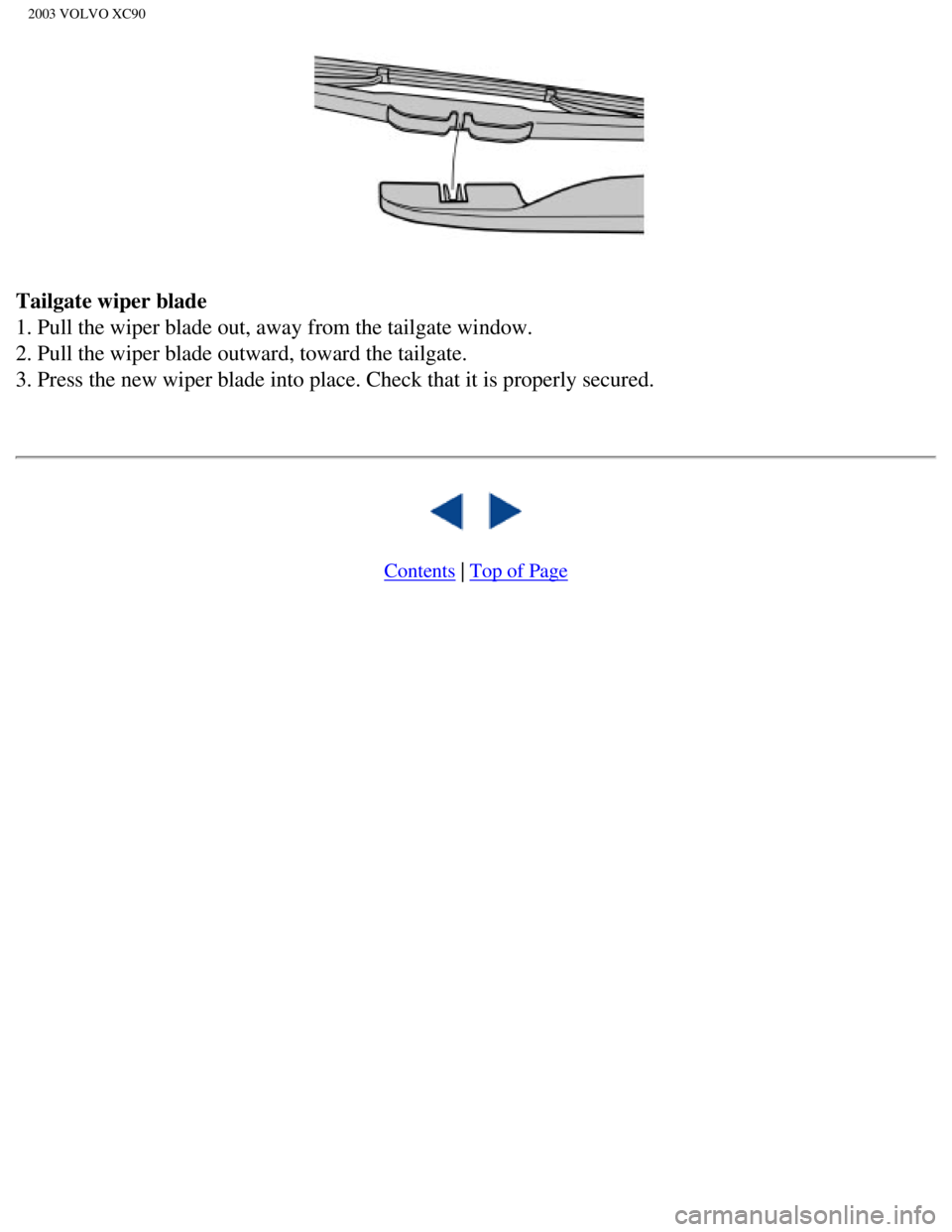
Tailgate wiper blade
1. Pull the wiper blade out, away from the tailgate window.
2. Pull the wiper blade outward, toward the tailgate.
3. Press the new wiper blade into place. Check that it is properly secur\
ed.
Contents | Top of Page
file:///K|/ownersdocs/2003/2003_XC90/03xc90_09a.htm (15 of 15)12/30/20\
06 4:19:02 PM
Page 168 of 242

2003 VOLVO XC90
pg. 134 Maintenance
Battery Maintenance
The battery in your vehicle is located under the floor of the cargo comp\
artment.
Driving habits and conditions, climate, the number of starts, etc. all a\
ffect the service life and function of
the battery. In order for your battery to perform satisfactorily, keep t\
he following in mind:
l Check the fluid level in each cell in the battery every 24 months or eve\
ry 15,000* miles (24,000 km),
whichever is sooner. The fluid should be at the level shown in the illus\
tration above (A)**.
l Use a screw driver to open the caps and a flashlight to inspect the leve\
l.
l If necessary, add distilled water. The level should never be above the i\
ndicator (A**).
l The fluid level should be checked if the battery has been recharged.
l After inspection, be sure the cap over each battery cell is securely in \
place.
l Check that the battery cables are correctly connected and properly tight\
ened. Route ventilation hose
through opening in floor (see
page 135)
l Never disconnect the battery when the engine is running, for example whe\
n changing the battery.
l The battery should be disconnected from the vehicle when a battery charg\
er is used directly on the
battery.
l However, if the battery is being charged via the connecting points in th\
e engine compartment (see
page 102), the battery must be connected.
* More frequently in warm climates.
** The level indicator inside the battery could be designed in various w\
ays. See illustration.
file:///K|/ownersdocs/2003/2003_XC90/03xc90_09b.htm (1 of 23)12/30/200\
6 4:19:04 PM