traction control VOLVO XC90 2003 Owners Manual
[x] Cancel search | Manufacturer: VOLVO, Model Year: 2003, Model line: XC90, Model: VOLVO XC90 2003Pages: 242, PDF Size: 6.5 MB
Page 23 of 242

2003 VOLVO XC90
WARNING!
The IC system is a supplement to the Side Impact Protection System. It i\
s not designed to deploy
during collisions from the front or rear of the vehicle. The Inflatable \
Curtains are designed to deploy
only during certain side-impact collisions, depending on the crash sever\
ity, angle, speed and impact.
The Inflatable Curtains are not designed to deploy in all side impact si\
tuations. Never try to open or
repair any components of the IC system. This should be done only by an a\
uthorized Volvo service
technician. In order for the IC to provide its best protection, both fro\
nt seat occupants and all
outboard rear seat occupants should sit in an upright position with the \
seat belt properly fastened;
adults using the seat belt and children using the proper child restraint\
system. Only adults should sit in
the front seats. Children must never be allowed in the front passenger s\
eat. See
page 20 for
guidelines. Failure to follow these instructions can result in injury to\
the vehicle occupants in an
accident.
When the backrest(s) in the rear seat(s) are folded down, the vehicl\
e should not be loaded to a level
higher than 2 inches (5 cm) below the upper edge of the side windows. \
Objects placed higher than
this level could impede the function of the Inflatable Curtain.
pg. 13 Safety
Roll-over Protection System
Volvo's Roll-over Protection System has been developed to help prevent t\
he vehicle from rolling over in
the event of sudden evasive maneuvers, skids, etc and to offer enhanced \
protection if a roll-over occurs.
The system works in two ways:
l The stabilizing system Roll Stability Control (RSC) acts to minimize b\
ody roll.
l The system provides additional protection with a reinforced body, Inflat\
able Curtains for all outboard
seating positions, and seat belt pretensioners for all seating positions\
.
RSC uses a gyro-sensor that registers the vehicle's angle of inclination\
and the speed at which this angle
changes. Using this information, the control module calculates the risk \
of a roll-over. If there is an
imminent roll-over risk, the Dynamic Stability and Traction Control (DS\
TC) system is activated, engine
speed is reduced, and the brakes are applied to one or more of the wheel\
s until the vehicle has regained
stability.
If a roll-over occurs, RSC triggers the seat belt pretensioners and then\
deploys the Inflatable Curtains
(which remain inflated for approximately 5 seconds). These curtains ar\
e designed to follow the contours
of the side windows so that they position themselves between the occupan\
ts' heads and the sides of the
vehicle.
pg. 14 Safety
file:///K|/ownersdocs/2003/2003_XC90/03xc90_01b.htm (4 of 15)12/30/200\
6 4:18:50 PM
Page 39 of 242

2003 VOLVO XC90
WARNING!
The If the fluid level is below the MIN mark in the reservoir or if a "B\
rake failure - Service urgent"
message is displayed in the text window: DO NOT DRIVE. Have the vehicle \
towed to an authorized
Volvo retailer and have the brake system inspected.
l If the brake fluid level is above the MIN mark, drive carefully to an au\
thorized Volvo retailer and
have the brake system inspected Volvo retailer and have the brake system\
inspected.
DSTC
The Dynamic Stability and Traction Control system (DSTC) is explained \
in greater detail on
pages 97
and 98. This system consists of several functions:
Risk for slippery conditions
If the warning light comes on and stays on, this indicates that traction\
with the road surface is reduced.
Drive with caution.
If this light flashes, it indicates that the DSTC system is working to restore traction to on\
e or more of the
wheels.
Reduced Stability Control
If the green indicator light in the DSTC button goes out, DSTC has reduc\
ed effect because the system
had been switched off with the button in the center console. The text DS\
TC SPIN CONTROL OFF will
be displayed in the text window.
Reduced anti-spin function
If the yellow indicator light comes on and remains on, DSTC's Stability \
Control function has been
switched off due to excessively high brake temperature. The text TRACTIO\
N CONTROL
TEMPORARILY OFF will be displayed in the text window.
file:///K|/ownersdocs/2003/2003_XC90/03xc90_02a.htm (5 of 16)12/30/200\
6 4:18:52 PM
Page 43 of 242

This system provides an audible warning if you back th")
2003 VOLVO XC90
The positions of these buttons may vary, depending on the specifications\
of your vehicle
1. Reverse warning system (option)
This system provides an audible warning if you back the vehicle to withi\
n approximately 5 feet (1.5
meters) of an object. See
page 99 for more information.
NOTE: The system activates automatically when the engine is started, and can b\
e deactivated by
pressing this button (e.g. when towing a trailer) or reactivated if ne\
cessary.
2. Folding sideview mirrors (option)
Press the button and release it to fold the sideview mirrors in or out. \
When the button is pressed while
the mirrors are folded in, there will be a delay of several seconds befo\
re the mirrors begin to move
outward.
3. Auxiliary lights
This button is used to switch on auxiliary lights (if installed). An L\
ED in the switch will light up to
indicate that the auxiliary lights are illuminated.
4. Dynamic Stability Traction Control system (DSTC)
This button is used to switch off DSTC's stability Control function. Whe\
n the LED in the button is ON,
all DSTC functions are active. See
pages 97 and 98 for additional information.
NOTE: To avoid inadvertently switching off the Stability Control function, the\
button must be pressed
for at least half a second. The text "SPIN CONTROL OFF" will be displaye\
d in the text window and the
green indicator light in the button will go out. All DSTC functions will\
be automatically be on when the
engine is started.
WARNING!
The Please be aware that the vehicle's handling characteristics may be a\
ffected if the Stability Control
function is switched off.
5. Rear seat air conditioing (option)
file:///K|/ownersdocs/2003/2003_XC90/03xc90_02a.htm (9 of 16)12/30/200\
6 4:18:52 PM
Page 104 of 242
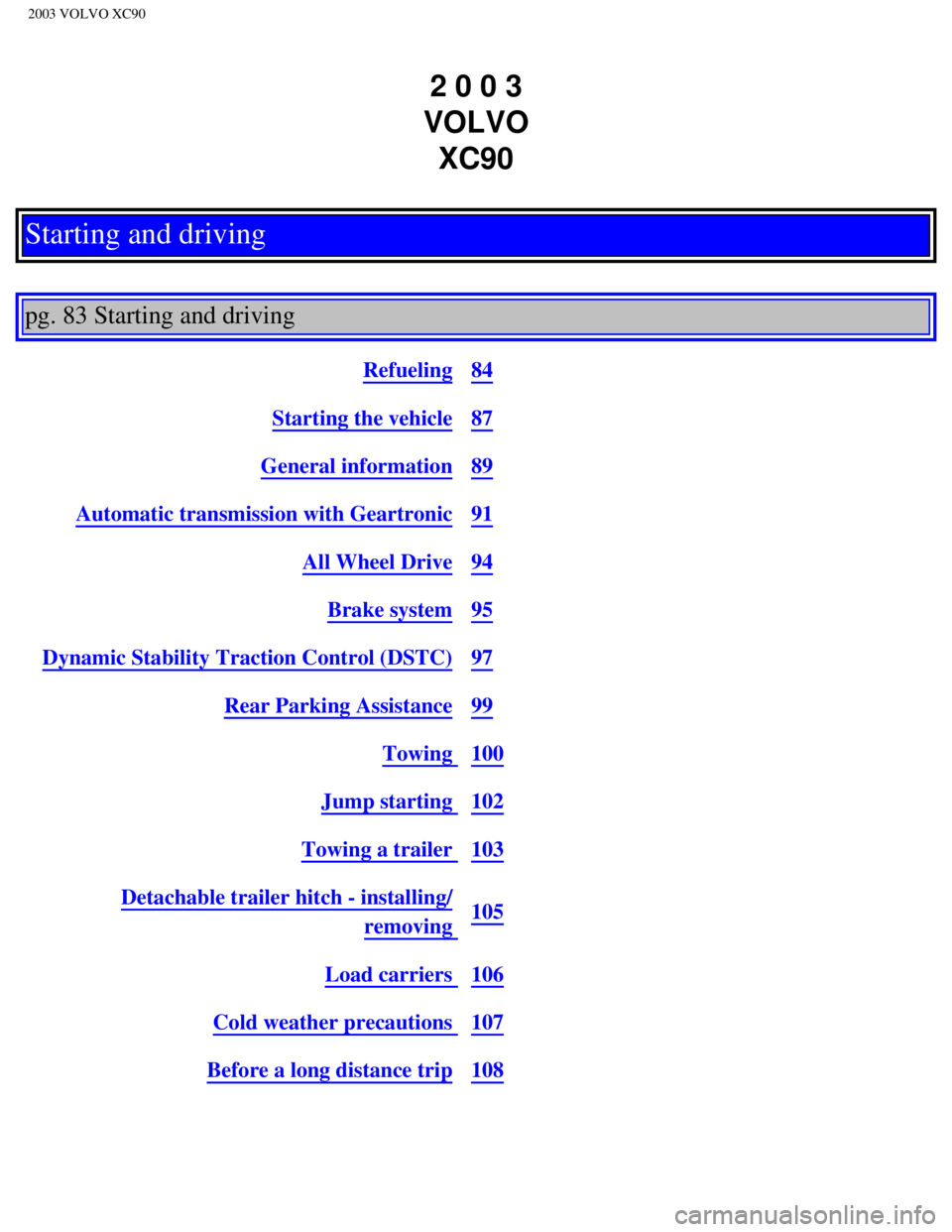
2003 VOLVO XC90
2 0 0 3
VOLVO XC90
Starting and driving
pg. 83 Starting and driving
Refueling84
Starting the vehicle87
General information89
Automatic transmission with Geartronic91
All Wheel Drive94
Brake system95
Dynamic Stability Traction Control (DSTC)97
Rear Parking Assistance99
Towing 100
Jump starting 102
Towing a trailer 103
Detachable trailer hitch - installing/
removing 105
Load carriers 106
Cold weather precautions 107
Before a long distance trip108
file:///K|/ownersdocs/2003/2003_XC90/03xc90_06a.htm (1 of 15)12/30/200\
6 4:18:58 PM
Page 118 of 242

2003 VOLVO XC90
to spin, an electronically controlled coupling distributes power to the \
wheels that have the best traction.
Tire dimensions
Volvo recommends that you always drive on tires of the same brand, size,\
construction (radial), tread
pattern, load-, speed-, traction-, temperature-, and treadwear rating. N\
ever drive on mixed tires, except
for brief periods when the temporary spare tire is in use. Always use pr\
operly inflated tires of correct
dimensions. Tire size and inflation pressures are shown on the tire pres\
sure label located inside the fuel
filler door.
Tire Rotation
Volvo recommends rotating the tires every 7,500 miles (12,000 km). Tir\
es should be rotated front-to-
back/back-to-front only. Tires must maintain the same direction of rotat\
ion throughout their lifetime, and
should never be rotated from one side of the vehicle to the other.
Temporary Spare
The temporary spare tire is for temporary, lowspeed, short-distance use \
only. Replace it with a full-sized
tire as soon as possible, in accordance with "Tire Rotation" in the prev\
ious paragraph. Do not drive on
the temporary spare at speeds above 50 m.p.h. (80km/h) or for distance\
s greater than 50 miles (80 km).
Never install snow chains on a temporary spare.
Contents | Top of Page
file:///K|/ownersdocs/2003/2003_XC90/03xc90_06a.htm (15 of 15)12/30/20\
06 4:18:58 PM
Page 121 of 242

2003 VOLVO XC90
If the BRAKE and ABS warning lights come on at the same time, this could\
indicate a fault in the brake
system.
l Stop the vehicle in a suitable place and switch off the engine.
l Restart the engine.
l If both warning lights go off, no further action is required.
l If both lights are still on after the engine has been restarted, switch \
off the engine again and check the
brake fluid level (see
page 128 for the location of the brake fluid reservoir).
l If the brake fluid level is above the MIN mark, drive carefully to an au\
thorized Volvo retailer and
have the brake system inspected.
WARNING!
If the fluid level is below the MIN mark in the reservoir or if a "Brake\
failure - Service urgent"
message is displayed in the text window: DO NOT DRIVE. Have the vehicle \
towed to a Volvo
retailer and have the brake system inspected.
pg. 97 Starting and driving
Dynamic Stability Traction Control (DSTC)
The DSTC system on the Volvo XC90 consists of a number of functions:
1. Traction control (TC)
This function is designed to help reduce wheel spin by transferring powe\
r from a drive wheel that begins
to lose traction to the wheel on the opposite side of the vehicle (on t\
he same axle). TC monitors and
compares the rotational speed of the drive wheels. If one of the drive w\
heels shows a tendency to spin,
the difference in speed is immediately detected. This triggers the Anti-\
lock Brake System, which brakes
the spinning wheel until the difference in rotational speed is corrected\
.
TC is most active at low speeds, and a pulsating sound will be audible w\
hen the system is regulating
wheel spin. This is quite normal.
This is one of the DSTC system's permanent functions and is not affected\
when the DSTC button on the
center control panel is pressed.
2. Spin control (SC)
The spin control function is designed to help prevent the drive wheels f\
rom spinning while the vehicle is
accelerating. This is done by temporarily reducing engine torque to the \
drive wheels, which helps
file:///K|/ownersdocs/2003/2003_XC90/03xc90_06b.htm (3 of 17)12/30/200\
6 4:18:59 PM
Page 122 of 242

2003 VOLVO XC90
improve tractive force. Under certain circumstances, such as when drivin\
g with snow chains, or driving
in deep snow or loose sand, it may be advisable to temporarily switch of\
f this function for maximum
tractive force. This is done by pressing the DSTC button on the center c\
ontrol panel for at least a half a
second.
When the SC function has been switched off:
l The text window will briefly display "DSTC SPIN CONTROL OFF"
l The LED in the DSTC button will be off.
3. Active Yaw Control (AYC)
This function helps maintain directional stability, for example when cor\
nering, by braking one or more
of the wheels if the vehicle shows a tendency to skid or slide laterally\
. This is done by activating the
Anti-lock Braking System. A pulsating sound will be audible when the fun\
ction is active, which is quite
normal. If you apply the brakes while this function is active, the brake\
pedal will feel stiffer than usual.
This is also one of the DSTC system's permanent functions and is not aff\
ected when the DSTC button on
the center control panel is pressed.
4. Roll Stability Control (RSC)
RSC utilizes a gyro-sensor to monitor the vehicle's angle of inclination\
, and the rate at which this angle
changes. If necessary, RSC activates the Anti-lock Brake System to brake\
one or more of the wheels to
help maintain stability. A pulsating sound will be audible when the func\
tion is active, which is quite
normal. If you apply the brakes while this function is active, the brake\
pedal will feel stiffer than usual.
This is one of the DSTC system's permanent functions and is not affected\
when the DSTC button on the
center control panel is pressed.
pg. 98 Starting and driving
Dynamic Stability Traction Control (DSTC) (contd)
The DSTC button
The DSTC button in the center control panel is used to switch the Spin C\
ontrol (SC) function on or off.
The button must be pressed for at least a half second to prevent SC from\
being switched off
inadvertently.
When the system has been switched off, the green indicator lamp in the b\
utton will go out and "DSTC
SPIN CONTROL OFF" will be displayed in the text window.
file:///K|/ownersdocs/2003/2003_XC90/03xc90_06b.htm (4 of 17)12/30/200\
6 4:18:59 PM
Page 123 of 242
activated each time the engine is started.
The Stability Control indicator light
The Stability Control indicator light will come on for approximately 2 s\")
2003 VOLVO XC90
All DSTC functions are (re)activated each time the engine is started.
The Stability Control indicator light
The Stability Control indicator light will come on for approximately 2 s\
econds when the ignition is
switched on as the system performs a self-diagnostic test.
The Stability Control indicator light will flash when:
l Traction Control is actively functioning to help avoid drive-wheel spin.\
l Spin Control is actively functioning to help avoid loss of traction duri\
ng acceleration.
l Active Yaw Control is actively functioning to help avoid skids or latera\
l slides.
l Roll Stability Control is actively functioning to help avoid a roll-over\
situation.
The warning symbol in the instrument panel
A steady yellow glow indicates:
l That the system has been automatically disengaged due to a fault. "ANTI \
SKID SERVICE
REQUIRED" be displayed in the text window. An authorized Volvo retailer \
should check the system.
l In the event of high brake temperature, "TRACTION CONTROL TEMPORARILY OF\
F" will be
displayed in the text window. The system will automatically switch on ag\
ain when the brakes have
cooled.
Emergency Brake Assistance (EBA)
The EBA function is an integrated part of the DSTC system. EBA is design\
ed to provide full brake
effect immediately in the event of sudden, hard braking. The system is a\
ctivated by the speed with which
you depress the brake pedal.
NOTE:
l When the EBA system is activated, the brake pedal will go down and press\
ure in the brake system
immediately increases to the maximum level. Maintain full pressure on th\
e brake pedal in order to utilize
the system completely. EBA is automatically deactivated when the brake p\
edal is released.
l When the vehicle has been parked for some time, the brake pedal may sink\
more than usual when the
engine is started. This is normal and the pedal will return to its usual\
position when it is released.
pg. 99 Starting and driving
Rear Parking Assistance
file:///K|/ownersdocs/2003/2003_XC90/03xc90_06b.htm (5 of 17)12/30/200\
6 4:18:59 PM
Page 147 of 242

2003 VOLVO XC90
TREADWEAR
The treadwear grade is a comparative rating based on the wear rate of th\
e tire when tested under
controlled conditions on a specified government test course. For example\
, a tire graded 150 would wear
one and one half (1 1/2) times as well on the government course as a t\
ire graded 100. The relative
performance of tires depends upon the actual conditions of their use, ho\
wever, and many depart
significantly from the norm due to variation in driving habits, maintena\
nce practices and differences in
road characteristics and climate.
TRACTION
The traction grades, from highest to lowest, are AA, A, B, and C, as mea\
sured under controlled
conditions on specified government test surfaces of asphalt and concrete\
. A tire marked C may have
poor traction performance.
WARNING!
The traction grade assigned to this tire is based on braking (straight-\
ahead) traction tests and is not a
measure of cornering (turning) traction.
TEMPERATURE
The temperature grades are AA (the highest), A, B, and C, representing\
the tire's resistance to the
generation of heat and its ability to dissipate heat when tested under c\
ontrolled conditions on specified
indoor laboratory test wheel. Sustained high temperature can cause the m\
aterial of the tire to degenerate
and reduce tire life, and excessive temperature can lead to sudden tire \
failure. The grade C corresponds
to minimum level of performance that all passenger vehicle tires must me\
et under the Federal Motor
Safety Standard No. 109. Grades B and A represent higher levels of perfo\
rmance on the laboratory test
wheel than the minimum required by law.
WARNING!
The temperature grade for this tire is established for a tire that is pr\
operly inflated and not overloaded.
Excessive speed, underinflation, or excessive loading, either separately\
or in combination, can cause
heat buildup and possible tire failure.
pg. 119 Wheels and tires
Changing wheels
file:///K|/ownersdocs/2003/2003_XC90/03xc90_08.htm (7 of 12)12/30/2006\
4:19:01 PM
Page 239 of 242

2003 VOLVO XC90
retailer before installing any accessory in or on your vehicle.
l Accessories that have not been approved by Volvo may or may not be speci\
fically tested for
compatibility with your vehicle. Additionally, an inexperienced installe\
r may not be familiar with some
of your vehicle's systems.
l Any of your vehicle's performance and safety systems could be adversely \
affected if you install
accessories that Volvo has not tested, or if you allow accessories to be\
installed by someone unfamiliar
with your vehicle.
l Damage caused by unapproved or improperly installed accessories may not \
be covered by your new
vehicle warranty. See your Warranty and Service Records Information book\
let for more warranty
information. Volvo assumes no responsibility for death, injury, or expen\
ses that may result from the
installation of nongenuine accessories.
Driver Distraction
l Driver distraction results from driver activities that are not directly \
related to controlling the vehicle in
the driving environment. Your new Volvo is, or can be, equipped with man\
y feature-rich entertainment
and communication systems. These include hands-free cellular telephones,\
navigation systems, and
multipurpose audio systems. You may also own other portable electronic d\
evices for your own
convenience. When used properly and safely, they enrich the driving expe\
rience. Improperly used, any
of these could cause a distraction.
l For all of these systems, we want to provide the following warning that \
reflects the strong Volvo
concern for your safety:
l Never use these devices or any feature of your vehicle in a way that dis\
tracts you from the task of
driving safely. Distraction can lead to a serious accident.In addition t\
o this general warning, we offer the
following guidance regarding specific newer features that may be found i\
n your vehicle:
l Never use a hand-held cellular telephone while driving. Some jurisdictio\
ns prohibit cellular telephone
use by a driver while the vehicle is moving.
l If your vehicle is equipped with a navigation system, set and make chang\
es to your travel itinerary
only with the vehicle parked.
l Never program your audio system while the vehicle is moving. Program rad\
io presets with the vehicle
parked, and use your programmed presets to make radio use quicker and si\
mpler.
l Never use portable computers or personal digital assistants while the ve\
hicle is moving. A driver has a
responsibility to do everything possible to ensure his or her own safety\
and the safety of passengers in
the vehicle and others sharing the roadway. Avoiding distractions is par\
t of that responsibility.
file:///K|/ownersdocs/2003/2003_XC90/03xc90_12.htm (11 of 14)12/30/200\
6 4:19:09 PM