warning VOLVO XC90 2004 Repair Manual
[x] Cancel search | Manufacturer: VOLVO, Model Year: 2004, Model line: XC90, Model: VOLVO XC90 2004Pages: 245, PDF Size: 7.14 MB
Page 127 of 245

This system is used to assist you when backing into parking spaces, etc \")
Downloaded from www.Manualslib.com manuals search engine ProCarManuals.com
2004 VOLVO XC90
Rear Parking Assistance (option)
This system is used to assist you when backing into parking spaces, etc \
by providing an audible tone as
you back up.
The system is automatically activated when you select reverse gear.
It utilizes ultrasound sensors located in the rear bumper to measure the\
distance to a vehicle or other
object, or a person who may be behind the vehicle.
When the system is active:
1. The audio system's volume will be reduced.
2. An intermittent signal will be audible from the audio system's speake\
rs to indicate that as you back
up, you are approaching a person, object, parked vehicle, etc. The signa\
ls begin when the vehicle is at a
distance of approximately 5 feet (1.5 meters) from an object/person, e\
tc.
3. At a distance of approximately 1 foot (30 cm), the signal will beco\
me constant.
Switching off the system
Towing a trailer, carrying bicycles in a tailgate-mounted carrier, etc, \
could trigger the reverse warning
system.
file:///K|/ownersdocs/2004/2004_XC90/04xc90_06b.htm (6 of 17)12/30/200\
6 4:35:23 PM
Page 128 of 245
.\")
Downloaded from www.Manualslib.com manuals search engine ProCarManuals.com
2004 VOLVO XC90
To temporarily off the system
l Press the button in the center control panel (see illustration above).\
The LED in the button will go out
to indicate that the system is not in active mode.
l Press the button again to reactivate the system.
Faults in the system
If a fault should occur in the system, the LED in the button will be swi\
tched off and a message will be
displayed in the text window.
Cleaning the sensors
For the system to function properly, the sensors should be kept clean. T\
hey can be cleaned with car
washing detergent and a sponge.
WARNING!
This system is designed to be a supplementary aid when the vehicle is ba\
cking up. It is not, however,
intended to replace the driver's attention and judgement.
pg. 98 Starting and driving
Towing
Positions for attaching towing eyelets
Emergency towing
The towing eyelet is located in the tool bag, under the floor of the car\
go area. This eyelet must be
screwed into the positions provided on the right sides of either the fro\
nt or rear bumper (see illustrations).
To attach the towing eyelet:
A Use a coin to pry open the lower edge of the cover (A).
file:///K|/ownersdocs/2004/2004_XC90/04xc90_06b.htm (7 of 17)12/30/200\
6 4:35:23 PM
Page 129 of 245
 in place (B), first by hand and then us\
ing the tire iron until it is securely")
Downloaded from www.Manualslib.com manuals search engine ProCarManuals.com
2004 VOLVO XC90
B Screw the towing eyelet (C) in place (B), first by hand and then us\
ing the tire iron until it is securely
in place.
After the vehicle has been towed, the eyelet should be removed and retur\
ned to the tool bag. Press the
cover back into position.
Precautions when the vehicle is in tow
l The steering wheel must be unlocked. Turn the ignition key to position I\
or II.
l The gear selector must be in position N.
l Maximum speed: 50 mph (80 km/h). Do not exceed the maximum allowable t\
owing speed.
l Maximum distance with front wheels on ground: 50 miles (80 km).
l While the vehicle is being towed, try to keep the tow rope taut at all t\
imes.
l The vehicle should only be towed in forward direction.
CAUTION
- Please check with state and local authorities before attempting this t\
ype of towing, as vehicles being
towed are subject to regulations regarding maximum towing speed, length \
and type of towing device,
lighting, etc.
- If the vehicle's battery is dead, do not attempt to start the vehicle \
by pushing or pulling it as this will
damage the three-way catalytic converter(s). The engine must be jump s\
tarted using an auxiliary
battery (see
page 100).
- If the vehicle is being towed on a flat bed truck, the towing eyelets \
must not be used to secure the
vehicle on the flat bed. Consult the tow truck operator.
WARNING!
- Remember that the power brakes and power steering will not function wh\
en engine is not running.
The braking and steering systems will function but the brake pedal press\
ure required is 3 - 4 times
above normal and greater steering effort must be exerted.
- The towing eyelets must not be used for pulling the vehicle out of a d\
itch or for any similar purpose
involving severe strain. Do not use the towing eyelets to pull the vehic\
le up onto a flat bed tow truck.
pg. 99 Starting and driving
file:///K|/ownersdocs/2004/2004_XC90/04xc90_06b.htm (8 of 17)12/30/200\
6 4:35:23 PM
Page 130 of 245
Downloaded from www.Manualslib.com manuals search engine ProCarManuals.com
2004 VOLVO XC90
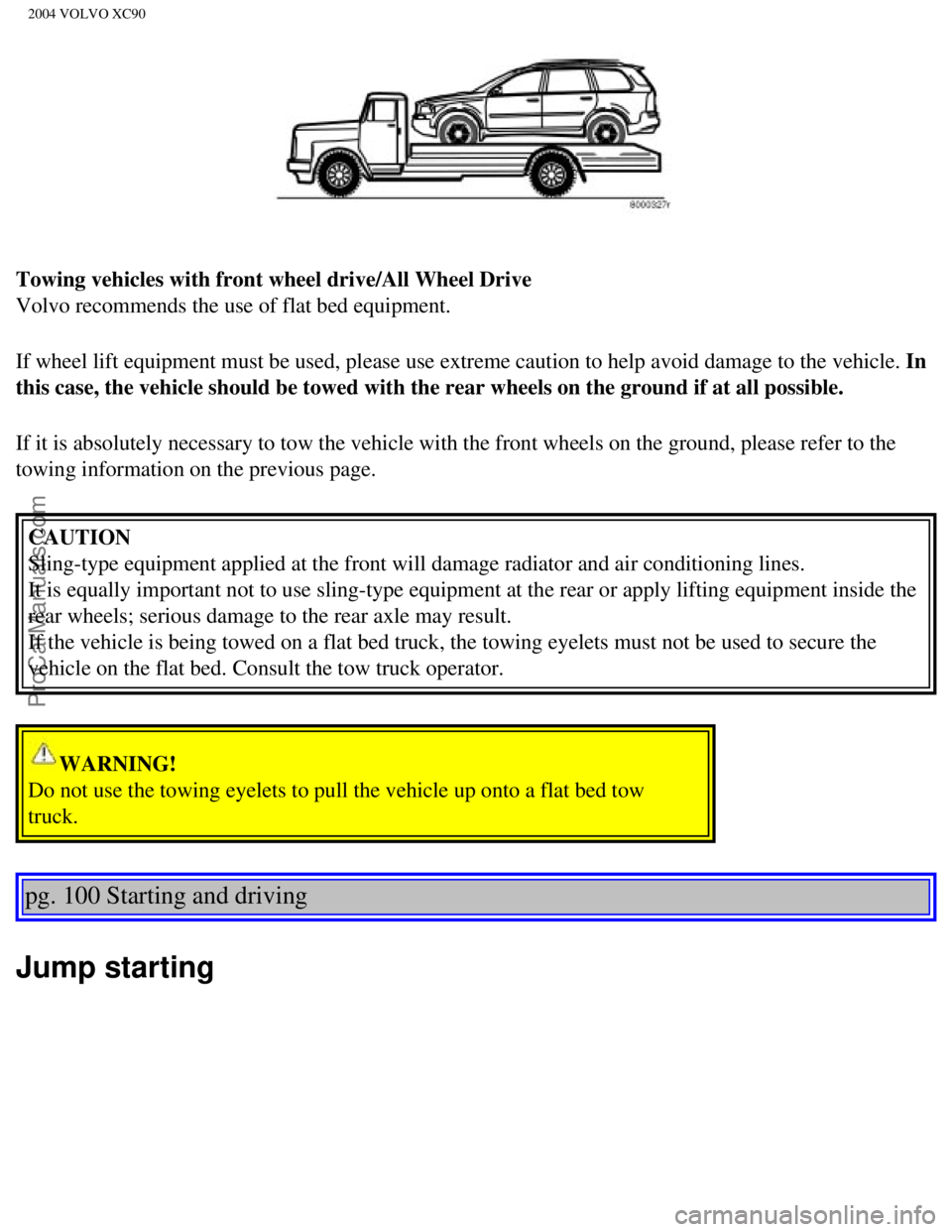
Towing vehicles with front wheel drive/All Wheel Drive
Volvo recommends the use of flat bed equipment.
If wheel lift equipment must be used, please use extreme caution to help\
avoid damage to the vehicle. In
this case, the vehicle should be towed with the rear wheels on the groun\
d if at all possible.
If it is absolutely necessary to tow the vehicle with the front wheels o\
n the ground, please refer to the
towing information on the previous page. CAUTION
Sling-type equipment applied at the front will damage radiator and air c\
onditioning lines.
It is equally important not to use sling-type equipment at the rear or a\
pply lifting equipment inside the
rear wheels; serious damage to the rear axle may result.
If the vehicle is being towed on a flat bed truck, the towing eyelets mu\
st not be used to secure the
vehicle on the flat bed. Consult the tow truck operator.
WARNING!
Do not use the towing eyelets to pull the vehicle up onto a flat bed tow\
truck.
pg. 100 Starting and driving
Jump starting
file:///K|/ownersdocs/2004/2004_XC90/04xc90_06b.htm (9 of 17)12/30/200\
6 4:35:23 PM
Page 131 of 245

Downloaded from www.Manualslib.com manuals search engine ProCarManuals.com
2004 VOLVO XC90
Jump starting
Follow these instructions to jump start your vehicle's dead battery or t\
o jump start another vehicle's dead
battery using your vehicle.
Although your vehicle's battery is located under the floor of the cargo \
area, jumper cables should be
connected in the engine compartment, to the points shown in the illustrations.
If the 12-volt auxiliary battery to be used is in another vehicle, check\
that the vehicles are not touching
to prevent premature completion of a circuit. Be sure to follow jump sta\
rting instructions provided for
the other vehicle.
To jump start your vehicle:
l Switch off the ignition.
l First connect the auxiliary battery positive (+) terminal (1) to the\
positive (+) terminal in your
vehicle's engine compartment (2), located under a small black plastic \
cover attached to the fuse box
cover, marked with a "+" sign.
Remove the cover on the main fuse box if necessary to access this termin\
al. Then connect the auxiliary
battery's negative (- ) terminal (3) to the ground point in your veh\
icle's engine compartment (4).
l Start the engine in the assisting vehicle, then start the engine in the \
vehicle with dead battery.
l After the engine has started, first remove the negative (-) terminal j\
umper cable. Then remove the
positive (+) terminal jumper cable.
WARNING!
PROPOSITION 65 WARNING!
Battery posts, terminals, and related accessories contain lead and lead \
compounds, chemicals known
to the state of California to cause cancer and reproductive harm. Wash h\
ands after handling
file:///K|/ownersdocs/2004/2004_XC90/04xc90_06b.htm (10 of 17)12/30/20\
06 4:35:23 PM
Page 132 of 245

Downloaded from www.Manualslib.com manuals search engine ProCarManuals.com
2004 VOLVO XC90
WARNING!
- Do not connect the jumper cable to any part of the fuel system or to a\
ny moving parts. Avoid
touching hot manifolds.
Never expose the battery to open flame or electric spark.
- Do not smoke near the battery.
- Batteries generate hydrogen gas, which is flammable and explosive.
- Battery fluid contains sulphuric acid. Do not allow battery fluid to c\
ontact eyes, skin, fabrics or
painted surfaces. If contact occurs, flush the affected area immediately\
with water. Obtain medical
help immediately if eyes are affected.
- Failure to follow the instructions for jump starting can lead to perso\
nal injury.
pg. 101 Starting and driving
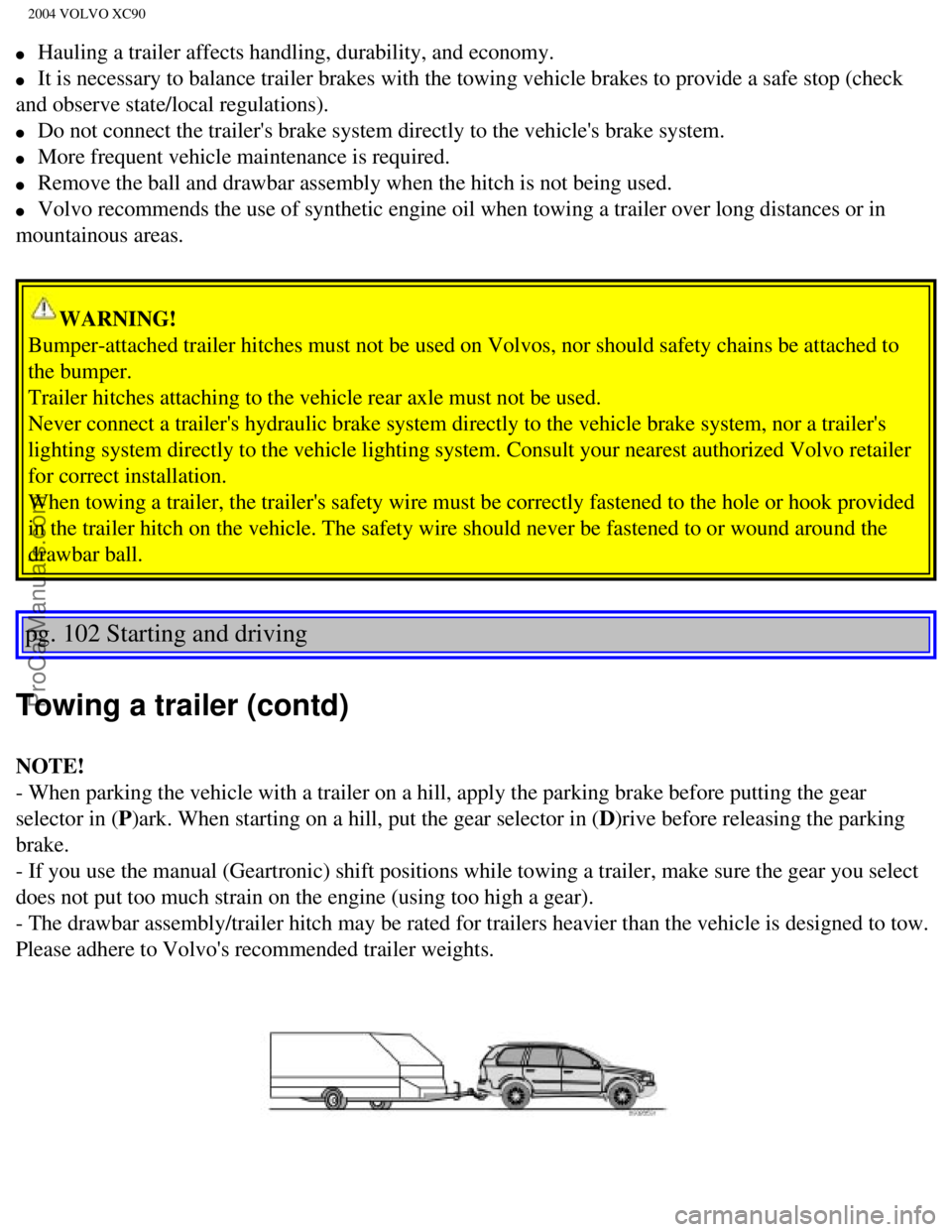
Towing a trailer
Volvo recommends the use of Volvo trailer hitches that are specially des\
igned for the vehicle.
l Maximum trailer weights recommended by Volvo are:
All models - trailers without brakes: 1,650 lbs (750 kg)
Models with all wheel drive - trailers with brakes: 4,960 lbs (2250 kg)\
Models with front wheel drive - trailers with brakes: 3,970 lbs (1800 k\
g)
Observe the legal requirements of the state/province in which the vehicl\
es are registered.
l All Volvo models are equipped with energy-absorbing shock-mounted bumper\
s. Trailer hitch
installation should not interfere with the proper operation of this bump\
er system.
Trailer towing does not normally present any particular problems, but ta\
ke into consideration:
l Increase tire pressure to recommended full. See section "Wheels and tire\
s."
l When your vehicle is new, avoid towing heavy trailers during the first 6\
20 miles (1,000 km).
l Recommended hitch tongue load is: Trailer weights below 2,650 lbs (1,200 kg) - 110 lbs (50 kg)
Trailer weights above 2,650 lbs (1,200 kg) - 198 lbs (90 kg)
l Maximum speed when towing a trailer: 50 mph (80 km/h).
l Engine and transmission are subject to increased loads. Therefore, engin\
e coolant temperature should
be closely watched when driving in hot climates or hilly terrain. Use a \
lower gear and turn off the air
conditioner if the temperature gauge needle enters the red range.
l If the automatic transmission begins to overheat, a message will be disp\
layed in the text window.
l Avoid overload and other abusive operation.
file:///K|/ownersdocs/2004/2004_XC90/04xc90_06b.htm (11 of 17)12/30/20\
06 4:35:23 PM
Page 133 of 245
Downloaded from www.Manualslib.com manuals search engine ProCarManuals.com
2004 VOLVO XC90
l Hauling a trailer affects handling, durability, and economy.
l It is necessary to balance trailer brakes with the towing vehicle brakes\
to provide a safe stop (check
and observe state/local regulations).
l Do not connect the trailer's brake system directly to the vehicle's brak\
e system.
l More frequent vehicle maintenance is required.
l Remove the ball and drawbar assembly when the hitch is not being used.
l Volvo recommends the use of synthetic engine oil when towing a trailer o\
ver long distances or in
mountainous areas.
WARNING!
Bumper-attached trailer hitches must not be used on Volvos, nor should s\
afety chains be attached to
the bumper.
Trailer hitches attaching to the vehicle rear axle must not be used.
Never connect a trailer's hydraulic brake system directly to the vehicle\
brake system, nor a trailer's
lighting system directly to the vehicle lighting system. Consult your ne\
arest authorized Volvo retailer
for correct installation.
When towing a trailer, the trailer's safety wire must be correctly faste\
ned to the hole or hook provided
in the trailer hitch on the vehicle. The safety wire should never be fas\
tened to or wound around the
drawbar ball.
pg. 102 Starting and driving
Towing a trailer (contd)
NOTE!
- When parking the vehicle with a trailer on a hill, apply the parking b\
rake before putting the gear
selector in (P)ark. When starting on a hill, put the gear selector in (D)rive before releasing the parking
brake.
- If you use the manual (Geartronic) shift positions while towing a tr\
ailer, make sure the gear you select
does not put too much strain on the engine (using too high a gear).
- The drawbar assembly/trailer hitch may be rated for trailers heavier t\
han the vehicle is designed to tow.
Please adhere to Volvo's recommended trailer weights.
file:///K|/ownersdocs/2004/2004_XC90/04xc90_06b.htm (12 of 17)12/30/20\
06 4:35:23 PM
Page 138 of 245

Downloaded from www.Manualslib.com manuals search engine ProCarManuals.com
2004 VOLVO XC90
l Check all lights, including high beams.
l Reflective warning triangles are legally required in some states/provinc\
es.
l Have a word with your Volvo retailer if you intend to drive in countries\
where it may be difficult to
obtain the correct fuel.
l Consider your destination. If you will be driving through an area where \
snow or ice are likely to
occur, consider snow tires.
* To prevent injury from contact with hot surfaces, do not inspect your \
vehicle's transmission fluid
yourself. Have your vehicle's transmission fluid level inspected by a qu\
alified Volvo service technician.
Contents | Top of Page
file:///K|/ownersdocs/2004/2004_XC90/04xc90_06b.htm (17 of 17)12/30/20\
06 4:35:23 PM
Page 140 of 245

Downloaded from www.Manualslib.com manuals search engine ProCarManuals.com
2004 VOLVO XC90
CAUTION
- During high pressure washing, the spray mouthpiece must never be close\
r to the vehicle than
13" (30 cm). Do not spray into the locks.
- When washing or steam cleaning the engine, avoid spraying water or ste\
am directly on the electrical
components or toward the rear side of the engine.
Special moonroof cautions:
- Always close the moonroof and visor before washing your vehicle.
- Never use abrasive cleaning agents on the moonroof.
- Never use wax on the rubber seals around the moonroof.
l After cleaning the engine, the spark plug wells should be inspected for \
water and blown dry if
necessary.
Suitable detergents: Special vehicle washing detergents should be used. A suitable mixture i\
s about 2.5
fl. oz. (8.5 cl) of detergent to 2.6 US gal. (10 liters) of warm wat\
er. After washing with a detergent the
vehicle should be well rinsed with clean water.
Bumpers: Wash the bumpers with the same cleaning agent used on the rest of the v\
ehicle. Never clean
the bumpers with gasoline or paint thinner. Difficult spots can be remov\
ed with denatured alcohol. To
avoid scratches, do not dry the bumpers with paper.
NOTE: When washing the vehicle, remember to remove dirt from the drain holes i\
n the doors and sills.
WARNING!
When the vehicle is driven immediately after being washed, apply the bra\
kes several times in order to
remove any moisture from the brake linings.
Engine cleaning agents should not be used when the engine is warm. This \
constitutes a fire risk.
pg. 119 Vehicle care
Automatic washing - simple and quick
l We do NOT recommend washing your vehicle in an automatic wash during the\
first six months
(because the paint will not have hardened sufficiently).
l An automatic wash is a simple and quick way to clean your vehicle, but i\
t is worth remembering that
it may not be as thorough as when you yourself go over the vehicle with \
sponge and water. Keeping the
underbody clean is most important, especially in the winter. Some automa\
tic washers do not have
facilities for washing the underbody.
l Before driving into an automatic car wash, make sure that side view mirr\
ors, auxiliary lamps, etc, are
secure, and that any antenna(s) are retracted or removed. Otherwise th\
ere is risk of the machine
file:///K|/ownersdocs/2004/2004_XC90/04xc90_07.htm (2 of 5)12/30/2006 \
4:35:24 PM
Page 148 of 245

Downloaded from www.Manualslib.com manuals search engine ProCarManuals.com
2004 VOLVO XC90
l With warm tires, correct only when the pressure is too low. The tire tem\
perature rises after driving
just a few miles.
Vehicle loading
The tires on your Volvo will perform to specifications at all normal loa\
ds when inflated as
recommended on the tire information label located on the inside of the f\
uel filler door. This label lists
both tire and vehicle design limits. Do not load your vehicle beyond the\
load limits indicated.
WARNING!
Improperly inflated tires will reduce tire life, adversely affect vehicl\
e handling and can possibly lead
to failure resulting in loss of vehicle control without prior warning.
Temporary Spare
The spare tire in your vehicle is called a "Temporary Spare".
Recommended tire pressure (see decal on Fuel filler door) should be ma\
intained irrespective which
position on the vehicle the Temporary Spare tire is used on. In the even\
t of damage this tire, a new one
can be purchased from your Volvo retailer.
WARNING!
Current legislation prohibits the use of the Temporary Spare" tire other\
than as a temporary
replacement for a punctured tire. It must be replaced as soon as possibl\
e by a standard tire. Road
holding and handling may be affected with the "Temporary Spare" in use. \
Do not exceed 50 mph (80
km/h). Do not drive farther than 50 miles (80 km) on a temporary spar\
e tire.
CAUTION
The vehicle must not be driven with wheels of different dimensions or wi\
th a spare tire other than the
one that came with the vehicle. The use of different size wheels can ser\
iously damage your vehicle's
transmission.
The temporary spare tire is for temporary, low-speed, short-distance use\
only. Replace it with a full-
sized tire as soon as possible, in accordance with "Tire Rotation" in th\
e previous paragraph. Do not drive
on the temporary spare at speeds above 50 m.p.h. (80km/h) or for dista\
nces greater than 50 miles (80
km).
Never install snow chains on a temporary spare.
NOTE: Certain models may be equipped with a full-size spare tire. When used, i\
t should be inflated to
file:///K|/ownersdocs/2004/2004_XC90/04xc90_08.htm (5 of 13)12/30/2006\
4:35:25 PM