steering wheel VOLVO XC90 2004 User Guide
[x] Cancel search | Manufacturer: VOLVO, Model Year: 2004, Model line: XC90, Model: VOLVO XC90 2004Pages: 245, PDF Size: 6.36 MB
Page 56 of 245

2004 VOLVO XC90
Cruise control
The cruise control panel is located on the left side of the steering whe\
el hub.
Engaging cruise control/setting speed
l Press the CRUISE button. The word CRUISE will be displayed in the window\
in the lower section of
the speedometer.
l Press + or - to set the current speed
l Increase or decrease speed as desired
NOTE: Cruise control will not function at speeds below 22 mph (35 km/h).
Braking
Cruise control is automatically disengaged when the brake pedal is depre\
ssed. The currently set speed is
stored in memory. Quickly pressing "resume"
will return the vehicle to the previously set speed.
Acceleration
l Momentary acceleration, such as when passing another vehicle, does not a\
ffect cruise control
operation. The vehicle will automatically return to the previously set s\
peed when you release the
accelerator pedal.
l When the cruise control is already engaged, the vehicle's speed can be i\
ncreased or decreased by
holding down + or - until the vehicle reaches the desired speed. One sho\
rt press on either symbol
corresponds to a speed change of approximately 1 mph (1.6 km/h).
Disengaging cruise control
Cruise control can also be disengaged by:
l Pressing the CRUISE button.
l Putting the gear selector in (N)eutral.
NOTE: Cruise control is automatically disengaged if the engine is switched off\
, if the gear selector is
placed in (N)eutral, if the vehicle's speed drops to under 70% of the \
currently set speed or if the wheels
file:///K|/ownersdocs/2004/2004_XC90/04xc90_02b.htm (5 of 16)12/30/200\
6 4:35:15 PM
Page 111 of 245

2004 VOLVO XC90
as possible when the needle nears the red zone, or when the fuel warning\
light comes on.
WARNING!
Never carry a cell phone that is switched on while refueling your vehicl\
e. If the phone rings, this may
cause a spark that could ignite gasoline fumes, resulting in fire and in\
jury.
CAUTION
- Do not refuel with the engine running *. Turn the ignition off or to p\
osition I. If the ignition is on,
an incorrect reading could occur in the fuel gauge
- After refueling, close the fuel filler cap by turning it clockwise unt\
il it clicks into place*.
- Allow for fuel expansion by not overfilling the tank. Overfilling coul\
d also cause damage to the
emission control systems.
- Avoid spilling gasoline during refueling. In addition to causing damag\
e to the environment,
gasolines containing alcohol can cause damage to painted surfaces, which\
may not be covered under
the New Vehicle Limited Warranty.
- Do not use gasolines containing methanol (methyl alcohol, wood alcoho\
l). This practice can result
in vehicle performance deterioration and can damage critical parts in th\
e fuel system. Such damage
may not be covered under the New Vehicle Limited Warranty.
* If the fuel filler cap is not closed tightly or if the engine is runni\
ng when the vehicle is refueled, the
Check Engine Light (malfunction indicator lamp) may indicate a fault. \
However, your vehicle's
performance will not be affected. Use only Volvo original or approved fu\
el filler caps.
pg. 85 Starting and driving
Starting the engine
1. Fasten the seat belt.
WARNING!
Before starting, check that the seat, steering wheel and mirrors are adj\
usted properly. Make sure the
brake pedal can be depressed completely. Adjust the seat if necessary. S\
ee
pages 54, 56.
2. Apply the parking brake if not already set. The gear selector is lock\
ed in the (P)ark position
(Shiftlock).
Manual transmission: the clutch must be fully depressed.
3. Without touching the accelerator pedal, turn the ignition key* to the\
starting position. Allow the
file:///K|/ownersdocs/2004/2004_XC90/04xc90_06a.htm (5 of 15)12/30/200\
6 4:35:22 PM
Page 113 of 245

2004 VOLVO XC90
WARNING!
Always place the gear selector in Park and apply the parking brake befor\
e leaving the vehicle. Never
leave the vehicle unattended with the engine running.
Always open garage doors fully before starting the engine inside a garag\
e to ensure adequate
ventilation. The exhaust gases contain carbon monoxide, which is invisib\
le and odorless but very
poisonous.
pg. 86 Starting and driving
Steering wheel lock
The steering wheel lock might be under tension when the vehicle is parke\
d.
file:///K|/ownersdocs/2004/2004_XC90/04xc90_06a.htm (7 of 15)12/30/200\
6 4:35:22 PM
Page 114 of 245

2004 VOLVO XC90
Turn the steering wheel slightly to free the ignition key.
In order to help reduce vehicle theft, make sure the steering wheel lock\
is engaged before leaving
the vehicle.
WARNING!
Never switch off the ignition (turn the ignition key to position 0) or\
remove the key from the ignition
switch while the vehicle is in motion. This could cause the steering whe\
el to lock, which would make
the vehicle impossible to steer.
* The gear selector must be in the (P)ark position (automatic transmission).
** Please be aware that leaving the key in this position will increase b\
attery drain.
pg. 87 Starting and driving
General information
Economical driving conserves natural resources
Better driving economy may be obtained by thinking ahead, avoiding rapid\
starts and stops and
adjusting the speed of your vehicle to immediate traffic conditions. Obs\
erve the following rules:
l Bring the engine to normal operating temperature as soon as possible by \
driving with a light foot on
the accelerator pedal for the first few minutes of operation. A cold eng\
ine uses more fuel and is subject
to increased wear.
l Whenever possible, avoid using the vehicle for driving short distances. \
This does not allow the engine
to reach normal operating temperature.
l Drive carefully and avoid rapid acceleration and hard braking.
l Use the transmission's (D)rive position as often as possible and avoid using "kickdown" to help
improve fuel economy.
l Do not exceed posted speed limits.
l Avoid carrying unnecessary items (extra load) in the vehicle.
l Maintain correct tire pressure. Check tire pressure regularly (when tir\
es are cold).
l Remove snow tires when threat of snow or ice has ended.
l Note that roof racks, ski racks, etc, increase air resistance and also f\
uel consumption.
l At highway driving speeds, fuel consumption will be lower with the air c\
onditioning on and the
windows closed than with the air conditioning off and the windows open. \
l Using the onboard trip computer's fuel consumption modes can help you le\
arn how to drive more
economically.
Other factors that decrease gas mileage are:
file:///K|/ownersdocs/2004/2004_XC90/04xc90_06a.htm (8 of 15)12/30/200\
6 4:35:22 PM
Page 115 of 245
2004 VOLVO XC90
l Dirty air cleaner
l Dirty engine oil and clogged oil filter
l Dragging brakes
l Incorrect front end alignment
Some of the above mentioned items and others are checked at the standard\
Maintenance intervals.
Weight distribution affects handling
At the specified curb weight your vehicle has a tendency to understeer, \
which means that the steering
wheel has to be turned more than might seem appropriate for the curvatur\
e of a bend. This ensures good
stability and reduces the risk of rear wheel skid. Remember that these p\
roperties can alter with the
vehicle load. The heavier the load in the cargo area, the less the tende\
ncy to understeer.
WARNING!
Driving with the tailgate open: Driving with the tailgate open could lead to poisonous exhaust gases
entering the passenger compartment. If the tailgate must be kept open fo\
r any reason, proceed as
follows
- Close the windows
- Set the ventilation system control to air flow to floor, windshield an\
d side windows and blower
control to its highest setting.
CAUTION
Drive slowly and carefully if going through standing water (i.e. floode\
d roadways, etc.). Damage to
the engine could result if excess water is drawn in through the air inta\
ke system. Never drive the
vehicle in water deeper than 18 inches (48 cm).
pg. 88 Starting and driving
General information (contd)
Handling, roadholding
Vehicle load, tire design and inflation pressure all affect vehicle hand\
ling. Therefore, check that the tires
are inflated to the recommended pressure according to the vehicle load. \
See "Tire pressure" section.
Loads should be distributed so that capacity weight or maximum permissib\
le axle loads are not exceeded.
Driving on rough/unpaved surfaces
The Volvo XC90 is designed primarily for onroad driving, and it has exce\
llent handling characteristics
on very rough or unpaved roads.
file:///K|/ownersdocs/2004/2004_XC90/04xc90_06a.htm (9 of 15)12/30/200\
6 4:35:22 PM
Page 129 of 245
 in place (B), first by hand and then us\
ing the tire iron until it is securely
in place.
After the vehicle has been towed, the eyelet should be remove")
2004 VOLVO XC90
B Screw the towing eyelet (C) in place (B), first by hand and then us\
ing the tire iron until it is securely
in place.
After the vehicle has been towed, the eyelet should be removed and retur\
ned to the tool bag. Press the
cover back into position.
Precautions when the vehicle is in tow
l The steering wheel must be unlocked. Turn the ignition key to position I\
or II.
l The gear selector must be in position N.
l Maximum speed: 50 mph (80 km/h). Do not exceed the maximum allowable t\
owing speed.
l Maximum distance with front wheels on ground: 50 miles (80 km).
l While the vehicle is being towed, try to keep the tow rope taut at all t\
imes.
l The vehicle should only be towed in forward direction.
CAUTION
- Please check with state and local authorities before attempting this t\
ype of towing, as vehicles being
towed are subject to regulations regarding maximum towing speed, length \
and type of towing device,
lighting, etc.
- If the vehicle's battery is dead, do not attempt to start the vehicle \
by pushing or pulling it as this will
damage the three-way catalytic converter(s). The engine must be jump s\
tarted using an auxiliary
battery (see
page 100).
- If the vehicle is being towed on a flat bed truck, the towing eyelets \
must not be used to secure the
vehicle on the flat bed. Consult the tow truck operator.
WARNING!
- Remember that the power brakes and power steering will not function wh\
en engine is not running.
The braking and steering systems will function but the brake pedal press\
ure required is 3 - 4 times
above normal and greater steering effort must be exerted.
- The towing eyelets must not be used for pulling the vehicle out of a d\
itch or for any similar purpose
involving severe strain. Do not use the towing eyelets to pull the vehic\
le up onto a flat bed tow truck.
pg. 99 Starting and driving
file:///K|/ownersdocs/2004/2004_XC90/04xc90_06b.htm (8 of 17)12/30/200\
6 4:35:23 PM
Page 137 of 245

2004 VOLVO XC90
state of charge more frequently and spray an antirust oil on the battery\
posts.
l Volvo recommends the use of snow tires on all four wheels for winter driving - see section "Wheels
and tires."
l To prevent the washer fluid reservoir from freezing, add washer solvents containing antifreeze (see
page 126 for the location of the washer fluid reservoir).
This is important since dirt is often splashed on the windshield during \
winter driving, requiring the
frequent use of the washers and wipers. Volvo Washer Solvent should be d\
iluted as follows:
Down to 14° F (-10° C): 1 part washer solvent and 4 parts water \
Down to 5° F (-15° C): 1 part washer solvent and 3 parts water
Down to 0° F (-18° C): 1 part washer solvent and 2 parts water
Down to -18° F (-28° C): 1 part washer solvent and 1 part water \
l Use Volvo Teflon Lock Spray in the locks.
NOTE: Avoid the use of de-icing sprays as they can cause damage to the locks.
W Winter/Wet driving mode-enhanced vehicle traction
l Mode W will only function if the gear selector is in the (D)rive position.
l Press the button at the base of the gear selector to engage/disengage th\
is driving mode.
l An LED in the button will light up to indicate that W is engaged and thi\
s will also be displayed in the
instrument panel (see
page 24).
l This mode may be selected for starting/moving off on slippery roads.
* Synthetic oil is not used when the oil is changed at the normal mainte\
nance intervals except at owner
request and at additional charge. Please consult your Volvo retailer.
pg. 106 Starting and driving
Before a long distance trip
It is always worthwhile to have your vehicle checked at a Volvo retailer\
before driving long distances.
Your retailer will also be able to supply you with bulbs, fuses, spark p\
lugs and wiper blades for your use
in the event that problems occur.
As a minimum, the following items should be checked before any long trip\
:
l Check that engine runs smoothly and that fuel consumption is normal.
l Check for fuel, oil, and fluid leakage
l Check transmission oil level*.
l Check condition of drive belts.
l Check state of the battery's charge.
l Examine tires carefully (the spare tire as well), and replace those th\
at are worn. Check tire pressures.
l The brakes, front wheel alignment, and steering gear should be checked b\
y your Volvo retailer only.
file:///K|/ownersdocs/2004/2004_XC90/04xc90_06b.htm (16 of 17)12/30/20\
06 4:35:23 PM
Page 169 of 245

2004 VOLVO XC90
Replace : No fluid change required
NOTE: If a problem should occur in the power steering system or if the vehicle\
has no electrical current
and must be towed, it is still possible to steer the vehicle. However, k\
eep in mind that greater effort will
be required to turn the steering wheel.
pg. 131 Interior
Wiper blades
NOTE: The driver's side wiper blade is straight. The passenger's side wiper bl\
ade is curved to match the
curve at the base of the windshield.
Replacing windshield wiper blades
1. Lift the wiper arm off the windshield and hold the blade at a 45° \
to the arm. Press the end of the
plastic clip located on the arm.
2. Slide the wiper blade along the arm to release it from the hook. The \
entire hooked part of the wiper
file:///K|/ownersdocs/2004/2004_XC90/04xc90_09a.htm (13 of 14)12/30/20\
06 4:35:26 PM
Page 191 of 245
15
20. Infotainment system 10
21. Relay extended D1 feed: climate control system, power drivers seat,\
instrument panel 10
22. Headlight s")
2004 VOLVO XC90
19. Heated front passenger's seat (option)15
20. Infotainment system 10
21. Relay extended D1 feed: climate control system, power driver's seat,\
instrument panel 10
22. Headlight switch module, climate control system, onboard diagnostic \
connector,
steering wheel lever modules 5
23. Turn signals 20
24. Automatic transmission - shift inhibitor, extended D2 feed 10
25. Fuel pump 15
26. Moonroof (option) 15
27. Central electronic module, vanity mirror lighting, courtesy lighting\
, glove compartment
lighting, alarm siren* 10
28. Alarm siren* 5
29. -
30. Daytime running lights 10
31. Daytime running lights 10
32. Left front/rear parking lights 7.5
33. Right front/rear parking lights, license plate lights 7.5
34. Front fog 15
35. -
36. High beam headlights 20
37. Navigation system (option), DVD player 10
38. Low beam headlights, Bi-Xenon headlights (option) 15
* Please be aware that if these fuses are not intact, or have been remov\
ed, the alarm will not sound.
pg. 146 Maintenance
Fuses (contd)
file:///K|/ownersdocs/2004/2004_XC90/04xc90_09b.htm (21 of 23)12/30/20\
06 4:35:28 PM
Page 200 of 245
2004 VOLVO XC90
Different types of oil should never be mixed.
Power steering
Grade: ATF
Brake fluid
Fluid type: DOT 4+ boiling point >536°F (280°C), P/N 9437433
Cooling system
Type Positive pressure, closed system.
Coolant Volvo original coolant/antifreeze
Volume 5-cyl. turbo 9.3 US qts. (8.8 liters)
6-cyl. turbo 11.2 US qts (10.6 liters)
The thermostat begins to open at 194°F (90°C).
Suspension
Rear suspension
Individual rear wheel suspension with longitudinal support arms, double \
link arms and track rods.
Front suspension
Spring strut suspension with integrated shock absorbers and control arms\
linked to the support frame.
Power-assisted rack and pinion steering. Safety type steering column.
pg. 153 Specifications
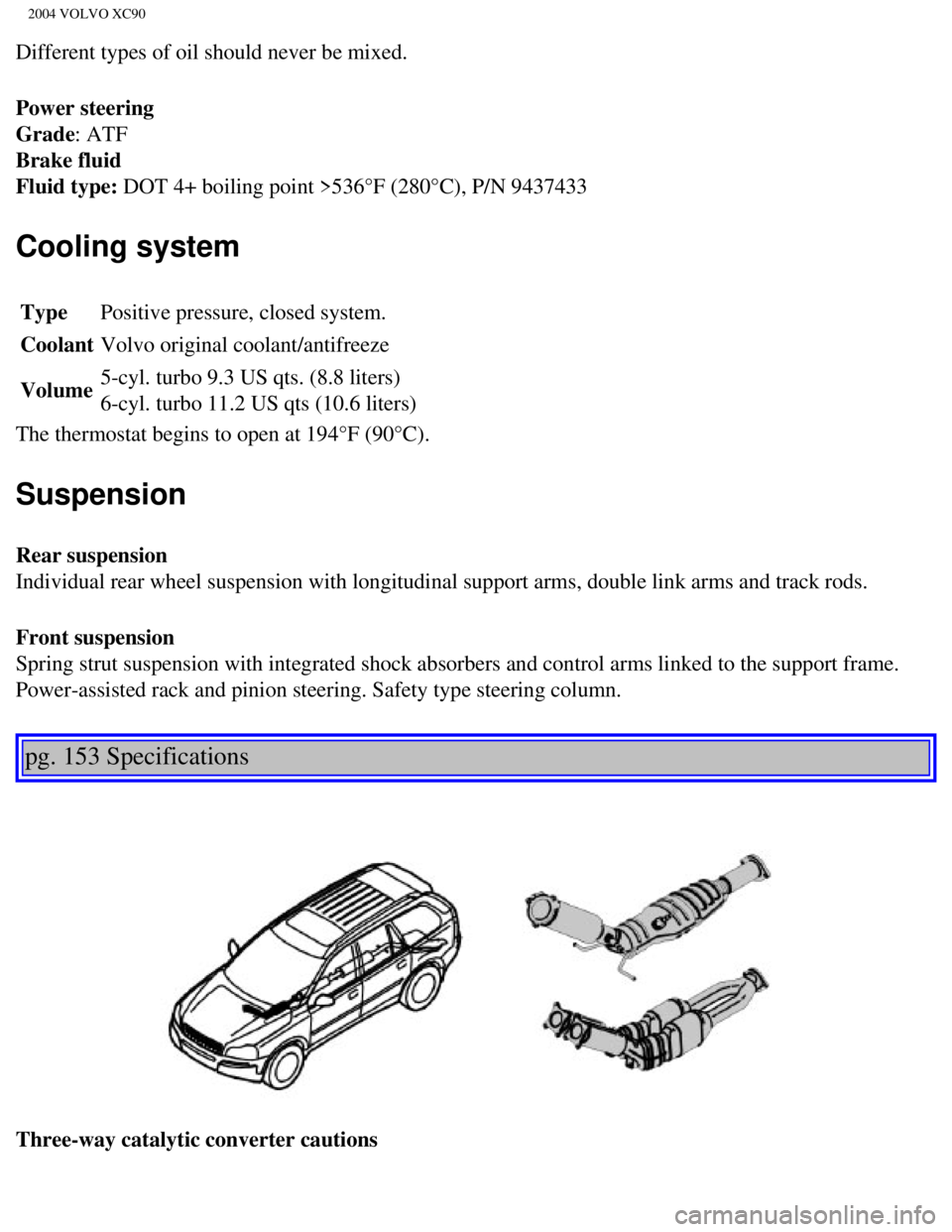
Three-way catalytic converter cautions
file:///K|/ownersdocs/2004/2004_XC90/04xc90_10.htm (7 of 11)12/30/2006\
4:35:29 PM