ESP VOLVO XC90 2005 User Guide
[x] Cancel search | Manufacturer: VOLVO, Model Year: 2005, Model line: XC90, Model: VOLVO XC90 2005Pages: 263, PDF Size: 6.99 MB
Page 160 of 263

61 (420)
a. These weights include the weight of all occupants of the car plus car\
go.
WARNING!
- Never install wheel/tire combinations lar")
2005 VOLVO XC90
Temporary spare tire
T155/85R18 61 (420)
61 (420)
a. These weights include the weight of all occupants of the car plus car\
go.
WARNING!
- Never install wheel/tire combinations larger than 18" on your Volvo XC\
90. Doing so will adversely
affect your vehicle's handling and stability, and safety system performa\
nce.
- Any damage caused by installation of unapproved wheel/tire size combin\
ations will not be covered
by your new vehicle warranty. Volvo assumes no responsibility for death,\
injury, or expenses that
may result from such installations.
pg. 116 Wheels and tires
Tire Pressure Monitoring System (TPMS) - option on certain U.S. models\
only
The tire pressure monitoring system uses sensors mounted in the tire val\
ves to check inflation pressure
levels. When the vehicle is moving at a speed of 20 mph (30 km/h) or f\
aster, these sensors transmit
inflation pressure data to a receiver located in the vehicle.
USA - FCC ID: MRXTG315AM04 This device complies with part 15 of the FCC \
rules. Operation is
subject to the following conditions: (1) This device may not cause har\
mful interference, and (2) this
device must accept any interference received, including interference tha\
t may cause undesired operation.
When low inflation pressure is detected, TPMS will light up the tire pre\
ssure warning light ( ) in the
instrument panel, and will display a message in the text window. The wor\
ding of this message is
determined by the degree of inflation pressure loss.
When the tire pressure monitoring system warning light is on, one or mor\
e of your tires is significantly
under-inflated. You should stop and check your tires as soon as possible\
, and inflate them to the proper
pressure as indicated on the vehicle's tire information placard.
Driving on a significantly under-inflated tire causes the tire to overhe\
at and can lead to tire failure.
Under-inflation also reduces fuel efficiency and tire tread life, and ma\
y affect the vehicle's handling and
stopping ability. Each tire, including the spare, should be checked mont\
hly when cold and set to the
recommended inflation pressure as specified in the vehicle placard and o\
wner's manual.
NOTE: TPMS indicates low tire pressure but does not replace normal tire maint\
enance. For information
on correct tire pressure, please refer to the table on
page 115, or consult your Volvo retailer.
file:///K|/ownersdocs/2005/2005_XC90/05xc90_08.htm (6 of 17)12/30/2006\
4:42:37 PM
Page 166 of 263
2005 VOLVO XC90
pg. 121 Wheels and tires
Uniform Tire Quality Grading
ALL PASSENGER VEHICLE TIRES MUST CONFORM TO FEDERAL SAFETY
REQUIREMENTS IN ADDITION TO THESE GRADES
Quality grades can be found, where applicable, on the tire sidewall betw\
een the tread shoulder
and maximum section width. For example:
Treadwear 200 Traction AA Temperature A
TREADWEAR
The treadwear grade is a comparative rating based on the wear rate of th\
e tire when tested under
controlled conditions on a specified government test course. For example\
, a tire graded 150 would wear
one and one half (1 1/2) times as well on the government course as a t\
ire graded 100. The relative
performance of tires depends upon the actual conditions of their use, ho\
wever, and many depart
significantly from the norm due to variation in driving habits, maintena\
nce practices and differences in
road characteristics and climate.
TRACTION
The traction grades, from highest to lowest, are AA, A, B, and C, as mea\
sured under controlled
conditions on specified government test surfaces of asphalt and concrete\
. A tire marked C may have
poor traction performance.
WARNING!
The traction grade assigned to this tire is based on braking (straight-\
ahead) traction tests and is not a
measure of cornering (turning) traction.
TEMPERATURE
The temperature grades are AA (the highest), A, B, and C, representing\
the tire's resistance to the
generation of heat and its ability to dissipate heat when tested under c\
ontrolled conditions on specified
indoor laboratory test wheel. Sustained high temperature can cause the m\
aterial of the tire to degenerate
and reduce tire life, and excessive temperature can lead to sudden tire \
failure. The grade C corresponds
to minimum level of performance that all passenger vehicle tires must me\
et under the Federal Motor
Safety Standard No. 109. Grades B and A represent higher levels of perfo\
rmance on the laboratory test
wheel than the minimum required by law.
file:///K|/ownersdocs/2005/2005_XC90/05xc90_08.htm (12 of 17)12/30/200\
6 4:42:37 PM
Page 168 of 263

2005 VOLVO XC90
and accelerating. Failure to do so could reduce traction to an unsafe le\
vel or adversely affect handling.
- Do not mix tires of different design as this could also negatively aff\
ect overall tire road grip.
- Winter tires wear more quickly on dry roads in warm weather. They shou\
ld be removed when the
winter driving season has ended.
- Studded tires should be run-in 300-600 miles (500-1000 km) during wh\
ich the car should be driven as
smoothly as possible to give the studs the opportunity to seat properly \
in the tires. The tires should have
the same rotational direction throughout their entire lifetime.
NOTE: Please consult state or provincial regulations restricting the use of st\
udded winter tires before
installing such tires.
1 Where permitted
pg. 123 Wheels and tires
Temporary Spare
The spare tire in your car is called a "Temporary Spare".
Recommended tire pressure (see the placard on the B-pillar or on the fu\
el filler door) should be
maintained irrespective of which position on the car the temporary spare\
tire is used on. In the event of
damage to this tire, a new one can be purchased from your Volvo retailer\
.
WARNING!
! Current legislation prohibits the use of the "Temporary Spare" tire ot\
her than as a temporary
replacement for a punctured tire. It must be replaced as soon as possibl\
e by a standard tire. Road
holding and handling may be affected with the "Temporary Spare" in use. \
Do not exceed 50 mph (80
km/h). Do not drive farther than 50 miles (80 km) on a temporary spar\
e tire.
CAUTION:
The car must not be driven with wheels of different dimensions or with a\
spare tire other than the one
that came with the car. The use of different size wheels can seriously d\
amage your car's transmission.
pg. 124 Wheels and tires
file:///K|/ownersdocs/2005/2005_XC90/05xc90_08.htm (14 of 17)12/30/200\
6 4:42:37 PM
Page 180 of 263

Checking the oil level
The oil level should be checked every time the vehicle is refueled. This\
is especially important
during the peri")
2005 VOLVO XC90
pg. 142 Maintenance
Oil and fluids (contd)
Checking the oil level
The oil level should be checked every time the vehicle is refueled. This\
is especially important
during the period up to the first maintenance. CAUTION
Not checking the oil level regularly can result in serious engine damage\
if the oil level becomes too
low.
Park the vehicle on a level surface and wait for at least 5 minutes afte\
r the engine has been switched
off. Be sure the oil level is maintained between the upper and lower mar\
ks on the dipstick. Low oil
level can cause internal damage to the engine and overfilling can result\
in high oil consumption. The
distance between the dipstick marks represents approx. 1.6 US qt (1.5 l\
iter). The oil should preferably
be checked when cold, before the engine has been started.
NOTE: The engine must be stopped when checking the oil.
WARNING!
Do not allow oil to spill onto or come into contact with hot exhaust pip\
e
surfaces.
file:///K|/ownersdocs/2005/2005_XC90/05xc90_09a.htm (9 of 14)12/30/200\
6 4:42:39 PM
Page 196 of 263
2005 VOLVO XC90
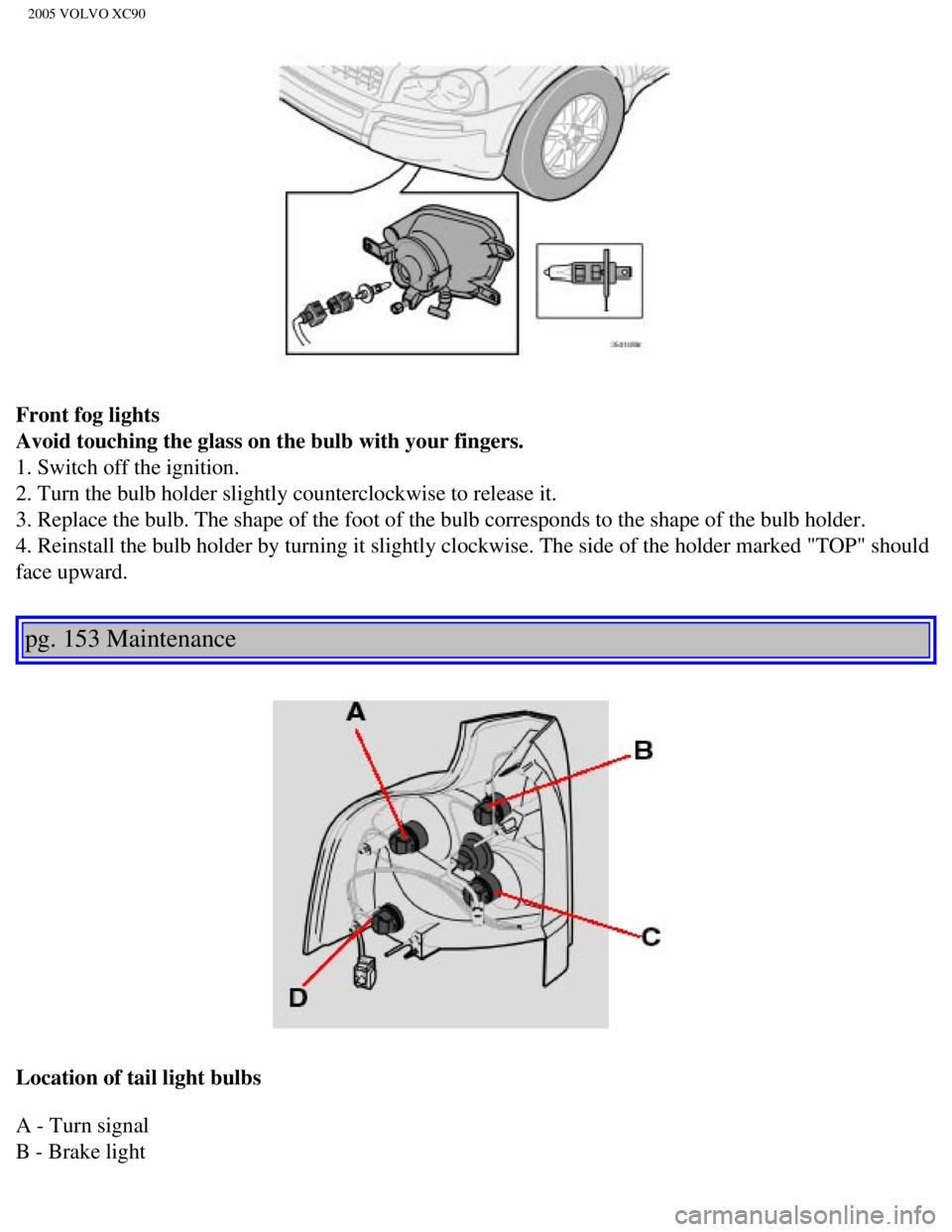
Front fog lights
Avoid touching the glass on the bulb with your fingers.
1. Switch off the ignition.
2. Turn the bulb holder slightly counterclockwise to release it.
3. Replace the bulb. The shape of the foot of the bulb corresponds to th\
e shape of the bulb holder.
4. Reinstall the bulb holder by turning it slightly clockwise. The side \
of the holder marked "TOP" should
face upward.
pg. 153 Maintenance
Location of tail light bulbs
A - Turn signal
B - Brake light
file:///K|/ownersdocs/2005/2005_XC90/05xc90_09b.htm (11 of 25)12/30/20\
06 4:42:40 PM
Page 213 of 263
 1
The VIN plate is located on the top left surface of the dashboard. The V\
IN is also stamped on the right
hand door pillar.
6. Federal Motor")
2005 VOLVO XC90
5. Vehicle Identification Number (VIN) 1
The VIN plate is located on the top left surface of the dashboard. The V\
IN is also stamped on the right
hand door pillar.
6. Federal Motor Vehicle Safety Standards (FMVSS) specifications (USA\
) and Ministry of
Transport (CMVSS) standards (Canada)
Your Volvo is designed to meet all applicable safety standards, as evide\
nced by the certification label on
the facing side of the driver's door. For further information regarding \
these regulations, please consult
your Volvo retailer.
7. Child safety latch label
8. Loads and Tire Pressures U.S. models only
Certain models will only have one decal, depending on the specifications\
of the vehicle.
1 The Vehicle Identification Number (VIN) should always be quoted in a\
ll correspondence concerning your vehicle with the
retailer and when ordering parts.
pg. 165 Specifications
Weights
Gross vehicle weight* USACanada
5-seat, 5-cyl, FWD 5640
lbs -
5-seat, 5-cyl, AWD 5790
lbs 2630 kg
5-seat, 6-cyl, AWD 5900
lbs 2680 kg
7-seat, 5-cyl, FWD 5840
lbs -
7-seat, 5-cyl, AWD 6005
lbs 2720 kg
7-seat, 6-cyl, AWD 6080
lbs 2760 kg
Capacity weight
file:///K|/ownersdocs/2005/2005_XC90/05xc90_10.htm (3 of 10)12/30/2006\
4:42:41 PM
Page 231 of 263
 or the \
AM/FM button (2).
2. Press briefly on
or to search for the next strong station. The radio wi")
2005 VOLVO XC90
Station search
1. Choose radio mode AM/FM1/FM2 using the SELECTOR control (1) or the \
AM/FM button (2).
2. Press briefly on
or to search for the next strong station. The radio will search for the ne\
xt
audible station and then stop.
3. Press one of the buttons again to start a new search.
Manually search for a known frequency
1. Press and hold the
or button (or the corresponding buttons on the steering wheel
keypad). MAN will be shown in the display. The radio will slowly scroll\
in the desired direction and
then increase speed after a few seconds.
2. Release the button when the desired frequency is displayed.
3. If you need to adjust the frequency, press briefly on
or .
4. The manual search function is available for five seconds after you la\
st pressed the button.
pg. 185 Audio
file:///K|/ownersdocs/2005/2005_XC90/05xc90_11a.htm (11 of 18)12/30/20\
06 4:42:43 PM
Page 233 of 263

Automatically storing stations - AUTOSTORE
This functio")
2005 VOLVO XC90
NOTE: The MY KEY buttons can only be programmed for one shortcut function at a\
time.
pg. 186 Audio
Radio functions (contd)
Automatically storing stations - AUTOSTORE
This function automatically searches for, and stores up to 10 strong AM \
or FM stations in a separate
memory. If more than 10 stations are found, the 10 strongest ones will b\
e stored. The function is
especially useful in areas in which you are not acquainted with radio st\
ations or their frequencies.
1. Choose radio mode using the SELECTOR control or the AM/FM button.
2. Select AUTOSTORE in the menu and press ENTER.
3. Select AST SEARCH and press ENTER.
4. AUTOSTORING is shown in the display and a number of strong stations (\
max. 10) from the set
frequency band are now automatically stored in the autostore memory. If \
there are no stations with
sufficient signal strength, NO AST FOUND is displayed.
5. The stored stations are available under the buttons 0-9 (1).
6. When the radio is in autostore mode, AUTO is shown in the display. AU\
TO disappears when you
return to the normal radio mode.
7. Return to normal radio mode by pressing the AM/FM button or EXIT/CLEA\
R.
8. To access previously stored stations, carry out steps 1-2 but select \
AST MODE in step 3 and press
ENTER.
file:///K|/ownersdocs/2005/2005_XC90/05xc90_11a.htm (13 of 18)12/30/20\
06 4:42:43 PM
Page 261 of 263

2005 VOLVO XC90
accessories that Volvo has not tested, or if you allow accessories to be\
installed by someone unfamiliar
with your vehicle.
l Damage caused by unapproved or improperly installed accessories may not \
be covered by your new
vehicle warranty. See your Warranty and Service Records Information book\
let for more warranty
information. Volvo assumes no responsibility for death, injury, or expen\
ses that may result from the
installation of non-genuine accessories.
Driver Distraction
l Driver distraction results from driver activities that are not directly \
related to controlling the vehicle in
the driving environment. Your new Volvo is, or can be, equipped with man\
y feature-rich entertainment
and communication systems. These include hands-free cellular telephones,\
navigation systems, and
multipurpose audio systems. You may also own other portable electronic d\
evices for your own
convenience. When used properly and safely, they enrich the driving expe\
rience. Improperly used, any
of these could cause a distraction.
l For all of these systems, we want to provide the following warning that \
reflects the strong Volvo
concern for your safety:
l Never use these devices or any feature of your vehicle in a way that dis\
tracts you from the task of
driving safely. Distraction can lead to a serious accident.In addition t\
o this general warning, we offer the
following guidance regarding specific newer features that may be found i\
n your vehicle:
l Never use a hand-held cellular telephone while driving. Some jurisdictio\
ns prohibit cellular telephone
use by a driver while the vehicle is moving.
l If your vehicle is equipped with a navigation system, set and make chang\
es to your travel itinerary
only with the vehicle parked.
l Never program your audio system while the vehicle is moving. Program rad\
io presets with the vehicle
parked, and use your programmed presets to make radio use quicker and si\
mpler.
l Never use portable computers or personal digital assistants while the ve\
hicle is moving. A driver has a
responsibility to do everything possible to ensure his or her own safety\
and the safety of passengers in
the vehicle and others sharing the roadway. Avoiding distractions is par\
t of that responsibility.
The following should be checked regularly:*
1. Washer fluid reservoir should be filled with water and solvent (wint\
ertime: windshield washer anti-
freeze). See
page 143.
2. Power steering - When cold, the level must not be above the COLD mark\
and when hot it must not be
above the HOT mark. Top up if the level drops to the ADD mark with ATF f\
luid. See
page 144.
3. Coolant level should be between the expansion tank marks. Mixture: 50\
% antifreeze and 50% water.
See
page 139.
4. Engine oil should be checked each time the vehicle is refueled. The o\
il level should be between the
dipstick marks. The distance between the marks represents approx. 1.6 US\
qt. (1.5 liter). See
page 141.
5. Brake fluid - check, without removing the cap, that the level is abov\
e the MIN mark. Use brake fluid
DOT 4+. See
page 144.
Fuel octane rating, see
page 86.
file:///K|/ownersdocs/2005/2005_XC90/05xc90_12.htm (12 of 14)12/30/200\
6 4:42:46 PM