ECO mode VOLVO XC90 2005 Owner's Manual
[x] Cancel search | Manufacturer: VOLVO, Model Year: 2005, Model line: XC90, Model: VOLVO XC90 2005Pages: 263, PDF Size: 6.99 MB
Page 126 of 263

2005 VOLVO XC90
P Park
Use this position when starting the engine or parking the vehicle.
Never use P while the vehicle is in motion.
The parking brake should also be set whenever the vehicle is parked.
The gear selector is mechanically locked in the P position (SHIFTLOCK)\
. To release the gear
selector from this position, the engine must be running (or the ignitio\
n key must be in position II) and
the brake pedal must be depressed.
N (Neutral)
Neutral - no gear engaged. Use the parking brake.
6-cylinder turbo models
WARNING!
Never leave the vehicle unattended when the engine is running. If, by mi\
stake, the gear selector is
moved from P, the vehicle may start moving.
R (Reverse)
Never engage R while the vehicle is moving forward.
D (Drive)
D is the normal driving position and should be used as often as possible\
to help improve fuel economy.
The vehicle should not be moving when shifting from R to the D position.
file:///K|/ownersdocs/2005/2005_XC90/05xc90_06a.htm (12 of 16)12/30/20\
06 4:42:33 PM
Page 129 of 263

2005 VOLVO XC90
6-cylinder turbo models
pg. 96 Starting and driving
All Wheel Drive
All Wheel Drive (AWD) - general information
Your Volvo can be equipped with permanent All Wheel Drive (option), wh\
ich means that power is
distributed automatically between the front and rear wheels. Under norma\
l driving conditions, most of
the engine's power is directed to the front wheels. However, if there is\
any tendency for the front wheels
to spin, an electronically controlled coupling distributes power to the \
wheels that have the best traction.
Tire dimensions
Volvo recommends that you always drive on tires of the same brand, size,\
construction (radial), tread
pattern, load-, speed-, traction-, temperature-, and treadwear rating. N\
ever drive on mixed tires, except
for brief periods when the temporary spare tire is in use.
Always use properly inflated tires of correct dimensions. Tire size and \
inflation pressures are shown on
the tire inflation pressure placards, located on the driver's side B-pil\
lar (the structural member at the side
of the vehicle, at the rear of the driver's door opening), or on the in\
side of the fuel filler door on
Canadian models.
Temporary Spare
The temporary spare tire is for temporary, lowspeed, short-distance use \
only. Replace it with a full-sized
tire as soon as possible. Do not drive on the temporary spare at speeds \
above 50 m.p.h. (80km/h) or for
distances greater than 50 miles (80 km).
Never install snow chains on a temporary spare.
file:///K|/ownersdocs/2005/2005_XC90/05xc90_06a.htm (15 of 16)12/30/20\
06 4:42:33 PM
Page 142 of 263

2005 VOLVO XC90
Max. trailer
hitch tongue
load400 lbs
(180 kg)
400 lbs
(180 kg)400 lbs
(180 kg)400 lbs
(180 kg)370 lbs
(165 kg)250 lbs (115
kg)
140 lbs (65 kg)
NOTE:
l Recommended hitch tongue load: not more than 10% of the trailer's weight\
.
The trailer load should be positioned so that it does not shift and the \
tongue load should be 10% of the
trailer's weight. However, the tongue load should not exceed the maximum\
permissible weights
indicated in the table above.
l When towing trailers without brakes, the maximum permissible trailer wei\
ght is 1,700 lbs (750 kg).
l If necessary, redistribute the weight of any cargo in the trailer to avo\
id excessive weight on the trailer
hitch.
l The maximum trailer weight listed in the table for All Wheel Drive model\
s, 5,000 lbs (2250 kg) is
only applicable when there are not more than two occupants in the vehicl\
e, in the front seats, with a
combined weight of 300 lbs (135 kg), with no other cargo in the vehicl\
e.
pg. 106 Starting and driving
Towing a trailer (contd)
l The maximum weight listed for Front Wheel Drive models, 4,000 lbs (1800\
kg) is only applicable
when there are not more than four occupants in the vehicle, in the front\
seats and second row of seats,
with a combined weight of 600 lbs (270 kg), with no other cargo in the\
vehicle.
l Please be aware that the load on the trailer hitch is part of the vehicl\
e's total load carrying capacity.
The amount of cargo in the vehicle and the trailer must be limited so th\
at the gross vehicle weight and
maximum permissible rear axle weight
(see page 165) are not exceeded.
l Vehicles used for towing a trailer on a regular basis, or for long-dista\
nce highway towing should be
equipped with an automatic transmission oil cooler and Volvo's automatic\
self-leveling system for the
rear suspension. Consult your Volvo retailer.
l Volvo recommends the use of Volvo trailer hitches that are specially des\
igned for the vehicle.
l All Volvo models are equipped with energy-absorbing shock-mounted bumper\
s. Trailer hitch
installation should not interfere with the proper operation of this bump\
er system.
l Increase tire pressure to recommended full inflation pressure. See chapt\
er "Wheels and tires."
l When your vehicle is new, avoid towing heavy trailers during the first 6\
20 miles (1,000 km).
l Engine and transmission are subject to increased loads. Therefore, engin\
e coolant temperature should
be closely watched when driving in hot climates or hilly terrain. Use a \
lower gear and turn off the air
conditioner if the temperature gauge needle enters the red range.
l If the automatic transmission begins to overheat, a message will be disp\
layed in the text window.
l Hauling a trailer affects handling, durability, and economy.
l It is necessary to balance trailer brakes with the towing vehicle brakes\
to provide a safe stop (check
and observe state/local regulations).
file:///K|/ownersdocs/2005/2005_XC90/05xc90_06b.htm (12 of 18)12/30/20\
06 4:42:35 PM
Page 147 of 263

2005 VOLVO XC90
are used more often. Moreover, the capacity of the battery decreases as \
the temperature drops. In very
cold weather, a poorly charged battery can freeze and be damaged. It is \
therefore advisable to check the
state of charge more frequently and spray an antirust oil on the battery\
posts.
l Volvo recommends the use of snow tires on all four wheels for winter driving - see section "Wheels
and tires."
l To prevent the washer fluid reservoir from freezing, add washer solvents containing antifreeze (see
page 140 for the location of the washer fluid reservoir).
This is important since dirt is often splashed on the windshield during \
winter driving, requiring the
frequent use of the washers and wipers. Volvo Washer Solvent should be d\
iluted as follows:
Down to 14° F (-10° C): 1 part washer solvent and 4 parts water \
Down to 5° F (-15° C): 1 part washer solvent and 3 parts water
Down to 0° F (-18° C): 1 part washer solvent and 2 parts water
Down to -18° F (-28° C): 1 part washer solvent and 1 part water \
l Use Volvo Teflon Lock Spray in the locks.
NOTE: Avoid the use of de-icing sprays as they can cause damage to the locks.
W Winter/Wet driving mode-enhanced vehicle traction
l Mode W will only function if the gear selector is in the (D)rive position.
l Press the button at the base of the gear selector to engage/disengage th\
is driving mode.
l An LED in the button will light up to indicate that W is engaged and thi\
s will also be displayed in the
instrument panel (see
page 26).
l This mode may be selected for starting/moving off on slippery roads.
* Synthetic oil is not used when the oil is changed at the normal mainte\
nance intervals except at owner request and at additional
charge. Please consult your Volvo retailer.
pg. 110 Starting and driving
Before a long distance trip
It is always worthwhile to have your vehicle checked at a Volvo retailer\
before driving long distances.
Your retailer will also be able to supply you with bulbs, fuses, spark p\
lugs and wiper blades for your use
in the event that problems occur.
As a minimum, the following items should be checked before any long trip\
:
l Check that engine runs smoothly and that fuel consumption is normal.
l Check for fuel, oil, and fluid leakage
l Check transmission oil level*.
l Check condition of drive belts.
l Check state of the battery's charge.
file:///K|/ownersdocs/2005/2005_XC90/05xc90_06b.htm (17 of 18)12/30/20\
06 4:42:35 PM
Page 156 of 263

2005 VOLVO XC90
surfaces.
Certain models are equipped with "all-season" tires, which provide a som\
ewhat higher degree of road
holding on slippery surfaces than tires without the "all-season" rating.\
However, for optimum road
holding on icy or snow-covered roads, we recommend suitable winter tires\
on all four wheels.
When replacing tires, be sure that the new tires are the same size desig\
nation, type (radial) and
preferably from the same manufacturer, on all four wheels. Otherwise the\
re is a risk of altering the car's
roadholding and handling characteristics.
NOTE: When storing wheel/tire assemblies (e.g. winter tires and wheels), ei\
ther stand the assemblies
upright, or suspend them off the ground. Laying wheel/tire assemblies on\
their sides for prolonged
periods can cause wheel and/or tire damage.
Tread wear indicator
The tires have wear indicator strips running across or parallel to the t\
read. The letters TWI are printed on
the side of the tire. When approximately 1/16" (1.6 mm) is left on the\
tread, these strips become visible
and indicate that the tire should be replaced. Tires with less than 1/16\
" (1.6 mm) tread offer very poor
traction.
When replacing worn tires, it is recommended that the tire be identical \
in type (radial) and size as the
one being replaced. Using a tire of the same make (manufacturer) will \
prevent alteration of the driving
characteristics of the vehicle.
New tires
Remember that tires are perishable goods. As of 2000, the manufacturing \
week and year will be
indicated with 4 digits (e.g. 1502 means that the tire illustrated was \
manufactured during week 15 of
2002).
file:///K|/ownersdocs/2005/2005_XC90/05xc90_08.htm (2 of 17)12/30/2006\
4:42:37 PM
Page 157 of 263
2005 VOLVO XC90
Improving tire economy:
l Maintain correct tire pressure. See the tire pressure table on page 115.
l Drive smoothly: avoid fast starts, hard braking and tire screeching.
l Tire wear increases with speed.
l Correct front wheel alignment is very important.
l Unbalanced wheels impair tire economy and driving comfort.
l Tires must maintain the same direction of rotation throughout their life\
time.
l When replacing tires, the tires with the most tread should be mounted on\
the rear wheels to reduce the
chance of oversteer during hard braking. Hitting curbs or potholes can d\
amage the tires and/or wheels
permanently.
pg. 113 Wheels and tires
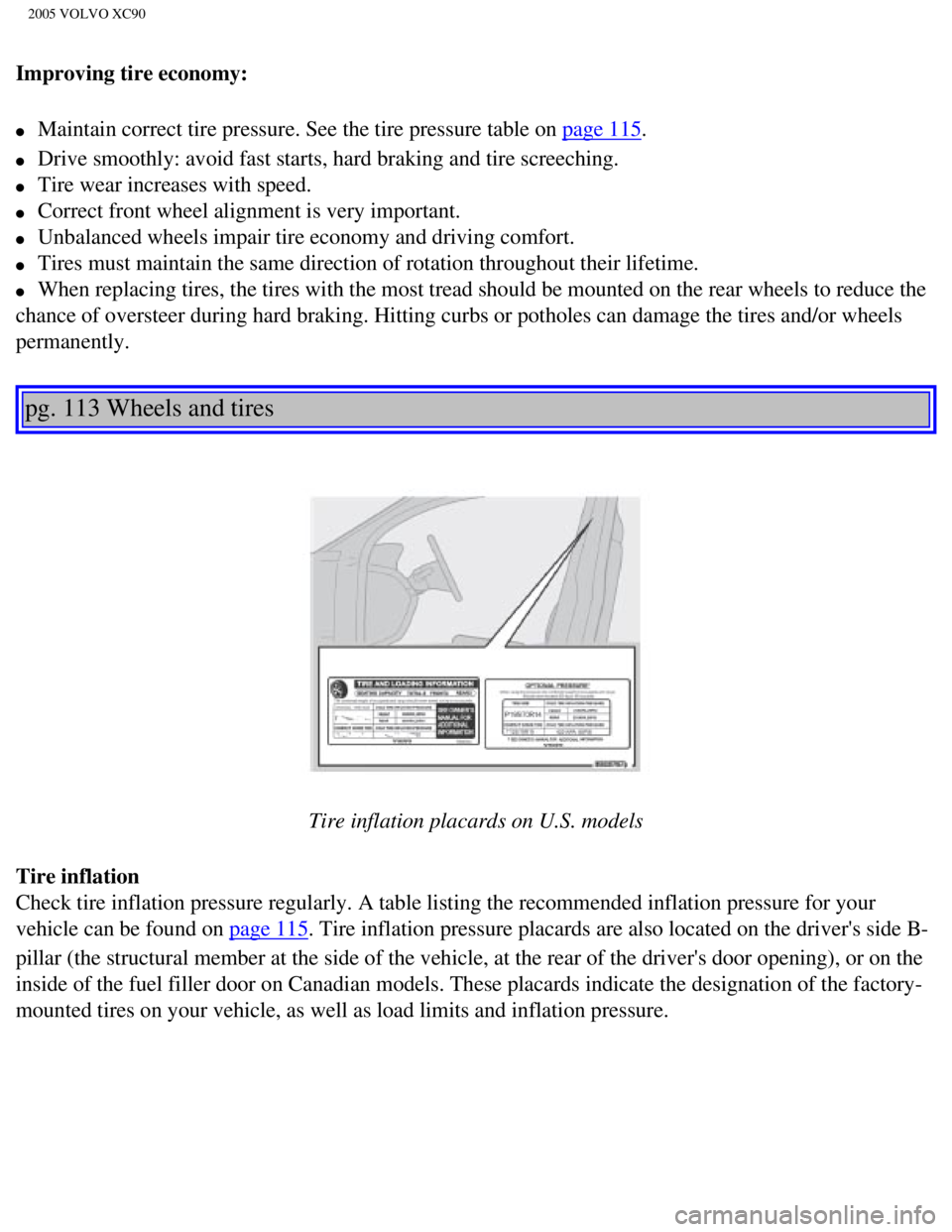
Tire inflation placards on U.S. models
Tire inflation
Check tire inflation pressure regularly. A table listing the recommended\
inflation pressure for your
vehicle can be found on
page 115. Tire inflation pressure placards are also located on the driver's side\
B-
pillar (the structural member at the side of the vehicle, at the rear o\
f the driver's door opening), or on the
inside of the fuel filler door on Canadian models. These placards indica\
te the designation of the factory-
mounted tires on your vehicle, as well as load limits and inflation pres\
sure.
file:///K|/ownersdocs/2005/2005_XC90/05xc90_08.htm (3 of 17)12/30/2006\
4:42:37 PM
Page 158 of 263

2005 VOLVO XC90
Tire inflation placard on Canadian models
NOTE: The placards shown indicate inflation pressure for the tires installed \
on the car at the factory
only.
l Use a tire gauge to check the tire inflation pressure, including the spa\
re, at least once a month and
before long trips. You are strongly urged to buy a reliable tire pressur\
e gauge, as automatic service
station gauges may be inaccurate.
l Use the recommended cold inflation pressure for optimum tire performance\
and wear.
l Under-inflation or over-inflation may cause uneven treadwear patterns.
WARNING!
- Under-inflation is the most common cause of tire failure and may resul\
t in severe tire cracking, tread
separation, or "blowout," with unexpected loss of vehicle control and in\
creased risk of injury.
- Under-inflated tires reduce the load carrying capacity of your vehicle\
.
When weather temperature changes occur, tire inflation pressures also ch\
ange. A 10-degree temperature
drop causes a corresponding drop of 1 psi (7 kPa) in inflation pressur\
e. Check your tire pressures
frequently and adjust them to the proper pressure, which can be found on\
the vehicle's tire information
placard or certification label.
Checking tire pressure
Cold tires
Inflation pressure should be checked when the tires are cold.
The tires are considered to be cold when they have the same temperature \
as the surrounding
(ambient) air.
This temperature is normally reached after the car has been parked for a\
t least 3 hours.
file:///K|/ownersdocs/2005/2005_XC90/05xc90_08.htm (4 of 17)12/30/2006\
4:42:37 PM
Page 160 of 263

61 (420)
a. These weights include the weight of all occupants of the car plus car\
go.
WARNING!
- Never install wheel/tire combinations lar")
2005 VOLVO XC90
Temporary spare tire
T155/85R18 61 (420)
61 (420)
a. These weights include the weight of all occupants of the car plus car\
go.
WARNING!
- Never install wheel/tire combinations larger than 18" on your Volvo XC\
90. Doing so will adversely
affect your vehicle's handling and stability, and safety system performa\
nce.
- Any damage caused by installation of unapproved wheel/tire size combin\
ations will not be covered
by your new vehicle warranty. Volvo assumes no responsibility for death,\
injury, or expenses that
may result from such installations.
pg. 116 Wheels and tires
Tire Pressure Monitoring System (TPMS) - option on certain U.S. models\
only
The tire pressure monitoring system uses sensors mounted in the tire val\
ves to check inflation pressure
levels. When the vehicle is moving at a speed of 20 mph (30 km/h) or f\
aster, these sensors transmit
inflation pressure data to a receiver located in the vehicle.
USA - FCC ID: MRXTG315AM04 This device complies with part 15 of the FCC \
rules. Operation is
subject to the following conditions: (1) This device may not cause har\
mful interference, and (2) this
device must accept any interference received, including interference tha\
t may cause undesired operation.
When low inflation pressure is detected, TPMS will light up the tire pre\
ssure warning light ( ) in the
instrument panel, and will display a message in the text window. The wor\
ding of this message is
determined by the degree of inflation pressure loss.
When the tire pressure monitoring system warning light is on, one or mor\
e of your tires is significantly
under-inflated. You should stop and check your tires as soon as possible\
, and inflate them to the proper
pressure as indicated on the vehicle's tire information placard.
Driving on a significantly under-inflated tire causes the tire to overhe\
at and can lead to tire failure.
Under-inflation also reduces fuel efficiency and tire tread life, and ma\
y affect the vehicle's handling and
stopping ability. Each tire, including the spare, should be checked mont\
hly when cold and set to the
recommended inflation pressure as specified in the vehicle placard and o\
wner's manual.
NOTE: TPMS indicates low tire pressure but does not replace normal tire maint\
enance. For information
on correct tire pressure, please refer to the table on
page 115, or consult your Volvo retailer.
file:///K|/ownersdocs/2005/2005_XC90/05xc90_08.htm (6 of 17)12/30/2006\
4:42:37 PM
Page 163 of 263
: This begins with the let\
ters \"DOT\" and indicates that the
tire meets a")
2005 VOLVO XC90
7. M+S or M/S = Mud and Snow, AT = All Terrain, AS = All Season
8. U.S. DOT Tire Identification Number (TIN): This begins with the let\
ters "DOT" and indicates that the
tire meets all federal standards. The next two numbers or letters are th\
e plant code where it was
manufactured, the next two are the tire size code and the last four numb\
ers represent the week and year
the tire was built. For example, the numbers 317 mean the 31st week of 1\
997. After 2000 the numbers
go to four digits. For example, 2501 means the 25th week of 2001. The nu\
mbers in between are
marketing codes used at the manufacturer's discretion. This information \
helps a tire manufacturer
identify a tire for safety recall purposes.
9. Tire Ply Composition and Material Used: Indicates the number of plies\
indicates or the number of
layers of rubber-coated fabric in the tire tread and sidewall. Tire manu\
facturers also must indicate the
ply materials in the tire and the sidewall, which include steel, nylon, \
polyester, and others.
10. Maximum Load: Indicates the maximum load in pounds and kilograms tha\
t can be carried by the
tire. Refer to the vehicle's tire information placard or the safety cert\
ification label, located on the B-Pillar
or the driver's door or on the inside of the fuel filler door on Canadia\
n models, for the correct tire
pressure for your vehicle.
11. Treadwear, Traction, and Temperature grades: See
page 121 for more information.
12. Maximum permissible inflation pressure: the greatest amount of air p\
ressure that should ever be put
in the tire. This limit is set by the tire manufacturer.
pg. 119 Wheels and tires
Glossary of tire terminology
The tire suppliers may have additional markings, notes or warnings such \
as standard load, radial
tubeless, etc.
Glossary of tire terminology
l Tire information placard: A placard showing the OE (Original Equipment) tire sizes, recommende\
d
inflation pressure, and the maximum weight the vehicle can carry.
l Tire Identification Number (TIN): A number on the sidewall of each tire providing information
about the tire brand and manufacturing plant, tire size and date of manu\
facturer.
l Inflation pressure: A measure of the amount of air in a tire.
l Standard load: A class of P-metric or Metric tires designed to carry a maximum load a\
t 35 psi [37
psi (2.5 bar) for Metric tires]. Increasing the inflation pressure bey\
ond this pressure will not increase the
tires load carrying capability.
l Extra load: A class of P-metric or Metric tires designed to carry a heavier maximu\
m load at 41 psi
file:///K|/ownersdocs/2005/2005_XC90/05xc90_08.htm (9 of 17)12/30/2006\
4:42:37 PM
Page 164 of 263
![VOLVO XC90 2005 Owners Manual
2005 VOLVO XC90
[43 psi (2.9 bar) for Metric tires]. Increasing the inflation pressure\
beyond this pressure will not increase
the tires load carrying capability.
l kPa: Kilopascal, a metric u](/img/45/58559/w960_58559-163.png "VOLVO XC90 2005 Owners Manual
2005 VOLVO XC90
[43 psi (2.9 bar) for Metric tires]. Increasing the inflation pressure\
beyond this pressure will not increase
the tires load carrying capability.
l kPa: Kilopascal, a metric u")
2005 VOLVO XC90
[43 psi (2.9 bar) for Metric tires]. Increasing the inflation pressure\
beyond this pressure will not increase
the tires load carrying capability.
l kPa: Kilopascal, a metric unit of air pressure.
l PSI: Pounds per square inch, a standard unit of air pressure.
l B-pillar: The structural member at the side of the vehicle behind the front door\
.
l Bead area of the tire: Area of the tire next to the rim.
l Sidewall of the tire: Area between the bead area and the tread.
l Tread area of the tire: Area of the perimeter of the tire that contacts the road when mounted \
on the
vehicle.
l Rim: The metal support (wheel) for a tire or a tire and tube assembly upo\
n which the tire beads are
seated.
l Maximum load rating: a figure indicating the maximum load in pounds and kilograms that can \
be
carried by the tire. This rating is established by the tire manufacturer\
.
l Maximum permissible inflation pressure: the greatest amount of air pressure that should ever be
put in the tire. This limit is set by the tire manufacturer.
l Recommended tire inflation pressure: inflation pressure, established by Volvo, which is based on
the type of tires that are mounted on a vehicle at the factory. This inf\
lation pressure is affected by the
number of occupants in the car, the amount of cargo, and the speed at wh\
ich the vehicle will be driven
for a prolonged period. This information can be found on the tire inflat\
ion placard(s) located on the
driver's side B-pillar or on the inside of the fuel filler door on Canad\
ian models, and in the tire inflation
table in this chapter.
l Cold tires: The tires are considered to be cold when they have the same temperatur\
e as the
surrounding (ambient) air. This temperature is normally reached after \
the car has been parked for at least
3 hours.
pg. 120 Wheels and tires
Vehicle loading
Properly loading your vehicle will provide maximum return of vehicle des\
ign performance. Before
loading your vehicle, familiarize yourself with the following terms for \
determining your vehicle's weight
ratings, with or without a trailer, from the vehicle's Federal/Canadian \
Motor Vehicle Safety Standards
(FMVSS/CMVSS) label, and the vehicle's tire information placard:
Curb weight
The weight of the vehicle including a full tank of fuel and all standard\
equipment. It does not include
passengers, cargo, or optional equipment.
Capacity weight
All weight added to the curb weight, including cargo and optional equipm\
ent. When towing, trailer hitch
tongue load is also part of cargo weight.
file:///K|/ownersdocs/2005/2005_XC90/05xc90_08.htm (10 of 17)12/30/200\
6 4:42:37 PM