tires VOLVO XC90 2005 Owner's Manual
[x] Cancel search | Manufacturer: VOLVO, Model Year: 2005, Model line: XC90, Model: VOLVO XC90 2005Pages: 263, PDF Size: 6.99 MB
Page 165 of 263

2005 VOLVO XC90
NOTE: For trailer towing information, please refer to the section "Towin\
g a trailer" on page 105.
Permissible axle weight
The maximum allowable weight that can be carried by a single axle (fron\
t or rear). These numbers are
shown on the Federal/Canadian Motor Vehicle Safety Standards (FMVSS/CMV\
SS) label. The total load
on each axle must never exceed its maximum permissible weight.
Gross vehicle weight (GVW)
The vehicle's curb weight + cargo + passengers.
NOTE:
l The location of the various labels in your vehicle can be found on page 164.
l A table listing important weight limits for your vehicle can be found on\
page 165.
Steps for Determining Correct Load Limit
(1) Locate the statement "the combined weight of occupants and cargo s\
hould never exceed XXX
pounds" on your vehicle's placard.
(2) Determine the combined weight of the driver and passengers that wi\
ll be riding in your vehicle.
(3) Subtract the combined weight of the driver and passengers from XXX\
kilograms or XXX pounds.
(4) The resulting figure equals the available amount of cargo and lugg\
age load capacity. For example, if
the "XXX" amount equals 1400 lbs. and there will be five 150 lb. passeng\
ers in your vehicle, the amount
of available cargo and luggage load capacity is 650 lbs. (1400-750 (5 \
x 150) = 650 lbs.)
(5) Determine the combined weight of luggage and cargo being loaded on\
the vehicle. That weight may
not safely exceed the available cargo and luggage load capacity calculat\
ed in Step 4.
(6) If your vehicle will be towing a trailer, load from your trailer w\
ill be transferred to your vehicle.
Consult this manual
1 to determine how this reduces the available cargo and luggage load capa\
city of
your vehicle.
WARNING!
- Exceeding the permissible axle weight, gross vehicle weight, or any ot\
her weight rating limits can
cause tire overheating resulting in permanent deformation or catastrophi\
c failure.
- Do not use replacement tires with lower load carrying capacities than \
the tires that were original
equipment on the vehicle because this will lower the vehicle's GVW ratin\
g. Replacement tires with a
higher limit than the originals do not increase the vehicle's GVW rating\
limitations.
1. See "Towing a trailer" on
page 105
file:///K|/ownersdocs/2005/2005_XC90/05xc90_08.htm (11 of 17)12/30/200\
6 4:42:37 PM
Page 166 of 263
2005 VOLVO XC90
pg. 121 Wheels and tires
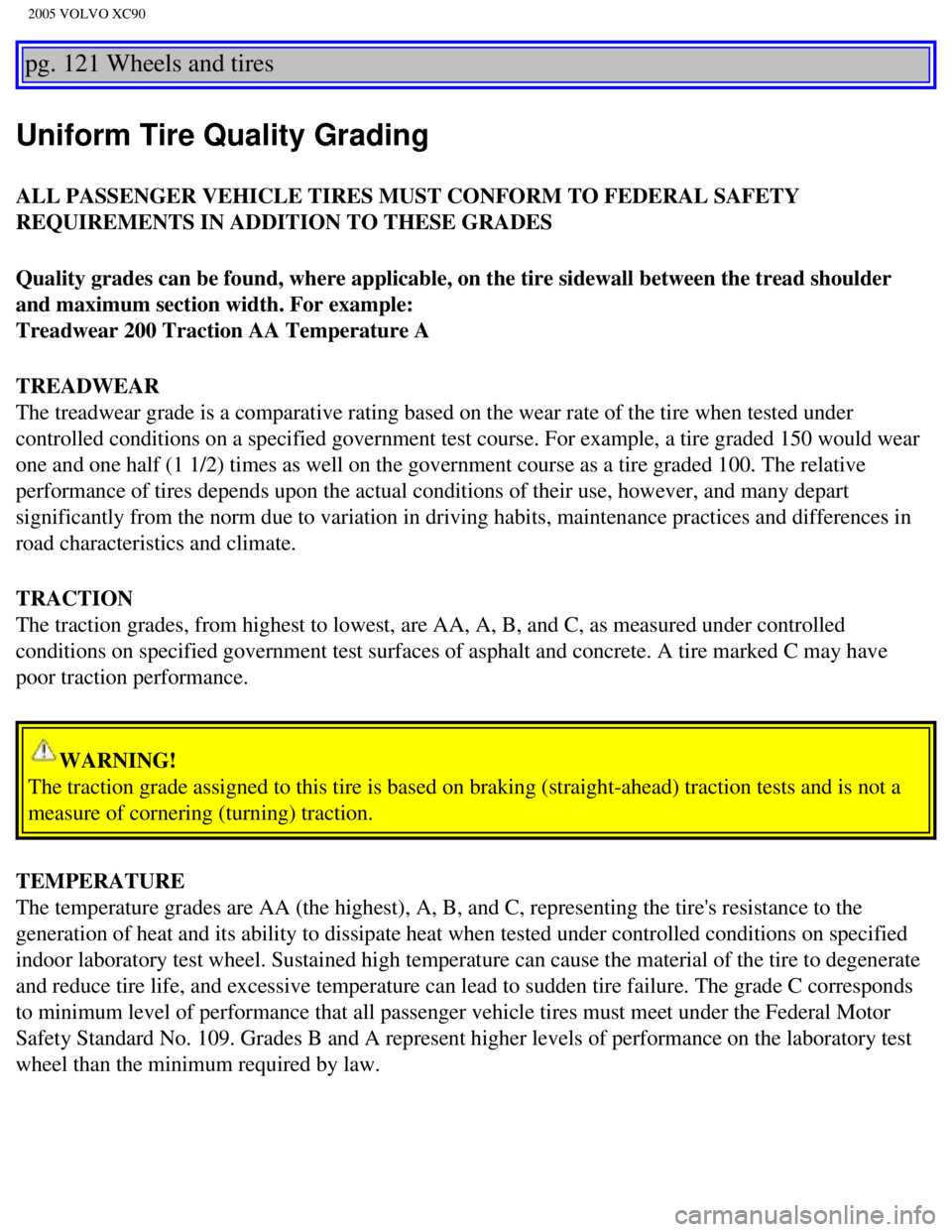
Uniform Tire Quality Grading
ALL PASSENGER VEHICLE TIRES MUST CONFORM TO FEDERAL SAFETY
REQUIREMENTS IN ADDITION TO THESE GRADES
Quality grades can be found, where applicable, on the tire sidewall betw\
een the tread shoulder
and maximum section width. For example:
Treadwear 200 Traction AA Temperature A
TREADWEAR
The treadwear grade is a comparative rating based on the wear rate of th\
e tire when tested under
controlled conditions on a specified government test course. For example\
, a tire graded 150 would wear
one and one half (1 1/2) times as well on the government course as a t\
ire graded 100. The relative
performance of tires depends upon the actual conditions of their use, ho\
wever, and many depart
significantly from the norm due to variation in driving habits, maintena\
nce practices and differences in
road characteristics and climate.
TRACTION
The traction grades, from highest to lowest, are AA, A, B, and C, as mea\
sured under controlled
conditions on specified government test surfaces of asphalt and concrete\
. A tire marked C may have
poor traction performance.
WARNING!
The traction grade assigned to this tire is based on braking (straight-\
ahead) traction tests and is not a
measure of cornering (turning) traction.
TEMPERATURE
The temperature grades are AA (the highest), A, B, and C, representing\
the tire's resistance to the
generation of heat and its ability to dissipate heat when tested under c\
ontrolled conditions on specified
indoor laboratory test wheel. Sustained high temperature can cause the m\
aterial of the tire to degenerate
and reduce tire life, and excessive temperature can lead to sudden tire \
failure. The grade C corresponds
to minimum level of performance that all passenger vehicle tires must me\
et under the Federal Motor
Safety Standard No. 109. Grades B and A represent higher levels of perfo\
rmance on the laboratory test
wheel than the minimum required by law.
file:///K|/ownersdocs/2005/2005_XC90/05xc90_08.htm (12 of 17)12/30/200\
6 4:42:37 PM
Page 167 of 263

2005 VOLVO XC90
WARNING!
The temperature grade for this tire is established for a tire that is pr\
operly inflated and not overloaded.
Excessive speed, under-inflation, or excessive loading, either separatel\
y or in combination, can cause
heat buildup and possible tire failure.
pg. 122 Wheels and tires
Snow chains, snow tire, studded tires
Snow chains
Snow chains can be used on your Volvo with the following restrictions:
l Snow chains should be installed on front wheels only. Use only Volvo app\
roved snow chains.
l If accessory, aftermarket or "custom" tires and wheels are installed and\
are of a size different than the
original tires and wheels, chains in some cases CANNOT be used. Sufficie\
nt clearances between chains
and brakes, suspension and body components must be maintained.
l Some strap-on type chains will interfere with brake components and there\
fore CANNOT be used.
l All Wheel Drive models: Snow chains should only be installed on the fron\
t wheels. Only chains
adapted for AWD models should be used.
NOTE: Consult your Volvo retailer for additional snow chain information.
CAUTION
- Check local regulations regarding the use of snow chains before instal\
ling.
- Always follow the chain manufacturer's installation instructions caref\
ully. Install chains as tightly as
possible and retighten periodically.
- Never exceed the chain manufacturer's specified maximum speed limit. (\
Under no circumstances
should you exceed 31 mph 50 km/h)
- Avoid bumps, holes or sharp turns when driving with snow chains.
- The handling of the vehicle can be adversely affected when driving wit\
h chains. Avoid fast or sharp
turns as well as locked wheel braking.
Snow tires, studded tires
1
Tires for winter use:
- Owners who live in or regularly commute through areas with sustained p\
eriods of snow or icy driving
conditions are strongly advised to fit suitable winter tires to help ret\
ain the highest degree of traction.
- It is important to install winter tires on all four wheels to help ret\
ain traction during cornering, braking,
file:///K|/ownersdocs/2005/2005_XC90/05xc90_08.htm (13 of 17)12/30/200\
6 4:42:37 PM
Page 168 of 263

2005 VOLVO XC90
and accelerating. Failure to do so could reduce traction to an unsafe le\
vel or adversely affect handling.
- Do not mix tires of different design as this could also negatively aff\
ect overall tire road grip.
- Winter tires wear more quickly on dry roads in warm weather. They shou\
ld be removed when the
winter driving season has ended.
- Studded tires should be run-in 300-600 miles (500-1000 km) during wh\
ich the car should be driven as
smoothly as possible to give the studs the opportunity to seat properly \
in the tires. The tires should have
the same rotational direction throughout their entire lifetime.
NOTE: Please consult state or provincial regulations restricting the use of st\
udded winter tires before
installing such tires.
1 Where permitted
pg. 123 Wheels and tires
Temporary Spare
The spare tire in your car is called a "Temporary Spare".
Recommended tire pressure (see the placard on the B-pillar or on the fu\
el filler door) should be
maintained irrespective of which position on the car the temporary spare\
tire is used on. In the event of
damage to this tire, a new one can be purchased from your Volvo retailer\
.
WARNING!
! Current legislation prohibits the use of the "Temporary Spare" tire ot\
her than as a temporary
replacement for a punctured tire. It must be replaced as soon as possibl\
e by a standard tire. Road
holding and handling may be affected with the "Temporary Spare" in use. \
Do not exceed 50 mph (80
km/h). Do not drive farther than 50 miles (80 km) on a temporary spar\
e tire.
CAUTION:
The car must not be driven with wheels of different dimensions or with a\
spare tire other than the one
that came with the car. The use of different size wheels can seriously d\
amage your car's transmission.
pg. 124 Wheels and tires
file:///K|/ownersdocs/2005/2005_XC90/05xc90_08.htm (14 of 17)12/30/200\
6 4:42:37 PM
Page 170 of 263

2005 VOLVO XC90
If the vehicle is equipped with the optional grocery bag holder: Fold up\
the rear section of the cargo area
floor, disconnect the grocery bag holder's retaining cords and fold up t\
he lower section of the floor.
CAUTION: Seven-seat models: Do not store objects in the area for the rear seat c\
ushions (when the
backrests are to be folded down). This could damage the cushions.
pg. 125 Wheels and tires
Changing wheels
Lowering the spare wheel
Changing wheels - lowering the spare wheel
The spare wheel is located under the floor of the rear cargo compartment\
. It can be lowered using the
crank (see previous page for location).
WARNING!
When raising or lowering the spare wheel, please keep in mind that compo\
nents in the exhaust system
may be very hot.
Lowering the spare wheel:
1. Fold down the lower section of the tailgate.
2. Fold up the rear section of the floor in the cargo compartment.
3. Connect the two sections of the jack's crank.
4. Insert the hooked end of the crank in the spare wheel retaining attac\
hment (see the illustration above).
5. Lower the spare wheel under the vehicle by turning the crank counterc\
lockwise until it is not possible
to turn it further.
6. Pivot the toggle at the end of the cable 90 degrees to release it fro\
m the spare wheel.
file:///K|/ownersdocs/2005/2005_XC90/05xc90_08.htm (16 of 17)12/30/200\
6 4:42:37 PM
Page 252 of 263

2005 VOLVO XC90
Child booster cushion 20
Child restraint anchorages
21
Child safety
19
Child safety locks
81
Child seat anchors
20
Cleaning the upholstery
132
Climate control systems - general information
50
Clock
26
Coat hanger
70
Coin compartment
68
Cold tires, definition
113
Cold weather precautions
109
Coolant - changing
139, 143
Coolant - checking level of
139
Cooling system
168
Courtesy light
65
Cruise control
40
Cup holder
68, 69
Cup holder in rear seat
68
Curb weight
120
Current fuel consumption
39
D
Defroster
53
Dimensions
166
Dolby Pro Logic II (DPL II)
181
Door mirror defroster
38
Driving economically
91
DSTC
31, 99
Dual-threshold air bags
5
E
ECC
52
Economical driving
91
file:///K|/ownersdocs/2005/2005_XC90/05xc90_12.htm (3 of 14)12/30/2006\
4:42:46 PM
Page 259 of 263

2005 VOLVO XC90
Text window - messages 30
Three-way catalytic converter
170
TIME FOR REGULAR SERVICE
30
Tire designations
118
Tire inflation
113
Tire inflation pressure table
115
Tire Pressure Monitoring System
29, 116
Tire pressure, checking
113
Tire terminology
119
Tires, changing
124
Tires
112
Towing
102
Towing - cars with All Wheel Drive
103
Towing a trailer
105
Trailer indicator lamp
29
Trailer towing
105
Transmission - Geartronic
93
Tread wear indicator
112
Treble
181
Trip computer
39
Trip odometer
26
Turn signals
35
U
Uniform Tire Quality Grading
128
Unlocking the vehicle
79
Upholstery, cleaning
132
V
Valet key
76
Vanity mirror
66
Vehicle Identification Number (VIN)
164
Vehicle loading
120
VIN (Vehicle Identification Number)
164
file:///K|/ownersdocs/2005/2005_XC90/05xc90_12.htm (10 of 14)12/30/200\
6 4:42:46 PM