fuel pressure VOLVO XC90 2005 Owners Manual
[x] Cancel search | Manufacturer: VOLVO, Model Year: 2005, Model line: XC90, Model: VOLVO XC90 2005Pages: 263, PDF Size: 6.99 MB
Page 4 of 263

2005 VOLVO XC90
environmental impact of a product throughout its complete life cycle. In\
this context, design, production,
product use, and recycling are all important considerations.
In production, Volvo has partly or completely phased out several chemica\
ls including chlorofluorocarbons
(CFCs), lead chromates, naphtanates, asbestos, mercury and cadmium; an\
d reduced the amount of chemicals
used in our plants 50% since 1991.
Volvo was the first in the world to introduce into production a three-wa\
y catalytic converter with Lambda
Sond, now called oxygen sensor, in 1976. The current version of this hig\
hly efficient system reduces emissions
of harmful substances (CO, HC, NOx) from the exhaust pipe by approxima\
tely 95% and the search to eliminate
the remaining emissions continues. Volvo is the only automobile manufact\
urer to offer CFC-free retrofit kits
for the air conditioning system of all models as far back as the 1975 Vo\
lvo 240. Advanced electronic engine
controls, refined purification systems and cleaner fuels are bringing us\
closer to our goal.
After Volvo vehicles and parts have fulfilled their use, recycling is th\
e next critical step in completing the life
cycle. The metal content is about 75% of the total weight of a vehicle, \
which makes the vehicle among the most
recycled industrial products. In order to have efficient and well contro\
lled recycling, many Volvo variants have
printed dismantling manuals, indicating the weight and material of indiv\
idual components. For Volvo, all
homogeneous plastic parts weighing more than 1.7 oz. (50 grams) are ma\
rked with international symbols that
indicate how the component is to be sorted for recycling.
In addition to continuous environmental refinement of conventional gasol\
ine-powered internal combustion
engines, Volvo is actively looking at advanced technology alternative-fu\
el vehicles.
When you drive a Volvo, you become our partner in the work to lessen the\
vehicle's impact on the environment.
To reduce your vehicle's environmental impact, you can:
l Maintain proper air pressure in your tires. Tests have shown decreased f\
uel economy with improperly
inflated tires.
l Follow the recommended maintenance schedule in your Warranty and Service\
Records Information booklet.
l Drive at a constant speed.
l See an authorized Volvo retailer as soon as possible for inspection if t\
he check engine (malfunction
indicator) lamp illuminates, or stays on after the vehicle has started.\
l Properly dispose of any vehicle-related waste such as used motor oil, us\
ed batteries, brake pads, etc.
l When cleaning your vehicle, use Volvo's own vehicle care products, all o\
f which have systematically been
adapted to the environment.
For additional information regarding the environmental activities in whi\
ch Volvo Cars of North America, LLC
and Volvo Car Corporation are involved, visit our Internet home page at:\
http://www.volvocars.us
PremAir®
On the surface of the radiator in the engine compartment, there is a spe\
cial coating called PremAir®. PremAir®
file:///K|/ownersdocs/2005/2005_XC90/05xc90_00.htm (4 of 7)12/30/2006 \
4:42:22 PM
Page 44 of 263

2005 VOLVO XC90
See page 116 for more information on this function.
PARKING BRAKE
This light will be on when the parking brake is applied. The parking bra\
ke pedal is located on the left
side of the driver's footwell.
Canadian models are equipped with this symbol.
Rear fog light
This light indicates that the fog light is on.
Turn signal indicator - trailer (certain models)
If you are towing a trailer, this light will flash simultaneously with t\
he turn signals on the trailer. If the
light does not flash when signaling, neither the trailer's turn signals \
nor the vehicle's turn signals are
functioning.
Oil pressure warning light
If the light comes on while driving, stop the vehicle and then stop the \
engine immediately and
check the engine oil level See
page 142. If the light stays on after restart, have the vehicle towed to the
nearest authorized Volvo retailer. After hard driving, the light may com\
e on occasionally when the
engine is idling. This is normal, provided it goes off when the engine s\
peed is increased.
CHECK ENGINE Malfunction indicator light
On-Board Diagnostics II (OBDII): As you drive, a computer called "OBDI\
I" monitors your vehicle's
engine, transmission, electrical and emission systems. The CHECK ENGINE \
light will light up if the
computer senses a condition that potentially may need correcting. When t\
his happens, please have your
vehicle checked by a Volvo retailer as soon as possible.
A CHECK ENGINE light may have many causes. Sometimes, you may not notice\
a change in your
vehicle's behavior. Even so, an uncorrected condition could hurt fuel ec\
onomy, emission cleanliness, and
driveability. Extended driving without correcting the cause could even d\
amage other components in
your vehicle.
Canadian models are equipped with this warning light.
pg. 30 Instruments and controls
file:///K|/ownersdocs/2005/2005_XC90/05xc90_02a.htm (6 of 17)12/30/200\
6 4:42:27 PM
Page 118 of 263

2005 VOLVO XC90
engine, and some of these additives contain organically volatile chemica\
ls. Do not needlessly expose
yourself to these chemicals.
pg. 88 Starting and driving
Fuel filler door
Press the button on the light switch panel (see illustration on
page 33) when the vehicle is at a standstill
to unlock the fuel filler door. Please note that the fuel filler door wi\
ll remain unlocked until the vehicle
begins to move forward. An audible click will be heard when the fuel fil\
ler door relocks.
If you intend to leave your vehicle while it is being refueled, this fea\
ture enables you to lock the doors/
tailgate while leaving the fuel filler door unlocked.
You can also keep the vehicle locked if you remain inside it during refu\
eling. The central locking button
does not lock the fuel filler door.
Be sure the fuel filler door is not obstructed and is completely closed \
after refueling.
Open the fuel filler cap slowly during hot weather.
NOTE: During a transitional period, a small number of service stations may st\
ill have fuel nozzles that
are not compatible with the fuel filler neck on vehicles equipped with t\
he evaporative control system.
Refueling
Fuel tank capacity:
6-cylinder turbo - 19 US gallons (72 liters), 5-cylinder turbo - 18 US\
gallons (68 liters) with sufficient
volume left over to accommodate possible expansion of the fuel in hot we\
ather. Be aware that the
"usable" tank capacity will be somewhat less than the specified maximum.\
When the fuel level is low,
such factors as ambient temperature, the fuel's "Reid vapor pressure" ch\
aracteristics, and terrain can
file:///K|/ownersdocs/2005/2005_XC90/05xc90_06a.htm (4 of 16)12/30/200\
6 4:42:33 PM
Page 123 of 263
ark position (automatic transmission).
** Please be aware that leaving the key in this position will increase b\
attery drain.
pg. 91 Starting")
2005 VOLVO XC90
* The gear selector must be in the (P)ark position (automatic transmission).
** Please be aware that leaving the key in this position will increase b\
attery drain.
pg. 91 Starting and driving
General information
Economical driving conserves natural resources
Better driving economy may be obtained by thinking ahead, avoiding rapid\
starts and stops and
adjusting the speed of your vehicle to immediate traffic conditions. Obs\
erve the following rules:
l Bring the engine to normal operating temperature as soon as possible by \
driving with a light foot on
the accelerator pedal for the first few minutes of operation. A cold eng\
ine uses more fuel and is subject
to increased wear.
l Whenever possible, avoid using the vehicle for driving short distances. \
This does not allow the engine
to reach normal operating temperature.
l Drive carefully and avoid rapid acceleration and hard braking.
l Use the transmission's (D)rive position as often as possible and avoid using "kickdown" to help
improve fuel economy.
l Do not exceed posted speed limits.
l Avoid carrying unnecessary items (extra load) in the vehicle.
l Maintain correct tire pressure. Check tire pressure regularly (when tir\
es are cold).
l Remove snow tires when threat of snow or ice has ended.
l Note that roof racks, ski racks, etc, increase air resistance and also f\
uel consumption.
l At highway driving speeds, fuel consumption will be lower with the air c\
onditioning on and the
windows closed than with the air conditioning off and the windows open. \
l Using the onboard trip computer's fuel consumption modes can help you le\
arn how to drive more
economically.
Other factors that decrease gas mileage are:
l Dirty air cleaner
l Dirty engine oil and clogged oil filter
l Dragging brakes
l Incorrect front end alignment
Some of the above mentioned items and others are checked at the standard\
Maintenance intervals.
Weight distribution affects handling
At the specified curb weight your vehicle has a tendency to understeer, \
which means that the steering
wheel has to be turned more than might seem appropriate for the curvatur\
e of a bend. This ensures good
stability and reduces the risk of rear wheel skid. Remember that these p\
roperties can alter with the
vehicle load. The heavier the load in the cargo area, the less the tende\
ncy to understeer.
file:///K|/ownersdocs/2005/2005_XC90/05xc90_06a.htm (9 of 16)12/30/200\
6 4:42:33 PM
Page 129 of 263

2005 VOLVO XC90
6-cylinder turbo models
pg. 96 Starting and driving
All Wheel Drive
All Wheel Drive (AWD) - general information
Your Volvo can be equipped with permanent All Wheel Drive (option), wh\
ich means that power is
distributed automatically between the front and rear wheels. Under norma\
l driving conditions, most of
the engine's power is directed to the front wheels. However, if there is\
any tendency for the front wheels
to spin, an electronically controlled coupling distributes power to the \
wheels that have the best traction.
Tire dimensions
Volvo recommends that you always drive on tires of the same brand, size,\
construction (radial), tread
pattern, load-, speed-, traction-, temperature-, and treadwear rating. N\
ever drive on mixed tires, except
for brief periods when the temporary spare tire is in use.
Always use properly inflated tires of correct dimensions. Tire size and \
inflation pressures are shown on
the tire inflation pressure placards, located on the driver's side B-pil\
lar (the structural member at the side
of the vehicle, at the rear of the driver's door opening), or on the in\
side of the fuel filler door on
Canadian models.
Temporary Spare
The temporary spare tire is for temporary, lowspeed, short-distance use \
only. Replace it with a full-sized
tire as soon as possible. Do not drive on the temporary spare at speeds \
above 50 m.p.h. (80km/h) or for
distances greater than 50 miles (80 km).
Never install snow chains on a temporary spare.
file:///K|/ownersdocs/2005/2005_XC90/05xc90_06a.htm (15 of 16)12/30/20\
06 4:42:33 PM
Page 148 of 263
, and replace those th\
at are worn. Check tire pressures.
l The brakes, front wheel alignment, and steering gear should be")
2005 VOLVO XC90
l Examine tires carefully (the spare tire as well), and replace those th\
at are worn. Check tire pressures.
l The brakes, front wheel alignment, and steering gear should be checked b\
y your Volvo retailer only.
l Check all lights, including high beams.
l Reflective warning triangles are legally required in some states/provinc\
es.
l Have a word with your Volvo retailer if you intend to drive in countries\
where it may be difficult to
obtain the correct fuel.
l Consider your destination. If you will be driving through an area where \
snow or ice are likely to
occur, consider snow tires.
* To prevent injury from contact with hot surfaces, do not inspect your \
vehicle's transmission fluid
yourself. Have your vehicle's transmission fluid level inspected by a qu\
alified Volvo service technician.
Contents | Top of Page
file:///K|/ownersdocs/2005/2005_XC90/05xc90_06b.htm (18 of 18)12/30/20\
06 4:42:35 PM
Page 155 of 263
2005 VOLVO XC90
2 0 0 5
VOLVO XC90
Wheels and tires
pg. 111 Wheels and tires
General information112
Tire inflation pressure tables115
Tire Pressure Monitoring System (TPMS) - option on certain U.S. models\
only116
Tire designations118
Glossary of tire terminology119
Vehicle loading120
Uniform Tire Quality Grading121
Snow chains, snow tire, studded tires122
Temporary Spare123
Changing wheels124
pg. 112 Wheels and tires
General information
General information
Your vehicle is equipped with tires according to the vehicle's tire info\
rmation placard on the Bpillar (the
structural member at the side of the vehicle, at the rear of the driver'\
s door opening), or on the inside of
the fuel filler door on Canadian models.
The tires have good road holding characteristics and offer good handling\
on dry and wet surfaces. It
should be noted however that the tires have been developed to give these\
features on snow/ice-free
file:///K|/ownersdocs/2005/2005_XC90/05xc90_08.htm (1 of 17)12/30/2006\
4:42:37 PM
Page 157 of 263
2005 VOLVO XC90
Improving tire economy:
l Maintain correct tire pressure. See the tire pressure table on page 115.
l Drive smoothly: avoid fast starts, hard braking and tire screeching.
l Tire wear increases with speed.
l Correct front wheel alignment is very important.
l Unbalanced wheels impair tire economy and driving comfort.
l Tires must maintain the same direction of rotation throughout their life\
time.
l When replacing tires, the tires with the most tread should be mounted on\
the rear wheels to reduce the
chance of oversteer during hard braking. Hitting curbs or potholes can d\
amage the tires and/or wheels
permanently.
pg. 113 Wheels and tires
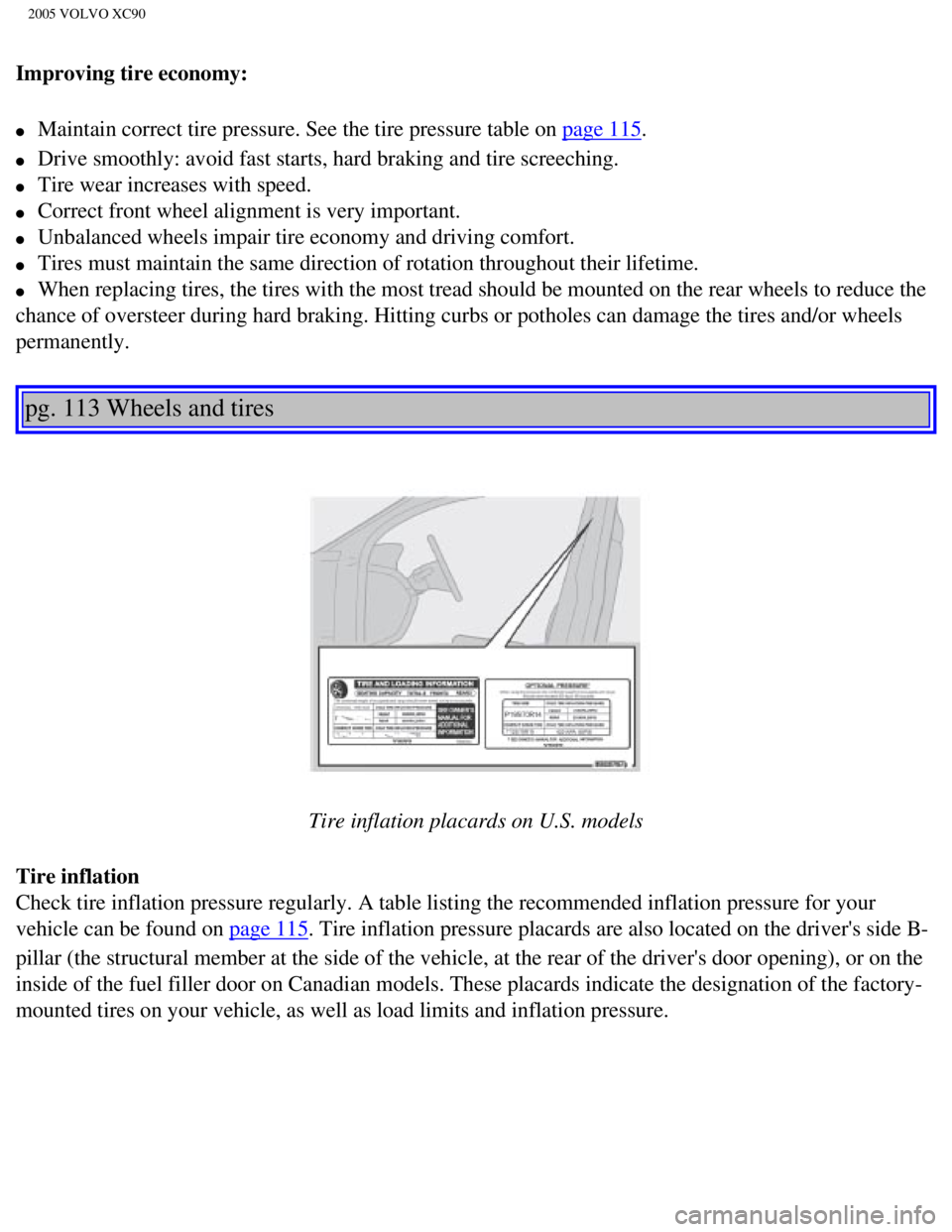
Tire inflation placards on U.S. models
Tire inflation
Check tire inflation pressure regularly. A table listing the recommended\
inflation pressure for your
vehicle can be found on
page 115. Tire inflation pressure placards are also located on the driver's side\
B-
pillar (the structural member at the side of the vehicle, at the rear o\
f the driver's door opening), or on the
inside of the fuel filler door on Canadian models. These placards indica\
te the designation of the factory-
mounted tires on your vehicle, as well as load limits and inflation pres\
sure.
file:///K|/ownersdocs/2005/2005_XC90/05xc90_08.htm (3 of 17)12/30/2006\
4:42:37 PM
Page 160 of 263

61 (420)
a. These weights include the weight of all occupants of the car plus car\
go.
WARNING!
- Never install wheel/tire combinations lar")
2005 VOLVO XC90
Temporary spare tire
T155/85R18 61 (420)
61 (420)
a. These weights include the weight of all occupants of the car plus car\
go.
WARNING!
- Never install wheel/tire combinations larger than 18" on your Volvo XC\
90. Doing so will adversely
affect your vehicle's handling and stability, and safety system performa\
nce.
- Any damage caused by installation of unapproved wheel/tire size combin\
ations will not be covered
by your new vehicle warranty. Volvo assumes no responsibility for death,\
injury, or expenses that
may result from such installations.
pg. 116 Wheels and tires
Tire Pressure Monitoring System (TPMS) - option on certain U.S. models\
only
The tire pressure monitoring system uses sensors mounted in the tire val\
ves to check inflation pressure
levels. When the vehicle is moving at a speed of 20 mph (30 km/h) or f\
aster, these sensors transmit
inflation pressure data to a receiver located in the vehicle.
USA - FCC ID: MRXTG315AM04 This device complies with part 15 of the FCC \
rules. Operation is
subject to the following conditions: (1) This device may not cause har\
mful interference, and (2) this
device must accept any interference received, including interference tha\
t may cause undesired operation.
When low inflation pressure is detected, TPMS will light up the tire pre\
ssure warning light ( ) in the
instrument panel, and will display a message in the text window. The wor\
ding of this message is
determined by the degree of inflation pressure loss.
When the tire pressure monitoring system warning light is on, one or mor\
e of your tires is significantly
under-inflated. You should stop and check your tires as soon as possible\
, and inflate them to the proper
pressure as indicated on the vehicle's tire information placard.
Driving on a significantly under-inflated tire causes the tire to overhe\
at and can lead to tire failure.
Under-inflation also reduces fuel efficiency and tire tread life, and ma\
y affect the vehicle's handling and
stopping ability. Each tire, including the spare, should be checked mont\
hly when cold and set to the
recommended inflation pressure as specified in the vehicle placard and o\
wner's manual.
NOTE: TPMS indicates low tire pressure but does not replace normal tire maint\
enance. For information
on correct tire pressure, please refer to the table on
page 115, or consult your Volvo retailer.
file:///K|/ownersdocs/2005/2005_XC90/05xc90_08.htm (6 of 17)12/30/2006\
4:42:37 PM
Page 163 of 263
: This begins with the let\
ters \"DOT\" and indicates that the
tire meets a")
2005 VOLVO XC90
7. M+S or M/S = Mud and Snow, AT = All Terrain, AS = All Season
8. U.S. DOT Tire Identification Number (TIN): This begins with the let\
ters "DOT" and indicates that the
tire meets all federal standards. The next two numbers or letters are th\
e plant code where it was
manufactured, the next two are the tire size code and the last four numb\
ers represent the week and year
the tire was built. For example, the numbers 317 mean the 31st week of 1\
997. After 2000 the numbers
go to four digits. For example, 2501 means the 25th week of 2001. The nu\
mbers in between are
marketing codes used at the manufacturer's discretion. This information \
helps a tire manufacturer
identify a tire for safety recall purposes.
9. Tire Ply Composition and Material Used: Indicates the number of plies\
indicates or the number of
layers of rubber-coated fabric in the tire tread and sidewall. Tire manu\
facturers also must indicate the
ply materials in the tire and the sidewall, which include steel, nylon, \
polyester, and others.
10. Maximum Load: Indicates the maximum load in pounds and kilograms tha\
t can be carried by the
tire. Refer to the vehicle's tire information placard or the safety cert\
ification label, located on the B-Pillar
or the driver's door or on the inside of the fuel filler door on Canadia\
n models, for the correct tire
pressure for your vehicle.
11. Treadwear, Traction, and Temperature grades: See
page 121 for more information.
12. Maximum permissible inflation pressure: the greatest amount of air p\
ressure that should ever be put
in the tire. This limit is set by the tire manufacturer.
pg. 119 Wheels and tires
Glossary of tire terminology
The tire suppliers may have additional markings, notes or warnings such \
as standard load, radial
tubeless, etc.
Glossary of tire terminology
l Tire information placard: A placard showing the OE (Original Equipment) tire sizes, recommende\
d
inflation pressure, and the maximum weight the vehicle can carry.
l Tire Identification Number (TIN): A number on the sidewall of each tire providing information
about the tire brand and manufacturing plant, tire size and date of manu\
facturer.
l Inflation pressure: A measure of the amount of air in a tire.
l Standard load: A class of P-metric or Metric tires designed to carry a maximum load a\
t 35 psi [37
psi (2.5 bar) for Metric tires]. Increasing the inflation pressure bey\
ond this pressure will not increase the
tires load carrying capability.
l Extra load: A class of P-metric or Metric tires designed to carry a heavier maximu\
m load at 41 psi
file:///K|/ownersdocs/2005/2005_XC90/05xc90_08.htm (9 of 17)12/30/2006\
4:42:37 PM