tire pressure VOLVO XC90 2005 Owners Manual
[x] Cancel search | Manufacturer: VOLVO, Model Year: 2005, Model line: XC90, Model: VOLVO XC90 2005Pages: 263, PDF Size: 6.99 MB
Page 4 of 263

2005 VOLVO XC90
environmental impact of a product throughout its complete life cycle. In\
this context, design, production,
product use, and recycling are all important considerations.
In production, Volvo has partly or completely phased out several chemica\
ls including chlorofluorocarbons
(CFCs), lead chromates, naphtanates, asbestos, mercury and cadmium; an\
d reduced the amount of chemicals
used in our plants 50% since 1991.
Volvo was the first in the world to introduce into production a three-wa\
y catalytic converter with Lambda
Sond, now called oxygen sensor, in 1976. The current version of this hig\
hly efficient system reduces emissions
of harmful substances (CO, HC, NOx) from the exhaust pipe by approxima\
tely 95% and the search to eliminate
the remaining emissions continues. Volvo is the only automobile manufact\
urer to offer CFC-free retrofit kits
for the air conditioning system of all models as far back as the 1975 Vo\
lvo 240. Advanced electronic engine
controls, refined purification systems and cleaner fuels are bringing us\
closer to our goal.
After Volvo vehicles and parts have fulfilled their use, recycling is th\
e next critical step in completing the life
cycle. The metal content is about 75% of the total weight of a vehicle, \
which makes the vehicle among the most
recycled industrial products. In order to have efficient and well contro\
lled recycling, many Volvo variants have
printed dismantling manuals, indicating the weight and material of indiv\
idual components. For Volvo, all
homogeneous plastic parts weighing more than 1.7 oz. (50 grams) are ma\
rked with international symbols that
indicate how the component is to be sorted for recycling.
In addition to continuous environmental refinement of conventional gasol\
ine-powered internal combustion
engines, Volvo is actively looking at advanced technology alternative-fu\
el vehicles.
When you drive a Volvo, you become our partner in the work to lessen the\
vehicle's impact on the environment.
To reduce your vehicle's environmental impact, you can:
l Maintain proper air pressure in your tires. Tests have shown decreased f\
uel economy with improperly
inflated tires.
l Follow the recommended maintenance schedule in your Warranty and Service\
Records Information booklet.
l Drive at a constant speed.
l See an authorized Volvo retailer as soon as possible for inspection if t\
he check engine (malfunction
indicator) lamp illuminates, or stays on after the vehicle has started.\
l Properly dispose of any vehicle-related waste such as used motor oil, us\
ed batteries, brake pads, etc.
l When cleaning your vehicle, use Volvo's own vehicle care products, all o\
f which have systematically been
adapted to the environment.
For additional information regarding the environmental activities in whi\
ch Volvo Cars of North America, LLC
and Volvo Car Corporation are involved, visit our Internet home page at:\
http://www.volvocars.us
PremAir®
On the surface of the radiator in the engine compartment, there is a spe\
cial coating called PremAir®. PremAir®
file:///K|/ownersdocs/2005/2005_XC90/05xc90_00.htm (4 of 7)12/30/2006 \
4:42:22 PM
Page 43 of 263

2005 VOLVO XC90
WARNING!
The If the fluid level is below the MIN mark in the reservoir or if a "B\
rake failure - Service urgent"
message is displayed in the text window: DO NOT DRIVE. Have the vehicle \
towed to an authorized
Volvo retailer and have the brake system inspected.
l If the brake fluid level is above the MIN mark, drive carefully to an au\
thorized Volvo retailer and
have the brake system inspected.
DSTC
The Dynamic Stability and Traction Control system (DSTC) is explained \
in greater detail on
pages 99
and 100.
pg. 29 Instruments and controls
Supplemental Restraint system (SRS)
If the light comes on (or stays on after the vehicle has started), the\
SRS diagnostic system has detected a
fault. Drive to an authorized Volvo retailer for an inspection of the sy\
stem. See the SRS section for more
information.
Generator warning light
If the light comes on while the engine is running, have the charging sys\
tem checked.
Seat belt reminder
This symbol lights up to indicate that the driver has not fastened his/h\
er seat belt.
Tire pressure monitoring light
file:///K|/ownersdocs/2005/2005_XC90/05xc90_02a.htm (5 of 17)12/30/200\
6 4:42:27 PM
Page 123 of 263
ark position (automatic transmission).
** Please be aware that leaving the key in this position will increase b\
attery drain.
pg. 91 Starting")
2005 VOLVO XC90
* The gear selector must be in the (P)ark position (automatic transmission).
** Please be aware that leaving the key in this position will increase b\
attery drain.
pg. 91 Starting and driving
General information
Economical driving conserves natural resources
Better driving economy may be obtained by thinking ahead, avoiding rapid\
starts and stops and
adjusting the speed of your vehicle to immediate traffic conditions. Obs\
erve the following rules:
l Bring the engine to normal operating temperature as soon as possible by \
driving with a light foot on
the accelerator pedal for the first few minutes of operation. A cold eng\
ine uses more fuel and is subject
to increased wear.
l Whenever possible, avoid using the vehicle for driving short distances. \
This does not allow the engine
to reach normal operating temperature.
l Drive carefully and avoid rapid acceleration and hard braking.
l Use the transmission's (D)rive position as often as possible and avoid using "kickdown" to help
improve fuel economy.
l Do not exceed posted speed limits.
l Avoid carrying unnecessary items (extra load) in the vehicle.
l Maintain correct tire pressure. Check tire pressure regularly (when tir\
es are cold).
l Remove snow tires when threat of snow or ice has ended.
l Note that roof racks, ski racks, etc, increase air resistance and also f\
uel consumption.
l At highway driving speeds, fuel consumption will be lower with the air c\
onditioning on and the
windows closed than with the air conditioning off and the windows open. \
l Using the onboard trip computer's fuel consumption modes can help you le\
arn how to drive more
economically.
Other factors that decrease gas mileage are:
l Dirty air cleaner
l Dirty engine oil and clogged oil filter
l Dragging brakes
l Incorrect front end alignment
Some of the above mentioned items and others are checked at the standard\
Maintenance intervals.
Weight distribution affects handling
At the specified curb weight your vehicle has a tendency to understeer, \
which means that the steering
wheel has to be turned more than might seem appropriate for the curvatur\
e of a bend. This ensures good
stability and reduces the risk of rear wheel skid. Remember that these p\
roperties can alter with the
vehicle load. The heavier the load in the cargo area, the less the tende\
ncy to understeer.
file:///K|/ownersdocs/2005/2005_XC90/05xc90_06a.htm (9 of 16)12/30/200\
6 4:42:33 PM
Page 124 of 263

2005 VOLVO XC90
WARNING!
Driving with the tailgate open: Driving with the tailgate open could lead to poisonous exhaust gases
entering the passenger compartment. If the tailgate must be kept open fo\
r any reason, proceed as
follows
- Close the windows
- Set the ventilation system control to air flow to floor, windshield an\
d side windows and blower
control to its highest setting.
CAUTION
Drive slowly and carefully if going through standing water (i.e. floode\
d roadways, etc.). Damage to
the engine could result if excess water is drawn in through the air inta\
ke system. Never drive the
vehicle in water deeper than 18 inches (48 cm).
pg. 92 Starting and driving
General information (contd)
Handling, roadholding
Vehicle load, tire design and inflation pressure all affect vehicle hand\
ling. Therefore, check that the tires
are inflated to the recommended pressure according to the vehicle load. \
See "Tire pressure" section.
Loads should be distributed so that capacity weight or maximum permissib\
le axle loads are not exceeded.
Driving on rough/unpaved surfaces
The Volvo XC90 is designed primarily for onroad driving, and it has exce\
llent handling characteristics
on very rough or unpaved roads.
When driving on poorly maintained or unpaved roads, please keep the foll\
owing in mind:
l Reduce speed on rough surfaces to minimize possible damage to the vehicl\
e's underbody.
l When driving on soft surfaces such as dry sand or snow, try to avoid sto\
pping if at all possible.
WARNING!
Avoid driving diagonally across steep inclines as this could increase th\
e risk of a roll-over. Try to
drive straight up or down the slope.
If the road is very steep, avoid turning the vehicle around to help avoi\
d the risk of rolling over. Back
the vehicle up or down the incline instead.
file:///K|/ownersdocs/2005/2005_XC90/05xc90_06a.htm (10 of 16)12/30/20\
06 4:42:33 PM
Page 129 of 263

2005 VOLVO XC90
6-cylinder turbo models
pg. 96 Starting and driving
All Wheel Drive
All Wheel Drive (AWD) - general information
Your Volvo can be equipped with permanent All Wheel Drive (option), wh\
ich means that power is
distributed automatically between the front and rear wheels. Under norma\
l driving conditions, most of
the engine's power is directed to the front wheels. However, if there is\
any tendency for the front wheels
to spin, an electronically controlled coupling distributes power to the \
wheels that have the best traction.
Tire dimensions
Volvo recommends that you always drive on tires of the same brand, size,\
construction (radial), tread
pattern, load-, speed-, traction-, temperature-, and treadwear rating. N\
ever drive on mixed tires, except
for brief periods when the temporary spare tire is in use.
Always use properly inflated tires of correct dimensions. Tire size and \
inflation pressures are shown on
the tire inflation pressure placards, located on the driver's side B-pil\
lar (the structural member at the side
of the vehicle, at the rear of the driver's door opening), or on the in\
side of the fuel filler door on
Canadian models.
Temporary Spare
The temporary spare tire is for temporary, lowspeed, short-distance use \
only. Replace it with a full-sized
tire as soon as possible. Do not drive on the temporary spare at speeds \
above 50 m.p.h. (80km/h) or for
distances greater than 50 miles (80 km).
Never install snow chains on a temporary spare.
file:///K|/ownersdocs/2005/2005_XC90/05xc90_06a.htm (15 of 16)12/30/20\
06 4:42:33 PM
Page 142 of 263

2005 VOLVO XC90
Max. trailer
hitch tongue
load400 lbs
(180 kg)
400 lbs
(180 kg)400 lbs
(180 kg)400 lbs
(180 kg)370 lbs
(165 kg)250 lbs (115
kg)
140 lbs (65 kg)
NOTE:
l Recommended hitch tongue load: not more than 10% of the trailer's weight\
.
The trailer load should be positioned so that it does not shift and the \
tongue load should be 10% of the
trailer's weight. However, the tongue load should not exceed the maximum\
permissible weights
indicated in the table above.
l When towing trailers without brakes, the maximum permissible trailer wei\
ght is 1,700 lbs (750 kg).
l If necessary, redistribute the weight of any cargo in the trailer to avo\
id excessive weight on the trailer
hitch.
l The maximum trailer weight listed in the table for All Wheel Drive model\
s, 5,000 lbs (2250 kg) is
only applicable when there are not more than two occupants in the vehicl\
e, in the front seats, with a
combined weight of 300 lbs (135 kg), with no other cargo in the vehicl\
e.
pg. 106 Starting and driving
Towing a trailer (contd)
l The maximum weight listed for Front Wheel Drive models, 4,000 lbs (1800\
kg) is only applicable
when there are not more than four occupants in the vehicle, in the front\
seats and second row of seats,
with a combined weight of 600 lbs (270 kg), with no other cargo in the\
vehicle.
l Please be aware that the load on the trailer hitch is part of the vehicl\
e's total load carrying capacity.
The amount of cargo in the vehicle and the trailer must be limited so th\
at the gross vehicle weight and
maximum permissible rear axle weight
(see page 165) are not exceeded.
l Vehicles used for towing a trailer on a regular basis, or for long-dista\
nce highway towing should be
equipped with an automatic transmission oil cooler and Volvo's automatic\
self-leveling system for the
rear suspension. Consult your Volvo retailer.
l Volvo recommends the use of Volvo trailer hitches that are specially des\
igned for the vehicle.
l All Volvo models are equipped with energy-absorbing shock-mounted bumper\
s. Trailer hitch
installation should not interfere with the proper operation of this bump\
er system.
l Increase tire pressure to recommended full inflation pressure. See chapt\
er "Wheels and tires."
l When your vehicle is new, avoid towing heavy trailers during the first 6\
20 miles (1,000 km).
l Engine and transmission are subject to increased loads. Therefore, engin\
e coolant temperature should
be closely watched when driving in hot climates or hilly terrain. Use a \
lower gear and turn off the air
conditioner if the temperature gauge needle enters the red range.
l If the automatic transmission begins to overheat, a message will be disp\
layed in the text window.
l Hauling a trailer affects handling, durability, and economy.
l It is necessary to balance trailer brakes with the towing vehicle brakes\
to provide a safe stop (check
and observe state/local regulations).
file:///K|/ownersdocs/2005/2005_XC90/05xc90_06b.htm (12 of 18)12/30/20\
06 4:42:35 PM
Page 148 of 263
, and replace those th\
at are worn. Check tire pressures.
l The brakes, front wheel alignment, and steering gear should be")
2005 VOLVO XC90
l Examine tires carefully (the spare tire as well), and replace those th\
at are worn. Check tire pressures.
l The brakes, front wheel alignment, and steering gear should be checked b\
y your Volvo retailer only.
l Check all lights, including high beams.
l Reflective warning triangles are legally required in some states/provinc\
es.
l Have a word with your Volvo retailer if you intend to drive in countries\
where it may be difficult to
obtain the correct fuel.
l Consider your destination. If you will be driving through an area where \
snow or ice are likely to
occur, consider snow tires.
* To prevent injury from contact with hot surfaces, do not inspect your \
vehicle's transmission fluid
yourself. Have your vehicle's transmission fluid level inspected by a qu\
alified Volvo service technician.
Contents | Top of Page
file:///K|/ownersdocs/2005/2005_XC90/05xc90_06b.htm (18 of 18)12/30/20\
06 4:42:35 PM
Page 155 of 263
2005 VOLVO XC90
2 0 0 5
VOLVO XC90
Wheels and tires
pg. 111 Wheels and tires
General information112
Tire inflation pressure tables115
Tire Pressure Monitoring System (TPMS) - option on certain U.S. models\
only116
Tire designations118
Glossary of tire terminology119
Vehicle loading120
Uniform Tire Quality Grading121
Snow chains, snow tire, studded tires122
Temporary Spare123
Changing wheels124
pg. 112 Wheels and tires
General information
General information
Your vehicle is equipped with tires according to the vehicle's tire info\
rmation placard on the Bpillar (the
structural member at the side of the vehicle, at the rear of the driver'\
s door opening), or on the inside of
the fuel filler door on Canadian models.
The tires have good road holding characteristics and offer good handling\
on dry and wet surfaces. It
should be noted however that the tires have been developed to give these\
features on snow/ice-free
file:///K|/ownersdocs/2005/2005_XC90/05xc90_08.htm (1 of 17)12/30/2006\
4:42:37 PM
Page 157 of 263
2005 VOLVO XC90
Improving tire economy:
l Maintain correct tire pressure. See the tire pressure table on page 115.
l Drive smoothly: avoid fast starts, hard braking and tire screeching.
l Tire wear increases with speed.
l Correct front wheel alignment is very important.
l Unbalanced wheels impair tire economy and driving comfort.
l Tires must maintain the same direction of rotation throughout their life\
time.
l When replacing tires, the tires with the most tread should be mounted on\
the rear wheels to reduce the
chance of oversteer during hard braking. Hitting curbs or potholes can d\
amage the tires and/or wheels
permanently.
pg. 113 Wheels and tires
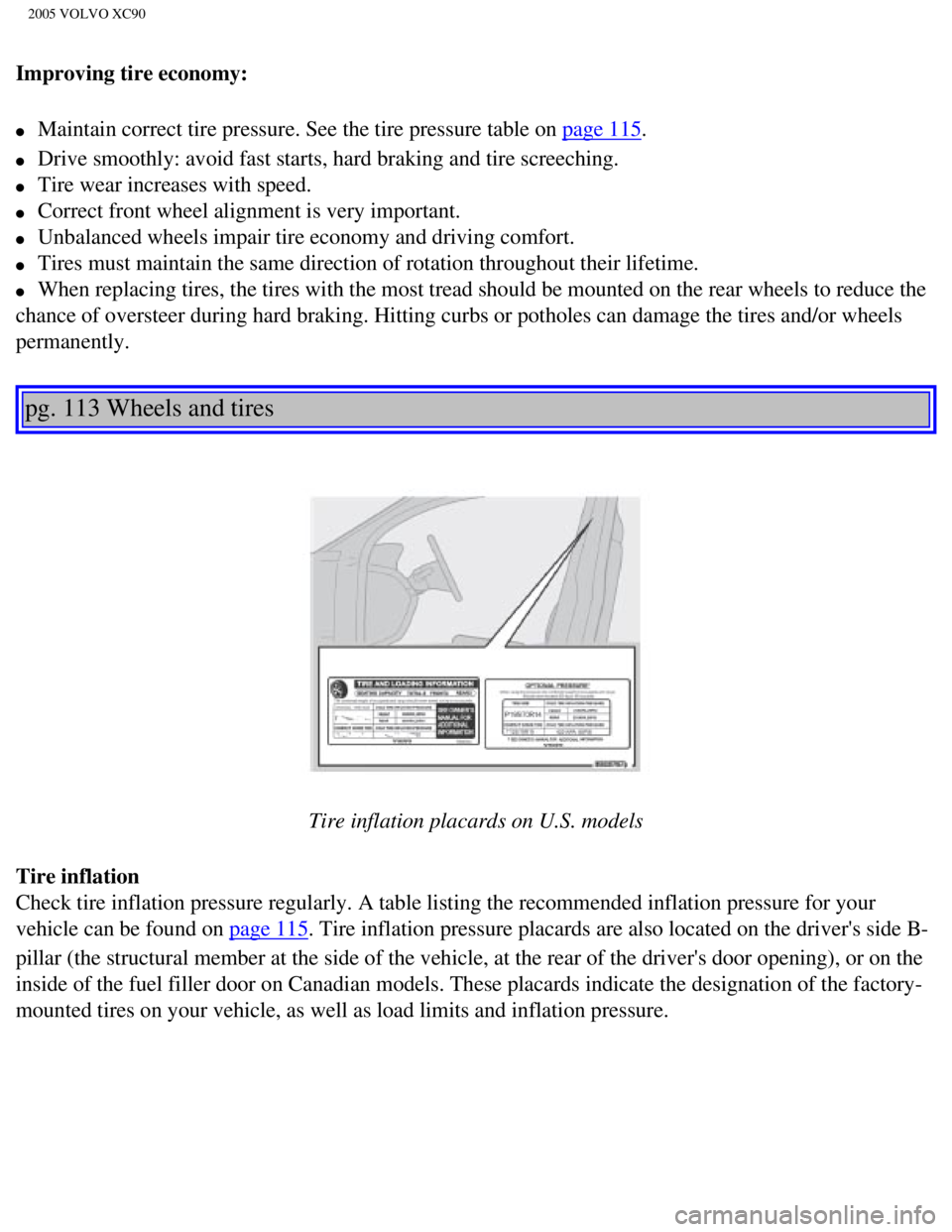
Tire inflation placards on U.S. models
Tire inflation
Check tire inflation pressure regularly. A table listing the recommended\
inflation pressure for your
vehicle can be found on
page 115. Tire inflation pressure placards are also located on the driver's side\
B-
pillar (the structural member at the side of the vehicle, at the rear o\
f the driver's door opening), or on the
inside of the fuel filler door on Canadian models. These placards indica\
te the designation of the factory-
mounted tires on your vehicle, as well as load limits and inflation pres\
sure.
file:///K|/ownersdocs/2005/2005_XC90/05xc90_08.htm (3 of 17)12/30/2006\
4:42:37 PM
Page 158 of 263

2005 VOLVO XC90
Tire inflation placard on Canadian models
NOTE: The placards shown indicate inflation pressure for the tires installed \
on the car at the factory
only.
l Use a tire gauge to check the tire inflation pressure, including the spa\
re, at least once a month and
before long trips. You are strongly urged to buy a reliable tire pressur\
e gauge, as automatic service
station gauges may be inaccurate.
l Use the recommended cold inflation pressure for optimum tire performance\
and wear.
l Under-inflation or over-inflation may cause uneven treadwear patterns.
WARNING!
- Under-inflation is the most common cause of tire failure and may resul\
t in severe tire cracking, tread
separation, or "blowout," with unexpected loss of vehicle control and in\
creased risk of injury.
- Under-inflated tires reduce the load carrying capacity of your vehicle\
.
When weather temperature changes occur, tire inflation pressures also ch\
ange. A 10-degree temperature
drop causes a corresponding drop of 1 psi (7 kPa) in inflation pressur\
e. Check your tire pressures
frequently and adjust them to the proper pressure, which can be found on\
the vehicle's tire information
placard or certification label.
Checking tire pressure
Cold tires
Inflation pressure should be checked when the tires are cold.
The tires are considered to be cold when they have the same temperature \
as the surrounding
(ambient) air.
This temperature is normally reached after the car has been parked for a\
t least 3 hours.
file:///K|/ownersdocs/2005/2005_XC90/05xc90_08.htm (4 of 17)12/30/2006\
4:42:37 PM