air condition VOLVO XC90 2007 User Guide
[x] Cancel search | Manufacturer: VOLVO, Model Year: 2007, Model line: XC90, Model: VOLVO XC90 2007Pages: 268, PDF Size: 8.57 MB
Page 122 of 268
: Press this button once to unlock the drivers door only. Wait for at le\
ast 1 second
and press the button again (")
2007 Volvo XC90
NOTE: This function will not open the tailgate.
Button 6 (Unlock): Press this button once to unlock the driver's door only. Wait for at le\
ast 1 second
and press the button again (within 10 seconds) to unlock all doors, an\
d the tailgate.
NOTE:
l If an airbag deploys, your vehicle's SRS control module will attempt to \
automatically unlock all
doors.
l The keys may also be used to lock and unlock the doors, and to activate \
and deactivate the alarm
system.
l To avoid leaving your keys in the vehicle, make a habit of always lockin\
g the vehicle with the remote
control.
l If the key blade section of the remote is not fully folded out when star\
ting the vehicle, the immobilizer
function may make it impossible to start the engine.
l The vehicle can be locked even if a door is open. When the door(s) are\
closed, they will be locked.
Please be aware that the keys could be locked in the car when this is do\
ne.
Automatic re-locking
If the doors are unlocked, the locks will automatically reengage (re-lo\
ck) and the alarm will rearm after
2 minutes unless a door or the tailgate has been opened. This helps prev\
ent the car from inadvertently
being left unlocked.
l FCC ID:LQNP2T-APU
This device complies with part 15 of the FCC rules. Operation is subject\
to the following conditions:
(1) This device may not cause harmful interference, and (2) this dev\
ice must accept any interference
received, including interference that may cause undesired operation.
l Canadian 2306104388
Model 504 2927 by Donnelly
Operation is subject to the following conditions: (1) this device may \
not cause interference, and (2)
this device must accept any interference, including interference that ma\
y cause undesired operation of
the device.
l Canadian 2306104388A
Model 509 977 by Connaught Electronics
Operation is subject to the following conditions: (1) this device may \
not cause interference, and (2)
this device must accept any interference, including interference that ma\
y cause undesired operation of
the device.
pg. 107 Locks and alarm
Keys and remote controls
file:///K|/ownersdocs/2007/2007_XC90/07xc90_05.htm (5 of 7)12/30/2006 \
5:53:41 PM
Page 133 of 268
 or\
remove the key from the ignition switch while the
vehicle is in motion. This could cause the steer")
2007 Volvo XC90
WARNING!
Never switch off the ignition (turn the ignition key to position 0) or\
remove the key from the ignition switch while the
vehicle is in motion. This could cause the steering wheel to lock, which\
would make the vehicle impossible to steer.
Economical driving conserves natural resources
Better driving economy may be obtained by thinking ahead, avoiding rapid\
starts and stops and adjusting the speed of your
vehicle to immediate traffic conditions. Observe the following rules:
l Bring the engine to normal operating temperature as soon as possible by \
driving with a light foot on the accelerator
pedal for the first few minutes of operation. A cold engine uses more fu\
el and is subject to increased wear.
l Whenever possible, avoid using the vehicle for driving short distances. \
This does not allow the engine to reach normal
operating temperature.
l Drive carefully and avoid rapid acceleration and hard braking.
l Use the transmission's (D)rive position as often as possible and avoid using "kickdown" to help \
improve fuel economy.
l Do not exceed posted speed limits.
l Avoid carrying unnecessary items (extra load) in the vehicle.
l Maintain correct tire pressure. Check tire pressure regularly (when tir\
es are cold).
l Remove snow tires when threat of snow or ice has ended.
1. The gear selector must be in the (P)ark position (automatic transmission).
2. Please be aware that leaving the key in this position will increase b\
attery drain.
pg. 122 Starting and driving
Economical driving
l Note that roof racks, ski racks, etc, increase air resistance and also f\
uel consumption.
l At highway driving speeds, fuel consumption will be lower with the air c\
onditioning on and the windows closed than
with the air conditioning off and the windows open.
l Using the onboard trip computer's fuel consumption modes can help you le\
arn how to drive more economically.
Other factors that decrease gas mileage are:
l Dirty air cleaner
l Dirty engine oil and clogged oil filter
l Dragging brakes
l Incorrect front end alignment.
Some of the above mentioned items and others are checked at the standard\
Maintenance Service intervals.
CAUTION!
Drive slowly and carefully if going through standing water (i.e. floode\
d roadways, etc.). Damage to the engine could
result if excess water is drawn in through the air intake system. Never \
drive the vehicle in water deeper than 18 inches
(48 cm).
pg. 123 Starting and driving
file:///K|/ownersdocs/2007/2007_XC90/07xc90_06.htm (9 of 32)12/30/2006\
5:53:44 PM
Page 134 of 268

2007 Volvo XC90
Difficult driving conditions
Driving on rough/unpaved surfaces
The Volvo XC90 is designed primarily for on-road driving, and it has exc\
ellent handling characteristics on very rough or
unpaved roads.
When driving on poorly maintained or unpaved roads, please keep the foll\
owing in mind:
l Reduce speed on rough surfaces to minimize possible damage to the vehicl\
e's underbody.
l When driving on soft surfaces such as dry sand or snow, try to avoid sto\
pping if at all possible.
WARNING!
Avoid driving diagonally across steep inclines as this could increase th\
e risk of a roll-over. Try to drive straight up or
down the slope.
If the road is very steep, avoid turning the vehicle around to help avoi\
d the risk of rolling over. Back the vehicle up or
down the incline instead.
NOTE: Avoid driving on steep inclines if the fuel tank is nearly empty. If th\
e flow of fuel to the engine is interrupted due
to the vehicle's angle of inclination, this could result in damage to th\
e three-way catalytic converter. We recommend
keeping the fuel tank at least half full when driving on steep inclines.\
Driving through water
The vehicle can be driven through water up to a depth of approximately 1\
8 inches (48 cm), at a maximum speed of 6 mph
(10 km/h).
Take particular care when driving through flowing water.
Clean the electrical connections for trailer wiring after driving in mud\
or water.
When driving through water, maintain low speed and do not stop in the wa\
ter.
WARNING!
After driving through water, press lightly on the brake pedal to ensure \
that the brakes are functioning normally. Water
or mud can make the brake linings slippery, resulting in delayed braking\
effect.
CAUTION!
l Engine damage will occur if water is drawn into the air cleaner.
l If the vehicle is driven through water deeper than 18 in (48 cm), wate\
r may enter the differential and the
transmission. This reduces the oil's lubricating capacity and may shorte\
n the service life of these components.
l Do not allow the vehicle to stand in water up to the door sills longer t\
han absolutely necessary. This could result in
electrical malfunctions.
l If the engine has been stopped while the car is in water, do not attempt\
to restart the engine. Have the car towed out
of the water.
pg. 124 Starting and driving
file:///K|/ownersdocs/2007/2007_XC90/07xc90_06.htm (10 of 32)12/30/200\
6 5:53:44 PM
Page 148 of 268

2007 Volvo XC90
watched when driving in hot climates or hilly terrain. Use a lower gear \
and turn off the air conditioner if the temperature
gauge needle enters the red range.
l If the automatic transmission begins to overheat, a message will be disp\
layed in the text window.
l Hauling a trailer affects handling, durability, and economy.
l It is necessary to balance trailer brakes with the towing vehicle brakes\
to provide a safe stop (check and observe state/
local regulations).
l Do not connect the trailer's brake system directly to the vehicle's brak\
e system.
l Remove the ball and drawbar assembly when the hitch is not being used.
l Volvo recommends the use of synthetic engine oil when towing a trailer o\
ver long distances or in mountainous areas.
NOTE:
l When parking the vehicle with a trailer on a hill, apply the parking bra\
ke before putting the gear selector in (P)ark.
When starting on a hill, put the gear selector in (D)rive before relea\
sing the parking brake. Always follow the trailer
manufacturer's recommendations for wheel chocking.
l If you use the manual (Geartronic) shift positions while towing a trai\
ler, make sure the gear you select does not put too
much strain on the engine (using too high a gear).
WARNING!
l Bumper-attached trailer hitches must not be used on Volvos, nor should s\
afety chains be attached to the bumper.
l Trailer hitches attaching to the vehicle rear axle must not be used.
l Never connect a trailer's hydraulic brake system directly to the vehicle\
brake system, nor a trailer's lighting system
directly to the vehicle lighting system. Consult your nearest authorized\
Volvo retailer for correct installation.
l When towing a trailer, the trailer's safety wire must be correctly faste\
ned to the hole or hook provided in the trailer
hitch on the vehicle. The safety wire should never be fastened to or wou\
nd around the drawbar ball.
pg. 139 Starting and driving
Towing a trailer
Smoother starts with a trailer
Models equipped with the V8-engine and the 6-speed automatic transmissio\
n have a built-in function that reduces
acceleration slightly in first gear when the vehicle is towing a trailer\
. This is done to help avoid wheel spin and to make
starting off smoother.
l This function is activated when the trailer's electrical connector is pl\
ugged into the electrical socket mounted near the
trailer hitch.
l The function is automatically deactivated when the trailer's wiring is d\
isconnected from the socket. The vehicle will
then accelerate normally.
NOTE: Since this function is activated when a connector is plugged into the e\
lectrical socket near the trailer hitch, it will
be activated by any electrical equipment (e.g. bicycle racks with light\
ing, etc) that is plugged in, and will remain active
until the equipment is unplugged from the socket.
Leveling
If your vehicle is equipped with automatic leveling, the rear suspension\
always retains the correct ride height regardless of
the load.
l The system adjusts the rear suspension to the correct level after the ve\
hicle has been driven a short distance.
file:///K|/ownersdocs/2007/2007_XC90/07xc90_06.htm (24 of 32)12/30/200\
6 5:53:44 PM
Page 155 of 268
2007 Volvo XC90
WARNING!
l BLIS does not react to cyclists or mopeds.
l BLIS does not react to vehicles that are standing still.
l The function of the BLIS cameras may be affected by intense light, or wh\
en driving at night in areas where there are
no external sources of light (e.g., street lights, other vehicles, etc.\
). In such cases, the system may react as if the cameras
were obscured.
In both of the above mentioned conditions, a message will appear in the \
information display.
When driving in such conditions, the system can be temporarily switched \
off. See
page 147 for instructions.
When the message is no longer displayed, BLIS will return to normal func\
tion.
l The BLIS cameras have the same limitation as the human eye. In other wor\
ds, their "vision is impaired" by adverse
weather conditions such as heavy snowfall, dense fog, etc.
Cleaning the BLIS camera lenses
In order to function optimally, the BLIS camera lenses must be kept clea\
n. They can be wiped clean with a soft cloth or
wet sponge. CAUTION!
Clean the lenses carefully to avoid scratching.
The lenses are electrically heated to help melt ice or snow. If necessar\
y, gently brush away snow from the
lenses.
pg. 147 Starting and driving
Blind Spot Information System (BLIS) - option
Switching BLIS on and off
BLIS is automatically activated when the ignition is switched on. The in\
dicator lights will provide confirmation by
flashing 3 times.
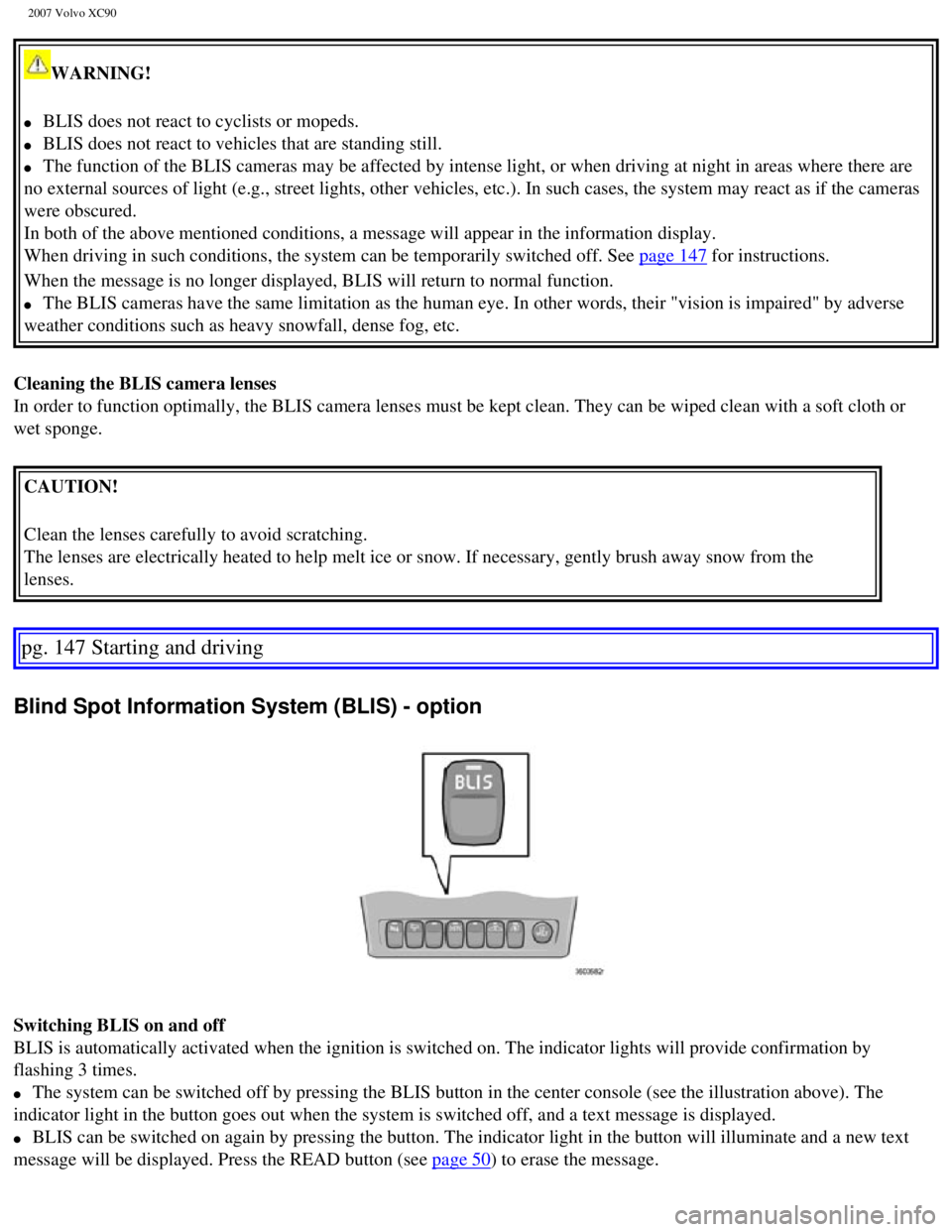
l The system can be switched off by pressing the BLIS button in the center\
console (see the illustration above). The
indicator light in the button goes out when the system is switched off, \
and a text message is displayed.
l BLIS can be switched on again by pressing the button. The indicator ligh\
t in the button will illuminate and a new text
message will be displayed. Press the READ button (see
page 50) to erase the message.
file:///K|/ownersdocs/2007/2007_XC90/07xc90_06.htm (31 of 32)12/30/200\
6 5:53:44 PM
Page 159 of 268

2007 Volvo XC90
General information
WARNING!
l The wheel and tire sizes for your Volvo are specified to meet stringent \
stability and handling
requirements. Unapproved wheel/tire size combinations can negatively aff\
ect your vehicle's stability
and handling. Approved tire sizes are shown in the Tire inflation pressu\
re tables on
page 154.
l Any damage caused by installation of unapproved wheel/tire size combinat\
ions will not be covered
by your new vehicle warranty. Volvo assumes no responsibility for death,\
injury, or expenses that
may result from such installations.
New tires
Remember that tires are perishable goods. As of 2000, the manufacturing \
week and year will be
indicated with 4 digits (e.g. 1502 means that the tire illustrated was \
manufactured during week 15 of
2002).
Tire age
Tires degrade over time, even when they are not being used. It is recomm\
ended that tires generally be
replaced after 6 years of normal service. Heat caused by hot climates, f\
requent high loading conditions
or Ultra Violet (U.V) exposure can accelerate the aging process.
You should replace the spare tire when you replace the other road tires \
due to the aging of the spare.
A tire's age can be determined by the DOT stamp on the sidewall (see th\
e illustration above).
A tire with e.g., visible cracks or discoloration should be replaced imm\
ediately.
Improving tire economy:
l Maintain correct tire pressure. See the tire pressure table on page 154.
l Drive smoothly: avoid fast starts, hard braking and tire screeching.
l Tire wear increases with speed.
l Correct front wheel alignment is very important.
l Unbalanced wheels impair tire economy and driving comfort.
l Tires must maintain the same direction of rotation throughout their life\
time.
When replacing tires, the tires with the most tread should be mounted on\
the rear wheels to reduce the
chance of oversteer during hard braking.
Hitting curbs or potholes can damage the tires and/or wheels permanently\
.
file:///K|/ownersdocs/2007/2007_XC90/07xc90_07.htm (3 of 23)12/30/2006\
5:53:47 PM
Page 192 of 268

2007 Volvo XC90
Check the belt regularly to make sure it is in good condition and is cle\
an. A worn or dirty belt can cause
poor cooling and low alternator output as well as impair the operation o\
f the power steering and the air
conditioning unit.
NOTE: The drive belt is equipped with a self-tensioning mechanism and require\
s no adjustment
between changes.
WARNING!
The engine must not be running when this check is
performed.
Check coolant level
The cooling system must be filled with coolant and not leak to operate a\
t maximum efficiency. Check
the coolant level regularly. The level should be between the "MAX" and "\
MIN" marks on the expansion
tank. The check should be made with particular thoroughness when the eng\
ine is new or when the
cooling system has been drained.
Do not remove the filler cap other than for topping up with coolant. Fre\
quent removal may prevent
coolant circulation between the engine and the expansion tank during eng\
ine warm up and cooling.
Changing coolant
Normally, the coolant does not need to be changed. If the system must be\
drained, consult your Volvo
retailer.
NOTE: Do not top off with water only. This reduces the rust-protective and an\
tifreeze qualities of the
coolant and has a lower boiling point. It can also cause damage to the c\
ooling system if it should freeze.
Top off with Volvo Genuine Coolant/Antifreeze only (a 50/ 50 mix of wat\
er and antifreeze). CAUTION!
The cooling system must always be kept filled to the correct level. If i\
t is not kept filled, there can be
high local temperatures in the engine which could result in damage. Diff\
erent types of antifreeze/
coolant may not be mixed.
WARNING!
Never remove the radiator cap while the engine is warm. Wait until the v\
ehicle
cools.
file:///K|/ownersdocs/2007/2007_XC90/07xc90_09.htm (6 of 37)12/30/2006\
5:53:50 PM
Page 221 of 268

2007 Volvo XC90
Fuses in the cargo compartment
The fuses in the cargo area are located behind the panel on the driver's\
side of the cargo compartment.
When replacing a blown fuse, be sure to replace it with a new one of the\
same color and amperage
(written on the fuse). No. Amperage
1. Backup lights 10
2. Parking lights, foglights, cargo compartment lighting, license plate \
lights, brake light
diodes 20
3. Accessories 15
4. -
5. Rear Electronic module 10
6. Rear Seat Entertainment (accessory) 7.5
7. Trailer wiring (30-feed) 15
8. 12-volt socket in cargo compartment 15
9. Rear passenger's side door - power window, power window cutout functi\
on 20
10. Rear driver's side door - power window, power window cutout function\
20
11. -
12. -
13. -
14. Subwoofer (option), rear air conditioning system (option) 15
15. -
file:///K|/ownersdocs/2007/2007_XC90/07xc90_09.htm (35 of 37)12/30/200\
6 5:53:51 PM
Page 230 of 268

2007 Volvo XC90
Fuel tank 21.1 US gals. (80 liters) Minimum octane requirement - AKI 87 (RON
91) - unleaded fuel (See also page 117)
Transmission oil
1
TF-80SC 7.4 US qts. (7.0 liters)
Miscellaneous
Power steering 1.1 US qts. (1.0 liters)
Windshield washer
reservoir 6.9 US qts. (6.5 liters)
Brake fluid 0.63 US qts. (0.6 liters)
Air conditioning system Front - 2.2 lb. (1 kg), Rear (option) 2.9 lb. (1.3 kg) R 134a (HF\
C134a)
Coolant Volvo original coolant/antifreeze (Thermostat begins to open at 194°\
F
(90° C)).
3.2 6-cyl. 7.9 US qts. (7.5 liters)
V8 10.7 US qts. (10.2 liters)
1. The transmission oil does not normally need to be changed during the \
service life of the vehicle. However, it
may be necessary to replace the oil if the vehicle is often driven in ar\
eas of sustained temperature extremes (hot
or cold), when towing a trailer over long distances, for prolonged driv\
ing in mountainous areas, or if the vehicle
is often driven short distances in temperatures under 40°F (5°C)\
.
Transmission
Oil grade:
Type: JWS 3309
Different types of oil should never be mixed.
Power steering
Grade: Volvo synthetic power steering fluid (Pentosin CHF 11S) P/N 1161529 o\
r equivalent.
Brake fluid
Fluid type: DOT 4+ boiling point >536° F (280° C), P/N 9437433
Rear suspension
Individual rear wheel suspension with longitudinal support arms, double \
link arms and track rods.
Front suspension
Spring strut suspension with integrated shock absorbers and control arms\
linked to
file:///K|/ownersdocs/2007/2007_XC90/07xc90_10.htm (7 of 10)12/30/2006\
5:53:52 PM
Page 260 of 268

2007 Volvo XC90
2 0 0 7
VOLVO XC90
Index
pg. 241-244 Index
A
A/C (air conditioning)
81
ABS
2, 49, 128
Accessory installation (special warnings)
5
Active Bi-Xenon headlights (ABL)
52, 55
Air cleaner
185
Air conditioning
76
Air distribution
78, 81
Air quality sensor
82
Air vents
78
Alarm
111
All Wheel Drive
126
All Wheel Drive - towing
135
Anti-lock Brake System (ABS)
2, 49
Ashtray
65, 94
Audio system
219
AUTO (climate control)
80
Autostart
119, 121
AUX (audio system)
232
Average speed
62
AWD
126
B
Bass
225
file:///K|/ownersdocs/2007/2007_XC90/07xc90_12.htm (1 of 9)12/30/2006 \
5:53:56 PM