brake VOLVO XC90 2007 User Guide
[x] Cancel search | Manufacturer: VOLVO, Model Year: 2007, Model line: XC90, Model: VOLVO XC90 2007Pages: 268, PDF Size: 8.57 MB
Page 73 of 268

2007 Volvo XC90
warning will be displayed in the text window.
l The covers should be kept on when the auxiliary sockets are not in use. \
l Maximum current from the sockets is 15A.
Ashtrays/cigarette lighter
The auxiliary sockets can also be used for cigarette lighters.
Ashtrays and lighters are available as accessories. Please contact your \
Volvo retailer.
pg. 66 Instruments and controls
Parking brake
file:///K|/ownersdocs/2007/2007_XC90/07xc90_02.htm (27 of 40)12/30/200\
6 5:53:37 PM
Page 74 of 268
. The brake is applied \
to the rear wheels.
When applying the parking brake
- Press firmly on the brake pedal.
- Pres")
2007 Volvo XC90
Parking brake
To apply the parking brake, press the pedal (C). The brake is applied \
to the rear wheels.
When applying the parking brake
- Press firmly on the brake pedal.
- Press down pedal C as far as possible.
- Release the brake pedal and ensure that the vehicle is at a standstill\
.
- Put the gear selector in P (automatic transmission).
WARNING!
l Always apply the parking brake fully when the vehicle is parked.
l The indicator light will light up even if the parking brake has only bee\
n partially applied. Always
press down the pedal as far as possible.
l When parking the vehicle, in addition to applying the parking brake, alw\
ays put the gear selector in
the Park position.
Parking on a hill
l If the vehicle is pointing uphill, turn the front wheels so that they po\
int away from the curb.
l If the vehicle is pointing downhill, turn the front wheels so that they \
point toward the curb.
Releasing the parking brake
- Press firmly on the brake pedal.
- Pull out the parking brake release handle (A).
NOTE: There is also an audible signal that will sound if the vehicle is drive\
n with the parking brake
engaged.
l Release the parking brake pulling out the lower edge of the release hand\
le (A).
l If you inadvertently pull the plastic cover (B), it can be pressed bac\
k into place.
file:///K|/ownersdocs/2007/2007_XC90/07xc90_02.htm (28 of 40)12/30/200\
6 5:53:37 PM
Page 96 of 268

2007 Volvo XC90
3. Raise/lower seat height: pump the seat up or down.
4. Lumbar support: turn the control for firmer or softer lumbar support.\
5. Backrest tilt: turn the control to adjust the angle of the backrest. \
6. Control panel for optional power seat (see
page 86 for more information).
WARNING!
l Do not adjust the seat while driving. The seat should be adjusted so tha\
t the brake pedal can be
depressed fully. In addition, position the seat as far rearward as comfo\
rt and control allow.
l Check that the seat is securely locked into position after adjusting.
pg. 85 Interior
Front seats
Folding the backrests in the front seat
The front passenger seat backrest can be folded to a horizontal position\
to make room for a long load.
Fold the backrest as follows:
- Move the seat as far back as possible.
- Adjust the backrest to the upright position.
- Lift the catches on the rear of the backrest.
- Without releasing the catches, push the backrest forward.
- Move the seat as far forward as possible so that the head restraint sl\
ides under the glove compartment.
file:///K|/ownersdocs/2007/2007_XC90/07xc90_04.htm (2 of 23)12/30/2006\
5:53:40 PM
Page 99 of 268

2007 Volvo XC90
WARNING!
l Because the driver's seat can be adjusted with the ignition off, childre\
n should never be left
unattended in the vehicle.
l Movement of the seat can be STOPPED at any time by pressing any button o\
n the power seat
control panel.
l Do not adjust the seat while driving.
l The seat should be adjusted so that the brake pedal can be depressed ful\
ly. In addition, position the
seat as far rearward as comfort and control allow.
l The seat rails on the floor must not be obstructed in any way when the s\
eat is in motion.
Programming the memory
Three different seating and door mirror positions can be stored in the d\
river seat's memory.
The following example explains how button 1 can be programmed. Buttons 2\
and 3 can be programmed
in the same way.
To program (store) a seat position in button 1:
- Move the seat to the desired position using the seat adjustment contro\
ls (see the previous page).
- Press and hold down the MEM (memory) button.
- With the MEM button depressed, press button 1 briefly to store the sea\
t's current position.
To move the seat to the position that it was in when button 1 was progra\
mmed:
Press and hold down button 1 until the seat stops moving.
As a safety precaution, the seat will stop automatically if the button i\
s released before the seat has
reached the preset position.
pg. 88 Interior
Rear seats
file:///K|/ownersdocs/2007/2007_XC90/07xc90_04.htm (5 of 23)12/30/2006\
5:53:40 PM
Page 125 of 268
2007 Volvo XC90
2 0 0 7
VOLVO XC90
Starting and driving
pg. 113 Starting and driving
General information
114
Fuel requirements
115
Refueling
117
Starting the vehicle
119
Economical driving
121
Difficult driving conditions
123
Automatic transmission with Geartronic
124
All Wheel Drive (option)
126
Brake system
127
Stability system
130
Front/rear park assist (accessory/option)
132
Towing
134
Jump starting
136
Towing a trailer
137
Detachable trailer hitch
140
Load carriers (accessory)
141
Cold weather precautions
143
Before a long distance trip
144
Blind Spot Information System (BLIS) -
option
145
pg. 114 Starting and driving
General information
Engine oil
Although some oil consumption occurs during normal engine operation, mor\
e oil is consumed when the engine is new as
the internal parts generate higher friction while wearing-in to each oth\
er. From the time the engine is new until the first
maintenance is performed, the oil consumption could be higher than norma\
l. For this reason, it is especially important to
check the oil every time you refuel your vehicle during this period. See\
page 187.
file:///K|/ownersdocs/2007/2007_XC90/07xc90_06.htm (1 of 32)12/30/2006\
5:53:44 PM
Page 130 of 268

2007 Volvo XC90
CAUTION!
- Do not refuel with the engine running
1. Turn the ignition off or to position I. If the ignition is on, an inco\
rrect reading
could occur in the fuel gauge.
- After refueling, close the fuel filler cap by turning it clockwise unt\
il it clicks into place
1.
- Avoid overfilling the fuel tank. Do not press the handle on the filler\
nozzle more than one extra time. Too much fuel in
the tank in hot weather conditions can cause the fuel to overflow. Overf\
illing could also cause damage to the emission
control systems.
- Avoid spilling gasoline during refueling. In addition to causing damag\
e to the environment, gasolines containing
alcohol can cause damage to painted surfaces, which may not be covered u\
nder the New Vehicle Limited Warranty.
- Do not use gasolines containing methanol (methyl alcohol, wood alcoho\
l). This practice can result in vehicle
performance deterioration and can damage critical parts in the fuel syst\
em. Such damage may not be covered under the
New Vehicle Limited Warranty.
1. If the fuel filler cap is not closed tightly or if the engine is runn\
ing when the vehicle is refueled, the Check Engine Light
(malfunction indicator lamp) may indicate a fault. However, your vehic\
le's performance will not be affected. Use only Volvo original
or approved fuel filler caps.
pg. 119 Starting and driving
Starting the vehicle
Starting the engine
- Fasten the seat belt.
WARNING!
Before starting, check that the seat, steering wheel and mirrors are adj\
usted properly. Make sure the brake pedal can be
depressed completely. Adjust the seat if necessary. See pages
84 and 87.
- Apply the parking brake (hand brake) if not already set. The gear se\
lector is locked in the (P)ark position
(SHIFTLOCK).
- Without touching the accelerator pedal, turn the ignition key
1 to the starting position. Allow the starter to operate for up
to 10 seconds. Release the key as soon as the engine starts
2. If the engine fails to start, repeat this step.
NOTE:
l If the key blade section of the remote is not fully folded out when star\
ting the vehicle, the immobilizer function may
make it impossible to start the engine.
l After a cold start, idle speed may be noticeably higher than normal for \
a short period. This is done to help bring
components in the emission control system to their normal operating temp\
erature as quickly as possible, which enables
them to control emissions and help reduce the vehicle's impact on the en\
vironment.
l For cold starts at altitudes above 6000 ft (1800 meters), depress the \
accelerator pedal halfway and turn the key to the
starting position. Release the pedal slowly when the engine starts.
- To release the gear selector from the (P)ark position, the engine must be running (or the ignition key must be\
in position
II) and the brake pedal must be depressed.
file:///K|/ownersdocs/2007/2007_XC90/07xc90_06.htm (6 of 32)12/30/2006\
5:53:44 PM
Page 131 of 268

2007 Volvo XC90
- Select the desired gear. The gear engages after a very slight delay wh\
ich is especially noticeable when selecting R.
NOTE: Your vehicle is equipped with a KEYLOCK system. When the engine is switched off, the gear selector must be
in the (P)ark position before the key can be removed from the ignition switch. W\
hen starting in cold weather, the
transmission may shift up at slightly higher engine speeds than normal u\
ntil the automatic transmission fluid reaches
normal operating temperature.
NOTE: Do not race a cold engine immediately after starting. Oil flow may not \
reach some lubrication points fast enough
to prevent engine damage.
WARNING!
An extra mat on the driver's floor can cause the accelerator pedal to ca\
tch. Check that the movement of the accelerator
pedal is not impeded. No more than one protective floor covering may be \
used at one time.
1. If two of the keys to your vehicle are close together, e.g. on the sa\
me key ring when you try to start the vehicle, this could cause
interference in the immobilizer system and result in the vehicle not sta\
rting. If this should occur, remove one of the keys from the key
ring before trying to start the vehicle again.
2. On vehicles equipped with the autostart feature, release the key imme\
diately. See also
page 121.
pg. 120 Starting and driving
Starting the vehicle
WARNING!
Always place the gear selector in Park and apply the parking brake befor\
e leaving the vehicle. Never leave the vehicle
unattended with the engine running. Always open garage doors fully befor\
e starting the engine inside a garage to ensure
adequate ventilation. The exhaust gases contain carbon monoxide, which i\
s invisible and odorless but very poisonous.
CAUTION!
Automatic transmission
The engine should be idling when you move the gear selector. Never accel\
erate until after you feel the transmission
engage! Accelerating immediately after selecting a gear will cause harsh\
engagement and premature transmission wear.
Selecting P or N when idling at a standstill for prolonged periods of ti\
me will help prevent overheating of the automatic
transmission fluid.
pg. 121 Starting and driving
Economical driving
Ignition switch and steering wheel lock
file:///K|/ownersdocs/2007/2007_XC90/07xc90_06.htm (7 of 32)12/30/2006\
5:53:44 PM
Page 133 of 268
 or\
remove the key from the ignition switch while the
vehicle is in motion. This could cause the steer")
2007 Volvo XC90
WARNING!
Never switch off the ignition (turn the ignition key to position 0) or\
remove the key from the ignition switch while the
vehicle is in motion. This could cause the steering wheel to lock, which\
would make the vehicle impossible to steer.
Economical driving conserves natural resources
Better driving economy may be obtained by thinking ahead, avoiding rapid\
starts and stops and adjusting the speed of your
vehicle to immediate traffic conditions. Observe the following rules:
l Bring the engine to normal operating temperature as soon as possible by \
driving with a light foot on the accelerator
pedal for the first few minutes of operation. A cold engine uses more fu\
el and is subject to increased wear.
l Whenever possible, avoid using the vehicle for driving short distances. \
This does not allow the engine to reach normal
operating temperature.
l Drive carefully and avoid rapid acceleration and hard braking.
l Use the transmission's (D)rive position as often as possible and avoid using "kickdown" to help \
improve fuel economy.
l Do not exceed posted speed limits.
l Avoid carrying unnecessary items (extra load) in the vehicle.
l Maintain correct tire pressure. Check tire pressure regularly (when tir\
es are cold).
l Remove snow tires when threat of snow or ice has ended.
1. The gear selector must be in the (P)ark position (automatic transmission).
2. Please be aware that leaving the key in this position will increase b\
attery drain.
pg. 122 Starting and driving
Economical driving
l Note that roof racks, ski racks, etc, increase air resistance and also f\
uel consumption.
l At highway driving speeds, fuel consumption will be lower with the air c\
onditioning on and the windows closed than
with the air conditioning off and the windows open.
l Using the onboard trip computer's fuel consumption modes can help you le\
arn how to drive more economically.
Other factors that decrease gas mileage are:
l Dirty air cleaner
l Dirty engine oil and clogged oil filter
l Dragging brakes
l Incorrect front end alignment.
Some of the above mentioned items and others are checked at the standard\
Maintenance Service intervals.
CAUTION!
Drive slowly and carefully if going through standing water (i.e. floode\
d roadways, etc.). Damage to the engine could
result if excess water is drawn in through the air intake system. Never \
drive the vehicle in water deeper than 18 inches
(48 cm).
pg. 123 Starting and driving
file:///K|/ownersdocs/2007/2007_XC90/07xc90_06.htm (9 of 32)12/30/2006\
5:53:44 PM
Page 134 of 268

2007 Volvo XC90
Difficult driving conditions
Driving on rough/unpaved surfaces
The Volvo XC90 is designed primarily for on-road driving, and it has exc\
ellent handling characteristics on very rough or
unpaved roads.
When driving on poorly maintained or unpaved roads, please keep the foll\
owing in mind:
l Reduce speed on rough surfaces to minimize possible damage to the vehicl\
e's underbody.
l When driving on soft surfaces such as dry sand or snow, try to avoid sto\
pping if at all possible.
WARNING!
Avoid driving diagonally across steep inclines as this could increase th\
e risk of a roll-over. Try to drive straight up or
down the slope.
If the road is very steep, avoid turning the vehicle around to help avoi\
d the risk of rolling over. Back the vehicle up or
down the incline instead.
NOTE: Avoid driving on steep inclines if the fuel tank is nearly empty. If th\
e flow of fuel to the engine is interrupted due
to the vehicle's angle of inclination, this could result in damage to th\
e three-way catalytic converter. We recommend
keeping the fuel tank at least half full when driving on steep inclines.\
Driving through water
The vehicle can be driven through water up to a depth of approximately 1\
8 inches (48 cm), at a maximum speed of 6 mph
(10 km/h).
Take particular care when driving through flowing water.
Clean the electrical connections for trailer wiring after driving in mud\
or water.
When driving through water, maintain low speed and do not stop in the wa\
ter.
WARNING!
After driving through water, press lightly on the brake pedal to ensure \
that the brakes are functioning normally. Water
or mud can make the brake linings slippery, resulting in delayed braking\
effect.
CAUTION!
l Engine damage will occur if water is drawn into the air cleaner.
l If the vehicle is driven through water deeper than 18 in (48 cm), wate\
r may enter the differential and the
transmission. This reduces the oil's lubricating capacity and may shorte\
n the service life of these components.
l Do not allow the vehicle to stand in water up to the door sills longer t\
han absolutely necessary. This could result in
electrical malfunctions.
l If the engine has been stopped while the car is in water, do not attempt\
to restart the engine. Have the car towed out
of the water.
pg. 124 Starting and driving
file:///K|/ownersdocs/2007/2007_XC90/07xc90_06.htm (10 of 32)12/30/200\
6 5:53:44 PM
Page 135 of 268
2007 Volvo XC90
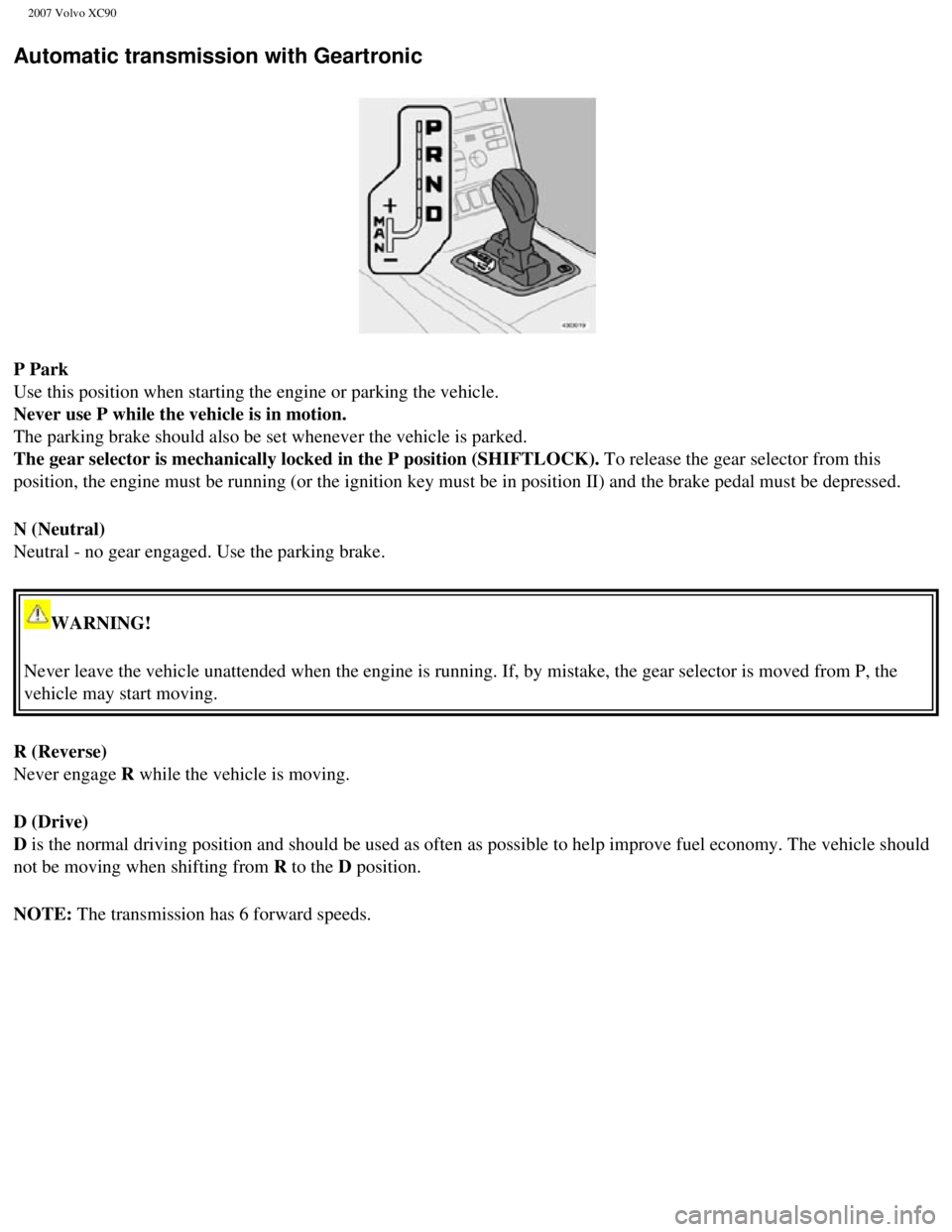
Automatic transmission with Geartronic
P Park
Use this position when starting the engine or parking the vehicle.
Never use P while the vehicle is in motion.
The parking brake should also be set whenever the vehicle is parked.
The gear selector is mechanically locked in the P position (SHIFTLOCK)\
. To release the gear selector from this
position, the engine must be running (or the ignition key must be in po\
sition II) and the brake pedal must be depressed.
N (Neutral)
Neutral - no gear engaged. Use the parking brake.
WARNING!
Never leave the vehicle unattended when the engine is running. If, by mi\
stake, the gear selector is moved from P, the
vehicle may start moving.
R (Reverse)
Never engage R while the vehicle is moving.
D (Drive)
D is the normal driving position and should be used as often as possible \
to help improve fuel economy. The vehicle should
not be moving when shifting from R to the D position.
NOTE: The transmission has 6 forward speeds.
file:///K|/ownersdocs/2007/2007_XC90/07xc90_06.htm (11 of 32)12/30/200\
6 5:53:44 PM