fuel VOLVO XC90 2007 User Guide
[x] Cancel search | Manufacturer: VOLVO, Model Year: 2007, Model line: XC90, Model: VOLVO XC90 2007Pages: 268, PDF Size: 8.57 MB
Page 70 of 268

2007 Volvo XC90
3. Current fuel consumption
This value indicates the current fuel consumption, based on readings tak\
en once per second. When the
vehicle is not moving, "----" will be displayed.
4. Average speed
This value indicates average speed since the last time the trip computer\
was reset (by pressing RESET,
button C). When the engine is switched off, information on average spee\
d is stored and remains in
system memory until the RESET (button C) is pressed again.
5. Current speed in miles per hour (Canadian models only)
This function provides the driver with an instantaneous conversion of th\
e vehicle's current speed from
km/h to mph.
NOTE: Trip computer readings may vary slightly depending on the circumference\
of the tires on the
vehicle and driving style.
1. Five functions on Canadian models.
2. A sixth time on Canadian models.
pg. 63 Instruments and controls
Cruise control
Cruise control
The cruise control panel is located on the left side of the steering whe\
el hub.
Engaging cruise control
Press the CRUISE button. CRUISE will be displayed in the information win\
dow in the instrument panel.
file:///K|/ownersdocs/2007/2007_XC90/07xc90_02.htm (24 of 40)12/30/200\
6 5:53:37 PM
Page 125 of 268
2007 Volvo XC90
2 0 0 7
VOLVO XC90
Starting and driving
pg. 113 Starting and driving
General information
114
Fuel requirements
115
Refueling
117
Starting the vehicle
119
Economical driving
121
Difficult driving conditions
123
Automatic transmission with Geartronic
124
All Wheel Drive (option)
126
Brake system
127
Stability system
130
Front/rear park assist (accessory/option)
132
Towing
134
Jump starting
136
Towing a trailer
137
Detachable trailer hitch
140
Load carriers (accessory)
141
Cold weather precautions
143
Before a long distance trip
144
Blind Spot Information System (BLIS) -
option
145
pg. 114 Starting and driving
General information
Engine oil
Although some oil consumption occurs during normal engine operation, mor\
e oil is consumed when the engine is new as
the internal parts generate higher friction while wearing-in to each oth\
er. From the time the engine is new until the first
maintenance is performed, the oil consumption could be higher than norma\
l. For this reason, it is especially important to
check the oil every time you refuel your vehicle during this period. See\
page 187.
file:///K|/ownersdocs/2007/2007_XC90/07xc90_06.htm (1 of 32)12/30/2006\
5:53:44 PM
Page 126 of 268
")
2007 Volvo XC90
Fuel requirements
Octane rating
Volvo engines are designed for optimum performance on unleaded premium g\
asoline with an AKI octane rating of 91 or
above. AKI (ANTI KNOCK INDEX) is an average of the Research Octane Num\
ber, RON, and the Motor Octane Number,
MON. ((RON + MON)/2). The minimum octane requirement is AKI 87 (RON\
91).
Deposit control gasoline (detergent additives)
Volvo recommends the use of detergent gasoline to control engine deposit\
s. Detergent gasoline is effective in keeping
injectors and intake valves clean. Consistent use of deposit control gas\
olines will help ensure good drivability and fuel
economy. If you are not sure whether the gasoline contains deposit contr\
ol additives, check with the service station
operator.
NOTE: Volvo does not recommend the use of external fuel injector cleaning sys\
tems.
Unleaded fuel
Each Volvo has a three-way catalytic converter and must use only unleade\
d gasoline. U.S. and Canadian regulations
require that pumps delivering unleaded gasoline be labelled "UNLEADED". \
Only these pumps have nozzles which fit
your vehicle's filler inlet. It is unlawful to dispense leaded fuel into\
a vehicle labelled "unleaded gasoline only". Leaded
gasoline damages the three-way catalytic converter and the heated oxygen\
sensor system. Repeated use of leaded gasoline
will lessen the effectiveness of the emission control system and could r\
esult in loss of emission warranty coverage. State
and local vehicle inspection programs will make detection of misfueling \
easier, possibly resulting in emission test failure
for misfueled vehicles.
NOTE: Some U.S. and Canadian gasolines contain an octane enhancing additive c\
alled methyl-cyclopentadienyl
manganese tricarbonyl (MMT). If such fuels are used, your Emission Con\
trol System performance may be affected, and
the Check Engine Light (malfunction indicator lamp) located on your in\
strument panel may light. If this occurs, please
return your vehicle to an authorized Volvo retailer for maintenance.
Gasoline containing alcohol and ethers "Oxygenated fuels"
Some fuel suppliers sell gasoline containing "oxygenates" which are usua\
lly alcohols or ethers. In some areas, state or
local laws require that the service pump be marked indicating use of alc\
ohols or ethers. However, there are areas in which
the pumps are unmarked. If you are not sure whether there is alcohol or \
ethers in the gasoline you buy, check with the
service station operator. To meet seasonal air quality standards, some a\
reas require the use of "oxygenated" fuel.
Volvo allows the use of the following "oxygenated" fuels; however, the o\
ctane ratings listed on this page must still be met.
Alcohol - Ethanol: Fuels containing up to 10% ethanol by volume may be u\
sed. Ethanol may also be referred to as Ethyl
alcohol, or "Gasohol".
Ethers - MTBE: Fuels containing up to 15% MTBE may be used.
pg. 115 Starting and driving
Fuel requirements
file:///K|/ownersdocs/2007/2007_XC90/07xc90_06.htm (2 of 32)12/30/2006\
5:53:44 PM
Page 127 of 268

2007 Volvo XC90
Octane rating
Volvo engines are designed to achieve rated horsepower, torque, and fuel\
economy performance using premium 91 octane
fuel. Volvo recommends premium for best performance, but using 87 octane\
or above will not affect engine reliability.
In demanding driving conditions, such as operating the vehicle in hot we\
ather, towing a trailer, or driving for extended
periods at higher altitudes than normal, it may be advisable to switch t\
o higher octane fuel (91 or higher) or to change
gasoline brands to fully utilize your engine's capacity, and for the smo\
othest possible operation.
NOTE: When switching to higher octane fuel or changing gasoline brands, it ma\
y be necessary to fill the tank more than
once before a difference in engine operation is noticeable.
Fuel Formulations
Do not use gasoline that contains lead as a knock inhibitor, and do not \
use lead additives. Besides damaging the exhaust
emission control systems on your vehicle, lead has been strongly linked \
to certain forms of cancer.
Many fuels contain benzene as a solvent. Unburned benzene has been stron\
gly linked to certain forms of cancer. If you
live in an area where you must fill your own gas tank, take precautions.\
These may include:
l standing upwind away from the filler nozzle while refueling
l refueling only at gas stations with vapor recovery systems that fully se\
al the mouth of the filler neck during refueling
l wearing neoprene gloves while handling a fuel filler nozzle.
Use of Additives
With the exception of gas line antifreeze during winter months, do not a\
dd solvents, thickeners, or other store-bought
additives to your vehicle's fuel, cooling, or lubricating systems. Overu\
se may damage your engine, and some of these
additives contain organically volatile chemicals. Do not needlessly expo\
se yourself to these chemicals.
file:///K|/ownersdocs/2007/2007_XC90/07xc90_06.htm (3 of 32)12/30/2006\
5:53:44 PM
Page 128 of 268

2007 Volvo XC90
WARNING!
Carbon monoxide is a poisonous, colorless, and odorless gas. It is prese\
nt in all exhaust gases. If you ever smell exhaust
fumes inside the vehicle, make sure the passenger compartment is ventila\
ted, and immediately return the vehicle to your
retailer for correction.
pg. 116 Starting and driving
Fuel requirements
WARNING!
Driving with the tailgate open: Driving with the tailgate open could lead to poisonous exhaust gases e\
ntering the
passenger compartment. If the tailgate must be kept open for any reason,\
proceed as follows:
l Close the windows
l Set the ventilation system control to air flow to floor, windshield and \
side windows and blower control to its highest
setting.
Weight distribution affects handling
At the specified curb weight your vehicle has a tendency to understeer, \
which means that the steering wheel has to be
turned more than might seem appropriate for the curvature of a bend. Thi\
s ensures good stability and reduces the risk of
rear wheel skid. Remember that these properties can alter with the vehic\
le load. The heavier the load in the cargo area, the
less the tendency to understeer.
Handling, roadholding
Vehicle load, tire design and inflation pressure all affect vehicle hand\
ling. Therefore, check that the tires are inflated to the
recommended pressure according to the vehicle load. See "Tire pressure" \
section. Loads should be distributed so that
capacity weight or maximum permissible axle loads are not exceeded.
Conserving electrical current
Keep the following in mind to help minimize battery drain:
l When the engine is not running, avoid turning the ignition key to positi\
on II (see page 121). Many electrical systems
(the audio system, the optional infotainment/ navigation systems, power\
windows, etc) will function with the ignition key
in position I. This position reduces drain on the battery.
l Please keep in mind that using systems, accessories, etc that consume a \
great deal of current when the engine is not
running could result in the battery being completely drained.
NOTE: A warning message will be displayed in the text window in the instrumen\
t panel when the battery charge is low.
pg. 117 Starting and driving
Refueling
file:///K|/ownersdocs/2007/2007_XC90/07xc90_06.htm (4 of 32)12/30/2006\
5:53:44 PM
Page 129 of 268
2007 Volvo XC90
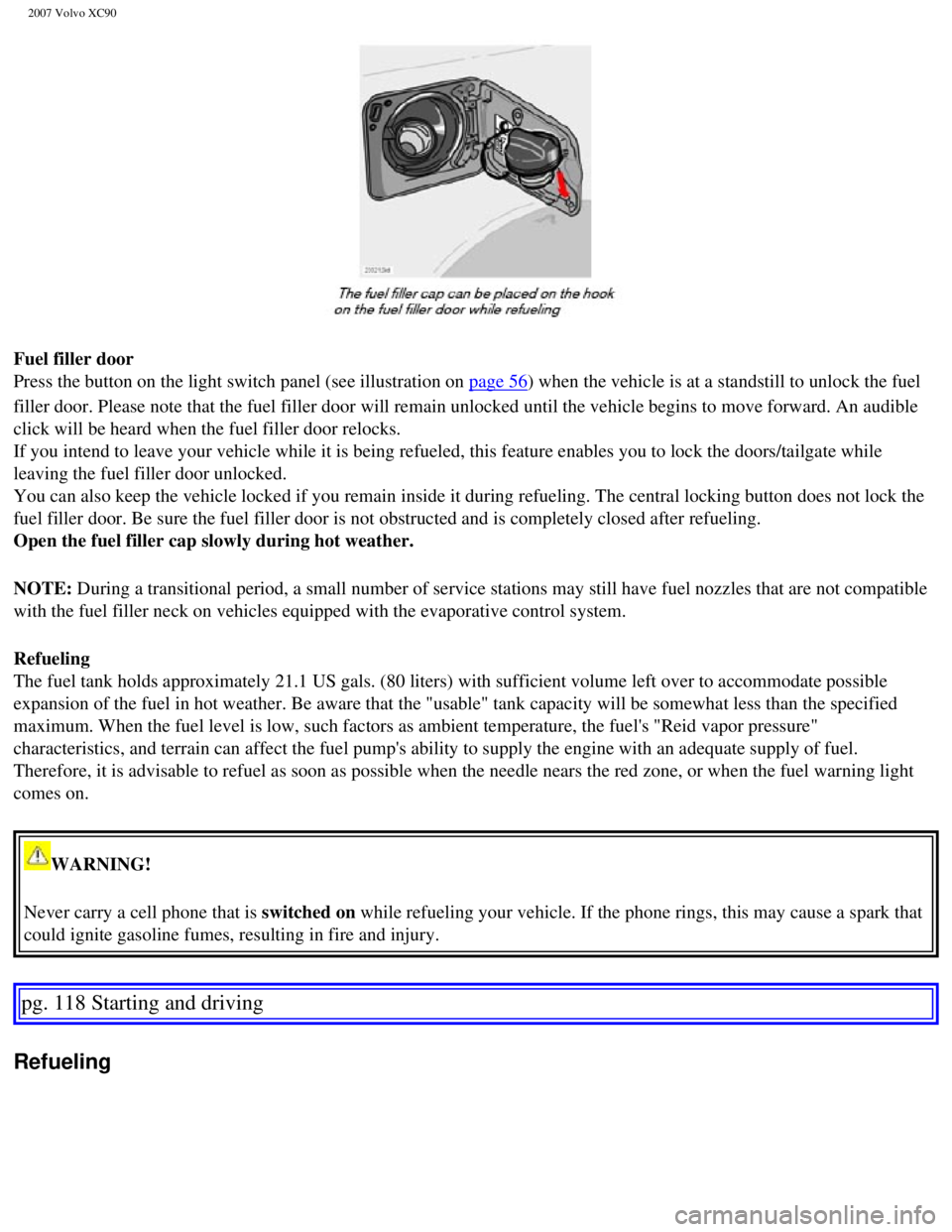
Fuel filler door
Press the button on the light switch panel (see illustration on
page 56) when the vehicle is at a standstill to unlock the fuel
filler door. Please note that the fuel filler door will remain unlocked \
until the vehicle begins to move forward. An audible
click will be heard when the fuel filler door relocks.
If you intend to leave your vehicle while it is being refueled, this fea\
ture enables you to lock the doors/tailgate while
leaving the fuel filler door unlocked.
You can also keep the vehicle locked if you remain inside it during refu\
eling. The central locking button does not lock the
fuel filler door. Be sure the fuel filler door is not obstructed and is \
completely closed after refueling.
Open the fuel filler cap slowly during hot weather.
NOTE: During a transitional period, a small number of service stations may st\
ill have fuel nozzles that are not compatible
with the fuel filler neck on vehicles equipped with the evaporative cont\
rol system.
Refueling
The fuel tank holds approximately 21.1 US gals. (80 liters) with suffi\
cient volume left over to accommodate possible
expansion of the fuel in hot weather. Be aware that the "usable" tank ca\
pacity will be somewhat less than the specified
maximum. When the fuel level is low, such factors as ambient temperature\
, the fuel's "Reid vapor pressure"
characteristics, and terrain can affect the fuel pump's ability to suppl\
y the engine with an adequate supply of fuel.
Therefore, it is advisable to refuel as soon as possible when the needle\
nears the red zone, or when the fuel warning light
comes on.
WARNING!
Never carry a cell phone that is switched on while refueling your vehicle. If the phone rings, this may cause a spar\
k that
could ignite gasoline fumes, resulting in fire and injury.
pg. 118 Starting and driving
Refueling
file:///K|/ownersdocs/2007/2007_XC90/07xc90_06.htm (5 of 32)12/30/2006\
5:53:44 PM
Page 130 of 268

2007 Volvo XC90
CAUTION!
- Do not refuel with the engine running
1. Turn the ignition off or to position I. If the ignition is on, an inco\
rrect reading
could occur in the fuel gauge.
- After refueling, close the fuel filler cap by turning it clockwise unt\
il it clicks into place
1.
- Avoid overfilling the fuel tank. Do not press the handle on the filler\
nozzle more than one extra time. Too much fuel in
the tank in hot weather conditions can cause the fuel to overflow. Overf\
illing could also cause damage to the emission
control systems.
- Avoid spilling gasoline during refueling. In addition to causing damag\
e to the environment, gasolines containing
alcohol can cause damage to painted surfaces, which may not be covered u\
nder the New Vehicle Limited Warranty.
- Do not use gasolines containing methanol (methyl alcohol, wood alcoho\
l). This practice can result in vehicle
performance deterioration and can damage critical parts in the fuel syst\
em. Such damage may not be covered under the
New Vehicle Limited Warranty.
1. If the fuel filler cap is not closed tightly or if the engine is runn\
ing when the vehicle is refueled, the Check Engine Light
(malfunction indicator lamp) may indicate a fault. However, your vehic\
le's performance will not be affected. Use only Volvo original
or approved fuel filler caps.
pg. 119 Starting and driving
Starting the vehicle
Starting the engine
- Fasten the seat belt.
WARNING!
Before starting, check that the seat, steering wheel and mirrors are adj\
usted properly. Make sure the brake pedal can be
depressed completely. Adjust the seat if necessary. See pages
84 and 87.
- Apply the parking brake (hand brake) if not already set. The gear se\
lector is locked in the (P)ark position
(SHIFTLOCK).
- Without touching the accelerator pedal, turn the ignition key
1 to the starting position. Allow the starter to operate for up
to 10 seconds. Release the key as soon as the engine starts
2. If the engine fails to start, repeat this step.
NOTE:
l If the key blade section of the remote is not fully folded out when star\
ting the vehicle, the immobilizer function may
make it impossible to start the engine.
l After a cold start, idle speed may be noticeably higher than normal for \
a short period. This is done to help bring
components in the emission control system to their normal operating temp\
erature as quickly as possible, which enables
them to control emissions and help reduce the vehicle's impact on the en\
vironment.
l For cold starts at altitudes above 6000 ft (1800 meters), depress the \
accelerator pedal halfway and turn the key to the
starting position. Release the pedal slowly when the engine starts.
- To release the gear selector from the (P)ark position, the engine must be running (or the ignition key must be\
in position
II) and the brake pedal must be depressed.
file:///K|/ownersdocs/2007/2007_XC90/07xc90_06.htm (6 of 32)12/30/2006\
5:53:44 PM
Page 133 of 268
 or\
remove the key from the ignition switch while the
vehicle is in motion. This could cause the steer")
2007 Volvo XC90
WARNING!
Never switch off the ignition (turn the ignition key to position 0) or\
remove the key from the ignition switch while the
vehicle is in motion. This could cause the steering wheel to lock, which\
would make the vehicle impossible to steer.
Economical driving conserves natural resources
Better driving economy may be obtained by thinking ahead, avoiding rapid\
starts and stops and adjusting the speed of your
vehicle to immediate traffic conditions. Observe the following rules:
l Bring the engine to normal operating temperature as soon as possible by \
driving with a light foot on the accelerator
pedal for the first few minutes of operation. A cold engine uses more fu\
el and is subject to increased wear.
l Whenever possible, avoid using the vehicle for driving short distances. \
This does not allow the engine to reach normal
operating temperature.
l Drive carefully and avoid rapid acceleration and hard braking.
l Use the transmission's (D)rive position as often as possible and avoid using "kickdown" to help \
improve fuel economy.
l Do not exceed posted speed limits.
l Avoid carrying unnecessary items (extra load) in the vehicle.
l Maintain correct tire pressure. Check tire pressure regularly (when tir\
es are cold).
l Remove snow tires when threat of snow or ice has ended.
1. The gear selector must be in the (P)ark position (automatic transmission).
2. Please be aware that leaving the key in this position will increase b\
attery drain.
pg. 122 Starting and driving
Economical driving
l Note that roof racks, ski racks, etc, increase air resistance and also f\
uel consumption.
l At highway driving speeds, fuel consumption will be lower with the air c\
onditioning on and the windows closed than
with the air conditioning off and the windows open.
l Using the onboard trip computer's fuel consumption modes can help you le\
arn how to drive more economically.
Other factors that decrease gas mileage are:
l Dirty air cleaner
l Dirty engine oil and clogged oil filter
l Dragging brakes
l Incorrect front end alignment.
Some of the above mentioned items and others are checked at the standard\
Maintenance Service intervals.
CAUTION!
Drive slowly and carefully if going through standing water (i.e. floode\
d roadways, etc.). Damage to the engine could
result if excess water is drawn in through the air intake system. Never \
drive the vehicle in water deeper than 18 inches
(48 cm).
pg. 123 Starting and driving
file:///K|/ownersdocs/2007/2007_XC90/07xc90_06.htm (9 of 32)12/30/2006\
5:53:44 PM
Page 134 of 268

2007 Volvo XC90
Difficult driving conditions
Driving on rough/unpaved surfaces
The Volvo XC90 is designed primarily for on-road driving, and it has exc\
ellent handling characteristics on very rough or
unpaved roads.
When driving on poorly maintained or unpaved roads, please keep the foll\
owing in mind:
l Reduce speed on rough surfaces to minimize possible damage to the vehicl\
e's underbody.
l When driving on soft surfaces such as dry sand or snow, try to avoid sto\
pping if at all possible.
WARNING!
Avoid driving diagonally across steep inclines as this could increase th\
e risk of a roll-over. Try to drive straight up or
down the slope.
If the road is very steep, avoid turning the vehicle around to help avoi\
d the risk of rolling over. Back the vehicle up or
down the incline instead.
NOTE: Avoid driving on steep inclines if the fuel tank is nearly empty. If th\
e flow of fuel to the engine is interrupted due
to the vehicle's angle of inclination, this could result in damage to th\
e three-way catalytic converter. We recommend
keeping the fuel tank at least half full when driving on steep inclines.\
Driving through water
The vehicle can be driven through water up to a depth of approximately 1\
8 inches (48 cm), at a maximum speed of 6 mph
(10 km/h).
Take particular care when driving through flowing water.
Clean the electrical connections for trailer wiring after driving in mud\
or water.
When driving through water, maintain low speed and do not stop in the wa\
ter.
WARNING!
After driving through water, press lightly on the brake pedal to ensure \
that the brakes are functioning normally. Water
or mud can make the brake linings slippery, resulting in delayed braking\
effect.
CAUTION!
l Engine damage will occur if water is drawn into the air cleaner.
l If the vehicle is driven through water deeper than 18 in (48 cm), wate\
r may enter the differential and the
transmission. This reduces the oil's lubricating capacity and may shorte\
n the service life of these components.
l Do not allow the vehicle to stand in water up to the door sills longer t\
han absolutely necessary. This could result in
electrical malfunctions.
l If the engine has been stopped while the car is in water, do not attempt\
to restart the engine. Have the car towed out
of the water.
pg. 124 Starting and driving
file:///K|/ownersdocs/2007/2007_XC90/07xc90_06.htm (10 of 32)12/30/200\
6 5:53:44 PM
Page 135 of 268
2007 Volvo XC90
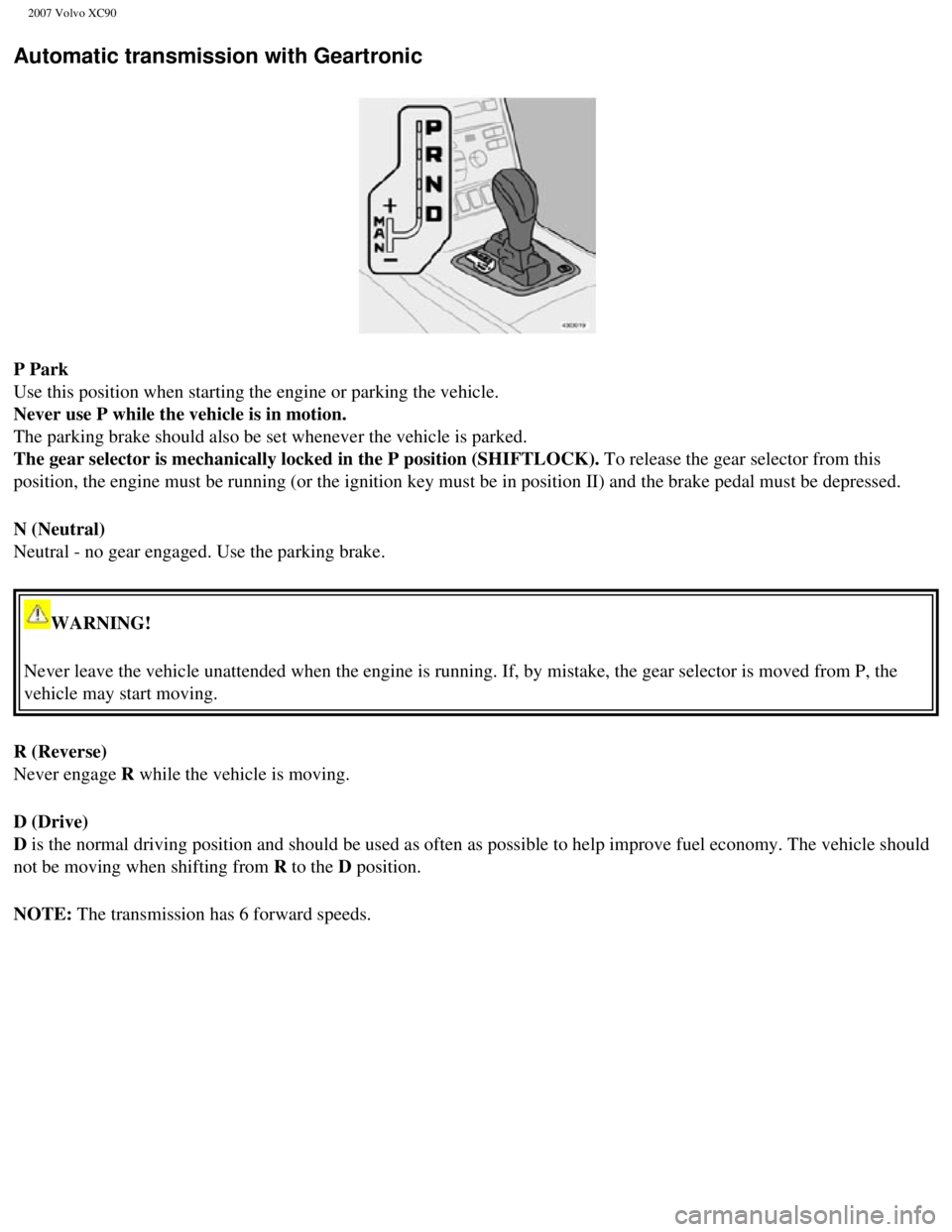
Automatic transmission with Geartronic
P Park
Use this position when starting the engine or parking the vehicle.
Never use P while the vehicle is in motion.
The parking brake should also be set whenever the vehicle is parked.
The gear selector is mechanically locked in the P position (SHIFTLOCK)\
. To release the gear selector from this
position, the engine must be running (or the ignition key must be in po\
sition II) and the brake pedal must be depressed.
N (Neutral)
Neutral - no gear engaged. Use the parking brake.
WARNING!
Never leave the vehicle unattended when the engine is running. If, by mi\
stake, the gear selector is moved from P, the
vehicle may start moving.
R (Reverse)
Never engage R while the vehicle is moving.
D (Drive)
D is the normal driving position and should be used as often as possible \
to help improve fuel economy. The vehicle should
not be moving when shifting from R to the D position.
NOTE: The transmission has 6 forward speeds.
file:///K|/ownersdocs/2007/2007_XC90/07xc90_06.htm (11 of 32)12/30/200\
6 5:53:44 PM