lights VOLVO XC90 2007 User Guide
[x] Cancel search | Manufacturer: VOLVO, Model Year: 2007, Model line: XC90, Model: VOLVO XC90 2007Pages: 268, PDF Size: 8.57 MB
Page 65 of 268

2007 Volvo XC90
Windshield wipers
Windshield wipers off
If the lever is in the 0 position and you move it upwards, the wipers wi\
ll sweep one stroke at a time for
as long as you hold the lever up.
"Single sweep" position
Move the lever slightly upward from the 0 position for one sweep of the \
wipers. The lever returns
automatically to 0 when released.
Intermittent wiper function
With the lever in this position, you can set the wiper interval by twist\
ing the control ring 1 upward to
increase wiper speed or downward to decrease the speed.
Windshield washer/headlight washer (certain models)
When the lever is pulled to wash the windshield, high pressure jets moun\
ted in the bumper will spray the
headlights.
CAUTION!
Use ample washer fluid when washing the windshield. The windshield shoul\
d be thoroughly wet
when the wipers are in operation.
l To conserve washer fluid in driving conditions where the windshield wash\
ers are used frequently, the
headlights will only be washed once for every five times the windshield \
is washed within a 10-minute
file:///K|/ownersdocs/2007/2007_XC90/07xc90_02.htm (19 of 40)12/30/200\
6 5:53:37 PM
Page 66 of 268
 remains in the washer fluid re\
servoir, the headlights will no")
2007 Volvo XC90
period.
l A short pull on the lever will wash the windshield only.
l When approximately 1 US quart (1 liter) remains in the washer fluid re\
servoir, the headlights will not
be washed when the lever is pulled to conserve washer fluid for the wind\
shield.
Rain sensor (option)
The rain sensor automatically regulates wiper speed according to the amo\
unt of water on the windshield.
The sensitivity of the sensor can be adjusted by twisting ring 1 up (the wipers will s\
weep the windshield
more frequently) or down (the wipers will sweep the windshield less fr\
equently).
Activating the rain sensor:
- Turn the ignition key to at least position I and put the windshield wi\
per lever in position 0.
- Press button 2.
A light in the button will light up to indicate that the rain sensor is \
active.
Deactivating the rain sensor:
- Press button 2.
or
- Move the windshield wiper lever down to another position.
Moving the lever up will not deactivate the rain sensor. Doing so will c\
ause the wipers to sweep the
windshield until the lever is released, at which time the wipers return \
to rain sensor mode.
pg. 60 Instruments and controls
Right-side steering wheel lever
The rain sensor is also deactivated when the key is removed from the ign\
ition.
CAUTION!
The rain sensor should be deactivated when washing the vehicle in an aut\
omatic car wash, etc. If the
rain sensor function is left on, the wipers will start inadvertently in \
the car wash and could be
damaged.
Continuous wiper function.
file:///K|/ownersdocs/2007/2007_XC90/07xc90_02.htm (20 of 40)12/30/200\
6 5:53:37 PM
Page 79 of 268

2007 Volvo XC90
Power windows in the rear doors
The rear door windows can be operated with the control on each door and \
the switch on the driver's
door. If the light in the switch for blocking power windows in the rear \
doors (located in the driver's door
control panel) is on, the rear door windows can only be operated from t\
he driver's door.
pg. 70 Instruments and controls
Rearview mirror/power folding sideview mirrors
Rearview mirror
To reduce glare from the headlights of following vehicles, use the contr\
ol to switch between the normal
and night-driving positions.
A. Normal position
B. Night position, reduces glare from following headlights
Autodim function (option)
The autodim function reacts to headlights from following traffic and aut\
omatically reduces glare.
file:///K|/ownersdocs/2007/2007_XC90/07xc90_02.htm (33 of 40)12/30/200\
6 5:53:37 PM
Page 94 of 268

system will recirculate the air in the passenger compartment until the r\
ecirculation button is pressed again.
l Timer")
2007 Volvo XC90
pg. 82 Climate control
Electronic climate control (ECC)
system will recirculate the air in the passenger compartment until the r\
ecirculation button is pressed again.
l Timer mode memory: If the vehicle is turned off while timer mode is acti\
ve, timer mode will still be active
when the vehicle is restarted.
Interior air quality sensor (option)
Some vehicles are equipped with a multi-filter and air quality sensor. T\
he filter separates gases and particles,
thereby reducing the amounts of odors and contaminants entering the vehi\
cle. The air quality sensor detects
increased levels of contaminants in the outside air. When the air qualit\
y sensor detects contaminated outside air,
the air intake closes and the air inside the passenger compartment is re\
circulated, i.e. no outside air enters the
vehicle. The filter also cleans recirculated passenger compartment air. \
When the ECC system is in the AUTO mode, the green LED will be on
.
Operation
Press
to operate the air quality sensor (normal setting).
or:
Select one of the following three functions by pressing
1, 2 or 3 times.
1. The AUT LED lights. The air quality sensor is now activated.
2. No LED lights. Recirculation is not activated unless needed to cool t\
he passenger compartment in a warm
climate.
3. The MAN LED lights. Recirculation is now activated.
Keep in mind the following:
l Make it a rule to have the air quality sensor activated at all times.
l Recirculation is limited in cold climates to avoid fogging.
l If window fogging occurs, you should deactivate the air quality sensor. \
l If fogging occurs, use the defroster functions for the windshield, side \
windows and rear window. See page 80.
l The filter should be changed at the intervals recommended in the service\
schedule. However, if the vehicle is
used in a severely contaminated environment, it may be necessary to chan\
ge the filter more frequently.
Contents | Top of Page
file:///K|/ownersdocs/2007/2007_XC90/07xc90_03.htm (8 of 8)12/30/2006 \
5:53:38 PM
Page 104 of 268
2007 Volvo XC90
Reading lights and courtesy light
1. Driver's side front reading lamp
2. Courtesy lights
3. Passenger's side front reading lamp
The reading lights can be switched on or off by pressing buttons 1 or 3.\
The courtesy light can be turned on or off by pressing button 2.
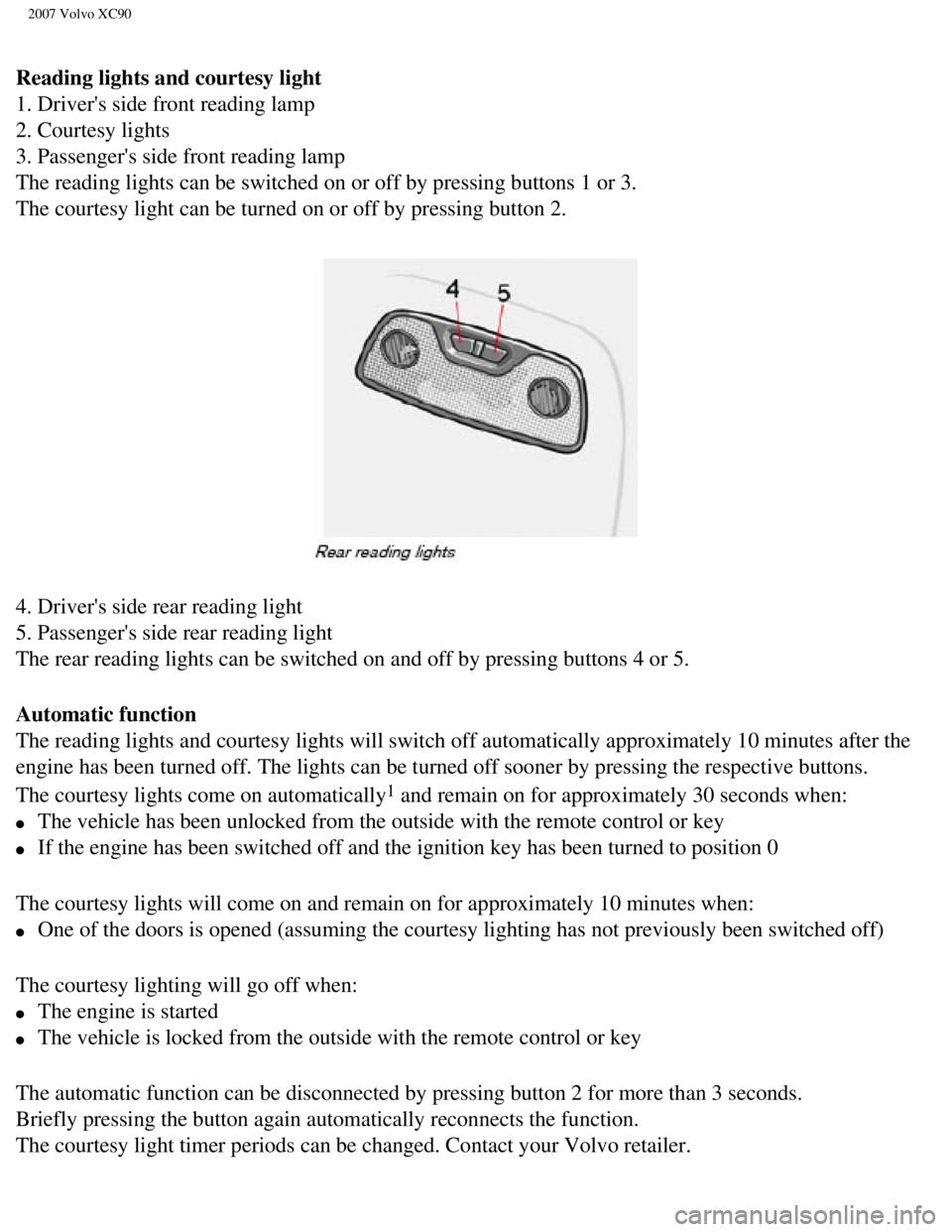
4. Driver's side rear reading light
5. Passenger's side rear reading light
The rear reading lights can be switched on and off by pressing buttons 4\
or 5.
Automatic function
The reading lights and courtesy lights will switch off automatically app\
roximately 10 minutes after the
engine has been turned off. The lights can be turned off sooner by press\
ing the respective buttons.
The courtesy lights come on automatically
1 and remain on for approximately 30 seconds when:
l The vehicle has been unlocked from the outside with the remote control o\
r key
l If the engine has been switched off and the ignition key has been turned\
to position 0
The courtesy lights will come on and remain on for approximately 10 minu\
tes when:
l One of the doors is opened (assuming the courtesy lighting has not prev\
iously been switched off)
The courtesy lighting will go off when:
l The engine is started
l The vehicle is locked from the outside with the remote control or key
The automatic function can be disconnected by pressing button 2 for more\
than 3 seconds.
Briefly pressing the button again automatically reconnects the function.\
The courtesy light timer periods can be changed. Contact your Volvo reta\
iler.
file:///K|/ownersdocs/2007/2007_XC90/07xc90_04.htm (10 of 23)12/30/200\
6 5:53:40 PM
Page 121 of 268
.
The transmitters will also activate or allow \"keyless\" entry into the pa\
ssenger compartment or the")
2007 Volvo XC90
unlock all doors and the tailgate from a distance of 10-15 feet (3-5 me\
ters).
The transmitters will also activate or allow "keyless" entry into the pa\
ssenger compartment or the
tailgate. They will also activate or deactivate your vehicle's alarm sys\
tem(s). The vehicle can also be
locked/ unlocked with the key.
1. Fold key in/out
2. Lock
3. Approach lighting
4. "Panic" function
5. Unlock tailgate
6. Unlock
If one of the transmitters is misplaced, contact your nearest authorized\
Volvo retailer for replacement.
Using the remote control
Button 1: Press to extend the key. This button must also be pressed when the key \
is folded back into the
slot in the side of the remote control unit.
pg. 106 Locks and alarm
Keys and remote controls
Button 2 (Lock): Press once to lock all doors, and the tailgate.
Button 3 (Approach lighting): Press this button when approaching the vehicle at night to light up the\
interior courtesy light, parking lights, license plate lights and the li\
ghts in the sideview mirrors.
Button 4 (Panic): See
page 111 for more information on this function.
Button 5 (Tailgate unlock): Press this button to unlock the tailgate (without unlocking the other \
doors).
file:///K|/ownersdocs/2007/2007_XC90/07xc90_05.htm (4 of 7)12/30/2006 \
5:53:41 PM
Page 132 of 268

2007 Volvo XC90
0 - Locked position:
Remove the key to lock the steering wheel
1.
WARNING!
Never turn the key to position O while driving or when the vehicle is be\
ing
towed.
I - Intermediate position2 - "radio position": Certain accessories, radio, etc. on, daytime running lights off.
II - Drive position: The key position when driving. The vehicle's entire electrical system i\
s connected.
III - Start position: Release the key when the engine starts. The key returns automatically t\
o the Drive position.
A chime will sound if the key is left in the ignition and the driver's d\
oor is opened.
Autostart
This function makes it possible to start the vehicle without holding the\
key in the start position (position III) until the
engine starts. Turn the key to position III and release it. The starter \
motor will then operate automatically (for up to ten
seconds) until the engine starts.
Steering wheel lock
The steering wheel lock might be under tension when the vehicle is parke\
d.
Turn the steering wheel slightly to free the ignition key.
In order to help reduce vehicle theft, make sure the steering wheel lock\
is engaged before leaving the vehicle.
file:///K|/ownersdocs/2007/2007_XC90/07xc90_06.htm (8 of 32)12/30/2006\
5:53:44 PM
Page 138 of 268

2007 Volvo XC90
BRAKE Brake circuit malfunction
The brake system is a hydraulic system consisting of two master cylinder\
s and two separate brake circuits. If a problem
should occur in one of these circuits, it is still possible to stop the \
vehicle with the other brake circuit.
If the brake pedal must be depressed farther than normal and requires gr\
eater foot pressure, the stopping distance will be
longer.
A warning light in the instrument panel will light up to warn the driver\
that a fault has occurred.
If this light comes on while driving or braking, stop immediately and ch\
eck the brake fluid level in the reservoir.
NOTE: Press the brake pedal hard and maintain pressure on the pedal - do not \
pump the brakes.
WARNING!
If the fluid level is below the MIN mark in the reservoir or if a "Brake\
failure - Service urgent" message is displayed in
the text window: DO NOT DRIVE. Have the vehicle towed to a Volvo retaile\
r and have the brake system inspected.
NOTE: When the vehicle is at a standstill and the engine is idling, e.g. at a\
traffic light and the brake pedal is depressed,
the pedal may go down slightly. This is a normal function of the power-a\
ssisted brake system.
Power brakes function only when the engine is running
The power brakes utilize vacuum pressure which is only created when the \
engine is running. Never let the vehicle roll to a
stop with the engine switched off.
If the power brakes are not working, the brake pedal must be pressed app\
roximately four times harder than usual to make
up for the lack of power assistance. This can happen for example when to\
wing your vehicle or if the engine is switched off
when the vehicle is rolling. The brake pedal feels harder than usual.
Water on brake discs and brake pads affects braking
Driving in rain and slush or passing through an automatic car wash can c\
ause water to collect on the brake discs and pads.
This will cause a delay in braking effect when the pedal is depressed. T\
o avoid such a delay when the brakes are needed,
depress the pedal occasionally when driving through rain, slush etc. Thi\
s will remove the water from the brakes. Check
that brake application feels normal. This should also be done after wash\
ing or starting in very damp or cold weather.
Severe strain on the brake system
The brakes will be subject to severe strain when driving in mountains or\
hilly areas, or when towing a trailer. Vehicle
speed is usually slower, which means that the cooling of the brakes is l\
ess efficient than when driving on level roads. To
reduce the strain on the brakes, shift into a lower gear and let the eng\
ine help with the braking. Do not forget that, if you
are towing a trailer, the brakes will be subjected to a greater than nor\
mal load.
pg. 128 Starting and driving
Brake system
Anti-lock brakes (ABS)
If the warning lamp lights up there is a malfunction of the ABS system (\
the standard braking system will however
function) and the vehicle should be driven cautiously to a Volvo retail\
er for inspection. The Anti-lock Braking System
(ABS) helps to improve vehicle control (stopping and steering) durin\
g severe braking conditions by limiting brake lockup.
file:///K|/ownersdocs/2007/2007_XC90/07xc90_06.htm (14 of 32)12/30/200\
6 5:53:44 PM
Page 139 of 268

2007 Volvo XC90
When the system "senses" impending lockup, braking pressure is automatic\
ally modulated in order to help prevent lockup,
which could lead to a skid.
The system performs a self-diagnostic test when the engine is started an\
d when the vehicle first reaches a speed of
approximately 12 mph (20 km/h). The brake pedal will pulsate several times and a sound may be audible f\
rom the ABS
control module. This is normal.
To obtain optimal effect from the ABS system, constant pressure should b\
e kept on the brake pedal. Do not pump the
brake pedal.
The switching of the ABS modulator will be audible and the brake pedal w\
ill pulsate during braking. Please be aware that
ABS does not increase the absolute braking potential of the vehicle. Whi\
le control will be enhanced, ABS will not shorten
stopping distances on slippery surfaces.
ABS with EBD (Electronic Brake Force Distribution)
EBD is an integrated part of the ABS system. EBD regulates the hydraulic\
pressure to the rear brakes to help provide
optimal braking capacity. The brake pedal will pulsate during braking, w\
hich is normal.
If the BRAKE and ABS warning lights come on at the same time, this could\
indicate a fault in the brake system.
- Stop the vehicle in a suitable place and switch off the engine.
- Restart the engine.
- If both warning lights go off, no further action is required.
- If both lights are still on after the engine has been restarted, switc\
h off the engine again and check the brake fluid level
(see
page 185 for the location of the brake fluid reservoir).
WARNING!
If the fluid level is below the MIN mark in the reservoir or if a "Brake\
failure - Service urgent" message is displayed in
the text window: DO NOT DRIVE. Have the vehicle towed to a Volvo retaile\
r and have the brake system inspected.
- If the brake fluid level is above the MIN mark, drive carefully to an \
authorized Volvo retailer and have the brake system
inspected.
Emergency Brake Assistance (EBA)
The EBA function is designed to provide full brake effect immediately in\
the event of sudden, hard braking. The system is
activated by the speed with which you depress the brake pedal.
NOTE:
l When the EBA system is activated, the brake pedal will go down and press\
ure in the brake system immediately
increases to the maximum level. You must maintain full pressure on the b\
rake pedal in order
pg. 129 Starting and driving
Brake system
to utilize the system completely. There will be no braking effect if the\
pedal is released. EBA is automatically deactivated
when the brake pedal is released.
l When the vehicle has been parked for some time, the brake pedal may sink\
more than usual when the engine is started.
file:///K|/ownersdocs/2007/2007_XC90/07xc90_06.htm (15 of 32)12/30/200\
6 5:53:44 PM
Page 143 of 268
, the signal will become \
constant. If objects are close to both the front and
rear bumpers, the signal will alternate between th")
2007 Volvo XC90
l At a distance of approximately 1 foot (30 cm), the signal will become \
constant. If objects are close to both the front and
rear bumpers, the signal will alternate between the front and rear speak\
ers.
Deactivating the system(s)
- Press the Park assist button on the center console (see
page 52) to temporarily deactivate the system(s).
- The indicator light in the button will go out when the system(s) hav\
e been deactivated.
- If the vehicle is equipped with front and rear park assist, both syste\
ms will be deactivated by pressing the button.
Park assist will be automatically reactivated the next time the engine i\
s started.
NOTE: It may be necessary to deactivate one or both of the park assist system\
s in certain cases.
l Rear park assist: towing a trailer, carrying bicycles in a rear-mounted carrier, etc, co\
uld trigger the rear park assist
system's sensors.
l Front park assist: it may not be possible to combine auxiliary headlights and front park \
assist since these lights could
trigger the system's sensors.
pg. 133 Starting and driving
Front/rear park assist (accessory/option)
Faults in the system
If the yellow warning symbol illuminates and a message is shown in the i\
nformation display, the system is not
functioning properly. Consult a Volvo retailer or authorized service tec\
hnician.
Cleaning the sensors
For the system to function properly, the sensors in the front and/or rea\
r bumpers should be kept clean. They can be cleaned
with car washing detergent and a sponge.
WARNING!
These systems are designed to be a supplementary aid when parking the ve\
hicle. They are not, however, intended to
replace the driver's attention and judgement.
CAUTION!
In certain circumstances, the park assist system may give unexpected war\
ning signals that can be caused by external
sound sources that use the same ultrasound frequencies as the system. Th\
is may include such things as the horns of
other vehicles, wet tires on asphalt, pneumatic brakes, motorcycle exhau\
st pipes, etc. This does not indicate a fault in
the system.
pg. 134 Starting and driving
Towing
file:///K|/ownersdocs/2007/2007_XC90/07xc90_06.htm (19 of 32)12/30/200\
6 5:53:44 PM