weight VOLVO XC90 2007 User Guide
[x] Cancel search | Manufacturer: VOLVO, Model Year: 2007, Model line: XC90, Model: VOLVO XC90 2007Pages: 268, PDF Size: 8.57 MB
Page 29 of 268

2007 Volvo XC90
for your child restraint can result in your child striking the vehicle's\
interior in a sudden stop.
Holding a child in your arms is NOT a suitable substitute for a child re\
straint system. In an accident, a
child held in a person's arms can be crushed between the vehicle's inter\
ior and an unrestrained person.
The child could also be injured by striking the interior, or by being ej\
ected from the vehicle during a
sudden maneuver or impact. The same can also happen if the infant or chi\
ld rides unrestrained on the
seat. Other occupants should also be properly restrained to help reduce \
the chance of injuring or
increasing the injury of a child.
All states and provinces have legislation governing how and where childr\
en should be carried in a
vehicle. Find out the regulations existing in your state or province. Re\
cent accident statistics have shown
that children are safer in rear seating positions than front seating pos\
itions when properly restrained. A
child restraint system can help protect a child in a vehicle. Here's wha\
t to look for when selecting a child
restraint system:
l It should have a label certifying that it meets applicable Federal Motor\
Vehicle Safety Standards
(FMVSS 213) - or in Canada, CMVSS 213.
l Make sure the child restraint system is approved for the child's height,\
weight and development - the
label required by the standard or regulation, or instructions for infant\
restraints, typically provide this
information.
l In using any child restraint system, we urge you to carefully look over \
the instructions that are
provided with the restraint. Be sure you understand them and can use the\
device properly and safely in
this vehicle. A misused child restraint system
pg. 29 Safety
Child safety
can result in increased injuries for both the infant or child and other \
occupants in the vehicle.
When a child has outgrown the child safety seat, you should use the rear\
seat with the standard seat belt
fastened. The best way to help protect the child here is to place the ch\
ild on a cushion so that the seat
belt is properly located on the hips (see the illustration on
page 40). Legislation in your state or province
may mandate the use of a child seat or cushion in combination with the s\
eat belt, depending on the
child's age and/or size. Please check local regulations.
A specially designed and tested booster cushion (not available in Canad\
a) can be obtained from your
Volvo retailer for children weighing 33 - 80 lb. (15 - 36 kg) and 38-5\
4 inches (97 - 137 cm) in height.
file:///K|/ownersdocs/2007/2007_XC90/07xc90_01.htm (22 of 39)12/30/200\
6 5:53:33 PM
Page 32 of 268

2007 Volvo XC90
WARNING!
A child seat should never be used in the front passenger seat of any veh\
icle with a front passenger
airbag - not even if the "Passenger airbag off" symbol near the rear-vie\
w mirror is illuminated (on
vehicles equipped with Occupant Weight Sensor). If the severity of an a\
ccident were to cause the
airbag to inflate, this could lead to serious injury or death to a child\
seated in this position.
WARNING!
Always refer to the child restraint manufacturer's instructions for deta\
iled information on securing the
restraint.
pg. 32 Safety
file:///K|/ownersdocs/2007/2007_XC90/07xc90_01.htm (25 of 39)12/30/200\
6 5:53:33 PM
Page 33 of 268

2007 Volvo XC90
Child restraint systems
WARNING!
l When not in use, keep the child restraint system secured or remove it fr\
om the passenger
compartment to help prevent it from injuring passengers in the event of \
a sudden stop or collision.
l A small child's head represents a considerable part of its total weight \
and its neck is still very weak.
Volvo recommends that children up to age 4 travel, properly restrained, \
facing rearward. In addition,
Volvo recommends that children should ride rearward facing, properly res\
trained, as long as possible.
pg. 33 Safety
Infant seats
Securing an infant seat with a seat belt
NOTE: Refer to
pages 38-39 for information on securing a child restraint using ISOFIX lower anchor\
s
and/or top tether anchorages.
1. Place the infant seat in the rear seat of the vehicle.
2. Attach the seat belt to the infant seat according to the manufacturer\
's instructions.
3. Fasten the seat belt by inserting the latch plate into the buckle (l\
ock) until a distinct click is audible.
file:///K|/ownersdocs/2007/2007_XC90/07xc90_01.htm (26 of 39)12/30/200\
6 5:53:33 PM
Page 34 of 268

2007 Volvo XC90
WARNING!
l An infant seat must be in the rear-facing position only.
l The infant seat should not be positioned behind the driver's seat unless\
there is adequate space for
safe installation.
WARNING!
A child seat should never be used in the front passenger seat of any veh\
icle with a front passenger
airbag - not even if the "Passenger airbag off" symbol near the rear-vie\
w mirror is illuminated (on
vehicles equipped with Occupant Weight Sensor). If the severity of an a\
ccident were to cause the
airbag to inflate, this could lead to serious injury or death to a child\
seated in this position.
file:///K|/ownersdocs/2007/2007_XC90/07xc90_01.htm (27 of 39)12/30/200\
6 5:53:33 PM
Page 37 of 268

2007 Volvo XC90
WARNING!
Always use a convertible seat that is suitable for the child's age and s\
ize. See the convertible seat
manufacturer's recommendations.
1. Place the convertible seat in the rear seat of the vehicle.
2. Attach the seat belt to the convertible seat according to the manufac\
turer's instructions.
WARNING!
l A small child's head represents a considerable part of its total weight \
and its neck is still very weak.
Volvo recommends that children up to age 4 travel, properly restrained, \
facing rearward. In addition,
Volvo recommends that children should ride rearward facing, properly res\
trained, as long as possible.
l Convertible child seats should be installed in the rear seat only.
l A rear-facing convertible seat should not be positioned behind the drive\
r's seat unless there is
adequate space for safe installation.
pg. 36 Safety
Convertible seats
file:///K|/ownersdocs/2007/2007_XC90/07xc90_01.htm (30 of 39)12/30/200\
6 5:53:33 PM
Page 39 of 268

2007 Volvo XC90
The convertible seat can be removed by unbuckling the seat belt and lett\
ing it retract completely.
WARNING!
A child seat should never be used in the front passenger seat of any veh\
icle with a front passenger
airbag - not even if the "Passenger airbag off" symbol near the rear-vie\
w mirror is illuminated (on
vehicles equipped with Occupant Weight Sensor). If the severity of an a\
ccident were to cause the
airbag to inflate, this could lead to serious injury or death to a child\
seated in this position.
pg. 37 Safety
Booster cushions
file:///K|/ownersdocs/2007/2007_XC90/07xc90_01.htm (32 of 39)12/30/200\
6 5:53:34 PM
Page 44 of 268

Volvos own integrated booster cushion has been specially designed to he\
lp safeguard a child seated in
the rear seat. When using an integrated")
2007 Volvo XC90
Integrated booster cushion (option)
Volvo's own integrated booster cushion has been specially designed to he\
lp safeguard a child seated in
the rear seat. When using an integrated booster cushion, the child must \
be secured with the vehicle's
three-point seat belt.
Use this booster cushion only with children who weigh between 33 and 80 \
lbs (15 and 36 kg) and whose
height is between 38 and 54 in (97 and 137 cm). In Canada, Transport C\
anada's weight recommendation
is 40-80 lbs (18-36 kg).
The booster cushion is designed to raise the child higher, so that the s\
houlder strap crosses over the
child's collarbone, not over the child's neck. If using a booster cushio\
n does not result in proper
positioning of the shoulder strap, then the child should be placed in a \
properly secured child restraint
(see the information beginning on
page 31). The shoulder belt must never be placed behind the child's
back or under the arm.
Canada only: This cushion may be referred to as a built-in booster cushi\
on.
WARNING!
l DEATH or SERIOUS INJURY can occur.
l Follow all instructions on the booster cushion and in the vehicle's owne\
r's manual.
l MAKE SURE THE BOOSTER CUSHION IS SECURELY LOCKED BEFORE THE CHILD IS
SEATED.
l Use this booster cushion only with children who weigh between 33 and 80 \
lbs (15 and 36 kg) and
whose height is between 38 and 54 in (97 and 137 cm). In Canada, Trans\
port Canada's weight
recommendation is 40-80 lbs (18-36 kg).
pg. 41 Safety
Integrated booster cushion
file:///K|/ownersdocs/2007/2007_XC90/07xc90_01.htm (37 of 39)12/30/200\
6 5:53:34 PM
Page 111 of 268

2007 Volvo XC90
As a safety precaution, all cargo in your vehicle should be securely anc\
hored to keep it from being
thrown forward in the event of sudden braking, etc. The vehicle is equip\
ped with eyelets in the cargo
space to which straps or other cargo restraints can be attached.
WARNING!
The eyelets are not to be used as passenger restraints or as anchorages \
for child
restraints.
Consult your Volvo retailer about suitable accessories for this purpose.\
Remember that an object weighing 44 lbs (20 kg) produces a force of 2,\
200 lbs (1,000 kg) in a head-
on collision at 30 mph (50 km/h)!
Keep the following in mind when loading the vehicle:
l The load carrying capacity of your vehicle is determined by factors such\
as the number of passengers,
the amount of cargo, the weight of any accessories that may be installed\
, etc. See the section "Vehicle
loading" in the chapter "Wheel and tires" for more detailed information.\
l Load the cargo against the backrest.
l Load heavy cargo as low as possible.
l If no one is sitting in the outboard rear seat(s), reinforce the backr\
est by fastening the seat belts.
l Never load cargo above the backrest without a cargo net.
file:///K|/ownersdocs/2007/2007_XC90/07xc90_04.htm (17 of 23)12/30/200\
6 5:53:40 PM
Page 128 of 268

2007 Volvo XC90
WARNING!
Carbon monoxide is a poisonous, colorless, and odorless gas. It is prese\
nt in all exhaust gases. If you ever smell exhaust
fumes inside the vehicle, make sure the passenger compartment is ventila\
ted, and immediately return the vehicle to your
retailer for correction.
pg. 116 Starting and driving
Fuel requirements
WARNING!
Driving with the tailgate open: Driving with the tailgate open could lead to poisonous exhaust gases e\
ntering the
passenger compartment. If the tailgate must be kept open for any reason,\
proceed as follows:
l Close the windows
l Set the ventilation system control to air flow to floor, windshield and \
side windows and blower control to its highest
setting.
Weight distribution affects handling
At the specified curb weight your vehicle has a tendency to understeer, \
which means that the steering wheel has to be
turned more than might seem appropriate for the curvature of a bend. Thi\
s ensures good stability and reduces the risk of
rear wheel skid. Remember that these properties can alter with the vehic\
le load. The heavier the load in the cargo area, the
less the tendency to understeer.
Handling, roadholding
Vehicle load, tire design and inflation pressure all affect vehicle hand\
ling. Therefore, check that the tires are inflated to the
recommended pressure according to the vehicle load. See "Tire pressure" \
section. Loads should be distributed so that
capacity weight or maximum permissible axle loads are not exceeded.
Conserving electrical current
Keep the following in mind to help minimize battery drain:
l When the engine is not running, avoid turning the ignition key to positi\
on II (see page 121). Many electrical systems
(the audio system, the optional infotainment/ navigation systems, power\
windows, etc) will function with the ignition key
in position I. This position reduces drain on the battery.
l Please keep in mind that using systems, accessories, etc that consume a \
great deal of current when the engine is not
running could result in the battery being completely drained.
NOTE: A warning message will be displayed in the text window in the instrumen\
t panel when the battery charge is low.
pg. 117 Starting and driving
Refueling
file:///K|/ownersdocs/2007/2007_XC90/07xc90_06.htm (4 of 32)12/30/2006\
5:53:44 PM
Page 147 of 268
2007 Volvo XC90
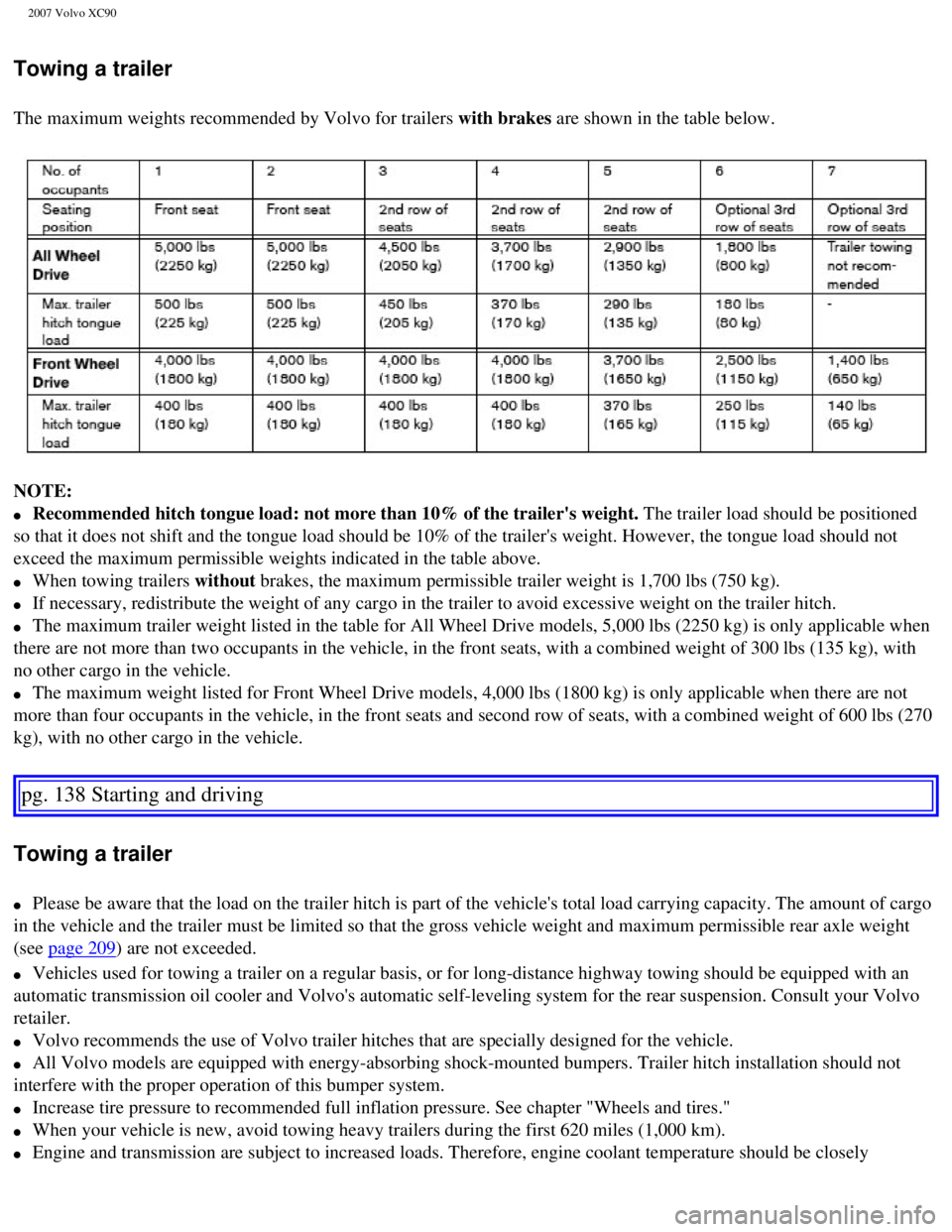
Towing a trailer
The maximum weights recommended by Volvo for trailers with brakes are shown in the table below.
NOTE:
l Recommended hitch tongue load: not more than 10% of the trailer's weight\
. The trailer load should be positioned
so that it does not shift and the tongue load should be 10% of the trail\
er's weight. However, the tongue load should not
exceed the maximum permissible weights indicated in the table above.
l When towing trailers without brakes, the maximum permissible trailer weight is 1,700 lbs (750 kg).\
l If necessary, redistribute the weight of any cargo in the trailer to avo\
id excessive weight on the trailer hitch.
l The maximum trailer weight listed in the table for All Wheel Drive model\
s, 5,000 lbs (2250 kg) is only applicable when
there are not more than two occupants in the vehicle, in the front seats\
, with a combined weight of 300 lbs (135 kg), with
no other cargo in the vehicle.
l The maximum weight listed for Front Wheel Drive models, 4,000 lbs (1800\
kg) is only applicable when there are not
more than four occupants in the vehicle, in the front seats and second r\
ow of seats, with a combined weight of 600 lbs (270
kg), with no other cargo in the vehicle.
pg. 138 Starting and driving
Towing a trailer
l Please be aware that the load on the trailer hitch is part of the vehicl\
e's total load carrying capacity. The amount of cargo
in the vehicle and the trailer must be limited so that the gross vehicle\
weight and maximum permissible rear axle weight
(see
page 209) are not exceeded.
l Vehicles used for towing a trailer on a regular basis, or for long-dista\
nce highway towing should be equipped with an
automatic transmission oil cooler and Volvo's automatic self-leveling sy\
stem for the rear suspension. Consult your Volvo
retailer.
l Volvo recommends the use of Volvo trailer hitches that are specially des\
igned for the vehicle.
l All Volvo models are equipped with energy-absorbing shock-mounted bumper\
s. Trailer hitch installation should not
interfere with the proper operation of this bumper system.
l Increase tire pressure to recommended full inflation pressure. See chapt\
er "Wheels and tires."
l When your vehicle is new, avoid towing heavy trailers during the first 6\
20 miles (1,000 km).
l Engine and transmission are subject to increased loads. Therefore, engin\
e coolant temperature should be closely
file:///K|/ownersdocs/2007/2007_XC90/07xc90_06.htm (23 of 32)12/30/200\
6 5:53:44 PM