steering VOLVO XC90 2007 Owner's Manual
[x] Cancel search | Manufacturer: VOLVO, Model Year: 2007, Model line: XC90, Model: VOLVO XC90 2007Pages: 268, PDF Size: 8.57 MB
Page 140 of 268

The")
2007 Volvo XC90
This is normal and the pedal will return to its usual position when it i\
s released.
pg. 130 Starting and driving
Stability system
Dynamic Stability Traction Control (DSTC)
The stability system consists of a number of functions designed help red\
uce wheel spin, counteract skidding, and to
generally help improve directional stability.
NOTE: A pulsating sound will be audible when the system is actively operating\
and is normal.
Traction control (TC)
This function is designed to help reduce wheel spin by transferring powe\
r from a drive wheel that begins to lose traction to
the wheel on the opposite side of the vehicle (on the same axle).
TC is most active at low speeds.
This is one of DSTC's permanent functions and cannot be switched off.
Spin control (SC)
The spin control function is designed to help prevent the drive wheels f\
rom spinning while the vehicle is accelerating.
Under certain circumstances, such as when driving with snow chains, or d\
riving in deep snow or loose sand, it may be
advisable to temporarily switch off this function for maximum tractive f\
orce.
Temporarily switching off Spin control
- Turn the thumbwheel (1) on the left-side steering wheel lever until \
the DSTC menu is displayed.
- Hold down the RESET button (2) to toggle between DSTC SPIN CONTROL O\
N or OFF.
NOTE:
l The message DSTC SPIN CONTROL OFF indicates that the stability system's \
spin control function has temporarily
been switched off.
l The stability control indicator light will illuminate and remain on until spin control has been reactivated.
l The spin control function is automatically enabled each time the engine \
is started.
l DSTC ON indicates that all system functions are active.
Active Yaw Control (AYC)
This function helps maintain directional stability, for example when cor\
nering, by braking one or more of the wheels if the
vehicle shows a tendency to skid or slide laterally.
This is one of DSTC's permanent functions and cannot be switched off
file:///K|/ownersdocs/2007/2007_XC90/07xc90_06.htm (16 of 32)12/30/200\
6 5:53:44 PM
Page 144 of 268

2007 Volvo XC90
Emergency towing
The towing eyelet is located in the tool bag, under the floor of the car\
go area. This eyelet must be screwed into the
positions provided on the right sides of either the front or rear bumper\
(see illustrations).
To attach the towing eyelet:
A. Use a coin to pry open the lower edge of the cover (A).
B. Screw the towing eyelet (C) in place (B), first by hand and then \
using the tire iron until it is securely in place.
After the vehicle has been towed, the eyelet should be removed and retur\
ned to the tool bag. Press the cover back into
position.
Precautions when the vehicle is in tow
l The steering wheel must be unlocked. Turn the ignition key to position I\
or II.
l The gear selector must be in position N.
l Maximum speed: 50 mph (80 km/h). Do not exceed the maximum allowable t\
owing speed.
l Maximum distance with front wheels on ground: 50 miles (80 km).
l While the vehicle is being towed, try to keep the tow rope taut at all t\
imes.
l The vehicle should only be towed in forward direction.
CAUTION!
- Please check with state and local authorities before attempting this t\
ype of towing, as vehicles being towed are subject
to regulations regarding maximum towing speed, length and type of towing\
device, lighting, etc.
- If the vehicle's battery is dead, do not attempt to start the vehicle \
by pushing or pulling it as this will damage the three-
way catalytic converter(s). The engine must be jump started using an a\
uxiliary battery (see
page 136).
- If the vehicle is being towed on a flat bed truck, the towing eyelets \
must not be used to secure the vehicle on the flat
bed. Consult the tow truck operator.
pg. 135 Starting and driving
Towing
file:///K|/ownersdocs/2007/2007_XC90/07xc90_06.htm (20 of 32)12/30/200\
6 5:53:44 PM
Page 145 of 268

2007 Volvo XC90
WARNING!
l Remember that the power brakes and power steering will not function when\
engine is not running. The braking and
steering systems will function but the brake pedal pressure required is \
3 - 4 times above normal and greater steering
effort must be exerted.
l The towing eyelets must not be used for pulling another vehicle out of a\
ditch or for any similar purpose involving
severe strain.
l Do not use the towing eyelets to pull the vehicle up onto a flat bed tow\
truck.
Towing vehicles with front wheel drive/All Wheel Drive
Volvo recommends the use of flat bed equipment.
If wheel lift equipment must be used, please use extreme caution to help\
avoid damage to the vehicle. In this case, the
vehicle should be towed with the rear wheels on the ground if at all pos\
sible.
If it is absolutely necessary to tow the vehicle with the front wheels o\
n the ground, please refer to the towing information
on the previous page.
CAUTION!
Sling-type equipment applied at the front will damage radiator and air c\
onditioning lines.
It is equally important not to use sling-type equipment at the rear or a\
pply lifting equipment inside the rear wheels;
serious damage to the rear axle may result.
If the vehicle is being towed on a flat bed truck, the towing eyelets mu\
st not be used to secure the vehicle on the flat
bed. Consult the tow truck operator.
WARNING!
Do not use the towing eyelets to pull the vehicle up onto a flat bed tow\
truck.
pg. 136 Starting and driving
Jump starting
file:///K|/ownersdocs/2007/2007_XC90/07xc90_06.htm (21 of 32)12/30/200\
6 5:53:44 PM
Page 152 of 268

2007 Volvo XC90
W - Winter/Wet driving mode - enhanced vehicle traction
l Mode W will only function if the gear selector is in the (D)rive position.
l Press the button at the base of the gear selector to engage/disengage th\
is driving mode.
l An LED in the button will light up to indicate that W is engaged and thi\
s will also be displayed in the instrument panel
(see
page 46).
l This mode may be selected for starting/ moving off on slippery roads.
1. Synthetic oil is not used when the oil is changed at the normal maint\
enance service intervals except at owner request and at
additional charge. Please consult your Volvo retailer.
pg. 144 Starting and driving
Before a long distance trip
It is always worthwhile to have your vehicle checked at a Volvo retailer\
before driving long distances. Your retailer will
also be able to supply you with bulbs, fuses, spark plugs and wiper blad\
es for your use in the event that problems occur.
As a minimum, the following items should be checked before any long trip\
:
l Check that engine runs smoothly and that fuel consumption is normal.
l Check for fuel, oil, and fluid leakage.
l Check transmission oil level1.
l Check condition of drive belts.
l Check state of the battery's charge.
l Examine tires carefully (the spare tire as well), and replace those th\
at are worn. Check tire pressures.
l The brakes, front wheel alignment, and steering gear should be checked b\
y your Volvo retailer only.
l Check all lights, including high beams.
l Reflective warning triangles are legally required in some states/provinc\
es.
l Have a word with your Volvo retailer if you intend to drive in countries\
where it may be difficult to obtain the correct
fuel.
l Consider your destination. If you will be driving through an area where \
snow or ice are likely to occur, consider snow
tires.
1. To prevent injury from contact with hot surfaces, do not inspect your\
vehicle's transmission fluid yourself. Have your vehicle's
transmission fluid level inspected by a qualified Volvo service technici\
an.
pg. 145 Starting and driving
Blind Spot Information System (BLIS) - option
file:///K|/ownersdocs/2007/2007_XC90/07xc90_06.htm (28 of 32)12/30/200\
6 5:53:44 PM
Page 165 of 268
\
or faster.
This will erase the warning text and the warning light will go out.
WARNING!
Incorrect inflation")
2007 Volvo XC90
- Drive the vehicle for several minutes at a speed of 20 mph (30 km/h)\
or faster.
This will erase the warning text and the warning light will go out.
WARNING!
Incorrect inflation pressure could lead to tire failure, resulting in a \
loss of control of the
vehicle.
Changing wheels with TPMS
Please note the following when changing or replacing the factory install\
ed TPMS wheels/ tires on the
vehicle:
l Only the factory-mounted wheels are equipped with TPMS sensors in the va\
lves.
l If the vehicle is equipped with a temporary spare tire, this tire does n\
ot have a TPMS sensor.
l If wheels without TPMS sensors are mounted on the vehicle, TIRE PRESS SY\
ST SERVICE
REQUIRED will be displayed each time the vehicle is driven above 25 mph \
(40 km/h) for 10 minutes or
more.
l Once TPMS sensors are properly installed, the warning message should not\
reappear.
l Volvo recommends that TPMS sensors be fitted on all wheels used on the v\
ehicle. Volvo does not
recommend moving sensors back and forth between sets of wheels.
CAUTION!
When inflating tires with TPMS valves, press the pump's mouthpiece strai\
ght onto the valve to help
avoid bending or otherwise damaging the valve.
Adjusting (recalibrating) TPMS
1
TPMS can be adjusted, or recalibrated, in order to help adapt the system\
to different inflation pressures,
for example when transporting heavy loads. To do so:
- Switch off the engine.
- Inflate the tires to the desired pressure.
- Turn the ignition key to position I or II.
- Turn the thumbwheel on the left steering wheel lever until the text TI\
RE PRESSURE CALIBRATION
is displayed.
- Press in and hold the Reset button (see the illustration on
page 50) until TIRE PRESSURE
CALIBRATED is displayed. This completes the procedure.
NOTE: TPMS should be recalibrated each time tire inflation pressure is change\
d.
file:///K|/ownersdocs/2007/2007_XC90/07xc90_07.htm (9 of 23)12/30/2006\
5:53:47 PM
Page 166 of 268

2007 Volvo XC90
1. Canadian models only
pg. 158 Wheels and tires
Tire Pressure Monitoring System (TPMS) - option
Deactivating (turning off) TPMS1
The system can be switched off if necessary, for example if winter tires\
without TPMS sensors are
mounted on the vehicle. To do so:
- Switch off the engine.
- Turn the ignition key to position I or II.
- Turn the thumbwheel on the left steering wheel lever until the text TI\
RE PRESS SYST ON is
displayed.
- Press in and hold the Reset button (see the illustration on
page 50) until TIRE PRESS SYST OFF is
displayed.
Repeat steps 1-4 to reactivate the system.
NOTE: If TPMS is switched off, it will remain off until it is reactivated acc\
ording to the steps described
above. The text TIRE PRESS SYST ON will then be displayed.
pg. 159 Wheels and tires
Tire designations
Federal law mandates that tire manufacturers place standardized informat\
ion on the sidewall of all tires
(see the illustration).
The following information is listed on the tire sidewall:
The tire designation (the following figures are examples of a tire desi\
gnation):
1. 215: the width of the tire (in millimeters) from sidewall edge to s\
idewall edge. The larger the number,
file:///K|/ownersdocs/2007/2007_XC90/07xc90_07.htm (10 of 23)12/30/200\
6 5:53:47 PM
Page 192 of 268

2007 Volvo XC90
Check the belt regularly to make sure it is in good condition and is cle\
an. A worn or dirty belt can cause
poor cooling and low alternator output as well as impair the operation o\
f the power steering and the air
conditioning unit.
NOTE: The drive belt is equipped with a self-tensioning mechanism and require\
s no adjustment
between changes.
WARNING!
The engine must not be running when this check is
performed.
Check coolant level
The cooling system must be filled with coolant and not leak to operate a\
t maximum efficiency. Check
the coolant level regularly. The level should be between the "MAX" and "\
MIN" marks on the expansion
tank. The check should be made with particular thoroughness when the eng\
ine is new or when the
cooling system has been drained.
Do not remove the filler cap other than for topping up with coolant. Fre\
quent removal may prevent
coolant circulation between the engine and the expansion tank during eng\
ine warm up and cooling.
Changing coolant
Normally, the coolant does not need to be changed. If the system must be\
drained, consult your Volvo
retailer.
NOTE: Do not top off with water only. This reduces the rust-protective and an\
tifreeze qualities of the
coolant and has a lower boiling point. It can also cause damage to the c\
ooling system if it should freeze.
Top off with Volvo Genuine Coolant/Antifreeze only (a 50/ 50 mix of wat\
er and antifreeze). CAUTION!
The cooling system must always be kept filled to the correct level. If i\
t is not kept filled, there can be
high local temperatures in the engine which could result in damage. Diff\
erent types of antifreeze/
coolant may not be mixed.
WARNING!
Never remove the radiator cap while the engine is warm. Wait until the v\
ehicle
cools.
file:///K|/ownersdocs/2007/2007_XC90/07xc90_09.htm (6 of 37)12/30/2006\
5:53:50 PM
Page 193 of 268
2007 Volvo XC90
pg. 185 Maintenance
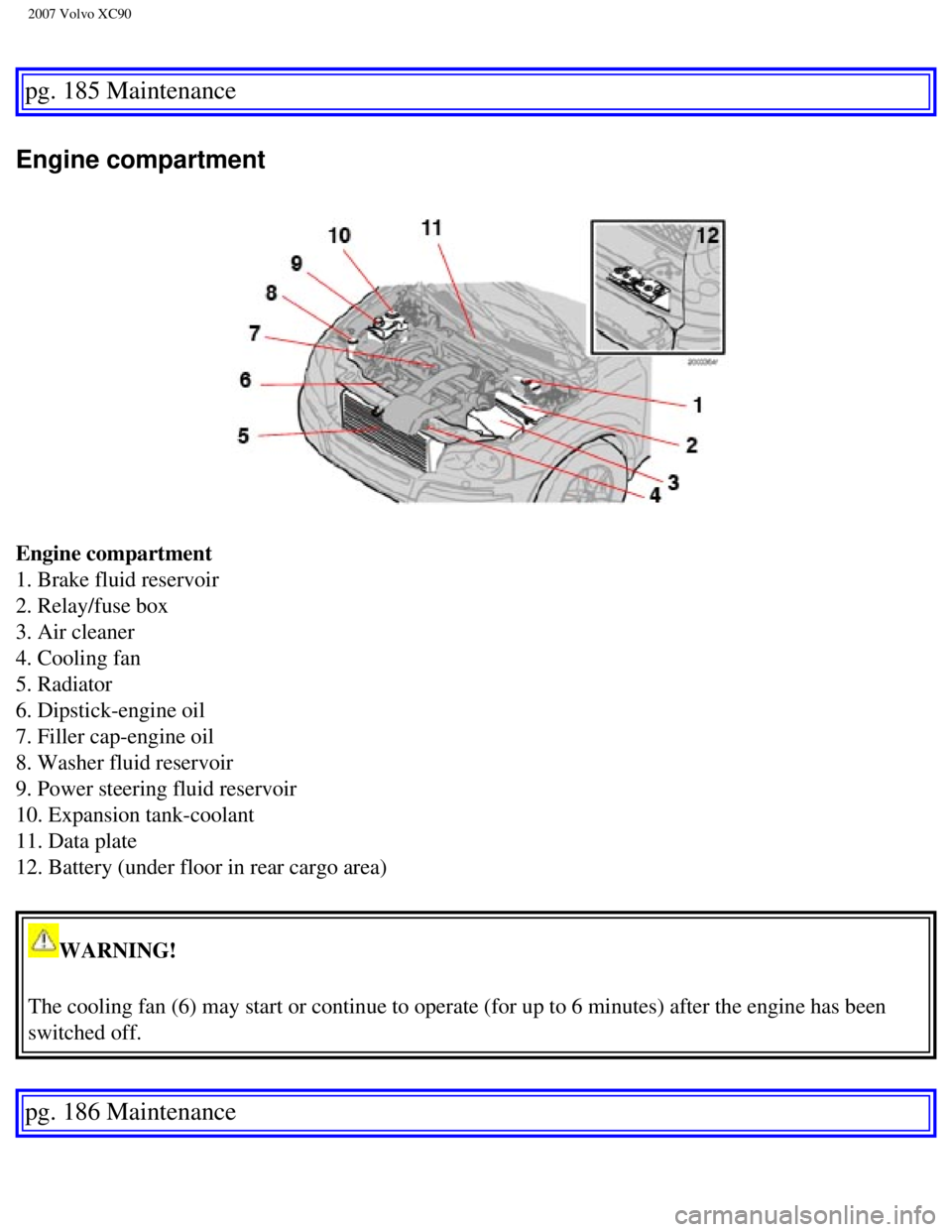
Engine compartment
Engine compartment
1. Brake fluid reservoir
2. Relay/fuse box
3. Air cleaner
4. Cooling fan
5. Radiator
6. Dipstick-engine oil
7. Filler cap-engine oil
8. Washer fluid reservoir
9. Power steering fluid reservoir
10. Expansion tank-coolant
11. Data plate
12. Battery (under floor in rear cargo area)
WARNING!
The cooling fan (6) may start or continue to operate (for up to 6 min\
utes) after the engine has been
switched off.
pg. 186 Maintenance
file:///K|/ownersdocs/2007/2007_XC90/07xc90_09.htm (7 of 37)12/30/2006\
5:53:50 PM
Page 199 of 268

2007 Volvo XC90
Brake fluid reservoir
The brake fluid should always be above the MIN mark on the side of the r\
eservoir. Check, without
removing the cap, that there is sufficient fluid in the reservoir.
Fluid type: DOT 4+ boiling point >536 °F (280 °C), P/N 9437433.
Replace: Every second year or 30,000 miles (48,000 km). The fluid should be re\
placed once a year or
every 15,000 miles (24,000 km) when driving under extremely hard condi\
tions (mountain driving, etc.).
Always entrust brake fluid changing to an authorized Volvo retailer.
Power steering fluid reservoir
The fluid level should always be between the ADD and FULL marks.
Fluid type: Volvo synthetic power steering fluid (Pentosin CHF 11S) P/N 1161529 o\
r equivalent.
Replace: No fluid change required.
NOTE: If a problem should occur in the power steering system or if the vehicl\
e has no electrical current
and must be towed, it is still possible to steer the vehicle. However, k\
eep in mind that greater effort will
be required to turn the steering wheel.
pg. 190 Maintenance
Wiper blades
file:///K|/ownersdocs/2007/2007_XC90/07xc90_09.htm (13 of 37)12/30/200\
6 5:53:50 PM
Page 217 of 268
2007 Volvo XC90
18. -
19. Engine control module feed, engine relay 5
20. Parking lights 15
21. -
pg. 203 Maintenance
Fuses
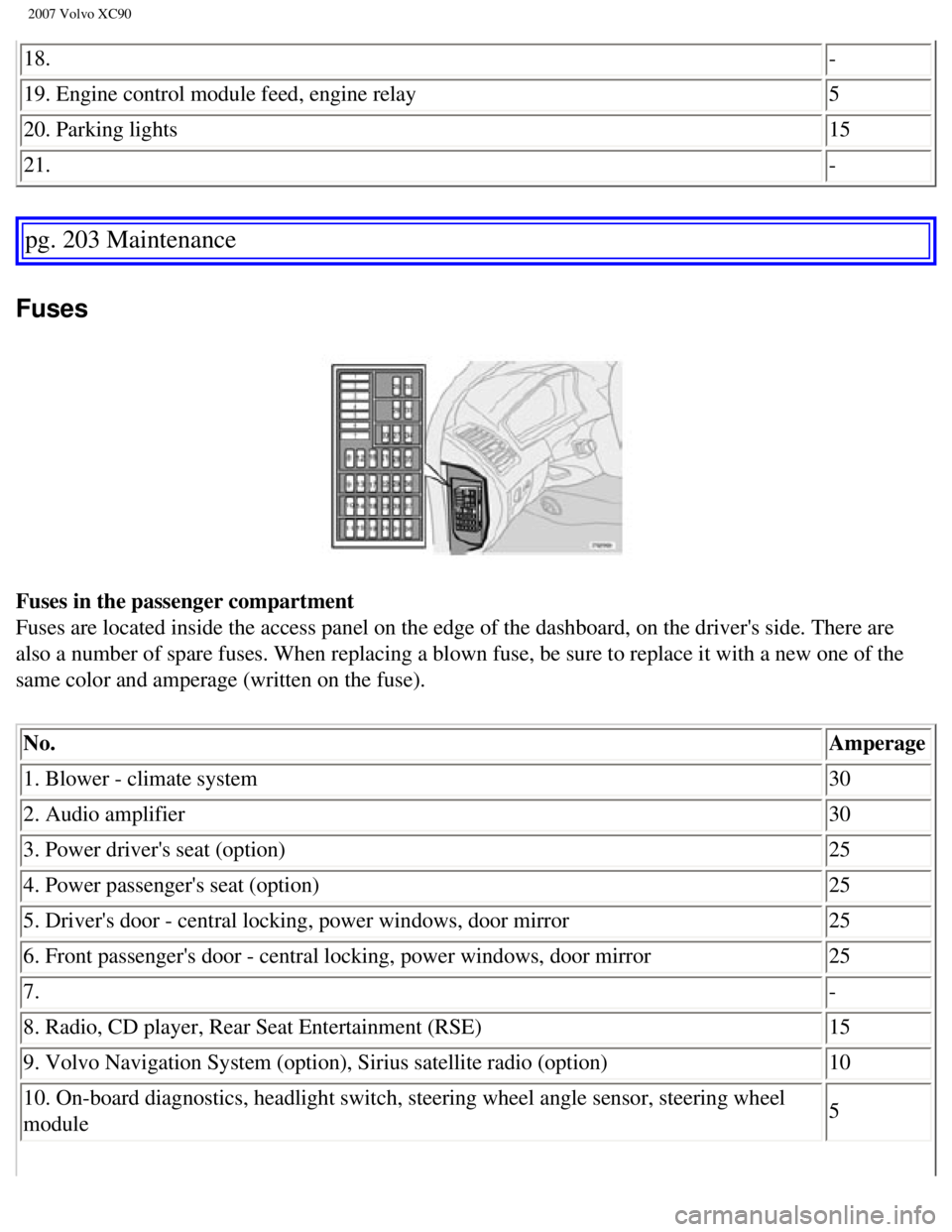
Fuses in the passenger compartment
Fuses are located inside the access panel on the edge of the dashboard, \
on the driver's side. There are
also a number of spare fuses. When replacing a blown fuse, be sure to re\
place it with a new one of the
same color and amperage (written on the fuse).
No. Amperage
1. Blower - climate system 30
2. Audio amplifier 30
3. Power driver's seat (option) 25
4. Power passenger's seat (option) 25
5. Driver's door - central locking, power windows, door mirror 25
6. Front passenger's door - central locking, power windows, door mirror \
25
7. -
8. Radio, CD player, Rear Seat Entertainment (RSE) 15
9. Volvo Navigation System (option), Sirius satellite radio (option)\
10
10. On-board diagnostics, headlight switch, steering wheel angle sensor,\
steering wheel
module 5
file:///K|/ownersdocs/2007/2007_XC90/07xc90_09.htm (31 of 37)12/30/200\
6 5:53:51 PM