tow VOLVO XC90 2007 Owner's Manual
[x] Cancel search | Manufacturer: VOLVO, Model Year: 2007, Model line: XC90, Model: VOLVO XC90 2007Pages: 268, PDF Size: 8.57 MB
Page 147 of 268
2007 Volvo XC90
Towing a trailer
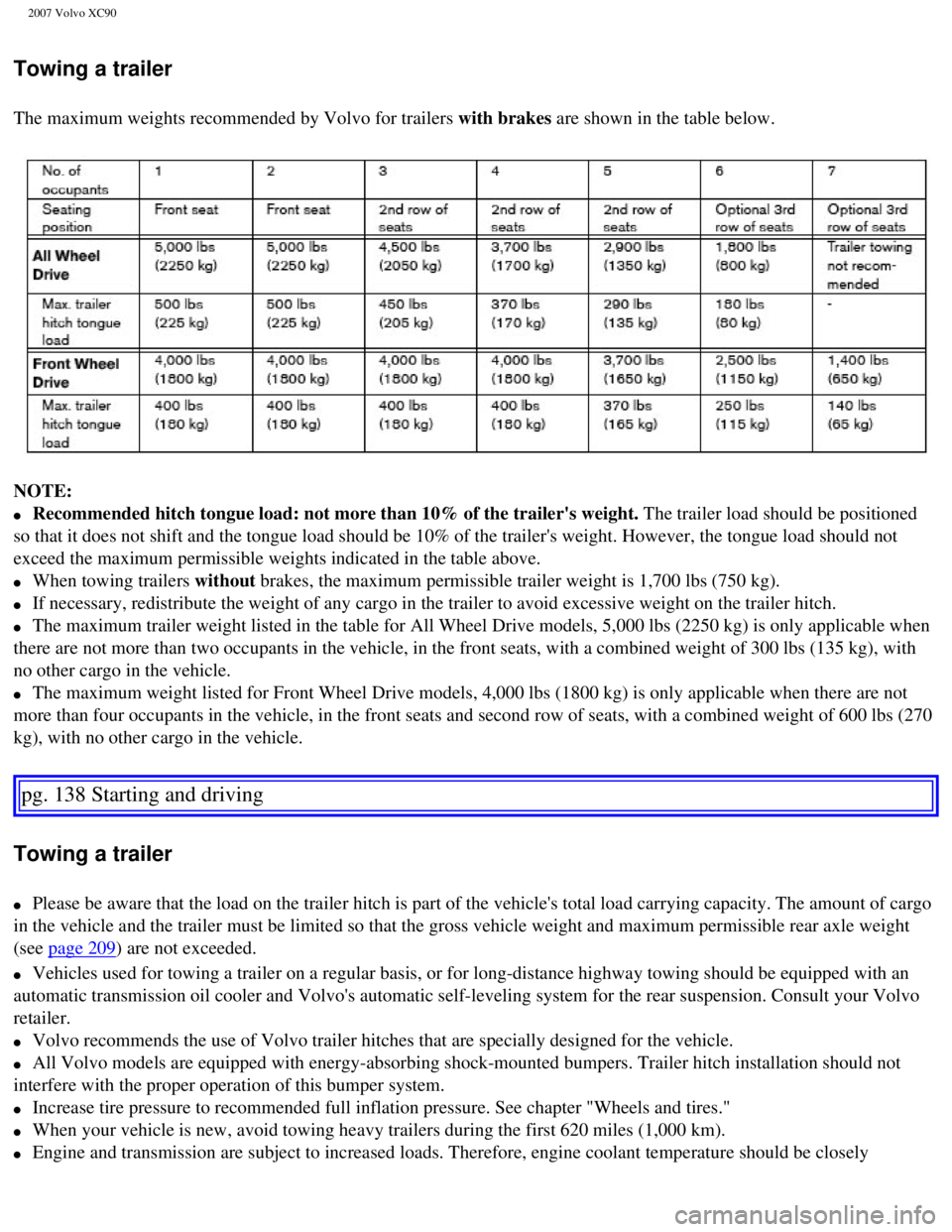
The maximum weights recommended by Volvo for trailers with brakes are shown in the table below.
NOTE:
l Recommended hitch tongue load: not more than 10% of the trailer's weight\
. The trailer load should be positioned
so that it does not shift and the tongue load should be 10% of the trail\
er's weight. However, the tongue load should not
exceed the maximum permissible weights indicated in the table above.
l When towing trailers without brakes, the maximum permissible trailer weight is 1,700 lbs (750 kg).\
l If necessary, redistribute the weight of any cargo in the trailer to avo\
id excessive weight on the trailer hitch.
l The maximum trailer weight listed in the table for All Wheel Drive model\
s, 5,000 lbs (2250 kg) is only applicable when
there are not more than two occupants in the vehicle, in the front seats\
, with a combined weight of 300 lbs (135 kg), with
no other cargo in the vehicle.
l The maximum weight listed for Front Wheel Drive models, 4,000 lbs (1800\
kg) is only applicable when there are not
more than four occupants in the vehicle, in the front seats and second r\
ow of seats, with a combined weight of 600 lbs (270
kg), with no other cargo in the vehicle.
pg. 138 Starting and driving
Towing a trailer
l Please be aware that the load on the trailer hitch is part of the vehicl\
e's total load carrying capacity. The amount of cargo
in the vehicle and the trailer must be limited so that the gross vehicle\
weight and maximum permissible rear axle weight
(see
page 209) are not exceeded.
l Vehicles used for towing a trailer on a regular basis, or for long-dista\
nce highway towing should be equipped with an
automatic transmission oil cooler and Volvo's automatic self-leveling sy\
stem for the rear suspension. Consult your Volvo
retailer.
l Volvo recommends the use of Volvo trailer hitches that are specially des\
igned for the vehicle.
l All Volvo models are equipped with energy-absorbing shock-mounted bumper\
s. Trailer hitch installation should not
interfere with the proper operation of this bumper system.
l Increase tire pressure to recommended full inflation pressure. See chapt\
er "Wheels and tires."
l When your vehicle is new, avoid towing heavy trailers during the first 6\
20 miles (1,000 km).
l Engine and transmission are subject to increased loads. Therefore, engin\
e coolant temperature should be closely
file:///K|/ownersdocs/2007/2007_XC90/07xc90_06.htm (23 of 32)12/30/200\
6 5:53:44 PM
Page 148 of 268

2007 Volvo XC90
watched when driving in hot climates or hilly terrain. Use a lower gear \
and turn off the air conditioner if the temperature
gauge needle enters the red range.
l If the automatic transmission begins to overheat, a message will be disp\
layed in the text window.
l Hauling a trailer affects handling, durability, and economy.
l It is necessary to balance trailer brakes with the towing vehicle brakes\
to provide a safe stop (check and observe state/
local regulations).
l Do not connect the trailer's brake system directly to the vehicle's brak\
e system.
l Remove the ball and drawbar assembly when the hitch is not being used.
l Volvo recommends the use of synthetic engine oil when towing a trailer o\
ver long distances or in mountainous areas.
NOTE:
l When parking the vehicle with a trailer on a hill, apply the parking bra\
ke before putting the gear selector in (P)ark.
When starting on a hill, put the gear selector in (D)rive before relea\
sing the parking brake. Always follow the trailer
manufacturer's recommendations for wheel chocking.
l If you use the manual (Geartronic) shift positions while towing a trai\
ler, make sure the gear you select does not put too
much strain on the engine (using too high a gear).
WARNING!
l Bumper-attached trailer hitches must not be used on Volvos, nor should s\
afety chains be attached to the bumper.
l Trailer hitches attaching to the vehicle rear axle must not be used.
l Never connect a trailer's hydraulic brake system directly to the vehicle\
brake system, nor a trailer's lighting system
directly to the vehicle lighting system. Consult your nearest authorized\
Volvo retailer for correct installation.
l When towing a trailer, the trailer's safety wire must be correctly faste\
ned to the hole or hook provided in the trailer
hitch on the vehicle. The safety wire should never be fastened to or wou\
nd around the drawbar ball.
pg. 139 Starting and driving
Towing a trailer
Smoother starts with a trailer
Models equipped with the V8-engine and the 6-speed automatic transmissio\
n have a built-in function that reduces
acceleration slightly in first gear when the vehicle is towing a trailer\
. This is done to help avoid wheel spin and to make
starting off smoother.
l This function is activated when the trailer's electrical connector is pl\
ugged into the electrical socket mounted near the
trailer hitch.
l The function is automatically deactivated when the trailer's wiring is d\
isconnected from the socket. The vehicle will
then accelerate normally.
NOTE: Since this function is activated when a connector is plugged into the e\
lectrical socket near the trailer hitch, it will
be activated by any electrical equipment (e.g. bicycle racks with light\
ing, etc) that is plugged in, and will remain active
until the equipment is unplugged from the socket.
Leveling
If your vehicle is equipped with automatic leveling, the rear suspension\
always retains the correct ride height regardless of
the load.
l The system adjusts the rear suspension to the correct level after the ve\
hicle has been driven a short distance.
file:///K|/ownersdocs/2007/2007_XC90/07xc90_06.htm (24 of 32)12/30/200\
6 5:53:44 PM
Page 154 of 268
2007 Volvo XC90
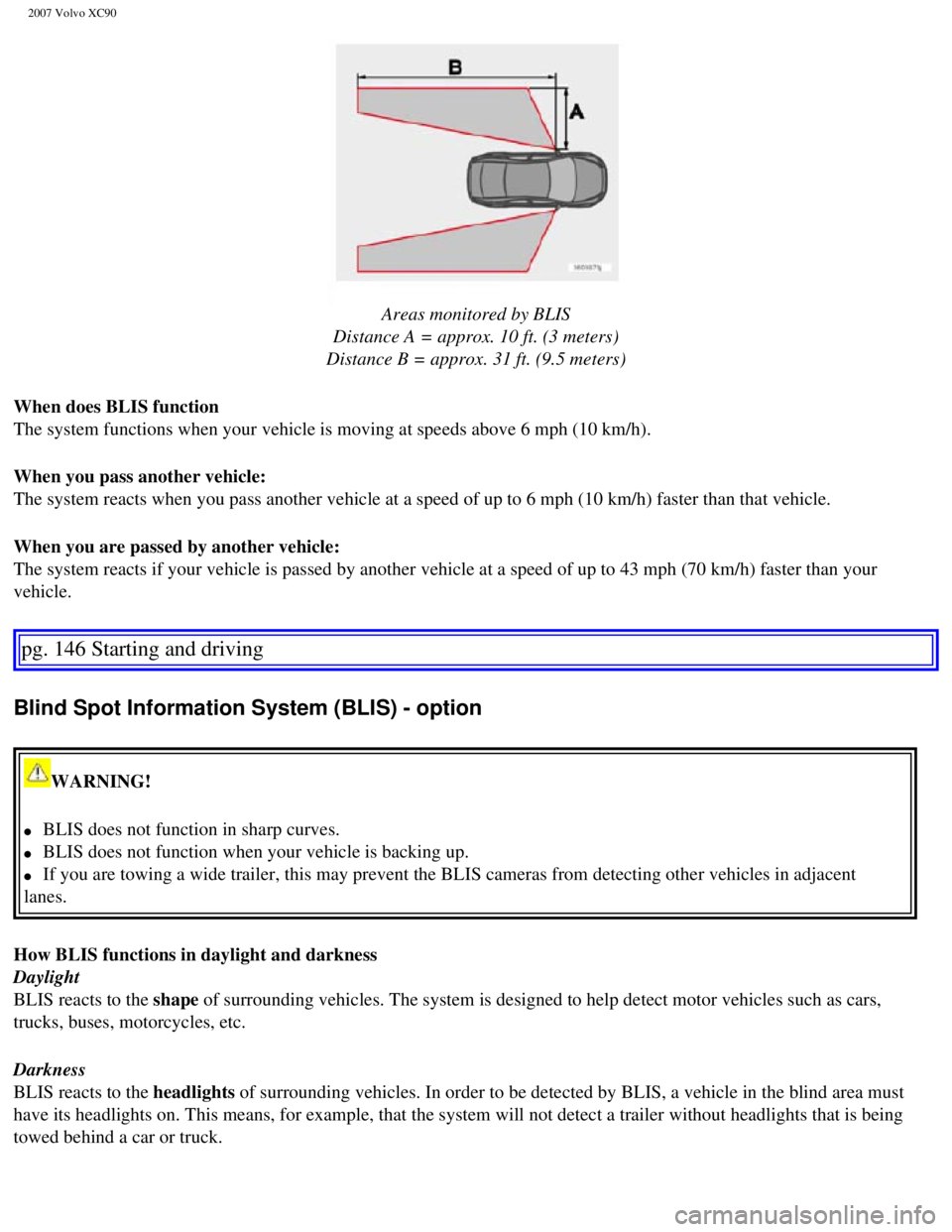
Areas monitored by BLIS
Distance A = approx. 10 ft. (3 meters)
Distance B = approx. 31 ft. (9.5 meters)
When does BLIS function
The system functions when your vehicle is moving at speeds above 6 mph (\
10 km/h).
When you pass another vehicle:
The system reacts when you pass another vehicle at a speed of up to 6 mp\
h (10 km/h) faster than that vehicle.
When you are passed by another vehicle:
The system reacts if your vehicle is passed by another vehicle at a spee\
d of up to 43 mph (70 km/h) faster than your
vehicle.
pg. 146 Starting and driving
Blind Spot Information System (BLIS) - option
WARNING!
l BLIS does not function in sharp curves.
l BLIS does not function when your vehicle is backing up.
l If you are towing a wide trailer, this may prevent the BLIS cameras from\
detecting other vehicles in adjacent
lanes.
How BLIS functions in daylight and darkness
Daylight
BLIS reacts to the shape of surrounding vehicles. The system is designed to help detect motor ve\
hicles such as cars,
trucks, buses, motorcycles, etc.
Darkness
BLIS reacts to the headlights of surrounding vehicles. In order to be detected by BLIS, a vehicle in \
the blind area must
have its headlights on. This means, for example, that the system will no\
t detect a trailer without headlights that is being
towed behind a car or truck.
file:///K|/ownersdocs/2007/2007_XC90/07xc90_06.htm (30 of 32)12/30/200\
6 5:53:44 PM
Page 169 of 268

2007 Volvo XC90
Properly loading your vehicle will provide maximum return of vehicle des\
ign performance.
Before loading your vehicle, familiarize yourself with the following ter\
ms for determining your vehicle's
weight ratings, with or without a trailer, from the vehicle's Federal/ C\
anadian Motor Vehicle Safety
Standards (FMVSS/CMVSS) label, and the vehicle's tire information plac\
ard.
Curb weight
The weight of the vehicle including a full tank of fuel and all standard\
equipment. It does not include
passengers, cargo, or optional equipment.
Capacity weight
All weight added to the curb weight, including cargo and optional equipm\
ent. When towing, trailer hitch
tongue load is also part of cargo weight.
NOTE: For trailer towing information, please refer to the section "Towing a t\
railer" on
page 137.
Permissible axle weight
The maximum allowable weight that can be carried by a single axle (fron\
t or rear). These numbers are
shown on the Federal/Canadian Motor Vehicle Safety Standards (FMVSS/ CM\
VSS) label. The total
load on each axle must never exceed its maximum permissible weight.
Gross vehicle weight (GVW)
The vehicle's curb weight + cargo + passengers.
NOTE:
l The location of the various labels in your vehicle can be found on page 208.
l A table listing important weight limits for your vehicle can be found on\
page 209.
Steps for Determining Correct Load Limit
- Locate the statement "the combined weight of occupants and cargo shoul\
d never exceed XXX pounds''
on your vehicle's placard.
- Determine the combined weight of the driver and passengers that will b\
e riding in your vehicle.
- Subtract the combined weight of the driver and passengers from XXX kil\
ograms or XXX pounds.
- The resulting figure equals the available amount of cargo and luggage \
load capacity. For example, if
the "XXX'' amount equals 1400 lbs. and there will be five 150 lb. passen\
gers in your vehicle, the amount
of available cargo and luggage load capacity is 650 lbs. (1400- 750 (5\
x 150) = 650 lbs.)
- Determine the combined weight of luggage and cargo being loaded on the\
vehicle. That weight may
not safely exceed the available cargo and luggage load capacity calculat\
ed in Step 4.
- If your vehicle will be towing a trailer, load from your trailer will \
be transferred to your vehicle.
Consult this manual
1 to determine how this reduces the available cargo and luggage load capa\
city of
your vehicle.
file:///K|/ownersdocs/2007/2007_XC90/07xc90_07.htm (13 of 23)12/30/200\
6 5:53:47 PM
Page 170 of 268

2007 Volvo XC90
1. See "Towing a trailer" on page 137.
pg. 162 Wheels and tires
Vehicle loading
WARNING!
l Exceeding the permissible axle weight, gross vehicle weight, or any othe\
r weight rating limits can
cause tire overheating resulting in permanent deformation or catastrophi\
c failure.
l Do not use replacement tires with lower load carrying capacities than th\
e tires that were original
equipment on the vehicle because this will lower the vehicle's GVW ratin\
g. Replacement tires with a
higher limit than the originals do not increase the vehicle's GVW rating\
limitations.
pg. 163 Wheels and tires
Uniform Tire Quality Grading
ALL PASSENGER VEHICLE TIRES MUST CONFORM TO FEDERAL SAFETY
REQUIREMENTS IN ADDITION TO THESE GRADES
Quality grades can be found, where applicable, on the tire sidewall betw\
een the tread shoulder
and maximum section width. For example:
Treadwear 200 Traction AA Temperature A
TREADWEAR
The treadwear grade is a comparative rating based on the wear rate of th\
e tire when tested under
controlled conditions on a specified government test course. For example\
, a tire graded 150 would wear
one and one half (1 1/2) times as well on the government course as a t\
ire graded 100. The relative
performance of tires depends upon the actual conditions of their use, ho\
wever, and many depart
significantly from the norm due to variation in driving habits, maintena\
nce practices and differences in
road characteristics and climate.
TRACTION
The traction grades, from highest to lowest, are AA, A, B, and C, as mea\
sured under controlled
conditions on specified government test surfaces of asphalt and concrete\
. A tire marked C may have
poor traction performance.
file:///K|/ownersdocs/2007/2007_XC90/07xc90_07.htm (14 of 23)12/30/200\
6 5:53:47 PM
Page 173 of 268

2007 Volvo XC90
WARNING!
Current legislation prohibits the use of the "Temporary Spare" tire othe\
r than as a temporary
replacement for a punctured tire. It must be replaced as soon as possibl\
e by a standard tire. Road
holding and handling may be affected with the "Temporary Spare" in use. \
Do not exceed 50 mph (80
km/h). Do not drive farther than 50 miles (80 km) on a temporary spar\
e tire.
CAUTION!
The vehicle must not be driven with wheels of different dimensions or wi\
th a spare tire other than the
one that came with the vehicle. The use of different size wheels can ser\
iously damage your vehicle's
transmission.
pg. 166 Wheels and tires
Changing wheels
Changing wheels
Location of jack, five-seat models
The jack is located to the right under the rear hatch in the cargo area \
floor. Lift this hatch and release the
retaining strap to lift out the jack.
The rear section of the jack's crank and the tool bag are stowed to the \
left under the hatch. The front
section of the crank is stored in the tool bag. The tool bag also contai\
ns a tool for removing certain
optional wheel covers. Consult your Volvo retailer.
file:///K|/ownersdocs/2007/2007_XC90/07xc90_07.htm (17 of 23)12/30/200\
6 5:53:47 PM
Page 174 of 268

2007 Volvo XC90
NOTE: The rear section of the crank is enclosed in a protective sleeve that s\
hould be slid off before the
crank is used. We recommend reinserting the crank into this sleeve befor\
e the crank is stowed.
If the vehicle is equipped with the optional grocery bag holder: Fold up\
the rear section of the cargo area
floor, disconnect the grocery bag holder's retaining cords and fold up t\
he lower section of the floor to
access the tool bag.
Location of jack, seven-seat models
The jack is located in the center under the rear hatch in the cargo area\
floor. Lift this hatch and release
the retaining strap to slide out the jack.
The rear section of the jack's crank and the tool bag are stowed to the \
left under the hatch. The front
section of the crank is stored in the tool bag.
NOTE: The rear section of the crank is enclosed in a protective sleeve that s\
hould be slid off before the
crank is used. We recommend reinserting the crank into this sleeve befor\
e the crank is stowed.
If the vehicle is equipped with the optional grocery bag holder: Fold up\
the rear section of the cargo area
floor, disconnect the grocery bag holder's retaining cords and fold up t\
he lower section of the floor.
pg. 167 Wheels and tires
Changing wheels
CAUTION!
Seven-seat models: Do not store objects in the area for the rear seat cushions (when the\
backrests are
to be folded down). This could damage the cushions.
Lowering the spare wheel
The spare wheel is located under the floor of the rear cargo compartment\
. It can be lowered using the
crank (see previous page for location).
WARNING!
When raising or lowering the spare wheel, please keep in mind that compo\
nents in the exhaust system
may be very hot.
To lower the spare wheel:
- Fold down the lower section of the tailgate.
- Fold up the rear section of the floor in the cargo compartment.
file:///K|/ownersdocs/2007/2007_XC90/07xc90_07.htm (18 of 23)12/30/200\
6 5:53:47 PM
Page 181 of 268

2007 Volvo XC90
l Tar spots can be removed with kerosene or tar remover after the vehicle \
has been washed.
l A stiff-bristle brush and lukewarm soapy water can be used to clean the \
wiper blades. Frequent
cleaning improves visibility considerably.
l Wash off the dirt from the underside (wheel housings, fenders, etc.). \
l In areas of high industrial fallout, more frequent washing is recommende\
d.
l After cleaning the engine, the spark plug wells should be inspected for \
water and blown dry if
necessary.
Suitable detergents
Special vehicle washing detergents should be used. A suitable mixture is\
about 2.5 fl. oz. (8.5 cl) of
detergent to 2.6 US gal. (10 liters) of warm water. After washing with\
a detergent the vehicle should be
well rinsed with clean water.
Exterior plastic components
Cleaning exterior plastic components should be done with a cleaning agen\
t specially designed for this
purpose. Solvents or stain removers should not be used. Consult your Vol\
vo retailer.
NOTE: When washing the vehicle, remember to remove dirt from the drain holes \
in the doors and sills.
CAUTION!
During high pressure washing, the spray mouthpiece must never be closer \
to the vehicle than 13" (30
cm). Do not spray into the locks.
When washing or steam cleaning the engine, avoid spraying water or steam\
directly on the electrical
components or toward the rear side of the engine.
Special moonroof cautions:
l Always close the moonroof and sun shade before washing your vehicle.
l Never use abrasive cleaning agents on the moonroof.
l Never use wax on the rubber seals around the moonroof.
pg. 175 Vehicle care
Washing and cleaning the vehicle
file:///K|/ownersdocs/2007/2007_XC90/07xc90_08.htm (2 of 7)12/30/2006 \
5:53:48 PM
Page 184 of 268

2007 Volvo XC90
Volvo's leather upholstery is manufactured with a protectant to repel so\
iling. Over time, sunlight, grease
and dirt can break down the protection. Staining, cracking, scuffing, an\
d fading can result.
Volvo offers an easy-to-use, non-greasy leather care kit formulated to c\
lean and beautify your vehicle's
leather, and to renew the protective qualities of its finish. The cleane\
r removes dirt and oil buildup. The
light cream protectant restores a barrier against soil and sunlight.
Volvo also offers a special leather softener that should be applied afte\
r the cleaner and protectant. It
leaves leather soft and smooth, and reduces friction between leather and\
other finishes in the vehicle.
Volvo recommends cleaning, protecting and conditioning your vehicle's le\
ather two to four times a year.
Ask your Volvo retailer about Leather Care Kit 951 0251 and Leather Soft\
ener 943 7429. CAUTION!
- Under no circumstances should gasoline, naphtha or similar cleaning ag\
ents be used on the plastic
or the leather since these can cause damage.
- Take extra care when removing stains such as ink or lipstick since the\
coloring can spread.
- Use solvents sparingly. Too much solvent can damage the seat padding. \
- Start from the outside of the stain and work toward the center.
- Sharp objects (e.g. pencils or pens in a pocket) or velcro fasteners\
on clothing may damage the
textile upholstery.
- Clothing that is not colorfast, such as new jeans or suede garments, m\
ay stain the upholstery.
Cleaning the seat belts
Clean only with lukewarm water and a mild soap solution.
Cleaning floor mats
The floor mats should be vacuumed or brushed clean regularly, especially\
during winter when they
should be taken out for drying. Spots on textile mats can be removed wit\
h a mild detergent.
pg. 178 Vehicle care
Paint touch up
file:///K|/ownersdocs/2007/2007_XC90/07xc90_08.htm (5 of 7)12/30/2006 \
5:53:48 PM
Page 189 of 268

2007 Volvo XC90
pg. 181 Maintenance
Maintaining your car
Owner maintenance
Periodic maintenance requirements and intervals are described in your ve\
hicle's Warranty and Service
Records Information booklet.
The following points can be carried out between the normally scheduled m\
aintenance services.
Each time the vehicle is refueled:
l Check the engine oil level
l Clean the windshield, windshield wipers, headlights, and tail lights
Monthly:
l Check cold tire pressure in all tires. Inspect the tires for wear.
l Check that engine coolant and other fluid levels are between the indicat\
ed "min" and "max" markings.
l Clean interior glass surfaces with a glass cleaner and soft paper towels\
.
l Wipe driver information displays with a soft cloth.
l Visually inspect battery terminals for corrosion. Corrosion may indicate\
a loose terminal connector, or
a battery near the end of its useful service life. Consult your Volvo re\
tailer for additional information.
As needed:
l Wash the vehicle, including the undercarriage, to reduce wear that can b\
e caused by a buildup of dirt,
and corrosion that can be caused by salt residues.
l Clean leaves and twigs from air intake vents at the base of the windshie\
ld, and from other places
where they may collect.
NOTE: Complete service information for qualified technicians is available onl\
ine for purchase or
subscription at
www.volvotechinfo.com.
pg. 182 Maintenance
Emission inspection readiness
What is an Onboard Diagnostic System (OBD II)?
OBD II is part of your vehicle's computerized engine management system. \
It stores diagnostic
information about your vehicle's emission controls. It can light the Che\
ck Engine light (MIL) if it detects
an emission control "fault." A "fault" is a component or system that is \
not performing within an expected
range. A fault may be permanent or temporary. OBD II will store a messag\
e about any fault.
file:///K|/ownersdocs/2007/2007_XC90/07xc90_09.htm (3 of 37)12/30/2006\
5:53:50 PM