wheel VOLVO XC90 2007 Owner's Manual
[x] Cancel search | Manufacturer: VOLVO, Model Year: 2007, Model line: XC90, Model: VOLVO XC90 2007Pages: 268, PDF Size: 8.57 MB
Page 130 of 268

2007 Volvo XC90
CAUTION!
- Do not refuel with the engine running
1. Turn the ignition off or to position I. If the ignition is on, an inco\
rrect reading
could occur in the fuel gauge.
- After refueling, close the fuel filler cap by turning it clockwise unt\
il it clicks into place
1.
- Avoid overfilling the fuel tank. Do not press the handle on the filler\
nozzle more than one extra time. Too much fuel in
the tank in hot weather conditions can cause the fuel to overflow. Overf\
illing could also cause damage to the emission
control systems.
- Avoid spilling gasoline during refueling. In addition to causing damag\
e to the environment, gasolines containing
alcohol can cause damage to painted surfaces, which may not be covered u\
nder the New Vehicle Limited Warranty.
- Do not use gasolines containing methanol (methyl alcohol, wood alcoho\
l). This practice can result in vehicle
performance deterioration and can damage critical parts in the fuel syst\
em. Such damage may not be covered under the
New Vehicle Limited Warranty.
1. If the fuel filler cap is not closed tightly or if the engine is runn\
ing when the vehicle is refueled, the Check Engine Light
(malfunction indicator lamp) may indicate a fault. However, your vehic\
le's performance will not be affected. Use only Volvo original
or approved fuel filler caps.
pg. 119 Starting and driving
Starting the vehicle
Starting the engine
- Fasten the seat belt.
WARNING!
Before starting, check that the seat, steering wheel and mirrors are adj\
usted properly. Make sure the brake pedal can be
depressed completely. Adjust the seat if necessary. See pages
84 and 87.
- Apply the parking brake (hand brake) if not already set. The gear se\
lector is locked in the (P)ark position
(SHIFTLOCK).
- Without touching the accelerator pedal, turn the ignition key
1 to the starting position. Allow the starter to operate for up
to 10 seconds. Release the key as soon as the engine starts
2. If the engine fails to start, repeat this step.
NOTE:
l If the key blade section of the remote is not fully folded out when star\
ting the vehicle, the immobilizer function may
make it impossible to start the engine.
l After a cold start, idle speed may be noticeably higher than normal for \
a short period. This is done to help bring
components in the emission control system to their normal operating temp\
erature as quickly as possible, which enables
them to control emissions and help reduce the vehicle's impact on the en\
vironment.
l For cold starts at altitudes above 6000 ft (1800 meters), depress the \
accelerator pedal halfway and turn the key to the
starting position. Release the pedal slowly when the engine starts.
- To release the gear selector from the (P)ark position, the engine must be running (or the ignition key must be\
in position
II) and the brake pedal must be depressed.
file:///K|/ownersdocs/2007/2007_XC90/07xc90_06.htm (6 of 32)12/30/2006\
5:53:44 PM
Page 131 of 268

2007 Volvo XC90
- Select the desired gear. The gear engages after a very slight delay wh\
ich is especially noticeable when selecting R.
NOTE: Your vehicle is equipped with a KEYLOCK system. When the engine is switched off, the gear selector must be
in the (P)ark position before the key can be removed from the ignition switch. W\
hen starting in cold weather, the
transmission may shift up at slightly higher engine speeds than normal u\
ntil the automatic transmission fluid reaches
normal operating temperature.
NOTE: Do not race a cold engine immediately after starting. Oil flow may not \
reach some lubrication points fast enough
to prevent engine damage.
WARNING!
An extra mat on the driver's floor can cause the accelerator pedal to ca\
tch. Check that the movement of the accelerator
pedal is not impeded. No more than one protective floor covering may be \
used at one time.
1. If two of the keys to your vehicle are close together, e.g. on the sa\
me key ring when you try to start the vehicle, this could cause
interference in the immobilizer system and result in the vehicle not sta\
rting. If this should occur, remove one of the keys from the key
ring before trying to start the vehicle again.
2. On vehicles equipped with the autostart feature, release the key imme\
diately. See also
page 121.
pg. 120 Starting and driving
Starting the vehicle
WARNING!
Always place the gear selector in Park and apply the parking brake befor\
e leaving the vehicle. Never leave the vehicle
unattended with the engine running. Always open garage doors fully befor\
e starting the engine inside a garage to ensure
adequate ventilation. The exhaust gases contain carbon monoxide, which i\
s invisible and odorless but very poisonous.
CAUTION!
Automatic transmission
The engine should be idling when you move the gear selector. Never accel\
erate until after you feel the transmission
engage! Accelerating immediately after selecting a gear will cause harsh\
engagement and premature transmission wear.
Selecting P or N when idling at a standstill for prolonged periods of ti\
me will help prevent overheating of the automatic
transmission fluid.
pg. 121 Starting and driving
Economical driving
Ignition switch and steering wheel lock
file:///K|/ownersdocs/2007/2007_XC90/07xc90_06.htm (7 of 32)12/30/2006\
5:53:44 PM
Page 132 of 268

2007 Volvo XC90
0 - Locked position:
Remove the key to lock the steering wheel
1.
WARNING!
Never turn the key to position O while driving or when the vehicle is be\
ing
towed.
I - Intermediate position2 - "radio position": Certain accessories, radio, etc. on, daytime running lights off.
II - Drive position: The key position when driving. The vehicle's entire electrical system i\
s connected.
III - Start position: Release the key when the engine starts. The key returns automatically t\
o the Drive position.
A chime will sound if the key is left in the ignition and the driver's d\
oor is opened.
Autostart
This function makes it possible to start the vehicle without holding the\
key in the start position (position III) until the
engine starts. Turn the key to position III and release it. The starter \
motor will then operate automatically (for up to ten
seconds) until the engine starts.
Steering wheel lock
The steering wheel lock might be under tension when the vehicle is parke\
d.
Turn the steering wheel slightly to free the ignition key.
In order to help reduce vehicle theft, make sure the steering wheel lock\
is engaged before leaving the vehicle.
file:///K|/ownersdocs/2007/2007_XC90/07xc90_06.htm (8 of 32)12/30/2006\
5:53:44 PM
Page 133 of 268
 or\
remove the key from the ignition switch while the
vehicle is in motion. This could cause the steer")
2007 Volvo XC90
WARNING!
Never switch off the ignition (turn the ignition key to position 0) or\
remove the key from the ignition switch while the
vehicle is in motion. This could cause the steering wheel to lock, which\
would make the vehicle impossible to steer.
Economical driving conserves natural resources
Better driving economy may be obtained by thinking ahead, avoiding rapid\
starts and stops and adjusting the speed of your
vehicle to immediate traffic conditions. Observe the following rules:
l Bring the engine to normal operating temperature as soon as possible by \
driving with a light foot on the accelerator
pedal for the first few minutes of operation. A cold engine uses more fu\
el and is subject to increased wear.
l Whenever possible, avoid using the vehicle for driving short distances. \
This does not allow the engine to reach normal
operating temperature.
l Drive carefully and avoid rapid acceleration and hard braking.
l Use the transmission's (D)rive position as often as possible and avoid using "kickdown" to help \
improve fuel economy.
l Do not exceed posted speed limits.
l Avoid carrying unnecessary items (extra load) in the vehicle.
l Maintain correct tire pressure. Check tire pressure regularly (when tir\
es are cold).
l Remove snow tires when threat of snow or ice has ended.
1. The gear selector must be in the (P)ark position (automatic transmission).
2. Please be aware that leaving the key in this position will increase b\
attery drain.
pg. 122 Starting and driving
Economical driving
l Note that roof racks, ski racks, etc, increase air resistance and also f\
uel consumption.
l At highway driving speeds, fuel consumption will be lower with the air c\
onditioning on and the windows closed than
with the air conditioning off and the windows open.
l Using the onboard trip computer's fuel consumption modes can help you le\
arn how to drive more economically.
Other factors that decrease gas mileage are:
l Dirty air cleaner
l Dirty engine oil and clogged oil filter
l Dragging brakes
l Incorrect front end alignment.
Some of the above mentioned items and others are checked at the standard\
Maintenance Service intervals.
CAUTION!
Drive slowly and carefully if going through standing water (i.e. floode\
d roadways, etc.). Damage to the engine could
result if excess water is drawn in through the air intake system. Never \
drive the vehicle in water deeper than 18 inches
(48 cm).
pg. 123 Starting and driving
file:///K|/ownersdocs/2007/2007_XC90/07xc90_06.htm (9 of 32)12/30/2006\
5:53:44 PM
Page 137 of 268
.
l Mode W w")
2007 Volvo XC90
W - Winter/Wet driving mode - enhanced vehicle traction
Press the button at the base of the gear selector to engage/disengage th\
is driving mode (see illustration).
l Mode W will only function if the gear selector is in the (D)rive position.
l When the W driving mode is engaged, this is displayed in the instrument \
panel (see page 46).
This mode may be selected for starting/ moving off on slippery roads.
1. Six-speed transmission: gears 2, 3, 4, 5, and 6.
pg. 126 Starting and driving
All Wheel Drive (option)
All Wheel Drive (AWD) - general information
Your Volvo can be equipped with permanent All Wheel Drive (option), wh\
ich means that power is distributed
automatically between the front and rear wheels. Under normal driving co\
nditions, most of the engine's power is directed
to the front wheels. However, if there is any tendency for the front whe\
els to spin, an electronically controlled coupling
distributes power to the wheels that have the best traction.
Tire dimensions
Volvo recommends that you always drive on tires of the same brand, size,\
construction (radial), tread pattern, load-,
speed-, traction- , temperature-, and treadwear rating. Never drive on m\
ixed tires, except for brief periods when the
temporary spare tire is in use.
Always use properly inflated tires of correct dimensions. Tire size and \
inflation pressures are shown on the tire inflation
pressure placards, located on the driver's side B-pillar (the structura\
l member at the side of the vehicle, at the rear of the
driver's door opening), or on the inside of the fuel filler door on Can\
adian models.
Temporary Spare
The temporary spare tire is for temporary, low-speed, short-distance use\
only. Replace it with a full-sized tire as soon as
possible. Do not drive on the temporary spare at speeds above 50 m.p.h. \
(80km/h) or for distances greater than 50 miles
(80 km).
Never install snow chains on a temporary spare.
pg. 127 Starting and driving
Brake system
file:///K|/ownersdocs/2007/2007_XC90/07xc90_06.htm (13 of 32)12/30/200\
6 5:53:44 PM
Page 140 of 268

The")
2007 Volvo XC90
This is normal and the pedal will return to its usual position when it i\
s released.
pg. 130 Starting and driving
Stability system
Dynamic Stability Traction Control (DSTC)
The stability system consists of a number of functions designed help red\
uce wheel spin, counteract skidding, and to
generally help improve directional stability.
NOTE: A pulsating sound will be audible when the system is actively operating\
and is normal.
Traction control (TC)
This function is designed to help reduce wheel spin by transferring powe\
r from a drive wheel that begins to lose traction to
the wheel on the opposite side of the vehicle (on the same axle).
TC is most active at low speeds.
This is one of DSTC's permanent functions and cannot be switched off.
Spin control (SC)
The spin control function is designed to help prevent the drive wheels f\
rom spinning while the vehicle is accelerating.
Under certain circumstances, such as when driving with snow chains, or d\
riving in deep snow or loose sand, it may be
advisable to temporarily switch off this function for maximum tractive f\
orce.
Temporarily switching off Spin control
- Turn the thumbwheel (1) on the left-side steering wheel lever until \
the DSTC menu is displayed.
- Hold down the RESET button (2) to toggle between DSTC SPIN CONTROL O\
N or OFF.
NOTE:
l The message DSTC SPIN CONTROL OFF indicates that the stability system's \
spin control function has temporarily
been switched off.
l The stability control indicator light will illuminate and remain on until spin control has been reactivated.
l The spin control function is automatically enabled each time the engine \
is started.
l DSTC ON indicates that all system functions are active.
Active Yaw Control (AYC)
This function helps maintain directional stability, for example when cor\
nering, by braking one or more of the wheels if the
vehicle shows a tendency to skid or slide laterally.
This is one of DSTC's permanent functions and cannot be switched off
file:///K|/ownersdocs/2007/2007_XC90/07xc90_06.htm (16 of 32)12/30/200\
6 5:53:44 PM
Page 141 of 268

2007 Volvo XC90
WARNING!
The car's handling and stability characteristics will be altered if the \
DSTC system functions have been
disabled.
DSTC-related messages in the text window
l "TRACTION CONTROL TEMPORARILY OFF" - The system has been temporarily swi\
tched off due to high brake
temperature and will automatically switch on again when the brakes have \
cooled.
"ANTI SKID SERVICE REQUIRED" - the system has been automatically disenga\
ged due to a fault. An authorized Volvo
retailer should check the system.
pg. 131 Starting and driving
Stability system
Symbols in the instrument panel
The Stability Control indicator light
This light indicates different conditions, depending on how it illuminat\
es.
The Stability Control indicator light illuminates for approximately 2 se\
conds
This indicates that the system is performing a self-diagnostic test when\
the ignition is switched on.
The Stability Control indicator light flashes
This indicates that the stability system is actively functioning to help\
counteract wheel spin and/or a skid.
The Stability Control indicator light glows steadily
"ANTI SKID SERVICE REQUIRED" will be displayed in the text window at the\
same time.
A fault is indicated in the stability system.
- Stop the vehicle in a safe place and switch off the engine.
- Restart the engine.
- If the indicator light goes out, the fault was temporary and no furthe\
r action is required.
- If the indicator light remains on, drive to an authorized Volvo worksh\
op as soon as possible to have the system checked.
The Stability Control indicator light glows steadily
If "DSTC SPIN CONTROL OFF" is displayed in the text window at the same t\
ime, this is a reminder that spin control has
been disabled by the driver.
The warning symbol
The warning symbol glows steadily yellow
The system has been temporarily switched off due to high brake temperatu\
re. "TRACTION CONTROL TEMPORARILY
OFF" will be displayed. The system will automatically switch on again wh\
en the brakes have cooled.
file:///K|/ownersdocs/2007/2007_XC90/07xc90_06.htm (17 of 32)12/30/200\
6 5:53:44 PM
Page 144 of 268

2007 Volvo XC90
Emergency towing
The towing eyelet is located in the tool bag, under the floor of the car\
go area. This eyelet must be screwed into the
positions provided on the right sides of either the front or rear bumper\
(see illustrations).
To attach the towing eyelet:
A. Use a coin to pry open the lower edge of the cover (A).
B. Screw the towing eyelet (C) in place (B), first by hand and then \
using the tire iron until it is securely in place.
After the vehicle has been towed, the eyelet should be removed and retur\
ned to the tool bag. Press the cover back into
position.
Precautions when the vehicle is in tow
l The steering wheel must be unlocked. Turn the ignition key to position I\
or II.
l The gear selector must be in position N.
l Maximum speed: 50 mph (80 km/h). Do not exceed the maximum allowable t\
owing speed.
l Maximum distance with front wheels on ground: 50 miles (80 km).
l While the vehicle is being towed, try to keep the tow rope taut at all t\
imes.
l The vehicle should only be towed in forward direction.
CAUTION!
- Please check with state and local authorities before attempting this t\
ype of towing, as vehicles being towed are subject
to regulations regarding maximum towing speed, length and type of towing\
device, lighting, etc.
- If the vehicle's battery is dead, do not attempt to start the vehicle \
by pushing or pulling it as this will damage the three-
way catalytic converter(s). The engine must be jump started using an a\
uxiliary battery (see
page 136).
- If the vehicle is being towed on a flat bed truck, the towing eyelets \
must not be used to secure the vehicle on the flat
bed. Consult the tow truck operator.
pg. 135 Starting and driving
Towing
file:///K|/ownersdocs/2007/2007_XC90/07xc90_06.htm (20 of 32)12/30/200\
6 5:53:44 PM
Page 145 of 268

2007 Volvo XC90
WARNING!
l Remember that the power brakes and power steering will not function when\
engine is not running. The braking and
steering systems will function but the brake pedal pressure required is \
3 - 4 times above normal and greater steering
effort must be exerted.
l The towing eyelets must not be used for pulling another vehicle out of a\
ditch or for any similar purpose involving
severe strain.
l Do not use the towing eyelets to pull the vehicle up onto a flat bed tow\
truck.
Towing vehicles with front wheel drive/All Wheel Drive
Volvo recommends the use of flat bed equipment.
If wheel lift equipment must be used, please use extreme caution to help\
avoid damage to the vehicle. In this case, the
vehicle should be towed with the rear wheels on the ground if at all pos\
sible.
If it is absolutely necessary to tow the vehicle with the front wheels o\
n the ground, please refer to the towing information
on the previous page.
CAUTION!
Sling-type equipment applied at the front will damage radiator and air c\
onditioning lines.
It is equally important not to use sling-type equipment at the rear or a\
pply lifting equipment inside the rear wheels;
serious damage to the rear axle may result.
If the vehicle is being towed on a flat bed truck, the towing eyelets mu\
st not be used to secure the vehicle on the flat
bed. Consult the tow truck operator.
WARNING!
Do not use the towing eyelets to pull the vehicle up onto a flat bed tow\
truck.
pg. 136 Starting and driving
Jump starting
file:///K|/ownersdocs/2007/2007_XC90/07xc90_06.htm (21 of 32)12/30/200\
6 5:53:44 PM
Page 147 of 268
2007 Volvo XC90
Towing a trailer
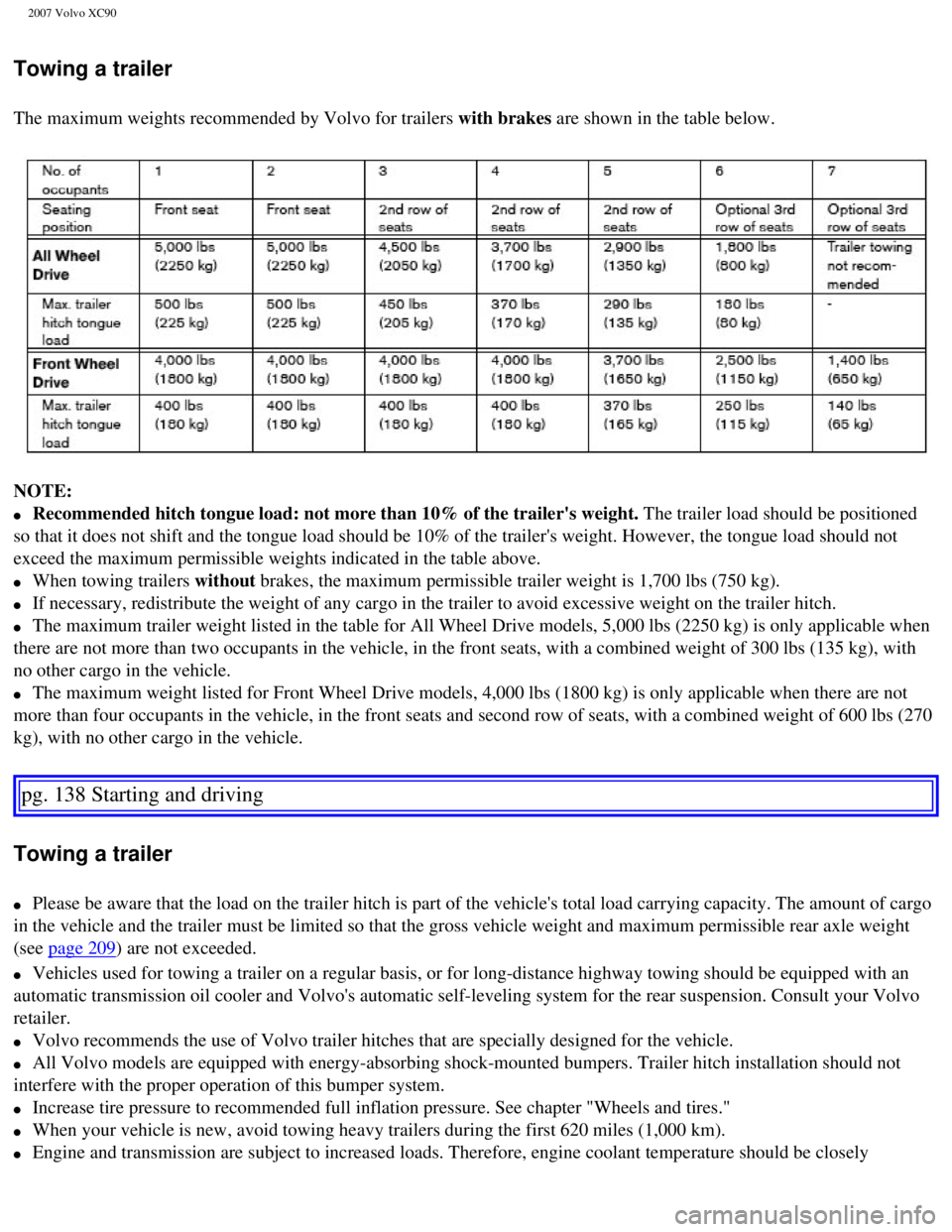
The maximum weights recommended by Volvo for trailers with brakes are shown in the table below.
NOTE:
l Recommended hitch tongue load: not more than 10% of the trailer's weight\
. The trailer load should be positioned
so that it does not shift and the tongue load should be 10% of the trail\
er's weight. However, the tongue load should not
exceed the maximum permissible weights indicated in the table above.
l When towing trailers without brakes, the maximum permissible trailer weight is 1,700 lbs (750 kg).\
l If necessary, redistribute the weight of any cargo in the trailer to avo\
id excessive weight on the trailer hitch.
l The maximum trailer weight listed in the table for All Wheel Drive model\
s, 5,000 lbs (2250 kg) is only applicable when
there are not more than two occupants in the vehicle, in the front seats\
, with a combined weight of 300 lbs (135 kg), with
no other cargo in the vehicle.
l The maximum weight listed for Front Wheel Drive models, 4,000 lbs (1800\
kg) is only applicable when there are not
more than four occupants in the vehicle, in the front seats and second r\
ow of seats, with a combined weight of 600 lbs (270
kg), with no other cargo in the vehicle.
pg. 138 Starting and driving
Towing a trailer
l Please be aware that the load on the trailer hitch is part of the vehicl\
e's total load carrying capacity. The amount of cargo
in the vehicle and the trailer must be limited so that the gross vehicle\
weight and maximum permissible rear axle weight
(see
page 209) are not exceeded.
l Vehicles used for towing a trailer on a regular basis, or for long-dista\
nce highway towing should be equipped with an
automatic transmission oil cooler and Volvo's automatic self-leveling sy\
stem for the rear suspension. Consult your Volvo
retailer.
l Volvo recommends the use of Volvo trailer hitches that are specially des\
igned for the vehicle.
l All Volvo models are equipped with energy-absorbing shock-mounted bumper\
s. Trailer hitch installation should not
interfere with the proper operation of this bumper system.
l Increase tire pressure to recommended full inflation pressure. See chapt\
er "Wheels and tires."
l When your vehicle is new, avoid towing heavy trailers during the first 6\
20 miles (1,000 km).
l Engine and transmission are subject to increased loads. Therefore, engin\
e coolant temperature should be closely
file:///K|/ownersdocs/2007/2007_XC90/07xc90_06.htm (23 of 32)12/30/200\
6 5:53:44 PM