air condition VOLVO XC90 2009 Owner´s Manual
[x] Cancel search | Manufacturer: VOLVO, Model Year: 2009, Model line: XC90, Model: VOLVO XC90 2009Pages: 282, PDF Size: 8.76 MB
Page 136 of 282
06 Starting and drivingEconomical driving
06136
Economical driving conserves natural
resourcesBetter driving economy may be obtained by
thinking ahead, avoiding rapid starts and stops
and adjusting the speed of your vehicle to
immediate traffic conditions. Observe the fol-
lowing rules:•
Bring the engine to normal operating tem-
perature as soon as possible by driving
with a light foot on the accelerator pedal for
the first few minutes of operation. A cold
engine uses more fuel and is subject to
increased wear.
•
Whenever possible, avoid using the vehicle
for driving short distances. This does not
allow the engine to reach normal operating
temperature.
•
Drive carefully and avoid rapid acceleration
and hard braking.
•
Use the transmission's D (Drive) position
as often as possible and avoid using "kick-
down" to help improve fuel economy.
•
Do not exceed posted speed limits.
•
Avoid carrying unnecessary items (extra
load) in the vehicle.
•
Maintain correct tire pressure. Check tire
pressure regularly (when tires are cold).
•
Remove snow tires when threat of snow or
ice has ended.
•
Note that roof racks, ski racks, etc,
increase air resistance and also fuel con-
sumption.
•
At highway driving speeds, fuel consump-
tion will be lower with the air conditioning
on and the windows closed than with the
air conditioning off and the windows open.
•
Using the onboard trip computer's fuel
consumption modes can help you learn
how to drive more economically.
Other factors that decrease gas mileage
are:
•
Dirty air cleaner
•
Dirty engine oil and clogged oil filter
•
Dragging brakes
•
Incorrect front end alignment.
Some of the above mentioned items and others
are checked at the standard Maintenance
Service intervals.CAUTION
Drive slowly and carefully if going through
standing water (i.e. flooded roadways, etc.).
Damage to the engine could result if excess
water is drawn in through the air intake sys-
tem. Never drive the vehicle in water deeper
than 18 inches (48 cm).
Page 137 of 282
06 Starting and driving
Difficult driving conditions
06
137 Driving on rough/unpaved surfaces
The Volvo XC90 is designed primarily for on-
road driving, and it has excellent handling cha-
racteristics on very rough or unpaved roads.
When driving on poorly maintained or unpaved
roads, please keep the following in mind:•
Reduce speed on rough surfaces to mini-
mize possible damage to the vehicle's
underbody.
•
When driving on soft surfaces such as dry
sand or snow, try to avoid stopping if at all
possible.WARNING
Avoid driving diagonally across steep
inclines as this could increase the risk of a
roll-over. Try to drive straight up or down the
slope.•
If the road is very steep, avoid turning
the vehicle around to help avoid the risk
of rolling over. Back the vehicle up or
down the incline instead.
NOTE
Avoid driving on steep inclines if the fuel
tank is nearly empty. If the flow of fuel to the
engine is interrupted due to the vehicle's
angle of inclination, this could result in dam-
age to the three-way catalytic converter. We
recommend keeping the fuel tank at least
half full when driving on steep inclines.Driving through waterThe vehicle can be driven through water up to
a depth of approximately 16 inches (40 cm), at
a maximum speed of 6 mph (10 km/h).
Take particular care when driving through flow-
ing water.
Clean the electrical connections for trailer wir-
ing after driving in mud or water.
When driving through water, maintain low
speed and do not stop in the water.
WARNING
After driving through water, press lightly on
the brake pedal to ensure that the brakes
are functioning normally. Water or mud can
make the brake linings slippery, resulting in
delayed braking effect.
CAUTION
•
Engine damage will occur if water is
drawn into the air cleaner.
•
If the vehicle is driven through water
deeper than 18 in (48 cm), water may
enter the differential and the transmis-
sion. This reduces the oil's lubricating
capacity and may shorten the service
life of these components.
•
Do not allow the vehicle to stand in
water up to the door sills longer than
absolutely necessary. This could result
in electrical malfunctions.
•
If the engine has been stopped while the
car is in water, do not attempt to restart
the engine. Have the car towed out of
the water.
Page 152 of 282
06 Starting and drivingTowing a trailer
06152
NOTE
•
Recommended hitch tongue load:
not more than 10% of the trailer's
weight. The trailer load should be posi-
tioned so that it does not shift and the
tongue load should be 10% of the trail-
er's weight. However, the tongue load
should not exceed the maximum per-
missible weights indicated in the table
above.
•
When towing trailers without brakes,
the maximum permissible trailer weight
is 1,700 lbs (750 kg).
•
If necessary, redistribute the weight of
any cargo in the trailer to avoid exces-
sive weight on the trailer hitch.
•
The maximum trailer weight listed in the
table for All Wheel Drive models,
5,000 lbs (2250 kg) is only applicable
when there are not more than two occu-
pants in the vehicle, in the front seats,
with a combined weight of 300 lbs
(135 kg), with no other cargo in the vehi-
cle.
•
The maximum weight listed for Front
Wheel Drive models, 4,000 lbs (1800 kg)
is only applicable when there are not
more than four occupants in the vehicle,
in the front seats and second row of
seats, with a combined weight of
600 lbs (270 kg), with no other cargo in
the vehicle.
NOTE
•
Vehicles used for towing a trailer on a
regular basis, or for long-distance high-
way towing should be equipped with an
automatic transmission oil cooler and
Volvo's automatic self-leveling system
for the rear suspension. Consult your
Volvo retailer.
•
Volvo recommends the use of Volvo
trailer hitches that are specially
designed for the vehicle.
•
All Volvo models are equipped with
energy-absorbing shock-mounted
bumpers. Trailer hitch installation
should not interfere with the proper
operation of this bumper system.
•
Increase tire pressure to recommended
full inflation pressure. See chapter
"Wheels and tires."
•
When your vehicle is new, avoid towing
heavy trailers during the first 620 miles
(1,000 km).
•
Engine and transmission are subject to
increased loads. Therefore, engine
coolant temperature should be closely
watched when driving in hot climates or
hilly terrain. Use a lower gear and turn
off the air conditioner if the temperature
gauge needle enters the red range.
Page 160 of 282
06 Starting and drivingBlind Spot Information System
06160
When you pass another vehicle:
The system reacts when you pass another
vehicle at a speed of up to 6 mph (10 km/h)
faster than that vehicle.
When you are passed by another vehicle:
The system reacts if your vehicle is passed by
another vehicle at a speed of up to 43 mph
(70 km/h) faster than your vehicle.
WARNING
•
BLIS does not function in sharp curves.
•
BLIS does not function when your vehi-
cle is backing up.
•
If you are towing a wide trailer, this may
prevent the BLIS cameras from detect-
ing other vehicles in adjacent lanes.
How BLIS functions in daylight and
darknessDaylight
BLIS reacts to the shape of surrounding vehi-
cles. The system is designed to help detect
motor vehicles such as cars, trucks, buses,
motorcycles, etc.
Darkness
BLIS reacts to the headlights of surrounding
vehicles. In order to be detected by BLIS, avehicle in the blind area must have its head-
lights on. This means, for example, that the
system will not detect a trailer without head-
lights that is being towed behind a car or truck.
WARNING
•
BLIS does not react to cyclists or
mopeds.
•
BLIS does not react to vehicles that are
standing still.
•
The function of the BLIS cameras may
be affected by intense light, or when
driving at night in areas where there are
no external sources of light (e.g., street
lights, other vehicles, etc.). In such
cases, the system may react as if the
cameras were obscured.
•
In both of the above mentioned condi-
tions, a message will appear in the infor-
mation display.
•
When driving in such conditions, the
system can be temporarily switched off.
For instructions, see page 161.
•
When the message is no longer dis-
played, BLIS will return to normal func-
tion.
•
The BLIS cameras have the same limi-
tation as the human eye. In other words,
their "vision is impaired" by adverse
weather conditions such as heavy
snowfall, dense fog, etc.
Page 167 of 282
07 Wheels and tires
General information
07
167
WARNING
•
The wheel and tire sizes for your Volvo
are specified to meet stringent stability
and handling requirements. Unap-
proved wheel/tire size combinations
can negatively affect your vehicle's sta-
bility and handling. Approved tire sizes
are shown in the Tire inflation pressure
tables on pages 170 and 171.
•
Any damage caused by installation of
unapproved wheel/tire size combina-
tions will not be covered by your new
vehicle warranty. Volvo assumes no
responsibility for death, injury, or
expenses that may result from such
installations.
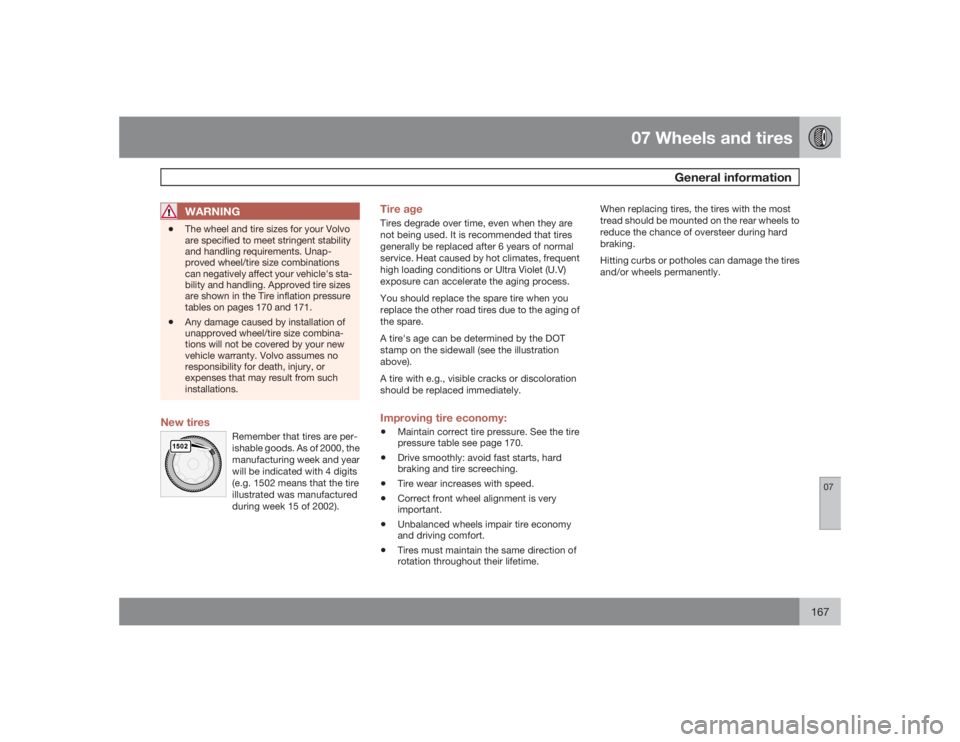
New tires
Remember that tires are per-
ishable goods. As of 2000, the
manufacturing week and year
will be indicated with 4 digits
(e.g. 1502 means that the tire
illustrated was manufactured
during week 15 of 2002).
Tire ageTires degrade over time, even when they are
not being used. It is recommended that tires
generally be replaced after 6 years of normal
service. Heat caused by hot climates, frequent
high loading conditions or Ultra Violet (U.V)
exposure can accelerate the aging process.
You should replace the spare tire when you
replace the other road tires due to the aging of
the spare.
A tire's age can be determined by the DOT
stamp on the sidewall (see the illustration
above).
A tire with e.g., visible cracks or discoloration
should be replaced immediately.Improving tire economy: •
Maintain correct tire pressure. See the tire
pressure table see page 170.
•
Drive smoothly: avoid fast starts, hard
braking and tire screeching.
•
Tire wear increases with speed.
•
Correct front wheel alignment is very
important.
•
Unbalanced wheels impair tire economy
and driving comfort.
•
Tires must maintain the same direction of
rotation throughout their lifetime.When replacing tires, the tires with the most
tread should be mounted on the rear wheels to
reduce the chance of oversteer during hard
braking.
Hitting curbs or potholes can damage the tires
and/or wheels permanently.
Page 202 of 282
09 Maintenance and servicingVolvo service
09202
Maintenance servicePeriodic maintenance will help keep your vehi-
cle running well. Your Warranty and Service
Records Information booklet provides a com-
prehensive maintenance schedule up to
150,000 miles (240,000 km) of vehicle service.
This maintenance program contains inspec-
tions and services necessary for the proper
function of your vehicle, and includes compo-
nents that affect vehicle emissions. The main-
tenance services contain several checks that
require special instruments and tools and
therefore must be performed by a qualified
technician. Volvo advises you to follow the
service program outlined in this booklet. To
keep your Volvo in top condition, specify time-
tested and proven Genuine Volvo Parts and
Accessories.The Federal Clean Air Act – U.S.The Federal Clean Air Act requires vehicle
manufacturers to furnish written instructions to
the ultimate purchaser to assure the proper
servicing and function of the components that
control emissions. These services, which are
listed in the "Warranty and Service Records
Information booklet," are not covered by the
warranty. You will be required to pay for labor
and material used.
Maintenance servicesYour Volvo passed several major inspections
before it was delivered to you, in accordance
with Volvo specifications. The maintenance
services outlined in the Warranty and Service
Records Information booklet, many of which
will positively affect your vehicle's emissions,
should be performed as indicated. It is recom-
mended that receipts for vehicle emission
services be retained in case questions arise
concerning maintenance.
Inspection and service should also be per-
formed anytime a malfunction is observed or
suspected.Vehicle Event Data (Black Box)Your vehicle's driving and safety systems
employ computers that monitor, and share
with each other, information about your vehi-
cle's operation. One or more of these comput-
ers may store what they monitor, either during
normal vehicle operation or in a crash or near-
crash event. Stored information may be read
and used by:•
Volvo Car Corporation
•
service and repair facilities
•
law enforcement or government agencies
•
others who may assert a legal right to
know, or who obtain your consent to know
such information.
Applicable warrantiesIn accordance with applicable U.S. and Cana-
dian regulations, the following list of warranties
is provided.•
New Car Limited Warranty
•
Parts and Accessories Limited Warranty
•
Corrosion Protection Limited Warranty
•
Seat Belt and Supplemental Restraint Sys-
tems Limited Warranty
•
Emission Design and Defect Warranty
•
Emission Performance Warranty
These are the Federal warranties; other war-
ranties are provided as required by state/pro-
vincial law. Refer to your separate Warranty
and Service Records Information booklet for
detailed information concerning each of the
warranties.
Page 206 of 282
09 Maintenance and servicingWorking on your vehicle
09206
Belt checkCheck the belt regularly to make sure it is in
good condition and is clean. A worn or dirty belt
can cause poor cooling and low alternator out-
put as well as impair the operation of the power
steering and the air conditioning unit.
NOTE
The drive belt is equipped with a self-ten-
sioning mechanism and requires no adjust-
ment between changes.
WARNING
The engine must not be running when this
check is performed.Check coolant levelThe cooling system must be filled with coolant
and not leak to operate at maximum efficiency.
Check the coolant level regularly. The level
should be between the MAX and MIN marks
on the expansion tank. The check should be
made with particular thoroughness when the
engine is new or when the cooling system has
been drained.
Do not remove the filler cap other than for top-
ping up with coolant. Frequent removal may
prevent coolant circulation between the engineand the expansion tank during engine warm up
and cooling.
Changing coolantNormally, the coolant does not need to be
changed. If the system must be drained, con-
sult a trained and qualified Volvo service tech-
nician.
Do not top off with water only. This reduces the
rust-protective and antifreeze qualities of the
coolant and has a lower boiling point. It can
also cause damage to the cooling system if it
should freeze. Top off with Volvo Genuine
Coolant/Antifreeze only (a 50/50 mix of water
and antifreeze.
CAUTION
The cooling system must always be kept
filled to the correct level. If it is not kept filled,
there can be high local temperatures in the
engine which could result in damage. Dif-
ferent types of antifreeze/coolant may not
be mixed.
WARNING
Never remove the radiator cap while the
engine is warm. Wait until the vehicle cools.
Page 232 of 282
09 Maintenance and servicingFuses
09232
No
A
14
Subwoofer (option), rear air
conditioning system (option)
15
15
–
16
–
17
Accessory audio
5
18
–
19
Rear window wiper
15
20
Trailer wiring (15-feed) - option
20
21
–
22
–
23
Park assist
7,5
24
–
25
–
26
Park assist (option)
5
27
Main fuse: trailer wiring, park
assist, All Wheel Drive
30
28
Central locking system
15
No
A
29
Driver's side trailer lighting:
parking lights, turn signal
(option)
25
30
Passenger's side trailer light-
ing: brake light, fog light, turn
signal (option)
25
31
Main fuse: fuses 37 and 38
40
32
–
33
–
34
–
35
–
36
–
37
Heated rear window
20
38
Heated rear window
20
Page 265 of 282
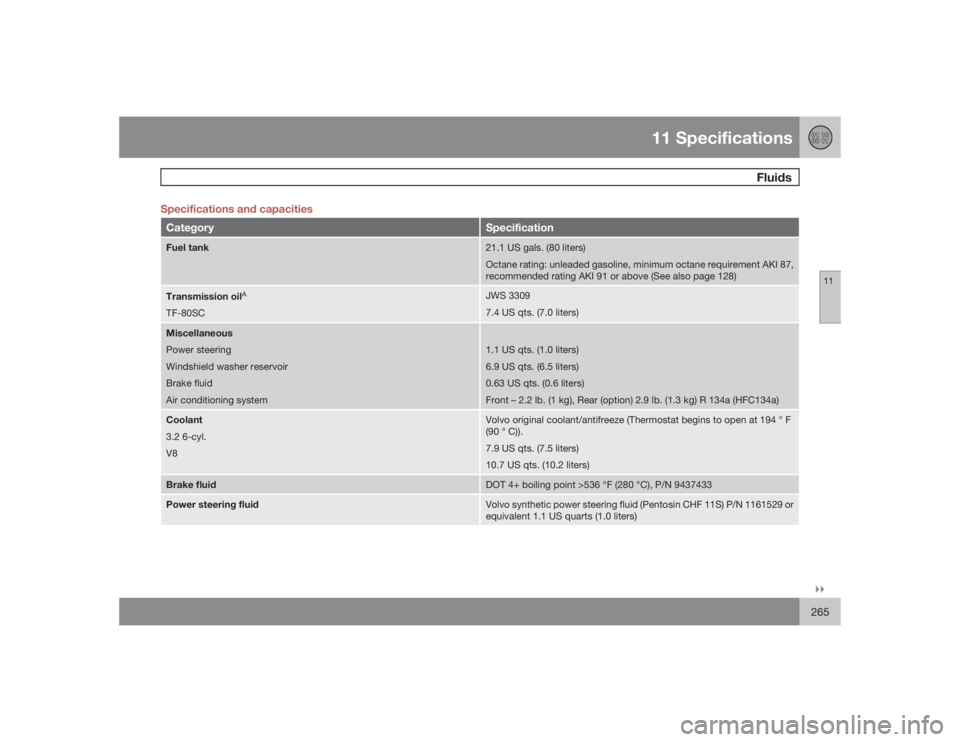
11 Specifications
Fluids
11``265 Specifications and capacities
Category
Specification
Fuel tank
21.1 US gals. (80 liters)
Octane rating: unleaded gasoline, minimum octane requirement AKI 87,
recommended rating AKI 91 or above (See also page 128)
Transmission oil
A
TF-80SC
JWS 3309
7.4 US qts. (7.0 liters)
Miscellaneous
Power steering
Windshield washer reservoir
Brake fluid
Air conditioning system
1.1 US qts. (1.0 liters)
6.9 US qts. (6.5 liters)
0.63 US qts. (0.6 liters)
Front – 2.2 lb. (1 kg), Rear (option) 2.9 lb. (1.3 kg) R 134a (HFC134a)
Coolant
3.2 6-cyl.
V8
Volvo original coolant/antifreeze (Thermostat begins to open at 194 ° F
(90 ° C)).
7.9 US qts. (7.5 liters)
10.7 US qts. (10.2 liters)
Brake fluid
DOT 4+ boiling point >536 °F (280 °C), P/N 9437433
Power steering fluid
Volvo synthetic power steering fluid (Pentosin CHF 11S) P/N 1161529 or
equivalent 1.1 US quarts (1.0 liters)
Page 266 of 282
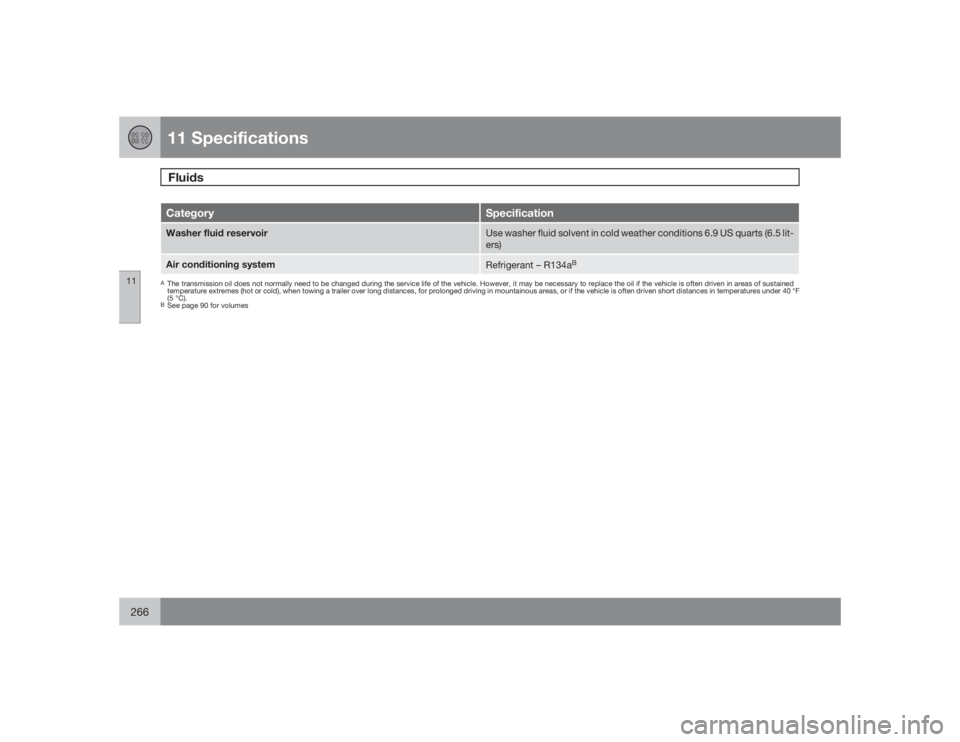
11 SpecificationsFluids
11266
Category
Specification
Washer fluid reservoir
Use washer fluid solvent in cold weather conditions 6.9 US quarts (6.5 lit-
ers)
Air conditioning system
Refrigerant – R134a
B
AThe transmission oil does not normally need to be changed during the service life of the vehicle. However, it may be necessary to replace the oil if the vehicle is often driven in areas of sustained
temperature extremes (hot or cold), when towing a trailer over long distances, for prolonged driving in mountainous areas, or if the vehicle is often driven short distances in temperatures under 40 °F
(5 °C).BSee page 90 for volumes