battery VOLVO XC90 2009 Owner´s Manual
[x] Cancel search | Manufacturer: VOLVO, Model Year: 2009, Model line: XC90, Model: VOLVO XC90 2009Pages: 282, PDF Size: 8.76 MB
Page 150 of 282
06 Starting and drivingTowing
06150
CAUTION
Vehicles with AWD (All Wheel Drive) with the
front wheels off the ground should not be
towed at speeds about 50 mph (70 km/h) or
for distances longer than 30 miles (50 km).
CAUTION
•
Please check with state and local
authorities before attempting this type
of towing, as vehicles being towed are
subject to regulations regarding maxi-
mum towing speed, length and type of
towing device, lighting, etc.
•
If the vehicle's battery is dead, do not
attempt to start the vehicle by pushing
or pulling it as this will damage the
three-way catalytic converter(s). The
engine must be jump started using an
auxiliary battery (see page 141).
•
If the vehicle is being towed on a flat bed
truck, the towing eyelets must not be
used to secure the vehicle on the flat
bed. Consult the tow truck operator.
WARNING
•
Remember that the power brakes and
power steering will not function when
engine is not running. The braking and
steering systems will function but the
brake pedal pressure required is
3 – 4 times above normal and greater
steering effort must be exerted.
•
The towing eyelets must not be used for
pulling another vehicle out of a ditch or
for any similar purpose involving severe
strain.
•
Do not use the towing eyelets to pull the
vehicle up onto a flat bed tow truck.
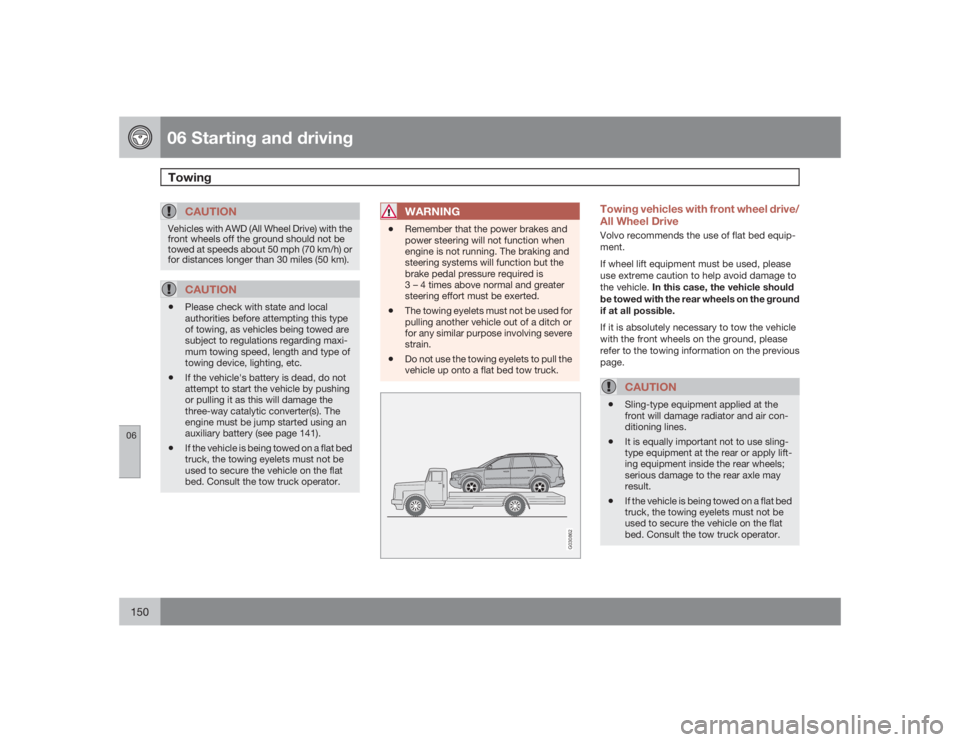
G030862
Towing vehicles with front wheel drive/
All Wheel DriveVolvo recommends the use of flat bed equip-
ment.
If wheel lift equipment must be used, please
use extreme caution to help avoid damage to
the vehicle. In this case, the vehicle should
be towed with the rear wheels on the ground
if at all possible.
If it is absolutely necessary to tow the vehicle
with the front wheels on the ground, please
refer to the towing information on the previous
page.
CAUTION
•
Sling-type equipment applied at the
front will damage radiator and air con-
ditioning lines.
•
It is equally important not to use sling-
type equipment at the rear or apply lift-
ing equipment inside the rear wheels;
serious damage to the rear axle may
result.
•
If the vehicle is being towed on a flat bed
truck, the towing eyelets must not be
used to secure the vehicle on the flat
bed. Consult the tow truck operator.
Page 157 of 282
06 Starting and driving
Cold weather precautions
06
157
If you wish to check your vehicle before the
approach of cold weather, the following advice
is worth noting:•
Make sure that the engine coolant contains
50 percent antifreeze. Any other mixture
will reduce freeze protection. This gives
protection against freezing down to –31 °F
(–35 °C). See section "Coolant".
•
The use of "recycled" antifreeze is not
approved by Volvo. Different types of
antifreeze must not be mixed.
•
Volvo recommends using only genuine
Volvo antifreeze in your vehicle's radiator.
Your Volvo retailer stocks plenty of Volvo
engine coolant to protect your vehicle dur-
ing cold weather.
•
Try to keep the fuel tank well filled – this
prevents the formation of condensation in
the tank. In addition, in extremely cold
weather conditions it is worthwhile to add
fuel line de-icer before refueling.
•
The viscosity of the engine oil is important.
Oil with low viscosity (thinner oil) improves
cold-weather starting as well as decreas-
ing fuel consumption while the engine is
warming up. For winter use, 5W-30 oil, par-
ticularly the synthetic type
1, is recom-
mended. Be sure to use good quality oil but
do not use cold-weather oil for hard drivingor in warm weather. See section "Engine
oil" for more information.
•
The load placed on the battery is greater
during the winter since the windshield wip-
ers, lighting, etc. are used more often.
Moreover, the capacity of the battery
decreases as the temperature drops. In
very cold weather, a poorly charged bat-
tery can freeze and be damaged. It is there-
fore advisable to check the state of charge
more frequently and spray an antirust oil on
the battery posts.
•
Volvo recommends the use of snow tires
on all four wheels for winter driving – see
section "Wheels and tires."
•
To prevent the washer fluid reservoir
from freezing, add washer solvents con-
taining antifreeze (see page 211 for the
location of the washer fluid reservoir). This
is important since dirt is often splashed on
the windshield during winter driving,
requiring the frequent use of the washers
and wipers. Volvo Washer Solvent should
be diluted as follows:
•
Down to 14 ° F (–10 ° C): 1 part washer
solvent and 4 parts water
•
Down to 5 ° F (–15 ° C): 1 part washer sol-
vent and 3 parts water
•
Down to 0 ° F (–18 ° C):1 part washer sol-
vent and 2 parts water
•
Down to –18 ° F (–28 ° C): 1 part washer
solvent and 1 part water
•
Use Volvo Teflon Lock Spray in the locks.NOTE
Avoid the use of de-icing sprays as they can
cause damage to the locks.W – Winter/Wet driving mode – enhanced
vehicle traction•
Mode W will only function if the gear selec-
tor is in the (D)rive position.
•
Press the button at the base of the gear
selector to engage/disengage this driving
mode.
•
An LED in the button will light up to indicate
that W is engaged and this will also be dis-
played in the instrument panel (see
page 54).
•
This mode may be selected for starting/
moving off on slippery roads.
1Synthetic oil is not used when the oil is changed at the normal maintenance service intervals except at owner request and at additional charge. Please consult your Volvo retailer.
Page 158 of 282
06 Starting and drivingBefore a long distance trip
06158
It is always worthwhile to have your vehicle
checked by a trained and qualified Volvo serv-
ice technician before driving long distances.
Your retailer or service technician will also be
able to supply you with bulbs, fuses, spark
plugs and wiper blades for your use in the event
that problems occur.
As a minimum, the following items should be
checked before any long trip:•
Check that engine runs smoothly and that
fuel consumption is normal.
•
Check for fuel, oil, and fluid leakage.
•
Check transmission oil level
1.
•
Check condition of drive belts.
•
Check state of the battery's charge.
•
Examine tires carefully (the spare tire as
well), and replace those that are worn.
Check tire pressures.
•
The brakes, front wheel alignment, and
steering gear should be checked by a
trained and qualified Volvo service techni-
cian only.
•
Check all lights, including high beams.
•
Reflective warning triangles are legally
required in some states/provinces.
•
Have a word with your Volvo retailer if you
intend to drive in countries where it may be
difficult to obtain the correct fuel.
•
Consider your destination. If you will be
driving through an area where snow or ice
are likely to occur, consider snow tires.
1To prevent injury from contact with hot surfaces, do not inspect your vehicle’s transmission fluid yourself. Have your vehicle’s transmission fluid level inspected by a qualified Volvo service technician.
Page 189 of 282
07 Wheels and tires
Tire Sealing System
07
189
NOTE
•
After use, the sealing compound bottle,
the hose, and certain other system
components must be replaced. Please
consult your Volvo retailer for replace-
ment parts.
•
If the sealing compound bottle’s expi-
ration date has passed, please take it to
a Volvo retailer or a recycling station
that can properly dispose of harmful
substances.
Inflating tiresThe tire sealing system can be used to inflate
the tires. To do so:
1. Park the car in a safe place.
2. The compressor should be switched off.
Ensure that the on/off switch is in position
0 (the 0 side of the switch should be
pressed down).
3. Take out the electrical wire and hose.
4. Remove the valve cap from the tire’s infla-
tion valve and screw the hose connector
onto the valve as tightly as possible by
hand.
5. Connect the electrical wire to the nearest
12-volt socket in the vehicle.6. Start the vehicle’s engine.
WARNING
•The vehicle’s engine should be running
when the tire sealing system is used to
avoid battery drain. Therefore, be sure
the vehicle is parked in a well ventilated
place, or outdoors, before using the sys-
tem.•Children should never be left unattended
in the vehicle when the engine is running.
7. Check the tire’s inflation pressure on the
gauge. Switch off the compressor briefly to
get a clear reading from the pressure
gauge.
8. Refer to the tire inflation tables for the cor-
rect inflation pressure. If the tire needs to
be inflated, start the tire sealing system’s
compressor (press the on/off switch to
position I). If necessary, release air from the
tire by turning the air release knob coun-
terclockwise.
CAUTION
The compressor should not be used for
more than 10 minutes at a time to avoid
overheating.
9. Turn off the compressor (press the on/off
switch to position 0) when the correct infla-
tion pressure has been reached.
10. Unscrew the hose from the tire’s inflation
valve and reinstall the valve cap.
11. Disconnect the electrical wire from the 12-
volt socket.
Page 200 of 282
G020922
200
Volvo service......................................................................................... 202
Maintaining your vehicle....................................................................... 203
Working on your vehicle........................................................................ 205
Engine compartment............................................................................. 207
Engine oil............................................................................................... 208
Fluids..................................................................................................... 211
Wiper blades......................................................................................... 213
Battery................................................................................................... 214
Replacing bulbs.................................................................................... 217
Fuses..................................................................................................... 224
Page 203 of 282
09 Maintenance and servicing
Maintaining your vehicle
09``203 Owner maintenance
Periodic maintenance requirements and inter-
vals are described in your vehicle's Warranty
and Service Records Information booklet.
The following points can be carried out
between the normally scheduled maintenance
services.Each time the vehicle is refueled•
Check the engine oil level
•
Clean the windshield, windshield wipers,
headlights, and tail lights
Monthly•
Check cold tire pressure in all tires. Inspect
the tires for wear.
•
Check that engine coolant and other fluid
levels are between the indicated "min" and
"max" markings.
•
Clean interior glass surfaces with a glass
cleaner and soft paper towels.
•
Wipe driver information displays with a soft
cloth.
•
Visually inspect battery terminals for cor-
rosion. Corrosion may indicate a loose ter-
minal connector, or a battery near the end
of its useful service life. Consult a trained
and qualified Volvo service technician for
additional information.
As needed•
Wash the vehicle, including the undercar-
riage, to reduce wear that can be caused
by a buildup of dirt, and corrosion that can
be caused by salt residues.
•
Clean leaves and twigs from air intake
vents at the base of the windshield, and
from other places where they may collect.
•
Complete service information for qualified
technicians is available online for purchase
or subscription at www.volvote-
chinfo.com.
Emission inspection readinessWhat is an Onboard Diagnostic System
(OBD II)?OBD II is part of your vehicle's computerized
engine management system. It stores diagnos-
tic information about your vehicle's emission
controls. It can light the Check Engine light
(MIL) if it detects an emission control "fault." A
"fault" is a component or system that is not
performing within an expected range. A fault
may be permanent or temporary. OBD II will
store a message about any fault.How do states use OBD II for emission
inspections?Many states connect a computer directly to a
vehicle's OBD II system. The inspector can
then read "faults." In some states, this type ofinspection has replaced the tailpipe emission
test.
How can my vehicle fail OBD II emission
inspection?Your vehicle can fail OBD II emission inspec-
tion for any of the following reasons.•
If your Check Engine (MIL) light is lit, your
vehicle may fail inspection.
•
If your vehicle's Check Engine light was lit,
but went out without any action on your
part, OBD II will still have a recorded fault.
Your vehicle may pass or fail, depending
on the inspection practices in your area.
•
If you had recent service that required dis-
connecting the battery, OBD II diagnostic
information may be incomplete and "not
ready" for inspection. A vehicle that is not
ready may fail inspection.
How can I prepare for my next OBD II
emission inspection?•
If your Check Engine (MIL) light is lit – or
was lit but went out without service, have
your vehicle diagnosed and, if necessary,
serviced by a qualified Volvo technician.
•
If you recently had service for a lit Check
Engine light, or if you had service that
required disconnecting the battery, a
period of driving is necessary to bring the
OBD II system to "ready" for inspection. A
half-hour trip of mixed stop-and-go/high-
Page 205 of 282
09 Maintenance and servicing
Working on your vehicle
09``205
G027001
Reinforced lifting pointsNote the following before you begin working
on your vehicle:Battery•
Ensure that the battery cables are correctly
connected and tightened.
•
Never disconnect the battery when the
engine is running (e.g., when replacing the
battery).
•
Never use a fast charger to charge the bat-
tery. The battery cables should be discon-
nected when recharging.
•
The battery contains acid that is both cor-
rosive and poisonous. It is important that
the battery is handled in an environmen-tally friendly way. See page 214 for more
information on handling the battery.
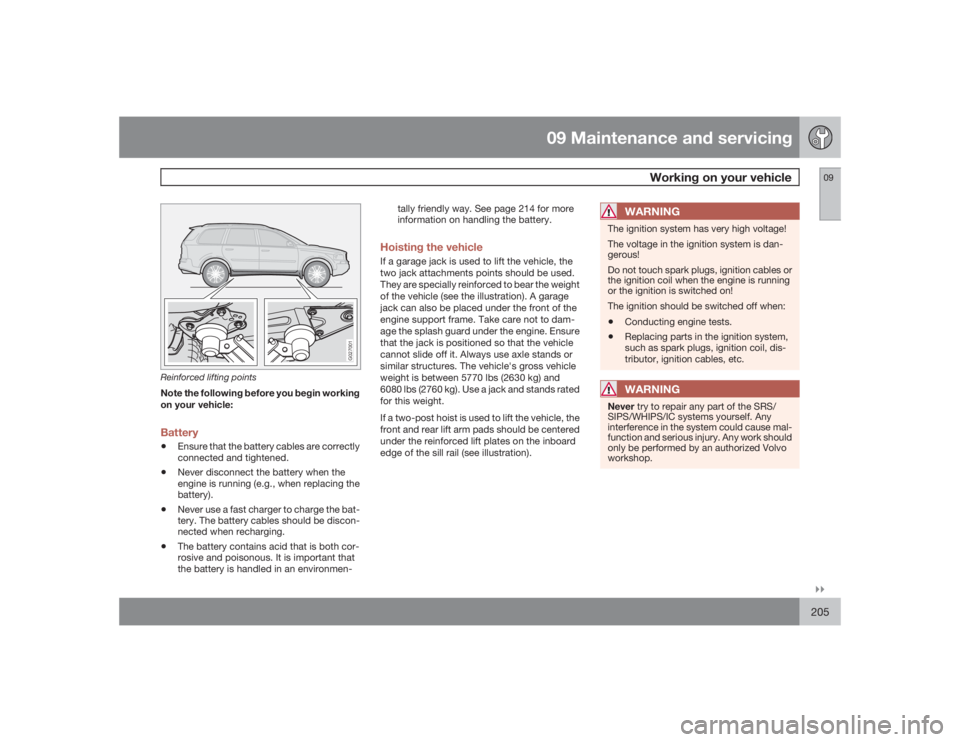
Hoisting the vehicleIf a garage jack is used to lift the vehicle, the
two jack attachments points should be used.
They are specially reinforced to bear the weight
of the vehicle (see the illustration). A garage
jack can also be placed under the front of the
engine support frame. Take care not to dam-
age the splash guard under the engine. Ensure
that the jack is positioned so that the vehicle
cannot slide off it. Always use axle stands or
similar structures. The vehicle's gross vehicle
weight is between 5770 lbs (2630 kg) and
6080 lbs (2760 kg). Use a jack and stands rated
for this weight.
If a two-post hoist is used to lift the vehicle, the
front and rear lift arm pads should be centered
under the reinforced lift plates on the inboard
edge of the sill rail (see illustration).
WARNING
The ignition system has very high voltage!
The voltage in the ignition system is dan-
gerous!
Do not touch spark plugs, ignition cables or
the ignition coil when the engine is running
or the ignition is switched on!
The ignition should be switched off when:•
Conducting engine tests.
•
Replacing parts in the ignition system,
such as spark plugs, ignition coil, dis-
tributor, ignition cables, etc.WARNING
Never try to repair any part of the SRS/
SIPS/WHIPS/IC systems yourself. Any
interference in the system could cause mal-
function and serious injury. Any work should
only be performed by an authorized Volvo
workshop.
Page 207 of 282
09 Maintenance and servicing
Engine compartment
09
207
G027074
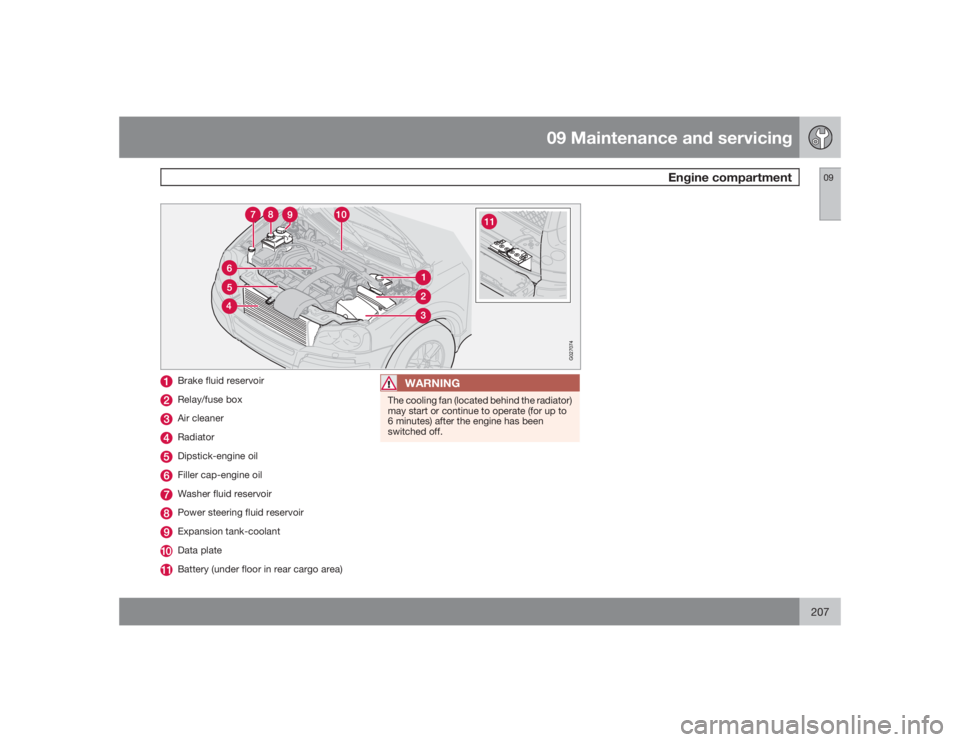
Brake fluid reservoirRelay/fuse boxAir cleanerRadiatorDipstick-engine oilFiller cap-engine oilWasher fluid reservoirPower steering fluid reservoirExpansion tank-coolantData plateBattery (under floor in rear cargo area)
WARNING
The cooling fan (located behind the radiator)
may start or continue to operate (for up to
6 minutes) after the engine has been
switched off.
Page 214 of 282
09 Maintenance and servicingBattery
09214
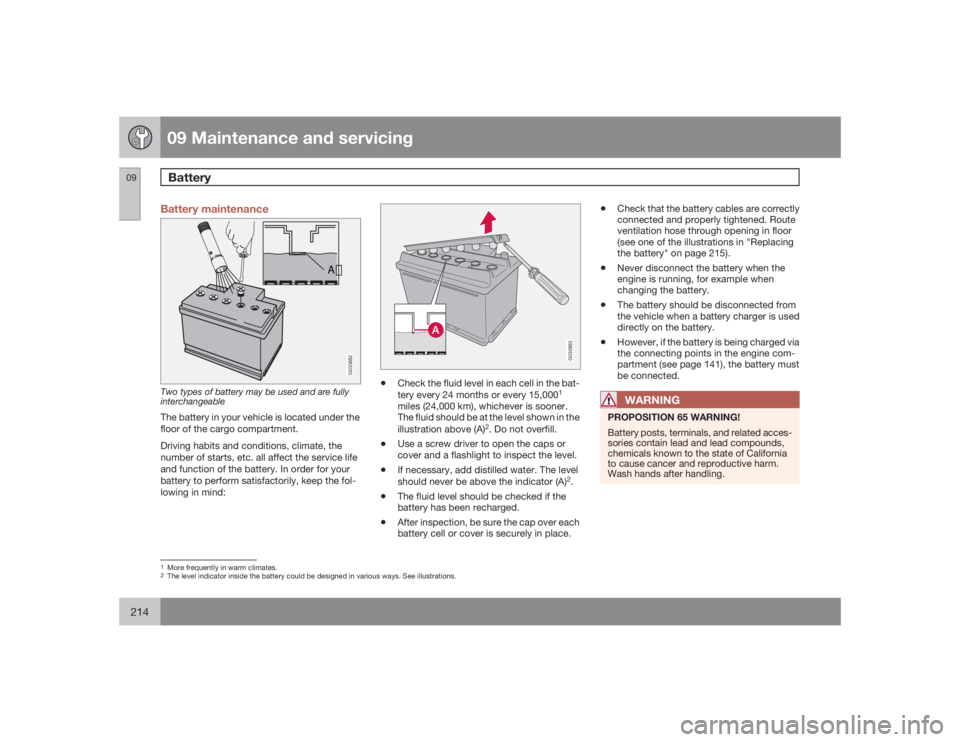
Battery maintenance
A
G030882
Two types of battery may be used and are fully
interchangeableThe battery in your vehicle is located under the
floor of the cargo compartment.
Driving habits and conditions, climate, the
number of starts, etc. all affect the service life
and function of the battery. In order for your
battery to perform satisfactorily, keep the fol-
lowing in mind:
G030883
•
Check the fluid level in each cell in the bat-
tery every 24 months or every 15,000
1
miles (24,000 km), whichever is sooner.
The fluid should be at the level shown in the
illustration above (A)
2. Do not overfill.
•
Use a screw driver to open the caps or
cover and a flashlight to inspect the level.
•
If necessary, add distilled water. The level
should never be above the indicator (A)
2.
•
The fluid level should be checked if the
battery has been recharged.
•
After inspection, be sure the cap over each
battery cell or cover is securely in place.
•
Check that the battery cables are correctly
connected and properly tightened. Route
ventilation hose through opening in floor
(see one of the illustrations in "Replacing
the battery" on page 215).
•
Never disconnect the battery when the
engine is running, for example when
changing the battery.
•
The battery should be disconnected from
the vehicle when a battery charger is used
directly on the battery.
•
However, if the battery is being charged via
the connecting points in the engine com-
partment (see page 141), the battery must
be connected.WARNING
PROPOSITION 65 WARNING!
Battery posts, terminals, and related acces-
sories contain lead and lead compounds,
chemicals known to the state of California
to cause cancer and reproductive harm.
Wash hands after handling.
1More frequently in warm climates.2The level indicator inside the battery could be designed in various ways. See illustrations.
Page 215 of 282
09 Maintenance and servicing
Battery
09``215
WARNING
•
Never expose the battery to open flame
or electric spark.
•
Do not smoke near the battery.
•
Battery fluid contains sulfuric acid. Do
not allow battery fluid to contact eyes,
skin, fabrics or painted surfaces. If con-
tact occurs, flush the affected area
immediately with water. Obtain medical
help immediately if eyes are affected.NOTE
Used batteries should be properly disposed
of at a recycling station or similar facility, or
taken to your Volvo retailer.
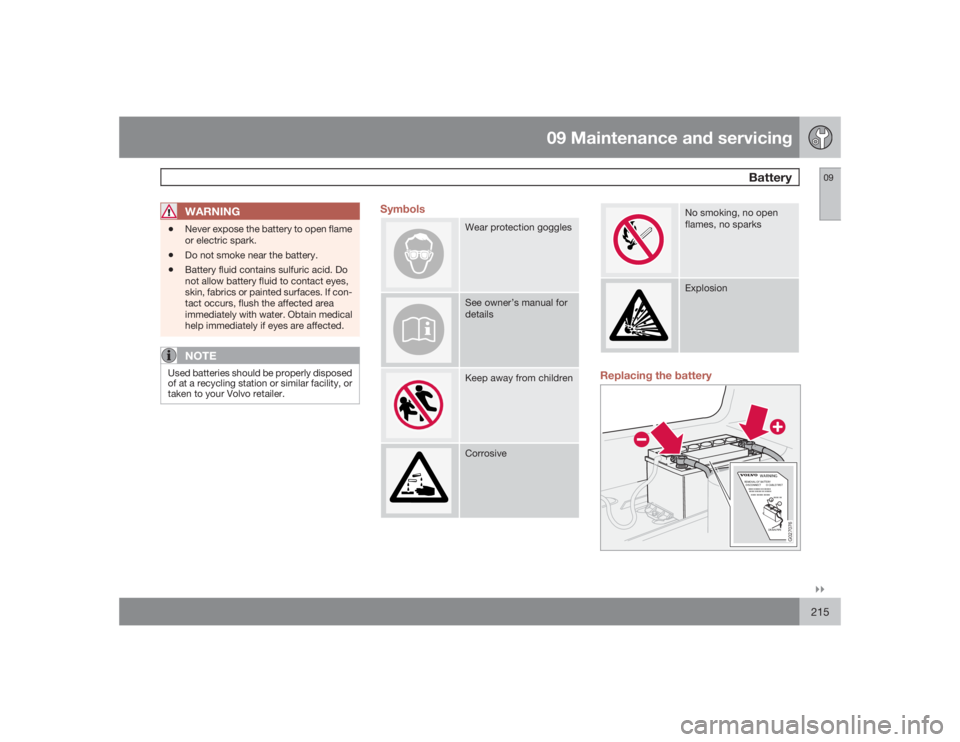
Symbols
Wear protection gogglesSee owner’s manual for
detailsKeep away from childrenCorrosive
No smoking, no open
flames, no sparksExplosion
Replacing the battery
DRAIN PIPE
xxxx xxxxx xx xxxxx DISCONNECT REMOVAL OF BATTERY
O CABLE FIRST
xxxx xxxxx xxxxx
xxxx xx+-
WARNINGxxxx xxxxx xx xxxxx
G027076