engine oil VOLVO XC90 2009 Owner´s Manual
[x] Cancel search | Manufacturer: VOLVO, Model Year: 2009, Model line: XC90, Model: VOLVO XC90 2009Pages: 282, PDF Size: 8.76 MB
Page 137 of 282
06 Starting and driving
Difficult driving conditions
06
137 Driving on rough/unpaved surfaces
The Volvo XC90 is designed primarily for on-
road driving, and it has excellent handling cha-
racteristics on very rough or unpaved roads.
When driving on poorly maintained or unpaved
roads, please keep the following in mind:•
Reduce speed on rough surfaces to mini-
mize possible damage to the vehicle's
underbody.
•
When driving on soft surfaces such as dry
sand or snow, try to avoid stopping if at all
possible.WARNING
Avoid driving diagonally across steep
inclines as this could increase the risk of a
roll-over. Try to drive straight up or down the
slope.•
If the road is very steep, avoid turning
the vehicle around to help avoid the risk
of rolling over. Back the vehicle up or
down the incline instead.
NOTE
Avoid driving on steep inclines if the fuel
tank is nearly empty. If the flow of fuel to the
engine is interrupted due to the vehicle's
angle of inclination, this could result in dam-
age to the three-way catalytic converter. We
recommend keeping the fuel tank at least
half full when driving on steep inclines.Driving through waterThe vehicle can be driven through water up to
a depth of approximately 16 inches (40 cm), at
a maximum speed of 6 mph (10 km/h).
Take particular care when driving through flow-
ing water.
Clean the electrical connections for trailer wir-
ing after driving in mud or water.
When driving through water, maintain low
speed and do not stop in the water.
WARNING
After driving through water, press lightly on
the brake pedal to ensure that the brakes
are functioning normally. Water or mud can
make the brake linings slippery, resulting in
delayed braking effect.
CAUTION
•
Engine damage will occur if water is
drawn into the air cleaner.
•
If the vehicle is driven through water
deeper than 18 in (48 cm), water may
enter the differential and the transmis-
sion. This reduces the oil's lubricating
capacity and may shorten the service
life of these components.
•
Do not allow the vehicle to stand in
water up to the door sills longer than
absolutely necessary. This could result
in electrical malfunctions.
•
If the engine has been stopped while the
car is in water, do not attempt to restart
the engine. Have the car towed out of
the water.
Page 152 of 282
06 Starting and drivingTowing a trailer
06152
NOTE
•
Recommended hitch tongue load:
not more than 10% of the trailer's
weight. The trailer load should be posi-
tioned so that it does not shift and the
tongue load should be 10% of the trail-
er's weight. However, the tongue load
should not exceed the maximum per-
missible weights indicated in the table
above.
•
When towing trailers without brakes,
the maximum permissible trailer weight
is 1,700 lbs (750 kg).
•
If necessary, redistribute the weight of
any cargo in the trailer to avoid exces-
sive weight on the trailer hitch.
•
The maximum trailer weight listed in the
table for All Wheel Drive models,
5,000 lbs (2250 kg) is only applicable
when there are not more than two occu-
pants in the vehicle, in the front seats,
with a combined weight of 300 lbs
(135 kg), with no other cargo in the vehi-
cle.
•
The maximum weight listed for Front
Wheel Drive models, 4,000 lbs (1800 kg)
is only applicable when there are not
more than four occupants in the vehicle,
in the front seats and second row of
seats, with a combined weight of
600 lbs (270 kg), with no other cargo in
the vehicle.
NOTE
•
Vehicles used for towing a trailer on a
regular basis, or for long-distance high-
way towing should be equipped with an
automatic transmission oil cooler and
Volvo's automatic self-leveling system
for the rear suspension. Consult your
Volvo retailer.
•
Volvo recommends the use of Volvo
trailer hitches that are specially
designed for the vehicle.
•
All Volvo models are equipped with
energy-absorbing shock-mounted
bumpers. Trailer hitch installation
should not interfere with the proper
operation of this bumper system.
•
Increase tire pressure to recommended
full inflation pressure. See chapter
"Wheels and tires."
•
When your vehicle is new, avoid towing
heavy trailers during the first 620 miles
(1,000 km).
•
Engine and transmission are subject to
increased loads. Therefore, engine
coolant temperature should be closely
watched when driving in hot climates or
hilly terrain. Use a lower gear and turn
off the air conditioner if the temperature
gauge needle enters the red range.
Page 153 of 282
06 Starting and driving
Towing a trailer
06``153
NOTE
•
If the automatic transmission begins to
overheat, a message will be displayed
in the text window.
•
Hauling a trailer affects handling, dura-
bility, and economy.
•
It is necessary to balance trailer brakes
with the towing vehicle brakes to pro-
vide a safe stop (check and observe
state/local regulations).
•
Do not connect the trailer's brake sys-
tem directly to the vehicle's brake sys-
tem.
•
Remove the ball and drawbar assembly
when the hitch is not being used.
•
Volvo recommends the use of synthetic
engine oil when towing a trailer over
long distances or in mountainous areas.
NOTE
•
When parking the vehicle with a trailer
on a hill, apply the parking brake before
putting the gear selector in P. When
starting on a hill, put the gear selector in
D before releasing the parking brake.
Always follow the trailer manufacturer's
recommendations for wheel chocking.
•
If you use the manual (Geartronic) shift
positions while towing a trailer, make
sure the gear you select does not put
too much strain on the engine (using too
high a gear).
WARNING
•
Bumper-attached trailer hitches must
not be used on Volvos, nor should
safety chains be attached to the
bumper.
•
Trailer hitches attaching to the vehicle
rear axle must not be used.
•
Never connect a trailer's hydraulic
brake system directly to the vehicle
brake system, nor a trailer's lighting
system directly to the vehicle lighting
system. Consult a trained and qualified
Volvo service technician for correct
installation.
•
When towing a trailer, the trailer's safety
wire must be correctly fastened to the
hole or hook provided in the trailer hitch
on the vehicle. The safety wire should
never be fastened to or wound around
the drawbar ball.
Smoother starts with a trailerModels equipped with the V8-engine and the
6-speed automatic transmission have a built-
in function that reduces acceleration slightly in
first gear when the vehicle is towing a trailer.
This is done to help avoid wheel spin and to
make starting off smoother.•
This function is activated when the trailer's
electrical connector is plugged into the
Page 157 of 282
06 Starting and driving
Cold weather precautions
06
157
If you wish to check your vehicle before the
approach of cold weather, the following advice
is worth noting:•
Make sure that the engine coolant contains
50 percent antifreeze. Any other mixture
will reduce freeze protection. This gives
protection against freezing down to –31 °F
(–35 °C). See section "Coolant".
•
The use of "recycled" antifreeze is not
approved by Volvo. Different types of
antifreeze must not be mixed.
•
Volvo recommends using only genuine
Volvo antifreeze in your vehicle's radiator.
Your Volvo retailer stocks plenty of Volvo
engine coolant to protect your vehicle dur-
ing cold weather.
•
Try to keep the fuel tank well filled – this
prevents the formation of condensation in
the tank. In addition, in extremely cold
weather conditions it is worthwhile to add
fuel line de-icer before refueling.
•
The viscosity of the engine oil is important.
Oil with low viscosity (thinner oil) improves
cold-weather starting as well as decreas-
ing fuel consumption while the engine is
warming up. For winter use, 5W-30 oil, par-
ticularly the synthetic type
1, is recom-
mended. Be sure to use good quality oil but
do not use cold-weather oil for hard drivingor in warm weather. See section "Engine
oil" for more information.
•
The load placed on the battery is greater
during the winter since the windshield wip-
ers, lighting, etc. are used more often.
Moreover, the capacity of the battery
decreases as the temperature drops. In
very cold weather, a poorly charged bat-
tery can freeze and be damaged. It is there-
fore advisable to check the state of charge
more frequently and spray an antirust oil on
the battery posts.
•
Volvo recommends the use of snow tires
on all four wheels for winter driving – see
section "Wheels and tires."
•
To prevent the washer fluid reservoir
from freezing, add washer solvents con-
taining antifreeze (see page 211 for the
location of the washer fluid reservoir). This
is important since dirt is often splashed on
the windshield during winter driving,
requiring the frequent use of the washers
and wipers. Volvo Washer Solvent should
be diluted as follows:
•
Down to 14 ° F (–10 ° C): 1 part washer
solvent and 4 parts water
•
Down to 5 ° F (–15 ° C): 1 part washer sol-
vent and 3 parts water
•
Down to 0 ° F (–18 ° C):1 part washer sol-
vent and 2 parts water
•
Down to –18 ° F (–28 ° C): 1 part washer
solvent and 1 part water
•
Use Volvo Teflon Lock Spray in the locks.NOTE
Avoid the use of de-icing sprays as they can
cause damage to the locks.W – Winter/Wet driving mode – enhanced
vehicle traction•
Mode W will only function if the gear selec-
tor is in the (D)rive position.
•
Press the button at the base of the gear
selector to engage/disengage this driving
mode.
•
An LED in the button will light up to indicate
that W is engaged and this will also be dis-
played in the instrument panel (see
page 54).
•
This mode may be selected for starting/
moving off on slippery roads.
1Synthetic oil is not used when the oil is changed at the normal maintenance service intervals except at owner request and at additional charge. Please consult your Volvo retailer.
Page 158 of 282
06 Starting and drivingBefore a long distance trip
06158
It is always worthwhile to have your vehicle
checked by a trained and qualified Volvo serv-
ice technician before driving long distances.
Your retailer or service technician will also be
able to supply you with bulbs, fuses, spark
plugs and wiper blades for your use in the event
that problems occur.
As a minimum, the following items should be
checked before any long trip:•
Check that engine runs smoothly and that
fuel consumption is normal.
•
Check for fuel, oil, and fluid leakage.
•
Check transmission oil level
1.
•
Check condition of drive belts.
•
Check state of the battery's charge.
•
Examine tires carefully (the spare tire as
well), and replace those that are worn.
Check tire pressures.
•
The brakes, front wheel alignment, and
steering gear should be checked by a
trained and qualified Volvo service techni-
cian only.
•
Check all lights, including high beams.
•
Reflective warning triangles are legally
required in some states/provinces.
•
Have a word with your Volvo retailer if you
intend to drive in countries where it may be
difficult to obtain the correct fuel.
•
Consider your destination. If you will be
driving through an area where snow or ice
are likely to occur, consider snow tires.
1To prevent injury from contact with hot surfaces, do not inspect your vehicle’s transmission fluid yourself. Have your vehicle’s transmission fluid level inspected by a qualified Volvo service technician.
Page 194 of 282
08 Car careWashing and cleaning the vehicle
08194
Washing•
The vehicle should be washed at regular
intervals since dirt, dust, insects and tar
spots adhere to the paint and may cause
damage. It is particularly important to wash
the vehicle frequently in the wintertime to
prevent corrosion, when salt has been
used on the roads.
•
When washing the vehicle, do not expose
it to direct sunlight. Use lukewarm water to
soften the dirt before you wash with a
sponge, and plenty of water, to avoid
scratching.
•
Bird droppings: Remove from paintwork as
soon as possible. Otherwise the finish may
be permanently damaged.
•
A detergent can be used to facilitate the
softening of dirt and oil.
•
A water-soluble grease solvent may be
used in cases of sticky dirt. However, use
a wash place equipped with a drainage
separator.CAUTION
Chromed wheels: Clean chrome-plated
wheels using the same detergents used for
the body of the vehicle. Aggressive wheel
cleaning agents can permanently stain
chrome-plated wheels.
•
Dry the vehicle with a clean chamois and
remember to clean the drain holes in the
doors and rocker panels.
•
Tar spots can be removed with kerosene
or tar remover after the vehicle has been
washed.
•
A stiff-bristle brush and lukewarm soapy
water can be used to clean the wiper
blades. Frequent cleaning of the wind-
shield and wiper blades improves visibility
considerably and also helps prolong the
service life of the wiper blades.
•
Wash off the dirt from the underside (wheel
housings, fenders, etc.).
•
In areas of high industrial fallout, more fre-
quent washing is recommended.
•
After cleaning the engine, the spark plug
wells should be inspected for water and
blown dry if necessary.
Suitable detergentsSpecial vehicle washing detergents should be
used. A suitable mixture is about 2.5 fl. oz.
(8.5 cl) of detergent to 2.6 US gal. (10 liters) of
warm water. After washing with a detergent the
vehicle should be well rinsed with clean water.
CAUTION
•
When washing or steam cleaning the
engine, avoid spraying water or steam
directly on the electrical components or
toward the rear side of the engine.
•
Dirt, snow, etc., on the headlights can
reduce lighting capacity considerably.
Clean the headlights regularly, for
example when refueling.
•
During high pressure washing, the
spray mouthpiece must never be closer
to the vehicle than 13 " (30 cm). Do not
spray into the locks.
Special moonroof cautions:
•
Always close the moonroof and sun
shade before washing your vehicle.
•
Never use abrasive cleaning agents on
the moonroof.
•
Never use wax on the rubber seals
around the moonroof.
Exterior componentsVolvo recommends the use of special cleaning
products, available at your Volvo retailer, for
cleaning colored plastic, rubber, or ornamental
components such as chromed strips on the
exterior of your vehicle. The instructions for
using these products should be followed care-
Page 200 of 282
G020922
200
Volvo service......................................................................................... 202
Maintaining your vehicle....................................................................... 203
Working on your vehicle........................................................................ 205
Engine compartment............................................................................. 207
Engine oil............................................................................................... 208
Fluids..................................................................................................... 211
Wiper blades......................................................................................... 213
Battery................................................................................................... 214
Replacing bulbs.................................................................................... 217
Fuses..................................................................................................... 224
Page 203 of 282
09 Maintenance and servicing
Maintaining your vehicle
09``203 Owner maintenance
Periodic maintenance requirements and inter-
vals are described in your vehicle's Warranty
and Service Records Information booklet.
The following points can be carried out
between the normally scheduled maintenance
services.Each time the vehicle is refueled•
Check the engine oil level
•
Clean the windshield, windshield wipers,
headlights, and tail lights
Monthly•
Check cold tire pressure in all tires. Inspect
the tires for wear.
•
Check that engine coolant and other fluid
levels are between the indicated "min" and
"max" markings.
•
Clean interior glass surfaces with a glass
cleaner and soft paper towels.
•
Wipe driver information displays with a soft
cloth.
•
Visually inspect battery terminals for cor-
rosion. Corrosion may indicate a loose ter-
minal connector, or a battery near the end
of its useful service life. Consult a trained
and qualified Volvo service technician for
additional information.
As needed•
Wash the vehicle, including the undercar-
riage, to reduce wear that can be caused
by a buildup of dirt, and corrosion that can
be caused by salt residues.
•
Clean leaves and twigs from air intake
vents at the base of the windshield, and
from other places where they may collect.
•
Complete service information for qualified
technicians is available online for purchase
or subscription at www.volvote-
chinfo.com.
Emission inspection readinessWhat is an Onboard Diagnostic System
(OBD II)?OBD II is part of your vehicle's computerized
engine management system. It stores diagnos-
tic information about your vehicle's emission
controls. It can light the Check Engine light
(MIL) if it detects an emission control "fault." A
"fault" is a component or system that is not
performing within an expected range. A fault
may be permanent or temporary. OBD II will
store a message about any fault.How do states use OBD II for emission
inspections?Many states connect a computer directly to a
vehicle's OBD II system. The inspector can
then read "faults." In some states, this type ofinspection has replaced the tailpipe emission
test.
How can my vehicle fail OBD II emission
inspection?Your vehicle can fail OBD II emission inspec-
tion for any of the following reasons.•
If your Check Engine (MIL) light is lit, your
vehicle may fail inspection.
•
If your vehicle's Check Engine light was lit,
but went out without any action on your
part, OBD II will still have a recorded fault.
Your vehicle may pass or fail, depending
on the inspection practices in your area.
•
If you had recent service that required dis-
connecting the battery, OBD II diagnostic
information may be incomplete and "not
ready" for inspection. A vehicle that is not
ready may fail inspection.
How can I prepare for my next OBD II
emission inspection?•
If your Check Engine (MIL) light is lit – or
was lit but went out without service, have
your vehicle diagnosed and, if necessary,
serviced by a qualified Volvo technician.
•
If you recently had service for a lit Check
Engine light, or if you had service that
required disconnecting the battery, a
period of driving is necessary to bring the
OBD II system to "ready" for inspection. A
half-hour trip of mixed stop-and-go/high-
Page 205 of 282
09 Maintenance and servicing
Working on your vehicle
09``205
G027001
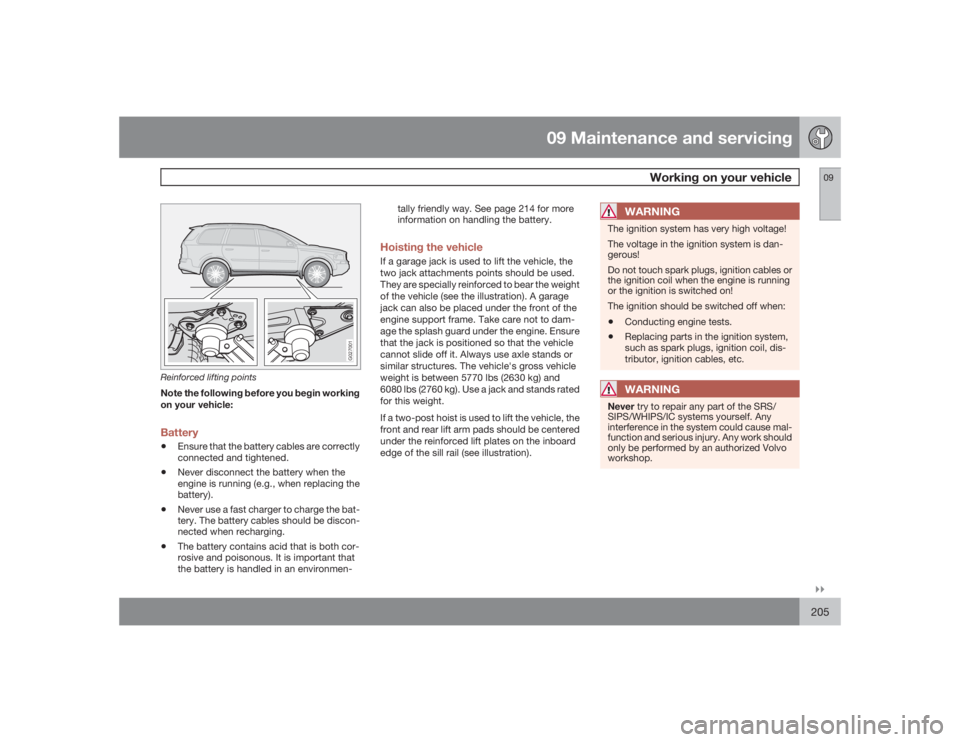
Reinforced lifting pointsNote the following before you begin working
on your vehicle:Battery•
Ensure that the battery cables are correctly
connected and tightened.
•
Never disconnect the battery when the
engine is running (e.g., when replacing the
battery).
•
Never use a fast charger to charge the bat-
tery. The battery cables should be discon-
nected when recharging.
•
The battery contains acid that is both cor-
rosive and poisonous. It is important that
the battery is handled in an environmen-tally friendly way. See page 214 for more
information on handling the battery.
Hoisting the vehicleIf a garage jack is used to lift the vehicle, the
two jack attachments points should be used.
They are specially reinforced to bear the weight
of the vehicle (see the illustration). A garage
jack can also be placed under the front of the
engine support frame. Take care not to dam-
age the splash guard under the engine. Ensure
that the jack is positioned so that the vehicle
cannot slide off it. Always use axle stands or
similar structures. The vehicle's gross vehicle
weight is between 5770 lbs (2630 kg) and
6080 lbs (2760 kg). Use a jack and stands rated
for this weight.
If a two-post hoist is used to lift the vehicle, the
front and rear lift arm pads should be centered
under the reinforced lift plates on the inboard
edge of the sill rail (see illustration).
WARNING
The ignition system has very high voltage!
The voltage in the ignition system is dan-
gerous!
Do not touch spark plugs, ignition cables or
the ignition coil when the engine is running
or the ignition is switched on!
The ignition should be switched off when:•
Conducting engine tests.
•
Replacing parts in the ignition system,
such as spark plugs, ignition coil, dis-
tributor, ignition cables, etc.WARNING
Never try to repair any part of the SRS/
SIPS/WHIPS/IC systems yourself. Any
interference in the system could cause mal-
function and serious injury. Any work should
only be performed by an authorized Volvo
workshop.
Page 206 of 282
09 Maintenance and servicingWorking on your vehicle
09206
Belt checkCheck the belt regularly to make sure it is in
good condition and is clean. A worn or dirty belt
can cause poor cooling and low alternator out-
put as well as impair the operation of the power
steering and the air conditioning unit.
NOTE
The drive belt is equipped with a self-ten-
sioning mechanism and requires no adjust-
ment between changes.
WARNING
The engine must not be running when this
check is performed.Check coolant levelThe cooling system must be filled with coolant
and not leak to operate at maximum efficiency.
Check the coolant level regularly. The level
should be between the MAX and MIN marks
on the expansion tank. The check should be
made with particular thoroughness when the
engine is new or when the cooling system has
been drained.
Do not remove the filler cap other than for top-
ping up with coolant. Frequent removal may
prevent coolant circulation between the engineand the expansion tank during engine warm up
and cooling.
Changing coolantNormally, the coolant does not need to be
changed. If the system must be drained, con-
sult a trained and qualified Volvo service tech-
nician.
Do not top off with water only. This reduces the
rust-protective and antifreeze qualities of the
coolant and has a lower boiling point. It can
also cause damage to the cooling system if it
should freeze. Top off with Volvo Genuine
Coolant/Antifreeze only (a 50/50 mix of water
and antifreeze.
CAUTION
The cooling system must always be kept
filled to the correct level. If it is not kept filled,
there can be high local temperatures in the
engine which could result in damage. Dif-
ferent types of antifreeze/coolant may not
be mixed.
WARNING
Never remove the radiator cap while the
engine is warm. Wait until the vehicle cools.