tire pressure VOLVO XC90 2009 Owner´s Manual
[x] Cancel search | Manufacturer: VOLVO, Model Year: 2009, Model line: XC90, Model: VOLVO XC90 2009Pages: 282, PDF Size: 8.76 MB
Page 168 of 282

07 Wheels and tiresTire inflation
07168
G032513
Tire inflation placards on U.S. modelsCheck tire inflation pressure regularly.
Tables listing the recommended inflation pres-
sure for your vehicle can be found on pages
170 and 171. A tire inflation pressure placard
is also located on the driver's side B-pillar (the
structural member at the side of the vehicle, at
the rear of the driver's door opening). This plac-
ard indicates the designation of the factory-
mounted tires on your vehicle, as well as load
limits and inflation pressure.
G032520
Tire inflation placard on Canadian models
NOTE
The placards shown indicate inflation pres-
sure for the tires installed on the vehicle at
the factory only.•
Use a tire gauge to check the tire inflation
pressure, including the spare, at least once
a month and before long trips. You are
strongly urged to buy a reliable tire pres-
sure gauge, as automatic service station
gauges may be inaccurate.
•
Use the recommended cold inflation pres-
sure for optimum tire performance and
wear.
•
Under-inflation or over-inflation may cause
uneven treadwear patterns.WARNING
•
Under-inflation is the most common
cause of tire failure and may result in
severe tire cracking, tread separation,
or "blow-out," with unexpected loss of
vehicle control and increased risk of
injury.
•
Under-inflated tires reduce the load car-
rying capacity of your vehicle.
When weather temperature changes occur, tire
inflation pressures also change. A 10-degree
temperature drop causes a corresponding
drop of 1 psi (7 kPa) in inflation pressure. Check
your tire pressures frequently and adjust them
to the proper pressure, which can be found on
the vehicle's tire information placard or certifi-
cation label.Checking tire pressureA certain amount of air seepage from the tires
occurs naturally and tire pressure fluctuates
with seasonal changes in temperature. Always
check tire pressure regularly.Cold tiresInflation pressure should be checked when the
tires are cold.
Page 169 of 282

07 Wheels and tires
Tire inflation
07
169
The tires are considered to be cold when
they have the same temperature as the sur-
rounding (ambient) air.
This temperature is normally reached after the
vehicle has been parked for at least 3 hours.
After driving a distance of approximately 1 mile
(1.6 km), the tires are considered to be hot. If
you have to drive farther than this distance to
pump your tire(s), check and record the tire
pressure first and add the appropriate air pres-
sure when you get to the pump.
If checking tire pressure when the tire is hot,
never "bleed" or reduce air pressure. The tires
are hot from driving and it is normal for pres-
sures to increase above recommended cold
pressures. A hot tire at or below recommended
cold inflation pressure could be significantly
under-inflated.To check inflation pressure:•
Remove the cap from the valve on one tire,
then firmly press the tire gauge onto the
valve.
•
Add air to reach the recommended air
pressure.
•
Replace the valve cap.
•
Repeat this procedure for each tire, includ-
ing the spare.
•
Visually inspect the tires to make sure there
are no nails or other objects embeddedthat could puncture the tire and cause an
air leak.
•
Check the sidewalls to make sure there are
no gouges, cuts, bulges or other irregular-
ities.NOTE
•
If you overfill the tire, release air by
pushing on the metal stem in the center
of the valve. Then recheck the pressure
with your tire gauge.
•
Some spare tires require higher inflation
pressure than the other tires. Consult
the tire inflation tables on pages 170
and 171 or see the inflation pressure
placard.
Page 170 of 282
07 Wheels and tiresTire inflation pressure tables – U.S. models
07170
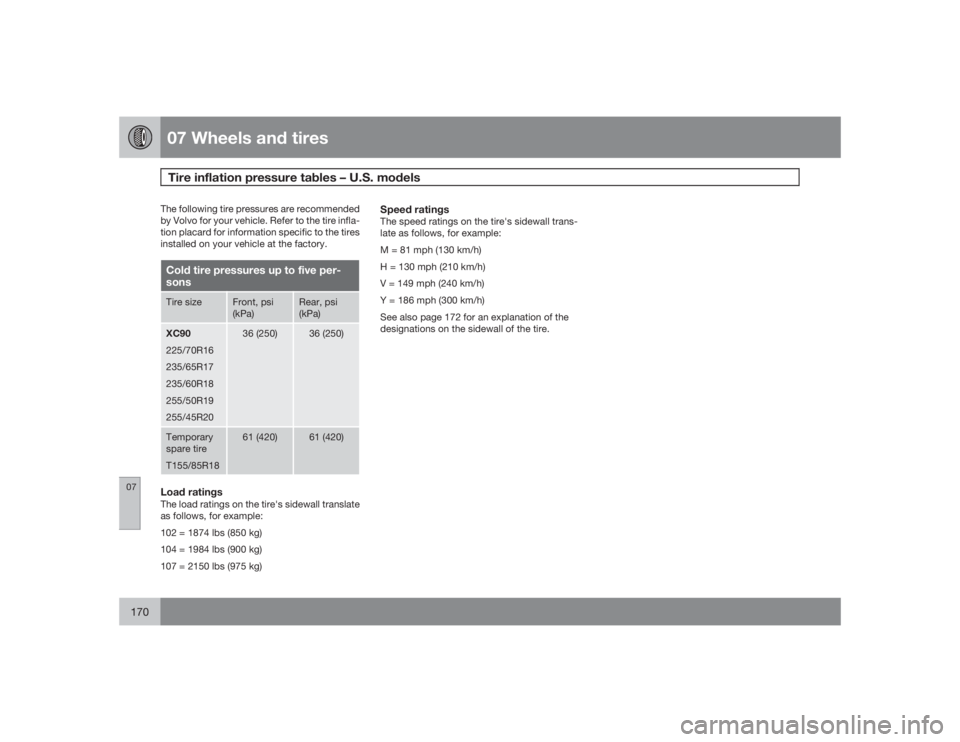
The following tire pressures are recommended
by Volvo for your vehicle. Refer to the tire infla-
tion placard for information specific to the tires
installed on your vehicle at the factory.Cold tire pressures up to five per-
sonsTire size
Front, psi
(kPa)
Rear, psi
(kPa)
XC90
225/70R16
235/65R17
235/60R18
255/50R19
255/45R20
36 (250)
36 (250)
Temporary
spare tire
T155/85R18
61 (420)
61 (420)
Load ratingsThe load ratings on the tire's sidewall translate
as follows, for example:
102 = 1874 lbs (850 kg)
104 = 1984 lbs (900 kg)
107 = 2150 lbs (975 kg)
Speed ratingsThe speed ratings on the tire's sidewall trans-
late as follows, for example:
M = 81 mph (130 km/h)
H = 130 mph (210 km/h)
V = 149 mph (240 km/h)
Y = 186 mph (300 km/h)
See also page 172 for an explanation of the
designations on the sidewall of the tire.
Page 171 of 282
07 Wheels and tires
Tire inflation pressure tables – Canadian models
07
171
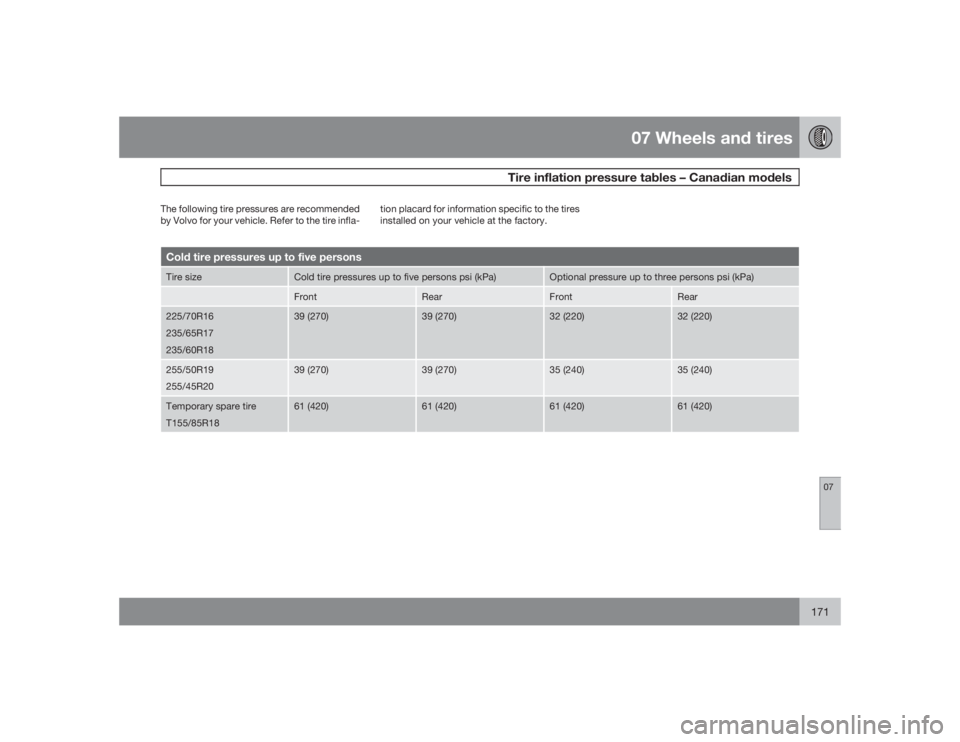
The following tire pressures are recommended
by Volvo for your vehicle. Refer to the tire infla-tion placard for information specific to the tires
installed on your vehicle at the factory.Cold tire pressures up to five personsTire size
Cold tire pressures up to five persons psi (kPa)
Optional pressure up to three persons psi (kPa)
Front
Rear
Front
Rear
225/70R16
235/65R17
235/60R18
39 (270)
39 (270)
32 (220)
32 (220)
255/50R19
255/45R20
39 (270)
39 (270)
35 (240)
35 (240)
Temporary spare tire
T155/85R18
61 (420)
61 (420)
61 (420)
61 (420)
Page 172 of 282
07 Wheels and tiresTire designations
07172
123456
1211108
7
9
G026442
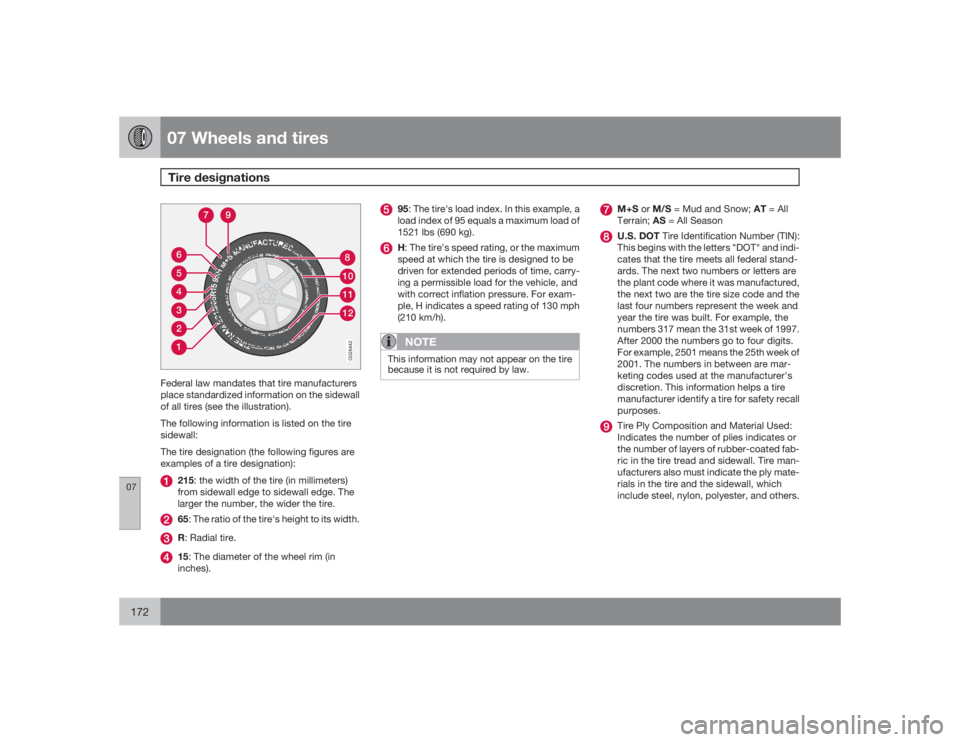
Federal law mandates that tire manufacturers
place standardized information on the sidewall
of all tires (see the illustration).
The following information is listed on the tire
sidewall:
The tire designation (the following figures are
examples of a tire designation):
215: the width of the tire (in millimeters)
from sidewall edge to sidewall edge. The
larger the number, the wider the tire.65: The ratio of the tire's height to its width.R: Radial tire.15: The diameter of the wheel rim (in
inches).
95: The tire's load index. In this example, a
load index of 95 equals a maximum load of
1521 lbs (690 kg).H: The tire's speed rating, or the maximum
speed at which the tire is designed to be
driven for extended periods of time, carry-
ing a permissible load for the vehicle, and
with correct inflation pressure. For exam-
ple, H indicates a speed rating of 130 mph
(210 km/h).NOTE
This information may not appear on the tire
because it is not required by law.
M+S or M/S = Mud and Snow; AT = All
Terrain;AS = All SeasonU.S. DOT Tire Identification Number (TIN):
This begins with the letters "DOT" and indi-
cates that the tire meets all federal stand-
ards. The next two numbers or letters are
the plant code where it was manufactured,
the next two are the tire size code and the
last four numbers represent the week and
year the tire was built. For example, the
numbers 317 mean the 31st week of 1997.
After 2000 the numbers go to four digits.
For example, 2501 means the 25th week of
2001. The numbers in between are mar-
keting codes used at the manufacturer's
discretion. This information helps a tire
manufacturer identify a tire for safety recall
purposes.Tire Ply Composition and Material Used:
Indicates the number of plies indicates or
the number of layers of rubber-coated fab-
ric in the tire tread and sidewall. Tire man-
ufacturers also must indicate the ply mate-
rials in the tire and the sidewall, which
include steel, nylon, polyester, and others.
Page 173 of 282
07 Wheels and tires
Tire designations
07
173
Maximum Load: Indicates the maximum
load in pounds and kilograms that can be
carried by the tire. Refer to the vehicle's tire
information placard or the safety certifica-
tion label, located on the B-Pillar or the
driver's door or on the inside of the fuel filler
door on Canadian models, for the correct
tire pressure for your vehicle.Treadwear, Traction, and Temperature
grades: see page 176 for more informa-
tion.Maximum permissible inflation pressure:
the greatest amount of air pressure that
should ever be put in the tire. This limit is
set by the tire manufacturer.
Tire suppliers may have additional markings,
notes or warnings such as standard load, radial
tubeless, etc.
Page 174 of 282
07 Wheels and tiresGlossary of tire terminology
07174
•
Tire information placard: A placard
showing the OE (Original Equipment) tire
sizes, recommended inflation pressure,
and the maximum weight the vehicle can
carry.
•
Tire Identification Number (TIN): A num-
ber on the sidewall of each tire providing
information about the tire brand and man-
ufacturing plant, tire size and date of man-
ufacturer.
•
Inflation pressure: A measure of the
amount of air in a tire.
•
Standard load: A class of P-metric or Met-
ric tires designed to carry a maximum load
at 35 psi [37 psi (2.5 bar) for Metric tires].
Increasing the inflation pressure beyond
this pressure will not increase the tires load
carrying capability.
•
Extra load: A class of P-metric or Metric
tires designed to carry a heavier maximum
load at 41 psi [43 psi (2.9 bar) for Metric
tires]. Increasing the inflation pressure
beyond this pressure will not increase the
tires load carrying capability.
•
kPa: Kilopascal, a metric unit of air pres-
sure.
•
PSI: Pounds per square inch, a standard
unit of air pressure.
•
B-pillar: The structural member at the side
of the vehicle behind the front door.
•
Bead area of the tire: Area of the tire next
to the rim.
•
Sidewall of the tire: Area between the
bead area and the tread.
•
Tread area of the tire: Area of the perim-
eter of the tire that contacts the road when
mounted on the vehicle.
•
Rim: The metal support (wheel) for a tire or
a tire and tube assembly upon which the
tire beads are seated.
•
Maximum load rating: a figure indicating
the maximum load in pounds and kilo-
grams that can be carried by the tire. This
rating is established by the tire manufac-
turer.
•
Maximum permissible inflation pres-
sure: the greatest amount of air pressure
that should ever be put in the tire. This limit
is set by the tire manufacturer.
•
Recommended tire inflation pressure:
inflation pressure, established by Volvo,
which is based on the type of tires that are
mounted on a vehicle at the factory. This
inflation pressure is affected by the number
of occupants in the vehicle, the amount of
cargo, and the speed at which the vehicle
will be driven for a prolonged period. This
information can be found on the tire infla-
tion placard(s) located on the driver's side
B-pillar or on the inside of the fuel filler dooron Canadian models, and in the tire infla-
tion table in this chapter.
•
Cold tires: The tires are considered to be
cold when they have the same temperature
as the surrounding (ambient) air. This tem-
perature is normally reached after the vehi-
cle has been parked for at least 3 hours.
Page 178 of 282
07 Wheels and tiresTemporary spare
07178
The spare tire in your vehicle is called a "Tem-
porary Spare".
Recommended tire pressure (see the placard
on the B-pillar or on the fuel filler door) should
be maintained irrespective of which position on
the vehicle the temporary spare tire is used.
In the event of damage to this tire, a new one
can be purchased from your Volvo retailer.
WARNING
Current legislation prohibits the use of the
"Temporary Spare" tire other than as a tem-
porary replacement for a punctured tire. It
must be replaced as soon as possible by a
standard tire. Road holding and handling
may be affected with the "Temporary
Spare" in use. Do not exceed 50 mph
(80 km/h).
CAUTION
The vehicle must not be driven with wheels
of different dimensions or with a spare tire
other than the one that came with the vehi-
cle. The use of different size wheels can
seriously damage your vehicle's transmis-
sion.
Page 182 of 282
07 Wheels and tiresChanging wheels
07182
5. Continue to raise the wheel by turning the
crank clockwise. Raise the wheel a little bit
at a time and guide it around the rear axle
until it is securely seated in the storage
area.
6. When it is no longer possible to turn the
crank any further, check that the spare
wheel is securely in position in the storage
compartment.
G026997
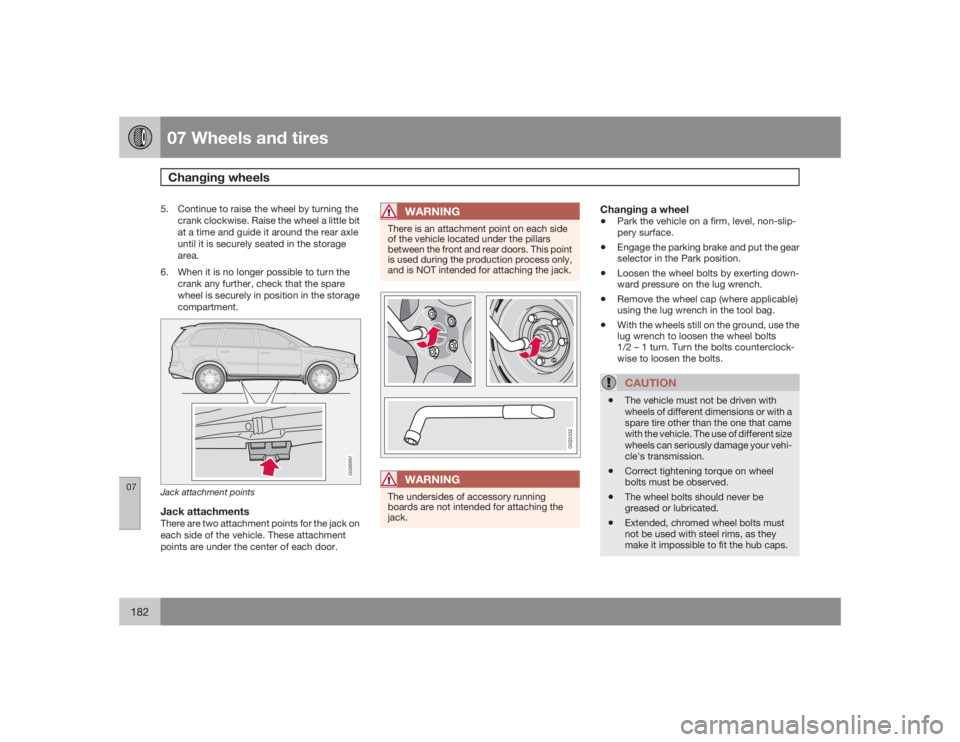
Jack attachment pointsJack attachmentsThere are two attachment points for the jack on
each side of the vehicle. These attachment
points are under the center of each door.
WARNING
There is an attachment point on each side
of the vehicle located under the pillars
between the front and rear doors. This point
is used during the production process only,
and is NOT intended for attaching the jack.
G020332
WARNING
The undersides of accessory running
boards are not intended for attaching the
jack.
Changing a wheel•
Park the vehicle on a firm, level, non-slip-
pery surface.
•
Engage the parking brake and put the gear
selector in the Park position.
•
Loosen the wheel bolts by exerting down-
ward pressure on the lug wrench.
•
Remove the wheel cap (where applicable)
using the lug wrench in the tool bag.
•
With the wheels still on the ground, use the
lug wrench to loosen the wheel bolts
1/2 – 1 turn. Turn the bolts counterclock-
wise to loosen the bolts.CAUTION
•
The vehicle must not be driven with
wheels of different dimensions or with a
spare tire other than the one that came
with the vehicle. The use of different size
wheels can seriously damage your vehi-
cle's transmission.
•
Correct tightening torque on wheel
bolts must be observed.
•
The wheel bolts should never be
greased or lubricated.
•
Extended, chromed wheel bolts must
not be used with steel rims, as they
make it impossible to fit the hub caps.
Page 185 of 282
07 Wheels and tires
Tire Sealing System
07``185 Introduction
Certain models are equipped with a tire sealing
system that enables you to temporarily seal a
hole in the tread surface and re-inflate a flat tire,
or to adjust a tire’s inflation pressure.
The system consists of an air compressor, a
container for the sealing compound, wiring to
connect the system to the vehicle’s electrical
system via one of the 12-volt sockets, and a
hose used to connect the system to the tire’s
inflation valve.
The 12-volt sockets are located on the rear side
of the center console (in the rear seat) and in
the cargo area.Accessing the tire sealing systemThe tire sealing system is stowed under the
floor of the cargo area. To access it:
1. Fold up or remove any protective floor cov-
ering or carpet.
2. Open the floor hatch.
3. Lift out the tire sealing system.
NOTE
•
The tire sealing system is only intended
to seal holes on the tire’s tread area, not
the sidewall.
•
Tires with large holes or tears cannot be
repaired with the tire sealing system.WARNING
•
After using the tire sealing system, the
vehicle should not be driven farther than
approximately 120 miles (200 km).
•
Have the tire inspected by a trained and
qualified Volvo service technician as
soon as possible to determine if it can
be permanently repaired or must be
replaced.
•
The vehicle should not be driven faster
than 50 mph (80 km/h) while using a tire
that has been temporarily repaired with
the tire sealing system.
•
After using the tire sealing system, drive
carefully and avoid abrupt steering
maneuvers and sudden stops.
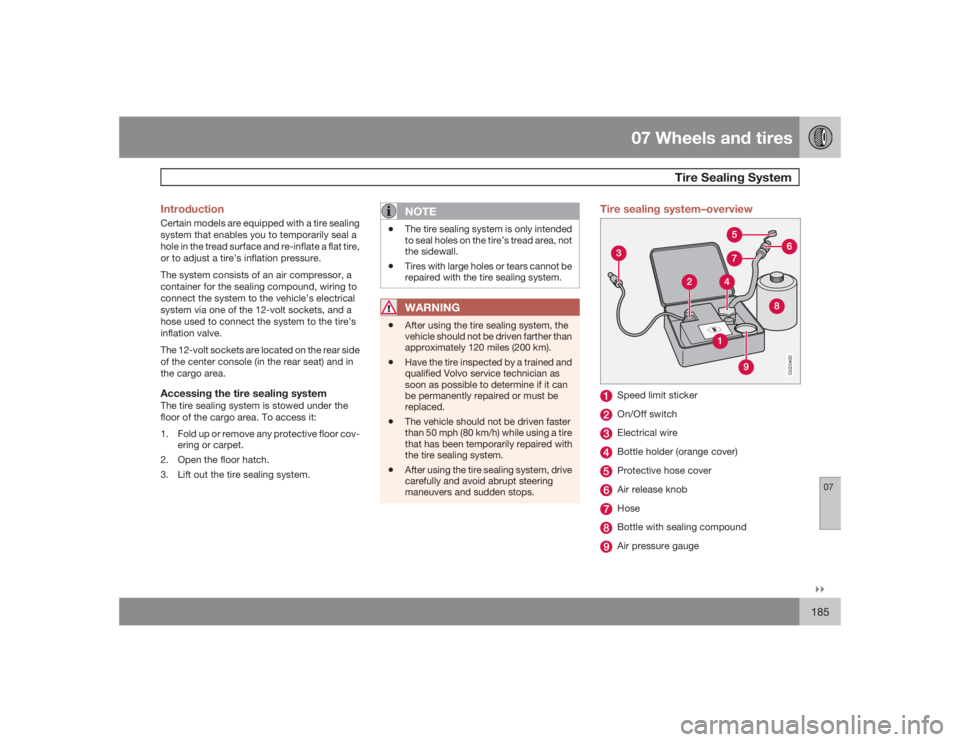
Tire sealing system–overview
G020400
Speed limit stickerOn/Off switchElectrical wireBottle holder (orange cover)Protective hose coverAir release knobHoseBottle with sealing compoundAir pressure gauge