tires VOLVO XC90 2009 Owner´s Manual
[x] Cancel search | Manufacturer: VOLVO, Model Year: 2009, Model line: XC90, Model: VOLVO XC90 2009Pages: 282, PDF Size: 8.76 MB
Page 158 of 282
06 Starting and drivingBefore a long distance trip
06158
It is always worthwhile to have your vehicle
checked by a trained and qualified Volvo serv-
ice technician before driving long distances.
Your retailer or service technician will also be
able to supply you with bulbs, fuses, spark
plugs and wiper blades for your use in the event
that problems occur.
As a minimum, the following items should be
checked before any long trip:•
Check that engine runs smoothly and that
fuel consumption is normal.
•
Check for fuel, oil, and fluid leakage.
•
Check transmission oil level
1.
•
Check condition of drive belts.
•
Check state of the battery's charge.
•
Examine tires carefully (the spare tire as
well), and replace those that are worn.
Check tire pressures.
•
The brakes, front wheel alignment, and
steering gear should be checked by a
trained and qualified Volvo service techni-
cian only.
•
Check all lights, including high beams.
•
Reflective warning triangles are legally
required in some states/provinces.
•
Have a word with your Volvo retailer if you
intend to drive in countries where it may be
difficult to obtain the correct fuel.
•
Consider your destination. If you will be
driving through an area where snow or ice
are likely to occur, consider snow tires.
1To prevent injury from contact with hot surfaces, do not inspect your vehicle’s transmission fluid yourself. Have your vehicle’s transmission fluid level inspected by a qualified Volvo service technician.
Page 164 of 282
G020918
164
General information............................................................................... 166
Tire inflation .......................................................................................... 168
Tire inflation pressure tables – U.S. models......................................... 170
Tire inflation pressure tables – Canadian models................................. 171
Tire designations................................................................................... 172
Glossary of tire terminology.................................................................. 174
Vehicle loading...................................................................................... 175
Uniform Tire Quality Grading................................................................ 176
Snow chains, snow tires, studded tires................................................ 177
Temporary spare................................................................................... 178
Tire rotation........................................................................................... 179
Changing wheels................................................................................... 180
Tire Sealing System ............................................................................. 185
Tire Pressure Monitoring System (TPMS) – U.S. models only.............. 190
Page 165 of 282
07
WHEELS AND TIRES
Page 166 of 282
07 Wheels and tiresGeneral information
07166
Your vehicle is equipped with tires according
to the vehicle's tire information placard on the
B-pillar (the structural member at the side of
the vehicle, at the rear of the driver's door
opening), or on the inside of the fuel filler door
on Canadian models.
CAUTION
Some Volvo models are equipped with an
Ultra High Performance tire and wheel com-
bination designed to provide maximum dry
pavement performance with consideration
for hydroplaning resistance. As such, they
may be more susceptible to road hazard
damage and, depending on driving condi-
tions, may achieve a tread life of less than
20,000 miles (30,000 km). Even if this vehi-
cle is equipped with Volvo’s advanced AWD
or DSTC system, these tires are not
designed for winter driving, and should be
replaced with winter tires when weather
conditions dictate.The tires have good road holding characteris-
tics and offer good handling on dry and wet
surfaces. It should be noted however that the
tires have been developed to give these fea-
tures on snow/ice-free surfaces.
Certain models are equipped with "all-season"
tires, which provide a somewhat higher degree
of road holding on slippery surfaces than tires
without the "all-season" rating. However, foroptimum road holding on icy or snow-covered
roads, we recommend suitable winter tires on
all four wheels.
When replacing tires, be sure that the new tires
are the same size designation, type (radial) and
preferably from the same manufacturer, on all
four wheels. Otherwise there is a risk of altering
the vehicle's roadholding and handling charac-
teristics.
Storing wheels and tiresWhen storing complete wheels (tires mounted
on rims), they should be suspended off the
floor or placed on their sides on the floor.
Tires not mounted on rims should be stored on
their sides or standing upright, but should not
be suspended.
CAUTION
Tires should preferably be stored in a cool,
dry, dark place, and should never be stored
in close proximity to solvents, gasoline, oils,
etc.
Tread wear indicator
G020323
Tread wear indicatorThe tires have wear indicator strips running
across or parallel to the tread. The letters TWI
are printed on the side of the tire. When
approximately 1/16 " (1.6 mm) is left on the
tread, these strips become visible and indicate
that the tire should be replaced. Tires with less
than 1/16 " (1.6 mm) tread offer very poor trac-
tion.
When replacing worn tires, it is recommended
that the tire be identical in type (radial) and size
as the one being replaced. Using a tire of the
same make (manufacturer) will prevent altera-
tion of the driving characteristics of the vehicle.
Page 167 of 282
07 Wheels and tires
General information
07
167
WARNING
•
The wheel and tire sizes for your Volvo
are specified to meet stringent stability
and handling requirements. Unap-
proved wheel/tire size combinations
can negatively affect your vehicle's sta-
bility and handling. Approved tire sizes
are shown in the Tire inflation pressure
tables on pages 170 and 171.
•
Any damage caused by installation of
unapproved wheel/tire size combina-
tions will not be covered by your new
vehicle warranty. Volvo assumes no
responsibility for death, injury, or
expenses that may result from such
installations.
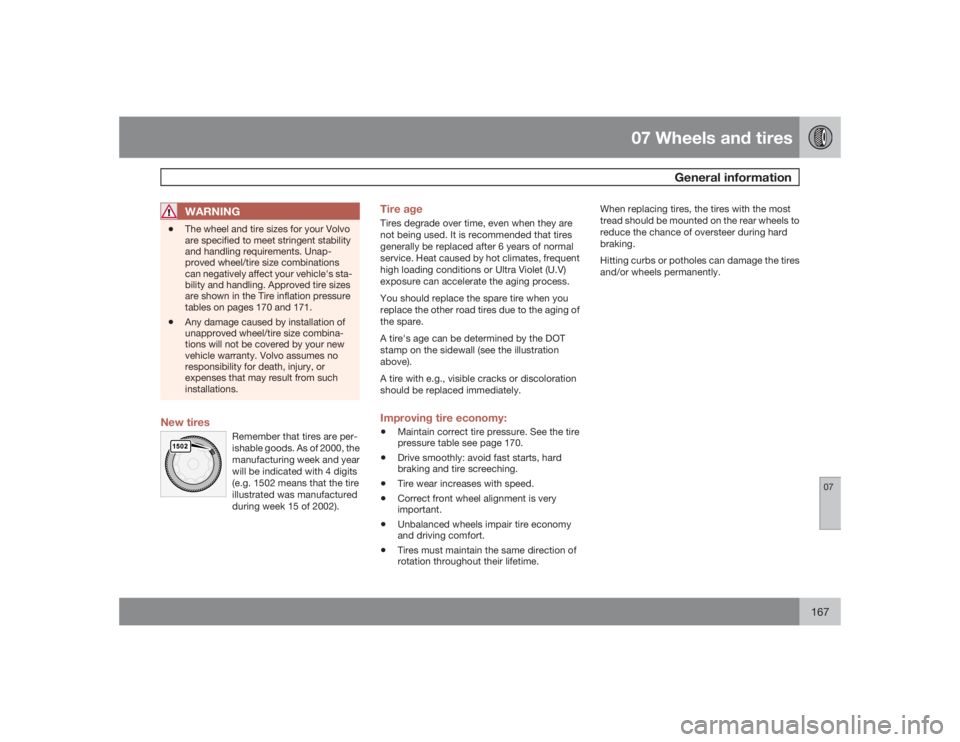
New tires
Remember that tires are per-
ishable goods. As of 2000, the
manufacturing week and year
will be indicated with 4 digits
(e.g. 1502 means that the tire
illustrated was manufactured
during week 15 of 2002).
Tire ageTires degrade over time, even when they are
not being used. It is recommended that tires
generally be replaced after 6 years of normal
service. Heat caused by hot climates, frequent
high loading conditions or Ultra Violet (U.V)
exposure can accelerate the aging process.
You should replace the spare tire when you
replace the other road tires due to the aging of
the spare.
A tire's age can be determined by the DOT
stamp on the sidewall (see the illustration
above).
A tire with e.g., visible cracks or discoloration
should be replaced immediately.Improving tire economy: •
Maintain correct tire pressure. See the tire
pressure table see page 170.
•
Drive smoothly: avoid fast starts, hard
braking and tire screeching.
•
Tire wear increases with speed.
•
Correct front wheel alignment is very
important.
•
Unbalanced wheels impair tire economy
and driving comfort.
•
Tires must maintain the same direction of
rotation throughout their lifetime.When replacing tires, the tires with the most
tread should be mounted on the rear wheels to
reduce the chance of oversteer during hard
braking.
Hitting curbs or potholes can damage the tires
and/or wheels permanently.
Page 168 of 282

07 Wheels and tiresTire inflation
07168
G032513
Tire inflation placards on U.S. modelsCheck tire inflation pressure regularly.
Tables listing the recommended inflation pres-
sure for your vehicle can be found on pages
170 and 171. A tire inflation pressure placard
is also located on the driver's side B-pillar (the
structural member at the side of the vehicle, at
the rear of the driver's door opening). This plac-
ard indicates the designation of the factory-
mounted tires on your vehicle, as well as load
limits and inflation pressure.
G032520
Tire inflation placard on Canadian models
NOTE
The placards shown indicate inflation pres-
sure for the tires installed on the vehicle at
the factory only.•
Use a tire gauge to check the tire inflation
pressure, including the spare, at least once
a month and before long trips. You are
strongly urged to buy a reliable tire pres-
sure gauge, as automatic service station
gauges may be inaccurate.
•
Use the recommended cold inflation pres-
sure for optimum tire performance and
wear.
•
Under-inflation or over-inflation may cause
uneven treadwear patterns.WARNING
•
Under-inflation is the most common
cause of tire failure and may result in
severe tire cracking, tread separation,
or "blow-out," with unexpected loss of
vehicle control and increased risk of
injury.
•
Under-inflated tires reduce the load car-
rying capacity of your vehicle.
When weather temperature changes occur, tire
inflation pressures also change. A 10-degree
temperature drop causes a corresponding
drop of 1 psi (7 kPa) in inflation pressure. Check
your tire pressures frequently and adjust them
to the proper pressure, which can be found on
the vehicle's tire information placard or certifi-
cation label.Checking tire pressureA certain amount of air seepage from the tires
occurs naturally and tire pressure fluctuates
with seasonal changes in temperature. Always
check tire pressure regularly.Cold tiresInflation pressure should be checked when the
tires are cold.
Page 169 of 282

07 Wheels and tires
Tire inflation
07
169
The tires are considered to be cold when
they have the same temperature as the sur-
rounding (ambient) air.
This temperature is normally reached after the
vehicle has been parked for at least 3 hours.
After driving a distance of approximately 1 mile
(1.6 km), the tires are considered to be hot. If
you have to drive farther than this distance to
pump your tire(s), check and record the tire
pressure first and add the appropriate air pres-
sure when you get to the pump.
If checking tire pressure when the tire is hot,
never "bleed" or reduce air pressure. The tires
are hot from driving and it is normal for pres-
sures to increase above recommended cold
pressures. A hot tire at or below recommended
cold inflation pressure could be significantly
under-inflated.To check inflation pressure:•
Remove the cap from the valve on one tire,
then firmly press the tire gauge onto the
valve.
•
Add air to reach the recommended air
pressure.
•
Replace the valve cap.
•
Repeat this procedure for each tire, includ-
ing the spare.
•
Visually inspect the tires to make sure there
are no nails or other objects embeddedthat could puncture the tire and cause an
air leak.
•
Check the sidewalls to make sure there are
no gouges, cuts, bulges or other irregular-
ities.NOTE
•
If you overfill the tire, release air by
pushing on the metal stem in the center
of the valve. Then recheck the pressure
with your tire gauge.
•
Some spare tires require higher inflation
pressure than the other tires. Consult
the tire inflation tables on pages 170
and 171 or see the inflation pressure
placard.
Page 170 of 282
07 Wheels and tiresTire inflation pressure tables – U.S. models
07170
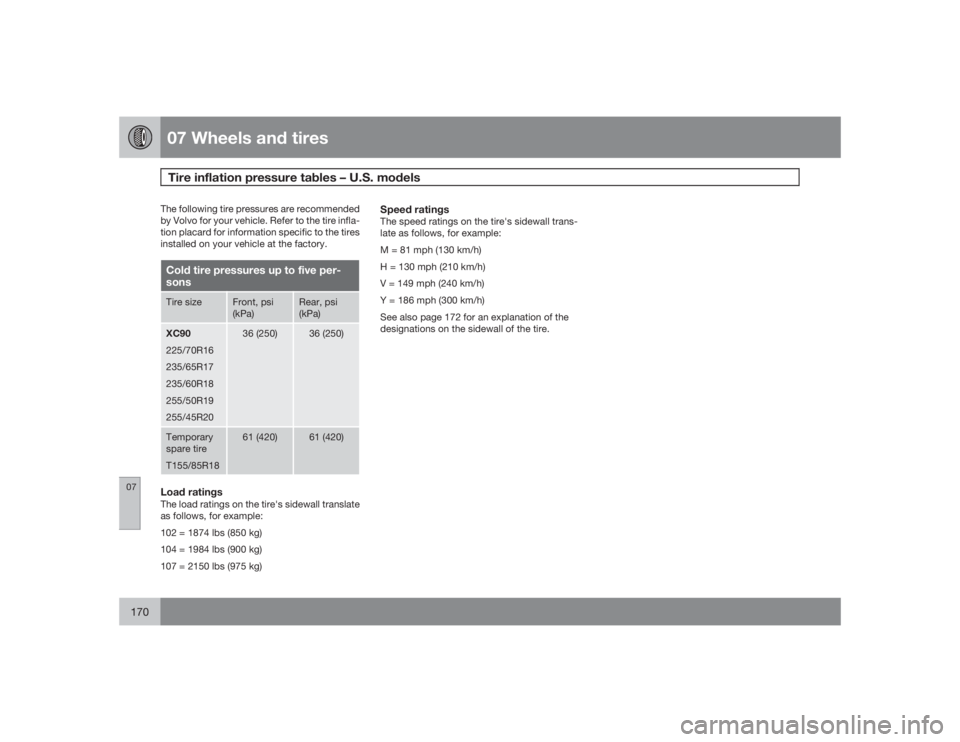
The following tire pressures are recommended
by Volvo for your vehicle. Refer to the tire infla-
tion placard for information specific to the tires
installed on your vehicle at the factory.Cold tire pressures up to five per-
sonsTire size
Front, psi
(kPa)
Rear, psi
(kPa)
XC90
225/70R16
235/65R17
235/60R18
255/50R19
255/45R20
36 (250)
36 (250)
Temporary
spare tire
T155/85R18
61 (420)
61 (420)
Load ratingsThe load ratings on the tire's sidewall translate
as follows, for example:
102 = 1874 lbs (850 kg)
104 = 1984 lbs (900 kg)
107 = 2150 lbs (975 kg)
Speed ratingsThe speed ratings on the tire's sidewall trans-
late as follows, for example:
M = 81 mph (130 km/h)
H = 130 mph (210 km/h)
V = 149 mph (240 km/h)
Y = 186 mph (300 km/h)
See also page 172 for an explanation of the
designations on the sidewall of the tire.
Page 171 of 282
07 Wheels and tires
Tire inflation pressure tables – Canadian models
07
171
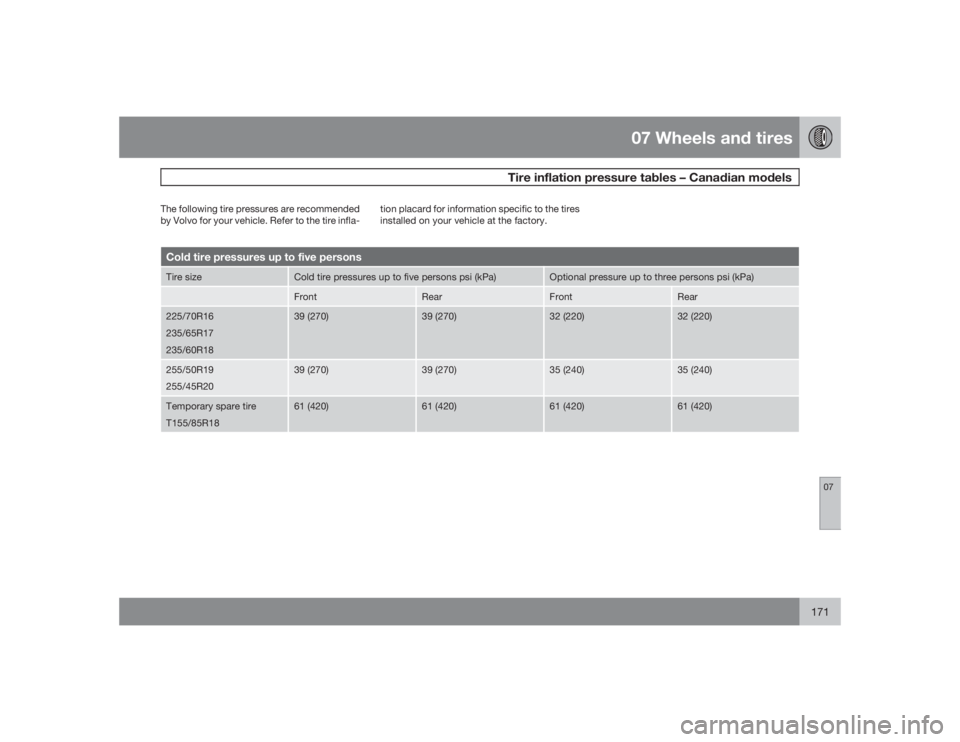
The following tire pressures are recommended
by Volvo for your vehicle. Refer to the tire infla-tion placard for information specific to the tires
installed on your vehicle at the factory.Cold tire pressures up to five personsTire size
Cold tire pressures up to five persons psi (kPa)
Optional pressure up to three persons psi (kPa)
Front
Rear
Front
Rear
225/70R16
235/65R17
235/60R18
39 (270)
39 (270)
32 (220)
32 (220)
255/50R19
255/45R20
39 (270)
39 (270)
35 (240)
35 (240)
Temporary spare tire
T155/85R18
61 (420)
61 (420)
61 (420)
61 (420)
Page 172 of 282
07 Wheels and tiresTire designations
07172
123456
1211108
7
9
G026442
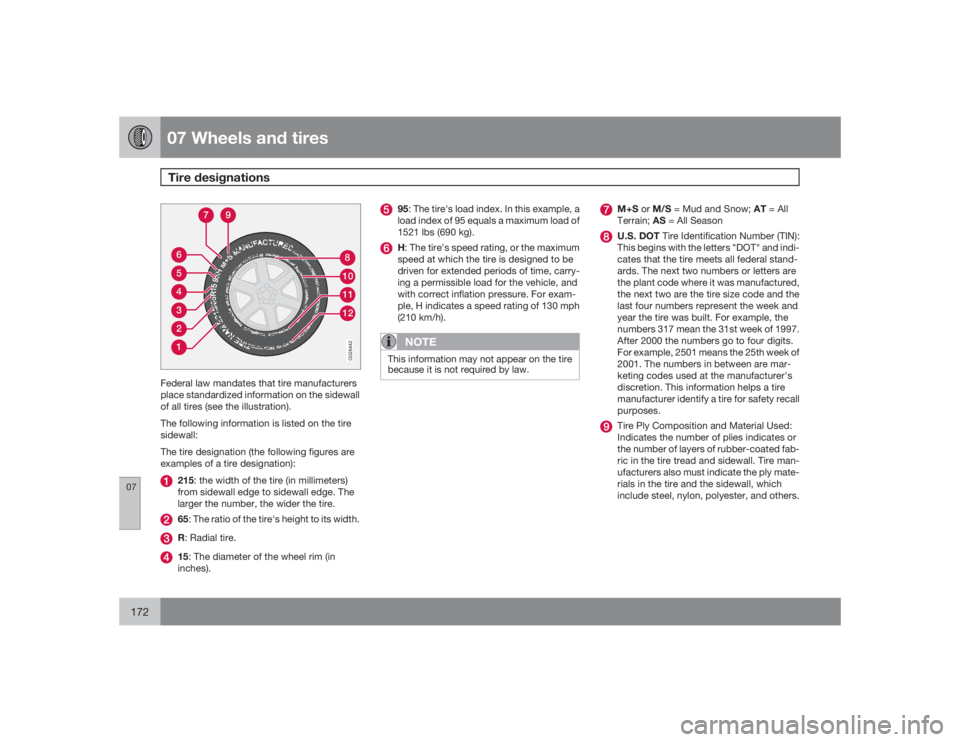
Federal law mandates that tire manufacturers
place standardized information on the sidewall
of all tires (see the illustration).
The following information is listed on the tire
sidewall:
The tire designation (the following figures are
examples of a tire designation):
215: the width of the tire (in millimeters)
from sidewall edge to sidewall edge. The
larger the number, the wider the tire.65: The ratio of the tire's height to its width.R: Radial tire.15: The diameter of the wheel rim (in
inches).
95: The tire's load index. In this example, a
load index of 95 equals a maximum load of
1521 lbs (690 kg).H: The tire's speed rating, or the maximum
speed at which the tire is designed to be
driven for extended periods of time, carry-
ing a permissible load for the vehicle, and
with correct inflation pressure. For exam-
ple, H indicates a speed rating of 130 mph
(210 km/h).NOTE
This information may not appear on the tire
because it is not required by law.
M+S or M/S = Mud and Snow; AT = All
Terrain;AS = All SeasonU.S. DOT Tire Identification Number (TIN):
This begins with the letters "DOT" and indi-
cates that the tire meets all federal stand-
ards. The next two numbers or letters are
the plant code where it was manufactured,
the next two are the tire size code and the
last four numbers represent the week and
year the tire was built. For example, the
numbers 317 mean the 31st week of 1997.
After 2000 the numbers go to four digits.
For example, 2501 means the 25th week of
2001. The numbers in between are mar-
keting codes used at the manufacturer's
discretion. This information helps a tire
manufacturer identify a tire for safety recall
purposes.Tire Ply Composition and Material Used:
Indicates the number of plies indicates or
the number of layers of rubber-coated fab-
ric in the tire tread and sidewall. Tire man-
ufacturers also must indicate the ply mate-
rials in the tire and the sidewall, which
include steel, nylon, polyester, and others.