wheel size VOLVO XC90 2009 Owner´s Manual
[x] Cancel search | Manufacturer: VOLVO, Model Year: 2009, Model line: XC90, Model: VOLVO XC90 2009Pages: 282, PDF Size: 8.76 MB
Page 182 of 282
07 Wheels and tiresChanging wheels
07182
5. Continue to raise the wheel by turning the
crank clockwise. Raise the wheel a little bit
at a time and guide it around the rear axle
until it is securely seated in the storage
area.
6. When it is no longer possible to turn the
crank any further, check that the spare
wheel is securely in position in the storage
compartment.
G026997
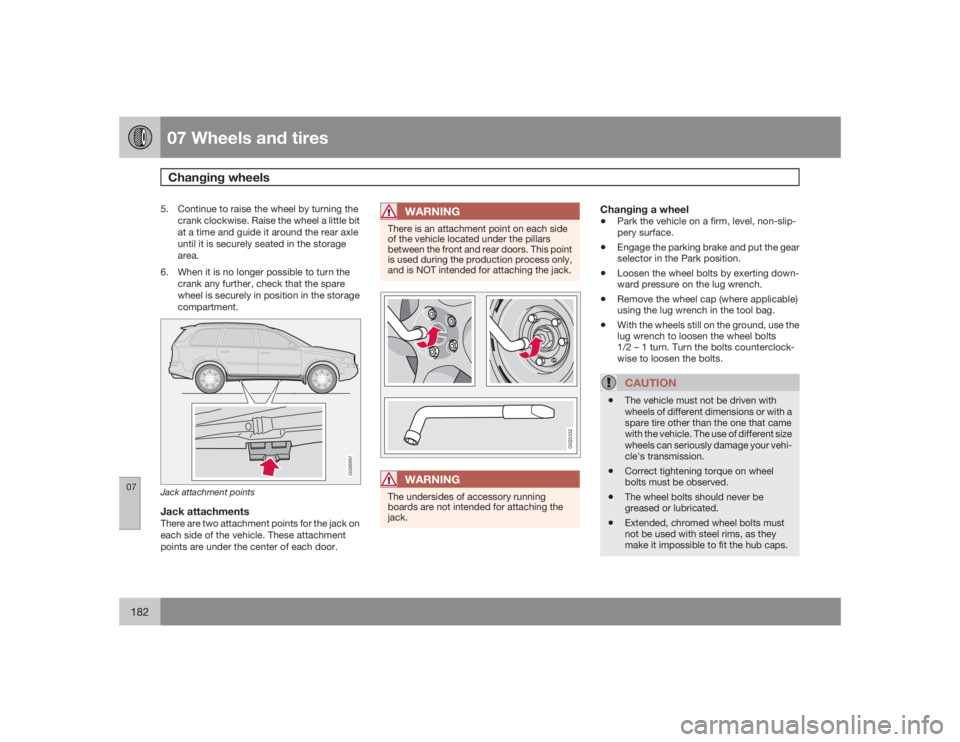
Jack attachment pointsJack attachmentsThere are two attachment points for the jack on
each side of the vehicle. These attachment
points are under the center of each door.
WARNING
There is an attachment point on each side
of the vehicle located under the pillars
between the front and rear doors. This point
is used during the production process only,
and is NOT intended for attaching the jack.
G020332
WARNING
The undersides of accessory running
boards are not intended for attaching the
jack.
Changing a wheel•
Park the vehicle on a firm, level, non-slip-
pery surface.
•
Engage the parking brake and put the gear
selector in the Park position.
•
Loosen the wheel bolts by exerting down-
ward pressure on the lug wrench.
•
Remove the wheel cap (where applicable)
using the lug wrench in the tool bag.
•
With the wheels still on the ground, use the
lug wrench to loosen the wheel bolts
1/2 – 1 turn. Turn the bolts counterclock-
wise to loosen the bolts.CAUTION
•
The vehicle must not be driven with
wheels of different dimensions or with a
spare tire other than the one that came
with the vehicle. The use of different size
wheels can seriously damage your vehi-
cle's transmission.
•
Correct tightening torque on wheel
bolts must be observed.
•
The wheel bolts should never be
greased or lubricated.
•
Extended, chromed wheel bolts must
not be used with steel rims, as they
make it impossible to fit the hub caps.
Page 190 of 282
07 Wheels and tiresTire Pressure Monitoring System (TPMS) – U.S. models only
07190
The tire pressure monitoring system uses sen-
sors mounted in the tire valves to check infla-
tion pressure levels. When the vehicle is
moving at a speed of approximately 20 mph
(30 km/h) or faster, these sensors transmit
inflation pressure data to a receiver located in
the vehicle.USA – FCC ID: MRXG403MA4
A
This device complies with part 15 of the FCC
rules. Operation is subject to the following
conditions: (1) This device may not cause
harmful interference, and (2) this device
must accept any interference received,
including interference that may cause unde-
sired operation.
When low inflation pressure is detected,
TPMS will light up the tire pressure warning
light (also referred to as a telltale) in the
instrument panel (see page 57), and will dis-
play a message in the text window. The
wording of this message is determined by
the degree of inflation pressure loss.AOn certain models, the FCC code is MRXTG315AM04
NOTE
If a fault occurs in TPMS, the tire pressure
warning light will flash for approximately
1 minute and
TIRE PRESS SYST
SERVICE REQUIRED
will be displayed.
Each tire, including the spare (if provided),
should be checked monthly when cold and
inflated to the inflation pressure recommended
by the vehicle manufacturer on the vehicle
placard or tire inflation pressure label. (If your
vehicle has tires of a different size than the size
indicated on the vehicle placard or tire inflation
pressure label, you should determine the
proper tire inflation pressure for those tires.)
As an added safety feature, your vehicle has
been equipped with a tire pressure monitoring
system (TPMS) that illuminates a low tire pres-
sure telltale when one or more of your tires is
significantly under-inflated. Accordingly, when
the low tire pressure telltale illuminates, you
should stop and check your tires as soon as
possible, and inflate them to the proper pres-
sure. Driving on a significantly under-inflated
tire causes the tire to overheat and can lead to
tire failure. Under-inflation also reduces fuel
efficiency and tire tread life, and may affect the
vehicle's handling and stopping ability.
Please note that the TPMS is not a substitute
for proper tire maintenance, and it is the driv-er's responsibility to maintain correct tire pres-
sure, even if under-inflation has not reached
the level to trigger illumination of the TPMS low
tire pressure telltale.
Your vehicle has also been equipped with a
TPMS malfunction indicator to indicate when
the system is not operating properly. The
TPMS malfunction indicator is combined with
the low tire pressure telltale. When the system
detects a malfunction, the telltale will flash for
approximately one minute and then remain
continuously illuminated. This sequence will
continue upon subsequent vehicle start-ups as
long as the malfunction exists. When the mal-
function indicator is illuminated, the system
may not be able to detect or signal low tire
pressure as intended. TPMS malfunctions may
occur for a variety of reasons, including the
installation of replacement or alternate tires or
wheels on the vehicle that prevent the TPMS
from functioning properly. Always check the
TPMS malfunction telltale after replacing one
or more tires or wheels on your vehicle to
ensure that the replacement or alternate tires
and wheels allow the TPMS to continue to
function properly.